India Biodiesel Market Report by Application, Feedstock, State and Company Analysis 2026-2034
Buy NowIndia Biodiesel Market Size & Forecast
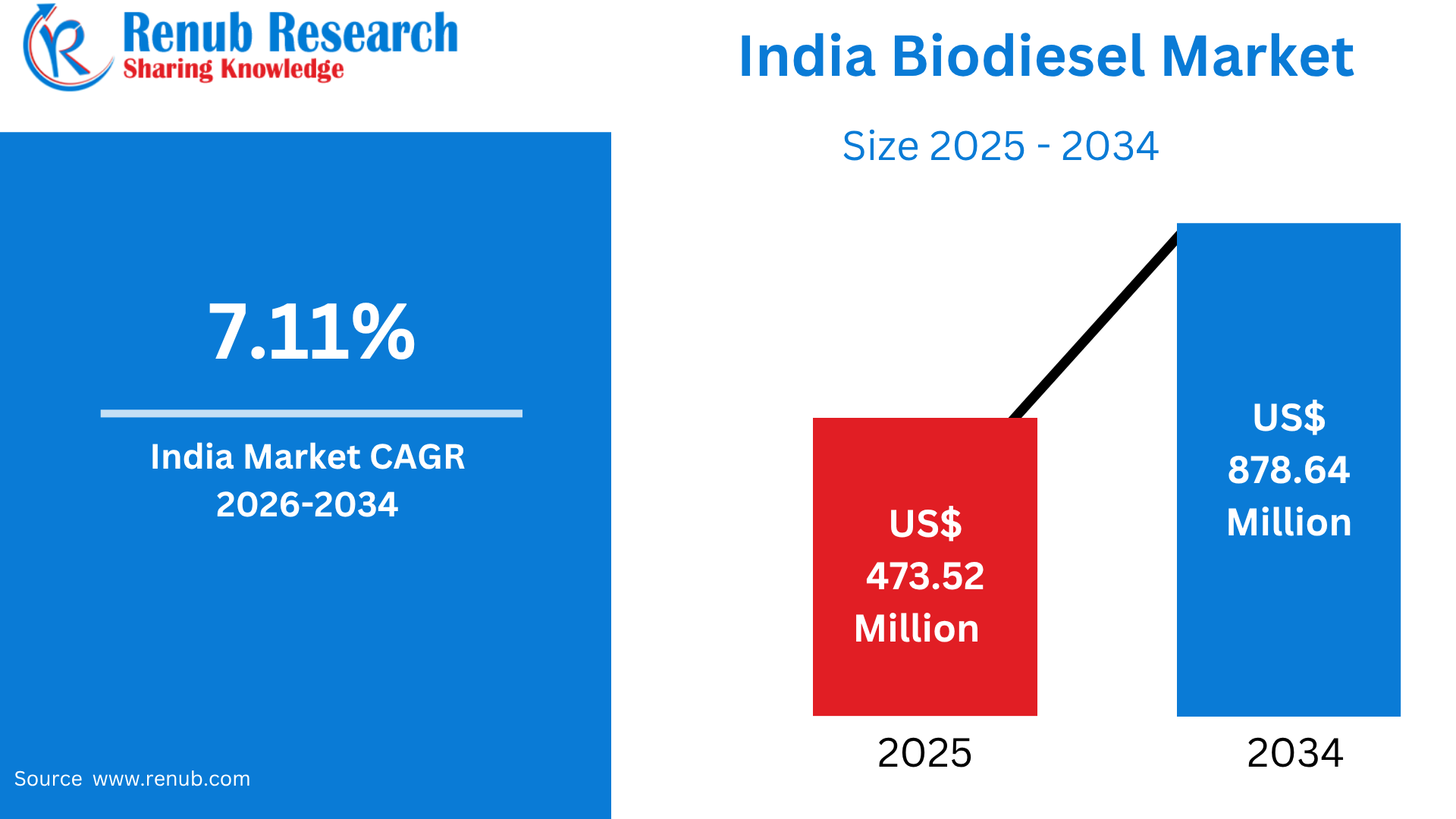
India biodiesel market is projected to grow from US$ 473.52 million in 2025 to US$ 878.64 million by 2034, registering a compound annual growth rate (CAGR) of 7.11% during the forecast period from 2026 to 2034. Market growth is primarily driven by rising energy demand, supportive government policies promoting renewable fuels, and initiatives to reduce dependence on imported fossil fuels. Additionally, increasing environmental concerns, ambitious carbon emission reduction targets, and continuous advancements in biodiesel production technologies are expected to accelerate market expansion. Growing adoption of sustainable transportation fuels and favorable blending mandates are further strengthening the outlook for India's biodiesel industry throughout the forecast period.
What is Biodiesel and Its Uses & Popularity in India
Biodiesel is a renewable, biodegradable fuel produced from vegetable oils, animal fats, used cooking oil, and other biological feedstocks through a chemical process known as transesterification. It can be used in conventional diesel engines either in its pure form (B100) or blended with petroleum diesel, such as B5, B10, and B20, without requiring significant engine modifications. Biodiesel offers lower greenhouse gas emissions, improved lubricity, and reduced particulate matter compared to conventional diesel, making it an environmentally friendly alternative fuel.
In India, biodiesel is gaining popularity due to increasing energy demand, rising crude oil import bills, and the government’s focus on achieving energy security and reducing carbon emissions. Initiatives such as the National Policy on Biofuels and blending targets have encouraged biodiesel production from non-edible oilseeds, used cooking oil, and agricultural waste. Biodiesel is widely used in transportation, agriculture, power generation, and industrial applications, particularly in diesel generators and commercial vehicles. Growing investments in biofuel production facilities, advancements in feedstock processing technologies, and increasing awareness of sustainable fuels are expected to further accelerate biodiesel adoption across India over the coming years.
India’s Ethanol Ecosystem
In January 2026, India surpassed its national target of 20% ethanol blending, achieving an average blending rate slightly above 20% by mixing more than 10.4 billion litres (BL) of ethanol with petrol. Industry estimates indicate that the national blending rate could exceed 23% by the end of 2026, supported by increased availability of diverse feedstocks such as sugarcane, corn, and surplus rice. While the country has made significant progress toward cleaner transportation fuels, achieving uniform E20 blending nationwide remains challenging due to regional differences in feedstock availability, fuel demand, and logistics infrastructure.
India has also significantly diversified its ethanol feedstock mix, reducing dependence on sugarcane. Grain-based feedstocks now contribute a substantial share of ethanol production, with corn accounting for approximately 46% and Food Corporation of India (FCI) rice contributing around 15% of total feedstock. During the 2024–25 ethanol supply cycle, India contracted 5.2 billion litres of ethanol from corn and 1.68 billion litres from FCI rice, while actual deliveries reached 4.78 billion litres and 1.32 billion litres, respectively. Market estimates suggest that nearly 7 million metric tons (MMT) of corn could be utilized for ethanol production during the current year, supplemented by surplus FCI rice. This transition toward grain-based ethanol enhances year-round production, strengthens supply chain resilience, and supports India’s long-term biofuel strategy, although seasonal feedstock availability and regional logistical challenges continue to influence production efficiency.
Growth Drivers
Government Biofuel Policies and Blending Targets Accelerating Biodiesel Adoption
Government support through favorable policies and blending mandates is one of the primary drivers of India’s biodiesel market. The National Policy on Biofuels promotes the production and use of biodiesel to enhance energy security, reduce crude oil imports, and lower greenhouse gas emissions. India imports nearly 85% of its crude oil requirements, making renewable fuels strategically important for reducing import dependence and improving energy resilience. Biodiesel production from used cooking oil (UCO), non-edible oilseeds, and agricultural residues is being actively encouraged through public-private partnerships and financial incentives. Oil Marketing Companies (OMCs) have also established procurement mechanisms to increase biodiesel blending across the country. Several state governments are supporting biodiesel manufacturing through industrial policies and infrastructure investments. In addition, programs promoting waste-to-fuel technologies are encouraging the collection of feedstocks from urban and industrial sources. As India continues to strengthen its renewable energy portfolio and decarbonize the transport sector, supportive government initiatives and regulatory frameworks are expected to remain major catalysts for sustained biodiesel market growth.
Rising Energy Demand and Dependence on Imported Crude Oil
India’s rapidly expanding economy and growing transportation sector are significantly increasing diesel consumption, creating substantial opportunities for biodiesel adoption. According to the International Energy Agency (IEA), India is projected to account for one of the largest increases in global energy demand over the coming decade. Diesel remains the dominant fuel for commercial vehicles, agriculture, railways, mining, and backup power generation. With crude oil imports meeting approximately 85% of domestic demand, reducing reliance on imported petroleum has become a national priority. Biodiesel offers a renewable alternative that can be blended with conventional diesel without requiring major modifications to existing engines or fuel infrastructure. Increasing freight movement, industrialization, infrastructure development, and agricultural mechanization are further driving diesel demand across the country. Biodiesel also improves fuel lubricity while reducing emissions of carbon monoxide, particulate matter, and sulfur compounds. As fuel consumption continues to rise, biodiesel is expected to play an increasingly important role in strengthening India’s energy security and supporting long-term sustainable economic development.
Growing Availability of Sustainable Feedstocks and Technological Advancements
Advancements in biodiesel production technologies and expanding availability of sustainable feedstocks are accelerating market growth across India. Biodiesel is increasingly being produced from used cooking oil (UCO), animal fats, non-edible oils such as Jatropha and Pongamia, and agricultural waste, reducing dependence on edible vegetable oils and improving sustainability. The Food Safety and Standards Authority of India (FSSAI) has promoted the “Repurpose Used Cooking Oil (RUCO)” initiative to encourage systematic collection and conversion of waste cooking oil into biodiesel. Modern transesterification technologies, improved catalysts, and automated processing systems have enhanced fuel quality while reducing production costs. Research into second-generation and advanced biofuels is further improving production efficiency and expanding feedstock options. Private companies are investing in integrated biodiesel production facilities capable of processing multiple feedstocks while minimizing waste generation. Growing investments in circular economy initiatives and waste-to-energy projects are also strengthening supply chains. These technological improvements and diversified raw material sources are expected to support long-term expansion of India’s biodiesel industry.
Challenges
Limited Feedstock Availability and Supply Chain Constraints
One of the major challenges facing India’s biodiesel industry is the inconsistent availability of affordable feedstocks. Although the country generates substantial quantities of agricultural residues and used cooking oil, organized collection systems remain underdeveloped in many regions. Feedstocks such as Jatropha have not achieved commercial-scale production as initially expected due to lower crop yields and limited farmer participation. Competition for vegetable oils from the food industry also restricts biodiesel production from edible oils. Collection, transportation, and storage of waste cooking oil remain fragmented, particularly in rural and semi-urban areas, affecting production consistency. Seasonal variations in agricultural output further contribute to supply instability and price fluctuations. These challenges increase manufacturing costs and reduce the competitiveness of biodiesel compared to conventional diesel. Strengthening feedstock collection networks, expanding contract farming for non-edible oil crops, improving waste oil recovery systems, and investing in advanced feedstock processing technologies will be essential to ensuring a stable and cost-effective biodiesel supply chain in India.
High Production Costs and Competition from Conventional Diesel
Despite growing government support, biodiesel production in India continues to face economic challenges due to relatively high manufacturing costs and price competition from petroleum diesel. Feedstock procurement accounts for a significant share of total production expenses, while fluctuations in raw material prices directly impact biodiesel profitability. Although technological advancements have improved production efficiency, biodiesel often remains more expensive than subsidized conventional diesel without policy incentives. Additional costs associated with logistics, storage, quality certification, and blending infrastructure further affect commercial viability. Limited retail distribution networks and varying state-level policies also slow market penetration. Furthermore, investment in advanced biodiesel production facilities requires substantial capital, creating barriers for smaller manufacturers. As electric mobility and alternative low-carbon fuels gain momentum, biodiesel producers also face increasing competition within the renewable transport fuel sector. Continued policy support, stable feedstock pricing, improved production technologies, and expanded blending programs will be crucial to enhancing the competitiveness and long-term growth of India’s biodiesel market.
Biodiesel launches in India
- December 2025 – Aemetis India (Universal Biofuels): Secured a US$58 million biodiesel supply allocation from India’s Oil Marketing Companies (OMCs) for the 2025 marketing year after successfully delivering US$103 million worth of biodiesel in 2024.
- April 2025 – Aemetis India: Commenced biodiesel shipments worth US$31 million to Indian OMCs, supplying more than 33,000 kilolitres of biodiesel for nationwide blending programs.
- February 2025 – Aemetis India: Received government approval to restart biodiesel production at its Kakinada facility, enabling renewed supplies to Indian Oil, BPCL, and HPCL.
- April 2025 – Indian Oil, BPCL & HPCL: Launched the FY2025–26 biodiesel procurement tender for approximately 200 million litres of biodiesel to support India’s national blending program.
- September 2024 – Indian Oil Corporation (IndianOil): Achieved a record 23.24 crore litres of biodiesel blending during FY2023–24 and received the Biodiesel Association of India Award for leadership in biodiesel adoption.
- 2025 – Rajputana Biodiesel Limited: Received Letters of Intent (LOIs) from Oil Marketing Companies under India’s FY2025–26 biodiesel procurement program to supply biodiesel for blending.
- 2025 – Nirvaanraj Energy Pvt. Ltd.: Secured OMC supply contracts under the national biodiesel procurement initiative to expand biodiesel deliveries across India.
- 2024 – Government Oil Marketing Companies (IOCL, BPCL & HPCL): Expanded procurement of biodiesel under the cost-plus pricing mechanism, encouraging higher domestic biodiesel production and blending.
- 2024 – MX100 BioEnergy India: Expanded its biodiesel dealership network into Jharkhand, adding outlets in Ranchi, Dhanbad, and Jamshedpur while introducing integrated biofuel retail solutions.
- 2025 – TruAlt Bioenergy: Received approval as an Oil Marketing Company (OMC) and announced plans to establish 100 fuel retail outlets, supporting wider availability of biodiesel and other renewable fuels across India.
Growing Demand for Cleaner Transportation Fuels
India biodiesel fuel market is witnessing steady growth, driven by rising demand for renewable transportation fuels, increasing fuel prices, and the country’s commitment to reducing carbon emissions. India imports nearly 85% of its crude oil requirements, making biodiesel an important component of its energy security strategy. Biodiesel can be blended with conventional diesel in proportions such as B5, B10, and B20 without requiring significant engine modifications, making it a practical low-carbon fuel for existing vehicles. Government initiatives under the National Policy on Biofuels and programs encouraging the use of waste-based feedstocks, including used cooking oil (UCO), are supporting market expansion. Commercial transportation, agriculture, mining, and logistics sectors are increasingly adopting biodiesel to lower operating emissions while reducing dependence on imported petroleum. Continuous improvements in biodiesel production technologies and growing investments in waste-to-fuel infrastructure are further enhancing market competitiveness. As India advances toward its renewable energy and net-zero emission goals, biodiesel fuel is expected to play a vital role in the country’s sustainable transportation ecosystem.
Renewable Fuel Supporting Decentralized Electricity Supply
The power generation biodiesel market in India is expanding as industries, commercial facilities, and remote communities seek cleaner alternatives to conventional diesel generators. According to the Central Electricity Authority (CEA), India continues to strengthen decentralized energy systems to improve electricity access in rural and off-grid regions. Biodiesel-powered generators provide reliable backup electricity during grid outages while reducing greenhouse gas emissions and particulate pollution compared to petroleum diesel. The fuel is increasingly used by hospitals, telecom towers, manufacturing plants, commercial buildings, and educational institutions aiming to meet environmental sustainability targets. One of biodiesel’s major advantages is its compatibility with existing diesel generator infrastructure, eliminating the need for expensive equipment modifications. Government initiatives promoting renewable energy, rural electrification, and cleaner backup power systems are further supporting market growth. As businesses increasingly adopt Environmental, Social, and Governance (ESG) practices and low-carbon energy solutions, biodiesel-based power generation is expected to witness sustained expansion across industrial, institutional, and rural applications.
Non-Edible Oil Feedstocks Driving Sustainable Production
The vegetable oil biodiesel segment remains one of the largest feedstock categories in India’s biodiesel industry, supported by growing utilization of non-edible oilseed crops such as Jatropha, Pongamia (Karanja), Mahua, and Neem. These feedstocks provide a sustainable alternative because they are cultivated on marginal and wasteland areas without directly competing with food crops, supporting both environmental sustainability and food security. Government programs have encouraged plantation of non-edible oilseed crops to expand domestic biodiesel feedstock availability. Advances in seed varieties, agricultural practices, and oil extraction technologies are gradually improving productivity and commercial viability. Biodiesel produced from vegetable oils offers lower sulfur emissions, improved lubricity, and reduced greenhouse gas emissions compared to conventional diesel. However, inconsistent crop yields, climate variability, and limited large-scale cultivation continue to affect feedstock availability. Increasing investments in agricultural research, contract farming, and integrated biofuel supply chains are expected to strengthen vegetable oil production and support long-term growth of India’s biodiesel market.
Waste-to-Fuel Solutions Supporting Circular Economy
The animal fats biodiesel market in India is emerging as an important segment within the country’s waste-to-energy and circular economy initiatives. Animal fats, including tallow and meat processing by-products, are increasingly utilized as low-cost feedstocks for biodiesel production, reducing waste disposal while generating renewable transportation fuel. Compared with edible vegetable oils, animal fats offer an economical alternative that avoids competition with food resources and enhances resource efficiency. Biodiesel produced from animal fats contributes to lower lifecycle greenhouse gas emissions while supporting sustainable waste management practices. Growing demand for alternative feedstocks has encouraged biodiesel manufacturers to diversify raw material sources beyond vegetable oils and used cooking oil. However, challenges including limited organized collection systems, inconsistent feedstock availability, and logistical constraints continue to restrict large-scale production. Investments in rendering facilities, waste collection infrastructure, and advanced processing technologies are expected to improve commercial viability. As India strengthens its circular economy framework, biodiesel production from animal fats is anticipated to become an increasingly important contributor to sustainable fuel development.
Maharashtra Growth and Waste Cooking Oil Initiatives Driving Biodiesel Market Demand
Maharashtra represents one of India’s leading biodiesel markets, supported by its strong industrial base, expanding transportation sector, and proactive renewable energy initiatives. As one of India’s largest economic contributors, accounting for around 14–15% of the country’s GDP, Maharashtra generates substantial diesel demand across manufacturing, logistics, agriculture, and commercial transportation. Major industrial hubs such as Mumbai, Pune, Nashik, and Nagpur are increasingly adopting sustainable fuels to reduce emissions and meet environmental compliance targets. The state government actively promotes biodiesel production through initiatives encouraging the collection and conversion of used cooking oil (UCO) into renewable fuel, supporting circular economy objectives. Maharashtra also benefits from a large hospitality and food service industry, providing a significant supply of waste cooking oil feedstock. Although challenges such as fluctuating feedstock availability and production costs remain, increasing investments in renewable energy infrastructure, waste management systems, and biofuel manufacturing facilities are expected to strengthen Maharashtra’s position as one of India’s fastest-growing biodiesel markets.
Uttar Pradesh Agricultural Resources Supporting Renewable Fuel Production
Uttar Pradesh is emerging as a promising biodiesel market due to its vast agricultural economy, growing energy demand, and abundant biomass resources. As India’s most populous state with over 240 million residents, Uttar Pradesh generates significant quantities of agricultural residues, non-edible oilseeds, and organic waste suitable for biodiesel production. The state’s extensive agricultural sector creates opportunities for utilizing biodiesel in tractors, irrigation pumps, harvesting equipment, and rural transportation. Growing awareness of renewable energy and increasing government support for sustainable fuel adoption are encouraging investments in biodiesel production facilities. Biodiesel also offers an effective solution for decentralized energy generation in rural areas where uninterrupted electricity supply remains a challenge. However, fragmented feedstock collection systems and inadequate processing infrastructure continue to limit large-scale commercialization. Government initiatives promoting rural development, biomass utilization, and renewable energy infrastructure are expected to strengthen biodiesel supply chains. As Uttar Pradesh continues expanding its clean energy portfolio, the biodiesel market is anticipated to witness steady long-term growth.
Madhya Pradesh Abundant Land Resources Supporting Feedstock Cultivation
Madhya Pradesh has significant potential in India’s biodiesel industry owing to its extensive agricultural land, availability of wastelands, and cultivation potential for non-edible oilseed crops such as Jatropha and Pongamia. As India’s second-largest state by area, Madhya Pradesh possesses favorable conditions for expanding biodiesel feedstock production without competing with food crops. Government initiatives promoting biofuel development and rural economic diversification are encouraging greater investment in biodiesel manufacturing and feedstock cultivation. Biodiesel is increasingly being adopted in agricultural machinery, rural transport, and decentralized power generation, supporting sustainable rural development. The state’s large agricultural economy also provides substantial quantities of crop residues and biomass suitable for advanced biofuel production. Despite these advantages, inconsistent raw material supply, limited biodiesel processing infrastructure, and logistical challenges continue to restrict rapid market expansion. Increasing farmer awareness, improvements in agricultural productivity, and investments in modern biofuel processing facilities are expected to enhance the commercial viability of biodiesel production across Madhya Pradesh over the forecast period.
Karnataka Innovation and Sustainability Accelerating Biofuel Adoption
Karnataka’s biodiesel market is expanding steadily, supported by strong government initiatives, technological innovation, and increasing emphasis on sustainable energy solutions. The state is home to Bengaluru, India’s leading technology and innovation hub, where growing environmental awareness and corporate sustainability commitments are encouraging the adoption of renewable transportation fuels. Karnataka actively promotes the utilization of non-edible oilseeds, used cooking oil (UCO), and agricultural residues as biodiesel feedstocks through public-private collaborations and renewable energy policies. The state’s well-developed agricultural sector provides additional opportunities for biodiesel production and utilization in farming equipment and rural transportation. Industrial clusters across Bengaluru, Mysuru, Hubballi-Dharwad, and Mangaluru are also exploring biodiesel as a cleaner alternative for commercial transportation and backup power generation. Although feedstock availability, production costs, and supply chain development remain ongoing challenges, continued investment in biofuel infrastructure, research, and advanced processing technologies is expected to support sustained growth. Karnataka’s focus on green technologies and circular economy initiatives positions it as one of India’s emerging biodiesel markets.
Market Segments
Application
- Fuel
- Power Generation
- Others
Feedstock
- Vegetable Oil
- Animal Fats
Top States
- Maharashtra
- Tamil Nadu
- Karnataka
- Gujarat
- Uttar Pradesh
- West Bengal
- Rajasthan
- Telangana
- Andhra Pradesh
- Madhya Pradesh
All companies have been covered with 5 Viewpoints
- Overviews
- Key Person
- Recent Developments
- SWOT Analysis
- Revenue Analysis
Company Analysis:
- Archer Daniels Midland Company
- FutureFuel
- Neste’s
- Renewable Energy Group, Inc.
- Bunge Global SA
- Wilmar
- Shell
Report Details:
| Report Features | Details |
| Base Year |
2025 |
| Historical Period |
2022 - 2025 |
| Forecast Period |
2026 - 2034 |
| Market |
US$ Billion |
| Segment Covered |
Application, Feedstock and States |
| States Covered |
|
| Companies Covered |
1. Archer Daniels Midland Company |
| Customization Scope |
20% Free Customization |
| Post-Sale Analyst Support |
1 Year (52 Weeks) |
| Delivery Format |
PDF and Excel through Email (We can also provide the editable version of the report in PPT/Word format on request) |
Key Questions Answered in This Report:
-
What is the expected market size of the India Biodiesel Market by 2033?
-
What was the market valuation of India's Biodiesel Market in 2024?
-
What is the CAGR (Compound Annual Growth Rate) of the India Biodiesel Market from 2025 to 2033?
-
What are the key growth drivers for the biodiesel market in India?
-
What are the major challenges faced by the biodiesel industry in India?
-
What are the main feedstocks used for biodiesel production in India?
-
Which sectors are the largest consumers of biodiesel in India?
-
How is the Indian government supporting the biodiesel industry through policies?
-
What are the regional trends in India's biodiesel market (North, South, East, and West)?
-
Who are the key players in the India Biodiesel Market?
Customization Services available
- Analysis of Market Size and Its Segments
- More Company Profiles (Upto 10 without any additional cost):
- Additional Countries (Other than mentioned Countries):
- Region/Country Specific Reports:
- Market Entry Strategy:
- Region-Specific Market Dynamics:
- Regional Market Share Analysis:
- Trade Analysis:
- Production Insights:
- Others Customized Requests:
For more information contact our analysts.
Need More Assistance?
- Talk to our analysts to get more precious information on the current market trends.
- Include more countries and segments and customize the report based on the final requirement.
- Get a competitive advantage in your industry by knowing the report findings and making a positive impact on your revenues and operations.
- Our analysts are always ready to provide more help and pertinent information if you need any additional assistance.