Europe Biodiesel Market Report by Application, Feedstock, Country and Company Analysis 2026-2034
Buy NowEurope Biodiesel Market Size and Forecast
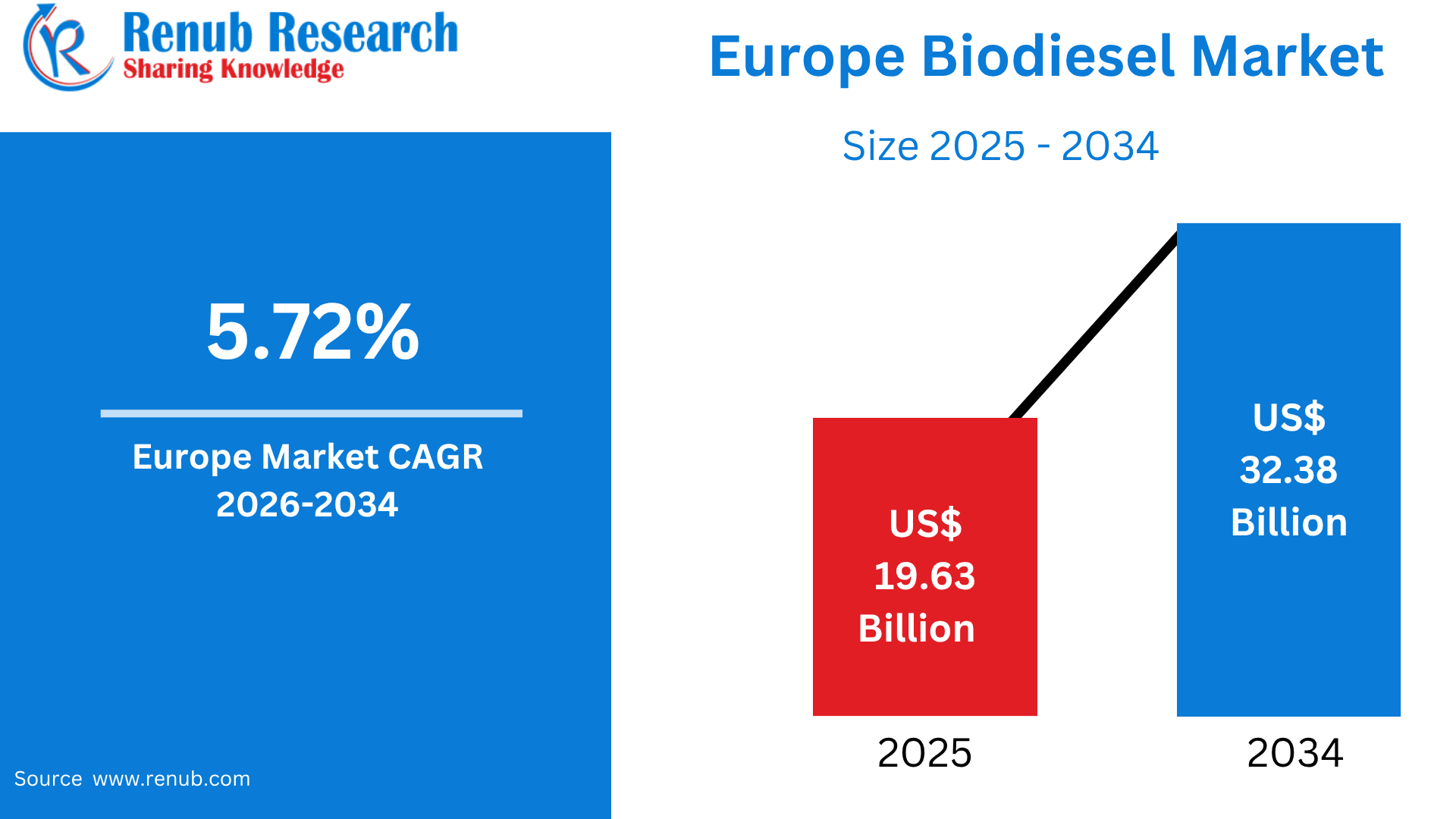
Europe Biodiesel Market is projected to expand from US$19.63 billion in 2025 to US$32.38 billion by 2034, registering a CAGR of 5.72% during 2026–2034. Market growth is being supported by Europe’s accelerating transition toward renewable fuels, stringent carbon-emission reduction targets, and increasing efforts to reduce dependence on conventional fossil fuels. Rising adoption of biodiesel in road transportation, commercial fleets, and other diesel-powered applications is creating additional demand. Government incentives, renewable-energy mandates, and sustainability initiatives are encouraging fuel producers and transport operators to increase the use of low-carbon alternatives.
What is Biodiesel? Uses and Popularity in Europe
Biodiesel is a renewable, biodegradable fuel produced mainly from vegetable oils, animal fats, and recycled cooking oils through a process called transesterification. It can be blended with conventional diesel or used in compatible diesel engines, making it an important alternative to petroleum-based transportation fuels. In Europe, biodiesel is widely used in passenger vehicles, commercial trucks, buses, agricultural machinery, and industrial equipment. It is also increasingly incorporated into renewable diesel and advanced biofuel strategies aimed at reducing greenhouse-gas emissions from transportation. Biodiesel’s popularity is supported by Europe’s strong renewable-energy policies and decarbonization targets.
The European Union’s Renewable Energy Directive sets a target of at least 29% renewable energy in transport by 2030, creating opportunities for renewable fuels and sustainable biofuels. Biodiesel derived from waste oils and residues is particularly attractive because it can provide lower lifecycle emissions while supporting circular-economy objectives. Countries such as Germany, France, Spain, Italy, and the Netherlands have established biodiesel production and consumption industries. Growing demand for cleaner transportation fuels, energy security, and reduced dependence on fossil fuels continues to strengthen biodiesel adoption across Europe.
EU Biodiesel Production by Country – Key Highlights, 2025
- Germany recorded the highest production at 2.85 Mt in 2025, up from 2.75 Mt in 2024, representing approximately 3.6% growth.
- Belgium, Ireland & the Netherlands collectively produced 2.11 Mt, compared with 2.32 Mt in 2024, indicating a decline of around 9.1%.
- Czechia, Bulgaria, Poland, Romania & Greece produced 1.02 Mt in 2025, unchanged from 1.02 Mt in 2024.
- France recorded 1.04 Mt in 2025, compared with 1.05 Mt in 2024, representing a slight decline of approximately 1.0%.
- Italy produced 0.99 Mt in 2025, increasing from 0.95 Mt in 2024, or approximately 4.2% growth.
- Spain & Portugal recorded combined production of 0.97 Mt in 2025, compared with 0.96 Mt in 2024, reflecting approximately 1.0% growth.
- Sweden & Finland produced 0.48 Mt in 2025, up from 0.40 Mt in 2024, representing the strongest percentage increase among the listed regions at approximately 20%.
- Total production reached 9.47 Mt in 2025, compared with 9.46 Mt in 2024, indicating broadly stable year-on-year production.
- Q1 2025 recorded the highest quarterly production at 2.44 Mt, followed by Q3 at 2.47 Mt, while Q2 and Q4 recorded 2.27 Mt and 2.29 Mt, respectively.
- Germany remained the largest individual producer, contributing approximately 30% of total 2025 production shown in the table.
EU Biodiesel and BioSAF Production – Key Highlights
- 2021: EU-27 production of FAME, HVO, and HEFA totaled approximately 13.7 million tonnes (Mt).
- 2022: Combined production declined slightly to 13.5 Mt, compared with 13.7 Mt in 2021.
- 2023: Production increased to approximately 14.1 Mt, marking a recovery and reaching the highest level shown for the period at that time.
- 2024: Total production stood at around 14.0 Mt, remaining broadly stable compared with 2023.
- 2025: Combined production increased to approximately 14.7 Mt, the highest level recorded in the chart.
- FAME remained the dominant product throughout 2021–2025, accounting for the largest share of EU-27 production.
- HVO (Hydrotreated Vegetable Oil) represented the second-largest production category and maintained a significant contribution across the period.
- HEFA (Hydroprocessed Esters and Fatty Acids) appeared as a smaller segment, with its contribution becoming more visible by 2025.
- Overall, EU-27 production increased from 13.7 Mt in 2021 to 14.7 Mt in 2025, representing an increase of approximately 7.3%.
- The trend indicates gradual expansion of Europe’s renewable diesel and biofuel production capacity, supported by increasing demand for lower-carbon transportation fuels.
Growth Drivers of the European Biodiesel Market
Strong Renewable Energy Targets and Decarbonization Policies
Europe’s ambitious climate policies are a major catalyst for biodiesel demand. The European Union has established a target for renewable energy to account for at least 29% of transport energy consumption by 2030, while member states are also pursuing greenhouse-gas reduction targets across road transportation. These policies encourage fuel suppliers and transport operators to increase the use of renewable fuels, including biodiesel and other advanced biofuels. Biodiesel can be blended with conventional diesel and used in many existing diesel-powered vehicles and equipment, allowing relatively easy integration into the transportation system. Germany, France, Spain, Italy, and the Netherlands are among the major European markets with established biofuel production and consumption infrastructure. Increasing carbon-reduction requirements for commercial fleets and transportation companies are also encouraging the adoption of lower-carbon fuels. Furthermore, sustainability mandates are increasing demand for biodiesel produced from used cooking oil, animal fats, and other waste-based feedstocks. Continued tightening of environmental regulations is therefore expected to support long-term biodiesel consumption across Europe.
Rising Demand for Low-Carbon Transportation Fuels
The transportation sector remains an important source of greenhouse-gas emissions in Europe, creating strong demand for renewable alternatives to conventional petroleum diesel. Road transport accounts for a substantial share of the region’s energy-related emissions, encouraging governments and businesses to adopt cleaner fuels. Biodiesel provides an immediate decarbonization option because it can be blended with conventional diesel and distributed through existing fuel infrastructure. Demand is particularly strong from commercial vehicles, buses, logistics fleets, agricultural machinery, and other diesel-intensive applications. The growing European logistics and e-commerce sectors are also increasing the number of commercial vehicles operating across the region, creating additional demand for renewable transportation fuels. In addition, fleet operators are increasingly evaluating lifecycle emissions when selecting fuels. Waste-based biodiesel is gaining attention because it can deliver significant greenhouse-gas savings compared with fossil diesel while supporting the circular economy. As European countries continue pursuing transport electrification alongside renewable fuels for harder-to-electrify applications, biodiesel is expected to remain an important component of the region’s low-carbon transportation strategy.
Expansion of Waste-Based Biodiesel and Advanced Feedstocks
The increasing availability and utilization of waste oils, used cooking oil, animal fats, and other residual feedstocks are creating new growth opportunities for the European biodiesel industry. Waste-based feedstocks are particularly attractive because they can reduce competition with food crops while improving the environmental profile of biofuel production. Under EU renewable-energy policies, fuels produced from qualifying waste and residue feedstocks can receive favorable treatment toward renewable transport targets. Europe has also developed a growing collection and processing ecosystem for used cooking oil, supporting investment in biodiesel and other renewable-fuel production. The region’s emphasis on circular-economy principles further encourages manufacturers to convert waste materials into valuable energy resources. Advances in pretreatment, feedstock purification, transesterification, and processing technologies are improving the ability of producers to handle diverse feedstocks efficiently. Meanwhile, rising demand for sustainable aviation and road-transport fuels is increasing competition for waste-based feedstocks and encouraging investment in collection networks. Continued technological development and greater availability of waste-derived raw materials are expected to strengthen the European biodiesel market through 2034.
Challenges of the European Biodiesel Market
Feedstock Availability and Rising Raw Material Costs
Limited availability of sustainable feedstocks is one of the major challenges facing Europe’s biodiesel market. Producers increasingly rely on used cooking oil, animal fats, vegetable oils, and agricultural residues, but the supply of these materials is finite and subject to fluctuations. Growing demand from biodiesel, renewable diesel, sustainable aviation fuel, and other biofuel industries is intensifying competition for waste-based feedstocks. Used cooking oil has become particularly valuable because of its favorable sustainability profile, resulting in increased procurement competition and price volatility. Agricultural feedstocks can also be affected by weather conditions, crop yields, commodity prices, and geopolitical disruptions. Furthermore, European sustainability regulations place strict requirements on the sourcing and traceability of feedstocks, limiting the availability of materials that qualify under renewable-fuel standards. Higher feedstock prices can increase biodiesel production costs and reduce competitiveness against conventional diesel when crude-oil prices are low. Producers are therefore investing in diversified feedstock portfolios, improved waste collection systems, and advanced processing technologies. However, maintaining a reliable and cost-effective sustainable feedstock supply remains a key challenge for long-term market expansion.
Competition from Electric Vehicles and Other Alternative Fuels
The rapid development of electric vehicles (EVs), renewable diesel, biomethane, hydrogen, and other low-carbon technologies presents a significant competitive challenge to the European biodiesel industry. Battery-electric vehicle adoption is accelerating across passenger cars and is gradually expanding into commercial transportation. According to the European Automobile Manufacturers’ Association, battery-electric cars accounted for around 14.6% of new EU car registrations in 2023, demonstrating the growing shift toward vehicle electrification. As charging infrastructure expands and battery technology improves, electricity is expected to capture an increasing share of passenger-vehicle energy demand. Biodiesel may therefore face greater competition in segments where electrification is practical. At the same time, renewable diesel and other advanced biofuels are attracting investment because they can provide lower-carbon alternatives while maintaining compatibility with conventional diesel infrastructure. Biodiesel producers must also comply with increasingly stringent sustainability and emissions requirements, which can raise production and certification costs. Nevertheless, biodiesel retains opportunities in heavy-duty vehicles, agriculture, existing diesel fleets, and other applications where complete electrification remains challenging, helping maintain its relevance within Europe’s broader renewable-fuel mix.
Biodiesel & Renewable Diesel Product Launches in Europe
- ORLEN HVO100 – Germany (2024): ORLEN launched HVO100 at two German service stations in Boizenburg and Achim. The fuel is produced from renewable oils and waste materials, including used cooking oil, and can reduce greenhouse-gas emissions by up to 90% versus fossil fuels.
- bp bioenergy HVO – Spain (2024): BP introduced its bioenergy HVO renewable diesel for heavy-duty road transportation at selected stations in Madrid, Valencia, and Navarre, expanding its European renewable-fuel offering.
- DEUTZ HVO Fuel – Germany (2024): DEUTZ opened an HVO refueling station at its Cologne-Porz facility, enabling its diesel-powered fleet, forklifts, service vehicles, and generators to operate on renewable HVO fuel.
- HVO Aurora – Europe (2025): Stellantis launched the HVO Aurora project to demonstrate and track real-world use of renewable HVO fuel in commercial-vehicle fleets. The initiative focuses on measurable and traceable reductions in carbon emissions.
- Galp Renewable HVO – Portugal (2026): Galp is developing a 270,000-ton-per-year HVO facility at Sines, using waste materials such as used cooking oils to produce renewable fuels. Large-scale production is planned from 2026.
- BeVant Biofuel – European Expansion: Be8’s BeVant is a renewable biofuel designed for use in diesel engines across public transportation, cargo, and maritime applications. The fuel can reportedly be used at up to 100% concentration without requiring new engine infrastructure.
- Netherlands Renewable-Fuel Ticket Products – 2026: Argus introduced a new range of renewable-fuel ticket price products for the Netherlands, supporting the country’s transition toward the latest EU renewable-energy requirements and increasing transparency in renewable-fuel markets.
- Advanced Waste-Based Biodiesel Products – EU: European producers are increasingly launching fuels derived from used cooking oil, animal fats, and other waste residues, reflecting growing demand for feedstocks that meet EU sustainability requirements. The European Biodiesel Board reported that its members represent around 70% of EU FAME and HVO output.
- HVO Fleet-Fuel Solutions – Germany: HVO-based renewable diesel solutions are expanding among industrial and commercial fleets, with applications extending beyond road vehicles to forklifts, generators, service vehicles, and other diesel equipment. DEUTZ’s Cologne deployment illustrates this broader product adoption.
- Waste-to-Biofuel Products – Spain: New European biofuel projects are increasingly developing products from complex waste feedstocks, including used cooking oils, animal fats, and industrial by-products. A planned Cádiz facility in Spain is designed to process these materials for HVO and sustainable aviation fuel production, with investment of about €46 million.
Europe Renewable Transportation Demand Supports Biodiesel Fuel Expansion
Europe biodiesel fuel market is expanding as governments and fuel suppliers intensify efforts to reduce transportation emissions and increase renewable-energy consumption. Under the revised EU Renewable Energy Directive, the region is targeting at least 29% renewable energy in transport by 2030, creating a favorable environment for biodiesel and other renewable fuels. Biodiesel can be blended with conventional diesel and used in compatible vehicles, allowing transportation operators to reduce lifecycle greenhouse-gas emissions without completely replacing existing infrastructure. Demand is increasing across passenger vehicles, commercial fleets, buses, agricultural machinery, and logistics operations. The growing availability of rapeseed oil, used cooking oil, animal fats, and other sustainable feedstocks is also supporting production. Technological improvements in feedstock processing and fuel quality are helping producers improve efficiency and meet increasingly stringent sustainability requirements. Waste-based biodiesel is gaining particular attention because it supports circular-economy objectives while reducing dependence on food-based feedstocks. With European countries strengthening decarbonization policies and promoting cleaner transportation, biodiesel is expected to remain an important renewable fuel through 2034.
Demand for Cleaner Backup and Distributed Power in Europe
Europe power generation biodiesel market is gaining importance as businesses, utilities, and remote facilities seek lower-carbon alternatives for diesel-powered generators. Biodiesel can be used in many existing compression-ignition generator systems, allowing operators to incorporate renewable fuel without requiring major modifications to equipment. It is particularly relevant for backup power, remote installations, agricultural facilities, construction sites, and distributed-generation applications. Europe’s focus on renewable energy and emissions reduction is encouraging organizations to evaluate biodiesel as an alternative to conventional fossil diesel for temporary and backup electricity generation. Waste-derived biodiesel also provides an opportunity to convert used cooking oils and animal fats into energy while supporting circular-economy objectives. Improvements in fuel processing and quality control are increasing the reliability of biodiesel for generator applications. However, electricity-sector demand remains smaller than transportation demand because Europe is rapidly expanding solar, wind, battery storage, and other renewable technologies. Nevertheless, biodiesel-powered generators can provide dispatchable backup capacity where grid reliability, portability, or rapid deployment is important, supporting steady niche growth.
Established Feedstock Base Supports Europe Vegetable Oil Biodiesel Production
Europe vegetable oil biodiesel market remains an important segment because of the region’s established agricultural sector and availability of oilseed feedstocks. Rapeseed oil has historically been one of the most important feedstocks for European biodiesel production, while soybean and sunflower oils also contribute to the supply mix. The European Union produces more than 10 million tonnes of rapeseed annually in many recent years, providing an established raw-material base for biodiesel manufacturers. Existing agricultural, crushing, refining, storage, and transportation infrastructure further supports feedstock availability. However, the use of food-grade vegetable oils for biofuel production has raised concerns regarding food security, land use, and indirect environmental impacts. Consequently, European policies increasingly favor waste and residue feedstocks and impose sustainability requirements on biofuels. Producers are responding through improved oil-extraction technologies, higher processing efficiency, and greater diversification of raw materials. Despite competition from waste-based alternatives and concerns surrounding crop-based feedstocks, vegetable oils remain important because of their established supply chains, predictable quality, and suitability for biodiesel production.
Europe Based Feedstocks Accelerate Sustainable Europe Animal Fats Biodiesel Production
Europe animal fats biodiesel market is gaining momentum as producers increasingly adopt waste-derived feedstocks to meet renewable-energy and sustainability objectives. Animal fats such as tallow and other by-products from meat processing can be converted into biodiesel, creating an additional value stream from materials that might otherwise require disposal. Their use also reduces dependence on edible vegetable oils and supports Europe’s broader circular-economy strategy. EU renewable-energy regulations provide favorable conditions for qualifying waste and residue-based fuels, increasing the attractiveness of animal-fat biodiesel for fuel producers. Technological advances in pretreatment, purification, and transesterification are improving the ability to process animal fats efficiently and produce biodiesel that meets fuel-quality requirements. Demand is also supported by the growing need for lower-carbon fuels in transportation and other diesel applications. However, the supply of suitable animal fats is limited, and competition from renewable diesel and sustainable aviation fuel producers can create feedstock-price pressure. Despite these constraints, the combination of waste reduction, resource recovery, and lower lifecycle emissions is expected to support continued expansion of animal-fat biodiesel in Europe.
Strong Agricultural Base and Renewable-Fuel Policies Support France Growth
France has one of Europe’s most established biodiesel markets, supported by its large agricultural sector, renewable-energy policies, and efforts to reduce transportation emissions. The country is a major producer of rapeseed, an important biodiesel feedstock, providing domestic manufacturers with access to established agricultural and processing infrastructure. Government policies promoting renewable fuels and carbon reduction continue to encourage biodiesel blending in road transportation. Growing demand for lower-carbon fuels from commercial fleets and logistics operators is also supporting market development. At the same time, France is increasingly interested in waste-based and advanced biofuels, which can reduce reliance on food-based feedstocks and improve lifecycle emissions performance. However, fluctuations in agricultural commodity prices, feedstock availability, and competition between food and fuel applications remain important challenges. In March 2026, TotalEnergies opened a 15,000-ton-per-year advanced plastic-waste recycling plant at its Grandpuits site, forming part of the site’s broader transformation into a Zero Crude platform. Although the facility is not a biodiesel plant, the investment reflects France’s broader shift toward circular-economy and low-carbon industrial activities, supporting the country’s wider renewable-fuel ecosystem.
Advanced Production Infrastructure and Decarbonization Drive Germany Demand
Germany represents one of Europe’s largest and most technologically developed biodiesel markets, supported by extensive biofuel production capabilities, sophisticated distribution infrastructure, and strong renewable-energy policies. The country has a well-established agricultural and industrial base that supports the production and processing of biodiesel feedstocks. Strict greenhouse-gas reduction requirements and sustainability regulations are encouraging fuel suppliers to increase the use of renewable and waste-derived fuels. Biodiesel remains relevant for road transportation, commercial fleets, agriculture, and other diesel-intensive applications, although growing electric-mobility adoption is increasing competitive pressure. Feedstock price volatility and sustainability requirements can also affect producer margins. Germany’s broader bioenergy sector continues to attract investment. In 2026, the Federal Network Agency announced auctions supporting more than 1 GW of bioenergy capacity, including 726.7 MW of biomass generation projects and 300 MW of biomethane production. While these auctions primarily target electricity generation rather than biodiesel, they demonstrate continued policy support for renewable biological energy. Germany’s combination of industrial expertise, renewable-energy investment, and emissions-reduction policies is expected to sustain its importance in Europe’s biodiesel market.
United Kingdom Waste-Based Fuels and Transport Decarbonization Support Biodiesel Expansion
United Kingdom biodiesel market is developing alongside the country’s broader strategy to decarbonize transportation and increase renewable-fuel consumption. The Renewable Transport Fuel Obligation (RTFO) provides a key policy framework by requiring fuel suppliers to incorporate renewable fuels into transportation fuel supplies or meet associated compliance requirements. Increasing attention is being given to used cooking oil, waste fats, and other non-food feedstocks, as these materials can provide lower-carbon alternatives while reducing reliance on edible oils. Demand from logistics, commercial transportation, construction, and other diesel-intensive sectors provides additional opportunities for biodiesel consumption. The UK’s biofuel industry is also benefiting from investments in production capacity and supporting infrastructure. In November 2025, Medway Council approved a £50 million expansion of the Syntech Biofuel facility at Kingsnorth Industrial Estate, intended to support biofuel production for a major UK road project. Nevertheless, changes in government policy, international trade conditions, feedstock availability, and competition from electric vehicles and other renewable fuels remain challenges. Continued investment in waste-based biofuels and transport decarbonization is expected to support the UK’s biodiesel industry.
Netherlands Strategic Ports and Advanced Biofuel Trade Strengthen Growth
Netherlands plays a strategically important role in Europe’s biodiesel market because of its major ports, extensive logistics infrastructure, and position as a leading European hub for fuel imports, exports, storage, and distribution. Rotterdam in particular provides access to international feedstock and renewable-fuel supply chains, strengthening the country’s role in the regional biofuel ecosystem. Dutch policies aimed at reducing transportation emissions are encouraging the adoption of renewable fuels, while increasing interest in waste-based biodiesel and advanced biofuels supports the transition toward a circular economy. The Netherlands is also investing in technologies that improve feedstock processing, fuel quality, and lifecycle emissions performance. In January 2026, Argus introduced new renewable-fuel ticket price assessments for the Netherlands, reflecting the country’s evolving renewable-fuel market and regulatory framework. The Netherlands is also preparing for the implementation of the latest EU Renewable Energy Directive (RED III) requirements, which place greater emphasis on emissions savings rather than simply renewable-energy percentages. Feedstock availability, competition from renewable diesel and other low-carbon fuels, and changing regulatory requirements remain challenges. Nevertheless, its strategic location, infrastructure, and advanced renewable-fuel ecosystem position the Netherlands as a key European biodiesel market.
Market Segments
- Application
- Fuel
- Power Generation
- Others
Feedstock
- Vegetable Oil
- Animal Fats
Countries
- France
- Germany
- Italy
- Spain
- United Kingdom
- Belgium
- Netherlands
- Russia
- Poland
- Greece
- Norway
- Romania
- Portugal
- Rest of Europe
All companies have been covered with 5 Viewpoints
- Overviews
- Key Person
- Recent Developments
- SWOT Analysis
- Revenue Analysis
Company
- Archer Daniels Midland Company
- Future Fuel
- Neste’s
- Renewable Energy Group, Inc.
- Bunge Global SA
- Wilmar
- Shell
Report Details:
| Report Features | Details |
| Base Year |
2025 |
| Historical Period |
2022 - 2025 |
| Forecast Period |
2026 - 2034 |
| Market |
US$ Billion |
| Segment Covered |
Application, Feedstock, and Countries |
| Countries Covered |
|
| Companies Covered |
1. Archer Daniels Midland Company |
| Customization Scope |
20% Free Customization |
| Post-Sale Analyst Support |
1 Year (52 Weeks) |
| Delivery Format |
PDF and Excel through Email (We can also provide the editable version of the report in PPT/Word format on request) |
Key Questions Answered in This Report:
-
What is the estimated size of the Europe biodiesel market by 2033?
-
What is the expected compound annual growth rate (CAGR) of the market from 2025 to 2033?
-
What are the primary drivers of growth in the European biodiesel market?
-
How does the European Union's Renewable Energy Directive (RED II) impact biodiesel demand?
-
What are the major challenges facing the European biodiesel market?
-
Which countries in Europe are leading in biodiesel production and consumption?
-
What are the key applications of biodiesel in Europe?
-
Which feedstocks are primarily used for biodiesel production in Europe?
-
What are some major companies operating in the European biodiesel market?
-
How is technological advancement influencing biodiesel production and adoption in Europe?
Customization Services available
- Analysis of Market Size and Its Segments
- More Company Profiles (Upto 10 without any additional cost):
- Additional Countries (Other than mentioned Countries):
- Region/Country Specific Reports:
- Market Entry Strategy:
- Region-Specific Market Dynamics:
- Regional Market Share Analysis:
- Trade Analysis:
- Production Insights:
- Others Customized Requests:
For more information contact our analysts.
Need More Assistance?
- Talk to our analysts to get more precious information on the current market trends.
- Include more countries and segments and customize the report based on the final requirement.
- Get a competitive advantage in your industry by knowing the report findings and making a positive impact on your revenues and operations.
- Our analysts are always ready to provide more help and pertinent information if you need any additional assistance.