Global Seafood Market Size, Share, Trends, Growth Analysis and Forecast Report 2026–2034
Buy NowGlobal Seafood Market Tends
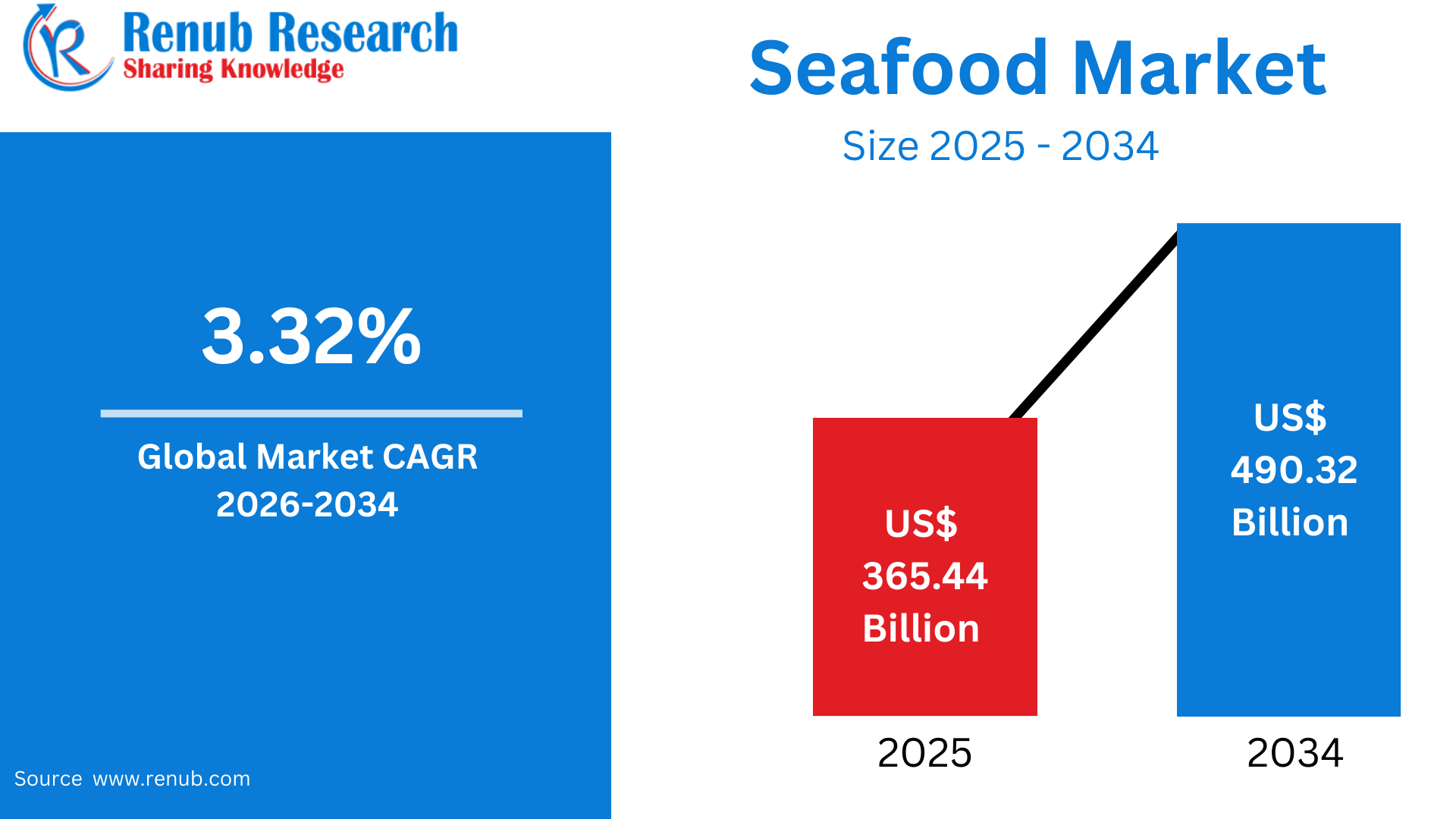
Global Seafood Market is projected to witness steady growth, expanding from US$ 365.44 billion in 2025 to US$ 490.32 billion by 2034, registering a CAGR of 3.32% during 2026–2034. Market growth is being driven by rising global demand for high-quality protein, increasing consumer awareness of the nutritional benefits of seafood, expanding aquaculture production, and the growing popularity of processed and convenience seafood products. In addition, improvements in cold-chain logistics, sustainable fishing practices, and international seafood trade are supporting the continued expansion of the market worldwide.
World Seafood Industry Analysis
Seafood comprises a wide variety of edible aquatic organisms harvested from marine and freshwater environments. It includes finfish such as salmon, tuna, cod, and mackerel; shellfish including shrimp, crab, lobster, and prawns; mollusks such as oysters, mussels, scallops, and clams; as well as edible marine plants like seaweed. Seafood is widely recognized as a nutrient-rich food source, providing high-quality protein, omega-3 fatty acids, vitamins, antioxidants, and essential minerals that support cardiovascular health, brain function, immune health, and overall well-being. It is consumed in numerous forms, including fresh, frozen, smoked, dried, canned, and value-added processed products, making it suitable for a broad range of culinary applications.
Growing health awareness and evolving dietary preferences are significantly increasing seafood consumption across global markets. As consumers seek healthier alternatives to red and processed meats, seafood has become an increasingly preferred source of lean protein due to its superior nutritional profile and lower saturated fat content. While seafood has traditionally been a dietary staple across coastal regions of Asia-Pacific, Europe, and Latin America, consumption is also expanding rapidly in inland areas of North America, the Middle East, and emerging economies as product availability and distribution networks continue to improve.
The market is also benefiting from rising demand for ready-to-cook, ready-to-eat, and premium value-added seafood products that align with modern lifestyles and busy consumer schedules. Advancements in cold storage infrastructure, seafood processing technologies, packaging innovations, and global supply chain efficiency have significantly improved product quality, freshness, and accessibility. Furthermore, the growing popularity of international cuisines, increasing disposable incomes, expanding retail and e-commerce distribution channels, and greater awareness of healthy eating habits are expected to sustain long-term growth in the global seafood market throughout the forecast period.
World Aquaculture and Capture Fisheries Production (1990–2034, Live-Weight Equivalent)
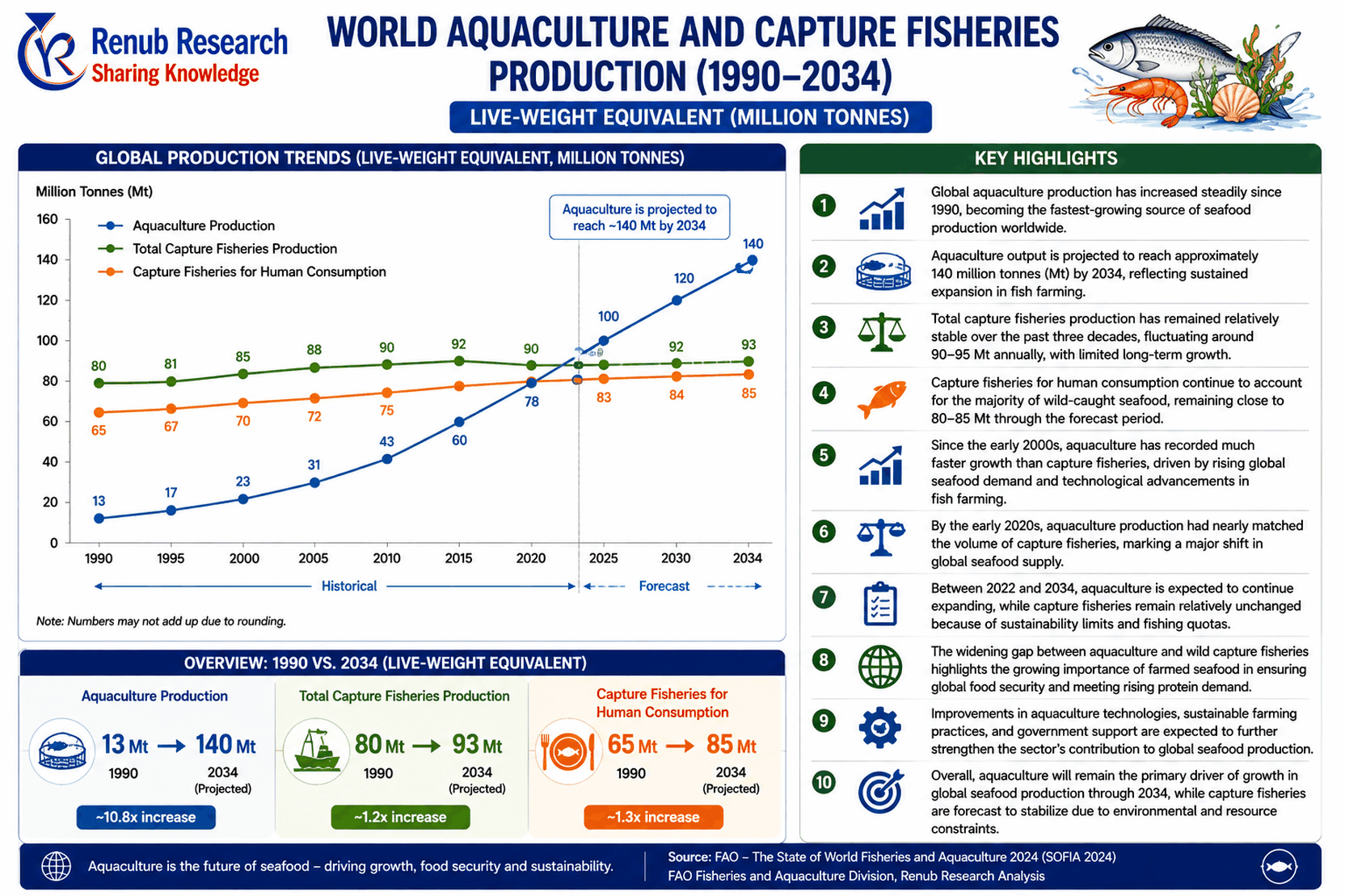
- Global aquaculture production has increased steadily since 1990, becoming the fastest-growing source of seafood production worldwide.
- Aquaculture output is projected to reach approximately 140 million tonnes (Mt) by 2034, reflecting sustained expansion in fish farming.
- Total capture fisheries production has remained relatively stable over the past three decades, fluctuating around 90–95 Mt annually, with limited long-term growth.
- Capture fisheries for human consumption continue to account for the majority of wild-caught seafood, remaining close to 80–85 Mt through the forecast period.
- Since the early 2000s, aquaculture has recorded much faster growth than capture fisheries, driven by rising global seafood demand and technological advancements in fish farming.
- By the early 2020s, aquaculture production had nearly matched the volume of capture fisheries, marking a major shift in global seafood supply.
- Between 2022 and 2034, aquaculture is expected to continue expanding, while capture fisheries remain relatively unchanged because of sustainability limits and fishing quotas.
- The widening gap between aquaculture and wild capture fisheries highlights the growing importance of farmed seafood in ensuring global food security and meeting rising protein demand.
- Improvements in aquaculture technologies, sustainable farming practices, and government support are expected to further strengthen the sector’s contribution to global seafood production.
- Overall, aquaculture will remain the primary driver of growth in global seafood production through 2034, while capture fisheries are forecast to stabilize due to environmental and resource constraints.
Market Catalysts
Rising Consumer Demand for Healthy, Protein-Rich Foods
Growing awareness of nutrition and preventive healthcare is one of the primary factors driving the global seafood market. Consumers are increasingly choosing seafood as a healthy source of lean protein because it contains high-quality protein, omega-3 fatty acids, vitamins, and essential minerals that support cardiovascular health, brain function, and overall well-being. As the prevalence of obesity, diabetes, and cardiovascular diseases continues to rise worldwide, many consumers are replacing red and processed meats with healthier dietary alternatives, making seafood an integral part of balanced diets. Healthcare professionals and nutrition experts also continue to recommend regular seafood consumption to promote long-term health. According to the 2024 International Food Information Council (IFIC) Food & Health Survey, consumers are actively increasing their protein intake and prioritizing nutrient-rich foods as part of healthier eating habits. Furthermore, PubMed Central reports that seafood typically contains 20–30% high-quality protein, making it one of the leanest animal protein sources available. The World Wildlife Fund (WWF) also estimates that more than 3 billion people worldwide rely on wild-caught and farmed seafood as an important source of dietary protein, highlighting its critical role in global food and nutritional security.
Expansion of Sustainable Aquaculture Production
The rapid development of the aquaculture industry has become a major contributor to the growth of the global seafood market. As wild fish stocks face increasing pressure from overfishing, climate change, and habitat degradation, aquaculture has emerged as the fastest-growing source of seafood production worldwide. Technological advancements in fish breeding, nutrition, disease management, water quality monitoring, and automated farming systems have significantly improved production efficiency, product quality, and year-round supply. In addition, growing adoption of sustainable aquaculture practices has strengthened consumer confidence by promoting environmentally responsible seafood production. Governments and private companies are also investing heavily in modern aquaculture infrastructure to meet rising global seafood demand while reducing pressure on natural marine ecosystems. Reflecting efforts to expand affordable seafood offerings, Red Lobster launched its “Ultimate SpendLESS Shrimp” promotion in September 2025, providing value-oriented shrimp meals to attract budget-conscious consumers and stimulate seafood consumption.
Growing Popularity of Processed and Value-Added Seafood Products
The increasing demand for convenience foods is significantly boosting the market for processed and value-added seafood products. Rapid urbanization, busier lifestyles, and changing consumer preferences have encouraged greater consumption of ready-to-cook and ready-to-eat seafood products that require minimal preparation time. Frozen seafood, canned fish, smoked seafood, marinated products, seafood snacks, and prepared meals offer extended shelf life, improved convenience, and consistent product quality, making them attractive to both households and foodservice operators. Continuous advancements in seafood processing technologies, packaging innovations, freezing techniques, and cold-chain logistics have further improved product freshness and expanded market accessibility across developed and emerging economies. In addition, the rapid growth of supermarkets, hypermarkets, convenience stores, and online grocery platforms has strengthened the distribution of packaged seafood products worldwide. Demonstrating this trend, Bumble Bee Seafoods introduced Bumble Bee Snackers™ in August 2025, launching its first line of single-serve flavored tuna snacks designed to appeal to younger consumers seeking convenient, high-protein meal options.
Problems occurs in the Market
Overfishing and Environmental Sustainability Concerns
Overfishing and environmental degradation continue to present significant challenges to the long-term sustainability of the global seafood industry. Excessive harvesting of wild fish stocks, combined with climate change, marine pollution, and habitat destruction, has placed increasing pressure on ocean ecosystems and reduced the availability of several commercially important fish species. In response, governments and international organizations have implemented stricter fishing quotas, sustainability regulations, and conservation measures to protect marine biodiversity. While these initiatives are essential for preserving fish populations, they also increase operational costs for fishing companies and seafood producers. Additionally, rising ocean temperatures, acidification, and changing migration patterns caused by climate change continue to affect fish reproduction, distribution, and harvest volumes, creating uncertainty across global seafood supply chains.
Supply Chain Complexity and Price Volatility
The seafood market also faces ongoing challenges related to complex global supply chains and fluctuating product prices. Because seafood is highly perishable, maintaining an uninterrupted cold chain from harvesting and processing to transportation, storage, and retail distribution is essential for preserving product quality and food safety. Any disruption caused by transportation delays, equipment failures, labor shortages, or geopolitical events can result in significant financial losses and product waste. Furthermore, seafood prices are influenced by numerous factors, including seasonal catch volumes, fuel costs, weather conditions, international trade policies, fishing regulations, currency fluctuations, and changing consumer demand. These price fluctuations create uncertainty for producers, distributors, retailers, and consumers, making effective supply chain management and cost control increasingly important for maintaining market stability.
Seafood Product Launches Worldwide
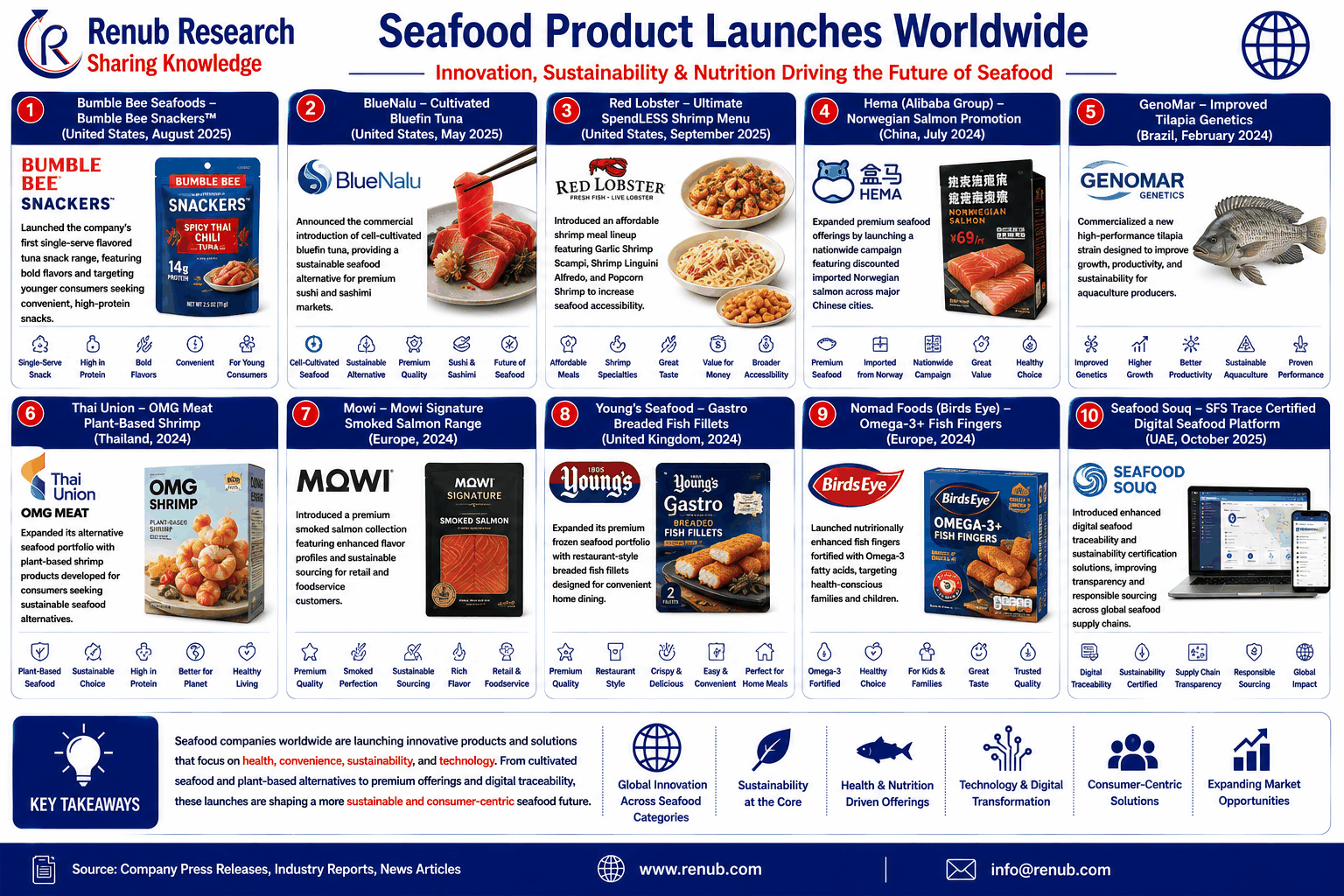
- Bumble Bee Seafoods – Bumble Bee Snackers™ (United States, August 2025) – Launched the company’s first single-serve flavored tuna snack range, featuring bold flavors and targeting younger consumers seeking convenient, high-protein snacks.
- BlueNalu – Cultivated Bluefin Tuna (United States, May 2025) – Announced the commercial introduction of cell-cultivated bluefin tuna, providing a sustainable seafood alternative for premium sushi and sashimi markets.
- Red Lobster – Ultimate SpendLESS Shrimp Menu (United States, September 2025) – Introduced an affordable shrimp meal lineup featuring Garlic Shrimp Scampi, Shrimp Linguini Alfredo, and Popcorn Shrimp to increase seafood accessibility.
- Hema (Alibaba Group) – Norwegian Salmon Promotion (China, July 2024) – Expanded premium seafood offerings by launching a nationwide campaign featuring discounted imported Norwegian salmon across major Chinese cities.
- GenoMar – Improved Tilapia Genetics (Brazil, February 2024) – Commercialized a new high-performance tilapia strain designed to improve growth, productivity, and sustainability for aquaculture producers.
- Thai Union – OMG Meat Plant-Based Shrimp (Thailand, 2024) – Expanded its alternative seafood portfolio with plant-based shrimp products developed for consumers seeking sustainable seafood alternatives.
- Mowi – Mowi Signature Smoked Salmon Range (Europe, 2024) – Introduced a premium smoked salmon collection featuring enhanced flavor profiles and sustainable sourcing for retail and foodservice customers.
- Young’s Seafood – Gastro Breaded Fish Fillets (United Kingdom, 2024) – Expanded its premium frozen seafood portfolio with restaurant-style breaded fish fillets designed for convenient home dining.
- Nomad Foods (Birds Eye) – Omega-3+ Fish Fingers (Europe, 2024) – Launched nutritionally enhanced fish fingers fortified with Omega-3 fatty acids, targeting health-conscious families and children.
- Seafood Souq – SFS Trace Certified Digital Seafood Platform (UAE, October 2025) – Introduced enhanced digital seafood traceability and sustainability certification solutions, improving transparency and responsible sourcing across global seafood supply chains.
Form Analysis:
Fresh Seafood
The global fresh seafood market comprises freshly harvested and chilled fish, crustaceans, mollusks, and other aquatic products distributed through supermarkets, specialty seafood retailers, traditional fish markets, and online grocery platforms. Fresh seafood is highly valued for its superior taste, texture, nutritional quality, and minimal processing, making it a preferred choice among health-conscious consumers and premium food enthusiasts. Demand remains particularly strong in coastal regions and countries with long-established seafood consumption traditions. Advancements in refrigerated transportation, cold-chain logistics, and freshness-preservation technologies have significantly extended product shelf life while reducing spoilage during distribution. However, the market continues to face challenges related to product perishability, seasonal supply fluctuations, and price volatility.
Ambient Seafood
The global ambient seafood market includes shelf-stable seafood products that can be stored without refrigeration, such as dried, smoked, salted, fermented, and preserved seafood. These products are widely consumed across Asia, Africa, and several European countries due to their affordability, long shelf life, and ease of storage and transportation. Ambient seafood offers a dependable source of protein, particularly in regions where refrigerated storage and cold-chain infrastructure remain limited. Growing consumer interest in traditional, ethnic, and convenience foods has further strengthened demand for shelf-stable seafood products. Although ambient seafood differs from fresh and frozen products in terms of texture and processing, it continues to play an essential role in global seafood consumption by providing accessible and cost-effective nutrition.
Canned and Processed
The canned and processed seafood segment represents one of the fastest-growing categories within the global seafood industry. Products including canned tuna, salmon, sardines, mackerel, frozen seafood fillets, breaded seafood, smoked seafood, and ready-to-eat seafood meals are experiencing rising demand because of their convenience, extended shelf life, and consistent product quality. Urbanization, busy lifestyles, and increasing consumer preference for quick meal solutions continue to drive market expansion. Technological advancements in food processing, packaging, preservation, and quality assurance have further improved product safety and freshness. In addition, the rapid expansion of supermarkets, convenience stores, and e-commerce platforms has increased product accessibility, particularly across North America and Europe, where convenience, portion-controlled packaging, and premium processed seafood products are highly valued.
Type Insights
Crustaceans
The global crustaceans seafood market includes shrimp, prawns, crabs, lobsters, crayfish, and other commercially important crustacean species. Shrimp continues to dominate the segment due to its affordability, versatility, widespread availability, and strong consumer demand across retail and foodservice channels. Crustaceans are extensively used in restaurants, hotels, catering services, frozen food manufacturing, and premium dining establishments worldwide. Market growth is supported by expanding aquaculture production, rising seafood consumption, and increasing demand for high-protein foods. However, producers continue to face challenges related to disease outbreaks in aquaculture, environmental sustainability concerns, fluctuating feed costs, and changing global market prices.
Molluscs
The global molluscs seafood market encompasses oysters, mussels, clams, scallops, squid, octopus, and other mollusk species that are highly valued for their distinctive flavor, nutritional value, and culinary versatility. These seafood products remain essential ingredients in premium cuisine as well as traditional regional dishes across many countries. Growing consumer interest in healthy diets, gourmet seafood experiences, and sustainable food production continues to support market growth. Expanding oyster and mussel farming operations have improved year-round product availability and supply consistency. Nevertheless, environmental factors such as changing water quality, climate change, and marine ecosystem conditions continue to influence production volumes. Increasing investment in sustainable aquaculture practices is helping address these challenges while supporting long-term market development.
Application Insights
Retail
The global seafood retail market consists of supermarkets, hypermarkets, specialty seafood stores, convenience stores, fish markets, and rapidly growing online retail channels. Retailers play a critical role in expanding seafood consumption by providing consumers with a diverse selection of fresh, frozen, canned, and processed seafood products. Supermarkets remain the dominant distribution channel due to their extensive product variety, competitive pricing, and availability of both branded and private-label seafood products. Meanwhile, the rapid growth of e-commerce, home delivery services, and digital grocery platforms has significantly improved consumer access to seafood products, offering greater convenience and wider product selection across global markets.
Foodservice
The global seafood foodservice market includes restaurants, hotels, cafés, catering companies, institutional foodservice providers, and quick-service restaurant (QSR) chains. Seafood continues to be a key ingredient across casual dining, fine dining, and international cuisines, reflecting growing consumer demand for healthier and premium meal options. The recovery of the hospitality industry, increasing international tourism, rising disposable incomes, and higher consumer spending on dining experiences are supporting market growth. Foodservice operators are increasingly utilizing frozen and processed seafood products due to their consistent quality, extended shelf life, and operational efficiency. In addition, sustainability and responsible sourcing have become increasingly important purchasing considerations, encouraging restaurants and hospitality businesses to procure certified and environmentally responsible seafood products.
Country Analysis
United States
The United States represents one of the world’s largest and most mature seafood markets, supported by strong consumer awareness of nutrition, well-developed retail infrastructure, and growing demand for healthy protein sources. Seafood varieties such as salmon, shrimp, tuna, crab, cod, and tilapia remain highly popular due to their rich protein content and abundance of omega-3 fatty acids. Although the country has extensive domestic commercial fisheries and aquaculture production, it continues to rely heavily on seafood imports to satisfy rising consumer demand. The increasing popularity of frozen, ready-to-cook, and ready-to-eat seafood products reflects changing lifestyles and the growing preference for convenient meal options. Supermarkets, warehouse clubs, specialty seafood retailers, and foodservice establishments dominate product distribution, while online grocery platforms continue to expand their market presence. In addition, consumers are placing greater emphasis on sustainably sourced, traceable, and eco-certified seafood products. Demonstrating continued innovation, BlueNalu announced in May 2025 its plans to commercialize cultivated bluefin tuna products in California, marking an important advancement in the alternative seafood sector.
United Kingdom
The United Kingdom has a well-established seafood market supported by a long-standing fishing heritage, advanced food retail sector, and increasing consumer focus on healthy eating. Traditional seafood products including cod, haddock, salmon, mackerel, and shellfish continue to dominate consumption, while demand for chilled, frozen, and processed seafood products continues to rise. Government dietary recommendations encouraging regular fish consumption, combined with increasing health awareness, have strengthened seafood demand across the country. Sustainability has become a key purchasing consideration, with consumers increasingly preferring responsibly sourced and certified seafood products. Supermarkets remain the leading retail channel through a combination of private-label and branded offerings, while restaurants, pubs, and quick-service restaurants contribute significantly to foodservice demand. Growing interest in convenient meal solutions has also boosted sales of frozen fillets, ready-to-cook seafood, and value-added products. In October 2024, Suempol, a leading Polish salmon producer, acquired UK-based seafood supplier Copernus Ltd, expanding its product portfolio beyond smoked salmon to include species such as cod and haddock while strengthening its presence in the European seafood market.
China
China is the world’s largest producer, consumer, and exporter of seafood, making it one of the most influential markets in the global seafood industry. The country’s extensive aquaculture sector provides a reliable supply of diverse seafood products, supporting both domestic consumption and international exports. Seafood has long been an integral part of Chinese culinary culture, and rising household incomes, urbanization, and changing dietary preferences continue to increase demand for premium seafood products. In addition to strong domestic production, imports of high-quality seafood—including salmon, lobster, shrimp, and premium shellfish—have expanded rapidly to satisfy evolving consumer preferences. The continued growth of modern retail, e-commerce platforms, and cold-chain logistics has further strengthened seafood distribution throughout the country. In July 2024, Alibaba Group’s Hema supermarket chain launched a promotional campaign offering discounted Norwegian salmon across major Chinese cities, including Shanghai, Beijing, Guangzhou, Shenzhen, Nanjing, Hangzhou, and Hefei, following lower import prices.
Brazil
Brazil is an emerging seafood market with significant long-term growth potential, driven by rising health awareness, expanding aquaculture production, and increasing consumer demand for nutritious protein sources. Although beef and poultry continue to dominate the Brazilian diet, seafood consumption has been steadily increasing, particularly in urban centers and coastal regions. Brazil’s abundant freshwater resources have supported the rapid expansion of tilapia farming, positioning the country among the world’s leading tilapia producers. Shrimp and tilapia remain the most widely consumed aquaculture products, while government initiatives and private investments continue to strengthen domestic seafood production. Despite strong growth prospects, infrastructure limitations, logistics challenges, and regional differences in seafood consumption continue to constrain market development. Reflecting continued investment in aquaculture innovation, GenoMar introduced a new genetically improved tilapia product in February 2024 to enhance productivity and support Brazilian fish farmers.
United Arab
The United Arab Emirates (UAE) has one of the highest per-capita seafood consumption rates globally, supported by a large expatriate population, a thriving tourism industry, and a rapidly expanding hospitality sector. The country depends heavily on seafood imports to meet domestic demand, while its advanced cold-chain logistics and distribution infrastructure ensure the availability of premium seafood products throughout the year. Fresh, frozen, and high-value seafood—including salmon, prawns, lobster, and shellfish—are widely consumed across hotels, restaurants, luxury retailers, and supermarkets. At the same time, the UAE government continues to promote food security and sustainable aquaculture through investments aimed at increasing domestic seafood production. Nevertheless, imported seafood remains a critical component of the national market. In October 2025, Seafood Souq signed a landmark Memorandum of Understanding (MoU) with the UAE Ministry of Climate Change and Environment (MOCCAE) during the IUCN Congress 2025 to promote greater sustainability, innovation, and transparency across the UAE seafood industry.
Market Segmentations
Form
- Fresh
- Frozen
- Ambient
- Canned & Processed Seafood
Type
- Fish
- Crustaceans
- Mollusca
- Others
Application
- Retail
- Institutions
- Food Service
Country
North America
- United States
- Canada
Europe
- France
- Germany
- Italy
- Spain
- United Kingdom
- Belgium
- Netherlands
- Turkey
Asia Pacific
- China
- Japan
- India
- South Korea
- Thailand
- Malaysia
- Indonesia
- Australia
- New Zealand
Latin America
- Brazil
- Mexico
- Argentina
Middle East & Africa
- Saudi Arabia
- UAE
- South Africa
All companies have been covered with 5 Viewpoints
- Overviews
- Key Person
- Recent Developments
- SWOT Analysis
- Revenue Analysis
Key Players Analysis
- Agrosuper S.A.
- Asian Sea Corporation Public Company Limited
- Austevoll Seafood ASA
- Bolton Group SRL
- Grieg Seafood ASA
- Maruha Nichiro Corporation
- Sysco Corporation
- Thai Union Group PCL
Report Details:
| Report Features | Details |
| Base Year |
2025 |
| Historical Period |
2022 - 2025 |
| Forecast Period |
2026 - 2034 |
| Market |
US$ Billion |
| Segment Covered |
Form, Type, Application and Countries |
| Countries Covered |
|
| Companies Covered |
|
| Customization Scope |
20% Free Customization |
| Post-Sale Analyst Support |
1 Year (52 Weeks) |
| Delivery Format |
PDF and Excel through Email (We can also provide the editable version of the report in PPT/Word format on request) |
Customization Services available
- Analysis of Market Size and Its Segments
- More Company Profiles (Upto 10 without any additional cost):
- Additional Countries (Other than mentioned Countries):
- Region/Country Specific Reports:
- Market Entry Strategy:
- Region-Specific Market Dynamics:
- Regional Market Share Analysis:
- Trade Analysis:
- Production Insights:
- Others Customized Requests:
For more information contact our analysts.
Need More Assistance?
- Talk to our analysts to get more precious information on the current market trends.
- Include more countries and segments and customize the report based on the final requirement.
- Get a competitive advantage in your industry by knowing the report findings and making a positive impact on your revenues and operations.
- Our analysts are always ready to provide more help and pertinent information if you need any additional assistance.