GCC App Analytics Market Report by Type, Application, Industry Vertical, Countries and Companies Analysis 2026-2034
Buy NowGCC App Analytics Market Size and Forecast
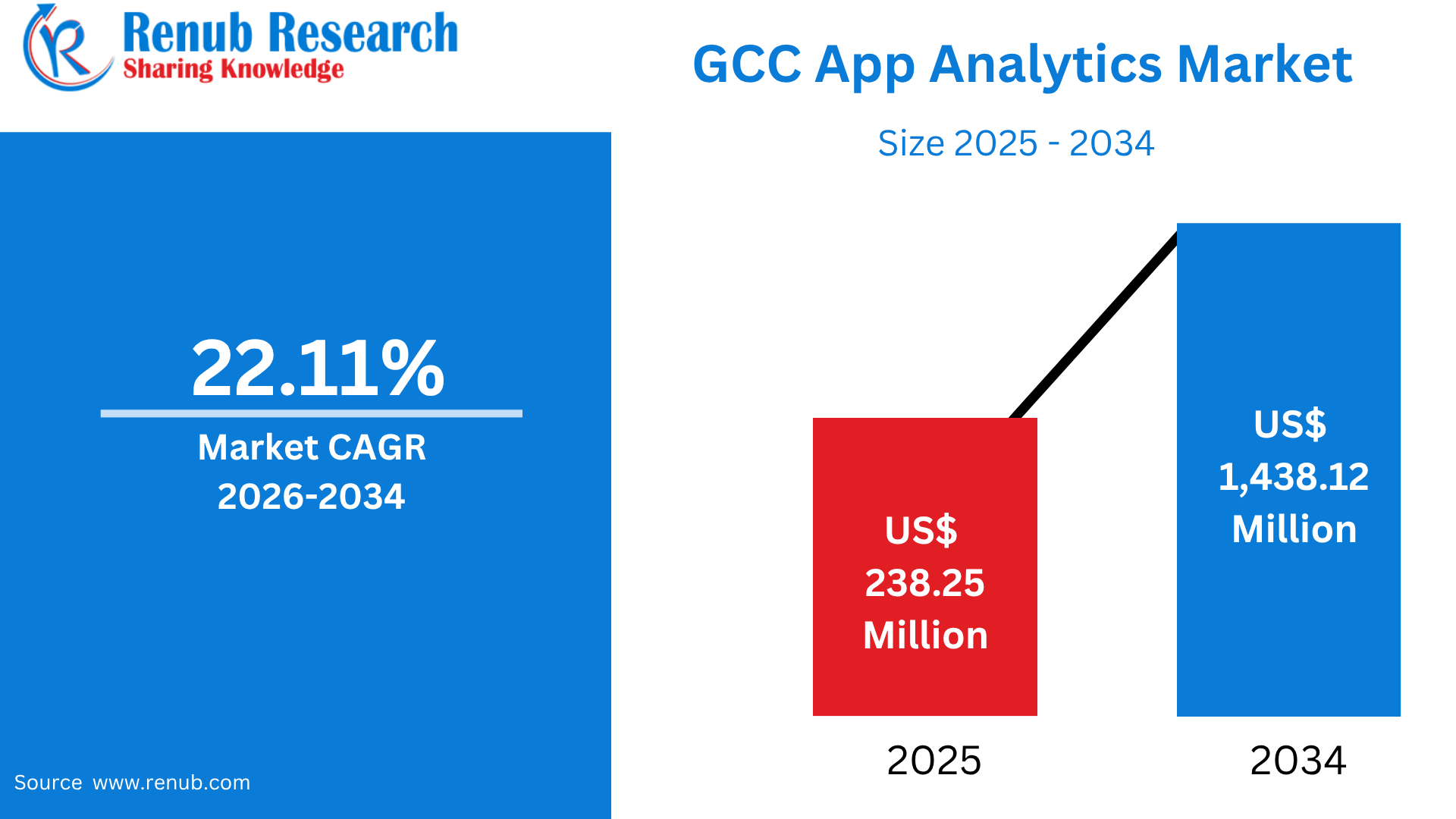
GCC App Analytics Market is projected to expand from US$ 238.25 million in 2025 to US$ 1,438.12 million by 2034, registering a CAGR of 22.11% during 2026–2034. The market is expected to experience strong growth as increasing smartphone penetration, accelerating digital transformation, and rising investments in mobile applications drive demand for advanced analytics solutions across industries. Businesses across the GCC are increasingly adopting app analytics to gain deeper insights into customer behavior, monitor user engagement, improve application performance, and optimize digital marketing strategies.
What is App Analytics and its Uses & Popularity in GCC
App analytics refers to the collection, measurement, and analysis of data generated through mobile and web applications to understand user behavior, application performance, engagement, conversions, and business outcomes. In the GCC, app analytics is becoming increasingly important as businesses accelerate their digital transformation and adopt mobile-first customer engagement strategies. Organizations use app analytics to track downloads, active users, session duration, retention, conversion rates, in-app purchases, crash rates, and marketing campaign performance. These insights help companies personalize digital experiences, identify customer preferences, improve application functionality, reduce user churn, and optimize marketing expenditure. App analytics is particularly relevant across banking, retail, e-commerce, healthcare, travel, hospitality, telecommunications, and entertainment. The GCC recorded 28.8 GB of mobile data usage per active smartphone per month in 2024, with this figure projected to reach approximately 45.4 GB by 2030.
Mobile App Launches in GCC
- HUMAIN Chat – Saudi Arabia | August 2025: HUMAIN launched its Arabic-first conversational AI application, HUMAIN Chat, powered by the ALLaM 34B large language model. The app was initially made available on web, iOS, and Android in Saudi Arabia, with regional expansion planned.
- Google Pay & Google Wallet – Saudi Arabia | September 2025: Google officially launched Google Pay and Google Wallet in Saudi Arabia, enabling Android users to make contactless payments and manage payment cards through their mobile devices.
- Tawakkalna App Interface – Saudi Arabia | September 2025: Saudi Arabia’s unified national Tawakkalna application introduced a redesigned interface and improved navigation to simplify access to digital government services for more than 34 million users.
- Make it with ADNOC – UAE | April 2025: ADNOC launched the Make it with ADNOC mobile application to provide manufacturers, SMEs, and entrepreneurs with real-time visibility into procurement opportunities and products ADNOC intends to purchase.
- Salik Mobile App – UAE | July 2025: Salik launched a new version of its mobile application on 25 July 2025, expanding digital services for Dubai motorists. The app recorded more than 89,667 new downloads and over 800,000 active users following its launch.
- Erth Dubai Mobile App – UAE | August 2025: Dubai launched the Erth Dubai mobile application to encourage residents and citizens to contribute personal stories, photographs, documents, and recordings documenting Dubai’s history and heritage.
- SMARTER. RICHER. BRAVER. – UAE | October 2025: UAE-based KFI Global launched SMARTER. RICHER. BRAVER., a mobile application designed to help Gen Z users understand financial behavior and develop stronger financial identities through behavioral insights.
- Qatar Central Bank Mobile App – Qatar | November 2025: Qatar Central Bank launched its mobile application to provide users with convenient access to financial-sector data, reports, announcements, and institutional updates through a mobile platform.
- Hala Digital – Qatar | June 2025: Ooredoo Qatar launched Hala Digital, a lightweight Progressive Web App that enables prepaid customers to monitor usage and balances, access personalized offers, and activate vouchers and data bundles without requiring a traditional app download.
- MSDF Unified Digital Platform – Qatar | April 2026: Qatar’s Ministry of Social Development and Family launched a unified digital platform available through mobile applications on Apple and Google app stores, allowing users to apply for public services and track requests in real time.
Growth Drivers of the GCC App Analytics Market
High Smartphone Penetration and Growing Mobile App Usage
The GCC’s exceptionally high mobile connectivity is creating a strong foundation for app analytics adoption. Mobile penetration exceeded 100% in every GCC country in 2024, ranging from 130% in Saudi Arabia to 231% in the UAE, reflecting the widespread use of multiple mobile connections. The region’s active smartphone users generate substantial volumes of behavioral and performance data through applications, increasing the need for analytics platforms that can convert this information into actionable insights. Mobile data consumption is also expanding rapidly, reaching 28.8 GB per active smartphone per month in 2024 and projected to reach 45.4 GB by 2030. As consumers increasingly rely on applications for banking, shopping, entertainment, transportation, communication, and government services, businesses need to monitor engagement, retention, conversions, and application performance. Saudi Arabia alone recorded 33.9 million internet users in early 2025, representing 99.0% internet penetration. This extensive mobile ecosystem is therefore supporting sustained demand for app analytics solutions across the GCC.
Accelerating Digital Transformation Across GCC Industries
Rapid digital transformation across government and private-sector industries is another major growth driver for app analytics in the GCC. Countries such as Saudi Arabia and the UAE are investing heavily in digital infrastructure, cloud technologies, fintech, smart services, e-commerce, and digital government platforms. The IMF reported that GCC countries have made significant progress in digital infrastructure, internet connectivity, 5G coverage, and fintech development, positioning the region among the strongest globally in digital connectivity. Saudi Arabia’s internet penetration reached 99% in 2023, while its digital economy contribution to real GDP reached 14% in 2022, according to IMF data. As organizations digitize customer journeys, they increasingly require real-time visibility into application usage and performance. App analytics enables companies to identify bottlenecks, understand customer journeys, measure digital-service adoption, and optimize application features. The expansion of digital banking, online retail, healthcare applications, logistics platforms, and smart-city services is consequently broadening the addressable market for app analytics providers.
Rising Demand for Data-Driven Personalization and Mobile Commerce
The growing importance of personalized digital experiences and mobile commerce is encouraging GCC businesses to adopt advanced app analytics capabilities. GCC consumers are highly engaged with mobile channels, making application data increasingly important for understanding purchasing behavior and improving customer journeys. In Saudi Arabia, mobile or card payments accounted for 94% of sales in 2024, according to the IMF. These trends generate extensive datasets covering product searches, transactions, engagement, conversions, and customer interactions. Businesses can use app analytics to segment users, identify high-value customers, evaluate promotional campaigns, optimize conversion funnels, and deliver personalized recommendations. The GCC app economy is also expanding: app downloads across the GCC increased 2.6% year over year, while in-app purchase revenue increased 20% to approximately US$700 million, according to Sensor Tower’s 2025 Middle East App Growth Report.
Challenges of the GCC App Analytics Market
Data Privacy, Security, and Regulatory Complexity
Data privacy and cybersecurity requirements represent important challenges for app analytics adoption across the GCC. App analytics platforms process sensitive information such as user interactions, device identifiers, location-related information, purchasing behavior, and engagement patterns. Companies therefore need appropriate consent mechanisms, data governance, access controls, and security measures when collecting and analyzing application data. Regulatory requirements can also differ between GCC countries, creating additional compliance considerations for organizations operating across multiple markets. Privacy concerns are becoming increasingly relevant as digital services and AI-enabled applications expand. Deloitte’s 2025 Digital Consumer Trends study found that 58% of surveyed consumers in Saudi Arabia and the UAE had used generative AI tools, while one in four respondents identified privacy as a top concern among infrequent AI users. For app analytics providers, maintaining transparent data practices and ensuring compliance with applicable privacy regulations can increase implementation complexity and costs. Businesses must balance the need for detailed behavioral insights with responsible data collection, secure storage, and consumer trust.
Integration Complexity and Shortage of Advanced Digital Skills
Integrating app analytics platforms with existing applications, customer relationship management systems, advertising platforms, cloud infrastructure, data warehouses, and business intelligence tools can be technically complex. Organizations may operate multiple applications across different platforms, creating challenges related to data consistency, tracking implementation, API integration, and real-time processing. The issue can be particularly significant for enterprises seeking to consolidate information from mobile, web, social, and offline customer touchpoints. The IMF has highlighted that, although GCC countries have strong digital infrastructure and connectivity, there remains room to improve digital skills, industry capabilities, and innovation ecosystems. Analytics implementation therefore requires professionals capable of managing data engineering, product analytics, cybersecurity, cloud systems, and advanced visualization. In addition, poor-quality tracking or inconsistent event definitions can produce unreliable insights and reduce confidence in analytics results. Smaller organizations may face additional financial and technical constraints when deploying sophisticated analytics platforms, training employees, and maintaining integrations. These factors can slow adoption and increase the overall cost of implementing app analytics solutions.
App Analytics-Specific Launches in GCC Countries
- 5 September 2024 – AppsFlyer | Privacy Sandbox Analytics Solution | UAE/GCC: Introduced privacy-compliant app measurement and analytics capabilities designed to help marketers and app developers measure application performance while strengthening user privacy and data protection.
- 10 September 2024 – Amplitude | Amplitude Made Easy Platform | GCC Region: Launched a simplified product and app analytics experience, providing businesses with enhanced tools to understand user behavior, measure engagement, and generate actionable product insights.
- February 2025 – AppsFlyer | UAE Crypto App Analytics Report Platform Expansion | UAE: Expanded its app intelligence and analytics coverage for the UAE cryptocurrency application ecosystem, supporting more comprehensive monitoring of mobile application performance, engagement, and user activity.
- 21 May 2025 – Genesis Platform | AI-Driven Analytics Platform Rollout | UAE/GCC: Rolled out an AI-powered analytics and risk-monitoring platform for enterprises across the GCC, enabling organizations to analyze operational data and strengthen risk identification and decision-making capabilities.
- 7 July 2025 – Black Duck Software | Polaris SaaS Analytics Platform | Saudi Arabia: Introduced a Saudi Arabia-hosted SaaS platform featuring application analysis and performance-monitoring capabilities, supporting organizations in identifying software risks and improving application security and operational visibility.
- 10 September 2025 – Valura.ai | AI Wealth Analytics Platform | UAE: Launched an AI-powered wealth analytics platform incorporating advanced data analysis and user-behavior insights to support wealth-management activities, customer understanding, and data-driven financial decision-making.
- 10 September 2025 – pX | AI Real Estate Analytics Platform | UAE/GCC: Officially launched an AI-powered real-estate analytics and decision-intelligence platform designed to help users analyze property-related data, identify market insights, and support more informed real-estate decisions.
Rising Focus on Mobile Monetization and Revenue Optimization
GCC revenue app analytics market is expanding as businesses increasingly seek to maximize monetization from their mobile applications. Revenue analytics enables companies to monitor key indicators such as in-app purchases, subscription revenue, advertising income, average revenue per user, conversion rates, and customer lifetime value. The opportunity is supported by the GCC’s highly connected mobile ecosystem. Mobile penetration exceeded 100% across every GCC country in 2024, while mobile data consumption reached 28.8 GB per active smartphone per month. This figure is projected to rise to approximately 45.4 GB by 2030. As mobile engagement increases, organizations across e-commerce, gaming, retail, media, fintech, and digital services are generating larger volumes of monetization data. GCC app downloads also increased 2.6% year over year, while in-app purchase revenue grew 20% to approximately US$700 million, according to Sensor Tower’s 2025 Middle East App Growth Report. These trends are encouraging businesses to analyze spending behavior, optimize pricing, improve subscription retention, segment customers, and identify additional revenue opportunities. Consequently, revenue analytics is becoming increasingly important for data-driven mobile monetization strategies across the GCC.
Growing Demand for Reliable and High-Performance Applications
GCC app crash analytics market is gaining momentum as organizations prioritize application stability, performance, and seamless digital experiences. Mobile applications have become essential customer-interaction channels across banking, retail, healthcare, telecommunications, transportation, and entertainment. With mobile penetration exceeding 100% throughout the GCC in 2024, businesses face increasing pressure to maintain reliable applications across a broad range of devices and operating environments. Mobile data consumption of 28.8 GB per active smartphone per month in 2024 further demonstrates the intensity of digital engagement in the region. App crash analytics platforms help development and IT teams detect crashes, identify software bugs, monitor performance bottlenecks, and determine the technical causes of application failures. Real-time diagnostics can accelerate issue resolution and reduce service interruptions that may negatively affect customer satisfaction and retention. As digital services become increasingly critical to everyday activities, organizations are investing in application performance monitoring and automated diagnostics. The growing complexity of mobile applications, combined with rising consumer expectations for fast and reliable services, is therefore creating sustained demand for crash analytics solutions throughout the GCC.
Digital Banking Expansion Strengthening Analytics Adoption
Banking, Financial Services, and Insurance (BFSI) sector represents a significant application area for app analytics across the GCC. Banks, fintech companies, insurers, and payment providers increasingly use analytics to understand customer journeys, improve application performance, personalize financial services, and identify potentially suspicious activities. Digital financial adoption is particularly strong in the region. According to IMF analysis, mobile or card payments accounted for 94% of sales in Saudi Arabia in 2024, demonstrating the increasing importance of digital transaction channels. The IMF also reported that Saudi Arabia’s digital economy contributed 14% of real GDP in 2022. App analytics enables financial institutions to measure login frequency, transaction behavior, feature adoption, conversion rates, customer retention, and service utilization. These insights support improvements in digital banking interfaces and help institutions identify service gaps and opportunities for personalization. Analytics can also contribute to risk monitoring and fraud-management processes by identifying unusual behavioral patterns. As GCC financial institutions continue investing in mobile banking, digital payments, fintech platforms, and AI-enabled services, demand for app analytics is expected to increase alongside the region’s broader digital financial ecosystem.
Digital Health Adoption Increasing Demand for Patient and Application Insights
GCC healthcare app analytics market is developing as hospitals, clinics, telemedicine providers, and health technology companies increasingly adopt digital platforms. Analytics solutions enable healthcare organizations to monitor patient interactions with mobile applications, appointment systems, telehealth platforms, wellness applications, and remote-monitoring services. The broader GCC digital transformation environment is supporting this trend, with governments investing in connected healthcare infrastructure and technology-enabled services. Saudi Arabia’s internet penetration reached 99% in early 2025, providing a strong digital foundation for mobile-based healthcare delivery. App analytics allows healthcare providers to measure application engagement, appointment completion, patient communication, service utilization, and user retention. These insights can help organizations identify weaknesses in digital patient journeys and improve accessibility and convenience. Analytics can also support operational planning by identifying periods of high application usage and demand for specific services. As healthcare organizations increasingly integrate artificial intelligence, cloud computing, telemedicine, and remote monitoring, the volume of application-generated data is expected to increase. Consequently, app analytics is becoming an important tool for improving digital healthcare experiences, supporting operational efficiency, and enabling more data-driven healthcare service management across the GCC.
Tourism Expansion and Mobile Booking Driving Analytics Adoption
GCC hospitality app analytics market is benefiting from the region’s expanding tourism industry and increasing reliance on mobile applications for travel and hotel services. Hotels, resorts, airlines, travel agencies, and tourism operators use analytics to understand booking behavior, guest preferences, application engagement, loyalty-program activity, and service utilization. The GCC’s highly connected consumer base provides a strong environment for mobile-first hospitality services, while mobile data consumption reached 28.8 GB per active smartphone per month in 2024. Applications are increasingly used for hotel reservations, check-in services, loyalty rewards, room services, travel planning, and customer communication. App analytics helps hospitality businesses identify high-value customer segments, evaluate promotional campaigns, optimize booking funnels, and personalize recommendations. Major tourism destinations including Dubai, Abu Dhabi, Riyadh, Doha, and other GCC cities are also investing in digital visitor experiences. The expansion of tourism and hospitality infrastructure is consequently generating additional opportunities for analytics providers. As competition among hotels and tourism businesses intensifies, organizations are increasingly using customer data to improve service quality, increase engagement, and support revenue optimization. These developments are expected to strengthen demand for hospitality-focused app analytics solutions.
Saudi Arabia Vision 2030 and Digital Economy Expansion Supporting Market Growth
Saudi Arabia is becoming a major market for app analytics in the GCC, supported by Vision 2030, expanding digital services, and widespread mobile adoption. The country recorded approximately 33.9 million internet users in early 2025, equivalent to 99.0% internet penetration. This extensive digital connectivity is supporting rapid growth in applications across e-commerce, banking, healthcare, entertainment, education, transportation, and government services. The country’s digital economy also represented approximately 14% of real GDP in 2022, according to IMF data. Businesses increasingly deploy app analytics to monitor customer engagement, optimize application performance, understand user journeys, and improve digital conversion rates. Government digitalization programs and investments in smart cities, artificial intelligence, cloud computing, and fintech are further increasing the volume and complexity of application-generated data. Saudi organizations are consequently placing greater emphasis on real-time insights and data-driven decision-making. The expansion of digital financial services is another important contributor, with mobile or card payments accounting for 94% of sales in Saudi Arabia in 2024. These developments are expected to support continued investment in app analytics platforms and position Saudi Arabia as a significant growth market within the GCC.
UAE Advanced Digital Infrastructure and Mobile-First Consumer Behavior
UAE represents a prominent app analytics market in the GCC, supported by advanced digital infrastructure, high mobile connectivity, and strong adoption of digital services. Mobile penetration in the UAE reached approximately 231% in 2024, the highest level among GCC countries, according to regional telecom industry data. This reflects the extensive use of mobile connections and provides a substantial ecosystem for application-based services. Businesses across financial services, retail, tourism, healthcare, telecommunications, and government increasingly rely on applications to interact with customers and deliver services. App analytics allows organizations to measure user engagement, analyze customer journeys, monitor application performance, and develop personalized experiences. The UAE’s focus on smart-city development, artificial intelligence, cloud computing, and digital government is further expanding demand for data analytics technologies. In addition, the country’s digitally engaged population is encouraging companies to optimize mobile experiences and improve customer retention. Growing adoption of AI and data-driven technologies is also enhancing the capabilities of analytics platforms through predictive modeling and automated insights. These factors are supporting continued development of the UAE app analytics market as organizations increasingly integrate analytics into digital product development and customer-experience strategies.
Qatar Smart-City Development and Digital Services Creating New Opportunities
Qatar’s app analytics market is expanding alongside the country’s digital transformation, smart-city development, and increasing adoption of mobile services. Organizations across banking, healthcare, retail, telecommunications, transportation, hospitality, and government are increasingly using mobile applications to interact with consumers and deliver services. These applications generate valuable data on user engagement, service adoption, transaction activity, and customer preferences, creating demand for analytics solutions capable of converting application data into actionable insights. Qatar’s digital ecosystem has also benefited from investments in advanced telecommunications and connected infrastructure. The country’s role as a major international tourism, business, and events destination has further encouraged businesses to adopt digital customer-engagement channels. App analytics can help organizations monitor application performance, improve digital journeys, personalize services, and evaluate marketing effectiveness. Financial institutions can additionally use analytics to understand digital banking behavior, while hospitality and retail companies can analyze booking and purchasing patterns. As organizations increasingly shift toward data-driven decision-making, demand for application intelligence is expected to strengthen. The continued development of smart infrastructure and digital government services is likely to create additional applications for analytics technologies across Qatar’s economy.
Kuwait Digitalization and Growing Mobile Engagement Supporting Market Expansion
Kuwait’s app analytics market is witnessing steady development as businesses and government organizations increase their adoption of digital platforms. Mobile applications are increasingly used across banking, retail, healthcare, education, telecommunications, and public services, creating growing volumes of user-generated data. App analytics enables organizations to evaluate application engagement, monitor performance, identify customer preferences, and improve digital service delivery. Kuwait’s digitally engaged population is contributing to rising expectations for convenient and responsive mobile experiences, encouraging businesses to invest in application optimization. Financial services are particularly relevant as banks and fintech providers increasingly expand mobile banking, payment, and digital-service capabilities. Analytics platforms can help these organizations understand transaction journeys, identify frequently used features, and develop more personalized services. Government digitalization and economic modernization initiatives are also contributing to the development of Kuwait’s technology ecosystem. Meanwhile, advancements in cloud computing, artificial intelligence, and data-management technologies are expanding the capabilities available to businesses. As organizations increasingly recognize the importance of understanding customer behavior and application performance, investment in app analytics is expected to increase. The combination of mobile adoption, digital transformation, and demand for improved customer experiences is supporting the long-term development of Kuwait’s app analytics market.
GCC App Analytics Market Segmentation
Application
- Revenue Analytics
- App Performance Analytics and Operations
- Crash Analytics
- Cross Platform Analysis
- User Analytics
- In-Behavioral Analytics
- Ad Monitoring and Marketing Analytics
- Campaign Analytics
Industry Vertical
- BFSI
- Retail
- Media and Entertainment
- Logistics, Travel and Transport (LTT)
- Telecom and IT
- Healthcare
- Hospitality
- Others
Countries
- Saudi Arabia
- UAE
- Kuwait
- Qatar
- Oman
- Bahrain
- Rest of GCC
Companies have been covered from 5 viewpoints
- Overviews
- Key Person
- Recent Developments
- SWOT Analysis
- Revenue Analysis
Key Players Analysis
- Adobe Inc.
- Amplitude Inc.
- IBM Corporation
- Amazon.com, Inc.
- AppsFlyer
- Google FZ-LLC
- MoEngage
Report Details:
| Report Features | Details |
| Base Year |
2025 |
| Historical Period |
2022 - 2025 |
| Forecast Period |
2026 - 2034 |
| Market |
US$ Million |
| Segment Covered |
Type, Application, Industry Vertical and Countries |
| Countries Covered |
|
| Companies Covered |
|
| Customization Scope |
20% Free Customization |
| Post-Sale Analyst Support |
1 Year (52 Weeks) |
| Delivery Format |
PDF and Excel through Email (We can also provide the editable version of the report in PPT/Word format on request) |
Customization Services available
- Analysis of Market Size and Its Segments
- More Company Profiles (Upto 10 without any additional cost):
- Additional Countries (Other than mentioned Countries):
- Region/Country Specific Reports:
- Market Entry Strategy:
- Region-Specific Market Dynamics:
- Regional Market Share Analysis:
- Trade Analysis:
- Production Insights:
- Others Customized Requests:
For more information contact our analysts.
Need More Assistance?
- Talk to our analysts to get more precious information on the current market trends.
- Include more countries and segments and customize the report based on the final requirement.
- Get a competitive advantage in your industry by knowing the report findings and making a positive impact on your revenues and operations.
- Our analysts are always ready to provide more help and pertinent information if you need any additional assistance.