Data Center Market Size, Share, Growth, Trends, Industry Analysis & Forecast 2026–2034
Buy NowGlobal Data Center Market Analysis: Valuation, Infrastructure Segments, and Long-Term Projections
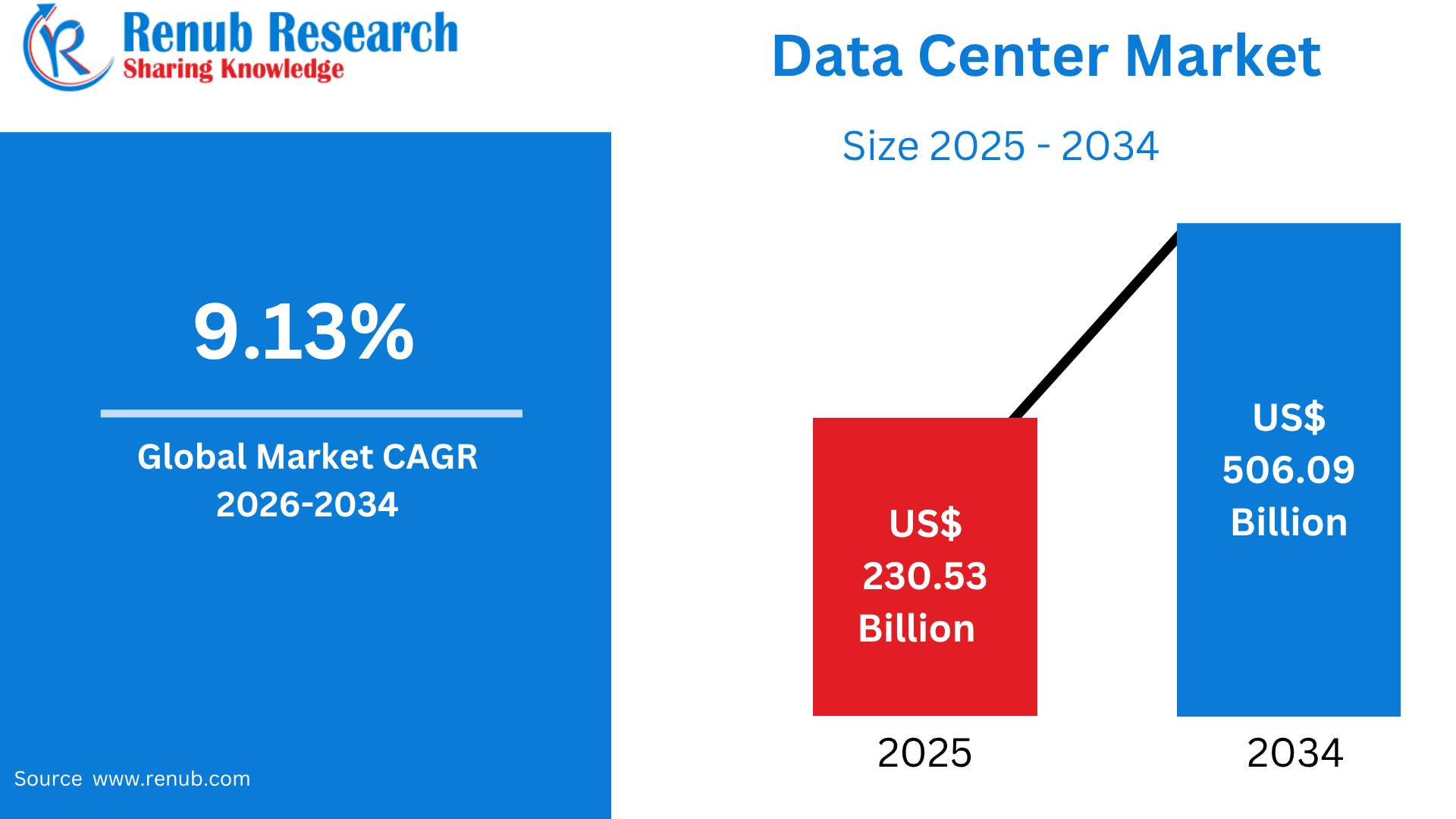
Global Data Center Market is projected to grow from US$ 230.53 Billion in 2025 to US$ 506.09 Billion by 2034, registering a compound annual growth rate (CAGR) of 9.13% during 2026–2034. Market growth is being driven by increasing cloud computing adoption, rapid expansion of artificial intelligence (AI) workloads, rising data generation, and growing demand for colocation and hyperscale facilities. Investments in edge computing, 5G infrastructure, and energy-efficient data center technologies are further accelerating market expansion, while enterprises continue modernizing digital infrastructure to support evolving business and connectivity requirements.
Data Center and its Uses & Popularity Worldwide
A data center is a specialized facility that houses computing infrastructure, including servers, storage systems, networking equipment, power supplies, cooling systems, and cybersecurity technologies, used to process, store, manage, and distribute digital data. It serves as the backbone of modern digital infrastructure by supporting cloud computing, artificial intelligence (AI), big data analytics, enterprise applications, e-commerce platforms, banking systems, telecommunications, streaming services, and government operations. Data centers ensure high availability, reliability, and security of information through redundant power systems, backup generators, advanced cooling technologies, disaster recovery solutions, and robust cybersecurity measures. They can be classified into enterprise, colocation, hyperscale, edge, and cloud data centers, depending on ownership and operational requirements.
Globally, data centers have become indispensable as digital transformation accelerates across every industry. Worldwide internet users now exceed 5.5 billion, while global data creation is projected to surpass 180 zettabytes annually by 2025, driving unprecedented demand for scalable computing infrastructure. The rapid adoption of cloud services, AI applications, Internet of Things (IoT) devices, 5G networks, and digital payment systems has significantly increased investments in hyperscale and edge data centers. Major technology companies continue expanding their global data center footprints to support growing workloads and improve service delivery. Additionally, increasing emphasis on sustainability has encouraged operators to adopt renewable energy, energy-efficient cooling systems, and green building practices, making data centers one of the fastest-growing segments of the global digital economy.
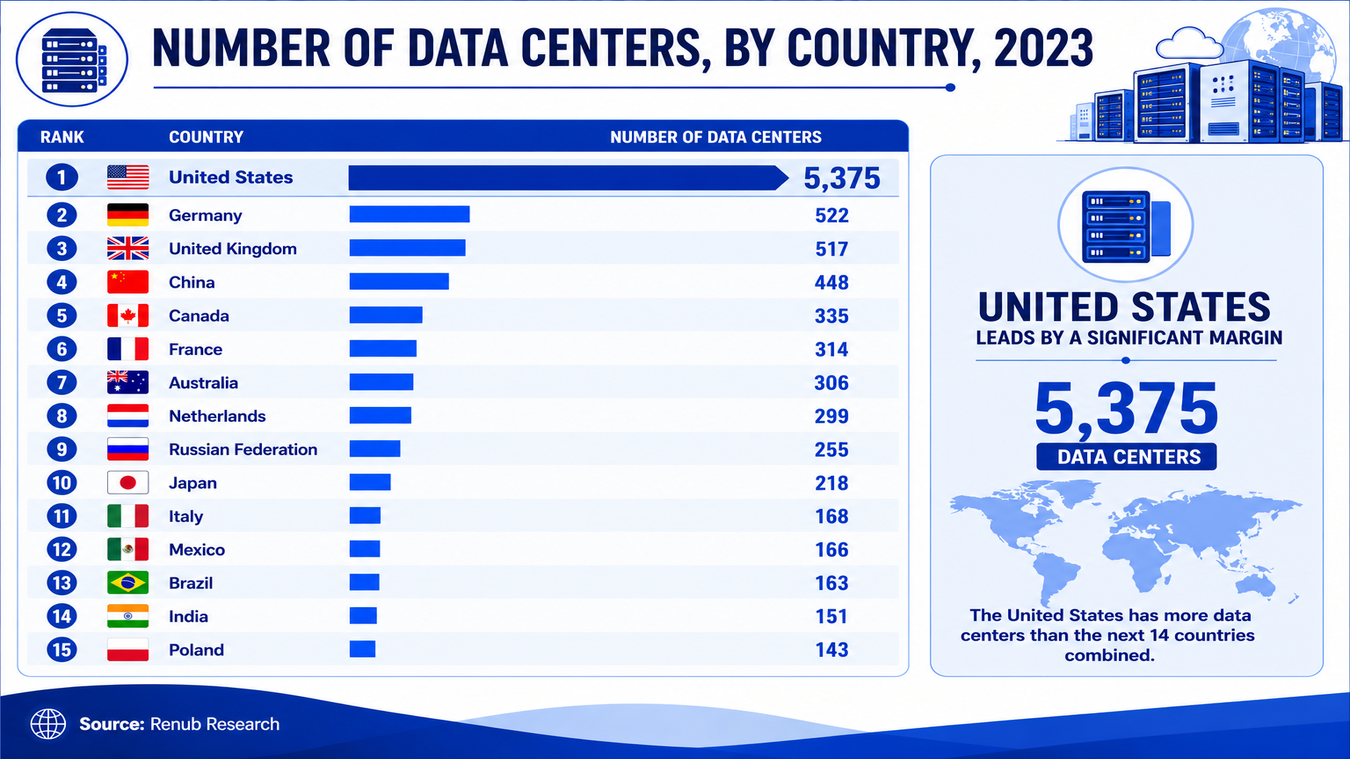
Number of Data Centers, by Country, 2023
- United States: 5,375 data centers (largest globally by a significant margin)
- Germany: 522 data centers
- United Kingdom: 517 data centers
- China: 448 data centers
- Canada: 335 data centers
- France: 314 data centers
- Australia: 306 data centers
- Netherlands: 299 data centers
- Russian Federation: 255 data centers
- Japan: 218 data centers
- Italy: 168 data centers
- Mexico: 166 data centers
- Brazil: 163 data centers
- India: 151 data centers
- Poland: 143 data centers
Growth Driver
Rapid Growth of Cloud Computing and Hyperscale Infrastructure
The rapid adoption of cloud computing remains one of the strongest growth drivers for the global data center market. Enterprises across industries are migrating workloads from traditional on-premise infrastructure to public, private, and hybrid cloud environments to improve scalability, operational efficiency, and business continuity. Global spending on public cloud services now exceeds US$700 billion annually, while hyperscale cloud providers continue investing billions of dollars in new facilities worldwide. More than 90% of large enterprises utilize cloud services in some capacity, significantly increasing demand for advanced server capacity, storage systems, networking equipment, and colocation services. Major cloud providers continue expanding hyperscale campuses to support artificial intelligence, machine learning, enterprise software, and digital collaboration platforms. Cloud-native applications, software-as-a-service (SaaS), and infrastructure-as-a-service (IaaS) continue generating enormous computing workloads. Continuous investment in high-density computing, energy-efficient infrastructure, and global cloud availability zones is expected to sustain long-term expansion of the worldwide data center market.
Explosive Growth of Artificial Intelligence, Big Data, and Digital Transformation
Artificial intelligence (AI), big data analytics, and enterprise digital transformation are dramatically increasing demand for advanced data center infrastructure. Global data creation is expected to exceed 180 zettabytes annually, driven by AI applications, connected devices, enterprise software, digital commerce, financial services, healthcare systems, and industrial automation. AI training models require thousands of high-performance GPUs and advanced storage architectures capable of processing massive datasets with minimal latency. Businesses across manufacturing, banking, healthcare, retail, and telecommunications are investing heavily in AI-powered automation and analytics, increasing computing requirements substantially. Organizations are modernizing legacy IT infrastructure while deploying advanced server clusters, liquid cooling technologies, and high-capacity networking systems to support increasingly complex workloads. Edge computing deployments are also expanding rapidly to process data closer to end users and connected devices. Continued growth in AI adoption, enterprise digitalization, and real-time analytics will remain a major catalyst for investment in hyperscale, enterprise, and edge data center infrastructure.
Expansion of 5G Networks, IoT, and Edge Computing
The worldwide rollout of 5G networks and the rapid expansion of Internet of Things (IoT) devices are creating substantial demand for new data center capacity. Global IoT deployments are projected to exceed 30 billion connected devices over the coming years, generating enormous volumes of real-time data that require rapid processing and storage. Edge data centers are becoming increasingly important because they reduce latency by locating computing resources closer to users, industrial equipment, autonomous vehicles, healthcare systems, and smart cities. Telecommunications companies continue investing heavily in distributed computing infrastructure to support ultra-low latency applications enabled by 5G technology. Manufacturing automation, autonomous transportation, video streaming, cloud gaming, and industrial robotics all require localized processing capabilities that traditional centralized facilities cannot efficiently provide. Governments and private enterprises are also investing in smart city infrastructure and digital public services that rely on resilient edge computing. The combination of 5G expansion, IoT adoption, and edge computing deployment will continue driving sustained growth across the global data center market.
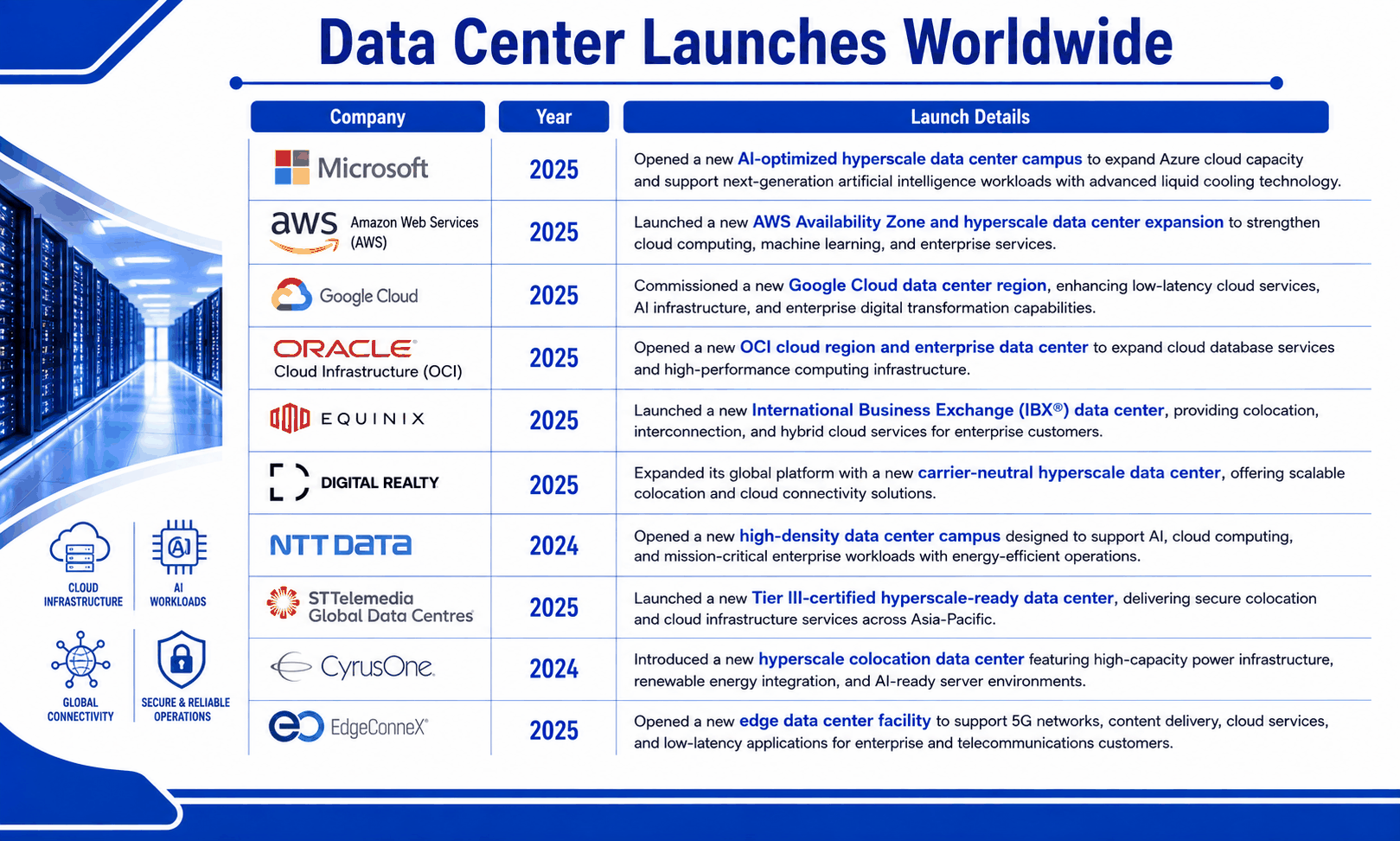
Data Center Launches Worldwide
- Microsoft (2025) – Opened a new AI-optimized hyperscale data center campus to expand Azure cloud capacity and support next-generation artificial intelligence workloads with advanced liquid cooling technology.
- Amazon Web Services (AWS) (2025) – Launched a new AWS Availability Zone and hyperscale data center expansion to strengthen cloud computing, machine learning, and enterprise services.
- Google Cloud (2025) – Commissioned a new Google Cloud data center region, enhancing low-latency cloud services, AI infrastructure, and enterprise digital transformation capabilities.
- Oracle Cloud Infrastructure (OCI) (2025) – Opened a new OCI cloud region and enterprise data center to expand cloud database services and high-performance computing infrastructure.
- Equinix (2025) – Launched a new International Business Exchange (IBX®) data center, providing colocation, interconnection, and hybrid cloud services for enterprise customers.
- Digital Realty (2025) – Expanded its global platform with a new carrier-neutral hyperscale data center, offering scalable colocation and cloud connectivity solutions.
- NTT DATA (2024) – Opened a new high-density data center campus designed to support AI, cloud computing, and mission-critical enterprise workloads with energy-efficient operations.
- ST Telemedia Global Data Centres (STT GDC) (2025) – Launched a new Tier III-certified hyperscale-ready data center, delivering secure colocation and cloud infrastructure services across Asia-Pacific.
- CyrusOne (2024) – Introduced a new hyperscale colocation data center featuring high-capacity power infrastructure, renewable energy integration, and AI-ready server environments.
- EdgeConneX (2025) – Opened a new edge data center facility to support 5G networks, content delivery, cloud services, and low-latency applications for enterprise and telecommunications customers.
Challenges
High Energy Consumption and Sustainability Requirements
Energy consumption remains one of the most significant challenges facing the global data center industry. Modern hyperscale facilities require enormous amounts of electricity to power servers, networking equipment, storage systems, and cooling infrastructure. Some large hyperscale campuses consume hundreds of megawatts of electricity, while data centers collectively account for an estimated 1–2% of global electricity consumption. As artificial intelligence workloads continue expanding, power demand is expected to increase even further. Rising electricity costs, carbon emission reduction targets, and environmental regulations are placing increasing pressure on operators to improve energy efficiency. Many organizations are investing in renewable energy, liquid cooling technologies, advanced power management systems, and highly efficient processors to reduce operational costs and environmental impact. However, implementing these technologies requires significant capital investment. Balancing increasing computational demand with sustainability objectives remains a major challenge for data center developers and operators worldwide.
Rising Construction Costs and Infrastructure Constraints
Building and expanding modern data centers requires substantial capital investment and access to critical infrastructure, creating significant barriers for market participants. Construction costs continue rising due to increasing prices for land, steel, concrete, electrical equipment, cooling systems, backup generators, networking hardware, and high-performance computing components. Skilled labor shortages and longer equipment lead times have also delayed many large-scale projects. In addition, hyperscale facilities require reliable electricity grids, abundant water resources for cooling in some regions, and extensive fiber-optic connectivity. Many major metropolitan areas are experiencing land availability limitations and grid capacity constraints, making new developments increasingly complex. Operators must also invest heavily in cybersecurity systems, disaster recovery infrastructure, and regulatory compliance while maintaining high service availability. As demand for AI-ready infrastructure accelerates, ensuring adequate power, connectivity, and construction resources will remain one of the industry’s most significant long-term operational and financial challenges.
Automation and Infrastructure Management Driving Growth in Data Center Software
The data center software market is expanding rapidly as organizations increasingly adopt automation, virtualization, artificial intelligence (AI), and software-defined infrastructure to improve operational efficiency. Data center software includes infrastructure management (DCIM), virtualization platforms, workload orchestration, security management, backup and disaster recovery, monitoring, and automation solutions. With global enterprise data generation exceeding 180 zettabytes annually, operators require intelligent software capable of managing increasingly complex computing environments. AI-powered predictive maintenance, real-time infrastructure monitoring, and automated resource allocation are reducing downtime while improving power utilization and operational efficiency. Software-defined data centers (SDDCs) enable enterprises to manage computing, networking, and storage resources through centralized platforms, reducing manual intervention and operating costs. Increasing adoption of hybrid cloud, containerized applications, and edge computing is further accelerating software demand. Growing cybersecurity requirements, compliance management, and digital transformation initiatives continue encouraging investment in advanced infrastructure management solutions. Continuous innovation in cloud-native software platforms and AI-driven operations is expected to sustain long-term growth in the global data center software market.
Cloud Expansion Fueling Large-Scale Infrastructure in Data Center
The hyperscale data center market represents one of the fastest-growing segments within the global digital infrastructure industry. Hyperscale facilities are massive computing environments designed to support cloud services, artificial intelligence, streaming platforms, social media, enterprise software, and large-scale digital applications. Today, more than 1,000 hyperscale data centers are operating worldwide, with new facilities continuously under construction. These campuses often contain hundreds of thousands of servers and require power capacities exceeding 100 megawatts per location. Major cloud service providers continue investing billions of dollars annually to expand hyperscale infrastructure across North America, Europe, Asia-Pacific, and the Middle East. AI model training, machine learning, and high-performance computing workloads require increasingly dense server deployments and advanced cooling technologies. Operators are also adopting renewable energy, liquid cooling systems, and modular construction techniques to improve sustainability and scalability. Continued expansion of cloud computing, AI services, and enterprise digital transformation will drive sustained growth in the global hyperscale data center market.
Digital Transformation Supporting Enterprise Investment in Large Enterprise Data Center
Large enterprise data centers remain essential for organizations requiring dedicated infrastructure to support mission-critical applications, regulatory compliance, cybersecurity, and business continuity. Industries including banking, healthcare, manufacturing, government, retail, telecommunications, and financial services continue operating enterprise facilities to manage sensitive information and specialized workloads. More than 90% of large enterprises utilize hybrid IT environments that combine private infrastructure with public cloud resources. Enterprise data centers provide greater control over security, compliance, latency, and application performance while supporting large-scale databases, ERP systems, customer relationship management platforms, and internal business operations. Growing adoption of artificial intelligence, advanced analytics, and automation is encouraging enterprises to modernize existing infrastructure through virtualization, software-defined networking, and energy-efficient hardware. Investments in disaster recovery, cybersecurity, and digital resilience have become increasingly important as cyber threats continue evolving. Modernization initiatives, coupled with increasing enterprise data volumes and hybrid cloud deployment strategies, are expected to support continued growth in the large enterprise data center market.
Public and Hybrid Cloud Adoption Accelerating Demand in Service Data Center
The cloud service data center market continues to expand rapidly as enterprises migrate applications and workloads to cloud-based infrastructure. Cloud data centers support public cloud, private cloud, hybrid cloud, and multi-cloud environments, providing scalable computing, storage, networking, and platform services for organizations worldwide. Global spending on cloud infrastructure now exceeds hundreds of billions of dollars annually, while enterprise cloud adoption continues increasing across virtually every industry. Businesses benefit from flexible resource allocation, lower capital expenditure, improved disaster recovery capabilities, and faster application deployment through cloud-based infrastructure. Artificial intelligence, software-as-a-service (SaaS), infrastructure-as-a-service (IaaS), and platform-as-a-service (PaaS) continue generating significant demand for additional cloud capacity. Cloud providers are expanding global availability zones while investing in AI-ready infrastructure, renewable energy, and advanced cybersecurity technologies. Increasing digital transformation initiatives, remote work environments, and cloud-native application development are expected to sustain strong long-term growth in the worldwide cloud service data center market.
5G Deployment and Edge Computing Driving Expansion in Telecom Data Center
The telecom data center market is experiencing significant growth as telecommunications companies expand infrastructure to support 5G networks, edge computing, and rapidly increasing mobile data traffic. Global mobile data consumption continues rising each year as billions of smartphone users access cloud services, video streaming, gaming, and connected applications. Telecom operators are investing heavily in distributed edge data centers to reduce latency and improve service quality for real-time applications. These facilities support network functions virtualization (NFV), software-defined networking (SDN), content delivery networks, Internet of Things (IoT) platforms, and next-generation communication services. The worldwide deployment of 5G technology enables ultra-low-latency applications such as autonomous vehicles, industrial automation, telemedicine, and smart city infrastructure, all of which require localized computing resources. Telecom companies are also modernizing legacy infrastructure through cloud-native network architectures and AI-powered network management systems. Continuous investment in fiber-optic connectivity, edge computing, and intelligent network infrastructure is expected to drive sustained long-term growth in the global telecom data center market.
United States Leadership in Hyperscale Infrastructure
United States data center market is the largest globally, supported by advanced digital infrastructure, strong cloud adoption, and the presence of major hyperscale cloud providers. The country hosts over 5,000 operational data centers, representing the largest concentration worldwide. Northern Virginia alone accounts for one of the world’s biggest data center clusters, handling a significant share of global internet traffic. The United States continues to lead investments in artificial intelligence (AI), cloud computing, high-performance computing, and enterprise digital transformation, creating sustained demand for new facilities. Major cloud companies continue expanding hyperscale campuses with capacities exceeding 100 MW per site to support AI training, cloud services, and enterprise applications. Increasing enterprise migration toward hybrid cloud infrastructure and rising demand for colocation services further strengthen market expansion. Investments in renewable energy-powered facilities, liquid cooling systems, and energy-efficient server technologies continue improving operational sustainability. Strong technology innovation, advanced fiber connectivity, and increasing AI workloads are expected to support continued long-term growth of the United States data center market.
Digital Economy Supporting Infrastructure Expansion in United Kingdom Data Center
United Kingdom data center market is expanding steadily due to strong cloud adoption, financial services digitization, and growing enterprise demand for secure computing infrastructure. London remains one of Europe’s largest colocation hubs, serving multinational corporations, cloud providers, banking institutions, and government organizations. The UK hosts more than 500 operational data centers, with significant concentrations across London, Slough, Manchester, and Birmingham. Financial services, healthcare, telecommunications, retail, and media industries continue driving demand for high-performance data processing and secure storage facilities. Growing investments in artificial intelligence, cybersecurity, cloud computing, and edge infrastructure are encouraging operators to modernize existing facilities. Sustainability has become a major priority, with operators increasingly utilizing renewable electricity, advanced cooling technologies, and energy-efficient building designs to reduce environmental impact. Rising demand for hybrid cloud services, enterprise digital transformation, and low-latency connectivity is expected to support continued market growth. Expansion of cloud availability zones and digital infrastructure investment will further strengthen the United Kingdom data center market.
India Digital Transformation and Cloud Adoption Driving Rapid Data Center Market Growth
India has emerged as one of the fastest-growing data center markets globally, supported by rapid digitalization, expanding internet usage, cloud computing adoption, and government initiatives promoting digital infrastructure. India has over 900 million internet users, generating enormous volumes of digital data that require advanced computing and storage capacity. Increasing smartphone penetration, digital payments, e-commerce, online education, healthcare digitization, and artificial intelligence adoption continue driving demand for new data center investments. Major metropolitan cities including Mumbai, Chennai, Hyderabad, Bengaluru, Pune, and Delhi NCR have become important data center hubs due to strong connectivity and business activity. Hyperscale cloud providers, colocation companies, and enterprise operators are investing heavily in large-scale facilities to support growing cloud workloads. Government policies encouraging domestic data localization and digital infrastructure development further accelerate investment. Growing renewable energy adoption, advanced cooling technologies, and expansion of fiber-optic connectivity are expected to sustain long-term growth of India’s rapidly evolving data center market.
Vision 2030 Accelerating Digital Infrastructure Investment in Saudi Arabia Data Center
Saudi Arabia’s data center market is witnessing strong growth as the Kingdom accelerates digital transformation under Vision 2030 and expands cloud computing, artificial intelligence, and smart city initiatives. Increasing government investment in digital services, e-government platforms, financial technology, healthcare digitization, and industrial automation continues driving demand for modern data center infrastructure. Riyadh, Jeddah, and NEOM are emerging as major locations for hyperscale and colocation developments supporting regional cloud services. International cloud providers and regional technology companies continue investing in new facilities to meet increasing enterprise demand while supporting data sovereignty requirements. Expansion of 5G networks, Internet of Things (IoT) deployments, and AI-enabled applications is further increasing demand for localized computing infrastructure. Operators are investing in energy-efficient facilities, advanced cooling technologies, and renewable energy integration to improve long-term sustainability. Continued investment in digital infrastructure, cloud adoption, cybersecurity, and smart city development is expected to position Saudi Arabia as one of the leading data center markets in the Middle East over the coming decade.
Market Segments
Component
- Hardware
- Software
Type
- Colocation
- Hyperscale
- Edge
- Others
Enterprise
- Large Enterprises
- Small and Medium Enterprises
End User
- Cloud Service Provider
- Technology Provider
- Telecom
- Healthcare
- BFSI
- Retail & E-commerce
- Entertainment & Media
- Energy
- Others
Countries
North America
- United States
- Canada
Europe
- France
- Germany
- Italy
- Spain
- United Kingdom
- Belgium
- Netherlands
- Turkey
Asia Pacific
- China
- Japan
- India
- Australia
- South Korea
- Thailand
- Malaysia
- Indonesia
- New Zealand
Latin America
- Brazil
- Mexico
- Argentina
Middle East & Africa
- South Africa
- Saudi Arabia
- UAE
All the Key players have been covered from 5 Viewpoints:
- Overviews
- Key Person
- Recent Developments
- SWOT Analysis
- Revenue Analysis
Key Players Analysis
- Delta Electronics, Inc.
- Cisco Systems, Inc.
- Equinix, Inc.
- Fujitsu Ltd.
- General Electric
- Hitachi, Ltd.
- Schneider Electric
- Siemens AG
Report Details:
| Report Features | Details |
| Base Year |
2025 |
| Historical Period |
2022 - 2025 |
| Forecast Period |
2026 - 2034 |
| Market |
US$ Billion |
| Segment Covered |
Component, Type, Enterprise, End User and Countries |
| Countries Covered |
|
| Companies Covered |
|
| Customization Scope |
20% Free Customization |
| Post-Sale Analyst Support |
1 Year (52 Weeks) |
| Delivery Format |
PDF and Excel through Email (We can also provide the editable version of the report in PPT/Word format on request) |
Customization Services available
- Analysis of Market Size and Its Segments
- More Company Profiles (Upto 10 without any additional cost):
- Additional Countries (Other than mentioned Countries):
- Region/Country Specific Reports:
- Market Entry Strategy:
- Region-Specific Market Dynamics:
- Regional Market Share Analysis:
- Trade Analysis:
- Production Insights:
- Others Customized Requests:
For more information contact our analysts.
Need More Assistance?
- Talk to our analysts to get more precious information on the current market trends.
- Include more countries and segments and customize the report based on the final requirement.
- Get a competitive advantage in your industry by knowing the report findings and making a positive impact on your revenues and operations.
- Our analysts are always ready to provide more help and pertinent information if you need any additional assistance.