Europe Smart Lighting Market Size, Share, Growth & Forecast Report by Offering, Technology, Installation Type, Light Source, Application, End User, Country and Company Analysis 2026-2034
Buy NowEurope Smart Lighting Market Size and Forecast 2026–2034
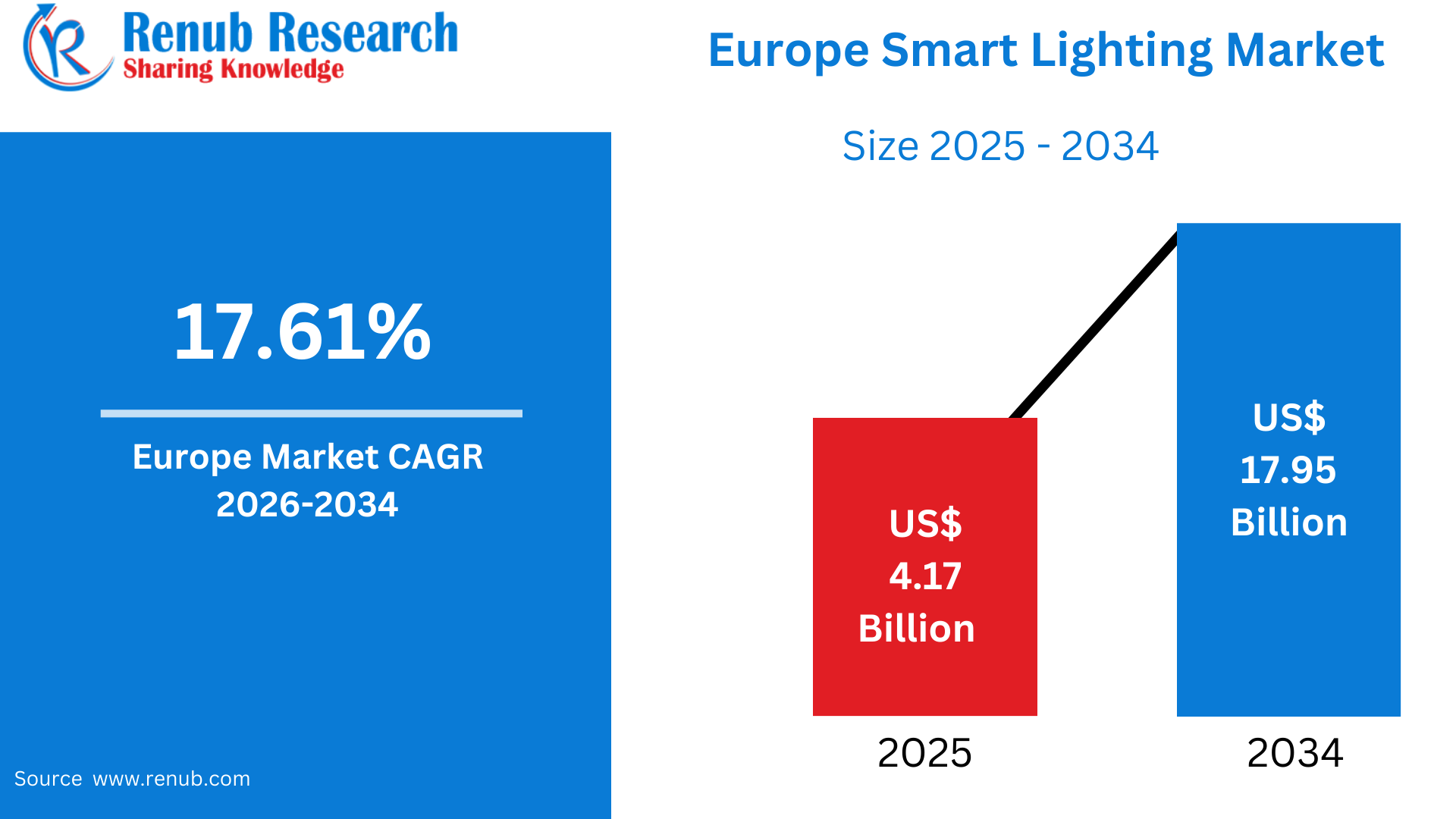
The Europe smart lighting market is expected to grow steadily with the increasing adoption of energy-efficient solutions, smart city projects, and the integration of IoT technology. The market is expected to grow from US$ 4.17 Billion in 2025 to US$ 17.95 Billion in 2034, registering a Compound Annual Growth Rate (CAGR) of 17.61% from 2026-2034. Government regulations, sustainability, and increasing demand in residential and commercial sectors are expected to drive the growth of the market.
Europe Smart Lighting Market Overview
Smart lighting can be defined as an advanced lighting solution that employs connected technology such as sensors, wireless communication, and software control to dynamically or remotely adjust the lighting. Smart lighting enables consumers to adjust the brightness, color temperature, and on/off timing of the lighting through mobile apps, voice commands, or building management systems. Smart lighting enhances energy efficiency by optimizing the use of lighting based on occupancy, daylight availability, and consumer preferences.
In Europe, smart lighting has received widespread acceptance because of the stringent energy efficiency policies and the increasing awareness of environmental issues. The government and public authorities are also encouraging the adoption of smart lighting in public structures such as roads, offices, and transportation centers to reduce carbon emissions. Smart lighting is also being adopted in residential settings as people are looking for comfort, convenience, and smart home solutions. The availability of advanced digital infrastructure and the widespread adoption of smart devices are also encouraging the adoption of smart lighting. The emphasis on smart cities and green buildings in Europe has also led to the increased adoption of smart lighting.
Growth Drivers in the European Smart Lighting Market
Stringent Energy Efficiency Regulations and Sustainability Goals
One of the most prominent drivers of the smart lighting market in the Europe region is the presence of stringent energy efficiency norms and sustainability targets. The European governments are actively encouraging the adoption of low-energy solutions in order to cut down carbon emissions and fulfill their climate change obligations. Smart lighting solutions also assist in this endeavor by optimizing electricity consumption through automated dimming, motion sensing, and daylight harvesting. Government projects related to street lighting and government buildings are increasingly adopting smart lighting solutions. This has led to an increase in the adoption of smart lighting solutions in the residential, commercial, and industrial segments, as it has become mandatory. The EU’s Green Deal and Ecodesign Directive, aiming for carbon neutrality by 2050, accelerates the demand for energy-efficient smart lighting solutions. Government policies, like the Bulgarian government’s investment of USD 34.08 million in energy-efficient street lighting in 2023, encourage the adoption of smart lighting solutions. For example, a report in 2023 showed that smart lighting solutions decreased energy consumption by up to 15% in pilot cities like Amsterdam and Munich. The combination of smart lighting solutions with 5G and IoT technologies improves connectivity and real-time control.
Expansion of Smart Cities and Urban Infrastructure Projects
The increasing adoption of smart cities in Europe is a major factor that is driving the adoption of smart lighting. Cities are investing in smart infrastructure to enhance energy management, public safety, and efficiency. Smart lighting is a core component that enables cities to manage lighting remotely, predictively, and adaptively. Smart lighting is also integrated with sensors and data analytics, which enables cities to lower operational costs while improving the quality of lighting. Smart lighting projects in cities create long-term contracts and revenue streams for companies. As the population in cities continues to rise, smart lighting is a core technology that enables smart cities. The EU Horizon Mission “Climate-Neutral and Smart Cities by 2030” invests more than 98 million euros in the systemic transition of over 100 European cities (including Bergamo, Bologna, Florence, Milan, Padua, Parma, Prato, Rome, and Turin), which are projected towards climate neutrality by 2030. The Mission cities, where 12% of the population of the European Union lives, through the project, are defined as innovation and experimentation hubs, and will become an example for all other European cities in accelerating the path towards the same objective by 2050, in accordance with the European Green Deal.
Growing Adoption of Smart Homes and IoT Integration
Another key factor propelling the Europe smart lighting market is the increasing adoption of smart home devices among consumers. Homeowners are increasingly drawn to the convenience, customization, and energy efficiency that smart lighting solutions provide. Smart lighting solutions seamlessly integrate with voice assistants, mobile applications, and home automation systems, making them more user-friendly. The high penetration of broadband and smart devices in Europe facilitates the swift adoption of smart lighting solutions. Moreover, the rising renovation and retrofitting of residential properties provides an impetus for the adoption of smart lighting solutions. As consumers become increasingly informed about the long-term benefits of smart lighting solutions in terms of cost savings and lifestyle improvements, the adoption of smart lighting solutions in residential properties continues to grow steadily. September 2024, Honeywell International Inc. (U.S.) won a multi-year contract to implement smart lighting solutions at Frankfurt Airport, a leading European airport. The initiative involves the implementation of IoT-enabled LED lighting solutions with advanced sensors to optimize energy consumption, enhance operational efficiency, and improve passenger experience through dynamic lighting in terminals. This development underlines Honeywell’s increasing presence in the Europe public infrastructure lighting market.
Challenges in the Europe Smart Lighting Market
High Initial Installation and Integration Costs
The high initial investment is a major hindrance to the adoption of smart lighting in Europe. Smart lighting involves sophisticated hardware and software, which can be more expensive than traditional lighting. For example, small businesses, households, and local governments with tight budgets may find the high initial investment a major setback. Upgrading existing infrastructure in old buildings can be even more expensive due to compatibility and wiring issues. While the long-term benefits of saving money through energy efficiency can be a major advantage, the long payback period can be a major deterrent to adoption.
Interoperability and Cybersecurity Concerns
However, the Europe smart lighting market faces challenges in terms of interoperability and cybersecurity. The use of various communication technologies and proprietary solutions may make it difficult to integrate them. Moreover, the lack of standardization may affect the scalability of the system. Additionally, with the increasing use of smart lighting systems that are linked to networks and cloud solutions, they become vulnerable to cyber attacks. Data privacy and security are major concerns, especially in public and commercial settings.
Europe Smart Lighting Software Market
The Europe smart lighting software market is at the forefront in facilitating intelligent control, monitoring, and optimization of lighting systems. Software solutions enable users to control brightness, timing, occupancy detection, and energy usage via centralized or mobile interfaces. The demand for software solutions is high in commercial buildings, smart cities, and industrial settings, where extensive lighting infrastructure demands optimized management. Software solutions are increasingly integrated with building management systems and IoT platforms, improving management efficiency and enabling informed decision-making. Cloud-based software solutions are gaining traction owing to their scalability, remote accessibility, and ease of maintenance. With the increasing focus of regulations on energy efficiency and real-time monitoring, software solutions are gaining increased acceptance. Ongoing innovation in analytics, artificial intelligence, and predictive maintenance further cements the importance of software solutions as a value-adding element of the Europe smart lighting market.
Europe Wireless Smart Lighting Market
The European wireless smart lighting market is growing at a fast pace owing to its flexibility, ease of installation, and compatibility with existing infrastructure. Wireless technologies allow lighting systems to communicate with each other without the need for extensive wiring, making them suitable for both new and retrofitting projects. Wireless smart lighting solutions also support advanced functionality such as remote control, automation, and interaction with smart home environments. The well-developed digital infrastructure and prevalence of connected devices in Europe drive the market forward. Furthermore, wireless solutions also offer faster installation times and lower costs compared to traditional wired systems. With the increasing need for flexible and adaptable lighting solutions, wireless smart lighting is also gaining popularity across various application segments.
Europe Smart Lighting New Installation Market
The new installation market for smart lighting in the Europe region is fueled by the construction of residential, commercial, and public infrastructure in line with energy-efficient building norms. New buildings are incorporating smart lighting solutions during the design stage to comply with regulations and cut down on energy costs in the long run. Smart lighting solutions are preferred by developers for their seamless integration with building automation systems. New installations enable the complete use of sensors, controls, and software solutions without the constraints of retrofits, enhancing the overall performance of the system. Smart offices, hospitals, educational institutions, and urban development projects are driving the demand for new installations in smart lighting solutions in the Europe region.
Europe Smart LED Lamps Market
The Europe smart LED lamps market is aided by the region’s focus on energy efficiency and the adoption of LEDs. Smart LED lamps offer low power consumption along with other advanced features such as dimming, color temperature adjustment, and remote control. Consumers are increasingly opting for smart LED lamps as an alternative to traditional lighting due to their longer lifespan and lower operating costs. The adoption rate of smart LED lamps is high in residential and small-scale commercial applications, where plug-and-play technology is preferred. Smart LED lamps are also compatible with voice assistants and smart home systems, which adds to their convenience. Government schemes to encourage the adoption of LEDs also aid the market.
Europe Indoor Smart Lighting Market
The European market for indoor smart lighting is growing in the residential, commercial, and institutional sectors. In the indoor sector, the focus is on comfort, productivity, and energy conservation, making smart lighting an attractive option. Adaptive lighting is used in offices to improve employee comfort, while dynamic lighting is used in retail to improve customer experience. Smart lighting is preferred in residential settings for its ability to customize ambiance and automate lighting. Smart lighting in indoor settings is often combined with sensors that can control lighting based on occupancy and daylight availability. The European emphasis on green buildings and efficient workplaces is driving the adoption of smart lighting.
Europe Residential Smart Lighting Market
The European residential smart lighting market is expanding steadily as consumers are adopting smart home solutions. Homeowners are increasingly looking for solutions that provide convenience, energy efficiency, and personalization. Smart lighting enables residents to control lighting remotely, set schedules, and change ambiance settings according to activities. The addition of voice assistants and mobile apps makes it easier to use. Increasing electricity prices and awareness about the environment are pushing households to adopt energy-saving solutions. The renovation of old residential buildings is also fueling the demand for smart lighting upgrades. As smart homes gain popularity, the adoption of residential smart lighting solutions is expected to rise and contribute significantly to market growth.
France Smart Lighting Market
The smart lighting market in France is fueled by the country’s strong focus on energy efficiency, sustainability, and carbon reduction. Smart lighting solutions are being adopted in public infrastructure projects such as street lighting and government buildings to optimize energy consumption and minimize operating expenses. In the commercial segment, offices, shopping centers, and hotels are implementing smart lighting solutions to improve comfort and energy management. Smart home solutions are also gaining traction in residential segments as they become more affordable. France’s emphasis on urban renewal and smart city development enables the widespread adoption of smart lighting networks. Moreover, the need to upgrade old buildings provides opportunities for the adoption of smart lighting solutions. Public awareness of the environmental advantages and cost-effectiveness of smart lighting solutions further fuels the growth of the market, making France a prominent participant in the expansion of the smart lighting market in Europe. Nov 2024 – Itron, Inc. (NASDAQ: ITRI), a company that is constantly working on new ways for utilities and cities to manage energy and water, has formed a partnership with Cielis, a consortium of Dalkia Electrotechnics and a subsidiary of Eiffage, to continue Itron’s management of the City of Paris’ nearly 200,000 smart streetlights.
United Kingdom Smart Lighting Market
The United Kingdom smart lighting market is driven by a high adoption rate of smart home solutions and advanced digital infrastructure. The residential sector has a high demand for smart lighting due to consumer interest in automation, convenience, and energy efficiency. In the commercial and industrial sectors, smart lighting solutions are widely adopted to enhance operational efficiency and achieve sustainability goals. The United Kingdom also has a high adoption rate of smart lighting solutions in public areas such as streets, transportation hubs, and educational institutions. Building management system and IoT integration of smart lighting solutions enhances their performance and data analysis capabilities. Retrofitting projects in old buildings are a significant growth area for the smart lighting market in the United Kingdom, as smart lighting solutions reduce energy consumption without requiring significant changes to the structure. With an increase in electricity costs and environmental awareness, the adoption of smart lighting solutions in the United Kingdom is expected to increase steadily. Dec 2025, Govee, a world leader in smart ambient lighting, has announced a major extension of its retail offering in the UK, launching a range of its most popular smart lighting products in high street giants Argos and Currys. This major partnership means that Govee’s innovative home, gaming, and seasonal lighting products will be easily accessible to UK consumers, cementing their place as a must-have tech gift for Christmas.
Netherlands Smart Lighting Market
The Netherlands smart lighting market is driven by the adoption of innovative technologies and the emphasis on the development of smart cities. Smart lighting solutions are widely adopted in municipal projects to enhance energy efficiency, safety, and city management. The commercial sector actively adopts smart lighting solutions to facilitate flexible working environments and sustainable building operations. Dutch consumers also demonstrate growing interest in smart lighting solutions for home automation and energy efficiency. The Netherlands enjoys superior digital connectivity and an innovative environment, facilitating fast technology adoption. Sustainability-oriented policies and the adoption of LED lighting solutions further boost market development. As cities and commercial organizations focus on data-driven energy management, smart lighting solutions remain at the forefront of the Netherlands’ intelligent infrastructure initiative. June 2024 – Aqara, a world leader and innovator in IoT, announced the launch of its Amazon brand store in the Netherlands. This new development on the Amazon platform represents an important milestone in making Aqara’s smart home product range more accessible to Dutch consumers.
Germany Smart Lighting Market
The German smart lighting market is fueled by the government’s strict regulations on energy efficiency, the modernization of industries, and the focus on sustainable solutions. Smart lighting solutions have been widely adopted in commercial buildings, factories, and warehouses, where energy efficiency and automation are of utmost importance. Smart lighting solutions are being increasingly incorporated in public infrastructure projects to lower energy expenses for municipalities. The trend of adopting smart lighting solutions in residential areas is also on the rise, driven by the increasing demand for smart homes and energy-efficient living. Germany’s robust manufacturing and engineering sector enables continuous innovation in smart lighting solutions. The need to upgrade existing infrastructure with smart lighting solutions is a major driver for the market. As digitalization and sustainability continue to be the country’s focus, Germany is expected to retain its leading edge in the European smart lighting market. In February 2023, Signify, the global leader in lighting solutions, is assisting the German municipality of Eichenzell in making it a future-ready smart city through the implementation of intelligent street lighting. Signify’s BrightSites solution provides fast and wireless broadband connectivity to the municipality, enabling Eichenzell to support next-generation IoT applications and future 5G densification.
Market Segmentation
Offering
- Hardware
- Software
- Services
Technology
- Wireless
- Wired
Installation Type
- New Installation
- Retrofit Installation
Light Source
- LED Lamps
- Fluorescent Lamps
- Compact Fluorescent Lamps
- High Intensity Discharge Lamps
- Others
Application
- Indoor
- Outdoor
End User
- Commercial
- Residential
- Public Infrastructure
- Others
Country
- France
- Germany
- Italy
- Spain
- United Kingdom
- Belgium
- Netherlands
- Russia
- Poland
- Greece
- Norway
- Romania
- Portugal
- Rest of Europe
All companies have been covered with 5 Viewpoints
- Overviews
- Key Person
- Recent Developments
- SWOT Analysis
- Revenue Analysis
Key Players Analysis
- Cree, Inc.
- Philips Lighting
- Honeywell International, Inc.
- Wipro Limited
- Acuity Brands, Inc.
- Eaton Corporation Plc.
- Legrand S.A.
- General Electric (GE)
- OSRAM Licht AG
Report Details:
| Report Features | Details |
| Base Year |
2025 |
| Historical Period |
2022 - 2025 |
| Forecast Period |
2026 - 2034 |
| Market |
US$ Billion |
| Segment Covered |
Offering, Technology, Installation Type, Light Source, Application, End User and Countries |
| Countries Covered |
|
| Companies Covered |
|
| Customization Scope |
20% Free Customization |
| Post-Sale Analyst Support |
1 Year (52 Weeks) |
| Delivery Format |
PDF and Excel through Email (We can also provide the editable version of the report in PPT/Word format on request) |
Key Questions Answered in This Report:
-
What is the projected market size of the Europe Smart Lighting Market by 2033?
-
What is the expected Compound Annual Growth Rate (CAGR) of the smart lighting market from 2025 to 2033?
-
What are the key drivers fueling the growth of the smart lighting market in Europe?
-
How does IoT integration impact the adoption of smart lighting solutions?
-
What role do government regulations and sustainability targets play in the market expansion?
-
Which European countries are leading in smart lighting adoption?
-
What are the key technologies and installation types dominating the smart lighting market?
-
How is the commercial sector contributing to the growth of the smart lighting market?
-
Who are the top market players in the European smart lighting industry?
-
How does the rising demand for smart homes influence the market trends?
Customization Services available
- Analysis of Market Size and Its Segments
- More Company Profiles (Upto 10 without any additional cost):
- Additional Countries (Other than mentioned Countries):
- Region/Country Specific Reports:
- Market Entry Strategy:
- Region-Specific Market Dynamics:
- Regional Market Share Analysis:
- Trade Analysis:
- Production Insights:
- Others Customized Requests:
For more information contact our analysts.
Need More Assistance?
- Talk to our analysts to get more precious information on the current market trends.
- Include more countries and segments and customize the report based on the final requirement.
- Get a competitive advantage in your industry by knowing the report findings and making a positive impact on your revenues and operations.
- Our analysts are always ready to provide more help and pertinent information if you need any additional assistance.