Smart Lighting Market Report by System Component, Communication Technology, Lighting Source, End Use, Country and Company Analysis 2026-2034
Buy NowSmart Lighting Market Size and Forecast
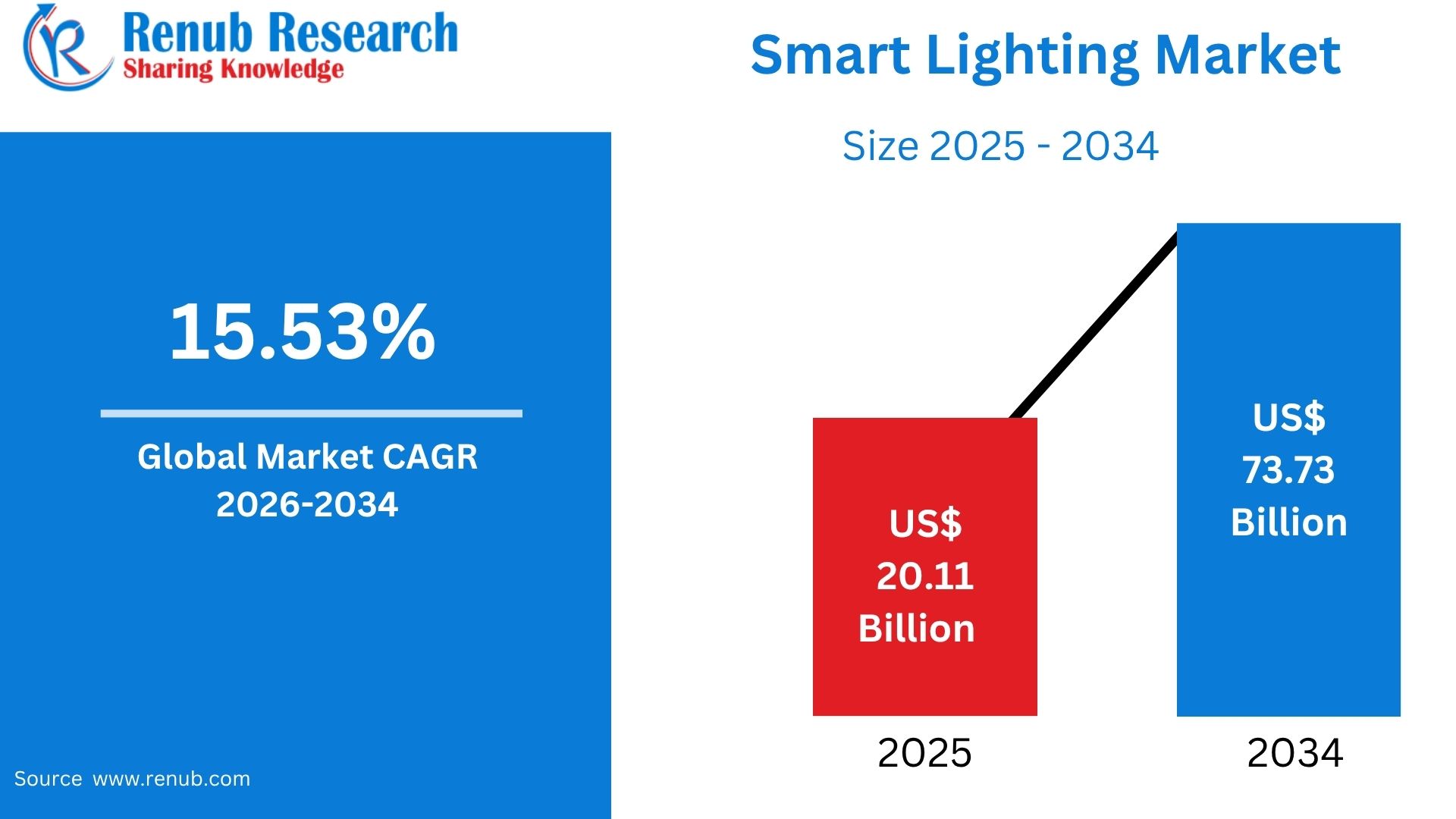
Smart Lighting Market is projected to expand from US$ 20.11 billion in 2025 to approximately US$ 73.73 billion by 2034, registering a CAGR of 15.53% during 2026–2034. Market growth is being supported by the increasing adoption of energy-efficient lighting technologies, rapid urbanization, and the development of smart cities and connected infrastructure. The growing integration of IoT, wireless connectivity, sensors, and automated lighting controls is enabling consumers and businesses to optimize energy consumption and improve lighting management.
What is Smart Lighting and Its Uses & Popularity Worldwide
Smart lighting refers to an advanced lighting system that uses LED technology, sensors, wireless connectivity, automation, and software to control and manage illumination more efficiently. Unlike conventional lighting, smart lighting can be remotely operated through smartphones, voice assistants, applications, or centralized building-management systems. Users can adjust brightness, color temperature, schedules, and operating modes according to their requirements.
Smart lighting is widely used in residential homes, offices, retail stores, hotels, warehouses, factories, hospitals, and smart-city infrastructure. Applications include automated street lighting, occupancy-based illumination, energy management, security lighting, mood lighting, and daylight harvesting. Its popularity is increasing globally because LEDs offer substantially higher efficiency than traditional lighting technologies. The IEA reports that LEDs sold today average close to 100 lumens per watt, while premium and professional products can exceed 200 lumens per watt. In 2024, lighting for buildings and outdoor applications represented around 8% of global electricity demand, equivalent to approximately 2,200 TWh. As energy costs, sustainability goals, and smart-home adoption increase, connected lighting is becoming an important element of modern digital infrastructure.
Flashnet Expands Smart Street Lighting Presence in North America
- Expanding U.S. Manufacturing: Flashnet is increasing its focus on American-made components and local manufacturing to strengthen its presence in the U.S. smart street lighting market.
- More Than 200,000 Controllers Installed: Flashnet has deployed over 200,000 inteliLIGHT® smart lighting controllers across the United States, demonstrating strong adoption of its connected lighting technology.
- Washington, D.C. Upgrade: The company’s Washington, D.C. smart street lighting project represents a major milestone, helping improve maintenance efficiency, public safety, and integration with smart-city infrastructure.
- Washington, D.C. launched a $309 million public–private partnership under its Vision Zero and sustainability initiatives to replace tens of thousands of aging streetlights with energy-efficient LEDs, while adding smart controls and predictive maintenance to reduce energy use, improve safety, and streamline operations.
- Smart City Integration: Flashnet’s inteliLIGHT® technology enables cities to remotely monitor and manage street lighting, supporting improved operational efficiency and more sustainable urban infrastructure.
- Growing North American Focus: Building on successful U.S. deployments, Flashnet is positioning itself to support the modernization of street lighting infrastructure across North America.
- Global Footprint: Flashnet’s technology is also being used across Europe, Australia, South America, the Middle East, and Asia, demonstrating its international reach.
- Presence in 45+ Countries: With projects implemented in more than 45 countries, Flashnet is expanding connected lighting solutions across established cities and rapidly developing urban areas.
- Focus on Sustainability: The company’s smart lighting solutions support cities in reducing energy consumption, improving maintenance practices, and developing more sustainable public-lighting networks.
- Urban Infrastructure Modernization: The growing deployment of inteliLIGHT® reflects the broader shift toward connected, automated, and digitally managed street lighting as cities pursue smart-city objectives.
- Future Growth Opportunity: Flashnet’s growing U.S. footprint, emphasis on local production, and international project experience position the company to play a larger role in the global smart street lighting market.
Growth Drivers of the Smart Lighting Market
Rising Demand for Energy-Efficient Lighting Solutions
The growing emphasis on reducing electricity consumption is a major driver of the smart lighting market. Smart lighting combines efficient LEDs with sensors, dimming controls, occupancy detection, timers, and automated management systems to reduce unnecessary energy use. According to the IEA, lighting in buildings and outdoor applications consumed approximately 2,200 TWh of electricity in 2024, representing around 8% of global electricity demand. This substantial energy requirement creates significant opportunities for efficiency improvements. LEDs already provide considerably better efficiency than traditional technologies, with today’s LEDs averaging close to 100 lumens per watt, while some premium products exceed 200 lumens per watt. Smart controls further improve efficiency by automatically switching lights off in unoccupied areas and adjusting brightness according to daylight availability. Governments and businesses are consequently investing in energy-saving lighting upgrades to reduce operating expenses and carbon emissions. The IEA also notes that minimum energy-performance standards now cover around 110 countries, supporting the transition toward efficient lighting technologies.
Expansion of Smart Homes, Buildings, and Cities
The rapid development of connected homes, intelligent buildings, and smart-city infrastructure is creating strong demand for smart lighting systems. Connected lighting can communicate with smartphones, sensors, security systems, HVAC equipment, and building-management platforms, allowing users to automate multiple functions through a single digital ecosystem. In residential applications, consumers increasingly use smart bulbs, switches, and fixtures for remote control, scheduling, dimming, and personalized lighting. Commercial buildings are adopting networked lighting to manage large numbers of fixtures and optimize energy consumption across offices, shopping centers, hotels, hospitals, and industrial facilities. Smart street lighting is also being deployed by municipalities because connected systems can enable remote monitoring, adaptive brightness, fault detection, and maintenance optimization. The opportunity is particularly significant because global building floor area has increased by more than 20% over the past decade, according to the IEA. At the same time, lighting electricity consumption in buildings has remained relatively stable because efficiency improvements have offset much of the increase in floor area. These trends are encouraging greater integration of intelligent lighting into modern infrastructure.
Integration of IoT, Sensors, and Automation Technologies
The integration of Internet of Things (IoT), wireless communication, artificial intelligence, and sensor technologies is expanding the capabilities of smart lighting beyond basic illumination. Modern systems can collect information from occupancy, motion, daylight, temperature, and environmental sensors and automatically adjust lighting according to real-time conditions. Integration with building-management platforms allows facility operators to monitor energy consumption, identify equipment faults, schedule maintenance, and optimize lighting across multiple locations. Smart lighting is also increasingly connected with voice assistants, smartphones, security systems, and home-automation platforms, improving convenience and user experience. Advanced LED systems support dimming, color adjustment, scheduling, and responsive illumination, making them suitable for both residential and commercial applications. The IEA highlights that LEDs offer advantages including long lifetimes, improved optical control, dimmability, and colour-shifting, while also being easier to integrate with smart controls than fluorescent technologies. Furthermore, the average efficacy of LEDs has roughly doubled since 2015, demonstrating continued technological improvement. As connected-device ecosystems expand, smart lighting is increasingly becoming an important component of automated and data-driven buildings.
Challenges of the Smart Lighting Market
High Initial Investment and Installation Complexity
High upfront costs remain an important challenge for smart lighting adoption, particularly for large commercial facilities and developing markets. Smart lighting systems require more than LED fixtures; they may also require sensors, wireless gateways, controllers, software, networking equipment, and professional installation. Although these technologies can reduce electricity and maintenance expenses over time, the initial investment can discourage price-sensitive consumers and organizations. Retrofitting existing buildings can be particularly complicated because older properties may require rewiring, fixture replacement, additional controls, or integration with legacy electrical systems. The IEA identifies retrofit complexity—including ceiling access, rewiring, and installation of new fixtures—as a factor that can delay lighting upgrades. While LED technology has become increasingly cost-effective, smart systems generally remain more expensive than conventional lighting because of their connected hardware and control capabilities. Small businesses and households may therefore prioritize basic LED replacements rather than fully connected systems. Manufacturers and service providers are addressing this challenge through wireless products, simplified installation, modular controls, and lower-cost smart bulbs. As component prices decline and energy savings become more visible, the long-term return on investment can increasingly justify the initial expenditure.
Cybersecurity, Interoperability, and Product Quality Concerns
The increasing connectivity of smart lighting creates challenges related to cybersecurity, interoperability, data management, and product reliability. Smart lighting systems connected to Wi-Fi, Bluetooth, cloud platforms, or building-management networks can potentially become entry points for cyber threats if they are not properly secured. Commercial and municipal deployments can be particularly sensitive because a compromised network may affect numerous connected devices simultaneously. Interoperability is another concern because products from different manufacturers may use different communication protocols, software platforms, and control standards, making integration more difficult. Poor-quality products can also reduce consumer confidence through short lifespans, inconsistent brightness, flicker, color-quality issues, or unreliable connectivity. The IEA has highlighted the need to protect markets from poor-quality LED products and stresses the importance of quality and performance regulations. In addition, end-of-life collection and recycling remain challenges for the broader lighting industry. Addressing these issues through stronger cybersecurity standards, common protocols, certification programs, software updates, and responsible recycling systems will be essential for sustainable smart lighting market development.
Smart Lighting Launches Worldwide
- Philips Smart Lighting HDMI Sync Box 2.1 – Global (2026): Signify introduced the HDMI Sync Box 2.1 to synchronize room lighting with movies, television, sports, and gaming content in real time. The product supports TV sizes from 55–65 inches and 75–85 inches.
- Philips Smart Lighting Gradient Floor Lamps – Global (2026): Signify expanded its WiZ-connected portfolio with Gradient Floor Lamps featuring multicolor lighting and flowing gradient effects for immersive room illumination.
- Philips Smart Lighting Gradient Light Bars – Global (2026): New Gradient Light Bars were introduced with multicolor segmented lighting, allowing users to create wall-washing effects and synchronize illumination with entertainment content.
- Philips Smart Lighting Squire Lite Table Lamp – Europe (2026): Signify launched the compact Squire Lite smart table lamp, offering dynamic lighting and integration with the WiZ platform for customized home illumination.
- Philips Smart Lighting Smart Dial Switch – Global (2026): The Smart Dial Switch was introduced to provide quick physical control of brightness, colors, and lighting scenes within the connected Philips Smart Lighting ecosystem.
- WiZ HDMI Sync Box with TV Backlight – Worldwide (2025): WiZ launched its HDMI Sync Box with TV Backlight globally, enabling lighting to automatically match colors displayed on connected screens. The system supports 4K at 60Hz, HDR10+, and Dolby Vision.
- WiZ Gradient Light Bars – Worldwide (2025): WiZ introduced Gradient Light Bars with segmented multicolor illumination, 16 million colors, preset lighting modes, and Matter compatibility for connected-home integration.
- WiZ Gradient Floor Light – Worldwide (2025): The Gradient Floor Light was launched with a wide beam angle, multicolor effects, plug-and-play installation, and synchronization with video and music.
- Aqara Ceiling Light T1M – Global (2024): Aqara expanded its smart lighting portfolio with the Ceiling Light T1M, combining white illumination with a colorful gradient ring and supporting 2700–6500K white light and 16 million colors.
- Philips Hue Essential Range & Hue Bridge Pro – Global (2025): Signify introduced the Philips Hue Essential range alongside the Hue Bridge Pro, which supports more than 150 lights and 50 accessories, expanding the Hue ecosystem and making connected lighting more accessible.
Growing Role of Software in Intelligent Lighting Management
Smart Lighting Software Market is gaining momentum as software becomes the central control layer for connected lighting infrastructure. Smart lighting platforms enable users to remotely control brightness, color temperature, scheduling, occupancy settings, and energy consumption through cloud-based or on-premise systems. In commercial buildings, offices, industrial facilities, and smart cities, these platforms help optimize lighting operations and reduce unnecessary electricity consumption. Integration with IoT sensors, building-management systems, and artificial intelligence is further expanding software capabilities. AI and analytics can support real-time monitoring, energy-performance analysis, fault detection, and predictive maintenance. The IEA estimates that lighting for buildings and outdoor applications consumed around 2,200 TWh of electricity in 2024, representing approximately 8% of global electricity demand, highlighting the potential for software-based optimization. As connected lighting installations increase, demand for centralized platforms capable of managing thousands of fixtures is expected to rise. Software is therefore becoming an essential component of modern smart lighting ecosystems, supporting automation, operational efficiency, and energy management.
Flexible Connectivity Supporting Rapid Adoption
Wireless Smart Lighting Market is expanding rapidly because wireless technologies enable flexible lighting installations without extensive cabling or major infrastructure modifications. Systems based on Wi-Fi, Bluetooth, Zigbee, and Z-Wave allow users to control lighting through smartphones, tablets, voice assistants, and centralized automation platforms. Wireless solutions are particularly attractive for homes, offices, retail stores, hotels, and renovated commercial buildings because installation can be faster and less disruptive than conventional wired systems. Businesses can remotely configure lighting schedules, adjust brightness, monitor energy consumption, and expand connected fixtures as requirements change. Wireless lighting also supports occupancy and daylight sensors, enabling lights to operate according to real-time conditions. The growing adoption of connected homes and intelligent buildings is strengthening demand for these solutions. The IEA notes that LEDs are well suited to smart controls because they support features such as dimming, improved optical control, and color shifting. As wireless networking becomes more reliable and smart-home ecosystems become increasingly interconnected, wireless lighting is expected to remain an important growth segment.
Energy Efficiency and Connected LED Technology
Smart LED Lighting Market is benefiting from the combination of energy-efficient LED technology and advanced connectivity. Smart LED products integrate LEDs with sensors, controllers, wireless communication, and digital platforms, enabling automated control and personalized lighting. LEDs generally consume less electricity and have longer operating lifetimes than traditional lighting technologies, making them attractive for residential, commercial, industrial, and outdoor applications. According to the IEA, LEDs sold today average close to 100 lumens per watt, while premium and professional products can exceed 200 lumens per watt. The organization also reports that LED efficacy has approximately doubled since 2015, demonstrating continued technological progress. Smart LED systems additionally offer dimming, scheduling, occupancy detection, and color-temperature adjustment, helping users improve both efficiency and comfort. Falling component costs, improvements in brightness and color quality, and government emphasis on energy conservation are supporting adoption. As sustainability becomes increasingly important for consumers, businesses, and municipalities, smart LEDs are emerging as a preferred technology for connected and energy-efficient lighting infrastructure.
Intelligent Illumination for Connected Indoor Environments
Indoor Smart Lighting Market is growing as residential and commercial users increasingly seek lighting systems that combine comfort, automation, and energy efficiency. Indoor smart lighting can automatically adjust illumination according to occupancy, time of day, user preferences, and available natural daylight. These systems are increasingly deployed in homes, offices, retail stores, hospitals, hotels, and educational institutions. Motion and occupancy sensors can switch lights on when rooms are occupied and reduce or turn them off when spaces are vacant, limiting unnecessary electricity consumption. Daylight-harvesting technologies can similarly adjust artificial illumination according to the amount of natural light entering a building. In commercial environments, smart lighting can contribute to employee comfort, customer experience, and operational efficiency. Advanced systems also allow users to customize brightness and color temperature for different activities. The IEA estimates that buildings and outdoor lighting accounted for around 8% of global electricity demand in 2024, demonstrating the substantial efficiency opportunity associated with intelligent lighting management. With buildings becoming increasingly connected, indoor smart lighting is becoming an important component of intelligent building infrastructure.
Smart Homes Accelerate Consumer Adoption
Residential Smart Lighting Market is expanding as consumers increasingly adopt smart-home technologies for convenience, energy management, personalization, and security. Smart lighting systems allow homeowners to control fixtures through mobile applications, voice assistants, remote controls, and automated schedules. Users can switch lights on or off remotely, adjust brightness, modify color temperature, and create customized lighting scenes for different activities. Integration with motion sensors and smart-home security systems can also provide security benefits by automatically activating lights when movement is detected or simulating occupancy while residents are away. Energy-monitoring capabilities allow households to identify unnecessary consumption and optimize lighting schedules. Smart bulbs, switches, fixtures, and starter kits have made connected lighting more accessible to consumers, while wireless installation reduces the need for extensive electrical modifications. The increasing availability of connected-home ecosystems is further encouraging adoption by allowing lighting to interact with cameras, thermostats, speakers, and other smart devices. As energy efficiency and home automation become increasingly important worldwide, residential applications are expected to remain a major contributor to smart lighting market growth.
Advanced Smart-Home Adoption and Infrastructure Investment in USA
United States Smart Lighting Market is among the most developed globally, supported by advanced digital infrastructure, widespread smart-home adoption, and strong demand for energy-efficient technologies. Consumers increasingly connect smart bulbs, fixtures, and lighting controls with smartphones, voice assistants, security systems, and broader home-automation platforms. Commercial applications are also expanding across offices, retail facilities, hospitals, hotels, and industrial buildings, where automated lighting can improve operational efficiency and reduce electricity consumption. Smart-city programs are creating additional opportunities for connected street lighting, particularly through remote monitoring, adaptive illumination, and energy management. In August 2025, Washington, D.C. announced a $309 million public-private partnership (P3) contract involving upgraded street lighting, energy savings, and technology flexibility. The presence of major technology and lighting companies is further supporting innovation in LEDs, wireless connectivity, sensors, and lighting-management software. As businesses and households increasingly prioritize energy efficiency, automation, and resource optimization, the U.S. is expected to remain a major contributor to global smart lighting development.
Sustainability Policies and Connected Home Technologies Drive United Kingdom Demand
United Kingdom Smart Lighting Market is expanding steadily as households and businesses increasingly adopt connected and energy-efficient lighting solutions. Smart bulbs, switches, sensors, and wireless controls allow consumers to remotely operate lighting, adjust brightness, establish schedules, and integrate illumination with other smart-home devices. Commercial buildings are also deploying intelligent lighting systems to improve workplace environments while reducing electricity consumption and operating costs. The country’s emphasis on carbon reduction, energy efficiency, and sustainable infrastructure provides a favorable environment for smart lighting adoption. Wireless technologies are gaining popularity because they can simplify installation and reduce the need for extensive electrical modifications, particularly in existing buildings. Retail availability is also improving. In December 2025, Govee expanded its UK retail presence through Argos and Currys, making a broader selection of its smart ambient lighting products accessible to consumers. Continued development of connected-home ecosystems, increasing awareness of energy efficiency, and growing consumer interest in personalized lighting are expected to support the UK’s smart lighting market over the coming years.
India Urbanization and Government-Led Energy Efficiency Initiatives
India’s Smart Lighting Market is witnessing rapid development, supported by urbanization, expanding smart-home adoption, infrastructure modernization, and increasing awareness of energy-efficient technologies. Government programs promoting LED adoption and energy conservation have helped establish efficient lighting as an important part of India’s infrastructure transition. Smart street lighting is gaining traction in cities because connected systems can enable remote monitoring, automated brightness adjustment, fault detection, and lower operating costs. Residential adoption is also increasing as consumers purchase smart bulbs, connected switches, sensors, and lighting-control systems for homes and apartments. Growing smartphone usage, expanding internet connectivity, and rising disposable incomes are making app-based lighting controls more accessible. Smart-city investments are creating additional opportunities for connected public lighting and intelligent infrastructure. In November 2025, Signify launched the Philips Smart Light Hub in Malappuram, Kerala, featuring more than 500 SKUs across a 2,500-square-foot retail space. Continued investment in digital infrastructure, smart cities, and connected homes is expected to position India as an important emerging market for smart lighting.
Saudi Arabia Smart Cities and Infrastructure Modernization Strengthen Adoption
Saudi Arabia Smart Lighting Market is gaining momentum as the country invests heavily in smart cities, advanced infrastructure, energy efficiency, and digital transformation under its broader modernization agenda. Smart lighting systems are being deployed across residential properties, commercial buildings, public spaces, and streets to improve illumination while optimizing electricity consumption and maintenance. Connected streetlights equipped with sensors and remote-management platforms can support adaptive lighting, fault detection, centralized monitoring, and improved public safety. Demand is also benefiting from new residential developments and premium properties that increasingly incorporate smart-home technologies. In May 2025, Flashnet, together with Saudi Delta Group, deployed 5,700 inteliLIGHT controllers using LoRaWAN communication technology in a Saudi smart street-lighting project, with capabilities supporting greater lighting efficiency and solar-power backup. Large-scale urban development and the country’s focus on technology-enabled infrastructure are expected to create further opportunities for connected lighting. As Saudi Arabia continues developing smart-city projects and modern residential and commercial infrastructure, smart lighting is likely to become an increasingly important element of its digital built environment.
Market Segments
Component
- Hardware
- Software
- Services
Communication Technology
- Wired Technology
- Wireless Technology
Light Source
- LED Lamps
- Fluorescent Lamps
- Compact Fluorescent Lamps
- High Intensity Discharge Lamps
- Others
Application
- Commercial
- Residential
- Others
Countries
North America
- United States
- Canada
Europe
- France
- Germany
- Italy
- Spain
- United Kingdom
- Belgium
- Netherlands
- Turkey
Asia Pacific
- China
- Japan
- India
- Australia
- South Korea
- Thailand
- Malaysia
- Indonesia
- New Zealand
Latin America
- Brazil
- Mexico
- Argentina
Middle East & Africa
- South Africa
- Saudi Arabia
- United Arab Emirates
All companies have been covered with 5 Viewpoints
- Overviews
- Key Person
- Recent Developments
- SWOT Analysis
- Revenue Analysis
Key Players Analysis
- Acuity Brands Lighting, Inc.
- Signify Holding
- Honeywell International Inc.
- Itron Inc.
- Wipro Lighting.
- Verizon
- Schneider Electric
- Zumtobel Group
Report Details:
| Report Features | Details |
| Base Year |
2025 |
| Historical Period |
2022 - 2025 |
| Forecast Period |
2026 - 2034 |
| Market |
US$ Billion |
| Segment Covered |
Component, Communication Technology, Light Source, Application and Countries |
| Countries Covered |
|
| Companies Covered |
|
| Customization Scope |
20% Free Customization |
| Post-Sale Analyst Support |
1 Year (52 Weeks) |
| Delivery Format |
PDF and Excel through Email (We can also provide the editable version of the report in PPT/Word format on request) |
Customization Services available
- Analysis of Market Size and Its Segments
- More Company Profiles (Upto 10 without any additional cost):
- Additional Countries (Other than mentioned Countries):
- Region/Country Specific Reports:
- Market Entry Strategy:
- Region-Specific Market Dynamics:
- Regional Market Share Analysis:
- Trade Analysis:
- Production Insights:
- Others Customized Requests:
For more information contact our analysts.
Need More Assistance?
- Talk to our analysts to get more precious information on the current market trends.
- Include more countries and segments and customize the report based on the final requirement.
- Get a competitive advantage in your industry by knowing the report findings and making a positive impact on your revenues and operations.
- Our analysts are always ready to provide more help and pertinent information if you need any additional assistance.