Europe Online Grocery Market Report by Product, Purchase Type, Countries and Company Analysis 2026-2034
Buy NowEurope Online Grocery Market Size, E-Commerce Adoption, and Growth Outlook
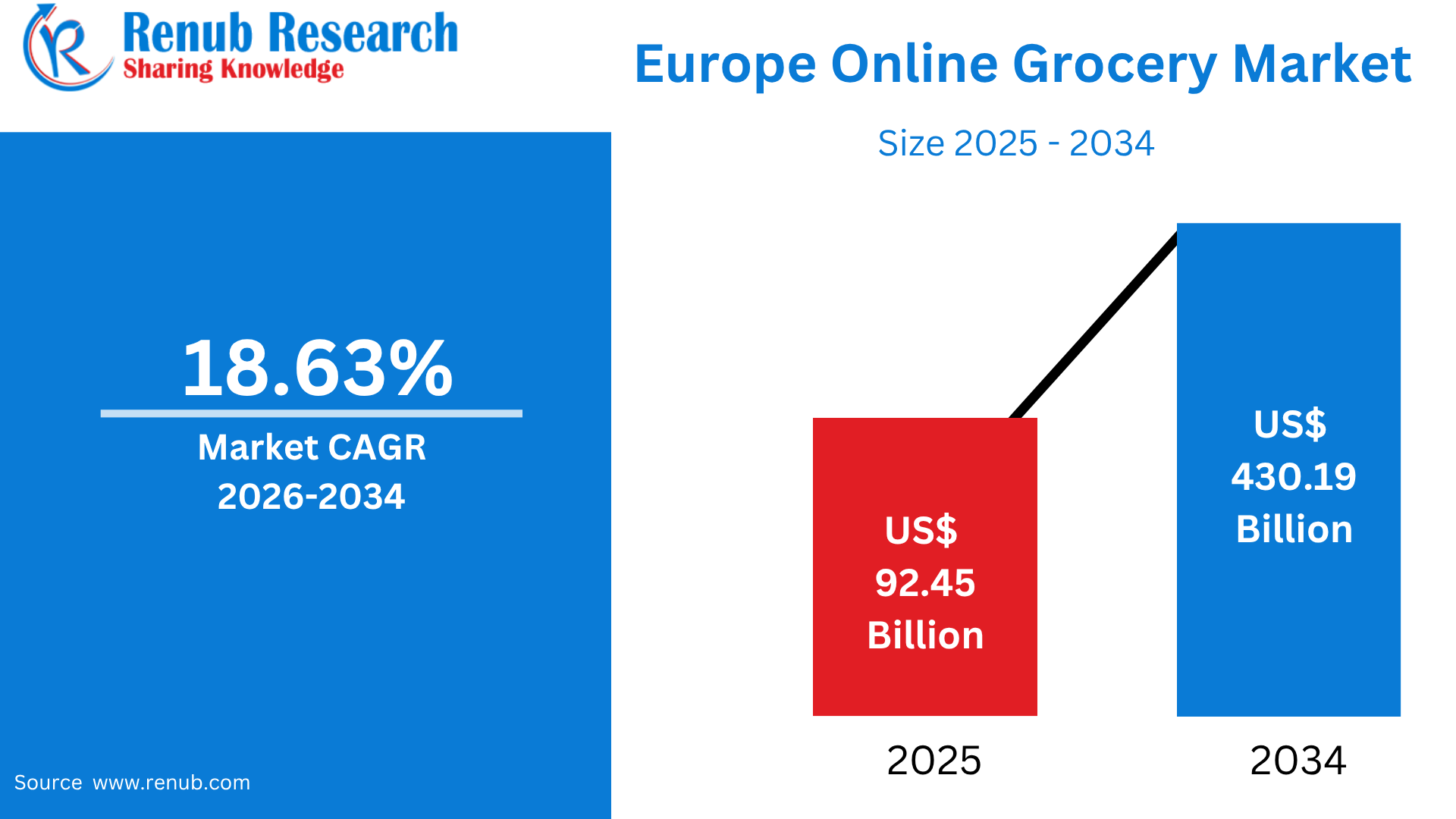
Europe Online Grocery Market is projected to expand from US$ 92.45 billion in 2025 to US$ 430.19 billion by 2034, registering a robust CAGR of 18.63% during the forecast period from 2026 to 2034. The market's strong growth is driven by increasing internet penetration, widespread smartphone adoption, evolving consumer shopping preferences, and the growing popularity of e-commerce platforms. In addition, advancements in last-mile delivery networks, rapid fulfillment services, digital payment solutions, and investments in automated warehousing are enhancing the online grocery shopping experience, supporting sustained market expansion across Europe.
Understanding Online Grocery Services, Practical Uses, and Mass Popularity
Online grocery refers to the digital purchase of food, beverages, household essentials, personal care products, and fresh produce through websites or mobile applications, with orders delivered directly to consumers' homes or made available for click-and-collect pickup. Online grocery platforms offer a wide variety of products, including fresh fruits and vegetables, dairy products, meat, seafood, bakery items, frozen foods, packaged groceries, and organic products. Consumers benefit from convenient shopping, real-time product availability, secure digital payments, scheduled deliveries, personalized recommendations, and subscription-based purchasing options. Retailers also utilize artificial intelligence, inventory management systems, and automated fulfillment centers to improve operational efficiency and customer satisfaction.
Across Europe, online grocery shopping has gained significant popularity due to increasing internet penetration, widespread smartphone usage, and changing consumer lifestyles that prioritize convenience and time savings. The rapid expansion of e-commerce platforms, supermarket delivery services, and quick-commerce providers has transformed grocery retail across major European markets. Consumers increasingly prefer online channels for weekly grocery shopping, attracted by competitive pricing, promotional offers, and flexible delivery options. Investments in automated warehouses, cold-chain logistics, electric delivery fleets, and same-day delivery services have further strengthened market growth. Rising demand for fresh, organic, locally sourced, and sustainable food products, combined with continuous digital innovation and expanding omnichannel retail strategies, continues to drive the popularity of online grocery services throughout Europe.
Internet Use and Online Purchases in Europe (2025)
- European Union (EU) Average
- 95% of individuals (aged 16–74) used the internet in the last 12 months.
- 78% of internet users made online purchases.
- Highest Internet Usage (≈99–100%)
- Netherlands
- Norway
- Switzerland
- Denmark
- Luxembourg
- Finland
- Sweden
- Highest Online Shopping Adoption (≈90–95%)
- Ireland (95%)
- Netherlands (95%)
- Norway (94%)
- Denmark (91%)
- Sweden (90%)
- Strong Online Shopping Markets (≈80–89%)
- Czechia (88%)
- Germany (85%)
- Estonia (80%)
- Belgium (81%)
- France (83%)
- Hungary (81%)
- Slovakia (83%)
- Finland (83%)
- Switzerland (86%)
- Moderate Online Shopping Adoption (≈60–79%)
- Greece (76%)
- Spain (73%)
- Croatia (71%)
- Italy (62%)
- Cyprus (67%)
- Latvia (73%)
- Lithuania (72%)
- Malta (74%)
- Austria (76%)
- Poland (77%)
- Portugal (67%)
- Slovenia (72%)
- North Macedonia (60%)
- Serbia (66%)
- Lower Online Shopping Adoption (Below 60%)
- Bulgaria (57%)
- Romania (63%)
- Bosnia and Herzegovina (54%)
- Montenegro (47%)
- Türkiye (56%)
Source: Eurostat – Internet Use and Online Purchases in the EU, 2025
Growth Driver
Rising Digital Adoption and Expanding E-commerce User Base
The rapid increase in digital adoption across Europe is a major driver of the online grocery market. More than 90% of European households have internet access, while smartphone penetration exceeds 80% in most Western European countries, making online shopping more accessible than ever. Consumers increasingly use grocery retailer apps and websites to purchase fresh produce, packaged foods, beverages, dairy products, and household essentials. Digital payment adoption has also expanded significantly, with contactless and mobile transactions becoming standard across the region. Artificial intelligence-powered product recommendations, subscription services, and personalized promotions are improving customer engagement and repeat purchases. Younger consumers, working professionals, and urban households particularly value the convenience of shopping from home. Retailers continue investing in mobile applications, automated fulfillment centers, and omnichannel strategies to enhance customer experience. As internet connectivity and digital literacy continue improving across both developed and emerging European markets, online grocery adoption is expected to maintain strong long-term growth.
Expansion of Last-Mile Delivery and Quick Commerce Networks
Efficient delivery infrastructure has become one of the strongest growth drivers for Europe’s online grocery market. Thousands of urban fulfillment centers, dark stores, and micro-warehouses now support rapid order processing and delivery across major European cities. Many retailers and quick-commerce operators now offer same-day delivery, while deliveries within 30–60 minutes have become common in densely populated metropolitan areas. Investments in route optimization software, artificial intelligence, automated picking systems, and electric delivery vehicles have significantly improved delivery efficiency while reducing operating costs. Cold-chain logistics have also expanded, ensuring safe transportation of fresh fruits, vegetables, dairy products, frozen foods, and meat products. Consumers increasingly prioritize convenience, flexible delivery slots, and real-time order tracking when selecting online grocery services. Continuous investment in automated distribution centers, sustainable logistics, and regional delivery networks enables retailers to serve a larger customer base while improving operational performance, supporting continued expansion of the European online grocery market.
Changing Consumer Lifestyle and Demand for Convenience
Changing consumer behavior and increasingly busy lifestyles continue driving strong demand for online grocery shopping across Europe. Urbanization now exceeds 75% of Europe’s population, while dual-income households continue increasing, creating greater demand for convenient grocery purchasing options. Consumers appreciate the ability to compare prices, schedule deliveries, access digital promotions, and avoid time spent traveling to physical supermarkets. Subscription-based grocery services, recurring orders, meal kits, and personalized shopping recommendations have further strengthened customer loyalty. Demand for organic foods, plant-based products, specialty diets, and locally sourced groceries has also expanded through online platforms that provide wider product availability than many traditional stores. Retailers continue integrating artificial intelligence, predictive inventory management, and personalized marketing to improve shopping experiences and customer retention. As convenience becomes a primary purchasing factor for European consumers, online grocery platforms are expected to capture an increasing share of total grocery retail spending throughout the forecast period.
Challenge
High Delivery Costs and Thin Profit Margins
One of the biggest challenges facing the European online grocery market is the high operational cost associated with order fulfillment and last-mile delivery. Delivery expenses often account for 20–30% of total order fulfillment costs, significantly affecting retailer profitability. Online grocery retailers must manage picking, packing, refrigeration, transportation, labor, and customer service while maintaining competitive pricing. Fresh and frozen products require temperature-controlled logistics, increasing storage and transportation expenses. Consumers frequently expect low-cost or free delivery, placing additional pressure on retailers’ profit margins. Order cancellations, returns, and missed deliveries further increase operational complexity. Smaller retailers often struggle to compete with larger supermarket chains and quick-commerce companies that benefit from economies of scale and automated fulfillment technologies. Balancing fast delivery, affordable pricing, and operational efficiency remains one of the most significant challenges for companies operating in Europe’s increasingly competitive online grocery market.
Inventory Management and Fresh Product Quality Control
Maintaining accurate inventory and ensuring product freshness remain persistent challenges for online grocery retailers. Grocery stores typically manage tens of thousands of stock-keeping units (SKUs), requiring sophisticated inventory management systems to avoid stock shortages and product waste. Fresh fruits, vegetables, dairy products, meat, seafood, and bakery items have limited shelf lives, making demand forecasting and stock rotation essential. Inaccurate inventory information can result in substitutions, delayed deliveries, or canceled orders, negatively affecting customer satisfaction. Seasonal demand fluctuations, supplier disruptions, and transportation delays further complicate inventory planning. Retailers are increasingly investing in artificial intelligence, real-time inventory tracking, warehouse automation, and predictive analytics to improve stock accuracy and reduce food waste. However, maintaining consistent product quality while managing high order volumes and minimizing spoilage continues to present a significant operational challenge for online grocery businesses across Europe.
Online Grocery Product or Site Launches in Europe
- January 2026 – Costco France launched its same-day online grocery website (sameday.costco.fr) in partnership with Instacart, offering rapid grocery and household product delivery across selected regions.
- January 2026 – Amazon launched Amazon Now in the United Kingdom, providing ultra-fast grocery and household item delivery within 30 minutes in selected London locations.
- March 2026 – JD.com launched the Joybuy Online Marketplace across Germany, France, the United Kingdom, the Netherlands, Belgium, and Luxembourg, expanding grocery and consumer goods offerings for European shoppers.
- February 2026 – Carrefour Belgium introduced its upgraded AI-powered Online Grocery Platform, featuring personalized recommendations, scheduled delivery options, and digital loyalty integration.
- November 2025 – Tesco UK launched its enhanced Tesco Grocery App, incorporating AI-assisted shopping lists, faster checkout, and improved same-day grocery delivery services.
- September 2025 – REWE Germany introduced its next-generation REWE Online Grocery Platform, featuring expanded fresh food selections, optimized delivery scheduling, and digital subscription services.
- July 2025 – EDEKA Germany launched its upgraded EDEKA24 Online Grocery Store, offering broader regional food selections, improved mobile shopping, and contactless home delivery.
- May 2025 – Mercadona Spain expanded its Online Grocery Platform with new automated fulfillment centers, enabling faster home deliveries and increased fresh food availability across major Spanish cities.
- March 2025 – Albert Heijn Netherlands launched its enhanced Online Grocery Subscription Service, offering recurring grocery deliveries, AI-based personalized shopping recommendations, and flexible delivery scheduling for households.
Europe Rising Demand for Fresh Produce Driving Online Sales
Europe Online Vegetables and Fruits Grocery Market is witnessing robust growth as consumers increasingly purchase fresh produce through digital grocery platforms. Fresh fruits and vegetables account for approximately 25–30% of total online grocery basket value across many European retailers, making them one of the largest product categories. Consumers are increasingly seeking organic produce, locally sourced vegetables, seasonal fruits, and pesticide-free products through online channels that provide wider selection and greater transparency. Retailers are investing in temperature-controlled storage, AI-based demand forecasting, and cold-chain logistics to maintain product freshness during transportation. Same-day and next-day delivery services have significantly improved consumer confidence in ordering perishable products online. Digital platforms also provide detailed product information, nutritional labeling, and origin tracking, supporting informed purchasing decisions. Rising health awareness, growing vegan and vegetarian populations, and increasing consumption of fresh foods continue supporting market expansion. Continuous improvements in fulfillment infrastructure and refrigerated logistics are expected to sustain long-term growth in Europe’s online vegetables and fruits grocery market.
Europe Cold Chain Expansion Supporting Market Growth
Europe Online Dairy Grocery Market continues expanding as consumers increasingly purchase milk, cheese, yogurt, butter, cream, and plant-based dairy alternatives through online grocery platforms. Dairy products contribute approximately 15–20% of online grocery food sales due to their frequent household consumption and recurring purchasing patterns. Advanced refrigerated storage facilities, insulated delivery packaging, and temperature-controlled transportation have improved product quality and customer confidence. Retailers are expanding assortments of lactose-free, organic, protein-rich, and plant-based dairy products to meet evolving consumer preferences. Subscription services for regular dairy deliveries are becoming increasingly popular among urban households seeking convenience. Artificial intelligence-based inventory management systems help retailers reduce spoilage while ensuring product availability. Growing demand for premium dairy products, functional nutrition, and sustainable packaging further supports market development. Continued investment in refrigerated logistics, automated fulfillment centers, and digital retail platforms is expected to strengthen Europe’s online dairy grocery market over the forecast period.
Europe Convenience Consumption Driving Digital Purchases
Europe Online Snacks Grocery Market is growing steadily due to increasing consumer demand for convenient food products and expanding e-commerce penetration. Snack products account for nearly 10–15% of packaged food purchases on online grocery platforms, including chips, biscuits, chocolates, nuts, cereal bars, popcorn, and healthier snack alternatives. Working professionals, students, and younger consumers increasingly purchase snacks online because of product variety, subscription discounts, and promotional offers unavailable in traditional retail stores. Retailers continue expanding portfolios of high-protein snacks, low-sugar products, gluten-free options, and plant-based alternatives to satisfy changing dietary preferences. Artificial intelligence-powered recommendations and personalized promotions encourage repeat purchases and higher basket values. Quick-commerce operators also benefit from frequent snack purchases through rapid delivery services. Growing health consciousness is encouraging manufacturers to introduce functional snacks containing added vitamins, fiber, and natural ingredients. Continued innovation in packaging, product diversification, and digital merchandising supports sustained growth in Europe’s online snacks grocery market.
Europe Recurring Orders Enhancing Customer Retention
Europe Online Grocery Subscription Purchase Market is expanding rapidly as retailers introduce recurring delivery programs that improve customer loyalty and purchasing convenience. Industry estimates indicate that 25–35% of frequent online grocery shoppers now participate in subscription or membership-based purchasing programs for regularly consumed products. Consumers use subscription services for staples including milk, eggs, beverages, cereals, coffee, baby products, pet food, household essentials, and personal care items. Retailers benefit from predictable revenue streams, improved inventory planning, and stronger customer retention through automatic replenishment services. Subscription members often receive exclusive discounts, free delivery, flexible scheduling, and personalized product recommendations based on purchasing behavior. Artificial intelligence and predictive analytics enable retailers to optimize replenishment timing and minimize stock shortages. Rising consumer preference for convenience, automated shopping experiences, and budget management continues accelerating subscription adoption. Continuous investment in digital platforms and personalized membership benefits is expected to drive sustained growth in Europe’s online grocery subscription purchase market.
Europe Last-Mile Logistics Fueling Market Expansion
Europe Online Grocery Home Delivery Market remains the largest delivery segment within online grocery retail, supported by continuous investment in fulfillment infrastructure and last-mile logistics. Home delivery accounts for approximately 70–75% of all online grocery orders across major European markets, reflecting strong consumer preference for doorstep convenience. Retailers are expanding automated fulfillment centers, dark stores, and micro-distribution hubs to improve delivery speed and operational efficiency. Same-day and scheduled delivery services have become standard in many metropolitan areas, while artificial intelligence-based route optimization reduces transportation costs and delivery times. Temperature-controlled vehicles ensure safe transportation of frozen foods, dairy products, meat, seafood, and fresh produce. Growing adoption of electric delivery vans and bicycles also supports sustainability initiatives while lowering emissions. Flexible delivery windows, real-time order tracking, and contactless delivery options continue improving customer satisfaction. Ongoing investments in logistics automation and omnichannel retail capabilities are expected to sustain long-term growth in Europe’s online grocery home delivery market.
France Online Grocery Market
France experiencing strong growth, driven by increasing digital adoption, evolving consumer shopping habits, and expanding e-commerce infrastructure. Urban households are increasingly purchasing groceries online to save time and benefit from convenient home delivery and click-and-collect services. The popular “drive” click-and-collect model accounts for nearly 45–50% of online grocery orders in France, making it one of the country’s preferred fulfillment methods. Consumers are showing greater demand for fresh fruits, vegetables, organic food, locally sourced products, and premium grocery items through digital platforms. Retailers continue investing in automated fulfillment centers, AI-powered inventory management, and faster delivery services to improve customer satisfaction. Rising smartphone penetration, secure digital payment systems, and omnichannel retail strategies are further accelerating market expansion. As competition intensifies, retailers are focusing on personalized promotions, loyalty programs, and sustainable delivery solutions to strengthen customer retention. In January 2026, Instacart and Costco Wholesale expanded their partnership into Europe by launching Costco’s first same-day delivery websites in France and Spain, powered by Instacart’s Storefront Pro commerce platform and fulfillment solutions.
United Kingdom Online Grocery Market
United Kingdom remains one of Europe’s most mature online grocery markets, supported by advanced digital infrastructure, widespread internet usage, and strong consumer acceptance of online shopping. More than 90% of households have internet access, while online grocery penetration is among the highest across Europe. Consumers increasingly rely on digital platforms for weekly grocery purchases due to convenience, flexible delivery schedules, and competitive pricing. Retailers continue investing in automated warehouses, artificial intelligence, predictive demand forecasting, and micro-fulfillment centers to improve operational efficiency. Same-day and next-day delivery services have become standard across many urban areas, while subscription programs and personalized shopping experiences continue increasing customer loyalty. The market is highly competitive, encouraging continuous innovation in logistics, mobile applications, and digital payment technologies. Growing consumer demand for fresh produce, meal solutions, and sustainable products further supports market expansion. In January 2026, Amazon introduced Amazon Now, an ultra-fast grocery delivery service offering thousands of grocery and household products within 30 minutes in selected areas of Southwark, London, with plans for broader expansion.
Germany Online Grocery Market
Germany continues to expand steadily as digital commerce adoption increases and consumer confidence in online grocery shopping improves. Although traditional in-store shopping remains popular, urban consumers are increasingly embracing online platforms for convenience, broader product selection, and time savings. Online grocery sales continue benefiting from Germany’s high internet penetration and growing use of mobile shopping applications. Organic and sustainably produced food remains a major purchasing priority, encouraging retailers to expand premium product assortments and local sourcing initiatives. Discount supermarket chains and established grocery retailers are investing in e-commerce platforms, automated fulfillment centers, and improved delivery networks to strengthen their competitive position. Artificial intelligence, warehouse automation, and optimized logistics are enhancing inventory management and delivery efficiency. As digital infrastructure continues improving, online grocery adoption is expected to increase across both metropolitan and suburban regions. In March 2026, JD.com expanded its international presence by launching the Joybuy online retail marketplace across Germany, France, the United Kingdom, the Netherlands, Belgium, and Luxembourg.
Spain Online Grocery Market
Spain online grocery market is witnessing consistent growth, supported by increasing internet usage, expanding smartphone adoption, and changing consumer purchasing behavior. Urban consumers are increasingly choosing online grocery platforms for their convenience, wider product availability, and flexible delivery options. Fresh fruits, vegetables, seafood, olive oil, and locally produced foods remain among the most frequently purchased grocery categories online. Retailers continue strengthening cold-chain logistics, automated warehouses, and rapid delivery services to maintain product freshness and improve customer satisfaction. Promotional campaigns, loyalty programs, and mobile shopping applications are encouraging higher online grocery spending, particularly among younger consumers and working professionals. While traditional supermarkets continue to dominate grocery retail, digital channels are steadily increasing their market share through improved technology and customer experience. Continued investment in fulfillment infrastructure and omnichannel retail strategies is expected to support long-term market expansion. In January 2026, Instacart and Costco Wholesale launched Costco’s first same-day delivery platform in Spain, powered by Instacart’s Storefront Pro technology, allowing members to order groceries directly through Costco’s dedicated online delivery website.
Europe Online Grocery Market Segments
Products
1. Vegetables and Fruits
2. Dairy Products
3. Staples and Cooking Essentials
4. Snacks
5. Meat & Seafood
6. Others
Purchaser Type
1. Subscription Purchase
2. One Time Purchase
Delivery Type
1. Click & Collect
2. Home Delivery
Country:
- France
- Germany
- Italy
- Spain
- United Kingdom
- Belgium
- Netherlands
- Russia
- Poland
- Greece
- Norway
- Romania
- Portugal
- Rest of Europe
All the companies have been studied from three points
1. Overview
2. Recent Development
3. Revenue Analysis
Company Covered
1. Tesco Plc
2. ICA Gruppen AB
3. Auchan SA
4. Colruyt Group
5. Carrefour
6. Costco Wholesale Corporation
7. Koninklijke Ahold Delhaize N.V.
8. Ocado Group plc
Report Details:
| Report Features | Details |
| Base Year |
2024 |
| Historical Period |
2020 - 2024 |
| Forecast Period |
2025 - 2033 |
| Market |
US$ Billion |
| Segment Covered |
Product Type, Lead Type, End User and Countries |
| Countries Covered |
1. Belgium |
| Companies Covered |
1. Tesco Plc |
| Customization Scope |
20% Free Customization |
| Post-Sale Analyst Support |
1 Year (52 Weeks) |
| Delivery Format |
PDF and Excel through Email (We can also provide the editable version of the report in PPT/Word format on request) |
Customization Services available
- Analysis of Market Size and Its Segments
- More Company Profiles (Upto 10 without any additional cost):
- Additional Countries (Other than mentioned Countries):
- Region/Country Specific Reports:
- Market Entry Strategy:
- Region-Specific Market Dynamics:
- Regional Market Share Analysis:
- Trade Analysis:
- Production Insights:
- Others Customized Requests:
For more information contact our analysts.
Need More Assistance?
- Talk to our analysts to get more precious information on the current market trends.
- Include more countries and segments and customize the report based on the final requirement.
- Get a competitive advantage in your industry by knowing the report findings and making a positive impact on your revenues and operations.
- Our analysts are always ready to provide more help and pertinent information if you need any additional assistance.