Europe Meat Snacks Market Report by Product, Nature, Distribution Channel, Countries and Company Analysis 2026-2034
Buy NowEurope Meat Snacks Market Size and Forecast
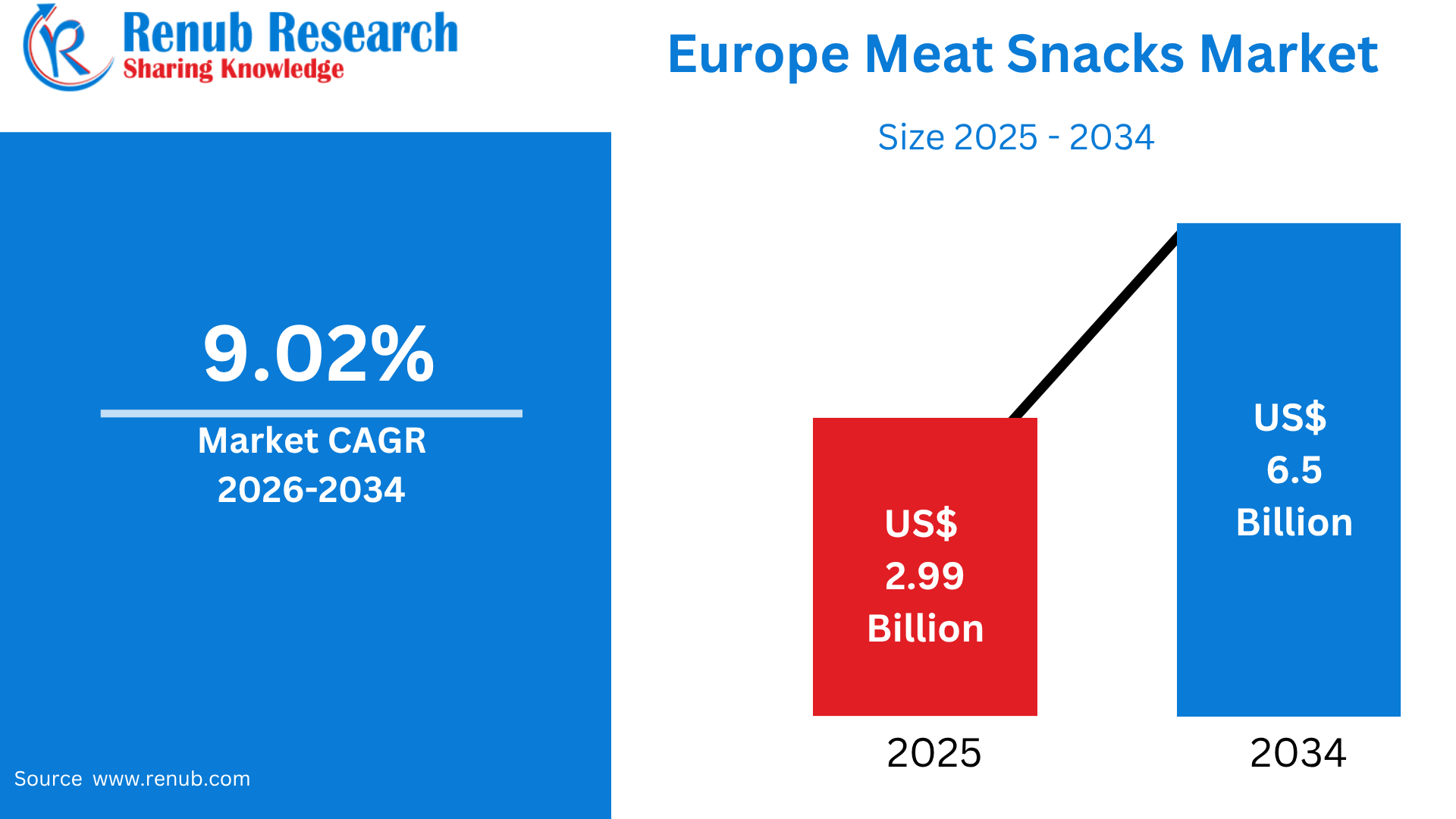
Europe Meat Snacks Market is expected to expand from US$ 2.99 billion in 2025 to approximately US$ 6.5 billion by 2034, growing at a CAGR of 9.02% during 2026–2034. Market expansion is supported by increasing consumer preference for convenient, protein-rich snack products and the growing trend toward on-the-go consumption. In addition, continuous product innovation, including premium, organic, and plant-based meat snack alternatives, is broadening consumer choices and creating new opportunities for market participants.
What is the Europe Meat Snacks Market and Its Uses & Popularity?
Europe meat snacks market comprises ready-to-eat meat-based products such as jerky, meat sticks, dried meat strips, salami snacks, sausages, and other portable processed-meat formats. These products are primarily consumed as convenient snacks between meals, during travel, at work, outdoor activities, and increasingly as protein-oriented options for active lifestyles. Meat snacks are valued for their portability, extended shelf life, portion-controlled packaging, and relatively high protein content. Their popularity is supported by established meat-consuming cultures across several European countries and the expansion of convenience and packaged-food retail channels.
According to the European Commission’s Knowledge4Policy database, European food-consumption data show substantial meat intake across different age groups, although consumption varies considerably between countries. Market research also identifies rising demand for convenient, high-protein snacks as an important factor supporting the European meat snacks sector. Manufacturers are increasingly expanding product ranges with premium, organic, lower-fat, reduced-additive, and innovative flavored products, allowing meat snacks to appeal to consumers seeking convenience alongside nutritional attributes.
Processed Meat Consumption Statistics in European Countries, 2024
- Germany: 5.3 million tonnes; approximately 64 kg per person.
- Spain: 2.6 million tonnes; approximately 54 kg per person.
- France: 2.4 million tonnes; per-capita figure not specified.
- United Kingdom: Approximately 3.8 million tonnes; per-capita figure not specified.
- Sweden: Per-capita processed meat consumption of approximately 49 kg per person; total volume not specified.
- Italy: Among the major processed-meat consuming countries in the European Union; specific 2024 volume not provided.
- Poland: Among the major processed-meat consuming countries in the European Union; specific 2024 volume not provided.
- Netherlands: Among the major processed-meat consuming countries in the European Union; specific 2024 volume not provided.
- Belgium: Among the major processed-meat consuming countries in the European Union; specific 2024 volume not provided.
Growth Drivers of the Europe Meat Snacks Market
Rising Demand for High-Protein and Convenient Snacks
The growing preference for protein-rich and convenient foods is a major driver of the European meat snacks market. Consumers increasingly seek snacks that can provide satiety and nutritional value without requiring preparation, making jerky, meat sticks, dried meat, and sausage snacks suitable for busy lifestyles. Market research identifies increasing protein intake among consumers, particularly younger adults and working professionals, as an important factor supporting meat-snack demand. The European Commission’s food-consumption database also demonstrates substantial meat consumption across European populations, although dietary patterns differ significantly by country and age group. The portability of meat snacks further supports their use during commuting, travel, outdoor recreation, and work breaks. Single-serving packaging and resealable formats enhance convenience and portion control. Manufacturers are responding by introducing products with higher protein content, new flavors, reduced sugar, and simpler ingredient lists. As convenience remains an important consideration in European food purchasing, the combination of portability and protein is expected to continue supporting market opportunities.
Expansion of On-the-Go Consumption and Retail Availability
The increasing popularity of on-the-go eating is creating favorable conditions for meat snacks across Europe. Consumers with busy work schedules increasingly favor foods that can be eaten without preparation, refrigeration immediately before consumption, or utensils. Meat sticks, jerky, dried sausages, and individually packaged meat products fit this consumption occasion particularly well. Market research identifies convenience, portability, and ready-to-eat characteristics as key factors behind the growing popularity of meat-stick formats in Europe. Wider availability through supermarkets, hypermarkets, convenience stores, grocery retailers, vending channels, specialty stores, and e-commerce is also increasing consumer access. The broader European food chain has extensive distribution infrastructure spanning production, wholesale, retail, food service, and consumption channels. In addition, the processed-meat sector provides an established manufacturing and distribution base. In 2024, approximately 35 million tonnes of processed meat were consumed across Europe according to IndexBox estimates. These established channels provide manufacturers with opportunities to introduce premium and specialized meat-snack products.
Product Innovation and Premiumization
Continuous product innovation is expanding the appeal of meat snacks beyond traditional processed-meat formats. European manufacturers are developing products with new flavor combinations, premium meat varieties, organic positioning, lower-fat formulations, and simplified ingredient lists to address changing consumer preferences. Market research highlights innovation in flavors, ingredients, packaging, and healthier recipes as an important trend in the European meat snacks industry. Organic and premium products can also provide manufacturers with opportunities to differentiate themselves in an increasingly competitive snack environment. Sustainability is another area of innovation, with companies exploring responsible sourcing, recyclable packaging, and alternative production practices. The broader European food industry is already experiencing significant innovation and changes in consumer purchasing patterns. Eurostat reported that EU food and non-alcoholic beverage prices increased 2.3% in 2024, while the wider food chain continued to adapt to changing consumer and environmental requirements. Manufacturers that combine convenient formats with distinctive flavors, transparent labeling, premium ingredients, and new product concepts can broaden the consumer base for meat snacks.
Challenges of the Europe Meat Snacks Market
Health Concerns Associated with Processed Meat Consumption
Health perceptions surrounding processed meat represent a significant challenge for the European meat snacks market. Many traditional meat snacks involve processing, curing, smoking, or the use of relatively high levels of sodium, which can create concerns among consumers seeking healthier diets. European dietary patterns are also changing, with greater attention to balanced nutrition and the environmental and health implications of food choices. The European Commission maintains extensive food-consumption datasets because understanding dietary exposure is important for nutrition and food-safety assessment. At the same time, the European processed-meat market has experienced a longer-term decline from its historical consumption peak: IndexBox estimates that processed-meat consumption in Europe reached about 35 million tonnes in 2024 but remained below the 45 million-tonne peak recorded in 2016. These trends encourage manufacturers to reformulate products through reduced sodium, lower fat, cleaner ingredient profiles, and portion-controlled packaging. The challenge is balancing improved nutritional positioning with taste, texture, shelf stability, and affordability.
Rising Production Costs and Meat Price Volatility
Raw-material costs and fluctuations in meat prices can pressure manufacturers’ margins and influence consumer purchasing decisions. Meat-snack production requires reliable supplies of beef, pork, poultry, or other meat inputs, while additional expenses arise from processing, energy, packaging, transportation, labor, and compliance. Eurostat reported that EU meat prices were 3.3% higher in February 2024 than in February 2023. Pork prices increased 5.7%, lamb and goat prices rose 4.5%, and beef and veal prices increased 3.0%, while poultry prices declined 1.6%. Although food-price inflation subsequently moderated, the cost base for food manufacturers remains sensitive to commodity and supply-chain conditions. Eurostat noted that food-price inflation fell substantially from 2023 to 2024, but many food prices remained at historically elevated levels. Meat-snack producers therefore face the challenge of maintaining competitive prices while protecting product quality and profitability. Premium positioning, efficient production, optimized packaging, and diversified sourcing can help manufacturers manage these cost pressures.
Meat Snacks Product Launches in Europe
SIDES Meat Snacks – United Kingdom, 2024
New World Foods, in collaboration with the Sidemen, launched the SIDES meat-snacking range in April 2024. The range included Buffalo Chicken, Chipotle Steak, and Korean BBQ Steak. The products were positioned as high-protein, low-calorie snacks and were initially introduced across 3,000 Tesco stores and 1,000 One Stop outlets in the UK.
2. Peperami Tapas – United Kingdom, 2024
Jack Link’s-owned Peperami introduced its Peperami Tapas range in April 2024, targeting adult consumers seeking premium at-home snacking options. The launch featured Chorizo and Salami snack sticks inspired by Spanish charcuterie and was positioned around bold flavors and protein-rich convenience.
3. Meateors Pork Meatballs – United Kingdom, 2024
Pork Farms launched Meateors in October 2024 as a ready-to-eat pork meatball snack brand. The initial range consisted of Spicy Fajita, Italian Style Herb, and Sweet BBQ Meateors. Each product was offered in a 50g pack and distributed through convenience stores, selected Morrisons Daily locations, and SPAR stores.
4. Snacker by Nõo Jerky Sticks – Estonia/Baltic Europe, 2024
Estonian producer Nõo Meat Factory introduced its Snacker Jerky Sticks at the PLMA trade show in Amsterdam in May 2024. The range was developed as a high-protein, low-fat meat snack smoked with alder wood chips and offered in Original, Emmental Cheese, Chilli, and Pepperoni varieties. Initial export markets included Latvia, Lithuania, Finland, and Sweden.
5. Knabber Nossi Salami Brezel – Austria, 2024
Maresi introduced Knabber Nossi Salami Brezel as a new salami-based snack designed for convenient consumption and sharing. The product uses 100% Austrian meat, is mildly seasoned, and comes in a seven-piece pack. Its monomaterial packaging also reflects the growing emphasis on convenient and more sustainability-oriented snack formats.
6. Casademont Fuetis Meat Snack Range – Spain, 2024
Spanish producer Casademont introduced Fuetis in March 2024 as an expanded meat-snack assortment. The range included salami sticks, salchichón sticks, and reduced-fat fuet sticks in 50g doypack packaging. The products were designed around convenience, variety, energy, and wellness-oriented consumption occasions.
7. All Y’alls “It’s Jerky Y’all” – European Union, 2025
All Y’alls Foods expanded its “It’s Jerky Y’all” plant-based jerky into 10 EU online marketplaces in October 2025. The launch covered Germany, the UK, France, Italy, Spain, the Netherlands, Sweden, Poland, Belgium, and Ireland. The expansion provides European consumers with a high-protein, fiber-rich alternative to conventional meat jerky.
8. Jack Link’s Organic Beef Jerky – Europe, 2025
Jack Link’s reportedly introduced a new organic beef jerky line in Europe in January 2025, targeting consumers interested in clean-label and high-protein snacks. The product was positioned around organic ingredients and sustainable sourcing, with distribution focused on premium retail and e-commerce channels.
9. Campofrío Meat Bars – Spain/Europe, 2024
Campofrío Food Group introduced meat bars in September 2024 featuring plant-based proteins and functional ingredients such as vitamins and minerals. The product concept reflects the industry’s movement toward hybrid formulations that combine animal protein with plant-based ingredients and nutritional positioning.
10. Peperami and Jack Link’s Meat-Snacking Innovations – United Kingdom, 2024
The UK market also saw continued innovation from Jack Link’s and its Peperami portfolio, with new formats and flavor-led products aimed at convenience and protein-focused snacking. The broader European category is increasingly emphasizing bold flavors, with smoked and chilli among the leading flavor profiles identified for recently launched European meat snacks.
High-Protein Convenience and Product Innovation Supporting Demand
Jerky remains an important category within Europe’s meat snacks market because of its portability, extended shelf life, and protein-rich nutritional profile. Beef is traditionally the leading raw material, while manufacturers are increasingly expanding into pork, turkey, chicken, and plant-based alternatives to accommodate changing consumer preferences. The European meat snacks market is benefiting from growing interest in convenient protein sources, particularly among consumers seeking portable foods for work, travel, exercise, and outdoor activities. According to the European Commission, meat consumption remains significant across European diets, although intake varies considerably by country and population group. Manufacturers are also differentiating jerky through flavors such as teriyaki, smoked paprika, barbecue, and Mediterranean seasoning. Improvements in resealable packaging and the expansion of online grocery platforms are increasing product accessibility. Premium, organic, reduced-sodium, and clean-label varieties are also emerging. These developments are enabling jerky brands to target consumers seeking convenient snacks while responding to evolving expectations surrounding nutrition, flavor, and ingredient transparency.
Traditional Consumption Patterns and Modern Product Formats Supporting Growth
Ham and sausage-based meat snacks maintain a strong position in Europe because of the region’s long-established traditions of cured, smoked, and fermented meat consumption. Products such as dry-cured ham, salami sticks, mini sausages, and smoked meat portions are particularly relevant in markets with strong charcuterie cultures, including Spain, Germany, Italy, and France. Europe’s processed-meat industry provides an established manufacturing and distribution infrastructure for these snack formats. IndexBox estimated European processed-meat consumption at approximately 35 million tonnes in 2024, although consumption remained below the peak recorded in 2016. Manufacturers are adapting traditional products to modern snacking occasions through smaller portions, resealable packaging, vacuum-sealed formats, and convenient single-serving packs. Health considerations are also encouraging the introduction of reduced-sodium, cleaner-label, and preservative-conscious products. This combination of established culinary traditions and contemporary packaging and formulation innovation is helping ham and sausage snacks remain relevant in Europe’s increasingly diversified convenience-food market.
Sustainability and Clean-Label Preferences Creating Premium Opportunities
Organic meat snacks are gaining attention in Europe as consumers increasingly consider product ingredients, farming practices, animal welfare, and environmental impacts when purchasing food. Organic jerky, cured meats, sausages, and dried meat strips are commonly positioned as premium alternatives to conventional products. The European Union has established harmonized organic-production rules covering areas including production methods, labeling, certification, and controls, helping provide a common framework for organic food products. Organic meat snacks can appeal to consumers seeking certified organic ingredients and greater transparency across the supply chain. However, higher production, certification, and sourcing costs generally contribute to premium retail prices. This creates a challenge for broader adoption, particularly among price-sensitive households. Manufacturers are therefore focusing on product differentiation through grass-fed sourcing, clean-label formulations, recognizable ingredients, and environmentally responsible packaging. As organic food distribution expands through supermarkets, specialty retailers, and online channels, organic meat snacks have opportunities to strengthen their presence within Europe’s premium and health-oriented snacking segment.
Affordability and Broad Retail Availability Maintaining Market Demand
Conventional meat snacks continue to represent an important part of the European market because of their relatively accessible prices, established consumer familiarity, and extensive retail availability. Traditional beef jerky, pork-based snacks, meat sticks, dried sausages, and other seasoned products are widely distributed through supermarkets, convenience stores, specialty retailers, and online platforms. European processed-meat consumption remains substantial, with IndexBox estimating approximately 35 million tonnes consumed in 2024. Price and taste remain important purchasing considerations, particularly when consumers face higher food costs. At the same time, conventional manufacturers are responding to changing health expectations by developing products with reduced sodium, fewer artificial additives, simpler ingredient lists, and improved nutritional profiles. Private-label products are also providing retailers with opportunities to compete on price while expanding their meat-snack assortments. Strong supermarket penetration and convenient single-serve formats continue to support the segment. Nevertheless, competition from organic products, plant-based snacks, and other high-protein alternatives is encouraging conventional brands to continually improve formulations and product positioning.
On-the-Go Consumption and Impulse Purchases Supporting Distribution Growth
Convenience stores represent an important retail channel for meat snacks because these outlets are designed around quick purchasing and immediate consumption. Meat sticks, jerky, mini sausages, and single-serving dried meat products are well suited to consumers seeking portable snacks during commuting, travel, work breaks, or other on-the-go occasions. The European convenience retail sector includes a wide network of small-format stores, forecourt retailers, kiosks, and other proximity outlets, providing manufacturers with extensive opportunities for impulse-oriented snack sales. According to Eurostat, EU households spent 14.8% of their total household expenditure on food and non-alcoholic beverages in 2024, illustrating the substantial role of food within household consumption. Retailers are expanding snack assortments with premium products, new flavors, and healthier formulations to increase basket value. Single-serve and resealable packaging further supports convenience. As consumers continue to prioritize speed and portability, convenience stores remain an important route to market for European meat-snack manufacturers.
Broad Product Assortments and Private Labels Strengthening Retail Sales
Grocery stores and supermarkets remain major distribution channels for meat snacks in Europe because they combine broad consumer reach with extensive product assortments. Retailers can offer conventional, premium, organic, reduced-sodium, and specialty meat snacks within dedicated snack, chilled, or packaged-meat sections. This enables consumers to compare brands, formats, ingredients, and prices in a single shopping environment. Eurostat reported that EU household expenditure on food and non-alcoholic beverages reached 13.2% of total household expenditure in 2024, highlighting the importance of grocery retail within household consumption. Private-label products are also becoming important as retailers seek to provide affordable alternatives while maintaining product quality and margins. Promotional campaigns, multi-buy offers, shelf displays, and new-product introductions can stimulate trial and repeat purchases. Online grocery services are further expanding access to meat snacks beyond physical stores. With extensive supermarket networks and increasingly diversified product ranges, grocery retailers are expected to remain a central channel for manufacturers seeking to reach mainstream European consumers.
France Gourmet Heritage and Health-Oriented Innovation Supporting Market Development
France’s meat snacks market is supported by the country’s strong charcuterie culture and growing consumer interest in premium, artisanal, and convenient food products. Traditional formats, including dried sausages, cured meats, and air-dried beef, continue to benefit from France’s established culinary heritage. At the same time, changing dietary preferences are encouraging consumers to consider products with simpler ingredients, lower fat, and improved nutritional profiles. This is prompting manufacturers to balance authentic flavors with contemporary health and convenience requirements. Product innovation is also extending beyond conventional meat, as consumers increasingly explore alternative proteins. In March 2024, Aoste introduced a new range of plant-based meat alternatives under its Better Balance brand, including burgers, sausages, breaded cutlets, and herb-based chunks. The products were positioned around nutritional quality and provided additional choices for consumers seeking alternatives to traditional meat. Such developments demonstrate how France’s meat-snacking landscape is combining established food traditions with innovation in health, nutrition, convenience, and alternative proteins.
Germany Strong Meat Consumption Culture and High-Protein Trends Driving Demand
Germany represents an important European market for meat snacks, supported by a well-established meat-processing industry and strong consumer familiarity with sausages, cured meats, and other convenient meat products. Bratwurst-style snack products, dried sausages, beef jerky, and meat sticks are suitable for consumers seeking portable foods for work, travel, and leisure activities. Growing participation in fitness and active lifestyles is also increasing interest in high-protein and lower-carbohydrate snack formats. Manufacturers are responding with products emphasizing protein content, convenient packaging, and differentiated flavors. Meanwhile, Germany’s market is experiencing growing interest in plant-based alternatives as consumers seek greater variety in protein sources. In July 2023, Beyond Meat expanded its German retail offering with new plant-based chicken products, increasing the availability of alternative-protein formats through major retail channels. This development illustrates the broader diversification of Germany’s snack market. The combination of established meat consumption, convenience, fitness-oriented nutrition, and alternative-protein innovation continues to influence the evolution of Germany’s meat snacks sector.
United Kingdom Convenience, Protein Nutrition, and Dietary Trends Supporting Market Expansion
United Kingdom meat snacks market is benefiting from increasing consumer demand for convenient, portable, and protein-rich foods. Products such as beef jerky, biltong, meat sticks, and other dried-meat formats are increasingly positioned as convenient options for consumers seeking snacks between meals or during busy daily schedules. Interest in high-protein dietary patterns has also created opportunities for meat snacks, particularly among consumers involved in fitness and active lifestyles. The growth of online grocery and specialty food retail has expanded access to a broader selection of domestic and international meat-snack brands. Manufacturers are also focusing on portion sizes, resealable packaging, and new flavors to address changing consumption habits. In October 2024, a UK pork-pie brand introduced Meateors, a ready-to-eat pork meatball snack designed for convenient consumption. The launch illustrates the expansion of meat snacks beyond conventional jerky and dried-meat formats. Continued product diversification, digital retail availability, and demand for portable protein are shaping opportunities across the UK market.
Spain Cured-Meat Heritage and Emerging Alternative Protein Trends Supporting Growth
Spain’s meat snacks market is strongly influenced by its longstanding tradition of cured and processed meats, particularly chorizo, jamón, salchichón, and other charcuterie products. These foods have an established role in Spanish cuisine and provide manufacturers with a strong foundation for developing convenient snack-sized formats. Increasing demand for premium quality, local sourcing, authentic flavors, and portability is encouraging companies to adapt traditional products for modern consumption occasions. Smaller portions and individually packaged cured meats are increasingly suitable for consumers looking for convenient snacks while maintaining traditional taste profiles. At the same time, Spain is experiencing innovation in alternative proteins and plant-based foods. In October 2023, researchers developed a clean-label meat substitute using carob under the Leggie brand, demonstrating efforts to incorporate locally relevant plant ingredients into meat alternatives. This combination of traditional cured-meat consumption and emerging alternative-protein innovation is diversifying the Spanish market. Premiumization, convenience, product reformulation, and new protein sources are expected to remain important themes in Spain’s evolving meat snacks industry.
Europe Meat Snacks Market Segments
Product
- Jerky
- Meat Sticks
- Pickled Sausages
- Ham Sausage
- Pickled Poultry Meat
- Others
Nature
- Conventional
- Organic
Distribution Channel
- Convenience Stores
- Supermarkets & Hypermarkets
- Grocery Stores
- Restaurants
- Others
Countries
- France
- Germany
- Italy
- Spain
- United Kingdom
- Belgium
- Netherlands
- Russia
- Poland
- Greece
- Norway
- Romania
- Portugal
- Rest of Europe
All companies have been covered with 5 Viewpoints
- Overviews
- Key Person
- Recent Developments
- SWOT Analysis
- Revenue Analysis
Company Analysis
- Meatsnacks Group
- Cremonini S.p.A.
- Jack Links EU
- Kingselitesnacks
- Danish Crown
- Kerry Group plc.
- Campofrio Food Group
- Espuña
- Giuseppe Citterio S.p.A.
- Bell Food Group AG
Report Details:
| Report Features | Details |
| Base Year |
2025 |
| Historical Period |
2022 - 2025 |
| Forecast Period |
2026 - 2034 |
| Market |
US$ Billion |
| Segment Covered |
Product, Nature, Distribution Channel and Countries |
| Countries Covered |
|
| Companies Covered |
|
| Customization Scope |
20% Free Customization |
| Post-Sale Analyst Support |
1 Year (52 Weeks) |
| Delivery Format |
PDF and Excel through Email (We can also provide the editable version of the report in PPT/Word format on request) |
Key Questions Answered in Report:
- What is the current size and expected growth rate (CAGR) of the Europe meat snacks market from 2025 to 2033?
- What are the primary factors driving the demand for meat snacks in Europe?
- How is the growing popularity of high-protein and clean-label diets (like keto and paleo) influencing the market?
- What are the key trends in product innovation and flavor diversification within the European meat snacks segment?
- How are retail and e-commerce channels shaping the distribution landscape for meat snacks in Europe?
- What role do organic and conventional meat snacks play in market segmentation and consumer preferences?
- What challenges does the meat snacks industry face in Europe regarding regulations and production costs?
- Which product types (e.g., jerky, meat sticks, ham sausage) are expected to dominate the market during the forecast period?
- How are individual countries such as Germany, France, the UK, and Spain contributing to regional growth?
- Who are the key companies operating in the European meat snacks market, and what are their strategic developments?
Customization Services available
- Analysis of Market Size and Its Segments
- More Company Profiles (Upto 10 without any additional cost):
- Additional Countries (Other than mentioned Countries):
- Region/Country Specific Reports:
- Market Entry Strategy:
- Region-Specific Market Dynamics:
- Regional Market Share Analysis:
- Trade Analysis:
- Production Insights:
- Others Customized Requests:
For more information contact our analysts.
Need More Assistance?
- Talk to our analysts to get more precious information on the current market trends.
- Include more countries and segments and customize the report based on the final requirement.
- Get a competitive advantage in your industry by knowing the report findings and making a positive impact on your revenues and operations.
- Our analysts are always ready to provide more help and pertinent information if you need any additional assistance.