Europe Luxury Hotel Market Report by Category, Type, Room Type, Booking Type, Countries and Companies Forecast 2026–2034
Buy NowEurope Luxury Hotel Market
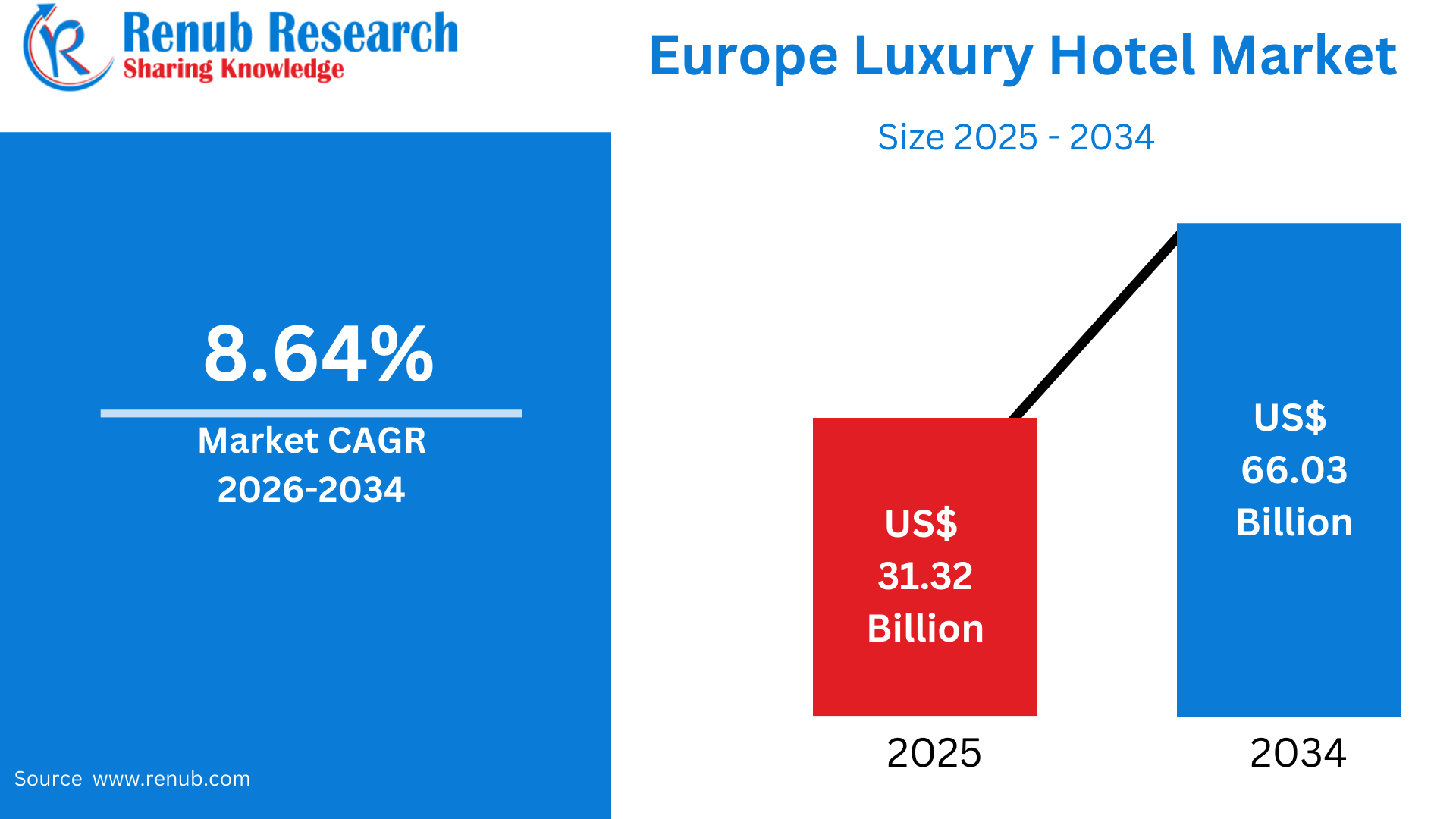
Europe Luxury Hotel Market is projected to expand from US$ 31.32 billion in 2025 to US$ 66.03 billion by 2034, registering a CAGR of 8.64% during the forecast period (2026–2034). Market growth is being driven by rising international tourist arrivals, increasing demand for premium travel experiences, and higher spending by high-net-worth individuals (HNWIs). The growing popularity of boutique luxury hotels, sustainable hospitality practices, wellness-focused accommodations, and technology-enabled personalized guest experiences is further accelerating industry expansion.
Europe Luxury Hotel Market Overview
Luxury hotels represent the highest tier of the hospitality industry, offering exceptional accommodations, personalized services, and premium amenities designed to deliver an exclusive guest experience. These properties feature elegantly designed rooms and suites, fine-dining restaurants, luxury spas, wellness centers, fitness facilities, concierge services, private lounges, and advanced in-room technologies. Every aspect of the guest experience is carefully curated to provide superior comfort, privacy, and convenience, making luxury hotels a preferred choice for affluent leisure travelers, business executives, celebrities, and high-net-worth individuals seeking world-class hospitality.
Europe remains one of the world’s most prestigious luxury hospitality destinations, benefiting from its rich cultural heritage, iconic architecture, historic landmarks, and globally recognized tourism appeal. Many luxury hotels are housed in restored palaces, castles, heritage buildings, and landmark properties, seamlessly blending historical elegance with contemporary design and modern amenities. Beyond premium accommodation, travelers are increasingly seeking immersive experiences that include Michelin-starred dining, luxury shopping, cultural festivals, wellness retreats, vineyard tours, and exclusive local experiences. The growing emphasis on experiential travel, eco-friendly luxury, digital concierge services, AI-powered personalization, and sustainable hotel operations is reshaping the European luxury hotel landscape. Supported by strong international tourism, rising premium travel demand, and continuous innovation in hospitality services, Europe is expected to maintain its leadership position in the global luxury hotel industry throughout the forecast period.
Nights Spent by International Tourists in 2025
- Spain – 330 million nights
- Italy – 265 million nights
- Turkey – 155 million nights
- France – 151 million nights
- United Kingdom (2024 data) – 150 million nights
- Greece – 131 million nights
- Austria – 97 million nights
- Croatia – 86 million nights
- Germany – 84 million nights
- Netherlands – 64 million nights
Source: Euronews (Datawrapper)
Growth Drivers of the Europe Luxury Hotel Market
Rising International Tourism and Growing High-Net-Worth Traveler Base
Europe continues to rank among the world’s most sought-after travel destinations, attracting millions of international visitors each year for leisure, business, cultural, and luxury tourism. The steady increase in high-net-worth individuals (HNWIs), ultra-high-net-worth families, and affluent millennials has significantly strengthened demand for premium hospitality experiences across the region. Luxury travelers increasingly seek exclusive accommodations, personalized services, privacy, and exceptional comfort, making luxury hotels the preferred choice. Renowned destinations such as Paris, London, Rome, Barcelona, the French Riviera, Venice, and the Swiss Alps continue to attract high-spending international tourists. Europe’s extensive transportation network, well-developed tourism infrastructure, simplified travel accessibility, and strong global connectivity further enhance its appeal to visitors from North America, the Middle East, and Asia-Pacific. Rising international arrivals, longer visitor stays, and sustained demand for premium travel experiences continue to support occupancy rates and revenue growth across the European luxury hotel sector, reinforcing its position as one of the world’s leading luxury hospitality markets. In 2025, the estimated number of nights spent at tourist accommodation establishments in the EU reached 3.08 billion, 61.5 million more than during the previous year. Europe continues to be one of the world’s favorite travel destinations, attracting millions of international tourists each year.
Growing Demand for Experiential and Personalized Luxury Travel
Recent statistics from the European Travel Commission show that international arrivals to the European continent were up 3% from January to September 2025, and overnight stays have grown 2.7%. This trend is materializing despite potentially adverse factors such as rising travel prices, heatwaves, and capacity constraints, underlining both the resilience and the maturity of the sector. Consumer preferences within the luxury travel segment are shifting from traditional accommodation toward highly personalized and experience-driven hospitality. Modern luxury travelers increasingly prioritize authentic cultural experiences, wellness retreats, gourmet dining, private excursions, and tailor-made itineraries over conventional hotel stays. European luxury hotels are responding by offering immersive experiences that reflect the region’s rich heritage, including palace hotels, historic castles, vineyard resorts, alpine retreats, coastal villas, and exclusive countryside estates. Advanced technologies such as artificial intelligence, smart room automation, digital concierge services, and data-driven personalization further enhance guest satisfaction by delivering customized recommendations and seamless hospitality experiences. Luxury hotels are also expanding wellness offerings through premium spas, holistic therapies, fitness programs, and medical wellness services. By combining exceptional accommodations with memorable lifestyle experiences, European luxury hotels are strengthening customer loyalty, increasing repeat visits, and creating opportunities to command premium pricing in an increasingly competitive market.
Expansion of Global Luxury Brands and Sustainable Hospitality
March 2025, APT, Australia's most renowned luxury travel company, has released its exclusive Europe holiday options for 2026. The range of Europe holiday options comes up with a number of carefully designed journeys that provide the finest luxury experiences tailored to suit various styles of traveling, namely River Cruising Holidays, Small Ship Cruising Holidays, Yacht Cruising Holidays, Small Group Tours, Land Tours, and Rail Holidays. The continuous expansion of international luxury hotel brands, combined with growing investment in sustainable hospitality, is accelerating the development of Europe’s luxury hotel market. Leading hospitality companies are investing heavily in new hotel developments, restoration of historic properties, luxury resort expansions, and premium lifestyle brands across major European destinations. At the same time, environmental sustainability has become a defining feature of luxury hospitality, with travelers increasingly favoring hotels that integrate responsible tourism practices into their operations. Luxury properties are adopting energy-efficient building designs, renewable energy solutions, waste reduction programs, locally sourced cuisine, water conservation systems, and eco-friendly guest services to reduce their environmental footprint. Many hotels are also restoring heritage buildings while preserving their architectural significance through sustainable renovation practices. These initiatives not only strengthen brand reputation but also attract environmentally conscious luxury travelers seeking responsible yet premium experiences, positioning sustainability as a major competitive advantage within Europe’s evolving luxury hospitality landscape.
Luxury Hotel Launches in European Countries
- Rosewood Amsterdam – Amsterdam, Netherlands (Opened 2025)
-
- Rosewood’s first property in the Netherlands, located in the restored former Palace of Justice along Amsterdam’s UNESCO-listed canals.
- The Chancery Rosewood – London, United Kingdom (Opening 2025)
-
- Luxury hotel developed in the iconic former U.S. Embassy on Grosvenor Square, featuring premium suites and fine-dining concepts.
- Six Senses London – London, United Kingdom (Opening 2025)
-
- Six Senses’ UK debut, transforming the historic Whiteleys building into a luxury wellness-focused hotel.
- Mandarin Oriental Vienna – Vienna, Austria (Opening 2025)
-
- Luxury hotel in a restored historic Art Nouveau building with an award-winning spa and premium hospitality.
- Airelles Venezia – Venice, Italy (Opening 2025)
-
- Airelles’ first international hotel, featuring luxury suites within restored historic Venetian palazzos on Giudecca Island.
- Lake Como EDITION – Lake Como, Italy (Opening 2025)
-
- EDITION Hotels’ first Italian lakeside resort offering contemporary luxury overlooking Lake Como.
- Vetera Matera (Relais & Châteaux) – Matera, Italy (Opened 2025)
-
- Boutique luxury hotel carved into the UNESCO-listed Sassi cave district, blending heritage architecture with modern luxury.
- Kimpton Main Frankfurt – Frankfurt, Germany (Opened 2025)
-
- Kimpton’s first hotel in Germany, offering luxury lifestyle accommodations in Frankfurt’s financial district.
- Kimpton Los Monteros Marbella – Marbella, Spain (Reopened 2025)
-
- Restored iconic Costa del Sol luxury resort under IHG’s Kimpton luxury lifestyle brand.
- Van Oys Maastricht Retreat – Eijsden, Netherlands (Opened 2025)
-
- Luxury countryside retreat housed in a historic estate near Maastricht, offering boutique hospitality and wellness experiences.
Challenges of the Europe Luxury Hotel Market
High Development and Operating Costs
One of the major challenges facing Europe’s luxury hotel industry is the substantial investment required to develop, operate, and maintain premium hospitality properties. Luxury hotels demand prime locations, iconic architecture, sophisticated interior design, premium furnishings, advanced technologies, and world-class amenities, all of which require significant capital expenditure. Operational costs are equally high due to the need for highly trained staff, personalized guest services, fine dining operations, wellness facilities, security, and continuous property upgrades. In addition, strict building regulations, heritage preservation requirements, environmental compliance standards, and sustainability certifications across many European countries further increase development and maintenance expenses. These financial pressures can limit profitability and create significant barriers for new market entrants while encouraging established operators to focus on operational efficiency and long-term value creation.
Economic Volatility and Seasonal Tourism Patterns
Europe’s luxury hotel market is also influenced by changing economic conditions and seasonal tourism demand. Factors such as inflation, currency fluctuations, geopolitical tensions, economic slowdowns, and shifts in consumer confidence can directly affect international travel and discretionary spending on luxury experiences. Since premium hospitality largely depends on affluent travelers, any decline in luxury travel expenditure can impact occupancy rates and hotel revenues. Additionally, many of Europe’s leading tourist destinations experience pronounced seasonal demand, with peak occupancy occurring during summer holidays, festive seasons, and major international events, while off-season periods often witness lower visitor numbers. Hotel operators must therefore implement dynamic pricing strategies, diversify target customer segments, and strengthen business travel, wellness tourism, and year-round experiential offerings to maintain stable occupancy levels and optimize revenue throughout the year.
Europe Chain Luxury Hotel Market
The Europe chain luxury hotel market is expanding steadily, supported by the strong presence of globally recognized hospitality brands that offer premium accommodations, consistent service quality, and trusted guest experiences. International hotel groups such as Marriott International, Accor, Hilton, Hyatt, IHG Hotels & Resorts, and Four Seasons continue to strengthen their luxury portfolios across major European cities and renowned resort destinations. Their extensive loyalty programs, global reservation platforms, and international marketing capabilities enable them to attract both leisure and business travelers from around the world. To remain competitive, luxury hotel chains are investing heavily in digital transformation, sustainability initiatives, smart hospitality technologies, and personalized guest services. Their large-scale operations also allow for greater operational efficiency, standardized training, and consistent service delivery. Increasingly, these brands are integrating local architecture, regional cuisine, cultural experiences, and destination-specific design into their properties, creating an ideal balance between global brand reliability and authentic European hospitality that continues to drive long-term market growth.
Europe Luxury Business Hotel Market
The Europe luxury business hotel market is driven by rising corporate travel, international business activities, and the growing demand for premium accommodations among executives and business professionals. These hotels are strategically located within major financial and commercial hubs such as London, Paris, Frankfurt, Zurich, Amsterdam, and Milan, providing convenient access to business districts, convention centers, and corporate headquarters. Luxury business hotels offer premium meeting facilities, executive lounges, high-speed internet connectivity, private workspaces, concierge services, and advanced conference technologies to support corporate events and business travelers. Many properties have also expanded their wellness offerings, fine dining experiences, fitness centers, and work-life balance amenities to meet evolving customer expectations. The continued growth of international conferences, exhibitions, and MICE (Meetings, Incentives, Conferences, and Exhibitions) tourism further strengthens demand for luxury business hotels. As organizations increasingly prioritize employee comfort, productivity, and premium travel experiences, the segment is expected to maintain strong occupancy and revenue growth throughout the forecast period.
Europe Luxury Holiday Hotel Market
Europe’s luxury holiday hotel market continues to thrive as the region remains one of the world’s most desirable destinations for premium leisure travel. Luxury resorts, boutique hotels, beachfront properties, alpine retreats, countryside estates, and heritage accommodations across destinations such as the French Riviera, Amalfi Coast, Greek Islands, Swiss Alps, and Spain attract affluent travelers seeking exclusive and immersive vacation experiences. Modern luxury holiday hotels emphasize personalized hospitality, wellness retreats, gourmet dining, cultural exploration, private excursions, and destination-inspired experiences that go beyond traditional accommodation. Growing demand from honeymooners, families, luxury vacationers, and multigenerational travelers has encouraged hotels to enhance privacy, architectural uniqueness, and bespoke guest services. Sustainability has also become a major differentiator, with luxury holiday properties adopting eco-friendly operations, green building practices, and responsible tourism initiatives. Rising disposable incomes, expanding international tourism, and increasing demand for high-end leisure experiences continue to position the luxury holiday hotel segment as a key contributor to Europe’s premium hospitality industry.
Europe Upper-Upscale Hotel Market
The Europe upper-upscale hotel market represents a fast-growing segment that bridges the gap between traditional upscale hotels and ultra-luxury properties. These hotels appeal to travelers seeking premium accommodations, high-quality services, and sophisticated amenities at relatively accessible price points compared to luxury hotels. Upper-upscale properties are commonly located in major cities, business districts, airport hubs, and emerging leisure destinations, offering spacious guest rooms, contemporary interiors, upscale restaurants, wellness facilities, meeting spaces, and exceptional customer service. The segment attracts affluent business travelers, international tourists, young professionals, and high-income millennials who value premium experiences while maintaining cost efficiency. Increasing demand for value-oriented luxury, flexible travel options, and modern lifestyle hospitality continues to drive investment in this category. As travelers seek greater comfort, convenience, and personalized experiences without the premium pricing of ultra-luxury hotels, the upper-upscale segment is expected to experience sustained growth across Europe.
Europe Luxury Hotel Direct Booking Market
The Europe luxury hotel direct booking market is expanding rapidly as hotel operators encourage guests to reserve accommodations through official brand websites and proprietary mobile applications. Direct booking enables hotels to strengthen customer relationships, reduce dependence on third-party booking platforms, and minimize commission expenses while maintaining greater control over pricing strategies and guest data. To encourage direct reservations, luxury hotels increasingly offer exclusive member discounts, complimentary upgrades, personalized travel packages, flexible cancellation policies, loyalty rewards, and value-added services unavailable through online travel agencies. Investments in artificial intelligence, mobile booking technologies, digital concierge services, and personalized recommendation engines are further enhancing the direct booking experience. By collecting valuable customer insights and delivering tailored communication before, during, and after each stay, luxury hotels can improve guest satisfaction, encourage repeat visits, and strengthen long-term brand loyalty, making direct booking an increasingly important revenue channel across Europe’s luxury hospitality sector.
Europe Luxury Hotel Travel Agents Market
Luxury travel agencies continue to play an important role in Europe’s premium hospitality market, particularly for high-net-worth individuals, corporate executives, and travelers planning complex or multi-destination itineraries. Specialized luxury travel advisors provide highly personalized travel planning, exclusive hotel recommendations, concierge services, and customized vacation packages that are difficult to replicate through self-service online platforms. Their long-standing relationships with luxury hotels often provide clients with preferential rates, complimentary room upgrades, VIP privileges, early check-in, late check-out, and exclusive amenities. Travel agents are especially valuable for destination weddings, luxury cruises, extended European tours, family vacations, and bespoke travel experiences spanning multiple countries. Although online bookings continue to increase, affluent travelers still rely on experienced travel advisors for expert destination knowledge, personalized itinerary planning, and seamless travel management. As experiential luxury tourism continues to grow, travel agencies remain an essential distribution channel, helping luxury hotels attract high-value guests while delivering exceptional and customized travel experiences.
United Kingdom Luxury Hotel Market
The United Kingdom luxury hotel market is supported by strong international tourism, a mature business travel ecosystem, and the country’s global reputation for history, culture, fashion, and premium hospitality. London remains the dominant market, hosting a large concentration of luxury and ultra-luxury hotels that cater to business executives, diplomats, high-net-worth individuals, and international leisure travelers. The city combines iconic heritage properties with contemporary luxury hotels, offering guests a blend of historic elegance and modern hospitality. Beyond London, destinations such as Edinburgh, Manchester, the Cotswolds, Bath, and the Scottish Highlands continue to attract affluent travelers seeking cultural experiences, countryside retreats, and wellness tourism. Luxury hotels are increasingly investing in sustainable operations, digital guest services, personalized experiences, and wellness-focused amenities to meet changing consumer expectations. Continued investment in premium accommodations and the expansion of independent luxury hotel collections are expected to strengthen the United Kingdom’s position as one of Europe’s leading luxury hospitality markets.
France Luxury Hotel Market
France remains one of the world’s premier luxury hospitality destinations, benefiting from its global reputation for fashion, gastronomy, art, culture, and tourism. Paris serves as the country’s luxury hotel hub, featuring world-renowned palace hotels, internationally recognized luxury brands, and exclusive boutique properties that cater to affluent leisure and business travelers. Beyond the capital, destinations such as the French Riviera, Provence, Bordeaux, the Loire Valley, and the French Alps attract visitors seeking premium resort experiences, vineyard retreats, and luxury wellness tourism. French luxury hotels emphasize elegant architecture, exceptional dining, personalized guest services, and authentic cultural experiences that reflect the country’s heritage. Sustainability, experiential travel, and heritage restoration are becoming increasingly important across the sector as luxury travelers seek environmentally responsible yet exclusive accommodations. Continuous investment from global hospitality groups and prestigious luxury brands is expected to reinforce France’s leadership position within Europe’s luxury hotel industry.
Italy Luxury Hotel Market
Italy’s luxury hotel market continues to expand, driven by the country’s exceptional cultural heritage, world-famous cuisine, luxury shopping, and iconic tourism destinations. Major cities including Rome, Milan, Venice, Florence, and Naples attract affluent international travelers interested in history, art, fashion, and business tourism. At the same time, luxury resort destinations such as the Amalfi Coast, Lake Como, Tuscany, Sardinia, Sicily, and the Italian Lakes remain highly desirable among high-end leisure travelers. Many luxury hotels operate within restored palaces, historic villas, castles, and heritage buildings, offering guests a unique combination of historical charm and contemporary luxury. Premium hospitality providers increasingly focus on personalized services, Michelin-star dining, wellness experiences, destination weddings, and authentic local experiences to differentiate themselves. Rising demand for experiential travel, slow tourism, luxury vacations, and exclusive lifestyle experiences continues to support investment and innovation across Italy’s premium hospitality sector.
Spain Luxury Hotel Market
Spain’s luxury hotel market is experiencing steady growth, supported by the country’s thriving tourism industry, favorable climate, diverse landscapes, and internationally renowned holiday destinations. Major cities such as Madrid and Barcelona continue to attract luxury business and leisure travelers, while premium coastal destinations including Costa del Sol, the Balearic Islands, the Canary Islands, Ibiza, and Marbella remain popular among affluent international tourists. Luxury hotels increasingly focus on resort-style accommodations, wellness retreats, golf tourism, fine dining, yacht experiences, and personalized hospitality services to enhance guest satisfaction. Boutique luxury hotels and exclusive lifestyle resorts are also gaining popularity as travelers seek more intimate and authentic experiences. Sustainability has become an important differentiator, with many luxury properties adopting eco-friendly building designs, renewable energy solutions, and responsible tourism practices. Continued investment by international hospitality companies and the renovation of iconic luxury properties are expected to further strengthen Spain’s position as one of Europe’s fastest-growing luxury hotel markets.
Market Segmentation
Category
- Chain
- Independent
Type
- Business Hotels
- Holiday Hotels
- Resorts & Spa
- Airport Hotels
- Others
Room Type
- Luxury
- Upper-Upscale
- Upscale
Booking Type
- Direct Booking
- Travel Agents
- Online Travel Agencies
Countries
- France
- Germany
- Italy
- Spain
- United Kingdom
- Belgium
- Netherlands
- Russia
- Poland
- Greece
- Norway
- Romania
All companies have been covered with 5 Viewpoints
- Overviews
- Key Person
- Recent Developments
- SWOT Analysis
- Revenue Analysis
Key Players Analysis
- Accor
- Best Western
- IHG Hotels & Resorts
- Groupe Du Louvre
- Carlson-Rezidor
- NH Hotels
- Hilton Worldwide
- Melia International
- Marriott International Inc.
- Hyatt Corporation
Report Details:
| Report Features | Details |
| Base Year |
2025 |
| Historical Period |
2022 - 2025 |
| Forecast Period |
2026 - 2034 |
| Market |
US$ Billion |
| Segment Covered |
Category, Type, Room Type, Booking Type and Countries |
| Countries Covered |
|
| Companies Covered |
|
| Customization Scope |
20% Free Customization |
| Post-Sale Analyst Support |
1 Year (52 Weeks) |
| Delivery Format |
PDF and Excel through Email (We can also provide the editable version of the report in PPT/Word format on request) |
Customization Services available
- Analysis of Market Size and Its Segments
- More Company Profiles (Upto 10 without any additional cost):
- Additional Countries (Other than mentioned Countries):
- Region/Country Specific Reports:
- Market Entry Strategy:
- Region-Specific Market Dynamics:
- Regional Market Share Analysis:
- Trade Analysis:
- Production Insights:
- Others Customized Requests:
For more information contact our analysts.
Need More Assistance?
- Talk to our analysts to get more precious information on the current market trends.
- Include more countries and segments and customize the report based on the final requirement.
- Get a competitive advantage in your industry by knowing the report findings and making a positive impact on your revenues and operations.
- Our analysts are always ready to provide more help and pertinent information if you need any additional assistance.