Europe LIPIDS Market Report by Product, Types, Source, Application, Countries and Companies Analysis 2026-2034
Buy NowEurope Lipids Market Size and Forecast
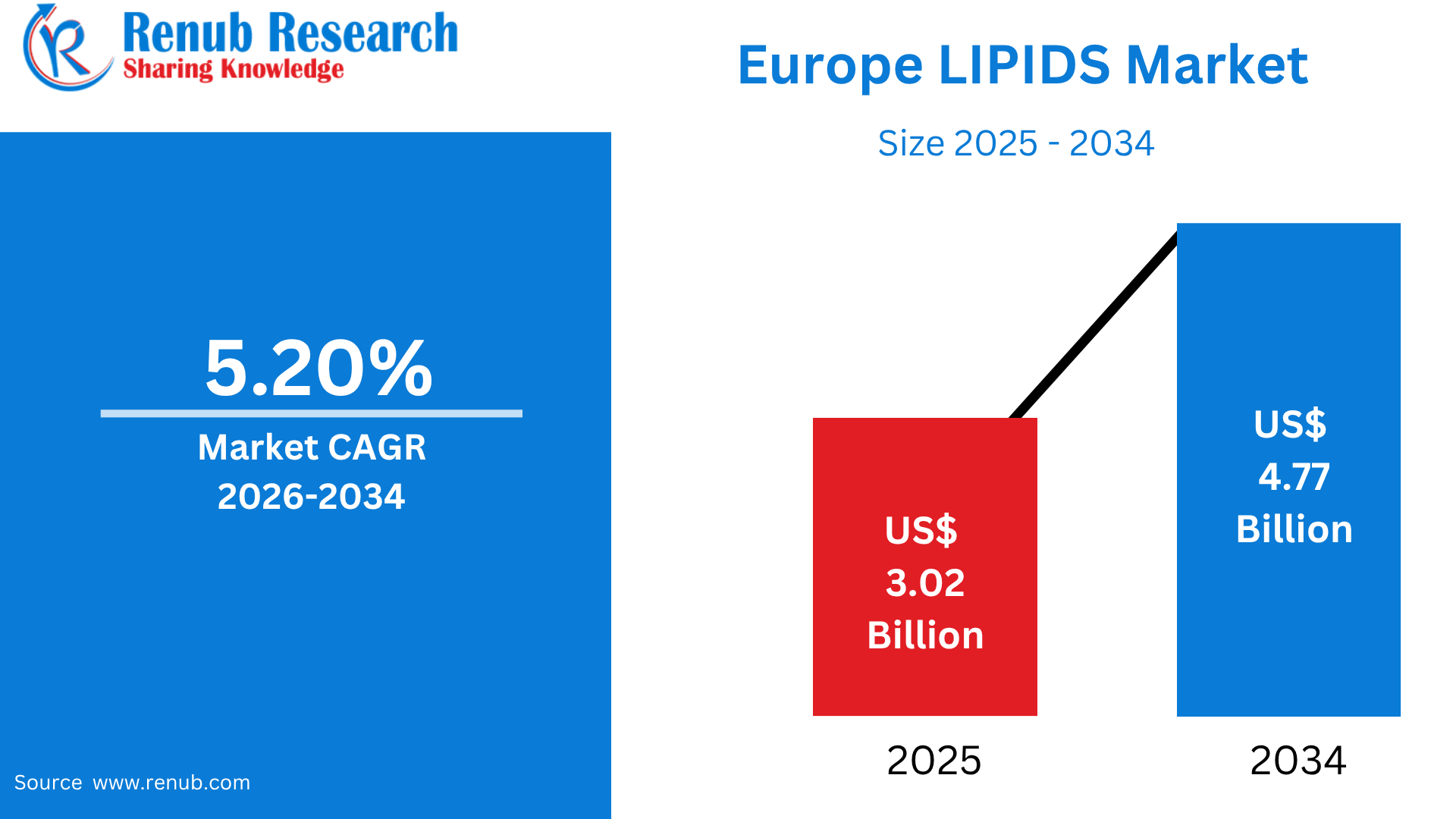
Europe Lipids Market is projected to grow from US$ 3.02 billion in 2025 to US$ 4.77 billion by 2034, expanding at a CAGR of 5.2% during 2026–2034. Market growth is being supported by increasing consumer awareness of preventive healthcare, healthy aging, and balanced nutrition across Europe. In addition, rising applications of lipid-based ingredients in dietary supplements, infant nutrition, clinical nutrition, functional foods, and pharmaceutical formulations are creating new growth opportunities. Advancements in sustainable lipid production, including the development of alternative and environmentally friendly lipid sources, are further contributing to the expansion of the European lipids market.
What is the Europe Lipids Market and Its Uses & Popularity?
Europe lipids market comprises fats, oils, fatty acids, triglycerides, phospholipids, sterols, omega-3 and omega-6 fatty acids, and other specialty lipid ingredients used across food, nutrition, pharmaceuticals, cosmetics, and biotechnology. Lipids perform important functions as energy sources, nutritional ingredients, emulsifiers, carriers, stabilizers, and drug-delivery components.
In food and beverages, they are incorporated into functional foods, infant nutrition, dairy products, bakery products, dietary supplements, and medical nutrition. In pharmaceuticals, lipid excipients and lipid-based delivery systems can improve the solubility, stability, and bioavailability of selected active ingredients. Demand is also increasing for omega-3 ingredients associated with cardiovascular and nutritional wellness. The European market benefits from strong pharmaceutical and food-processing industries. EU pharmaceutical production was estimated at €285 billion in 2023, while pharmaceutical exports supported 926,000 EU jobs in 2023, demonstrating the scale of the sector in which specialized lipid ingredients are used.
European Union Food Supplement Regulations
European Union has established a harmonized regulatory framework for food supplements through Directive 2002/46/EC, with particular emphasis on products containing vitamins, minerals, and other active substances. The directive establishes requirements concerning important areas such as product labeling, ingredient safety, and consumer information. The introduction of new ingredients is subject to safety and risk assessment, with the European Food Safety Authority (EFSA) playing a central role in evaluating scientific evidence. EFSA also assesses health claims made for food supplements to ensure that they are supported by credible scientific evidence.
The European Federation of Associations of Health Product Manufacturers (EHPM) represents manufacturers and distributors of health products across Europe and serves as a major industry association for the dietary supplements sector. It supports businesses in understanding and complying with European regulatory requirements while promoting the production of safe and high-quality products.
Although EU legislation provides a common regulatory foundation, differences remain among individual member states. Certain countries maintain additional requirements or restrictions on specific ingredients, including herbal extracts. In some cases, particular ingredients may be subject to pharmaceutical controls, creating variations in the marketing and availability of food supplements across European markets.
France Food Supplement Regulations
In France, food supplements are regulated under Decree No. 2006-352, which implements the principles established under EU Directive 2002/46/EC. The framework aims to ensure that food supplements meet applicable requirements for safety, quality, composition, labeling, and regulatory conformity before and during their marketing.
The Syndicat National des Compléments Alimentaires (Synadiet) is the French trade association representing companies involved in the food supplement industry. The organization contributes to industry education by providing information and regulatory guidance to manufacturers and supporting awareness of applicable standards. Its activities help businesses better understand regulatory obligations and encourage compliance with the requirements governing food supplements in France.
Growth Drivers of the Europe Lipids Market
Rising Demand for Nutritional Supplements and Functional Foods
Increasing consumer interest in preventive healthcare, healthy aging, and nutritional wellness is supporting demand for specialty lipids across Europe. Omega-3 fatty acids, MCTs, phospholipids, plant sterols, and other lipid ingredients are increasingly incorporated into dietary supplements and functional foods positioned around cardiovascular, cognitive, metabolic, and general wellness. The Europe omega-3 supplements market is projected to grow at an 8.3% CAGR from 2024 to 2031, reflecting strong consumer and commercial interest in omega-3 products. Germany represented the leading European country market in 2023, while France was projected to record a 9.1% CAGR over the same period. The broader expansion of functional nutrition is creating opportunities for suppliers of purified and application-specific lipids. Demand for convenient nutritional products, scientifically supported formulations, and targeted supplementation is encouraging food and supplement manufacturers to develop products with higher-value lipid ingredients. This trend is expected to remain a major contributor to European lipids market expansion.
Lipids Product Launches in Europe
- CordenPharma LNP Starter Kits – Europe, 2024
CordenPharma introduced its Lipid Nanoparticle (LNP) Starter Kits in February 2024 to support mRNA formulation development. The kits contain four key lipid components—ionizable lipids, helper lipids, PEGylated lipids, and sterols—for applications including mRNA vaccines and gene therapies. - EPAX® Omega 3-9-11 – Europe, 2024
Epax launched EPAX® Omega 3-9-11 in March 2024, a concentrated marine oil combining omega-3 EPA and DHA with long-chain omega-9 and omega-11 fatty acids. The ingredient was developed for applications including skin-health and metabolic-health supplements. - Valbiotis®PRO Cholestérol with Lipidrive® – France, 2024
Valbiotis launched Valbiotis®PRO Cholestérol in France in May 2024. The dietary supplement contains Lipidrive®, a patented plant-derived active ingredient developed for managing mild-to-moderate hypercholesterolemia. The product became available through pharmacies and the company’s e-commerce platform. - Krill Phospholipids PL+DHA – Europe, 2024
Spanish supplement manufacturer Cien por Cien Natural launched a krill phospholipid and DHA product in Europe in 2024 using Aker BioMarine’s PL+ technology. The formulation uses marine phospholipids as a delivery platform for DHA and was positioned around improved absorption and bioavailability. - Lipidol Animal Nutrition Supplements – Central & Eastern Europe, 2024
Brenntag Specialties announced an exclusive distribution agreement for Pathway Intermediates’ Lipidol range in December 2024. The lipid-based absorption-enhancer products were made available to customers in animal nutrition and pet food across Central and Eastern Europe, Benelux, and Nordic markets. - EPAX® Evolve 05 – Europe, 2025
Epax launched EPAX® Evolve 05 in April 2025 at Vitafoods Europe. The product was introduced as the first commercially available very-long-chain polyunsaturated fatty acid (VLC-PUFA) product, expanding the range of specialized omega-3 lipid ingredients available for nutritional applications. - LipoGalen™ – Germany/Europe, 2025
Germany-based IOI Oleo launched LipoGalen™ in October 2025 as a new family of functional lipid-based excipients. The polyglycerol ester platform was developed for pharmaceutical formulations and made its debut at CPHI Frankfurt, addressing formulation requirements involving stability and functionality. - Kensing Sunflower-Derived Plant Sterols – Europe, 2025
Kensing received EFSA novel-food approval in 2025 for plant sterols developed from sunflower seeds at its Spanish facility. The ingredient provides food, beverage, and supplement manufacturers with an alternative source of plant sterols and combines lipid functionality with an upcycled-source positioning. - Marble7® Bioactive Lipid – Sweden/Europe, 2026
Swedish precision-fermentation company Melt&Marble commercially launched Marble7® in 2026 as its first commercially available personal-care ingredient. The bioactive lipid is produced through precision fermentation and was developed for personal-care formulations, representing the expansion of biotechnology-derived lipids into cosmetics. - Valbiotis®PRO Metabolic Health – France, 2025
Valbiotis launched Valbiotis®PRO Metabolic Health in France in February 2025 following the earlier launch of its Lipidrive®-based cholesterol product. The product is based on the company’s TOTUM•63 ingredient and expands its portfolio of clinically developed nutritional products targeting metabolic health.
Expanding Pharmaceutical Applications and Lipid-Based Drug Delivery
The pharmaceutical sector is an important growth engine for the European lipids market because specialty lipids are used as excipients, carriers, and components of advanced drug-delivery systems. Lipid-based formulations can help address challenges involving poorly water-soluble active pharmaceutical ingredients by improving formulation performance and, in appropriate applications, bioavailability. Europe’s large pharmaceutical manufacturing base provides substantial downstream demand. Eurostat reported that EU sold production of basic pharmaceutical products and pharmaceutical preparations increased 12.7% in value from €234 billion in 2023 to €263 billion in 2024. In addition, pharmaceutical exports to non-EU countries supported approximately 926,000 jobs across the EU in 2023, including 325,000 direct pharmaceutical-industry jobs. Growing investment in advanced formulations, biologics, targeted delivery technologies, and pharmaceutical excipients is therefore creating opportunities for high-purity triglycerides, phospholipids, ionizable lipids, and other specialty lipid materials.
Innovation in Sustainable and Specialty Lipid Production
Innovation in sustainable lipid production is creating new opportunities for the European market as manufacturers seek alternatives to conventional raw materials and respond to environmental and supply-chain considerations. Companies and research organizations are exploring plant-based, microbial, algae-derived, and other alternative lipid sources for food, nutrition, cosmetics, and pharmaceutical applications. Biotechnology is particularly important because it can enable the development of more specialized lipid molecules with controlled composition and functionality. Europe’s broader industrial and pharmaceutical ecosystem provides a strong foundation for this innovation. Eurostat reported that pharmaceutical manufacturing was one of the fastest-growing major manufacturing groups in the EU in 2024, with sold production increasing 12.7% year over year. Meanwhile, demand for sustainable and scientifically characterized ingredients is encouraging suppliers to invest in purification, fermentation, biotechnology, and formulation technologies. Such developments can expand the range of lipid ingredients available to manufacturers while supporting higher-value applications across nutrition, healthcare, food, and personal care.
Challenges of the Europe Lipids Market
Regulatory Requirements and Product-Quality Standards
Strict regulatory requirements represent an important challenge for lipid manufacturers and suppliers operating in Europe. Lipid ingredients used in food, dietary supplements, infant nutrition, pharmaceuticals, and cosmetics may be subject to different safety, purity, labeling, traceability, and authorization requirements depending on their application. Pharmaceutical-grade lipids face particularly demanding quality and manufacturing requirements because they can be used as excipients or components of advanced drug-delivery systems. Compliance can increase development costs, testing requirements, documentation, and time to market. Europe’s highly developed pharmaceutical sector illustrates the importance of maintaining consistent quality throughout the supply chain. EU pharmaceutical products generated €277 billion in extra-EU exports in 2023, highlighting the scale and international significance of the sector. For lipid suppliers, meeting increasingly sophisticated customer specifications while maintaining batch consistency and regulatory compliance can be resource-intensive. Smaller companies may face greater difficulties because certification, analytical testing, and regulatory expertise require significant investment.
Raw-Material Costs, Supply-Chain Volatility, and Sustainability Pressures
Fluctuations in raw-material availability and pricing can create challenges for European lipid manufacturers. Many lipid ingredients depend on agricultural, marine, or specialty biological feedstocks, making production costs sensitive to commodity prices, weather conditions, fisheries supply, geopolitical disruptions, and transportation expenses. Sustainability requirements can add another layer of complexity, particularly for companies sourcing marine oils, animal-derived lipids, palm-derived ingredients, or other materials with environmental considerations. Manufacturers are consequently investing in alternative sources such as algae, microbial oils, and plant-derived ingredients, but these technologies can involve higher production costs or require additional scale-up and purification capabilities. At the same time, Europe’s food and pharmaceutical industries are large and competitive markets. EU manufacturing sold production of food, beverages, and tobacco reached approximately €1.081 trillion in 2024, while pharmaceutical production reached €263 billion. Suppliers must therefore balance cost competitiveness, reliable supply, sustainability objectives, and consistent product quality while developing differentiated lipid ingredients.
Growing Applications in Nutrition, Pharmaceuticals, and Functional Foods
European triglycerides market is supported by broad applications across food and beverages, pharmaceuticals, nutraceuticals, sports nutrition, and personal care. Medium-chain triglycerides (MCTs) are particularly important because they are rapidly absorbed and are increasingly incorporated into functional foods, dietary supplements, and specialized nutrition products. The European sports nutrition and wellness trends are creating additional opportunities for MCT-based formulations. In pharmaceuticals, triglycerides are used as excipients and lipid carriers in formulations designed to improve the solubility and bioavailability of poorly water-soluble active ingredients. The market is also benefiting from interest in weight management and healthier dietary patterns. According to the European Commission, obesity affected 15.6% of adults in the EU in 2022, while another 36.0% were pre-obese, demonstrating the substantial population exposed to weight-related health concerns. Manufacturers are responding by developing specialty triglycerides with improved functionality, cleaner ingredient profiles, and traceable sourcing. Continued innovation in clinical nutrition, nutraceuticals, and lipid-based pharmaceutical delivery is expected to maintain demand for triglyceride ingredients across Europe.
Expanding Nutraceutical and Pharmaceutical Applications
Europe phospholipids market is developing through applications in pharmaceuticals, nutraceuticals, food, infant nutrition, and cosmetics. Phospholipids possess emulsifying properties and are important structural components of biological membranes, making them useful in nutritional and pharmaceutical formulations. Soy and sunflower lecithins are widely used as natural phospholipid sources, while specialized phospholipid ingredients are increasingly incorporated into products targeting cognitive health, liver health, healthy aging, and sports nutrition. Pharmaceutical applications represent an important opportunity because phospholipids are used in liposomes and other lipid-based delivery technologies. The European pharmaceutical sector provides a substantial research and manufacturing base; Eurostat reported that EU pharmaceutical manufacturing generated approximately €313 billion in sold production value in 2023, illustrating the scale of the industry supporting demand for advanced formulation ingredients. Growing interest in plant-derived and clean-label ingredients is also encouraging manufacturers to develop sunflower-based alternatives to traditional soy-derived phospholipids. Furthermore, advances in liposomal formulations and lipid nanoparticles are increasing the technological importance of phospholipids. Product innovation, pharmaceutical research, and demand for natural nutritional ingredients are expected to support continued development of the European phospholipid market.
Food, Animal Nutrition, and Specialty Applications Supporting Demand
Animal-derived lipids remain an important component of Europe’s broader lipid industry, with applications in food processing, animal feed, pharmaceuticals, cosmetics, and industrial products. Tallow, lard, fish oils, and other animal-derived fats can provide functional properties such as energy density, texture, stability, and formulation performance. In animal nutrition, lipid ingredients are used as concentrated energy sources and can contribute to feed palatability and nutritional formulations. The European livestock industry provides a significant demand base: Eurostat reported that the EU had approximately 134 million pigs, 74 million cattle, 61 million sheep, and 10 million goats in 2023. However, the segment is increasingly influenced by traceability, sustainability, food safety, and consumer preferences regarding animal-derived ingredients. Manufacturers are consequently focusing on responsible sourcing, rendering efficiency, quality control, and value-added processing. Regulatory compliance is particularly important because animal-derived materials used in food, feed, pharmaceuticals, and cosmetics must satisfy sector-specific safety requirements. Opportunities are also emerging from the development of refined specialty fats and higher-value lipid ingredients. As European processors seek efficient utilization of animal by-products, improved processing technologies can support the continued role of animal lipids in regional supply chains.
Functional Nutrition and Specialty Lipids Driving Food Applications
Europe lipid food and beverages market encompasses oils, fats, phospholipids, triglycerides, omega-3 ingredients, and other specialty lipids used to improve flavor, texture, stability, energy density, and nutritional characteristics. Lipids are essential components of dairy products, bakery goods, confectionery, processed foods, infant nutrition, functional foods, and numerous beverage formulations. Increasing consumer interest in healthier nutrition is encouraging manufacturers to reformulate products using selected fatty-acid profiles, plant-based oils, omega-3 ingredients, and specialty lipid systems. The European food-processing industry provides a substantial customer base, comprising approximately 309,000 food and beverage processing enterprises in the EU in 2023, with around 4.8 million employees. Demand for functional and fortified foods is also creating opportunities for lipid ingredients that can deliver nutritional benefits while maintaining desirable taste and texture. Manufacturers are increasingly emphasizing sustainable sourcing, traceability, clean-label formulations, and reduced processing. In addition, plant-based foods and alternative dairy products require carefully selected lipid systems to replicate the texture and sensory characteristics of conventional products. Continued innovation in omega-3 fortification, emulsification, specialty fats, and functional nutrition is expected to support the European food and beverage lipid market.
Germany Strong Pharmaceutical and Nutritional Applications Supporting Market Expansion
Germany represents one of Europe’s major lipids markets, supported by its well-developed pharmaceutical, nutraceutical, food, and healthcare industries. Demand is increasing for omega-3 fatty acids, phospholipids, medium-chain triglycerides (MCTs), and specialty lipid ingredients used in dietary supplements, infant nutrition, clinical nutrition, functional foods, and pharmaceutical formulations. The country’s advanced healthcare infrastructure and aging population are strengthening interest in cardiovascular wellness, healthy aging, and preventive nutrition. Germany is also an important manufacturing and research hub for pharmaceutical excipients and lipid-based drug delivery technologies, creating opportunities for specialized lipid suppliers. Growing investment in biotechnology is encouraging the development of sustainable lipid sources, including microbial and algae-derived oils. Consumer demand for clean-label, plant-based, and scientifically supported nutritional products is further contributing to market development. Regulatory compliance, product quality, formulation expertise, and technological innovation remain important competitive factors. In October 2025, Germany-based IOI Oleo launched LipoGalen™, a family of functional lipid-based excipients for advanced pharmaceutical formulations.
France Nutraceutical Innovation and Cardiovascular Wellness Driving Demand
France has a significant lipids market supported by established pharmaceutical, nutraceutical, food ingredient, and cosmetics industries. Increasing consumer awareness of cardiovascular health, healthy aging, preventive healthcare, and nutritional wellness is supporting demand for omega-3 fatty acids, specialty oils, phospholipids, and other functional lipid ingredients. Lipids are increasingly incorporated into functional foods and dietary supplements positioned around heart health, metabolic wellness, and nutritional support. France also benefits from a strong biotechnology and microalgae research ecosystem, encouraging innovation in sustainable lipid production and alternative sources. Within pharmaceuticals, lipid excipients and lipid-based delivery systems are gaining importance because they can improve the solubility, bioavailability, and performance of selected formulations. The country’s emphasis on scientific validation and product quality supports opportunities for premium lipid ingredients. Sustainability, clean-label formulations, and premium nutritional products are expected to remain important areas of innovation. In January 2025, French company Valbiotis reported Phase II/III results for Lipidrive®, an ingredient developed for lipid management and LDL-cholesterol reduction.
Italy Nutraceutical Tradition and Functional Nutrition Supporting Market Growth
Italy’s lipids market is supported by its established pharmaceutical, nutraceutical, food, and functional nutrition industries. Rising consumer interest in preventive healthcare, healthy aging, and wellness is creating opportunities for lipid-based ingredients in dietary supplements, medical nutrition, functional foods, and pharmaceutical products. Omega-3 fatty acids, phospholipids, MCTs, and specialty oils are increasingly utilized in products associated with cardiovascular health, cognitive wellness, metabolic health, and nutritional support. Italy’s strong nutraceutical manufacturing base and consumer preference for high-quality, scientifically supported products provide a favorable environment for specialty lipid ingredients. Pharmaceutical companies are also adopting lipid-based excipients and delivery technologies to address formulation requirements and enhance the bioavailability of selected active ingredients. At the same time, growing interest in plant-based and clean-label products is encouraging manufacturers to explore alternative lipid sources and sustainable production processes. Innovation in functional formulations, nutritional science, and specialty ingredients is therefore expected to create additional opportunities across Italy’s lipid ingredient industry.
Spain Sustainable Lipid Sources and Functional Food Applications Creating Opportunities
Spain’s lipids market is expanding across nutraceuticals, food ingredients, pharmaceuticals, biotechnology, and cosmetics. Growing awareness of cardiovascular wellness, healthy aging, preventive nutrition, and functional health is increasing demand for omega-3 oils, plant sterols, phospholipids, and other specialty lipid ingredients. Spain also has an active biotechnology and research ecosystem supporting the development of algae-derived oils and sustainable lipid-production technologies. The expanding functional food and dietary supplement sectors provide additional applications for lipid ingredients in beverages, dairy products, nutritional products, and specialized formulations. In pharmaceuticals and cosmetics, advanced lipid systems are increasingly investigated for their potential to improve ingredient delivery, stability, and bioavailability. Consumer interest in natural, sustainable, clean-label, and scientifically validated ingredients is further influencing product development. Spanish companies are also benefiting from opportunities to develop specialized ingredients for international markets, making innovation and export activity important areas of industry development. In 2025, Spain-based ALGAKTIV launched ALGAKTIV® Exometics™ G, a microalgae-derived biomimetic exosome technology based on lipid vesicle systems for skincare and regenerative applications.
Europe LIPIDS Market Segments:
Product
- Triglycerides
- Phospholipids
- Sphingolipids
- Ionizable Lipids
- Others
Types
- Omega-3 and Omega-6
- Phospholipids
- Medium Chain Triglycerides
- Sterols
Sources
- Animal
- Plant
Application
- Food & Beverages
- Pharmaceuticals
- Nutrition & Supplements
- Others
Countries
- France
- Germany
- Italy
- Spain
- United Kingdom
- Belgium
- Netherlands
- Russia
- Poland
- Greece
- Norway
- Romania
- Portugal
- Rest of Europe
All companies have been covered from 4 viewpoints:
- Overview
- Key Persons
- Recent Development
- Financial Insights
Company Analysis
- Cargill, Incorporated
- Archer Daniels Midland Company
- BASF SE
- Croda International PLC
- Kerry Group plc
- Koninklijke DSM N.V.
- NOF Corporation
- Merck KGaA
Report Details:
| Report Features | Details |
| Base Year |
2025 |
| Historical Period |
2022 - 2025 |
| Forecast Period |
2026 - 2034 |
| Market |
US$ Billion |
| Segment Covered |
Product, Type, Source, Application and Countries |
| Countries Covered |
|
| Companies Covered |
|
| Customization Scope |
20% Free Customization |
| Post-Sale Analyst Support |
1 Year (52 Weeks) |
| Delivery Format |
PDF and Excel through Email (We can also provide the editable version of the report in PPT/Word format on request) |
Customization Services available
- Analysis of Market Size and Its Segments
- More Company Profiles (Upto 10 without any additional cost):
- Additional Countries (Other than mentioned Countries):
- Region/Country Specific Reports:
- Market Entry Strategy:
- Region-Specific Market Dynamics:
- Regional Market Share Analysis:
- Trade Analysis:
- Production Insights:
- Others Customized Requests:
For more information contact our analysts.
Need More Assistance?
- Talk to our analysts to get more precious information on the current market trends.
- Include more countries and segments and customize the report based on the final requirement.
- Get a competitive advantage in your industry by knowing the report findings and making a positive impact on your revenues and operations.
- Our analysts are always ready to provide more help and pertinent information if you need any additional assistance.