Europe Defibrillator Market Report by Product, End User, Countries and Companies Analysis 2026-2034
Buy NowEurope Defibrillator Market Size and Forecast
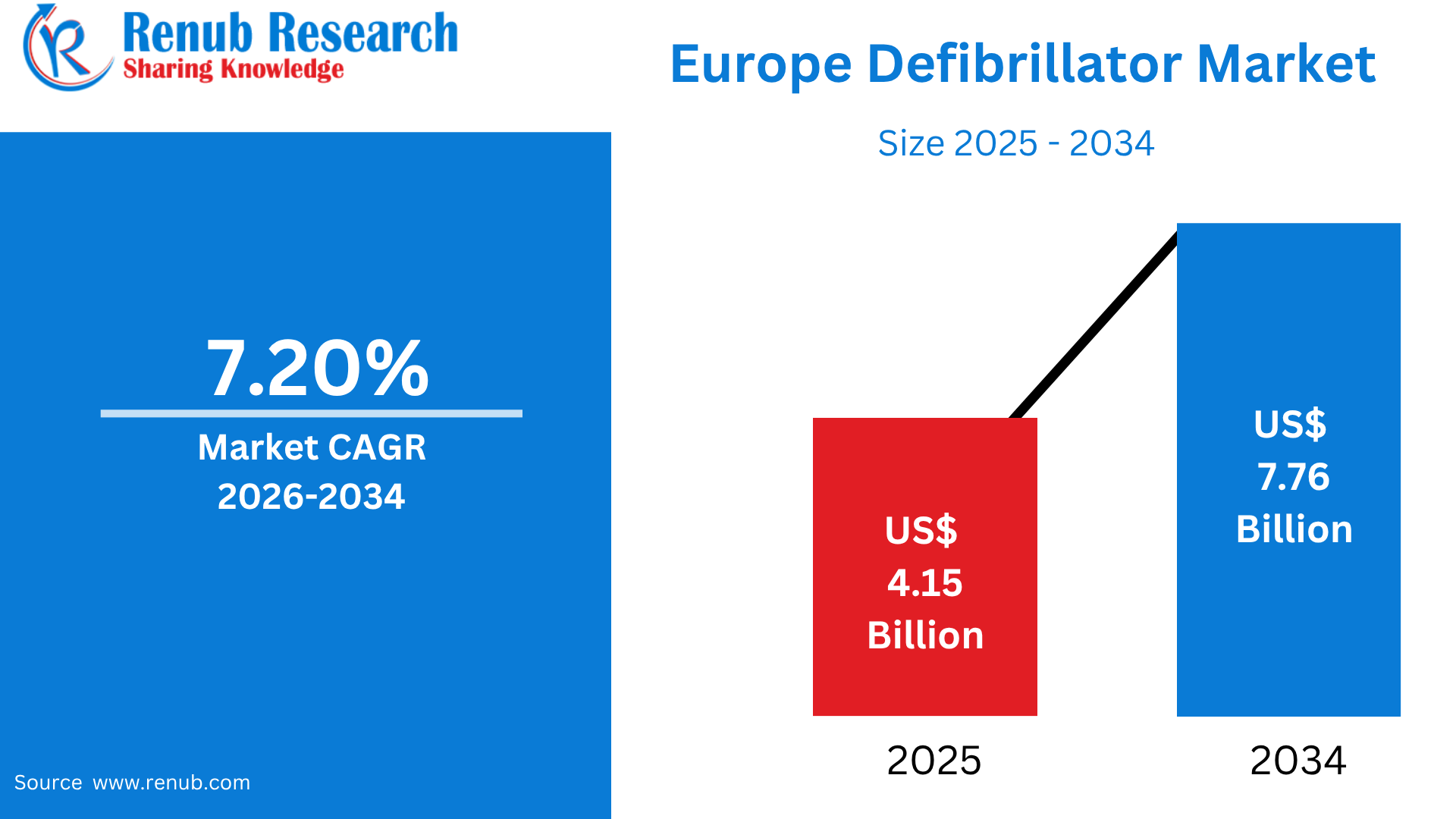
Europe Defibrillator Market is projected to expand from US$ 4.15 billion in 2025 to US$ 7.76 billion by 2034, registering a CAGR of 7.20% during 2026–2034. Market growth is supported by the rising burden of cardiovascular diseases, increasing availability of automated external defibrillators (AEDs), and continuous technological advancements in cardiac emergency care. Growing awareness of sudden cardiac arrest and the importance of rapid defibrillation is encouraging the deployment of defibrillators across hospitals, emergency medical services, ambulatory care settings, and public locations.
What is a Defibrillator and its Uses & Popularity in Europe
A defibrillator is a medical device that delivers an electrical shock to the heart to help restore a normal rhythm during certain life-threatening cardiac arrhythmias, particularly ventricular fibrillation and pulseless ventricular tachycardia. Defibrillators are used in hospitals, emergency medical services, ambulances, clinics, airports, sports facilities, workplaces, shopping centers, and other public locations. Automated external defibrillators (AEDs) are specifically designed to analyze a patient’s heart rhythm and provide instructions for use, allowing trained or, where permitted, lay responders to provide early intervention before emergency services arrive. Their importance is closely associated with the substantial cardiac-arrest burden in Europe. The 2025 European Resuscitation Council guidelines report an annual incidence of EMS-treated out-of-hospital cardiac arrest (OHCA) of approximately 55 per 100,000 people, while AED use before EMS arrival ranges from 2.6% to 59% across European countries. In the EU, circulatory diseases accounted for 1.59 million deaths, or 32.8% of all deaths, in 2023.
European Countries – Heart Disease Statistics in 2025
Bulgaria
Bulgaria has one of the highest cardiovascular mortality rates in Europe, with approximately 900+ deaths per 100,000 population attributed to circulatory diseases. Cardiovascular conditions remain a major cause of mortality, influenced by risk factors such as smoking, hypertension, insufficient preventive screening, and delayed diagnosis. Although Bulgaria has benefited from healthcare support and investment programs, cardiovascular outcomes remain considerably higher than those observed in many Western European countries. Differences in healthcare availability between urban and rural areas can further contribute to delayed diagnosis and treatment, particularly for patients requiring specialized cardiac services.
Romania
Romania experiences a substantial cardiovascular disease burden, with cardiovascular mortality estimated at approximately 780–800 deaths per 100,000 population. Ischemic heart disease and stroke represent important contributors to mortality. Several behavioral and socioeconomic factors, including obesity, alcohol consumption, smoking, and differences in healthcare accessibility, influence cardiovascular outcomes. Improvements in emergency medical services and cardiac-care infrastructure have strengthened treatment capabilities, although preventive healthcare and early detection remain important areas for improvement.
Latvia
Latvia continues to experience a significant cardiovascular disease burden, with approximately 720–750 deaths per 100,000 population associated with circulatory diseases. Cardiovascular conditions account for a substantial proportion of premature mortality. Smoking, hypertension, unhealthy lifestyle patterns, and other cardiovascular risk factors contribute to the disease burden. Access to specialist cardiac services can also vary geographically, particularly between major urban centers and rural communities, affecting timely diagnosis and treatment.
Lithuania
Lithuania records approximately 650–700 cardiovascular deaths per 100,000 population, placing cardiovascular disease among the country’s major health concerns. The burden is particularly significant among older adults and men. Hypertension, smoking, alcohol consumption, and other lifestyle-related risk factors contribute to cardiovascular mortality. Improvements in healthcare accessibility, diagnosis, and preventive services have supported progress, although continued efforts to manage risk factors and strengthen early detection remain important for reducing cardiovascular disease-related mortality.
Hungary
Hungary has a comparatively high cardiovascular mortality burden in Central Europe, with approximately 600–650 deaths per 100,000 population associated with circulatory diseases. Ischemic heart disease represents a major contributor to mortality, while smoking, obesity, unhealthy dietary patterns, hypertension, and other metabolic risk factors increase cardiovascular risk. Healthcare reforms, improved screening initiatives, and greater emphasis on prevention are supporting efforts to address the country’s cardiovascular disease burden. Continued improvements in early diagnosis, lifestyle-risk management, and access to specialized cardiac care remain important components of cardiovascular health strategies.
Growth Drivers of the Europe Defibrillator Market
Rising Cardiovascular Disease and Cardiac Arrest Burden
The substantial cardiovascular disease burden across Europe is creating continued demand for emergency cardiac-care equipment, including defibrillators. Cardiovascular and circulatory diseases remain among the most important causes of mortality across European countries. Eurostat reported that 1.59 million deaths among EU residents were caused by circulatory diseases in 2023, representing 32.8% of all deaths. OECD data also show that circulatory diseases accounted for more than 1.7 million deaths, or 32% of all deaths, in the EU in 2021. Cardiac arrest represents a particularly urgent emergency because survival depends heavily on rapid CPR and defibrillation when a shockable rhythm is present. The 2025 European Resuscitation Council guidelines estimate EMS-treated OHCA incidence at 55 cases per 100,000 inhabitants annually, with approximately 20% presenting with a shockable rhythm. This ongoing burden encourages hospitals, emergency services, workplaces, public authorities, and community organizations to maintain appropriate defibrillation capabilities. Consequently, demand is expanding for AEDs, manual defibrillators, monitor-defibrillators, and technologically advanced systems that can support faster diagnosis and emergency intervention.
Expansion of Public-Access AED Programs and Awareness
Growing awareness of the importance of immediate intervention during cardiac arrest is supporting deployment of automated external defibrillators in public and community settings. European resuscitation data demonstrate considerable room for improvement in early AED use. The 2025 European Resuscitation Council guidelines report that AED use before EMS arrival ranges from 2.6% to 59% across European countries, while the European bystander CPR rate averages approximately 58%. These differences encourage governments, healthcare organizations, municipalities, employers, sports organizations, and other institutions to expand AED availability and training. Modern AEDs are designed with automated rhythm analysis and audio or visual instructions, reducing the technical knowledge required for operation. OECD reporting notes that AED access is important for improving survival following out-of-hospital cardiac arrest and that modern devices are designed for layperson use. Public-access programs are consequently increasing the potential locations for AED deployment beyond hospitals and ambulances. Airports, railway stations, schools, universities, offices, shopping centers, sports venues, and community facilities can all represent potential AED locations, creating a broader addressable market for manufacturers and distributors.
Technological Advancements and Modernization of Emergency Care
Technological innovation is another factor supporting the European defibrillator market as healthcare providers increasingly seek devices that combine defibrillation with monitoring, connectivity, portability, and simplified operation. Modern defibrillators can incorporate features such as automated rhythm analysis, synchronized cardioversion, ECG monitoring, real-time guidance, event recording, remote data management, and improved battery technologies. These capabilities can support emergency medical teams in making rapid decisions while improving device usability. The need for such modernization is reinforced by differences in cardiac-arrest outcomes across Europe. The 2025 European Resuscitation Council data report 7.5% overall survival after OHCA, with country-level survival ranging from 3.1% to 35%, demonstrating substantial variation in resuscitation systems and outcomes. Manufacturers are therefore focusing on lightweight AEDs, connected devices, advanced monitoring capabilities, and intuitive interfaces that can be deployed across hospitals and out-of-hospital environments. Regulatory modernization also remains relevant: the European Commission states that the EU Medical Device Regulation has applied since 26 May 2021, establishing a framework emphasizing safety and innovation.
Challenges of the Europe Defibrillator Market
Uneven AED Availability and Differences Across European Countries
A major challenge for the European defibrillator market is the substantial variation in AED availability, deployment, and utilization between countries and regions. Although public-access defibrillation has expanded, the latest European Resuscitation Council data indicate that AED use before EMS arrival varies from only 2.6% to 59% between European countries. The earlier European Resuscitation Council epidemiological review similarly found average AED use of approximately 28%, with a range of 3.8% to 59%. Such variation reflects differences in public-access programs, emergency-response systems, AED registries, geographic coverage, training, and public awareness. Rural and remote areas can face additional difficulties because emergency medical response times may be longer and AED placement may be less dense than in major urban centers. Furthermore, simply installing a device does not guarantee its use during an emergency; members of the public must know where the device is located and feel confident initiating CPR and defibrillation. The market therefore faces a combined equipment-and-infrastructure challenge, requiring investment not only in devices but also in registration, maintenance, accessibility, training, and coordinated emergency-response systems.
Regulatory Requirements, Procurement Costs, and Maintenance Burden
Regulatory compliance and the cost of purchasing and maintaining defibrillation equipment can create challenges for manufacturers and healthcare organizations. Defibrillators are regulated medical devices in the European Union, and the EU Medical Device Regulation (EU) 2017/745 has applied since 26 May 2021. The European Commission states that the regulatory framework is intended to maintain a high level of patient safety while supporting innovation. Compliance can require manufacturers to meet requirements relating to clinical evidence, quality management, technical documentation, post-market surveillance, and device safety. For healthcare providers and public organizations, the expense extends beyond the initial purchase price. AEDs require periodic inspection, battery replacement, electrode-pad replacement, software or firmware management, accessories, and appropriate storage conditions. Public organizations deploying multiple devices may therefore face significant lifecycle costs. Procurement decisions can also be affected by healthcare-budget constraints and differences in reimbursement or public-access programs across European countries. Smaller organizations may find these requirements particularly challenging. Consequently, manufacturers need to balance advanced functionality and regulatory compliance with affordability, reliability, ease of maintenance, and long-term operating costs.
Defibrillator Launches in Europe
·April 2024 – MicroPort TALENTIA™ & ENERGYA™ ICD/CRT-D Launch
- MicroPort CRM launched the TALENTIA™ ICD and CRT-D and ENERGYA™ ICD and CRT-D systems in Europe.
- The devices incorporate Bluetooth connectivity and advanced monitoring capabilities.
- The launch expanded MicroPort’s portfolio of implantable cardiac rhythm-management solutions across European markets.
·January 2024 – MicroPort ICD/CRT-D CE Mark Expansion
- MicroPort received CE approval for upgraded ICD and CRT-D systems.
- The systems included enhanced remote-monitoring capabilities.
- The regulatory expansion supported broader commercialization of the devices across Europe.
·March 2025 – SmartView Connect Remote Monitoring App
- MicroPort introduced the SmartView Connect application in Europe.
- The platform supports remote monitoring of patients using compatible ICD and CRT-D devices.
- Improved connectivity enables healthcare professionals to monitor patient and device information remotely.
·February 2026 – BIOTRONIK Acticor Sky & Rivacor Sky Launch
- BIOTRONIK introduced its next-generation Acticor Sky ICD and Rivacor Sky CRT-D systems in Europe.
- The devices incorporate advanced arrhythmia-management capabilities and support conduction system pacing.
- The launch represents an expansion of BIOTRONIK’s implantable cardiac-device portfolio.
·February 2026 – First European Rivacor Sky CRT-D Implantation
- The first commercial implantation of the Rivacor Sky CRT-D was performed in Germany.
- The procedure marked the beginning of the device’s European clinical rollout.
- The launch expanded access to newer CRT-D technology for eligible patients.
·April 2026 – AliveCor Kardia 12L AI ECG System
- AliveCor introduced its Kardia 12L AI-enabled ECG system in Europe.
- The technology supports advanced ECG assessment and detection of cardiac abnormalities.
- While not a defibrillator itself, the system can support cardiac-care pathways by helping identify patients who may require further evaluation or intervention.
Rising Cardiac Disease Burden and Increasing ICD Adoption
European implantable defibrillator market is supported by the continuing burden of cardiovascular disease, arrhythmias, cardiomyopathy, and heart failure. Implantable cardioverter-defibrillators (ICDs) and cardiac resynchronization therapy defibrillators (CRT-Ds) are used for patients at elevated risk of life-threatening ventricular arrhythmias and sudden cardiac death. The scale of cardiovascular disease provides a substantial clinical need: circulatory diseases accounted for approximately 1.59 million deaths, or 32.8% of all deaths, in the EU in 2023. Germany, France, the UK, Italy, and other Western European markets benefit from established electrophysiology centers, specialist cardiac services, and comparatively sophisticated healthcare infrastructure. Technological improvements are also supporting adoption, including smaller devices, longer battery life, advanced arrhythmia detection, MRI compatibility, and remote monitoring. Remote connectivity enables clinicians to review device information without requiring every follow-up to occur in person. In addition, increasing emphasis on risk stratification and long-term management of heart failure is supporting demand for CRT-D systems among appropriate patients. As European healthcare systems continue to invest in advanced cardiac services, implantable defibrillators remain an important component of specialist arrhythmia and heart-failure management.
Public-Access AED Deployment Strengthens Emergency Cardiac Care
European external defibrillator market is expanding as healthcare authorities, municipalities, businesses, and community organizations increase access to automated external defibrillators (AEDs). AEDs can analyze cardiac rhythms and provide an electrical shock when appropriate, making them suitable for deployment outside conventional clinical environments. The need for rapid access is substantial because the 2025 European Resuscitation Council guidelines estimate EMS-treated out-of-hospital cardiac arrest at approximately 55 cases per 100,000 people annually across Europe. However, AED use before emergency medical services arrive varies considerably between European countries, ranging from 2.6% to 59%, indicating differences in public-access programs and implementation. Airports, railway stations, schools, sports venues, shopping centers, offices, and other public facilities are increasingly considered potential AED locations. Government initiatives and public-awareness campaigns are also encouraging CPR and AED training. Manual and semi-automatic defibrillators remain essential in ambulances, emergency departments, and critical-care environments. Improvements in portability, battery performance, connectivity, voice guidance, and automated rhythm analysis are further improving usability. These developments are broadening access to defibrillation and strengthening emergency-response infrastructure across Europe.
Advanced Cardiac Infrastructure Sustains Hospital Demand
Hospitals represent a major end-use environment for defibrillators because they manage cardiac emergencies, high-risk patients, surgical procedures, intensive-care cases, and interventional cardiology procedures. Defibrillators are deployed across emergency departments, intensive-care units, operating theatres, catheterization laboratories, and cardiac-care units. Hospital-grade systems increasingly combine defibrillation with ECG monitoring, synchronized cardioversion, pacing, automated rhythm analysis, event recording, and connectivity to clinical information systems. The importance of these capabilities is reinforced by the scale of cardiovascular disease in Europe. OECD data indicate that cardiovascular diseases accounted for more than 1.7 million deaths, or approximately 32% of all deaths, in the EU in 2021. Germany, France, the Netherlands, the UK, and other countries with advanced cardiac-care networks continue to provide important markets for sophisticated defibrillation equipment. Hospital modernization, replacement of aging equipment, and demand for integrated monitoring solutions support market opportunities. Innovation is also expanding the capabilities of implantable and external systems. In February 2024, Royal Papworth Hospital NHS Foundation Trust reported the first European implantation outside clinical trials of a new ICD technology, illustrating continuing innovation in specialist cardiac care. These developments support demand for advanced hospital defibrillators and related monitoring technologies.
Aging Population and Remote Cardiac Monitoring Support Home-Based Care
European home healthcare defibrillator segment is developing alongside broader shifts toward decentralized care, remote monitoring, and management of chronic cardiovascular conditions outside hospitals. Europe has an aging population, increasing the importance of long-term management for conditions such as heart failure and arrhythmias. Home-based cardiac technologies can help selected high-risk patients maintain access to monitoring and emergency-response capabilities while reducing dependence on repeated hospital visits. Remote monitoring is particularly relevant for patients with implanted cardiac devices, as connected systems can transmit device and physiological information to healthcare professionals. The European Society of Cardiology recommends remote monitoring as an important component of follow-up for patients with cardiac implantable electronic devices in appropriate circumstances. Portable AEDs may also be deployed in residential or community settings, although their use depends on clinical circumstances, local emergency protocols, and device accessibility. Wearable cardioverter-defibrillators provide another option for selected patients who require temporary protection from sudden cardiac death and are not immediately candidates for an implanted device. Improvements in connectivity, telemedicine, compact device design, and remote clinical management are supporting the development of home-oriented cardiac-care solutions. These trends can contribute to more patient-centered cardiac management across European healthcare systems.
France Public-Access Programs and Advanced Cardiac Technologies
France defibrillator market is supported by public-access defibrillation initiatives, regulatory measures, healthcare investment, and increasing awareness of sudden cardiac arrest. France has established a national framework for AED deployment and maintenance, while public and private organizations increasingly place devices in locations such as sports facilities, workplaces, transport hubs, and public buildings. French regulations also require AED operators to ensure that devices are accessible and maintained. The country’s cardiovascular disease burden provides an important underlying need for emergency cardiac-care equipment. France’s healthcare system supports access to advanced cardiac procedures, including ICD and CRT-D implantation, while specialist hospitals continue to adopt connected monitoring technologies. Device innovation is another market contributor. In April 2024, MicroPort CRM launched TALENTIA™ and ENERGYA™ ICD and CRT-D systems in Europe, incorporating connectivity and advanced monitoring capabilities. Such developments reflect the broader shift toward digitally connected cardiac-care solutions. Public CPR and AED awareness programs can further encourage early intervention during cardiac emergencies, supporting continued demand for both automated external and implantable defibrillation technologies.
Germany Advanced Healthcare Infrastructure and Strong Implantable Device Adoption
Germany represents an important European market for defibrillators, supported by extensive healthcare infrastructure, specialist cardiac centers, and established emergency medical services. The country’s substantial cardiovascular disease burden creates sustained clinical demand for both external and implantable defibrillation technologies. Germany accounted for approximately 1.1 million tonnes of green coffee imports in 2023—irrelevant to cardiac care—but in healthcare, its large population and extensive hospital network provide a substantial addressable market for medical devices. More directly, Eurostat reported that cardiovascular diseases remain among the leading causes of mortality across the EU, accounting for 1.59 million deaths, or 32.8% of all deaths, in 2023. Germany’s hospitals use defibrillators across emergency departments, intensive-care units, operating rooms, ambulances, and specialist cardiology facilities. The country also has a strong medical-device industry and established relationships between hospitals, manufacturers, and research institutions. Public AED deployment in workplaces, transport facilities, sports venues, and other locations is contributing to emergency preparedness. In February 2026, the first commercial implantation of BIOTRONIK’s Rivacor Sky CRT-D was performed in Germany, marking an important European clinical rollout of the next-generation device. These developments reinforce Germany’s role as a significant market for advanced cardiac technologies.
United Kingdom Public AED Accessibility and NHS Cardiac-Care Infrastructure
United Kingdom defibrillator market benefits from public-access AED initiatives, NHS cardiac services, charitable organizations, and increasing awareness of rapid intervention during sudden cardiac arrest. AEDs are increasingly available in community facilities, workplaces, schools, transport locations, sports venues, and other public environments. The scale of the need is significant: the 2025 European Resuscitation Council guidelines estimate approximately 55 EMS-treated out-of-hospital cardiac arrests per 100,000 population annually across Europe, while AED use before EMS arrival varies considerably between countries. Organizations such as the British Heart Foundation have supported community defibrillator access and CPR awareness. The NHS also uses sophisticated external and implantable defibrillation technologies across emergency departments, cardiac units, and specialist hospitals. The UK market is additionally influenced by home-oriented and wearable cardiac technologies, particularly for selected patients requiring temporary protection from sudden cardiac death. Product innovation continues to expand accessibility. In March 2022, CellAED introduced a compact personal defibrillator in the UK, designed to provide portable emergency defibrillation capabilities. Increasing public awareness, healthcare modernization, and continued deployment of AEDs are supporting demand across community and clinical settings.
Russia Emergency Healthcare Modernization and Regional Access Challenges
Russia defibrillator market is influenced by the country’s cardiovascular disease burden, emergency-care requirements, and efforts to modernize medical infrastructure. Defibrillators are used in hospitals, ambulances, emergency departments, intensive-care units, and other clinical environments, while AED deployment has expanded in selected public and institutional settings. Cardiovascular diseases remain an important contributor to mortality, creating a continuing clinical requirement for rapid diagnosis, resuscitation, and cardiac rhythm management. However, market development varies substantially by geography. Major cities and large medical centers generally have better access to advanced cardiac equipment and specialist personnel than remote and rural areas. Budget constraints, procurement costs, maintenance requirements, and availability of trained staff can affect deployment. External defibrillators remain particularly important for emergency medical services because rapid intervention is essential when treating cardiac arrest. Hospitals also require increasingly sophisticated monitor-defibrillator systems capable of ECG monitoring, synchronized cardioversion, pacing, and event recording. Local manufacturing and domestic procurement can influence product availability, while changes in international trade and medical-device supply chains can affect access to imported technologies. Consequently, market development is closely connected with healthcare infrastructure investment, emergency-service modernization, equipment affordability, and regional availability of trained cardiac-care personnel.
Europe Defibrillator Market Segments
Product
- Implantable Defibrillators
- External Defibrillators
End User
- Hospital
- Pre-hospital
- Public Access
- Alternate Care
- Home Healthcare
Countries
- France
- Germany
- Italy
- Spain
- United Kingdom
- Belgium
- Netherlands
- Russia
- Poland
- Greece
- Norway
- Romania
- Portugal
- Rest of Europe
Companies have been covered from 5 viewpoints
- Overviews
- Key Person
- Recent Developments
- SWOT Analysis
- Revenue Analysis
Key Players Analysis
- Medtronic Plc.
- Philips Healthcare
- Nihon Kohden Corporation
- Boston Scientific Corporation
- Stryker Corporation
- Asahi Kasei Corporation
- LivaNova PLC.
- Abbott
Report Details:
| Report Features | Details |
| Base Year |
2025 |
| Historical Period |
2022 - 2025 |
| Forecast Period |
2026 - 2034 |
| Market |
US$ Billion |
| Segment Covered |
Product, End User and Countries |
| Countries Covered |
|
| Companies Covered |
|
| Customization Scope |
20% Free Customization |
| Post-Sale Analyst Support |
1 Year (52 Weeks) |
| Delivery Format |
PDF and Excel through Email (We can also provide the editable version of the report in PPT/Word format on request) |
Customization Services available
- Analysis of Market Size and Its Segments
- More Company Profiles (Upto 10 without any additional cost):
- Additional Countries (Other than mentioned Countries):
- Region/Country Specific Reports:
- Market Entry Strategy:
- Region-Specific Market Dynamics:
- Regional Market Share Analysis:
- Trade Analysis:
- Production Insights:
- Others Customized Requests:
For more information contact our analysts.
Need More Assistance?
- Talk to our analysts to get more precious information on the current market trends.
- Include more countries and segments and customize the report based on the final requirement.
- Get a competitive advantage in your industry by knowing the report findings and making a positive impact on your revenues and operations.
- Our analysts are always ready to provide more help and pertinent information if you need any additional assistance.