Europe Cervical Cancer Market Report by Application, Population, Countries and Companies Analysis 2026-2034
Buy NowEurope Cervical Cancer Screening Market Size and Forecast 2026-2034
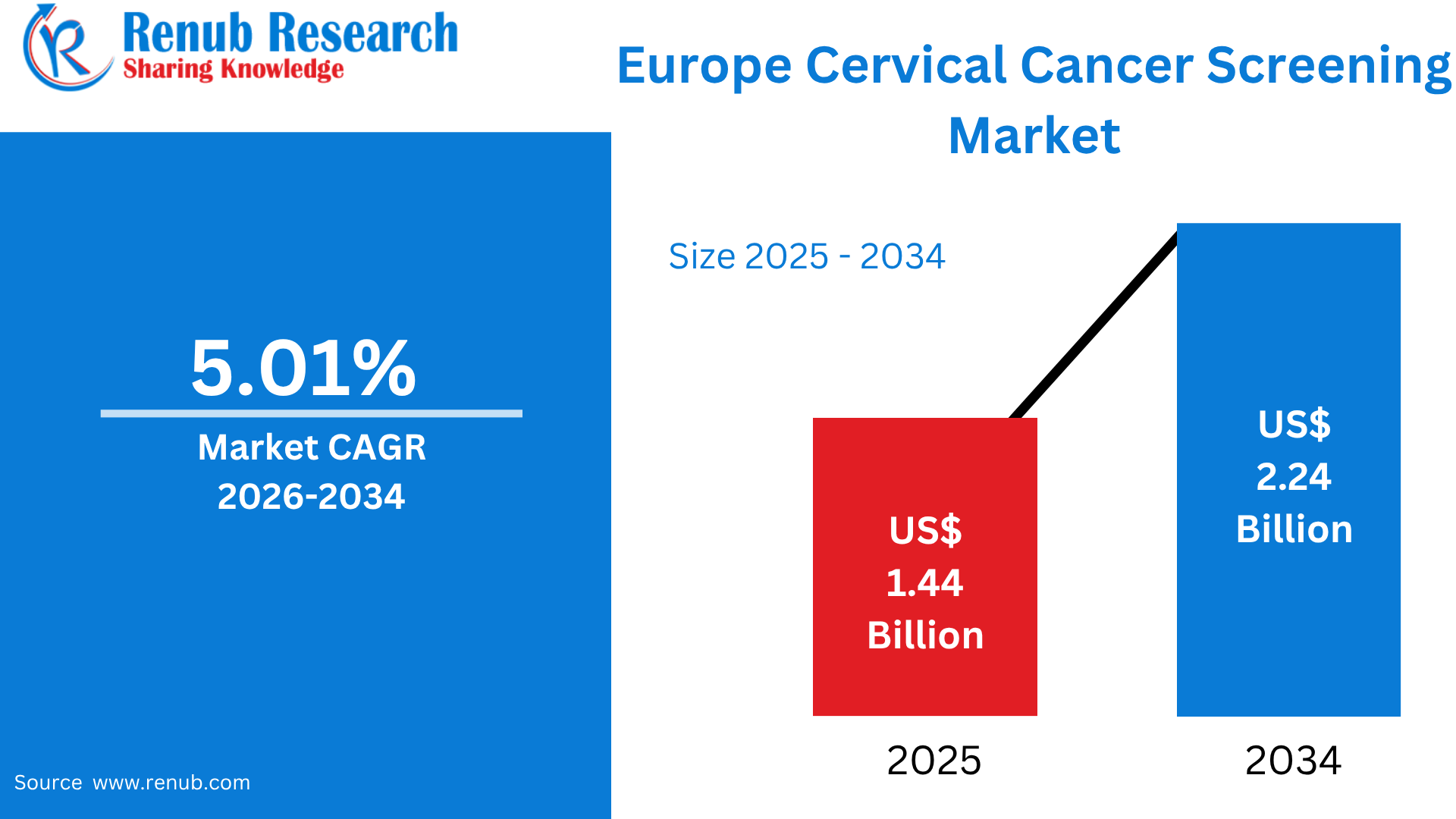
Europe Cervical Cancer Screening Market is expected to reach US$ 2.24 billion by 2034 from US$ 1.44 billion in 2025, with a CAGR of 5.01% from 2026 to 2034. The watch market grows through rising demand for luxury craftsmanship, expanding health-focused smartwatch features, technological innovation, strong brand heritage, and shifting consumer preferences toward premium mechanical movements, enhanced wellness tracking, and durable everyday wearables supported by major global manufacturers.
Europe Cervical Cancer Screening Industry Overview
The Europe cervical cancer screening industry had evolved significantly due to increasing emphasis on preventive healthcare and early cancer detection strategies. Cervical cancer screening had remained a critical component of women’s healthcare programs across European countries, supported by national screening initiatives and public health awareness campaigns. Third-party assessments had indicated that healthcare authorities had increasingly prioritized regular screening to reduce cervical cancer incidence and mortality rates. Conventional Pap smear testing had continued to play an important role, while the adoption of HPV-based screening technologies had expanded across several healthcare systems. Growing awareness regarding the importance of early diagnosis and routine gynecological examinations had further contributed to increased participation in screening programs throughout the region.
Technological advancements had also transformed the cervical cancer screening landscape in Europe. The integration of molecular diagnostics, HPV DNA testing, liquid-based cytology, and automated screening systems had improved diagnostic accuracy and efficiency. Healthcare providers had increasingly shifted toward HPV primary screening approaches due to their higher sensitivity in identifying high-risk cases. In addition, digital healthcare integration and laboratory automation had enhanced workflow management within diagnostic facilities. Government-backed vaccination programs targeting human papillomavirus infections had also influenced screening strategies, encouraging more comprehensive preventive care approaches. The combination of vaccination awareness and routine screening initiatives had strengthened the overall cervical cancer prevention ecosystem in Europe.
The rising incidence and mortality rates associated with cervical cancer in Europe are majorly fuelling the demand for cervical cancer screening in this region. According to the European Cancer Organisation, cervical cancer accounts for approximately 12% of all female cancers in Europe, with over 60,000 new cases diagnosed annually. The European Commission underscores that early detection through screening programs can reduce mortality rates by up to 70%, underscoring the importance of accessible and reliable diagnostic tools. For instance, Eurostat estimates that countries implementing structured screening programs have achieved a 30% reduction in advanced-stage diagnoses over the past decade.
Growth Drivers of the Europe Cervical Cancer Screening Market
National Screening Programs in Europe Supported by the Government
One of the key elements driving the expansion of the European cervical cancer screening industry is the introduction of national screening programs supported by the government. Over 80% of EU member states have implemented structured screening programs, which are expected to reach 90% of eligible women by 2030, according to the European Cancer Organization.
The European Commission emphasizes that since the programs' commencement, there has been a 50% decrease in advanced-stage diagnoses, demonstrating their critical role in lowering cervical cancer incidence and fatality rates. For example, approximately 3 million women have been screened each year by the UK's NHS Cervical Screening Programme, which has reduced cervical cancer-related fatalities by 25% over the previous ten years.
Subsidies and public awareness efforts have also raised participation rates by 15%, especially among marginalized groups. According to a European Health Economics Association study, nations with strong screening systems claim a 40% improvement in early detection rates, demonstrating their revolutionary influence on public health outcomes. Together, these elements support the market's growth trajectory and highlight how important it is to the advancement of preventive healthcare solutions.
Technological Developments in Screening
The European market for cervical cancer screening is expanding thanks to technological advancements in the field. The European Medical Device Technology Association claims that improvements in liquid-based cytology and HPV DNA testing have improved diagnostic precision, reaching sensitivity rates above 95%. According to the European Commission, during the past five years, investments in next-generation sequencing (NGS) platforms have increased by 20% yearly, making it possible to accurately identify high-risk HPV strains. For instance, HPV DNA testing outperforms conventional Pap smears in identifying precancerous lesions, with predictive values above 90%. Furthermore, the incorporation of AI-driven analytics has expedited data interpretation, resulting in a 30% reduction in diagnostic times.
According to a survey by the European Biotech Research Institute, hospitals that use cutting-edge screening technologies claim a 25% improvement in patient adherence, indicating its increasing acceptance. These developments confirm technological advancement as a major force behind market expansion by improving clinical efficacy and encouraging increased acceptance among healthcare professionals.
Government-Supported Screening and Vaccination Programs
Government-backed cervical cancer prevention initiatives had been a major driver of market growth in Europe. National healthcare authorities had implemented organized screening programs aimed at improving accessibility and increasing participation among eligible populations. Public funding support and awareness campaigns had strengthened adoption of routine screening practices. Additionally, HPV vaccination programs targeting adolescent populations had enhanced long-term cervical cancer prevention strategies. Collaboration between healthcare organizations, public health agencies, and research institutions had further supported educational initiatives regarding women’s health. Several countries had also expanded outreach efforts to improve screening access in underserved populations. These coordinated public health measures had contributed significantly to strengthening the cervical cancer screening ecosystem across Europe.
Challenges in the Europe Cervical Cancer Screening Market
Low Rates of Eligible Women's Participation
The growth of the European cervical cancer screening market is being hindered by low participation rates among eligible women. Less than 60% of women between the ages of 25 and 64 take part in routine screening programs, with differences being especially noticeable in Eastern and Southern Europe, according to the European Centre for Disease Prevention and Control. The European Commission emphasizes that this problem is exacerbated by cultural stigmas, ignorance, and practical difficulties, which lead to lost chances for early diagnosis.
For example, according to a survey by the European Public Opinion Research Institute, more than 40% of women say that the main reasons they skip examinations are discomfort and dread of the results. Furthermore, access to screening facilities is restricted in underserved and rural areas, which exacerbates disparities in the provision of healthcare. According to a study by the European Health Economics Association, resolving these issues necessitates ongoing funding for community outreach initiatives and educational campaigns, but their efficacy is frequently hampered by a lack of resources and conflicting objectives. These obstacles prevent efforts to optimize the therapeutic potential of cervical cancer screening technology as well as market penetration.
Rural Areas' High Prices and Limited Accessibility
The European market's expansion is being hindered by the high costs of cervical cancer screening technologies and their restricted accessibility in rural areas. Depending on the technology employed, an HPV DNA test can cost anywhere from €50 to €150 on average, according to the European Health Economics Association. Limited payment coverage in a number of European nations, especially in Eastern Europe where public healthcare funds are tight, makes this financial burden worse. Patients must travel great distances for diagnostic services because more than 30% of rural clinics lack the infrastructure needed to perform advanced examinations, according to the European Commission.
For example, a Romanian study shows that 25% of eligible women are discouraged from taking part in screening programs due to time constraints and transportation costs. Rural and underserved areas are especially impacted by access gaps brought about by differences in healthcare spending among member states. These logistical and financial obstacles present a significant obstacle to wider adoption since they not only impede market penetration but also worsen already-existing healthcare disparities.
United Kingdom Cervical Cancer Screening Market
The United Kingdom cervical cancer screening market had been supported by well-established national screening programs and strong public healthcare initiatives focused on preventive care. The country had increasingly emphasized early diagnosis and regular screening participation to reduce cervical cancer incidence. Adoption of HPV primary screening methods had strengthened diagnostic accuracy and improved identification of high-risk individuals. Public awareness campaigns and healthcare outreach initiatives had further encouraged participation in routine screening services. In addition, advancements in laboratory automation and molecular diagnostics had enhanced screening efficiency across healthcare facilities. Government support for women’s health programs and HPV vaccination initiatives had also contributed to long-term cervical cancer prevention efforts. The market had continued evolving through integration of advanced diagnostic technologies and digital healthcare solutions aimed at improving patient outcomes and screening accessibility.
Germany Cervical Cancer Screening Market
The Germany cervical cancer screening market had been characterized by strong healthcare infrastructure and increasing adoption of advanced diagnostic technologies. Organized screening initiatives and public awareness campaigns had supported routine participation in preventive healthcare services. HPV DNA testing and liquid-based cytology had increasingly been integrated into screening protocols to improve diagnostic accuracy and efficiency. The country had also witnessed growing investments in laboratory automation and digital healthcare systems. Healthcare providers had emphasized early disease detection and personalized preventive care strategies. In addition, government-supported vaccination programs targeting HPV infections had strengthened long-term cervical cancer prevention efforts. Research activities related to women’s health and molecular diagnostics had further contributed to technological advancement within the market. Overall, the market had continued evolving through innovation-driven healthcare improvements and expanded preventive screening initiatives.
- Germany's strong concentration on research and development, with yearly investments topping €10 billion, and its sophisticated healthcare infrastructure are the reasons for its supremacy in the European market. The German Biotechnology Industry Organization reports that there are more than 600 screening facilities in Germany, many of which focus on liquid-based cytology and sophisticated HPV detection. The European Commission notes that Germany's aging population—more than 21% of the country's population is 65 or older—increases the need for efficient and reasonably priced screening methods. Furthermore, the nation has established itself as a center for technological developments in cervical cancer prevention thanks to its proficiency in automation and AI-driven analytics.
France Cervical Cancer Screening Market
The France cervical cancer screening market had experienced growth due to increasing focus on women’s health and preventive oncology programs. National healthcare initiatives had encouraged routine cervical screening participation and improved awareness regarding early diagnosis. The country had increasingly adopted HPV-based testing methods alongside conventional cytology approaches to enhance diagnostic sensitivity. Technological advancements in molecular diagnostics and automated laboratory systems had supported improved screening efficiency. Public healthcare policies promoting organized cancer prevention programs had further strengthened market development. In addition, growing awareness regarding HPV vaccination and cervical cancer prevention had contributed to broader participation in screening services. Healthcare providers had also focused on expanding access to screening facilities across different population groups. The market had continued to progress through healthcare modernization efforts and increased adoption of advanced diagnostic solutions.
Italy Cervical Cancer Screening Market
The Italy cervical cancer screening market had been influenced by increasing awareness regarding preventive healthcare and women’s oncology services. Public healthcare initiatives had promoted routine screening participation and early detection of cervical abnormalities. Adoption of HPV testing technologies had increased across diagnostic laboratories and healthcare facilities, improving screening sensitivity and efficiency. The country had also focused on expanding organized screening coverage to improve accessibility among different population groups. Healthcare modernization efforts and digital diagnostic integration had supported improved workflow management within screening centers. In addition, awareness campaigns related to HPV vaccination and cervical cancer prevention had contributed to stronger public participation in screening programs. Despite regional differences in healthcare accessibility, demand for advanced screening solutions had continued to rise. The market had remained focused on improving preventive healthcare outcomes and expanding access to women’s health services.
Europe Cervical Cancer Screening Market Segments
Application
- Pap Smear Test
- HPV DNA Test
Population
- Pap Smear Test Population
- HPV DNA Test Population
Countries
- United Kingdom
- France
- Germany
- Italy
- Spain
- Sweden
- Switzerland
- Norway
- Netherlands
All companies have been covered with 5 Viewpoints
- Overviews
- Key Person
- Recent Developments
- SWOT Analysis
- Revenue Analysis
Company Analysis
- Abbott laboratories
- Hologic Corporation
- Becton
- Siemens AG
- Roche Diagnostics
- Quest Diagnostics
- Cardinal Health
Report Details:
| Report Features | Details |
| Base Year |
2025 |
| Historical Period |
2022 - 2025 |
| Forecast Period |
2026 - 2034 |
| Market |
US$ Billion |
| Segment Covered |
Test Population, Market, and Countries |
| Countries Covered |
|
| Companies Covered |
|
| Customization Scope |
20% Free Customization |
| Post-Sale Analyst Support |
1 Year (52 Weeks) |
| Delivery Format |
PDF and Excel through Email (We can also provide the editable version of the report in PPT/Word format on request) |
Customization Services available
- Analysis of Market Size and Its Segments
- More Company Profiles (Upto 10 without any additional cost):
- Additional Countries (Other than mentioned Countries):
- Region/Country Specific Reports:
- Market Entry Strategy:
- Region-Specific Market Dynamics:
- Regional Market Share Analysis:
- Trade Analysis:
- Production Insights:
- Others Customized Requests:
For more information contact our analysts.
Need More Assistance?
- Talk to our analysts to get more precious information on the current market trends.
- Include more countries and segments and customize the report based on the final requirement.
- Get a competitive advantage in your industry by knowing the report findings and making a positive impact on your revenues and operations.
- Our analysts are always ready to provide more help and pertinent information if you need any additional assistance.