Electric Two-Wheeler Market: Growth, Battery Technology, Smart Mobility, Charging Trends, Type, Drive, Voltage, Country and Company Analysis 2026–2034
Buy NowElectric Two-Wheeler Market Size & Forecast
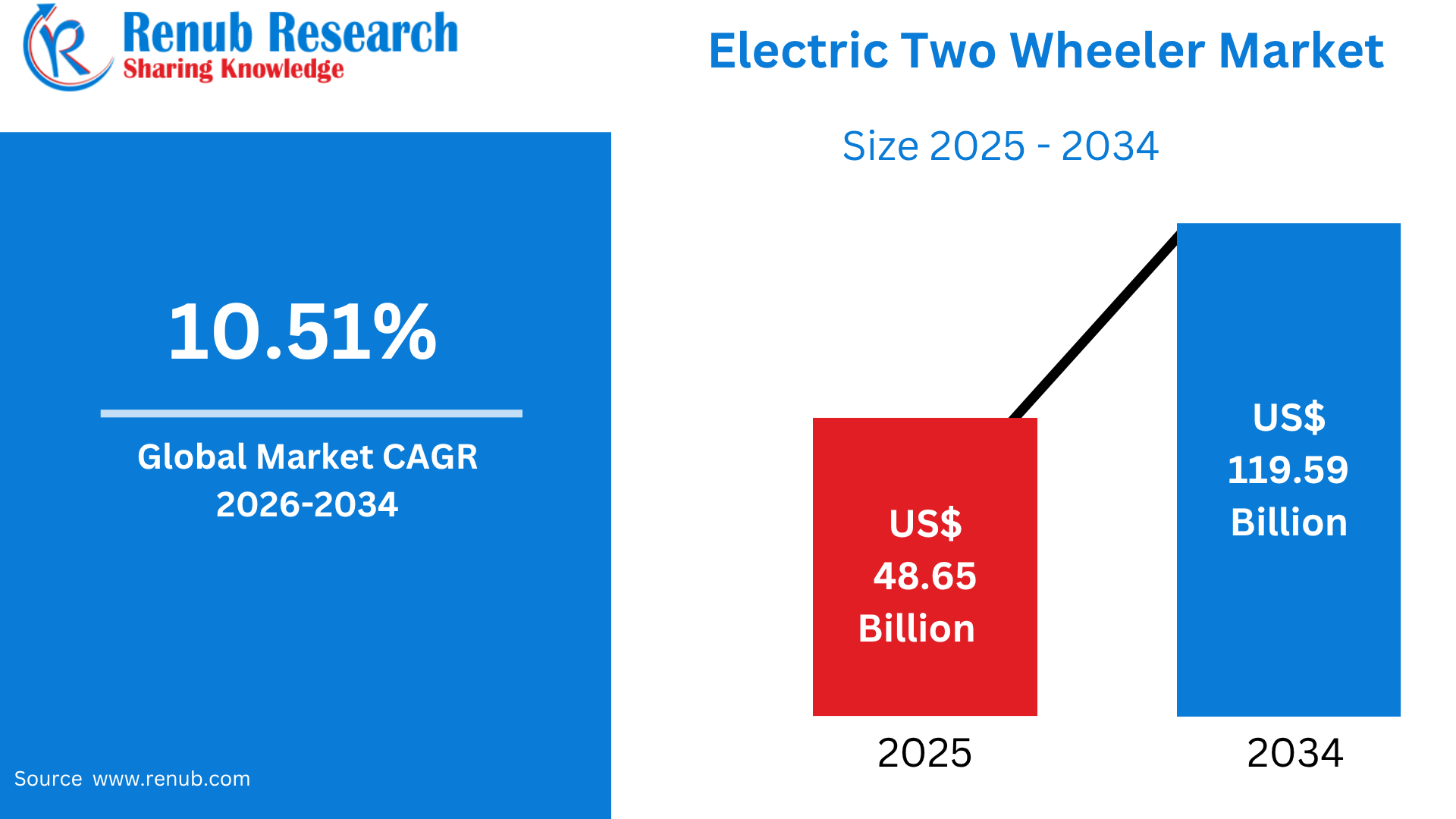
Electric Two-Wheeler Market is projected to grow from approximately US$ 48.65 billion in 2025 to US$ 119.59 billion by 2034, registering a CAGR of 10.51% during 2026–2034. Market expansion is being driven by growing environmental concerns, rising fuel prices, and increasing government incentives promoting electric mobility. In addition, advancements in battery technology, charging infrastructure, vehicle performance, and energy efficiency are improving the affordability and practicality of electric two-wheelers. Growing consumer demand for cost-effective, low-emission, and convenient urban transportation solutions is further supporting adoption worldwide.
What is an Electric Two-Wheeler and Its Uses & Popularity Worldwide
An electric two-wheeler is a battery-powered vehicle designed with two wheels and an electric motor for propulsion. The category includes electric scooters, electric motorcycles, electric mopeds, and e-bikes, which use rechargeable batteries instead of conventional petrol or diesel engines. Electric two-wheelers produce zero tailpipe emissions and generally have lower operating and maintenance costs than internal-combustion vehicles, making them an attractive option for sustainable transportation.
Electric two-wheelers are widely used for daily commuting, last-mile delivery, food delivery, ride-sharing, personal mobility, and short-distance transportation. Their compact design makes them particularly suitable for congested urban areas, while relatively low charging and maintenance costs improve their economic appeal. The global popularity of electric two-wheelers is increasing rapidly due to rising fuel prices, urban pollution, government incentives, and growing environmental awareness. Countries such as China, India, Vietnam, Indonesia, and several European markets are witnessing strong adoption. Improvements in battery capacity, charging infrastructure, vehicle range, and smart connectivity are further enhancing consumer acceptance. As cities promote low-emission mobility and consumers seek affordable transportation alternatives, electric two-wheelers are becoming an increasingly important component of the global electric mobility ecosystem.
Electric Vehicle Sales by Area in 2024
- China: Sold approximately 11 million electric cars, making it the largest market among the regions shown.
- Europe: Recorded approximately 3.1 million electric car sales, making it the second-largest market.
- USA: Sold around 1.6 million electric cars in 2024.
- Combined Sales: China, Europe, and the USA together accounted for approximately 15.7 million electric car sales in 2024.
- Market Leadership: China accounted for the largest share, significantly exceeding sales recorded in Europe and the USA.
- Note: The chart refers to electric light-duty vehicles, including battery electric vehicles (BEVs) and plug-in hybrid electric vehicles (PHEVs).
Electric Two-Wheeler Sales by Region, 2016–2024
- 2016: Global electric two-wheeler sales were approximately 2.9 million units, with China accounting for the overwhelming majority of sales.
- 2017: Sales increased to around 3.3 million units, supported primarily by continued growth in China.
- 2018: Global sales reached approximately 4.6 million units, with China remaining the dominant market and other Asian markets gradually expanding.
- 2019: Sales rose to nearly 6.0 million units, driven largely by strong Chinese demand and increasing adoption across Asia.
- 2020: Global sales exceeded 8.0 million units, with China contributing the largest share and Vietnam, India, and other Asian markets gaining importance.
- 2021: Sales reached a peak of approximately 10.9 million units, representing the strongest level during the period shown. China accounted for most sales, while India and other Asian markets expanded.
- 2022: Global sales declined to around 8.9 million units, although India recorded stronger growth and began contributing a larger share.
- 2023: Sales remained relatively stable at approximately 9.0 million units, with China still leading and India continuing to expand.
- 2024: Global electric two-wheeler sales were approximately 8.7 million units. China remained the largest market, while India became the second-largest contributor, followed by Vietnam and other Asian markets.
- Regional trend: China dominated global electric two-wheeler sales throughout 2016–2024, while India experienced increasing importance in the later years. Europe and North America represented comparatively smaller shares of global sales.
- Overall trend: Global sales increased substantially from approximately 2.9 million units in 2016 to around 8.7 million units in 2024, despite the decline from the 2021 peak.
Growth Drivers of the Global Electric Two-Wheeler Market
Rising Fuel Prices and Lower Cost of Electric Mobility
Increasing fuel costs and the relatively low operating expenses of electric vehicles are major factors driving electric two-wheeler adoption worldwide. Electric scooters and motorcycles generally require less energy per kilometer than petrol-powered vehicles and have fewer moving components, reducing maintenance requirements. For urban commuters and delivery operators, these cost advantages can significantly reduce total ownership expenses. The global electric mobility transition is also supported by declining battery costs. Lithium-ion battery pack prices have fallen dramatically from more than US$1,000 per kWh in 2010 to below US$150 per kWh in recent years, improving the economics of electric vehicles. Electric two-wheelers are particularly attractive in emerging markets because their smaller battery packs require lower upfront energy storage costs than electric cars. In addition, high fuel prices encourage consumers to consider alternatives for daily commuting and commercial deliveries. Growing demand for last-mile delivery services is further increasing the use of electric scooters and motorcycles. As battery prices, vehicle prices, and charging costs become increasingly competitive, electric two-wheelers are expected to gain greater market penetration.
Government Incentives and Emission-Reduction Policies
Government initiatives promoting clean transportation are accelerating the adoption of electric two-wheelers across major markets. Governments are introducing purchase subsidies, tax benefits, registration incentives, preferential financing, and investments in charging infrastructure to encourage consumers and businesses to shift away from internal-combustion vehicles. China has developed one of the world’s largest electric two-wheeler markets, while India has set a target of achieving 30% electric mobility for private cars, 70% for commercial vehicles, 40% for buses, and 80% for two- and three-wheelers by 2030. European countries are similarly implementing low-emission zones and stricter vehicle-emission standards. These policies improve the affordability of electric scooters and motorcycles while encouraging manufacturers to increase production capacity and introduce new models. Governments are also investing in battery manufacturing and charging networks to strengthen domestic electric-vehicle ecosystems. Furthermore, cities facing air-quality challenges are encouraging zero-emission mobility for commuting and delivery applications. As governments continue pursuing climate targets and reducing dependence on fossil fuels, policy support is expected to remain a critical catalyst for electric two-wheeler market growth.
Battery and Charging Technology Advancements
Rapid improvements in battery technology, charging infrastructure, vehicle range, and powertrain efficiency are significantly supporting the global electric two-wheeler market. Modern lithium-ion batteries provide higher energy density and longer operating ranges than earlier battery technologies, addressing one of the primary concerns of consumers. Battery costs have declined substantially over the past decade, while advances in battery-management systems are improving safety, durability, and charging performance. Manufacturers are also introducing fast-charging and battery-swapping systems, particularly for commercial delivery fleets where vehicle downtime directly affects operating costs. Battery-swapping networks can allow riders to replace depleted batteries within minutes rather than waiting for conventional charging. Meanwhile, expanding public and private charging infrastructure is improving the practicality of electric scooters and motorcycles for urban users. Connected technologies, including smartphone applications, GPS, remote diagnostics, and smart battery monitoring, are further improving user experience. Improvements in motor efficiency and regenerative braking are also helping extend vehicle range. Continued technological development is expected to lower ownership costs, improve performance, and encourage consumers who previously considered electric two-wheelers unsuitable for longer or commercial applications.
Challenges of the Global Electric Two-Wheeler Market
Limited Charging Infrastructure and Range Anxiety
Insufficient charging infrastructure remains a significant challenge to widespread electric two-wheeler adoption, particularly in emerging markets and smaller cities. Although home charging is convenient for many users, apartment residents, commercial riders, and consumers without dedicated parking may face difficulties accessing reliable charging facilities. Public charging networks are expanding, but availability remains uneven between cities and countries. Range anxiety is another concern, particularly for delivery riders and commuters who depend on their vehicles for extended daily travel. Depending on battery capacity and vehicle type, many electric scooters and motorcycles offer ranges of approximately 80–200 kilometers per charge, although premium models can provide considerably longer distances. Charging time can also be significantly longer than conventional refueling unless fast-charging or battery-swapping systems are available. Furthermore, differences in charging standards and infrastructure investment can complicate cross-market deployment. Governments and manufacturers are addressing these issues through battery-swapping networks, fast chargers, workplace charging, and residential solutions. Nevertheless, continued investment in accessible and reliable infrastructure will be essential to support large-scale adoption and reduce consumer concerns regarding range and charging convenience.
High Initial Costs and Battery-Related Concerns
The relatively high upfront cost of electric two-wheelers compared with conventional petrol-powered models remains a major barrier, particularly among price-sensitive consumers in developing markets. Although electric vehicles generally provide lower fuel and maintenance costs over their lifetime, the purchase price can remain higher because of the cost of battery systems. Battery packs can account for a significant proportion of an electric vehicle’s overall cost. Consumers also have concerns regarding battery degradation, replacement expenses, safety, and resale values. While lithium-ion battery prices have fallen by more than 80% since 2010, battery materials such as lithium, nickel, cobalt, and graphite remain exposed to commodity-price fluctuations and supply-chain risks. Extreme temperatures can also affect battery performance and charging efficiency. Furthermore, recycling and end-of-life battery management require additional infrastructure and investment as the global electric two-wheeler fleet expands. Manufacturers are responding by developing lower-cost lithium iron phosphate batteries, improving battery warranties, and introducing battery-leasing and swapping models. However, reducing upfront costs while ensuring battery safety, durability, and performance will remain essential for accelerating mass-market adoption.
Electric Two-Wheeler Launches Worldwide
- Honda WN7 – Europe (2025): Honda unveiled the WN7, its first fixed-battery electric motorcycle, at EICMA 2025. The model offers a claimed range of 140 km and is compatible with car charging infrastructure.
- Yamaha AEROX E – India (2025): Yamaha launched the AEROX E electric sport scooter in India in November 2025, expanding its premium electric two-wheeler portfolio.
- Yamaha EC-06 – India (2025): Yamaha introduced the EC-06, an electric scooter developed in collaboration with River Mobility, alongside the AEROX E in November 2025.
- Honda UC3 – Thailand & Vietnam (2026): Honda launched the UC3, a fixed-battery electric two-wheeler designed for personal commuting, in Thailand and Vietnam in January 2026.
- Honda EV Fun Concept – Europe (2024): Honda unveiled the EV Fun Concept at EICMA 2024 as its first electric sports motorcycle concept, with commercialization planned as part of its global electrification strategy.
- Honda EV Urban Concept – Europe (2024): Honda also presented the EV Urban Concept, showcasing a connected electric mobility solution focused on urban transportation and future electric two-wheeler applications.
- Honda CUV e: – Europe (2024/2025): Honda confirmed the CUV e: for mass production as its second two-wheeled EV for Europe, targeting practical urban mobility applications.
- Electric.AI Trion – India (2026): Bengaluru-based Electric.AI launched the Trion electric scooter in 2026 with three variants and a claimed range of 165 km, incorporating AI-oriented smart features.
- Ultraviolette F77 MACH 2 RECON – UK (2025): Ultraviolette expanded into the UK market with the F77 MACH 2 RECON, bringing its performance-focused electric motorcycle to the European market.
- Ultraviolette F77 SuperStreet RECON – UK (2025): The company also introduced the F77 SuperStreet RECON in the UK alongside the MACH 2 RECON, strengthening its international electric motorcycle portfolio.
Rising Demand for High-Performance Sustainable Mobility
The electric motorcycles market is gaining momentum as consumers increasingly seek high-performance, environmentally friendly, and cost-efficient transportation solutions. Electric motorcycles use rechargeable battery packs and electric motors instead of internal-combustion engines, eliminating direct tailpipe emissions during operation. They also generally require fewer mechanical components and can reduce maintenance requirements compared with conventional motorcycles. Improvements in battery capacity, motor efficiency, vehicle range, fast charging, and smart connectivity are encouraging manufacturers to introduce more advanced models. Electric motorcycles are increasingly equipped with smartphone connectivity, GPS, digital dashboards, regenerative braking, and intelligent battery-management systems. Government policies are also supporting market development through purchase incentives, tax benefits, emission regulations, and investments in charging infrastructure. Global battery prices have declined substantially over the past decade, improving the economics of electric mobility. As consumers become more environmentally conscious and urban transportation systems shift toward low-emission mobility, electric motorcycles are gaining popularity among commuters, delivery operators, and performance-oriented riders. Continued technological innovation and expanding charging networks are expected to further strengthen the segment worldwide.
High Energy Density Supporting Battery Adoption
The electric two-wheeler lithium-ion market is expanding as lithium-ion batteries remain the dominant energy-storage technology for electric scooters, motorcycles, and other lightweight electric vehicles. Lithium-ion batteries offer several advantages, including high energy density, lighter weight, longer cycle life, faster charging capability, and better power performance compared with traditional lead-acid batteries. Battery pack prices have fallen by more than 80% since 2010, helping improve the affordability of electric two-wheelers and encouraging manufacturers to increase lithium-ion adoption. These batteries also enable manufacturers to design vehicles with greater range and improved acceleration without significantly increasing battery weight. Continuous developments in battery-management systems, thermal management, cell chemistry, and charging technology are further improving safety and performance. Manufacturers are increasingly exploring lithium iron phosphate (LFP) batteries because of their durability, thermal stability, and lower dependence on certain costly materials. Growing global electric vehicle production is also supporting investment in battery manufacturing capacity and supply chains. As battery costs continue to decline and energy density improves, lithium-ion technology is expected to remain a key component of the global electric two-wheeler industry.
Simple Design and Low Maintenance Supporting Electric Two-Wheeler Hub Drive Adoption
The electric two-wheeler hub drive market is gaining traction because hub motors provide a relatively simple and efficient propulsion solution for electric scooters, motorcycles, and e-bikes. In a hub-drive system, the electric motor is integrated directly into the wheel, reducing the need for conventional mechanical components such as chains, belts, clutches, and multi-speed transmissions. This simplified architecture can reduce maintenance requirements and contribute to lower operating costs. Hub motors also provide quiet operation, smooth acceleration, and efficient power delivery, making them particularly suitable for urban commuting and short-distance mobility. Depending on vehicle design, hub motors can be configured for front- or rear-wheel drive, while dual-hub configurations can provide additional traction and performance. The increasing adoption of electric two-wheelers is creating opportunities for manufacturers of compact, lightweight, and cost-efficient hub motors. Improvements in motor efficiency, power density, thermal management, and electronic controllers are further enhancing performance. Hub-drive systems are particularly attractive in price-sensitive markets because of their relatively simple construction. As demand increases for affordable electric mobility with lower maintenance requirements, hub motors are expected to remain an important drive technology in the electric two-wheeler market.
Affordable Configuration for Urban and Short-Distance Mobility
48V electric two-wheeler market represents an important segment for affordable commuter and short-distance mobility applications. A 48V electrical architecture provides a balance between performance, energy efficiency, battery size, and manufacturing cost, making it suitable for many electric scooters, low-speed motorcycles, and urban mobility vehicles. These systems are particularly relevant in densely populated cities where vehicles are primarily used for daily commuting, shopping, education, and short-distance transportation. Compared with higher-voltage systems, 48V configurations can offer relatively lower system complexity and component costs, supporting the development of more affordable electric two-wheelers. Improvements in lithium-ion battery technology are also enabling 48V vehicles to achieve better range and charging performance than earlier battery-powered models. The growing adoption of electric mobility in emerging markets is creating additional opportunities because consumers in these regions often prioritize affordability and operating-cost savings. Manufacturers are developing 48V scooters and motorcycles with digital displays, connected features, regenerative braking, and improved battery-management systems. As urban consumers increasingly seek economical alternatives to petrol-powered two-wheelers, the 48V segment is expected to maintain steady demand, particularly in commuter-oriented applications.
Higher Power and Performance Expanding the Premium Segment
72V electric two-wheeler market is positioned toward higher-performance applications, offering greater electrical power potential for electric motorcycles and performance-oriented scooters. Higher-voltage systems can support stronger motor performance, improved acceleration, and efficient power delivery, making them suitable for riders seeking capabilities closer to conventional gasoline-powered motorcycles. Depending on battery capacity, motor output, vehicle weight, and riding conditions, 72V electric two-wheelers can also support longer-distance applications than many lower-voltage commuter models. Manufacturers are increasingly introducing high-performance electric motorcycles equipped with larger battery packs, advanced motor controllers, regenerative braking, connected features, and fast-charging capabilities. The continuing improvement of lithium-ion and LFP battery technologies is helping increase range while improving battery durability and safety. Demand for higher-performance electric mobility is particularly relevant in urban markets where consumers want environmentally friendly vehicles without sacrificing acceleration or riding experience. Although 72V systems can involve higher battery and component costs than 48V configurations, improvements in battery economics and powertrain technology are gradually improving their commercial viability. Consequently, the segment is expected to benefit from increasing consumer acceptance of premium and performance-oriented electric two-wheelers.
Growing Interest in Sustainable Urban Mobility in United States Electric Two-Wheeler
United States electric two-wheeler market is expanding steadily as consumers increasingly explore low-emission and cost-efficient transportation options. Rising awareness of climate change, fluctuations in gasoline prices, and growing interest in sustainable mobility are supporting demand for electric motorcycles, scooters, and e-bikes. Electric two-wheelers are particularly suitable for short-distance urban travel because of their compact size, lower operating costs, and ability to navigate congested roads efficiently. Technological advancements in lithium-ion batteries, vehicle range, charging systems, connectivity, and motor efficiency are further improving consumer acceptance. The U.S. transportation sector accounts for nearly 29% of total U.S. greenhouse-gas emissions, strengthening the need for cleaner mobility solutions. Manufacturers are introducing increasingly sophisticated electric motorcycles and scooters for commuting, recreational riding, and delivery applications. Federal and state-level incentives, along with investments in charging infrastructure and zero-emission transportation, are also supporting market development. As American cities continue encouraging cleaner mobility and consumers seek alternatives to gasoline-powered vehicles, electric two-wheelers are expected to achieve gradual and sustained adoption across the country.
United Kingdom Government Decarbonization Goals Supporting Electric Two-Wheeler Adoption
United Kingdom electric two-wheeler market is developing steadily as the country strengthens its focus on low-carbon transportation and urban air-quality improvement. Electric motorcycles, scooters, and other two-wheelers are increasingly attractive for urban commuters because they can provide lower running and maintenance costs than conventional petrol-powered vehicles while producing zero tailpipe emissions. The UK government has committed to ending the sale of new petrol and diesel cars and vans by 2030, reinforcing the broader transition toward electric mobility. Low-emission initiatives in major cities are also encouraging consumers and businesses to consider cleaner transportation options. Improvements in battery range, charging performance, connectivity, and vehicle design are increasing the practicality of electric two-wheelers for commuting and delivery applications. In addition, the expansion of charging infrastructure is helping address range and convenience concerns. In November 2025, Bengaluru-based electric motorcycle manufacturer Ultraviolette entered the UK market with its F77 MACH 2 RECON and F77 SuperStreet RECON, expanding the availability of performance-oriented electric motorcycles. Continued decarbonization policies and technological improvements are expected to support market growth.
High Two-Wheeler Usage and Government Support India Electric Two-Wheeler Driving Expansion
India electric two-wheeler market is among the fastest-growing segments of the country’s electric vehicle industry, supported by high two-wheeler ownership, rising petrol prices, urban congestion, and government initiatives promoting electrification. Two-wheelers account for a major share of India’s personal mobility fleet, making electrification of scooters and motorcycles particularly important for reducing transportation emissions and fuel consumption. Electric scooters are especially attractive in cities because they offer relatively low running costs and are well suited to short- and medium-distance commuting. Government programs and state-level incentives have encouraged manufacturers to expand production and introduce more affordable models. India’s national target includes achieving 80% electric two- and three-wheeler penetration by 2030, highlighting the strategic importance of the segment. Battery prices, charging infrastructure, and vehicle range have also improved, strengthening consumer confidence. Local manufacturers are increasingly introducing connected scooters, longer-range models, and faster-charging solutions designed for Indian driving conditions. The expansion of charging networks is further supporting adoption. With a large addressable customer base and continuing policy support, India’s electric two-wheeler market is expected to experience strong growth over the coming years.
Smart-City Development Creating New Mobility Opportunities in Saudi Arabia
Saudi Arabia electric two-wheeler market is emerging as the Kingdom accelerates economic diversification and invests in sustainable transportation technologies. Although conventional gasoline-powered vehicles remain dominant, electric scooters and motorcycles are gaining attention for short-distance urban mobility, last-mile delivery, tourism, and recreational applications. Saudi Arabia’s Vision 2030 strategy emphasizes economic diversification, technological development, and improved environmental sustainability, creating opportunities for electric mobility solutions. The development of smart cities and large-scale infrastructure projects is also providing a favorable environment for connected and low-emission transportation. Expanding charging infrastructure, improving battery technology, and increasing awareness of sustainable mobility are gradually supporting consumer and commercial adoption. Electric two-wheelers can be particularly useful for delivery operators because of their lower energy and maintenance requirements compared with conventional motorcycles. In December 2024, Vego Group announced a strategic partnership with a Chinese company to establish an electric two-wheeler manufacturing facility in Sudair City for Industry and Business, approximately 150 km from Riyadh, with full operations planned for 2026. Such investments could strengthen local manufacturing capabilities and encourage development of the broader electric mobility ecosystem.
Market Segmentation
Type
- Electric Motorcycles
- Electric Scooters
Battery Type
- Nickel Metal Hybride Batteries
- Sealed Lead Acid Batteries
- Lithium-Ion Batteries
Drive Type
- Hub Drive Motor
- Mid-Drive Motor
Voltage
- 36V
- 48V
- 60V
- 72V
- Above 72V
Countries
North America
- United States
- Canada
Europe
- France
- Germany
- Italy
- Spain
- United Kingdom
- Belgium
- Netherlands
- Turkey
Asia Pacific
- China
- Japan
- India
- Australia
- South Korea
- Thailand
- Malaysia
- Indonesia
- New Zealand
Latin America
- Brazil
- Mexico
- Argentina
Middle East & Africa
- South Africa
- Saudi Arabia
- UAE
All the Key players have been covered from 5 Viewpoints:
- Overviews
- Key Person
- Recent Developments
- SWOT Analysis
- Revenue Analysis
Company Analysis:
- BMW AG
- GOVECS AG
- Hero Electric Vehicles Pvt. Ltd.
- Mahindra GenZe
- Terra Motors Corporation
- Vmoto Limited
- Zero Motorcycles, Inc.
Report Details:
| Report Features | Details |
| Base Year |
2025 |
| Historical Period |
2022 - 2025 |
| Forecast Period |
2026 - 2034 |
| Market |
US$ Billion |
| Segment Covered |
Type, Battery Type, Drive Type, Voltage and Countries |
| Countries Covered |
|
| Companies Covered |
|
| Customization Scope |
20% Free Customization |
| Post-Sale Analyst Support |
1 Year (52 Weeks) |
| Delivery Format |
PDF and Excel through Email (We can also provide the editable version of the report in PPT/Word format on request) |
Customization Services available
- Analysis of Market Size and Its Segments
- More Company Profiles (Upto 10 without any additional cost):
- Additional Countries (Other than mentioned Countries):
- Region/Country Specific Reports:
- Market Entry Strategy:
- Region-Specific Market Dynamics:
- Regional Market Share Analysis:
- Trade Analysis:
- Production Insights:
- Others Customized Requests:
For more information contact our analysts.
Need More Assistance?
- Talk to our analysts to get more precious information on the current market trends.
- Include more countries and segments and customize the report based on the final requirement.
- Get a competitive advantage in your industry by knowing the report findings and making a positive impact on your revenues and operations.
- Our analysts are always ready to provide more help and pertinent information if you need any additional assistance.