Drug Abuse Testing Market Report by Product & Service, Sample Type, Drug Type, End Users, Countries and Company Analysis 2026-2034
Buy NowDrug Abuse Testing Market Size and Forecast 2026-2034
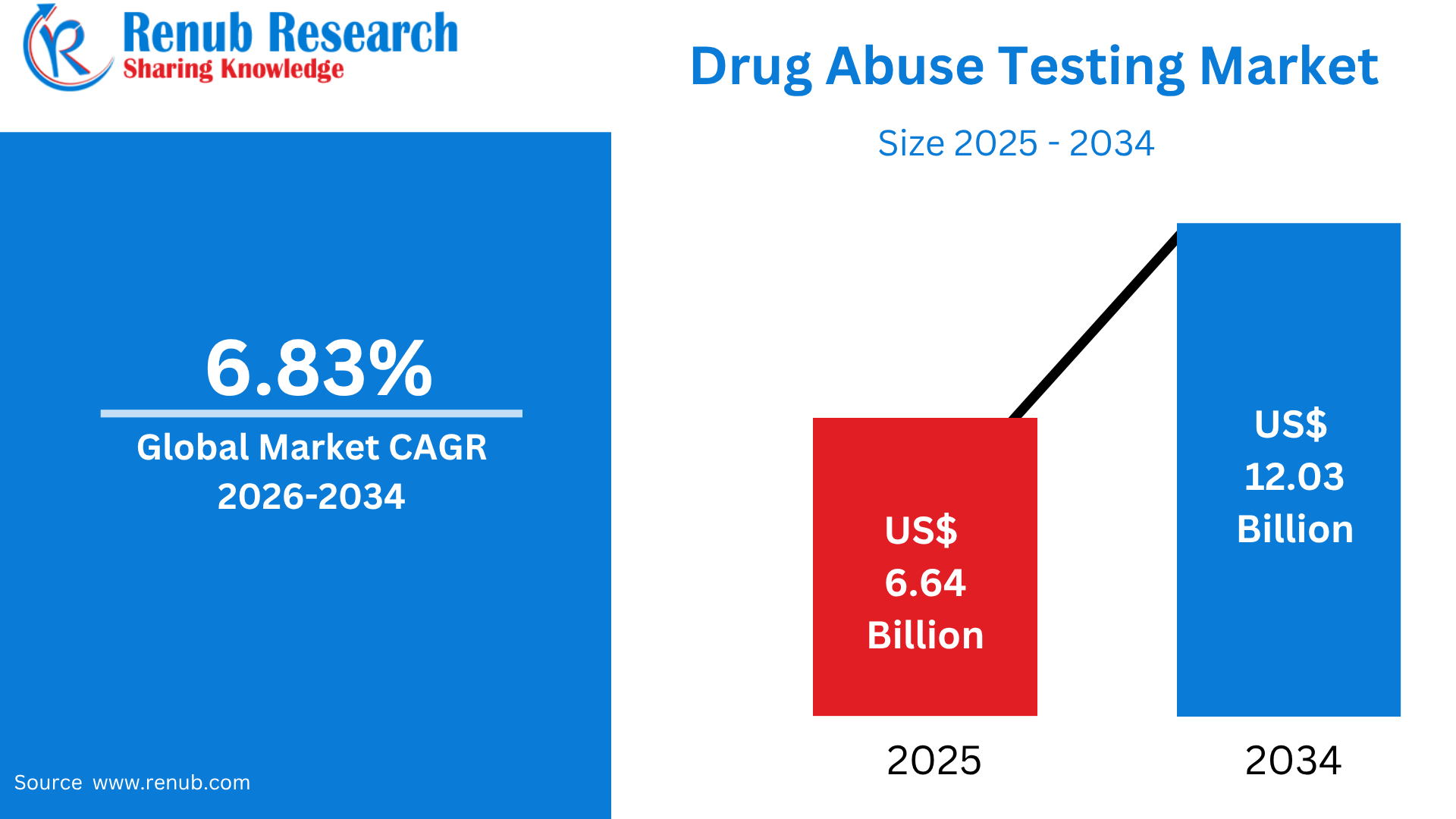
Drug Abuse Testing Market is expected to reach US$ 12.03 Billion by 2034 from US$ 6.64 Billion in 2025, with a CAGR of 6.83% from 2026 to 2034. Rising substance abuse cases, increasing workplace drug screening, strict regulatory frameworks, and technological advancements in rapid testing kits are driving the drug abuse testing market, alongside growing awareness of public health risks and demand for accurate, real-time diagnostic solutions.
Drug Abuse Testing Industry Overview
Drug abuse testing refers to the detection of illicit drugs or prescription drug misuse in biological samples such as urine, blood, saliva, hair, or sweat. It is widely used in workplaces, hospitals, forensic laboratories, law enforcement, and rehabilitation centers to identify substance use and ensure safety compliance. Testing methods include immunoassay screening and confirmatory techniques such as gas chromatography–mass spectrometry (GC-MS). These tests help monitor drug consumption, support treatment programs, and prevent drug-related risks in safety-sensitive environments. Increasing adoption of rapid testing kits and laboratory-based diagnostics is enhancing accuracy, speed, and accessibility of drug abuse testing across clinical and non-clinical settings.
The market is primarily driven by the increasing prevalence of drug abuse and related fatalities worldwide, prompting governments and healthcare systems to expand screening programs. Workplace drug testing policies, particularly in safety-sensitive industries such as transportation and construction, further support demand. Technological advancements in rapid testing devices and point-of-care diagnostics are improving detection speed and accuracy. Rising awareness of substance abuse disorders and growing rehabilitation programs also contribute to market growth. Additionally, stricter regulations and monitoring by public health authorities are encouraging routine drug testing. The expansion of forensic and toxicology laboratories globally is further strengthening adoption of advanced drug testing solutions.
Recent Developments in Drug Abuse Testing Market
- In September 2024, Quest Diagnostics acquired select laboratory assets from Allina Health to expand access to affordable, high-quality laboratory services for patients and physicians across Minnesota and western Wisconsin.
- In August 2024, Quest Diagnostics and University Hospitals reached an agreement for Quest to acquire select assets of the health system’s outreach laboratory services business, strengthening diagnostic accessibility and operational efficiency.
- In May 2024, Omega Laboratories partnered with Cannabix Technologies Inc. to integrate Cannabix’s THC breathalyzer into its drug-testing services, becoming the exclusive laboratory provider and enhancing testing accuracy and efficiency.
- In February 2024, Veriteque USA partnered with OraSure Technologies to distribute SwabTek oral-fluid presumptive testing kits, broadening their use in educational, workplace, and home safety environments.
Growth Drivers for the Drug Abuse Testing Market
Rising Substance Abuse Prevalence & Mandatory Testing Regulations
The escalating rate of drug consumption globally is a primary driver of the drug abuse testing market. According to the World Health Organization Western Pacific Region, more than 39 million people around the world suffer from drug use disorders, yet only 1 in 5 of them are in treatment. Governments are responding by strengthening mandatory drug screening policies for workplaces, transport, military, and public safety sectors. In the U.S., the Department of Transportation (DOT) continues to enforce rigorous random testing for safety-sensitive employees, increasing demand for high-volume testing. Likewise, several Asia-Pacific countries have intensified narcotics surveillance due to rising methamphetamine use. In December 2023, Quest Diagnostics announced the launch of its new 88-Compound Novel Psychoactive Substance (NPS) Test Panel.
Technological Advancements in Rapid & Point-of-Care Drug Testing
Innovation in drug testing technologies—especially portable, AI-enabled, and digitally integrated systems—is significantly boosting market growth. Advanced immunoassay platforms now deliver faster and more reliable screening results with minimal sample handling, improving efficiency in clinical and workplace settings. Confirmatory techniques such as chromatography and mass spectrometry continue to evolve, offering higher precision for laboratory-based analysis. In addition, the growing availability of home-based drug testing kits is enhancing accessibility and user convenience. Healthcare providers, employers, and law enforcement agencies are increasingly adopting rapid testing solutions to enable timely decision-making and improve safety outcomes. These technological advancements are playing a crucial role in expanding the adoption of drug abuse testing across diverse end-use environments.
In September, 2025 – Siemens Healthineers launched the Atellica DT 250 Drug Testing Analyzer, a new benchtop drug testing system designed to deliver clinical-quality results for court, military, forensic, and clinical applications. The analyzer supports comprehensive drug screening with an expanded immunoassay menu of 65+ assays and automated specimen validity testing for urine, serum, and plasma samples — helping labs increase throughput and improve detection accuracy.
Increasing Workplace & Roadside Testing to Improve Safety
Rising workplace accidents associated with substance misuse have prompted employers and regulators to mandate robust drug screening programs. Transportation, construction, oil & gas, and manufacturing sectors are increasingly implementing pre-employment, random, and post-incident testing to enhance workforce safety. Roadside drug testing is also becoming more common as impaired driving incidents continue to rise. Europe and the U.S. have intensified enforcement of drug-impaired driving laws, boosting demand for portable breath, saliva, and urine analyzers.
In April 2025, Biolabs International LLC introduced PowderTracer™, a rapid forensic drug-detection tool capable of identifying seven different drugs in under five minutes, providing fast and reliable results for law enforcement, border patrol, and first responders. This innovation addresses the urgent need for quick drug identification amid the escalating opioid crisis and significantly enhances field-based drug detection performance.
Challenges in the Drug Abuse Testing Market
High Cost of Advanced Testing Technologies
One major challenge is the high cost associated with advanced chromatography, toxicology analyzers, and laboratory infrastructure. Smaller clinics and rural healthcare settings often struggle to adopt mass-spectrometry-based confirmatory systems due to expensive equipment, maintenance costs, and skilled labor requirements. Additionally, increasing operational costs for quality assurance, calibration, and regulatory compliance further burden testing facilities. As many regions lack insurance coverage for routine drug screening, individuals and employers must bear full expenses, limiting widespread adoption. Although rapid test kits are cheaper, they sometimes lack the sensitivity and specificity required for legal or clinical confirmation, demanding costly laboratory follow-up tests that affect overall affordability.
Privacy, Legal, and Ethical Concerns in Drug Testing
Drug abuse testing often raises concerns related to privacy, consent, and ethical implications. Employees and individuals may be reluctant to undergo testing due to fear of stigma, job loss, or social discrimination. Strict data-protection laws—such as GDPR in Europe—impose complex requirements for sample handling, storage, and reporting, making compliance challenging for organizations. Disputes over false positives, sample tampering, or improper collection procedures can lead to legal liabilities for employers and healthcare providers. Additionally, varying drug testing guidelines across countries complicate global implementation. These issues often deter companies from adopting extensive drug-screening programs, especially in non-regulated industries.
United States Drug Abuse Testing Market
The U.S. drug abuse testing market continues to expand due to widespread substance misuse, comprehensive regulatory mandates, and increased workplace screening. Drug testing is used extensively across clinical settings, rehabilitation centers, workplaces, and law enforcement agencies to support safety and compliance. According to the 2024 National Survey on Drug Use and Health (NSDUH) by the Substance Abuse and Mental Health Services Administration (SAMHSA), an estimated 25.5% of Americans aged 12 or older reported illicit drug use in the past year — underscoring ongoing demand for reliable detection tools.
Additionally, government agencies such as the U.S. Department of Transportation (DOT) require rigorous random drug testing for safety-sensitive employees, fueling adoption of rapid screening kits and laboratory diagnostics. Initiatives to address opioid and stimulant misuse have increased investments in both point-of-care devices and advanced laboratory platforms. Enhanced enforcement of drug-impaired driving laws further supports demand for portable saliva, breath, and urine analyzers across federal and state jurisdictions.
Germany Drug Abuse Testing Market
Germany’s drug abuse testing market is supported by strict workplace regulations, rising cannabis use, and expanding toxicology screening in hospitals. In recent years, cannabis consumption has become increasingly prevalent in Germany. Approximately 4.5 million adults aged 18–59 and around 340,000 adolescents aged 12–17 have used cannabis at least once in the past 12 months, whether regularly or occasionally. The country also emphasizes roadside drug testing, with police widely using saliva analyzers. Advanced chromatography systems are increasingly adopted in diagnostic laboratories for confirmatory toxicology. Continued government focus on substance abuse prevention programs is expected to sustain market expansion across both public and private healthcare sectors.
India Drug Abuse Testing Market
India’s drug abuse testing market is growing due to rising narcotics consumption, especially among young populations. The most common substances used in the past year, after tobacco (4 per cent) and alcohol (3.8 per cent), were opioids (2.8 per cent), followed by cannabis (2 per cent) and inhalants (1.9 per cent). Use of non-prescribed pharmaceutical opioids was most common among opioid users (90.2 per cent). Corporate sectors are also adopting pre-employment drug screening as part of safety protocols. However, limited awareness and cost constraints in rural regions hinder broader adoption. Increasing use of rapid urine and saliva test kits supports expansion in clinical and diagnostic centers.
Saudi Arabia Drug Abuse Testing Market
Saudi Arabia’s market is growing due to strict anti-drug regulations and mandatory workplace testing across government, defense, and transportation sectors. According to the Saudi National Committee for Narcotics Control (2024), drug-related cases increased by 18%, prompting authorities to intensify screening procedures. Vision 2030 healthcare expansion is boosting laboratory infrastructure, enabling wider adoption of advanced toxicology analyzers. The country also performs frequent drug screening for expatriates entering the workforce, increasing test volume. Rising investment in digital health and telemedicine supports integration of remote monitoring tools and rapid testing kits. Strong regulatory enforcement continues to make Saudi Arabia one of the most controlled drug-testing environments globally.
Analyzers Drug Abuse Testing Market
The drug abuse testing analyzers market comprises instruments used to detect illicit substances in biological samples such as urine, blood, and oral fluids. These analyzers, including immunoassay analyzers and chromatography systems, are widely used in laboratories, hospitals, and forensic settings. Growth is driven by rising substance abuse, stricter workplace drug testing regulations, and technological advancements enabling faster and more accurate results. Automation and integration with digital health systems are improving workflow efficiency. Demand is particularly strong in developed regions due to regulatory mandates, while emerging markets are expanding due to increasing awareness. Key players focus on innovation, portability, and multi-panel testing capabilities to enhance detection of a broader range of drugs.
Oral Fluid Drug Abuse Testing Market
The oral fluid drug abuse testing market focuses on saliva-based testing methods for detecting drug use. These tests are gaining popularity due to their non-invasive nature, ease of collection, and reduced risk of sample tampering compared to urine testing. They are widely used in roadside testing, workplace screening, and law enforcement applications. Increasing adoption of point-of-care devices and rapid testing kits is boosting market growth. Technological improvements have enhanced detection sensitivity and shortened turnaround times. Regulatory support for saliva testing in various countries is further driving demand. However, limitations such as shorter detection windows compared to urine may restrain growth. Overall, convenience and reliability continue to support market expansion globally.
Cannabis/Marijuana Drug Abuse Testing Market
The cannabis or marijuana drug abuse testing market is expanding rapidly due to increasing legalization and regulatory oversight worldwide. Testing is essential for workplace compliance, roadside safety, and clinical monitoring. Various testing methods include urine, oral fluid, blood, and hair analysis, each with different detection windows. The rise in cannabis consumption has increased demand for accurate detection of THC and its metabolites. Innovations such as breath analyzers and real-time impairment testing are emerging trends. However, challenges remain in distinguishing recent use from past exposure. Regulatory frameworks vary across regions, influencing market dynamics. Overall, growing awareness of safety concerns and legal compliance continues to drive the demand for cannabis testing solutions.
Drug Testing Laboratories Market
The drug testing laboratories market includes facilities that provide analytical testing services for detecting drugs and substances of abuse. These laboratories serve industries such as healthcare, workplace compliance, criminal justice, and sports organizations. Market growth is driven by increasing drug abuse rates, stringent regulatory requirements, and outsourcing trends by hospitals and employers. Advanced technologies such as mass spectrometry and molecular diagnostics are improving accuracy and reliability. Laboratories are expanding service portfolios to include specialized testing and rapid turnaround services. Consolidation through mergers and partnerships is a key trend, enhancing geographic reach and capabilities. North America dominates the market, while Asia-Pacific is witnessing significant growth due to rising awareness and infrastructure development.
Drug Abuse Market Testing Market Segments
Product & Service
- Analysers
- Rapid Testing Devices
- Consumables
- Laboratory Services
Sample Type
- Urine
- Oral Fluid
- Breath
- Hair
- Others
Drug Type
- Alcohol
- Cannabis/Marijauna
- Cocaine
- Opioids
- Amphetamine & Methaphetamine
- LSD
- Others
End User
- Drug Testing Laboratories
- Workplaces
- Hospitals
- Rehabilitation Centers
- Academic Institutes and Research Centers
- Others
Countries
North America
- United States
- Canada
Europe
- France
- Germany
- Italy
- Spain
- United Kingdom
- Belgium
- Netherlands
- Turkey
Asia Pacific
- China
- Japan
- India
- Australia
- South Korea
- Thailand
- Malaysia
- Indonesia
- New Zealand
Latin America
- Brazil
- Mexico
- Argentina
Middle East & Africa
- South Africa
- Saudi Arabia
- United Arab Emirates
All companies have been covered with 5 Viewpoints
- Overviews
- Key Person
- Recent Developments
- SWOT Analysis
- Revenue Analysis
Key Players Analysis
- Danaher Corporation
- LabCorp
- Abbott Laboratories
- Quest Diagnostics
- Thermo Fisher Scientific Inc.
- F. Hoffmann-La Roche Ltd.
- Bio-Rad Laboratories Ltd.
- Medtronic Plc.
Report Details:
| Report Features | Details |
| Base Year |
2025 |
| Historical Period |
2022 - 2025 |
| Forecast Period |
2026 - 2034 |
| Market |
US$ Billion |
| Segment Covered |
Product & Service, Sample Type, Drug Type, End User and Countries |
| Countries Covered |
|
| Companies Covered |
|
| Customization Scope |
20% Free Customization |
| Post-Sale Analyst Support |
1 Year (52 Weeks) |
| Delivery Format |
PDF and Excel through Email (We can also provide the editable version of the report in PPT/Word format on request) |
Key Questions Answered in Report:
- What are the primary factors driving the growth of the drug abuse testing market?
- How are technological advancements in drug abuse testing contributing to market expansion?
- What is the impact of rising drug abuse and addiction rates on the global drug abuse testing market?
- How do government regulations and workplace safety mandates affect the demand for drug testing solutions?
- What are the challenges related to privacy concerns and regulatory variations in the drug abuse testing market?
- How does the growing awareness and public education on drug abuse contribute to the market's growth?
- What role do technological innovations like portable and rapid testing devices play in enhancing market accessibility?
- Which regions are expected to witness the highest growth in the drug abuse testing market by 2033?
- How do the different sample types (urine, saliva, hair, etc.) influence market demand and growth?
- What are the key strategies employed by major players in the drug abuse testing market to maintain their competitive edge?
Customization Services available
- Analysis of Market Size and Its Segments
- More Company Profiles (Upto 10 without any additional cost):
- Additional Countries (Other than mentioned Countries):
- Region/Country Specific Reports:
- Market Entry Strategy:
- Region-Specific Market Dynamics:
- Regional Market Share Analysis:
- Trade Analysis:
- Production Insights:
- Others Customized Requests:
For more information contact our analysts.
Need More Assistance?
- Talk to our analysts to get more precious information on the current market trends.
- Include more countries and segments and customize the report based on the final requirement.
- Get a competitive advantage in your industry by knowing the report findings and making a positive impact on your revenues and operations.
- Our analysts are always ready to provide more help and pertinent information if you need any additional assistance.