Global Drone Market Size, Share, Growth & Forecast Report by Application, Type, Country and Company Analysis 2026-2034
Buy NowGlobal Drone Market Size and Forecast 2026–2034
Worldwide Drone Market is anticipated to witness strong growth, owing to the rising adoption of drones in the military, agriculture, logistics, construction, and aerial photography sectors. Global Drone Market is projected to grow from US$ 33.82 Billion in 2025 to US$ 80.8 Billion in 2034, registering a Compound Annual Growth Rate (CAGR) of 10.16% from 2026-2034. Advancements in technology and a reduction in hardware prices are major drivers for the growth of the international drone market.
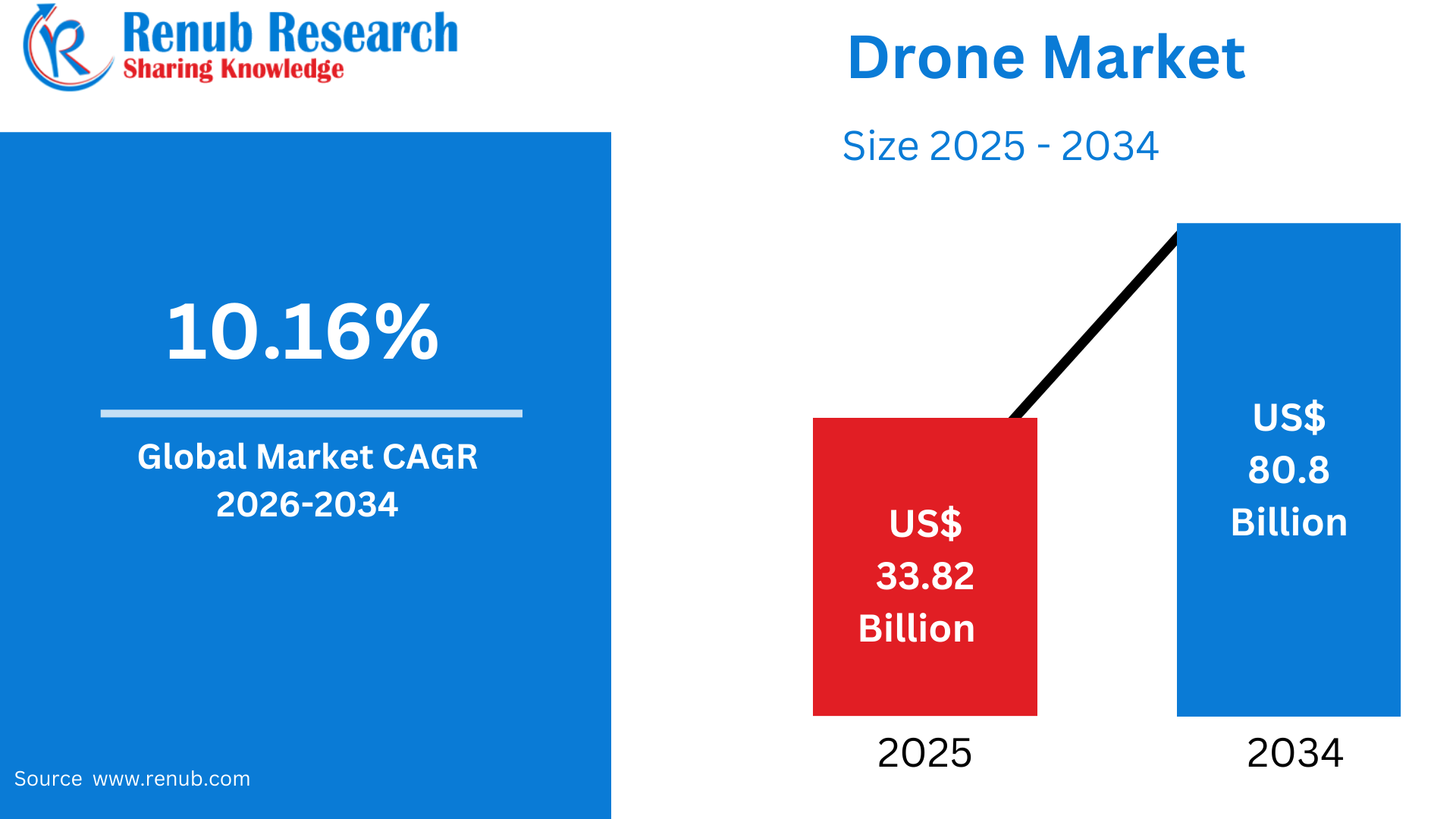
Worldwide Drone Market Outlook
Drone: A drone, also known as an unmanned aerial vehicle (UAV), is a type of aircraft that flies without a human pilot on board and is controlled from a distance or flies autonomously through the use of software and sensors on board. Drones are equipped with cameras, GPS, sensors, and communication technology that enables them to carry out tasks such as aerial photography, surveying, mapping, monitoring, and delivery. Drones come in different sizes and capabilities, from small consumer drones to industrial and military drones.
The use of drones has gained immense popularity across the globe due to their versatility, cost-effectiveness, and technological advancements. Organizations are increasingly using drones to enhance productivity, minimize risks associated with operations, and provide accurate real-time information. In the agricultural sector, drones are used for crop monitoring and precision agriculture. In the construction sector, drones are used for inspection and monitoring of construction progress. The hobby of photography and video shooting has also contributed to the popularity of drones. Moreover, governments and the defense sector use drones for surveillance, security, and disaster response activities.
Growth Drivers in the Global Drone Market
Expanding Commercial and Industrial Applications
One of the most significant drivers of the global drone market is the increasing number of commercial applications at a rapid pace. Drones are being increasingly used in agriculture for crop monitoring, spraying, and yield analysis. In the construction sector, drones are being used for site inspection, surveying, and progress monitoring. The use of drones is also being seen in the mining, energy, and telecommunication sectors for asset inspection and maintenance. The use of drones is increasing as they are able to provide high-resolution data at a faster rate. As a result, the demand for commercial drones is increasing at a rapid pace. July 2025 – DJI, the world's leading brand in civilian drones and creative camera technology, is pleased to announce the global launch of the DJI Agras T100, DJI Agras T70P, and DJI Agras T25P. The latest lineup of DJI Agriculture's popular spray drones has been developed after over 12 years of research and development.
Technological Advancements and Integration of AI
The rapid development of drone technology is a major factor in the growth of the market. Advances in battery technology, sensors, image-capturing technology, and navigation systems have improved the capabilities of drones. The integration of artificial intelligence and machine learning algorithms has enabled drones to fly autonomously, detect objects, and analyze data in real-time. Such capabilities have increased the uses of drones beyond manual control to complex tasks like predictive maintenance, monitoring, and accurate mapping. Advanced software solutions have improved the management of drone fleets and data processing. As technology becomes more advanced and easier to use, more people are embracing drones, leading to continuous growth in the market. January 2026, Telewind Electronics demonstrated its artificial intelligence-driven anti-drone solutions, emphasizing an integrated approach that leverages radar, electro-optical sensors, and centralized command systems to detect, track, and neutralize unmanned aerial threats.
Rising Demand from Defense and Public Safety Sectors
Use cases in the field of defense and public safety continue to be one of the primary drivers of the drone industry worldwide. Governments continue to invest in drones for surveillance, reconnaissance, border security, and tactical missions. Drones have also found extensive use in disaster response, search and rescue, and emergency response services. The capability of drones to reach and access dangerous or hard-to-reach areas makes them an essential tool for public safety organizations. The rising geopolitical tensions and security concerns continue to fuel investments in advanced drone technology. As defense spending and homeland security programs continue to grow, the demand for military and public safety drones continues to be strong globally. In Sept 2025, Teledyne FLIR Defense, a Teledyne Technologies Incorporated company, unveiled its game-changing SkyCarrier™ platform at the DSEI tradeshow in London.
Challenges in the Global Drone Market
Regulatory Restrictions and Airspace Management
Complex regulations are a major issue for the global drone industry. Various countries have different sets of regulations concerning the use of drones, flying them, and accessing airspace. Some regulations include restrictions on the maximum height to fly, beyond the visual line of sight, and flying in urban areas. This makes it difficult for commercial drones to scale. It is also time-consuming and expensive to obtain regulatory approvals. Privacy, security, and air traffic control issues add to the complexity of regulations.
Limited Battery Life and Operational Constraints
The limited battery life and payload capacity are still some of the challenges faced in drone technology. Most drones have to be recharged constantly, which limits the flight time and range. This has been a challenge in areas such as long-distance delivery, surveying large areas, and continuous monitoring. Weather conditions such as heavy winds and rain also affect the drones. Although technological advancements are being made, it is still a challenge to strike a balance between power consumption and payload capacity.
Global Energy Drone Market
The global energy drone market is growing at a fast pace as the energy sector is adopting drones for enhanced inspection efficiency, safety, and accuracy. Drones are increasingly used for inspecting power lines, wind energy turbines, solar energy farms, pipelines, and offshore platforms. They facilitate real-time monitoring, thermal scanning, and the early detection of defects, which helps in minimizing downtime and maintenance expenses. Drones also reduce the requirement for manual inspections in dangerous areas, ensuring the safety of employees. The rising global interest in renewable energy projects is also fueling the demand for energy drones, as large-scale wind and solar energy projects require periodic monitoring. The integration of advanced sensors and analytics is also enhancing asset management and predictive maintenance.
Global Entertainment Drone Market
The entertainment drone market has been in high demand because of its application in aerial photography, movie production, live shows, and drone light shows. Drones have been able to offer dynamic camera angles and immersive visuals that were not easily achievable in the past. In the entertainment sector, drones are mainly used in movie production, television, sports, and advertising. Drone light shows are increasingly being used in place of fireworks because they are reusable, safe, and environmentally friendly. Consumer drones are also fueling the market for entertainment drones. Advances in technology have improved the quality of cameras, stabilization, and control systems, which has increased their applications. As a result, entertainment drones are increasingly being adopted across various sectors.
Global Law Enforcement Drone Market
The international law enforcement drone market is increasing as public safety organizations begin to use drones to improve surveillance, monitoring, and response to emergencies. The drones are used for crowd control, traffic surveillance, search and rescue missions, and crime scene analysis. The drones offer real-time aerial intelligence, which improves decision-making. The drones also improve officer safety as they can monitor dangerous situations remotely. The drones have advanced capabilities such as thermal imaging, night vision, and facial recognition, which improve their effectiveness. Governments are increasingly investing in drone technology to improve public safety and emergency preparedness. As security threats continue to change, law enforcement organizations across the world continue to increase the use of drones for effective policing.
Global Fixed-Wing Drone Market
The fixed-wing drone market is fueled by the need for long-endurance and large-area coverage missions. Fixed-wing drones are employed for mapping, surveying, environmental observation, and military missions. The aerodynamic design of fixed-wing drones enables them to fly for a longer period and at faster speeds than rotary-wing drones. Fixed-wing drones are largely employed in agricultural applications for crop analysis and land evaluation. Fixed-wing drones are also employed for border protection and disaster response. Although fixed-wing drones need runways or launchers, their efficiency and endurance make them highly valuable. The increasing need for high-efficiency aerial data collection has increased the importance of fixed-wing drones.
Global Rotary-Wing Drone Market
The rotary wing drone market is one of the largest segments in the global market because of its versatility and usability. Rotary wing drones have the capability of vertical takeoff and landing, hovering, and precise flight, which makes them suitable for inspection, photography, and surveillance applications. Rotary wing drones lead the market in the consumer and commercial sectors, especially in the construction, media, and law enforcement sectors. The capability of rotary wing drones to fly in tight spaces and urban areas increases their usability. Improvements in battery life, stability, and carrying capacity are increasing their usability in various sectors.
United States Drone Market
The United States drone market is one of the most developed and varied around the world, thanks to widespread adoption in the defense, commercial, and consumer sectors. Drones have been adopted in agriculture, construction, energy inspection, logistics, and aerial photography. The defense industry is also a significant contributor, with steady investments in surveillance and unmanned systems. Commercial adoption is fueled by technological development, sophisticated software integration, and a thriving startup culture. Increasing enterprise needs for precision data, automation, and cost savings are also fueling adoption. Regulatory policies are also adapting to support wider commercial use. With advancing technology and applications, the United States drone market is set to see steady growth in various sectors. Dec 2025, The Defense Department is starting a $1 billion program to build U.S.-made drones capable of one-way attack missions, the type of missions that have been extremely successful in the Ukraine war.
United Kingdom Drone Market
The United Kingdom drone market is expanding steadily, aided by the rising use of drones in infrastructure inspection, media, agriculture, and public safety. Drones are used extensively for surveying, mapping, and monitoring infrastructure in the construction and transportation sectors. The creative sector is also a major driver of the use of drones for aerial filming and photography. Public sector bodies use drones for emergency services and environmental monitoring. Technological development and the rising awareness of the benefits of operational efficiency are factors that promote the growth of the market. The regulatory framework is focused on safety and prudent use, which has a bearing on market adoption. With the increasing adoption of digital and automated technology, the UK drone market is set to continue its growth in both commercial and public sectors. January 2026, Amazon has begun successful drone flights from its Darlington fulfillment center, with the northern city soon to become the first in the UK to launch Prime Air later in 2026. The new service will employ Amazon’s latest MK30 drone, which flies safely and independently with highly advanced, industry-leading detect-and-avoid technology, protecting people, pets, and property.
India Drone Market
The drone market in India is growing at a fast pace due to government support, technological advancements, and increasing uses in commercial sectors. Drones are being used in agriculture for crop observation and pesticide spraying, which helps in increasing productivity and decreasing costs. Infrastructure development, land surveying, and mining operations are also increasing the demand for drones. Defense and security-related uses are significantly increasing the market size. The startup culture and manufacturing capabilities in India are helping in innovation and making drones more affordable. As government regulations are becoming more favorable and awareness about drones is increasing, drones are being adopted in various sectors. India is one of the fastest-growing markets for drones because of the country’s large size and the developing digital economy. February 2025, the Indian drone manufacturer Garuda Aerospace announced that it will unveil 8 drones for defense, safety, and military use at Aero India at Yelahanka Air Force Station, Bengaluru.
Saudi Arabia Drone Market
The Saudi Arabia drone market is growing steadily with investments in smart city development, infrastructure, and defense modernization. The use of drones is for construction monitoring, energy inspection, and security surveillance. Government initiatives in the adoption of advanced technologies are encouraging. The energy sector, specifically oil and gas, is a major application area for drones. Growing interest in aerial mapping, environmental monitoring, and logistics is also supporting the market. While the regulatory environment is still evolving, growing technological investments make Saudi Arabia an attractive growth market for drone technology. Sep 2025, In a significant move that heralds a radical change in the Saudi Arabian logistics industry, a successful trial of drone parcel delivery was conducted in Jeddah. This is the first official experiment in the Kingdom to utilize unmanned aerial vehicles (UAVs) for postal services, bringing together aviation and logistics regulators to tap into faster, safer, and more sustainable delivery options.
Market Segmentation
Application
- Construction
- Agriculture
- Energy
- Entertainment
- Law Enforcement
- Other Applications
Type
- Fixed-wing Drones
- Rotary-wing Drones
Country
North America
- United States
- Canada
Europe
- France
- Germany
- Italy
- Spain
- United Kingdom
- Belgium
- Netherlands
- Turkey
Asia Pacific
- China
- Japan
- India
- Australia
- South Korea
- Thailand
- Malaysia
- Indonesia
- New Zealand
Latin America
- Brazil
- Mexico
- Argentina
Middle East & Africa
- South Africa
- Saudi Arabia
- United Arab Emirates
All companies have been covered with 5 Viewpoints
- Overviews
- Key Person
- Recent Developments
- SWOT Analysis
- Revenue Analysis
Company Analysis
- AeroVironment Inc.
- Delair SAS
- Intel Corporation
- Boeing Company
- Parrot Drones S.A.S.
- AgEagle Aerial Systems Inc
- Teledyne FLIR LLC
Report Details:
| Report Features | Details |
| Base Year |
2025 |
| Historical Period |
2022 - 2025 |
| Forecast Period |
2026 - 2034 |
| Market |
US$ Billion |
| Segment Covered |
Application, Type, and Countries |
| Countries Covered |
|
| Companies Covered |
|
| Customization Scope |
20% Free Customization |
| Post-Sale Analyst Support |
1 Year (52 Weeks) |
| Delivery Format |
PDF and Excel through Email (We can also provide the editable version of the report in PPT/Word format on request) |
Customization Services available
- Analysis of Market Size and Its Segments
- More Company Profiles (Upto 10 without any additional cost):
- Additional Countries (Other than mentioned Countries):
- Region/Country Specific Reports:
- Market Entry Strategy:
- Region-Specific Market Dynamics:
- Regional Market Share Analysis:
- Trade Analysis:
- Production Insights:
- Others Customized Requests:
For more information contact our analysts.
Need More Assistance?
- Talk to our analysts to get more precious information on the current market trends.
- Include more countries and segments and customize the report based on the final requirement.
- Get a competitive advantage in your industry by knowing the report findings and making a positive impact on your revenues and operations.
- Our analysts are always ready to provide more help and pertinent information if you need any additional assistance.