Dental Implant Market Report by Material Type, Design, Type, End User, Country and Company Analysis 2026-2034
Buy NowDental Implant Market Size & Forecast
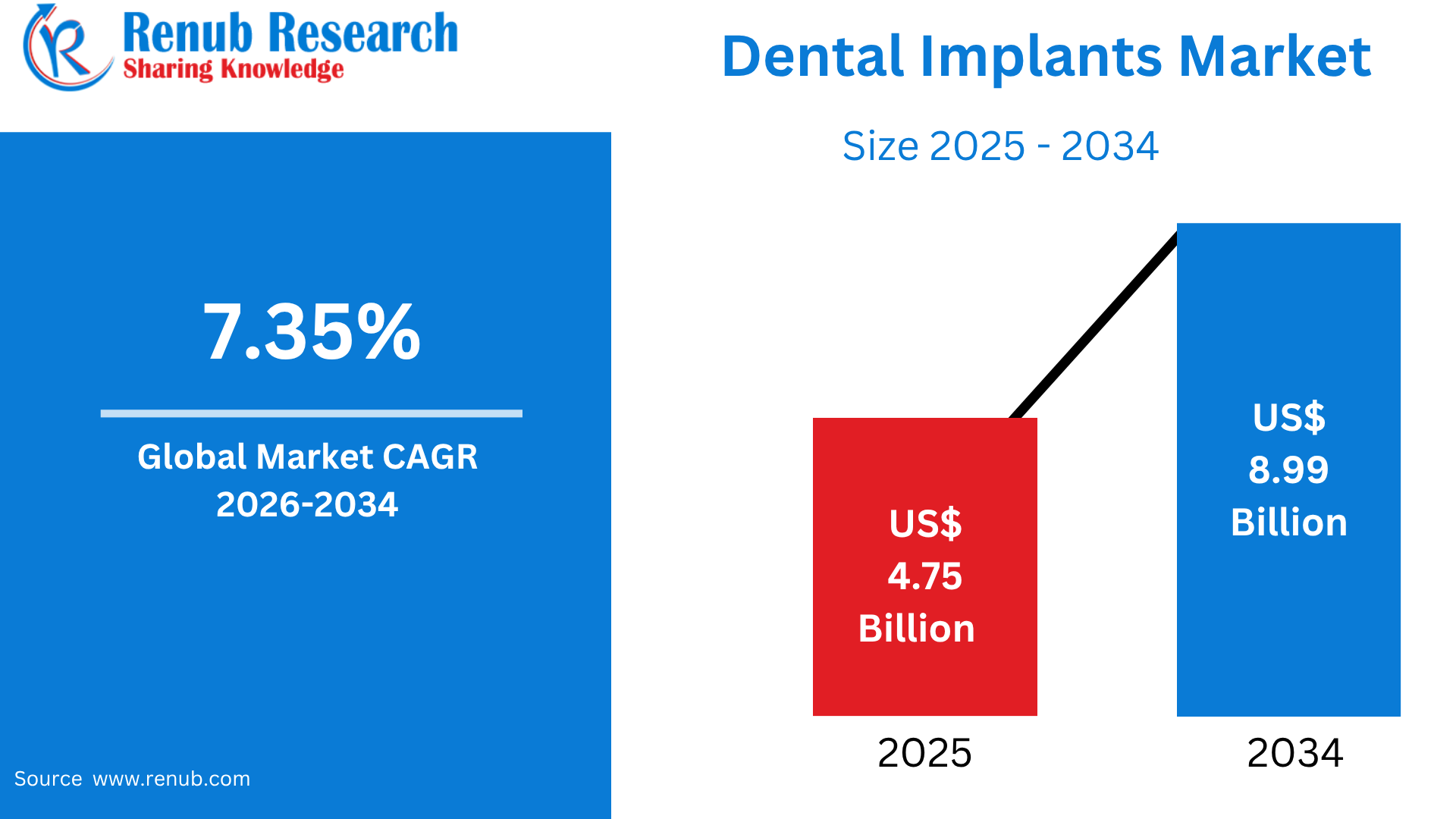
Dental Implant Market is projected to expand from US$ 4.75 billion in 2025 to approximately US$ 8.99 billion by 2034, registering a CAGR of 7.35% during 2026–2034. Market growth is supported by the rising prevalence of tooth loss and dental disorders, increasing awareness of oral health, and growing demand for aesthetic and restorative dentistry. In addition, advances in implant materials, digital dentistry, 3D imaging, computer-guided implant placement, and improved treatment techniques are enhancing clinical outcomes and patient satisfaction. The growing availability of specialized dental care services and increasing access to advanced treatment options are also encouraging adoption worldwide.
What is Dental Implant and Its Uses & Popularity Worldwide
A dental implant is a medical device used to replace missing teeth by providing an artificial tooth root that supports a crown, bridge, or denture. Most dental implants consist of a biocompatible material, commonly titanium, that is surgically positioned into the jawbone. After the implant integrates with the surrounding bone, an abutment and artificial tooth are placed to restore function and appearance. Dental implants are widely used for replacing a single missing tooth, multiple teeth, or supporting full-arch dental restorations. They can improve chewing ability, speech, facial appearance, and oral function while helping maintain jawbone structure following tooth loss.
The popularity of dental implants is increasing worldwide because of growing awareness of oral health, rising tooth-loss rates among aging populations, and increasing demand for cosmetic and restorative dentistry. Technological developments such as 3D imaging, CAD/CAM systems, digital treatment planning, and computer-guided implant placement have improved treatment precision and outcomes. Growing access to specialized dental clinics and advanced dental-care services is further supporting adoption. As patients increasingly seek durable and natural-looking tooth replacement solutions, dental implants have become an important part of modern restorative dentistry globally.
Dental disease prevalence
- Dental caries remains the most common health condition worldwide, with an estimated 2.5 billion people living with untreated tooth decay in permanent teeth.
- Around 514 million children have untreated decay in their primary teeth.
- Severe periodontal (gum) disease affects almost one-in-five adults globally (19%), which equates to around 1 billion people.
- Edentulism (complete tooth loss) is widespread in older populations, with prevalence exceeding 30% of adults over 65 years in many high-income countries.
Growth Drivers of the Dental Implant Market
Rising Prevalence of Tooth Loss and Oral Diseases
The increasing global burden of oral diseases is creating a substantial patient pool for dental implants. According to the World Health Organization (WHO), nearly 3.7 billion people are affected by oral diseases worldwide, while untreated dental caries affects approximately 2.5 billion people. Severe periodontal disease affects more than 1 billion people globally and can cause teeth to loosen and eventually fall out. Tooth loss is one of the major consequences of untreated dental diseases and trauma, creating demand for restorative solutions such as dental implants. WHO estimates that complete tooth loss affected approximately 350 million people aged 20 years and older in 2019, with global prevalence close to 7%. Among people aged 60 years and above, prevalence increased to approximately 23%, or nearly one in four individuals. As awareness of the functional and aesthetic consequences of missing teeth increases, more patients are seeking durable replacement options. The expanding burden of oral disease, combined with increasing treatment-seeking behavior, is therefore expected to support sustained dental implant demand worldwide.
Aging Population and Growing Demand for Restorative Dentistry
The global aging population is another important growth driver for the dental implant market because tooth loss becomes increasingly common with age. WHO data indicate that complete tooth loss has an estimated prevalence of 23% among people aged 60 years and older, compared with nearly 7% among adults aged 20 years and above. This demographic trend is particularly important because older adults increasingly seek treatments that restore chewing ability, speech, facial appearance, and overall quality of life. Dental implants can provide a stable foundation for individual crowns, bridges, and implant-supported dentures, making them attractive for patients requiring long-term tooth replacement. In addition, improved life expectancy means people are retaining their natural teeth for longer periods but may still require restorative treatment when severe decay or periodontal disease occurs. WHO estimates that the number of complete-tooth-loss cases globally reached approximately 350 million in 2019, while case numbers increased by more than 80% between 1990 and 2019. Increasing demand for healthy aging, functional dentistry, and aesthetically acceptable restorations is therefore expected to expand the potential patient base for dental implants.
Advancements in Digital and Implant Dentistry
Technological advancements are improving the precision, planning, and overall efficiency of implant procedures, encouraging wider adoption among dental professionals and patients. Digital dentistry increasingly incorporates 3D imaging, computer-aided treatment planning, CAD/CAM workflows, digital impressions, and computer-guided implant placement. These technologies allow dentists to evaluate bone structures more accurately and develop customized treatment plans before surgery. Improvements in implant materials and surface technologies are also supporting better integration with surrounding bone and more predictable treatment outcomes. The broader oral-health burden provides a large potential market for these technologies: WHO estimates that oral diseases affected approximately 3.5 billion people globally in 2019, while complete tooth loss accounted for about 350 million cases. At the same time, patients are increasingly interested in restorations that provide a natural appearance and improved functionality. Digital workflows can reduce treatment complexity and improve communication between dentists, laboratories, and patients. The development of minimally invasive and digitally guided approaches is therefore helping dental implant procedures become more predictable and patient-focused. Continued innovation in implant design, imaging, materials, and restorative techniques is expected to remain a significant market growth catalyst.
Challenges of the Dental Implant Market
High Treatment Costs and Limited Accessibility
The relatively high cost of dental implant treatment remains a major challenge, particularly in developing and low-income markets. Implant procedures can involve multiple stages, including diagnostic imaging, implant placement, abutment installation, crowns or dentures, and sometimes bone grafting, making the overall treatment more expensive than several conventional tooth-replacement options. WHO highlights that oral-health prevention and treatment are often expensive and are usually not included in national universal health-coverage benefit packages. This creates affordability barriers for patients who require advanced restorative treatment. Access is particularly difficult in low- and middle-income countries, where WHO reports that many countries do not have sufficient services to prevent and treat oral-health conditions. The broader economic burden is also significant: WHO estimates that the main oral diseases generated more than US$380 billion in direct expenditure globally in 2019, equivalent to approximately 4.8% of global direct health expenditures. Consequently, despite the clinical benefits of implants, high procedure costs, limited reimbursement, shortages of specialized dental professionals, and uneven access to advanced dental facilities can restrict adoption. Expanding affordable treatment options and improving dental-care coverage remain important for wider market penetration.
Limited Dental Care Access and Treatment Complexity
Limited access to professional dental services and the complexity of implant treatment can constrain market expansion, especially in underserved regions. Dental implants require professional assessment, adequate bone quality, surgical expertise, appropriate sterilization, and follow-up care. Patients with severe bone loss may additionally require procedures such as bone augmentation, increasing treatment time and expense. The underlying need is substantial: WHO estimates that 350 million people aged 20 years and older experienced complete tooth loss globally in 2019, while severe periodontal disease affected more than 1 billion people. However, the availability of advanced dental services does not match this potential demand in many countries. WHO reports that most low- and middle-income countries lack sufficient services for preventing and treating oral-health conditions. Patient hesitation regarding surgery, treatment duration, potential complications, and maintenance can further delay implant adoption. In addition, successful outcomes depend heavily on appropriate patient selection, professional expertise, oral hygiene, and regular follow-up. These factors make implants more complex than simpler tooth-replacement alternatives. Expanding specialist training, improving dental infrastructure, and increasing patient education will be essential for overcoming these barriers and supporting broader adoption.
Dental Implant Launches Worldwide
- MIS LYNX – United States, 2025: Dentsply Sirona launched MIS LYNX in the U.S. as a premium, cost-effective implant solution. The system features a wet implant surface, sterile single-use drills packaged with each implant, and a broad prosthetic portfolio.
- Tapered Pro Conical – UK & Ireland, 2025: BioHorizons Camlog introduced Tapered Pro Conical, its first dental implant with a deep conical connection. The system was designed for immediate-treatment applications ranging from single-tooth replacement to full-arch rehabilitation.
- ApexKonnect Dental Implant System – India, 2025: Dentalkart launched ApexKonnect in New Delhi in September 2025. The system was promoted for immediate placement, reduced drilling requirements, shorter surgical procedures, and integration with digital workflows.
- GEN5 & GEN5+ – United States, 2025: Paragon Implant launched its GEN5 and GEN5+ dental implants as a new generation of implant systems. The company highlighted their vertical flexibility and development focused on addressing issues such as peri-implantitis.
- Adin Long Dental Implant System – United States, 2026: The Adin Long Dental Implant System received FDA 510(k) clearance in March 2026. The system is classified as an endosseous, root-form dental implant.
- NizPlant Dental Implant System – United States, 2025: Paragon Implant’s NizPlant Dental Implant System received FDA 510(k) clearance in December 2025, expanding the company’s portfolio of endosseous root-form implant systems.
- DAND Dental Implant System – United States, 2025: The DAND Dental Implant System, developed by D.A.N.D. Metal Industries North, received FDA 510(k) clearance in April 2025 for an endosseous root-form dental implant.
- Bioline Dental Implant System – United States, 2025: Bioline Dental Implant Systems received FDA 510(k) clearance for its Bioline Dental Implant System in June 2025, adding another implant system to the U.S. market.
- S.I.N. Dental Implant System – United States, 2025: Brazil-based S.I.N. Implant System received FDA 510(k) clearance for its S.I.N. Dental Implant System in September 2025, supporting its expansion in the U.S. dental implant market.
- Straumann iEXCEL – Global, 2024–2025: Straumann launched iEXCEL, a next-generation implant system combining four implant designs with a standardized TorcFit connection and a single instrument set. The system was launched in North America and selected EMEA markets.
Biocompatibility and Long-Term Stability Drive Titanium Implant Adoption
The dental titanium implant market represents a major segment of restorative dentistry because titanium combines excellent biocompatibility, mechanical strength, corrosion resistance, and osseointegration. Titanium can integrate with the jawbone, creating a stable foundation for crowns, bridges, and implant-supported dentures. The global need for such solutions is substantial, as the WHO estimates that approximately 350 million adults aged 20 years and older experienced complete tooth loss in 2019, while severe periodontal disease affects more than 1 billion people worldwide. These conditions create a significant potential patient population for implant-based tooth replacement. Demand is further supported by increasing awareness of oral health, cosmetic dentistry, and the advantages of permanent tooth replacement. Manufacturers and dental professionals are also adopting improved implant surfaces, micro-textured structures, and advanced designs to enhance bone integration and treatment predictability. Digital imaging, computer-guided surgery, and customized implant planning are further improving clinical workflows. As populations age and patients increasingly seek natural-looking and durable restorations, titanium implants are expected to maintain their leading position in the dental implant industry.
Cylindrical Design Supports Predictable Implant Placement
The dental implant parallel-walled market is gaining importance because cylindrical or parallel-sided implants can provide predictable placement and stable restorative support when suitable bone conditions are available. Parallel-walled implants are generally designed with relatively consistent diameter along the implant body, allowing dental professionals to select appropriate sizes according to the patient’s anatomy and treatment requirements. Their use is particularly relevant in cases where adequate bone volume and density are available. The segment benefits from the broader increase in dental implant procedures associated with tooth loss and restorative dentistry. According to the WHO, complete tooth loss affected approximately 350 million adults aged 20 years and older in 2019, highlighting the significant global need for tooth-replacement solutions. Advances in 3D cone-beam computed tomography (CBCT), digital treatment planning, and computer-guided surgery are helping clinicians evaluate bone anatomy and improve implant positioning. Increasing demand for predictable, customized, and aesthetically pleasing dental restorations is encouraging continued development of implant geometry and surface characteristics. These developments are expected to support the adoption of parallel-walled implants where clinically appropriate.
Established Clinical Use Makes Endosteal Implants the Dominant Design
The endosteal dental implant market represents the most widely used implant approach in modern implant dentistry. Endosteal implants are surgically positioned directly into the jawbone and subsequently connected to artificial teeth through an abutment. Titanium is commonly used because of its favorable biocompatibility and ability to integrate with bone. The segment benefits from the large global burden of tooth loss. WHO estimates that approximately 350 million people aged 20 years and older experienced complete tooth loss in 2019, while the prevalence among people aged 60 years and above was approximately 23%. These demographic and oral-health trends create continued demand for durable restorative solutions. Technological improvements are also supporting the segment through 3D imaging, digital impressions, CAD/CAM workflows, and computer-guided implant surgery. Such technologies allow dentists to assess bone structure, plan implant positioning, and design customized restorations with greater precision. Increasing patient awareness of implant-supported tooth replacement and growing demand for natural-looking restorations further strengthen adoption. Because of its versatility, established clinical application, and suitability for a broad range of restorative cases, the endosteal implant segment is expected to remain a central component of the global dental implant market.
Specialized Applications Create a Niche Opportunity
The transosteal dental implant market is a specialized segment used primarily in complex cases involving the lower jaw, particularly when conventional implant placement may be difficult because of limited bone height or challenging anatomical conditions. Unlike conventional endosteal implants, transosteal systems extend through the mandibular bone and are secured through the lower border of the jaw. Their specialized design makes them considerably less common than conventional implant systems, limiting their overall market share. However, the continuing global burden of tooth loss creates a need for alternative approaches in difficult restorative cases. WHO estimates that complete tooth loss affected approximately 350 million adults aged 20 years and older in 2019, demonstrating the scale of potential restorative requirements. Advances in diagnostic imaging, surgical planning, implant materials, and specialized reconstruction techniques are improving clinicians’ ability to manage complex dental conditions. Nevertheless, the invasive nature, technical complexity, limited indications, and availability of alternative implant technologies restrict widespread adoption. Future opportunities are likely to remain concentrated in specialized dental centers and complex cases where conventional implant approaches are unsuitable. Continued innovation in surgical techniques and patient-specific planning may gradually improve the clinical applicability of transosteal systems.
Rising Patient Demand and Digital Dentistry Strengthen Clinic-Based Treatment
The dental implant dental clinics market is an important part of the overall implant ecosystem because clinics serve as primary locations for consultation, diagnosis, implant placement, restoration, and follow-up care. Growing awareness of oral health and increasing demand for cosmetic and restorative dentistry are encouraging more patients to seek long-term solutions for missing teeth. WHO reports that nearly 3.7 billion people worldwide experience oral diseases, while untreated dental caries affects approximately 2.5 billion people, creating a substantial need for restorative dental services. Dental clinics are increasingly adopting CBCT imaging, intraoral scanners, CAD/CAM technology, digital treatment planning, and computer-guided implant placement to improve treatment precision and patient communication. The expansion of specialized implant centers and multi-specialty dental practices is also improving access to advanced procedures. In addition, growing consumer interest in natural-looking restorations and improved oral functionality supports demand for implant treatment. However, high treatment costs and limited insurance coverage remain barriers in several markets. Continued investment in digital equipment, professional training, specialized implant services, and patient education is expected to strengthen the role of dental clinics in the global dental implant market.
Advanced Dental Infrastructure and Rising Aesthetic Demand in USA
United States dental implant market is highly developed, supported by strong demand for restorative and cosmetic dentistry, advanced dental infrastructure, and widespread access to specialized professionals. The country has a substantial population affected by tooth loss and periodontal disease, creating continued demand for durable tooth-replacement solutions. Increasing awareness of dental aesthetics is encouraging patients to consider implants as an alternative to conventional bridges and removable dentures. The adoption of digital dentistry, 3D imaging, CAD/CAM systems, and computer-guided implant placement is improving treatment planning and precision. Rising disposable incomes and the availability of financing options are also helping make implant procedures more accessible. According to the WHO, complete tooth loss affects approximately 23% of people aged 60 years and older globally, highlighting the growing relevance of restorative dentistry as populations age. Competition among dental technology providers is encouraging continuous improvements in implant design, materials, and surgical techniques. In March 2026, Nuventus announced the commercial launch of its NV.C Implant System in the United States, adding another implant system to the competitive U.S. market.
Private Dental Care and Technological Advancements Support United Kingdom Growth
United Kingdom dental implant market is expanding steadily as awareness of oral health, dental aesthetics, and long-term tooth replacement increases. Patients experiencing tooth loss are increasingly considering implants because of their durability, stability, and natural appearance. The market benefits from the UK’s established dental-care infrastructure, which includes both NHS and private providers. However, implant treatment through the NHS remains limited, meaning private dental practices represent an important channel for implant procedures. Technological developments such as 3D imaging, digital treatment planning, minimally invasive techniques, and guided surgery are improving treatment precision and supporting better clinical outcomes. The aging population is also creating additional demand for restorative dental services, as the likelihood of tooth loss increases with age. Cosmetic dentistry and growing attention to personal appearance further support demand among younger and middle-aged consumers. In February 2022, Dentsply Sirona introduced the DS PrimeTaper implant system in the UK and Ireland, featuring a progressive thread design intended to facilitate efficient bone engagement and support immediate-loading applications where clinically appropriate. High treatment costs remain a challenge, but improving technology and awareness continue to support market development.
Rising Middle-Class Spending and Dental Tourism Expand India Adoption
India dental implant market is experiencing strong growth as awareness of oral health improves and more patients seek advanced solutions for missing teeth. Urbanization, changing dietary habits, and lifestyle-related dental problems are contributing to demand for sophisticated restorative procedures. Dental implants, previously considered a premium treatment, are becoming more accessible as private dental clinics expand and competition encourages more varied pricing. India’s growing middle-class population and increasing disposable incomes are also supporting spending on cosmetic and restorative dental care. In addition, dental tourism remains an important opportunity because international patients can access advanced dental procedures at comparatively competitive costs. Expansion of modern dental clinics, digital imaging, CAD/CAM technology, and implant-focused practices is further improving treatment availability. Patient education and greater awareness of the functional and aesthetic benefits of implants are expected to strengthen adoption. In March 2026, Dr. Srikanth Cherukadu launched American Dental Implants & Smile Clinic in Hyderabad’s Financial District, adding a specialized implant-focused clinic to India’s expanding private dental-care infrastructure. Despite affordability differences between urban and rural populations and uneven access to advanced dental services, improving healthcare infrastructure and growing consumer awareness are expected to support continued market expansion.
Healthcare Investment and Cosmetic Dentistry Strengthen Saudi Arabia Market Opportunities
Saudi Arabia dental implant market is developing as healthcare modernization, rising oral-health awareness, and increasing interest in cosmetic dentistry encourage demand for advanced restorative procedures. Tooth loss and periodontal disease create a need for replacement solutions, while growing consumer attention to appearance and personal grooming is strengthening interest in aesthetically focused dental treatments. Government investment in healthcare infrastructure is expanding access to modern hospitals, specialized dental centers, and advanced clinics. The availability of skilled dental professionals and technologies such as digital imaging, 3D treatment planning, CAD/CAM, and computer-guided procedures is also improving the country’s implant-treatment capabilities. Saudi Arabia’s broader healthcare transformation under Vision 2030 provides additional support for private-sector investment and specialized medical services. In September 2025, Magrabi Health announced the acquisition of UniDents, an established dental practice in Jeddah, adding 18 high-tech dental chairs to its portfolio. The company stated an ambition to reach 400 dental chairs within two years, demonstrating continued investment in dental-care capacity. Although treatment costs and access differences can limit adoption, increasing healthcare expenditure, modern infrastructure, and rising patient awareness are expected to support the Saudi dental implant market over the long term.
Dental Implant Market Segments
Material Types
- Titanium Implants
- Zirconium Implants
Design
- Parallel-Walled Implants
- Tapered Implants
Types
- Endosteal Implants
- Subperiosteal Implant
- Transosteal Implant
End-Users
- Antiplatelet Agents Hospitals
- Dental Clinics
- Others
Countries
North America
- United States
- Canada
Europe
- France
- Germany
- Italy
- Spain
- United Kingdom
- Belgium
- Netherlands
- Turkey
Asia Pacific
- China
- Japan
- India
- Australia
- South Korea
- Thailand
- Malaysia
- Indonesia
- New Zealand
Latin America
- Brazil
- Mexico
- Argentina
Middle East & Africa
- South Africa
- Saudi Arabia
- UAE
All companies have been covered with 5 Viewpoints
- Overviews
- Key Person
- Recent Developments
- SWOT Analysis
- Revenue Analysis
Company Analysis:
- Danaher Corporation
- Dentsply Sirona
- Institut Straumann AG
- Zimmer Biomet
- Kyocera Corporation
- Henry Schein, Inc.
- Biocon LLC,
- Osstem implant
Report Details:
| Report Features | Details |
| Base Year |
2025 |
| Historical Period |
2022 - 2025 |
| Forecast Period |
2026 - 2034 |
| Market |
US$ Billion |
| Segment Covered |
Material Type, Design, Type, End User and Countries |
| Countries Covered |
|
| Companies Covered |
|
| Customization Scope |
20% Free Customization |
| Post-Sale Analyst Support |
1 Year (52 Weeks) |
| Delivery Format |
PDF and Excel through Email (We can also provide the editable version of the report in PPT/Word format on request) |
Key Questions Answered in This Report:
-
What is the projected market size of the global dental implant market by 2033?
-
What is the expected CAGR of the dental implant market from 2024 to 2033?
-
Which material types are covered in the dental implant market segmentation?
-
How does the aging population contribute to the growth of the dental implant market?
-
What technological advancements are driving the adoption of dental implants?
-
What are the major challenges facing the dental implant market?
-
Why are dental implants preferred over traditional dentures?
-
Which country has the largest dental implant market in North America?
-
What role does cosmetic dentistry play in the growth of the dental implant market?
-
Name three key companies operating in the dental implant market.
Customization Services available
- Analysis of Market Size and Its Segments
- More Company Profiles (Upto 10 without any additional cost):
- Additional Countries (Other than mentioned Countries):
- Region/Country Specific Reports:
- Market Entry Strategy:
- Region-Specific Market Dynamics:
- Regional Market Share Analysis:
- Trade Analysis:
- Production Insights:
- Others Customized Requests:
For more information contact our analysts.
Need More Assistance?
- Talk to our analysts to get more precious information on the current market trends.
- Include more countries and segments and customize the report based on the final requirement.
- Get a competitive advantage in your industry by knowing the report findings and making a positive impact on your revenues and operations.
- Our analysts are always ready to provide more help and pertinent information if you need any additional assistance.