Global Contact Lenses Market Report by Material, Usage, Design, Application, Distribution Channel, Countries and Company Analysis 2026-2034
Buy NowContact Lenses Market Size and Forecast
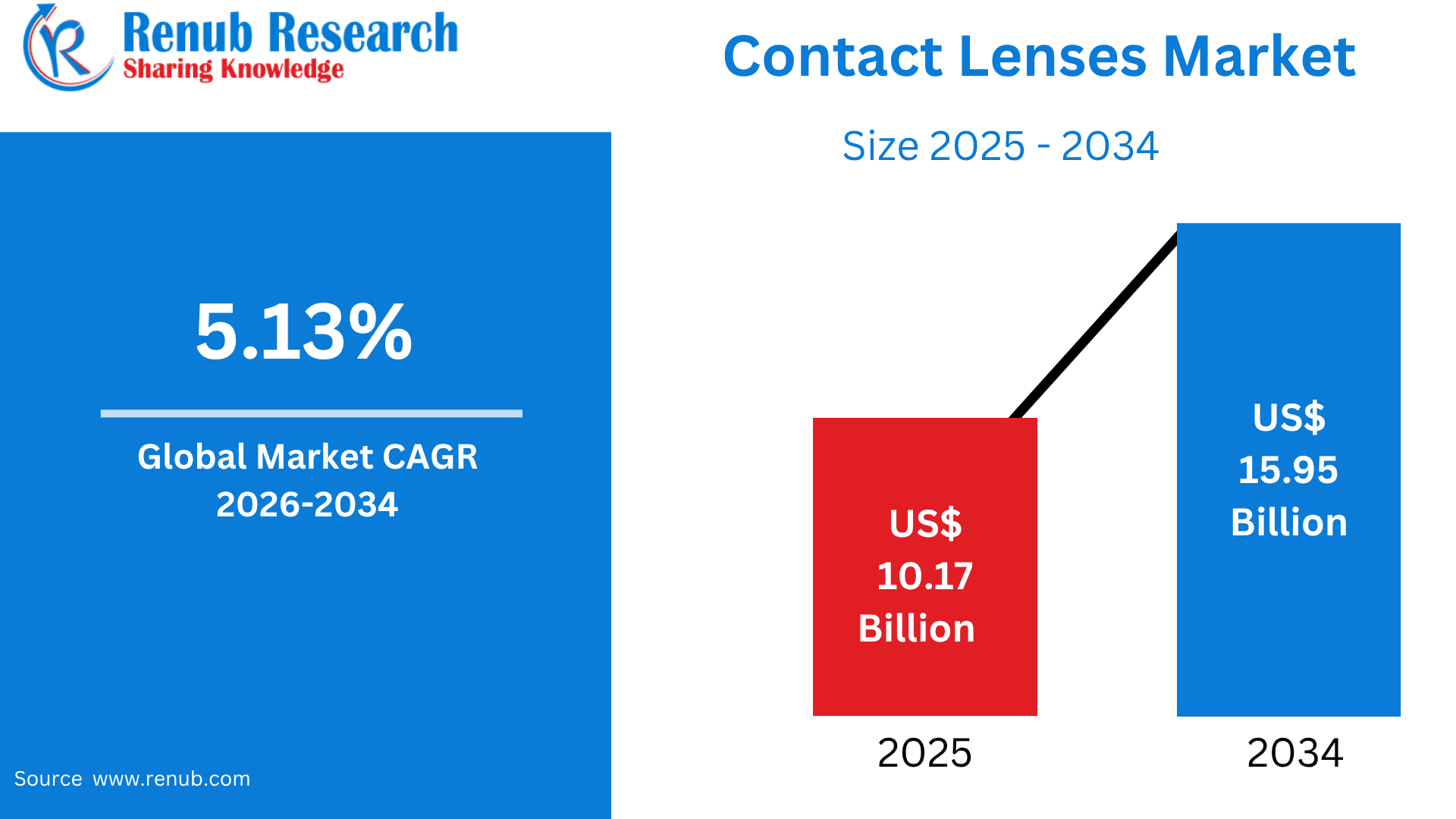
Global contact lenses market is projected to grow from US$ 10.17 billion in 2025 to US$ 15.95 billion by 2034, registering a CAGR of 5.13% during 2026–2034. The market is being supported by the increasing prevalence of myopia worldwide, ongoing advancements in contact lens materials and designs, and growing interest in specialty lenses. Emerging innovations such as AR-integrated contact lenses are creating new opportunities, while the expansion of specialty lens portfolios is addressing a broader range of vision-correction requirements.
What are Contact Lenses and Their Uses & Popularity Worldwide?
Contact lenses are thin, curved medical devices placed directly on the surface of the eye to correct refractive vision problems such as myopia, hyperopia, astigmatism, and presbyopia. They work by altering the way light enters the eye, providing clear vision without the need for conventional eyeglasses.
Contact lenses are available in several forms, including soft lenses, rigid gas-permeable lenses, toric lenses, multifocal lenses, and specialty lenses designed for specific vision requirements. They are widely used for everyday vision correction, sports, professional activities, cosmetic purposes, and situations where eyeglasses may be inconvenient. Their popularity worldwide is increasing due to growing awareness of eye health, rising rates of refractive errors, improvements in lens comfort and oxygen permeability, and expanding product choices.
Daily disposable lenses have gained particular attention because they offer convenience and can reduce handling requirements. Specialty lenses are also becoming more important for astigmatism, presbyopia, and myopia management. In addition, ongoing innovations in smart and digitally integrated lenses are creating new applications beyond conventional vision correction, supporting continued interest and technological development in the global contact lenses market.
Blindness and Vision Impairment: Key Facts
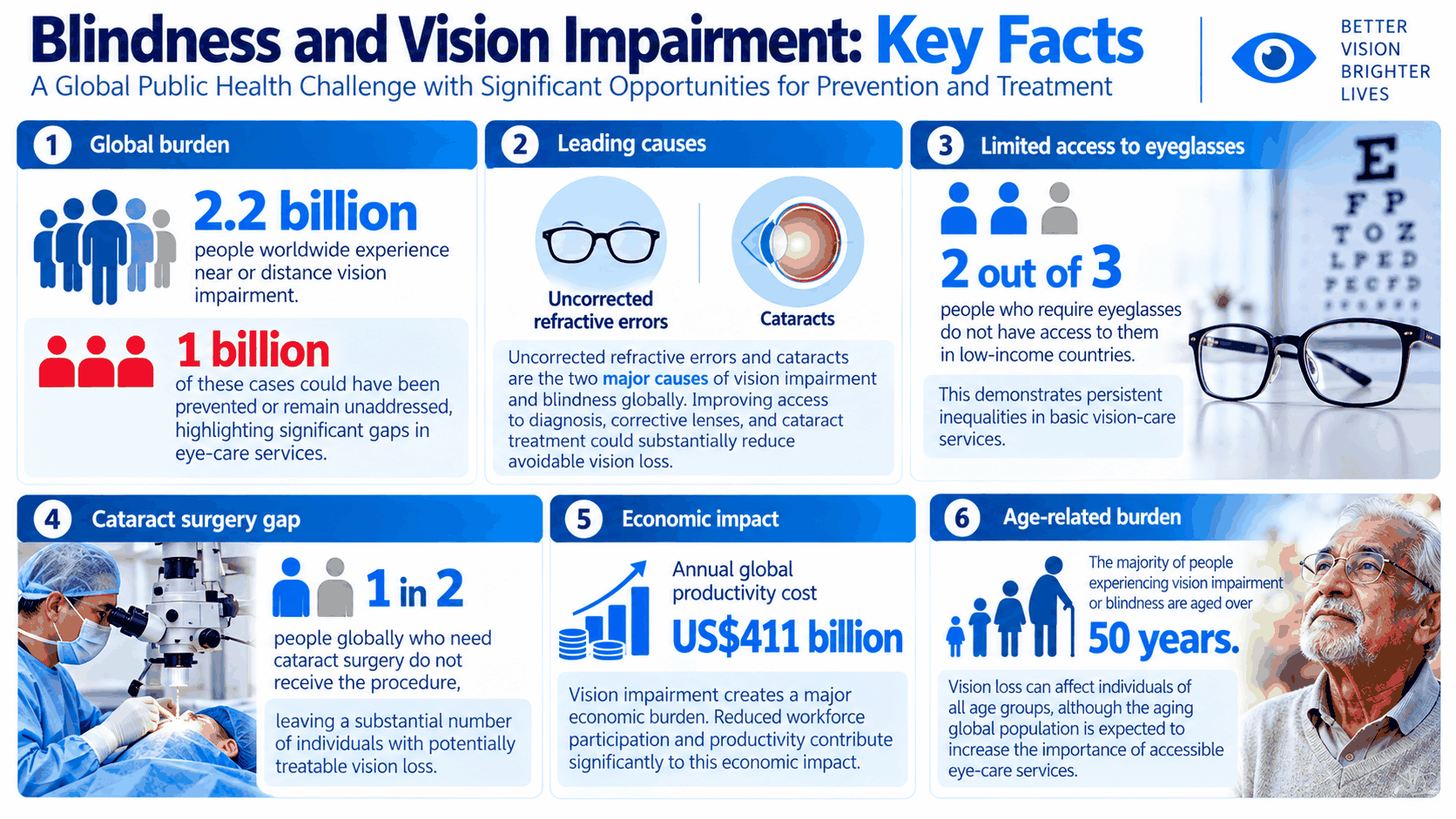
- Global burden: At least 2.2 billion people worldwide experience near or distance vision impairment. Of these, approximately 1 billion cases could have been prevented or remain unaddressed, highlighting significant gaps in eye-care services.
- Leading causes: Uncorrected refractive errors and cataracts are the two major causes of vision impairment and blindness globally. Improving access to diagnosis, corrective lenses, and cataract treatment could substantially reduce avoidable vision loss.
- Limited access to eyeglasses: In low-income countries, around 2 out of 3 people who require eyeglasses do not have access to them, demonstrating persistent inequalities in basic vision-care services.
- Cataract surgery gap: Approximately 1 in 2 people globally who need cataract surgery do not receive the procedure, leaving a substantial number of individuals with potentially treatable vision loss.
- Economic impact: Vision impairment creates a major economic burden, with the annual global productivity cost estimated at US$411 billion. Reduced workforce participation and productivity contribute significantly to this economic impact.
- Age-related burden: Vision loss can affect individuals of all age groups, although the majority of people experiencing vision impairment or blindness are aged over 50 years. The aging global population is therefore expected to increase the importance of accessible eye-care services.
Growth Drivers of the Contact Lenses Market
Rising Global Prevalence of Myopia and Refractive Errors
The increasing prevalence of myopia and other refractive errors is a major growth driver for the global contact lenses market. Myopia is among the most common vision conditions worldwide, creating a large and expanding population requiring vision correction. A global analysis covering 145 studies and 2.1 million participants estimated that approximately 1.4 billion people, or 22.9% of the world’s population, had myopia in 2000. The same research projects the number to reach 4.76 billion people, representing 49.8% of the global population, by 2050. High myopia is also projected to increase from 163 million people in 2000 to 938 million by 2050. This expanding vision-correction requirement is increasing opportunities for contact lenses as an alternative to spectacles. Soft lenses, toric lenses, multifocal lenses, and specialty products allow manufacturers to address different refractive conditions and consumer needs. Rising awareness of eye examinations and vision correction, particularly among younger populations, is further supporting adoption. Consequently, the growing global burden of myopia is expected to generate sustained demand for contact lenses over the coming years.
Technological Innovation and Expansion of Specialty Lenses
Continuous technological advancement in contact lens materials, designs, and manufacturing is creating new opportunities for market expansion. Manufacturers are developing lenses with improved oxygen permeability, moisture retention, comfort, UV protection, and wearing performance, helping address common consumer concerns associated with traditional lenses. Specialty products such as toric lenses for astigmatism, multifocal lenses for presbyopia, scleral lenses, and myopia-management lenses are expanding the addressable customer base beyond conventional spherical lenses. The development of daily disposable lenses has also increased convenience by reducing the need for cleaning and storage, supporting adoption among consumers seeking easier vision-correction options. Research and development is additionally moving toward smart and digitally integrated contact lenses capable of incorporating sensing and other advanced functionalities. The growing prevalence of myopia provides an important foundation for these innovations: one major global projection estimates that nearly 50% of the world’s population could be myopic by 2050. As manufacturers continue improving comfort, functionality, and specialized vision correction, product innovation is expected to encourage existing users to upgrade and attract new consumers.
Growing Demand for Myopia Management and Advanced Vision-Correction Solutions
The increasing focus on managing myopia progression, particularly among children and young people, is creating another important opportunity for contact lens manufacturers. Global research indicates that myopia prevalence among children and adolescents has increased substantially over recent decades. A 2024 systematic review covering 276 studies, 5.41 million participants, and 50 countries found that pooled myopia prevalence increased from 24.32% in 1990 to 35.81% in 2023, with the study projecting prevalence to reach 39.80% by 2050. This trend is encouraging greater attention toward specialized myopia-control approaches, including specially designed contact lenses intended to slow myopia progression. Orthokeratology and multifocal or dual-focus lens designs are among the approaches being explored and adopted in clinical practice. In parallel, parents and eye-care professionals are becoming more aware of the potential long-term consequences associated with progressive and high myopia. High myopia is projected to affect approximately 938 million people by 2050 under widely cited global projections. Increasing demand for clinically supported myopia-management solutions, combined with product innovation and professional awareness, is therefore expected to strengthen the contact lenses market.
Challenges of the Contact Lenses Market
Risk of Eye Infections and Improper Lens Handling
The possibility of eye irritation, infection, and other complications associated with improper contact lens use remains a significant challenge for market expansion. Unlike spectacles, contact lenses come into direct contact with the eye and require appropriate hygiene, storage, replacement, and wearing practices. Failure to follow recommended cleaning procedures or wearing schedules can increase the risk of microbial contamination and other eye complications. The challenge can be greater among first-time users and consumers who do not consistently follow instructions from eye-care professionals. Extended or inappropriate wearing of lenses can also contribute to discomfort and reduced oxygen availability to the cornea, potentially affecting user satisfaction. Consequently, some consumers may prefer spectacles because they require less direct eye contact and generally involve simpler maintenance. Manufacturers and eye-care providers are addressing these concerns through daily disposable lenses, improved breathable materials, moisture-enhancing technologies, and consumer education. Daily disposables can reduce some cleaning and storage requirements, but affordability can remain a consideration for frequent users. Maintaining high safety standards and improving user compliance will therefore remain important for expanding contact lens adoption while protecting consumer eye health.
High Cost, Regulatory Requirements, and Limited Consumer Adoption
Cost and regulatory requirements can create barriers to wider contact lens adoption, particularly in price-sensitive developing markets. Contact lenses require periodic replacement, professional fitting in many cases, and ongoing purchases of lenses and related products, making their cumulative cost potentially higher than that of conventional spectacles for some consumers. Specialty and advanced lenses, including multifocal, toric, and myopia-management products, can be more expensive because of their specialized designs and manufacturing requirements. In addition, contact lenses are regulated medical devices in many countries, requiring manufacturers to demonstrate appropriate safety, quality, and performance before commercialization. New technologies therefore often face lengthy development, testing, and approval processes, increasing research and development expenditure and potentially extending time-to-market. Consumer comfort also remains an important adoption consideration because some individuals experience dryness, irritation, or difficulty adapting to lens wear. Although innovations in materials and lens designs are addressing these issues, the need for professional guidance and recurring expenditure can limit penetration among price-sensitive consumers. Manufacturers must therefore balance advanced functionality with affordability, comfort, safety, and regulatory compliance to achieve broader worldwide adoption.
Contact Lens Launches Worldwide
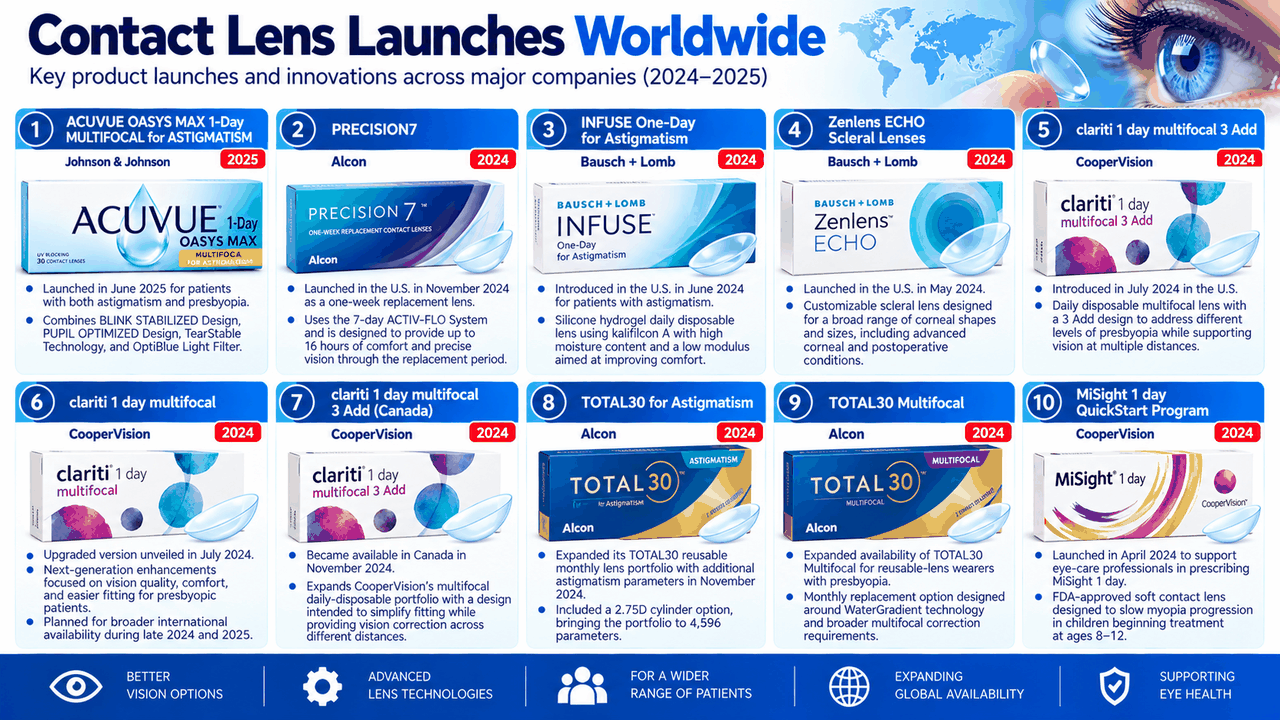
- ACUVUE OASYS MAX 1-Day MULTIFOCAL for ASTIGMATISM – Johnson & Johnson, 2025: Launched in June 2025, this daily disposable lens was introduced for patients with both astigmatism and presbyopia. It combines BLINK STABILIZED Design, PUPIL OPTIMIZED Design, TearStable Technology, and OptiBlue Light Filter.
- PRECISION7 – Alcon, 2024: Alcon launched PRECISION7 in the U.S. in November 2024 as a one-week replacement contact lens. It uses the 7-day ACTIV-FLO System and is designed to provide up to 16 hours of comfort and precise vision through the replacement period.
- INFUSE One-Day for Astigmatism – Bausch + Lomb, 2024: Introduced in the U.S. in June 2024, this silicone hydrogel daily disposable lens was developed for patients with astigmatism. It uses kalifilcon A material with high moisture content and a low modulus aimed at improving comfort.
- Zenlens ECHO Scleral Lenses – Bausch + Lomb, 2024: Launched in the U.S. in May 2024, Zenlens ECHO is a customizable scleral lens designed for a broad range of corneal shapes and sizes, including advanced corneal and postoperative conditions.
- clariti 1 day multifocal 3 Add – CooperVision, 2024: CooperVision introduced this daily disposable multifocal lens in July 2024 in the U.S. The lens features a 3 Add design intended to address different levels of presbyopia while supporting vision at multiple distances.
- clariti 1 day multifocal – CooperVision, 2024: CooperVision unveiled an upgraded version of clariti 1 day multifocal in July 2024, incorporating next-generation enhancements focused on vision quality, comfort, and easier fitting for presbyopic patients. The product was planned for broader international availability during late 2024 and 2025.
- clariti 1 day multifocal 3 Add – CooperVision Canada, 2024: The product became available in Canada in November 2024, expanding CooperVision’s multifocal daily-disposable portfolio with a design intended to simplify fitting while providing vision correction across different distances.
- TOTAL30 for Astigmatism – Alcon, 2024: Alcon expanded its TOTAL30 reusable monthly lens portfolio with additional astigmatism parameters in November 2024. The expanded range included a 2.75D cylinder option, bringing the portfolio to 4,596 parameters.
- TOTAL30 Multifocal – Alcon, 2024: Alcon expanded the availability of TOTAL30 Multifocal for reusable-lens wearers with presbyopia, providing a monthly replacement option designed around its WaterGradient technology and broader multifocal correction requirements.
- MiSight 1 day QuickStart Program – CooperVision, 2024: In April 2024, CooperVision launched the MiSight 1 day QuickStart Program to support eye-care professionals in prescribing its myopia-management contact lens. MiSight 1 day is an FDA-approved soft contact lens designed to slow myopia progression in children beginning treatment at ages 8–12.
Specialized Vision Correction and Growing Scleral Lens Adoption
Gas permeable contact lenses, also known as rigid gas permeable (RGP) lenses, are gaining continued demand because they provide sharp vision, durability, and high oxygen transmission. They are particularly valuable for patients with astigmatism, irregular corneas, keratoconus, and other complex refractive conditions where conventional soft lenses may provide limited visual performance. Global prescribing data for 2025 showed that standard rigid corneal and scleral lenses represented approximately 10% of reported contact-lens fits, while orthokeratology accounted for another 2%. Among rigid lenses, scleral lenses represented 19% of reported rigid-lens fits, demonstrating increasing interest in specialized designs. Earlier global research also found that gas-permeable lens prescribing has remained relatively stable despite declining conventional rigid-corneal lens use, largely because of increasing adoption of scleral and orthokeratology lenses. Improvements in lens materials, customized fitting technologies, and advanced designs are helping expand applications. As awareness of specialty vision correction increases, gas-permeable lenses are expected to maintain an important position in the global contact-lens market.
Combination of Comfort and Visual Performance in Hybrid
Hybrid contact lenses combine a rigid gas-permeable center with a soft outer skirt, providing the visual sharpness associated with rigid lenses while improving comfort and lens stability. This combination makes hybrid lenses useful for consumers who require advanced vision correction but find conventional RGP lenses difficult to tolerate. Hybrid lenses are particularly relevant for irregular corneas, astigmatism, and certain post-surgical vision-correction requirements. Although hybrid lenses represent a relatively specialized portion of the overall contact-lens industry, their ability to address complex fitting requirements creates continued demand. Industry segmentation indicates that hybrid lenses account for a smaller share than soft and RGP categories, reflecting their more targeted applications. The segment can also benefit from increasing numbers of patients requiring specialized correction following refractive or other ocular procedures. Improvements in lens geometry, fitting techniques, oxygen permeability, and material technology are enhancing comfort and performance. As eye-care professionals increasingly seek customized solutions for patients who cannot achieve satisfactory results with standard lenses, hybrid contact lenses are expected to remain a valuable specialty segment.
Convenience, Hygiene, and Rising Daily-Use Adoption
Disposable contact lenses are experiencing strong adoption because they offer convenience, simplified maintenance, and improved hygiene compared with reusable lenses. Daily disposable products are particularly attractive because users replace the lenses after each day, eliminating the need for routine cleaning and storage. International prescribing research covering 265,106 daily-wear soft lens fits across 20 countries found that daily disposable prescribing increased from 17.1% in 2000 to 46.7% in 2023. More recent international prescribing data showed that daily disposables represented 44% of all contact-lens fits in 2025, compared with 40% for daily-wear reusable lenses. Among soft lenses specifically, daily disposables accounted for 53% of prescriptions in 2025. Their popularity is supported by active lifestyles, travel, sports participation, growing awareness of eye hygiene, and increasing consumer preference for convenient products. Advances in silicone-hydrogel materials are also improving oxygen transmission and wearing comfort. Continued expansion of daily disposable parameters and availability is expected to support strong growth in this segment.
Fashion Trends and Growing Interest in Eye Appearance
Cosmetic contact lenses are designed to alter or enhance the appearance of the eyes and include colored, tinted, opaque, and decorative lenses. Their popularity is being supported by fashion trends, social media influence, entertainment culture, photography, and growing consumer interest in personal appearance. Cosmetic lenses are increasingly available in a wide range of colors and designs, allowing consumers to change their eye appearance for everyday use, special occasions, costumes, and beauty applications. The soft-lens category dominates cosmetic contact lenses because of its comfort and flexibility; one industry analysis estimated that soft lenses represented 72.7% of the cosmetic contact-lens market in 2025. Rigid gas-permeable lenses represented 18.9%, while hybrid lenses accounted for 8.5%. Asia-Pacific is an important market for cosmetic lenses, supported by a large young population and cultural acceptance of colored and circle lenses. However, product safety and proper fitting remain important because cosmetic lenses can cause eye complications when purchased or used without appropriate professional guidance. Increasing consumer awareness and movement toward regulated products are therefore expected to influence future market development.
Expansion of Retail and Omnichannel Purchasing
The contact lenses retail market is benefiting from the increasing availability of products through optical stores, pharmacies, eye-care centers, supermarkets, and online platforms. Retail channels provide consumers with convenient access to corrective, specialty, and disposable lenses while enabling repeat purchases, particularly for daily and monthly products. Online retail is becoming increasingly important because consumers can conveniently reorder prescribed products and compare available options. At the same time, professional optical retailers remain essential for eye examinations, fitting, prescription verification, and specialty lenses. Recent global prescribing data covering 24 markets and 11,264 contact-lens fits in 2025 found that 35% of patients were new fits, highlighting continued opportunities for retail and professional channels to attract first-time users. Daily disposable lenses are particularly favorable for retail because they generate recurring purchase requirements; they represented 44% of all reported fits in 2025. The increasing use of e-commerce, digital prescription services, home delivery, and omnichannel purchasing is expected to make contact lenses more accessible while strengthening the global retail segment.
Strong Adoption of Daily Disposables and Specialty Lenses in the USA
United States contact lenses market remains one of the most advanced globally, supported by strong demand for daily disposable, silicone hydrogel, multifocal, toric, and myopia-management lenses. In 2025, daily disposable lenses accounted for approximately 53% of soft contact-lens prescriptions, highlighting the country’s strong preference for convenient and low-maintenance products. The market also benefits from an extensive network of optometrists, ophthalmologists, optical retailers, and advanced diagnostic facilities that support professional fitting and prescription-based adoption. Increasing screen exposure and changing lifestyles are contributing to greater awareness of vision correction and eye comfort. Consumers are increasingly interested in premium lenses offering improved oxygen transmission, moisture retention, UV protection, and specialized vision correction. E-commerce and subscription-based lens delivery services are also improving purchasing convenience and encouraging recurring orders. Growing interest in myopia-control solutions, specialty lenses, and digitally enabled eye-care services is further expanding market opportunities. With high healthcare spending, strong consumer awareness, and continuous product innovation, the United States is expected to remain a major market for advanced contact lenses.
Premium Products and Professional Eye-Care Infrastructure Supporting Germany Growth
Germany’s contact lenses market is supported by a sophisticated healthcare system, established optical retail infrastructure, and strong consumer interest in high-quality vision-correction products. Daily disposable and silicone hydrogel lenses are gaining popularity because consumers increasingly prioritize comfort, convenience, and eye health. Germany’s aging population is also creating opportunities for multifocal and specialty contact lenses, particularly for individuals experiencing presbyopia and other age-related vision requirements. Professional opticians and eye-care specialists play an important role in lens fitting, prescription management, and consumer education, helping improve confidence in contact-lens use. Digital-device exposure is also increasing awareness of eye fatigue and vision-related discomfort, encouraging consumers to explore alternative vision-correction options. Germany has approximately 19 million people aged 65 years or older, representing a substantial demographic base for age-related vision-correction products. At the same time, strict European medical-device regulations emphasize product safety, performance, and quality. The combination of advanced healthcare infrastructure, premium product demand, professional fitting services, and demographic changes is expected to support moderate and consistent development of the German contact lenses market.
High Myopia Prevalence and Rapid E-Commerce Expansion in the China
China represents one of the most promising contact lenses markets, largely because of its exceptionally high prevalence of myopia among children, adolescents, and young adults. A major national survey reported that approximately 51.9% of Chinese children and adolescents were affected by myopia in 2022, creating significant long-term demand for vision-correction and myopia-management solutions. Rising urbanization, increasing disposable income, fashion trends, and greater awareness of appearance are supporting demand for both corrective and cosmetic lenses. E-commerce has become an important distribution channel, particularly among younger consumers who value convenient purchasing and home delivery. Interest in specialty products, including myopia-control lenses and orthokeratology solutions, is also increasing as families and healthcare professionals focus more strongly on controlling childhood myopia. Domestic manufacturers are expanding their product portfolios and competing with international brands through competitive pricing and localized products. Regulatory oversight is becoming increasingly important as authorities emphasize the safety and quality of contact lenses. China’s enormous population, high myopia burden, growing middle class, and expanding digital retail ecosystem provide substantial long-term opportunities for market expansion.
Young Consumers and Healthcare Modernization Driving Saudi Arabia Adoption
Saudi Arabia’s contact lenses market is expanding as improving eye-care awareness, demographic changes, and lifestyle trends increase demand for convenient vision-correction products. The country has a relatively young population, with approximately 63% of Saudi citizens under the age of 30, creating a substantial consumer base for corrective and cosmetic contact lenses. Fashion-conscious younger consumers are increasingly interested in colored and cosmetic lenses, while growing awareness of refractive errors is supporting demand for corrective products. Increasing smartphone, computer, and digital-device usage is also contributing to greater awareness of visual comfort and the need for regular eye examinations. Healthcare transformation under Saudi Vision 2030 is strengthening medical infrastructure and improving access to specialized healthcare and optical services. International brands remain important, while distributors, optical retailers, and online platforms are expanding product availability across major cities. Consumers are increasingly seeking daily disposable and premium lenses that provide convenience and comfort, although affordability remains an important consideration. Rising healthcare investment, expanding e-commerce, and a growing middle-income population are expected to create further opportunities for the Saudi Arabian contact lenses market.
Recent Developments in Contact Lenses Market
- In June 2025, Johnson & Johnson introduced its first daily disposable multifocal toric contact lens through its vision care division—an important advancement for individuals managing both astigmatism and presbyopia. This launch enhances the company’s premium soft lens lineup by delivering better comfort and sharper visual performance.
- In May 2025, the Food and Drug Administration (FDA) authorized Menicon to market its Prostora Toric II lens, engineered specifically to improve astigmatism correction and expand the brand’s product range.
- In April 2025, Johnson & Johnson Vision strengthened its global footprint by acquiring the European contact lens maker Euclidian Group, adding to its specialized lens capabilities.
- Earlier, in March 2024, Alcon, part of Novartis, formed a strategic partnership with Google to develop smart contact lenses equipped with sensors and wireless technology, targeting next-generation health-monitoring applications.
Contact Lenses Market Segments
Material
- Gas Permeable
- Silicone Hydrogel
- Hybrid
Usage
- Daily Disposable
- Disposable
- Frequently Disposable
- Traditional (Reusable) Lenses
Design
- Spherical
- Toric
- Multifocal
Application
- Vision Correction
- Cosmetic
Distribution Channel
- Online
- Retail
- Hospital
Countries
North America
- United States
- Canada
Europe
- France
- Germany
- Italy
- Spain
- United Kingdom
- Belgium
- Netherlands
- Turkey
Asia Pacific
- China
- Japan
- India
- Australia
- South Korea
- Thailand
- Malaysia
- Indonesia
- New Zealand
Latin America
- Brazil
- Mexico
- Argentina
Middle East & Africa
- South Africa
- Saudi Arabia
- United Arab Emirates
All companies have been covered with 5 Viewpoints
- Overviews
- Key Person
- Recent Developments
- SWOT Analysis
- Revenue Analysis
Key Company Covered
- Bausch & Lomb Incorporated
- Alcon
- Carl Zeiss Meditec AG
- The Cooper Companies Inc
- Hoya Corporation
- EssilorLuxottica
- Menicon Co. ltd
- Seed Co. Ltd.
Report Details:
| Report Features | Details |
| Base Year |
2025 |
| Historical Period |
2022 - 2025 |
| Forecast Period |
2026 - 2034 |
| Market |
US$ Billion |
| Segment Covered |
Product, Application, Technology, End User, and Countries |
| Countries Covered |
|
| Companies Covered |
|
| Customization Scope |
20% Free Customization |
| Post-Sale Analyst Support |
1 Year (52 Weeks) |
| Delivery Format |
PDF and Excel through Email (We can also provide the editable version of the report in PPT/Word format on request) |
Customization Services available
- Analysis of Market Size and Its Segments
- More Company Profiles (Upto 10 without any additional cost):
- Additional Countries (Other than mentioned Countries):
- Region/Country Specific Reports:
- Market Entry Strategy:
- Region-Specific Market Dynamics:
- Regional Market Share Analysis:
- Trade Analysis:
- Production Insights:
- Others Customized Requests:
For more information contact our analysts.
Need More Assistance?
- Talk to our analysts to get more precious information on the current market trends.
- Include more countries and segments and customize the report based on the final requirement.
- Get a competitive advantage in your industry by knowing the report findings and making a positive impact on your revenues and operations.
- Our analysts are always ready to provide more help and pertinent information if you need any additional assistance.