Colorectal Cancer Screening Tests Market Report by Type, End-User, Countries and Companies Analysis 2026-2034
Buy NowColorectal Cancer Screening Tests Market Size and Forecast
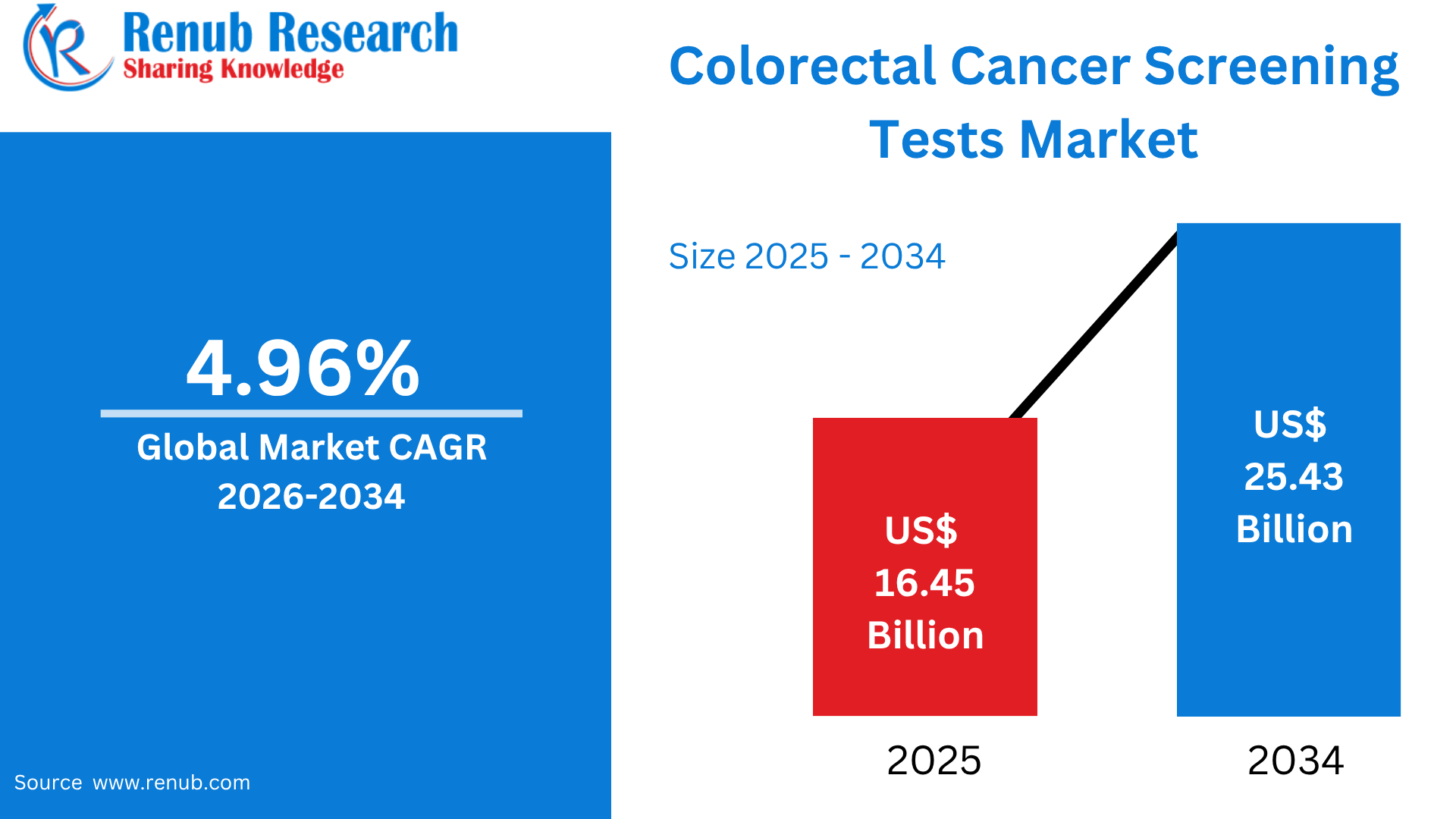
Colorectal Cancer Screening Tests Market is projected to grow from US$ 16.45 billion in 2025 to US$ 25.43 billion by 2034, registering a CAGR of 4.96% during 2026–2034. Market expansion is expected to be driven by rising awareness of preventive healthcare, the increasing adoption of colorectal cancer screening programs, technological advancements in diagnostic and testing methods, and growing emphasis on early detection and timely intervention.
What is the Colorectal Cancer Screening Tests Market and Its Uses & Popularity Worldwide?
The colorectal cancer screening tests market comprises diagnostic tests and procedures used to detect colorectal cancer, precancerous polyps, and other abnormalities in the colon and rectum, often before symptoms appear. Major screening methods include fecal immunochemical tests (FIT), guaiac fecal occult blood tests (gFOBT), stool DNA-FIT, colonoscopy, flexible sigmoidoscopy, and CT colonography. These tests are used for population screening, early detection, risk assessment, and follow-up of abnormal findings. Screening is particularly important because colorectal cancer remains a major global health burden. The World Health Organization estimated approximately 1.9 million new colorectal cancer cases and more than 900,000 deaths worldwide in 2022.
Popularity of colorectal cancer screening is increasing globally as healthcare systems emphasize preventive medicine and earlier diagnosis. Screening programs are expanding across developed and emerging markets, while convenient stool-based tests are improving accessibility through home-based testing. In the United States, the USPSTF recommends screening average-risk adults aged 45 to 75 years, with options including annual FIT, stool DNA-FIT, CT colonography, flexible sigmoidoscopy, and colonoscopy.
Top Countries by Colorectal Cancer Incidence
Global Total: 1,926,425 cases (ASR: 18.4 per 100,000)
- China: 517,106 cases | ASR: 20.1 per 100,000
- United States: 160,186 cases | ASR: 27.0 per 100,000
- Japan: 145,756 cases | ASR: 36.6 per 100,000
- Russia: 83,693 cases | ASR: 29.4 per 100,000
- India: 70,038 cases | ASR: 4.9 per 100,000
- Germany: 62,544 cases | ASR: 25.7 per 100,000
- Brazil: 60,118 cases | ASR: 19.8 per 100,000
- Italy: 54,784 cases | ASR: 30.6 per 100,000
- France (metropolitan): 51,636 cases | ASR: 32.1 per 100,000
- United Kingdom: 49,249 cases | ASR: 30.9 per 100,000
Growth Drivers of the Colorectal Cancer Screening Tests Market
Rising Global Burden of Colorectal Cancer
The increasing worldwide burden of colorectal cancer is a major factor supporting demand for screening tests. According to the World Health Organization, approximately 1.9 million new colorectal cancer cases and more than 900,000 deaths were recorded globally in 2022. The disease was the second leading cause of cancer-related death worldwide, highlighting the importance of prevention and early detection. Colorectal cancer risk generally increases with age, while several countries have also reported increasing incidence among younger adults. This expanding disease burden encourages governments, healthcare providers, and medical organizations to strengthen screening programs. Screening can identify cancers at earlier stages and detect precancerous lesions that can potentially be removed before progressing to cancer. The WHO also notes that colorectal cancer outcomes depend strongly on the stage at diagnosis, with earlier detection associated with substantially better survival. Consequently, rising disease incidence, mortality concerns, and greater recognition of the benefits of early diagnosis are increasing demand for FIT, stool DNA tests, colonoscopy, CT colonography, and other screening technologies worldwide.
Expansion of Organized Screening Programs and Preventive Healthcare
The expansion of organized colorectal cancer screening programs is creating sustained demand for screening tests across healthcare systems. Governments and medical organizations increasingly emphasize routine screening for populations at elevated risk based on age and other factors. For example, the U.S. Preventive Services Task Force recommends colorectal cancer screening for average-risk adults from 45 to 75 years, providing several screening options that include annual FIT, stool DNA-FIT every 1–3 years, CT colonography every five years, flexible sigmoidoscopy, and colonoscopy every 10 years. Such recommendations broaden the eligible screening population and encourage healthcare providers to incorporate testing into preventive-care programs. The availability of multiple testing approaches also allows screening to be adapted to patient preferences, healthcare infrastructure, and access conditions. Stool-based tests are particularly useful because FIT can be completed at home without bowel preparation, anesthesia, or transportation. As countries increase cancer-control initiatives and improve preventive healthcare coverage, greater numbers of eligible individuals are expected to enter regular screening programs, supporting market growth.
Advancements in Non-Invasive and Convenient Screening Technologies
Technological advancement is improving the convenience and accessibility of colorectal cancer screening, supporting market expansion. Traditional colonoscopy remains an important screening and diagnostic procedure, but non-invasive stool-based approaches provide additional options for individuals who may be reluctant to undergo invasive examinations. FIT detects blood in stool using antibodies and can be completed using a single stool sample at home. Stool DNA-FIT combines molecular biomarker detection with FIT, providing another non-invasive screening approach. According to the USPSTF, recommended screening strategies include annual FIT, stool DNA-FIT every 1–3 years, CT colonography every five years, and colonoscopy every 10 years. Home-based testing reduces requirements for bowel preparation, sedation, transportation, and clinical visits for the initial test, potentially improving accessibility. Continued development of molecular biomarkers, digital healthcare platforms, laboratory automation, and improved diagnostic accuracy is expected to broaden the range of screening options. These innovations can also help healthcare providers reach populations that face barriers to conventional screening procedures.
Challenges of the Colorectal Cancer Screening Tests Market
Low Screening Participation and Patient Adherence
Low participation and inconsistent adherence remain significant challenges for the colorectal cancer screening market. Although multiple effective screening methods are available, individuals may delay or avoid testing because of limited awareness, fear of cancer diagnosis, discomfort associated with colonoscopy, concerns about bowel preparation, or inconvenience. The USPSTF notes that screening with FIT requires good adherence over multiple rounds of testing, while abnormal stool-based results require follow-up colonoscopy. This creates a multi-step pathway in which completing the initial test does not always guarantee completion of diagnostic follow-up. Colonoscopy can also involve bowel preparation, sedation, transportation requirements, and concerns about complications. The USPSTF identifies bleeding and perforation as important potential harms associated with colonoscopy, although the overall harms of screening are considered small for recommended age groups. Improving patient education, reminder systems, healthcare-provider engagement, and access to convenient home-based testing will therefore remain important for increasing screening participation and ensuring that abnormal results receive appropriate follow-up.
Limited Healthcare Access and Screening Infrastructure in Emerging Markets
Unequal access to healthcare infrastructure presents another challenge to the worldwide colorectal cancer screening tests market. Screening programs require trained healthcare professionals, diagnostic laboratories, endoscopy facilities, pathology services, follow-up systems, and financing mechanisms. These resources are more readily available in well-developed healthcare systems, while lower-resource regions may face shortages of specialists, diagnostic equipment, and organized screening programs. Even when stool-based tests are available, positive results generally require further diagnostic evaluation, frequently including colonoscopy. The USPSTF specifically notes that abnormal stool-based screening results should be followed by colonoscopy for further evaluation. This can create capacity constraints in regions with limited endoscopy services. Geographic disparities, healthcare costs, limited insurance coverage, insufficient public awareness, and differences in national screening policies can further restrict adoption. As colorectal cancer incidence increases in many populations, expanding affordable screening infrastructure and establishing reliable referral and follow-up pathways will be important for translating technological availability into broader population-level screening coverage.
Colorectal Cancer Screening Test Launches Worldwide
- Cologuard Plus – United States, 2025
Exact Sciences launched Cologuard Plus in March 2025 as a next-generation, non-invasive multi-target stool DNA test for average-risk adults aged 45 and above. The FDA-approved test demonstrated 95% sensitivity for colorectal cancer at 94% specificity and was designed to reduce unnecessary follow-up colonoscopies by up to 40% compared with the original Cologuard test. - Shield – United States, 2024
Guardant Health’s Shield became the first FDA-approved blood-based colorectal cancer screening test for average-risk adults aged 45 years and older. Approved on July 26, 2024, the test analyzes blood-derived DNA for molecular changes associated with colorectal cancer, providing a less invasive alternative to stool collection and colonoscopy as a primary screening option. - ColoSense – United States, 2024
Geneoscopy’s ColoSense received FDA approval in May 2024. The laboratory-based stool test analyzes RNA biomarkers and occult blood from a single stool sample to detect colorectal cancer. The product expands the availability of molecular stool-based screening and provides another non-invasive option for average-risk screening populations. - Freenome Blood-Based CRC Screening Test – United States, 2025–2026
Freenome advanced its blood-based colorectal cancer screening test toward commercialization through an exclusive agreement with Exact Sciences in August 2025. The first-generation test demonstrated 81% sensitivity for colorectal cancer and 14% sensitivity for advanced precancerous lesions at 90% specificity in the PREEMPT study. Freenome submitted the final module of its FDA premarket application, with commercial availability anticipated following regulatory approval. - Freenome–Exact Sciences Next-Generation Blood Screening Development – United States, 2025
Exact Sciences and Freenome entered an agreement in August 2025 giving Exact Sciences exclusive U.S. rights to current and future versions of Freenome’s blood-based colorectal cancer screening tests. The agreement was valued at up to US$885 million, subject to regulatory and other milestones. The collaboration combines Freenome’s multiomics and AI/ML technology with Exact Sciences’ commercial infrastructure, highlighting the increasing importance of blood-based and computationally supported screening technologies.
United States Expanded Screening Eligibility and Test Innovation
United States colorectal cancer screening tests market is supported by established preventive-care practices, advanced diagnostic infrastructure, and broad adoption of evidence-based screening recommendations. The American Cancer Society’s 2026 guideline recommends regular colorectal cancer screening for average-risk adults beginning at age 45 and continuing through age 75, creating a substantial addressable population for screening providers and diagnostic companies. Recommended options include annual FIT and high-sensitivity stool tests, multi-target stool DNA and RNA tests, colonoscopy, CT colonography, and other visual examinations. Innovation is also reshaping the U.S. market. In July 2024, the FDA approved Guardant Health’s Shield, a blood-based colorectal cancer screening test for average-risk adults aged 45 years and older. In clinical studies involving 7,861 participants, Shield detected colorectal cancer 83% of the time, although positive results require follow-up colonoscopy. The 2026 ACS update additionally incorporated a multi-target stool RNA option and guidance on blood-based screening, reflecting industry efforts to expand convenient testing choices and improve participation.
United Kingdom Nationwide Screening Infrastructure and FIT Adoption
The United Kingdom colorectal cancer screening tests market benefits from a mature, publicly funded screening infrastructure, particularly through the NHS Bowel Cancer Screening Programme in England. The programme has progressively expanded eligibility, with invitations now extending from age 50 through 74 every two years. Home-based FIT testing provides a convenient first-stage screening approach, while individuals with abnormal results can be referred for diagnostic evaluation, including colonoscopy. During 2024–25, the English programme invited 7.96 million people for bowel cancer screening, with 5.20 million adequately participating, representing a 65.2% uptake rate. Programme coverage for the eligible 60–74 population reached 72.9% by March 2025. The programme also recorded 100,778 diagnostic tests during the year and diagnosed 5,170 people with cancer. Continued expansion toward younger age groups, alongside FIT adoption and investments in endoscopy, laboratory testing, and pathology, is creating opportunities for screening-test manufacturers and diagnostic-service providers.
China Large Disease Burden and Expanding Screening Demand
China represents a significant opportunity for colorectal cancer screening technologies because of its large population and substantial colorectal cancer burden. According to IARC’s GLOBOCAN 2022 estimates, China recorded approximately 517,106 new colorectal cancer cases, making colorectal cancer the country’s second most commonly diagnosed cancer overall. Rising emphasis on prevention and earlier diagnosis is encouraging greater use of FIT, risk-assessment tools, molecular diagnostics, and colonoscopy-based follow-up. Shanghai provides an important example of organized screening implementation. A recent analysis reports that the citywide programme launched in 2013 has delivered more than 6 million screenings to over 3 million residents, covering 38.4% of the eligible 50–74 population. About 70% of residents completed the recommended two FIT tests within seven days, while 90% completed both within one month. These results demonstrate demand for scalable stool-based testing while also highlighting the importance of improving follow-up colonoscopy participation. Earlier Shanghai research found that only 39.8% of initially positive participants completed colonoscopy, illustrating a continuing opportunity to strengthen the screening-to-diagnosis pathway.
United Arab Emirates Government-Supported Preventive Screening
The United Arab Emirates is developing its colorectal cancer screening tests market through increased emphasis on preventive healthcare, early detection, and accessible diagnostic services. In Abu Dhabi, the Department of Health and Abu Dhabi Public Health Center recommend colorectal cancer screening for men and women aged 40–75 years. Eligible individuals can access multiple screening approaches, including colonoscopy once every 10 years and annual FIT testing. The UAE is also incorporating newer technologies into its screening framework. Abu Dhabi’s programme lists the Shield liquid-biopsy test as an option once every three years for eligible individuals meeting the test’s inclusion criteria. Screening is available through IFHAS providers for Thiqa cardholders aged 40–75, while individuals with other insurance coverage are advised to consult their family doctor. The availability of stool-based, endoscopic, and blood-based approaches is broadening the diagnostic landscape and creating opportunities for laboratory providers, molecular diagnostic companies, hospitals, and preventive-healthcare platforms. Continued public awareness initiatives and healthcare modernization are expected to support wider screening participation and earlier identification of colorectal abnormalities.
Recent Developments in Colorectal Cancer Screening Tests Market
- In March 2026: Through a collaboration with Quest Diagnostics, Guardant Health, Inc. made its Shield Guardant blood-based screening test easily accessible to doctors across the country. By utilizing one of the biggest diagnostic networks in the nation, our partnership enables clinicians throughout the United States to use this cutting-edge blood-based screening for colorectal cancer (CRC).
- In January 2025, NHS England stated that home FIT screening would be available to people over the age of 50, increasing the number of stool tests and the qualifying population.
Market Segmentations
Type
- Stool-based Tests
- Colonoscopy
- CT Colonography
- Flexible Sigmoidoscopy
- Others
End User
- Hospitals & Clinics
- Clinical Laboratories
- Diagnostics Imaging Centers
- Others
Countries
North America
- United States
- Canada
Europe
- France
- Germany
- Italy
- Spain
- United Kingdom
- Belgium
- Netherlands
- Turkey
Asia Pacific
- China
- Japan
- India
- Australia
- South Korea
- Thailand
- Malaysia
- Indonesia
- New Zealand
Latin America
- Brazil
- Mexico
- Argentina
Middle East & Africa
- South Africa
- Saudi Arabia
- United Arab Emirates
All the Key players have been covered with 5 Viewpoints
- Overviews
- Key Person
- Recent Developments
- SWOT Analysis
- Revenue Analysis
Key Players Analysis
- Polymedco Inc.
- Eiken Chemical Co. Ltd.
- Sysmex Corporation
- Siemens Healthineers AG
- Quidel Corporation
- Novigenix SA
- Hemosure Inc.
- Exact Sciences Corporation
- Epigenomics Inc.
- Olympus Corporation
Report Details:
| Report Features | Details |
| Base Year |
2025 |
| Historical Period |
2022 - 2025 |
| Forecast Period |
2026 - 2034 |
| Market |
US$ Billion |
| Segment Covered |
Type, End User and Countries |
| Countries Covered |
|
| Companies Covered |
|
| Customization Scope |
20% Free Customization |
| Post-Sale Analyst Support |
1 Year (52 Weeks) |
| Delivery Format |
PDF and Excel through Email (We can also provide the editable version of the report in PPT/Word format on request) |
Customization Services available
- Analysis of Market Size and Its Segments
- More Company Profiles (Upto 10 without any additional cost):
- Additional Countries (Other than mentioned Countries):
- Region/Country Specific Reports:
- Market Entry Strategy:
- Region-Specific Market Dynamics:
- Regional Market Share Analysis:
- Trade Analysis:
- Production Insights:
- Others Customized Requests:
For more information contact our analysts.
Need More Assistance?
- Talk to our analysts to get more precious information on the current market trends.
- Include more countries and segments and customize the report based on the final requirement.
- Get a competitive advantage in your industry by knowing the report findings and making a positive impact on your revenues and operations.
- Our analysts are always ready to provide more help and pertinent information if you need any additional assistance.