China Energy Drinks Market Report by Type, Distribution Channel, Packaging Type, City and Company Analysis 2026-2034
Buy NowChina Energy Drinks Market Size & Forecast
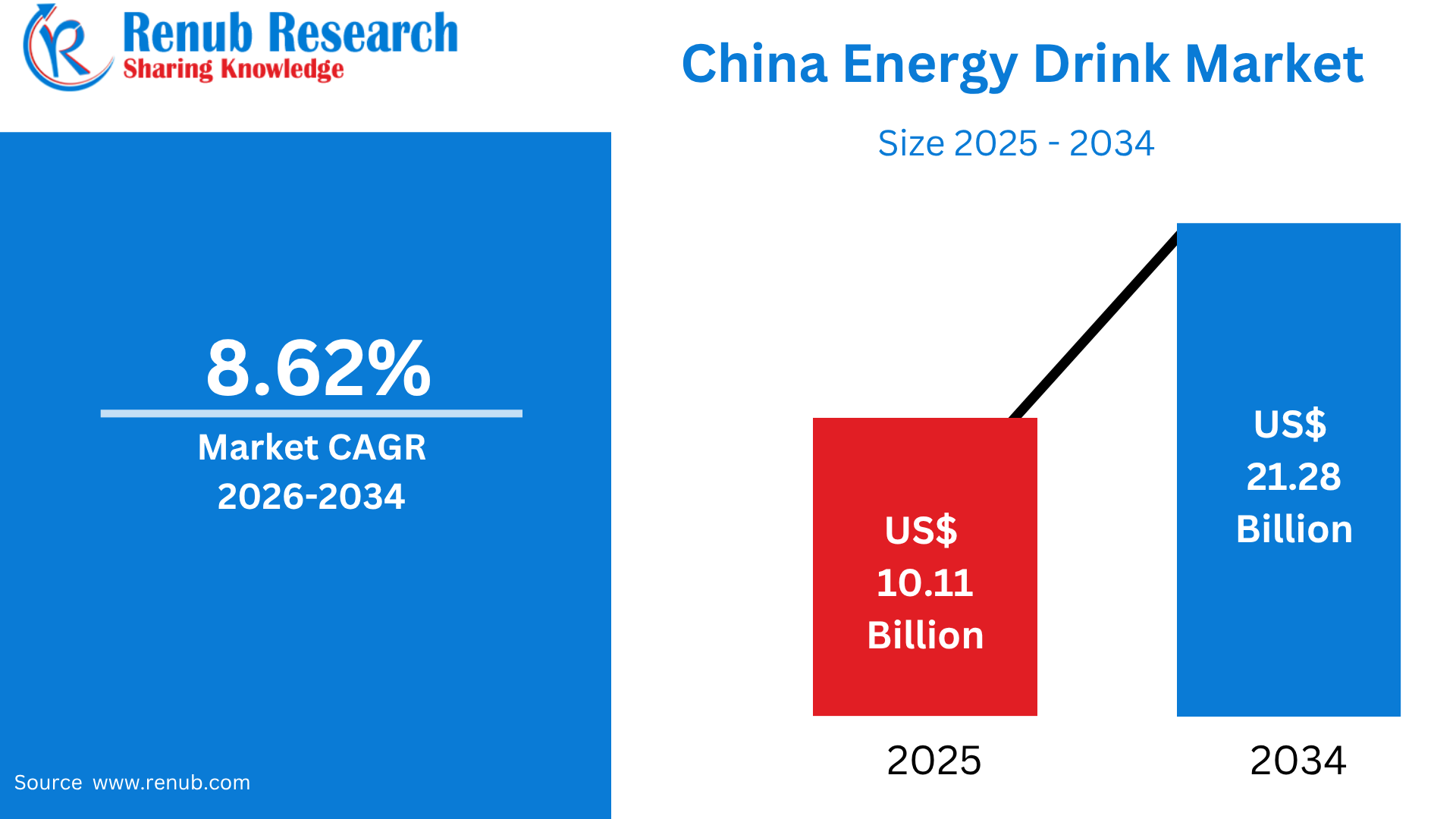
China energy drinks market is projected to expand from US$10.11 billion in 2025 to US$21.28 billion by 2034, registering a CAGR of 8.62% during 2026–2034. The market is expected to maintain strong momentum, supported by rapid urbanization, rising consumer interest in functional and performance-oriented beverages, and the expanding young population. Increasing participation in sports and fitness activities, busy urban lifestyles, and growing demand for convenient products that provide energy and alertness are further strengthening consumption.
What are Energy Drinks and Their Uses & Popularity in China
Energy drinks are functional beverages formulated to provide a temporary boost in energy, alertness, concentration, and physical performance. They commonly contain caffeine, taurine, B vitamins, sugars or sweeteners, and other functional ingredients. In China, energy drinks are increasingly consumed as convenient beverages during work, study, exercise, travel, gaming, driving, and outdoor activities. Their popularity is supported by changing lifestyles, longer working hours, increasing fitness participation, and consumer interest in beverages offering functional benefits. The category has also expanded beyond traditional energy-boosting occasions toward leisure and everyday consumption. Per-capita consumption was still only 5.3 liters in 2024, compared with 17.1 liters in the United States, indicating substantial room for future penetration.
Average Per-Capita Energy Drink Consumption Worldwide, 2023
- United States: 29.7 liters per capita — the highest consumption among the countries shown.
- United Kingdom: 14.1 liters per capita, ranking second.
- Japan: 10.9 liters per capita, reflecting relatively strong consumption in Asia.
- Spain: 10.2 liters per capita.
- Germany: 8.3 liters per capita.
- Indonesia: 5.9 liters per capita.
- Mexico: 2.7 liters per capita.
- France: 2.4 liters per capita.
- China: 1.6 liters per capita, significantly below most major markets and indicating substantial room for market penetration.
- Russia: 0.3 liters per capita, the lowest among the countries presented.
Source: Daxue Consulting, The Booming Energy Drinks Market in China, citing Statista Market Research for worldwide per-capita consumption data.
Growth Drivers of the China Energy Drinks Market
Expanding Functional Beverage Consumption
Demand for beverages offering functional benefits is becoming an important growth engine for China’s energy drinks market. Consumers increasingly seek convenient products that can support alertness, stamina, concentration, and recovery while fitting into busy daily routines. Energy drinks benefit from this wider shift because they provide a recognizable functional proposition—rapid energy and refreshment—without requiring preparation. Work and study are particularly important consumption occasions. Meanwhile, consumption occasions are expanding into exercise, long-distance driving, leisure, and outdoor activities. This diversification enables brands to target multiple consumer groups and increases purchase frequency. Consequently, functional positioning, product innovation, and convenient formats are expected to remain important contributors to market expansion.
Urbanization, Working Population and Busy Lifestyles
Rapid urbanization and the large working-age population provide a substantial consumer base for energy drinks in China. By the end of 2025, China had 953.8 million urban permanent residents, representing 67.9% of the total population, while 851.36 million people aged 16–59 accounted for 60.6% of the population. This large urban and working-age population creates significant opportunities for beverages positioned around convenience, alertness, and stamina. Modern lifestyles characterized by commuting, office work, studying, gaming, travel, and outdoor activities are broadening the occasions in which consumers use energy drinks. The relatively low per-capita consumption of 5.3 liters in 2024 compared with the United States’ 17.1 liters suggests considerable headroom as urban consumers become increasingly accustomed to functional beverages.
Product Innovation, Premiumization and Expanding Distribution
Product innovation and broader distribution are helping energy-drink manufacturers reach new consumer segments in China. Brands are introducing reduced-sugar formulations, new flavors, larger pack sizes, and different packaging formats to respond to changing preferences. Euromonitor reports that strong volume growth was visible in China’s energy drinks in 2025, with Eastroc Super Drink contributing significantly through competitive pricing and larger packaging formats, while reduced-sugar products gained traction alongside broader health trends. Packaging is particularly important for convenience-oriented consumption. Cans accounted for more than half of China’s energy-drink market share by packaging in 2025, according to Mordor Intelligence. E-commerce is also expanding accessibility, allowing brands to reach consumers beyond traditional physical stores. At the same time, natural ingredients, sugar-free products, novel flavors, and premium formulations can help manufacturers differentiate themselves in an increasingly competitive market.
Challenges of the China Energy Drinks Market
Health Concerns and Rising Demand for Lower-Sugar Products
Health concerns surrounding caffeine, sugar, and frequent consumption represent an important challenge for China’s energy-drink industry. Although consumers purchase these beverages for functional benefits, increasing health consciousness is encouraging consumers to examine ingredient lists, sugar content, caffeine levels, and perceived nutritional value more closely. This creates pressure on manufacturers to reformulate traditional products while maintaining the taste, energy effect, and affordability expected by consumers. The market is already responding to this shift. Euromonitor reported in 2025 that reduced-sugar variants were gaining traction as energy-drink companies responded to broader health trends in China. These trends create additional formulation and marketing costs for manufacturers. Companies must balance caffeine and functional ingredients with healthier nutritional profiles while preserving consumer acceptance. Failure to adapt could limit consumption among health-conscious adults and encourage substitution toward tea, coffee, functional waters, and other better-for-you beverages.
Intense Competition and Market Saturation
Intense competition among established domestic and international brands presents another challenge. China’s energy-drink market includes powerful players such as Red Bull, Eastroc Super Drink, Monster, and other emerging brands competing through pricing, distribution, packaging, flavors, sponsorships, and marketing. Euromonitor identifies Red Bull and Eastroc Super Drink as maintaining strong positions in the category, while newer products are increasing competitive pressure. Although this creates opportunities, it also encourages more companies to enter the category and increases pressure on shelf space, pricing and advertising. Large brands can leverage extensive distribution networks and marketing budgets, making customer acquisition difficult for smaller players. Consequently, new entrants increasingly need differentiated formulations, strong branding, competitive pricing, and targeted digital or e-commerce strategies to establish market share.
Energy-drink product launches in China
- Red Bull 0 Sugar Fruit-Flavored Vitamin Energy Drink – 2022: TCP Group introduced a zero-sugar, fruit-flavored Red Bull variant in China, targeting consumers seeking energy with reduced sugar.
- Red Bull Bottled Energy Drink – 2023: TCP Group launched its first bottled Red Bull Energy Drink in China, adding a portable PET format to its existing canned portfolio.
- Red Bull Dragon Year “Nine Dragons Got Your Back” Limited Edition – 2024: A limited-edition Vitamin Flavor Drink featuring nine dragon designs was launched in collaboration with Forbidden City Culture for the Year of the Dragon.
- Monster Energy Ultra Paradise – 2024: Monster expanded its Chinese lineup with the green-can Ultra Paradise variant as part of its 2024 product expansion.
- Monster Energy Pink Variant – 2024: Monster introduced a pink-can energy drink variant in China in 2024, expanding its portfolio for younger and flavor-oriented consumers.
- Predator Energy – 2024: Swire Coca-Cola introduced Predator to selected Chinese mainland markets, adding another international energy-drink brand to its portfolio.
- Eastroc Water Boost – 2023: Eastroc introduced its Water Boost electrolyte beverage, expanding beyond its core energy-drink business into functional hydration.
- Eastroc Bushuila (补水啦) – Early 2024: Eastroc launched the 1-liter Bushuila hydration product, reflecting the company’s move toward a broader functional-beverage portfolio.
- Red Bull Passion Fruit & Mixed Fruit Vitamin Flavor Drink – 2024: TCP Group expanded Red Bull’s flavor portfolio in China with passion-fruit and mixed-fruit options aimed at greater flavor variety and personalization.
- Monster Energy Ultra Paradise & Other Expanded Formats – 2024: Monster strengthened its Chinese portfolio with new flavors alongside its existing Monster and Ultra products, while expanding distribution across major provinces including Shanghai, Beijing, Guangdong, Jiangsu, Zhejiang, Henan, Liaoning, Sichuan, and Shandong.
China Energy Shots Market
China’s energy shots market is an emerging segment within the broader energy-drink industry, offering concentrated formulations designed to deliver a rapid energy and alertness boost in a small serving. Unlike conventional energy drinks, energy shots emphasize portability, quick consumption, and functional concentration, making them suitable for busy professionals, students, drivers, gamers, and consumers with demanding schedules. Their compact packaging allows users to consume the product without carrying or finishing a full-sized beverage, supporting adoption in densely populated urban areas. The segment is benefiting from the broader expansion of functional beverages in China, where consumers increasingly seek convenient products that combine refreshment with specific benefits. Energy shots can further benefit from innovations such as sugar-free formulations, added B vitamins, electrolytes, and botanical ingredients. However, limited consumer familiarity, relatively low brand recognition, and premium pricing remain barriers. As manufacturers improve product positioning and distribution, energy shots are likely to gain greater visibility.
China Energy Drinks PET Market
PET-bottled energy drinks represent an important packaging format in China because they combine affordability, portability, durability, and convenient resealing. PET bottles are particularly suitable for consumers who want to carry an energy drink during commuting, work, study, travel, or outdoor activities. Their availability in different capacities enables manufacturers to target both individual consumption and larger-volume occasions. PET packaging also benefits from China’s extensive retail infrastructure, including supermarkets, convenience stores, grocery outlets, vending machines, and e-commerce platforms. The relatively lightweight nature of PET also reduces transportation and handling costs compared with heavier packaging alternatives, supporting competitive retail pricing. However, environmental concerns surrounding plastic waste and recycling remain significant challenges. China’s increasing emphasis on sustainable packaging is encouraging manufacturers to explore recyclable PET, recycled-content materials, and lightweight bottle designs. Despite these pressures, PET remains attractive because of its practical design and cost efficiency. Continued improvements in recycling infrastructure and sustainable materials could help maintain PET’s relevance in China’s energy-drink market.
China Energy Drinks Cans Market
Canned energy drinks have established a strong presence in China, supported by their premium appearance, portability, durability, and strong branding potential. Cans are particularly associated with internationally recognized energy-drink brands and are widely used to create distinctive visual identities through bold colors, graphics, limited editions, and sports or entertainment partnerships. Their popularity is supported by convenience-store availability, where chilled cans can be purchased and consumed immediately. Cans are also particularly attractive to younger consumers, gamers, office workers, and consumers engaged in sports and entertainment activities. Their compact format allows easy storage in refrigerators, bags, and vending machines. In addition, aluminum cans provide an effective platform for seasonal campaigns and limited-edition packaging, helping brands generate consumer attention. Nevertheless, canned products can carry higher prices than some PET alternatives, potentially limiting demand among price-sensitive consumers. Manufacturers therefore need to balance premium positioning with affordability while using product innovation and distinctive branding to strengthen consumer loyalty.
China Energy Drinks Convenience Stores Market
Convenience stores are an important distribution channel for China’s energy-drink industry because they provide consumers with quick access to ready-to-drink beverages in high-traffic locations. Stores located near offices, transportation hubs, residential communities, universities, and commercial districts can capture demand from workers, students, travelers, and consumers seeking immediate refreshment. Extended operating hours also support energy-drink consumption during early mornings, late evenings, night shifts, and long-distance travel. China’s convenience-store network provides particularly strong opportunities for impulse purchases because energy drinks are frequently displayed in refrigerated cabinets, checkout areas, and prominent promotional locations. Convenience stores therefore provide manufacturers with an important route to broad consumer exposure. Retailer–manufacturer partnerships, promotional discounts, new-product launches, and exclusive packaging can further stimulate sales. However, limited shelf and refrigerator space creates intense competition among energy-drink brands and other ready-to-drink beverages. As urbanization and convenience-oriented lifestyles continue to expand, convenience stores are expected to remain a crucial channel for energy-drink distribution in China.
Beijing Energy Drinks Market
Beijing represents one of China’s most developed markets for energy drinks, supported by its large population of professionals, students, and business communities. As the national capital and a major center for government, technology, education, finance, and services, the city has a large consumer base with demanding work and study schedules. Energy drinks are commonly purchased for maintaining alertness during long working hours, examination periods, commuting, and other demanding activities. The presence of major universities further supports consumption among students and young adults. Convenience stores, supermarkets, vending machines, and e-commerce platforms provide broad access to domestic and international brands. Health-conscious consumers are also encouraging demand for low-sugar, sugar-free, vitamin-enriched, and functional formulations, creating opportunities for premium products. At the same time, awareness of caffeine intake and nutritional content is influencing purchasing decisions. China’s energy beverage retail market increased in 2025, demonstrating the broader market environment supporting consumption in major cities. Beijing’s high purchasing power, sophisticated retail infrastructure, and fast-paced lifestyle are expected to sustain its position as a significant regional market.
Shanghai Energy Drinks Market
Shanghai is one of China’s most dynamic energy-drink markets, supported by its position as a major global financial, commercial, and technology center. The city has a large concentration of young professionals, students, international residents, and service-sector employees who often maintain demanding work schedules. Employment in finance, information technology, consulting, logistics, hospitality, and other service industries creates regular occasions for consuming energy drinks to support alertness and stamina. Shanghai’s vibrant entertainment and nightlife sectors provide additional consumption occasions. Energy drinks are widely available through convenience stores, supermarkets, vending machines, e-commerce platforms, and online food-delivery services, allowing consumers to purchase products conveniently throughout the day. Health awareness is also influencing product preferences, with growing interest in low-sugar, sugar-free, and functional beverages. China’s off-trade energy-drink channels accounted higher % of the market in 2025, highlighting the importance of retail accessibility. Shanghai’s strong presence of multinational and domestic brands also creates intense competition. Consequently, manufacturers need differentiated flavors, attractive packaging, functional ingredients, competitive pricing, and strong digital marketing to gain consumer attention in this sophisticated market.
Jiangsu Energy Drinks Market
Jiangsu has strong potential for energy drinks because of its industrial base, manufacturing activity, urban development, and rising consumer purchasing power. Cities such as Nanjing, Suzhou, Wuxi, and Nantong have large populations of industrial workers, logistics employees, office professionals, and students, creating diverse consumption occasions. Energy drinks are particularly relevant for workers involved in manufacturing, transportation, warehousing, and other occupations requiring extended periods of physical or mental activity. The province’s expanding urban population also supports demand among young professionals and students. Convenience stores, supermarkets, wholesalers, vending machines, and online retailers provide extensive distribution coverage across urban and semi-urban areas. Price remains an important consideration, encouraging demand for affordable PET-bottled and canned products. China’s energy-drink sales volume increased in 205, indicating expanding consumption opportunities across major regional markets. Jiangsu’s combination of population scale, industrial employment, urbanization, and improving retail infrastructure makes it an attractive growth market, although manufacturers must compete effectively on price, functionality, and brand recognition.
Fujian Energy Drinks Market
Fujian’s energy-drink market is supported by its coastal economy, manufacturing activities, logistics sector, commercial centers, and expanding urban consumer base. Cities such as Fuzhou and Xiamen serve as important economic and trade hubs, creating consumption opportunities among business professionals, transportation workers, manufacturing employees, students, and younger consumers. The province’s port-related activities and logistics networks generate demand for convenient beverages among workers with physically demanding or extended working schedules. Energy drinks are also increasingly accessible through convenience stores, supermarkets, hypermarkets, vending machines, and online retail platforms. Price and functionality remain important purchase considerations, particularly among consumers seeking affordable beverages for work and travel. At the same time, rising health awareness is encouraging greater interest in low-sugar, sugar-free, vitamin-fortified, and functional energy drinks. China’s energy beverage retail industry is creating a favorable national environment for regional expansion. However, Fujian’s market faces competition from traditional tea and other caffeinated beverages, which have strong cultural acceptance. Brands that combine affordable pricing, convenient packaging, distinctive flavors, and functional benefits can therefore strengthen their position in the province.
China Energy Drinks Market Segments:
Type
- Energy drink
- Energy shots
- Energy mixers
Distribution Channel
- Hypermarket
- Supermarket
- Mass merchandisers
- Convenience stores
- Food service outlets
- Online
- Others
Packaging Type
- PET
- Glass bottles
- Cans
- Cartons
- Others
Cities
- Beijing
- Shanghai
- Jiangsu
- Fujian
- Zhejiang
- Tianjin
- Guangdong
- Inner Mongolia
- Hubei
- Chongqing
- Rest of China
All companies have been covered with 5 Viewpoints
- Overviews
- Key Person
- Recent Developments
- SWOT Analysis
- Revenue Analysis
Company Analysis
- Red Bull
- Monster beverage corporation
- Taisho Pharmaceutical Holding Company
- Dali food group co ltd.
- Coca cola
- Pepsico
- Southland Trade Company Ltd.
- Hangzhou Wahaha Group Co.,Ltd.
Report Details:
| Report Features | Details |
| Base Year |
2025 |
| Historical Period |
2022 - 2025 |
| Forecast Period |
2026 - 2034 |
| Market |
US$ Billion |
| Segment Covered |
Type, Distribution Channel, Packaging Type, and Cities |
| Cities Covered |
|
| Companies Covered |
|
| Customization Scope |
20% Free Customization |
| Post-Sale Analyst Support |
1 Year (52 Weeks) |
| Delivery Format |
PDF and Excel through Email (We can also provide the editable version of the report in PPT/Word format on request) |
Customization Services available
- Analysis of Market Size and Its Segments
- More Company Profiles (Upto 10 without any additional cost):
- Additional Countries (Other than mentioned Countries):
- Region/Country Specific Reports:
- Market Entry Strategy:
- Region-Specific Market Dynamics:
- Regional Market Share Analysis:
- Trade Analysis:
- Production Insights:
- Others Customized Requests:
For more information contact our analysts.
Need More Assistance?
- Talk to our analysts to get more precious information on the current market trends.
- Include more countries and segments and customize the report based on the final requirement.
- Get a competitive advantage in your industry by knowing the report findings and making a positive impact on your revenues and operations.
- Our analysts are always ready to provide more help and pertinent information if you need any additional assistance.