Canada Diabetes Devices Market Forecast Report by Type, Distribution Channel, Region, and Companies Analysis 2026-2034
Buy NowCanada Diabetes Device Market Size and Forecast 2026-2034
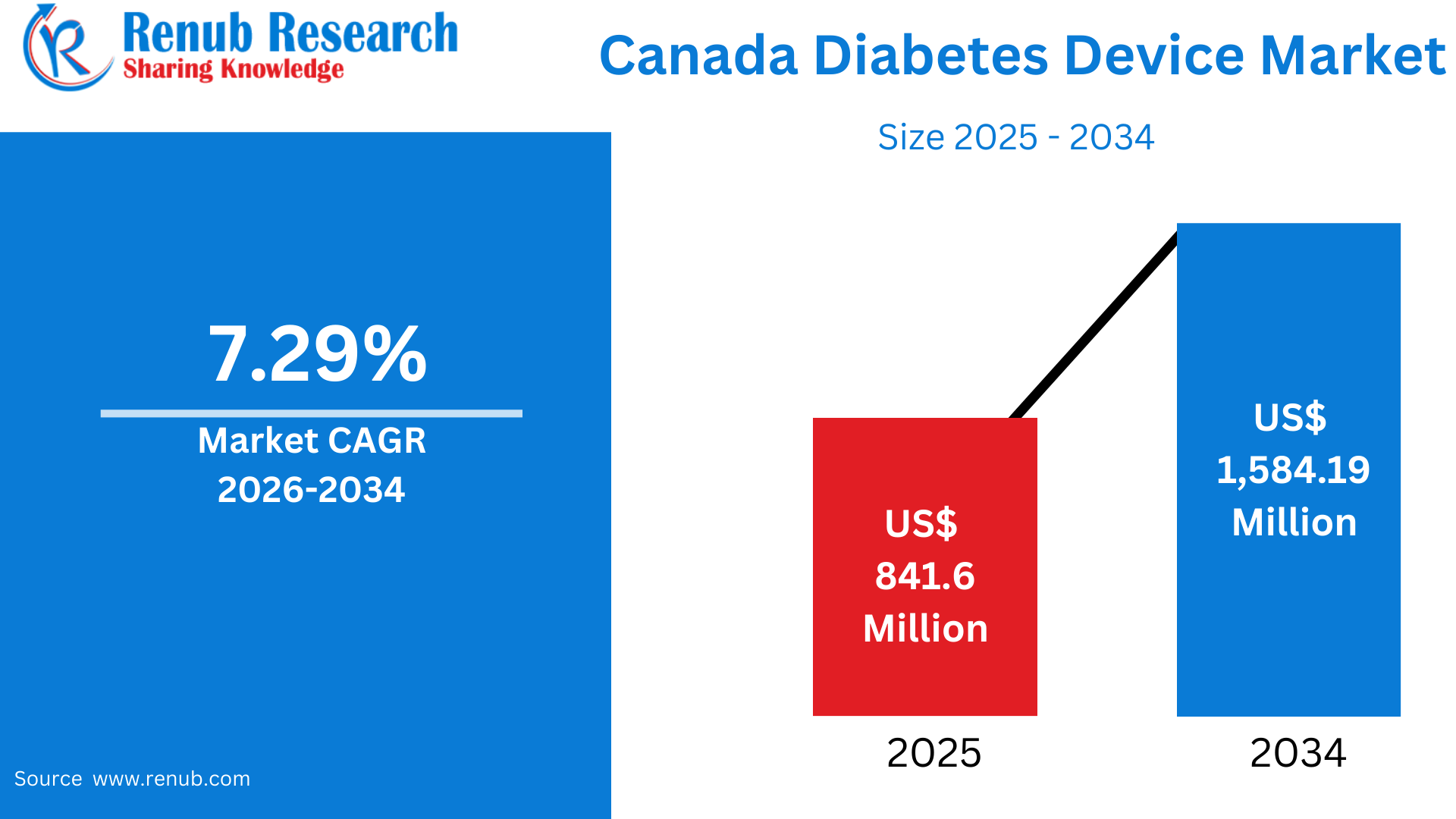
Canada Diabetes Device Market to grow at a steady rate from US$ 841.60 million in 2025 to US$ 1,584.19 million in 2034, registering a CAGR of 7.29% during the period of 2026 to 2034, backed by the increasing prevalence of diabetes, robust public health support, and the acceptance of innovative technologies like Continuous Glucose Monitors and insulin delivery systems in the region, besides the rising acceptance of home-care practices and the need to be digitally enabled.
Canada Diabetes Devices Market Overview
A diabetic device refers to a medical device that can be utilized to check the blood glucose level and administer insulin to enable people to control their diabetic condition and prevent complications associated with the disease. Some of the common diabetic devices include self-blood glucose monitoring devices, insulin pens, insulin pumps, and glucose monitoring devices. These devices make it possible for people to evaluate and change their treatment strategies to make informed decisions about their lifestyle, including dietary and exercise practices. Advances in technology have also led to improvements in diabetic devices, including their ability to be linked to smartphones and their monitoring capabilities.
In Canada, diabetes devices are very well accepted due to the increasing prevalence of diabetes and the strong healthcare system available to the public. Healthcare systems are available to cover the expenses of necessary monitoring and insulin pump devices. Healthcare professionals are encouraging patients to adopt devices to avoid complications and hospitalizations. A health-aware population, the prevalence of digital health technology, and the increasing adoption of home healthcare are other determining factors. Thus, diabetes devices are an essential component of current diabetes management practice.
Drivers in the Canada Diabetes Device Market
Increasing Prevalence of Diabetes & Aged Population
Under Statistics Canada’s medium growth assumption, from 2031 onwards, immigration could represent over 80 % of Canada’s population growth. Today, Canada is experiencing an increasing incidence of diabetes, fueled by an aging population, sedentary lifestyles, obesity, and unhealthy diets. Type 2 diabetes affects senior citizens in large numbers, who thereby face long-term challenges in managing their conditions. As the average life span rises with diabetes, the need for continuous glucose monitors (CGM systems), self-monitoring blood glucose meters, insulin pens, and insulin pumps that help manage the disease in patients daily grows. Moreover, the average senior patient with diabetes is susceptible to complications like cardiovascular disease and diabetic neuropathy, thereby fueling the need for controlled glucose levels that stimulate regular diabetic monitoring. In turn, this large patient base sustains the market for diabetic devices in hospitals, clinics, and homecare facilities, thereby making demographic factors an essential long-term driver. Today, in Canada, about 3.9 million people aged one and above are living with diagnosed cases of diabetes, with an incidence rate of 9.7 % amongst the population. The incidence does not include people with gestational diabetes. Moreover, in Canada, around 6 % of adults are estimated to be experiencing prediabetes, putting them at an increased risk for developing type 2 diabetes.
Robust Public Health Care System and Support of Reimbursement Mechanisms
Canada’s geography and advanced information technology have also spurred the adoptability of home-based diabetes management. Increased accessibility of devices enabling remote patient tracking, telecommunication connectivity, and the ability for patients to share information electronically are being continually sought after for better patient convenience and reduced travel requirements for hospital visits in remote locations. The gadget devices for Glucose Monitoring and Blood Sugar Management are in line with telemedicine solutions for patient comfort. The increased focus of the healthcare delivery system in Canada on patient and information-directed patient services has increased market demands for digital diabetes technology devices. April 2024 — LMC Healthcare is pleased to announce the successful launch of myLMC™, an innovative new platform for digital health developed in collaboration with My Viva Inc®. This launch represents an important new step in chronic illness management, giving 100,000 LMC Healthcare patients new access through personal technology-based solutions and plans for expansion throughout Canada. myLMC™ is looking forward to providing its expertise in the management of Type 2 Diabetes and offers more in chronic illness services.
Issues in Canada Diabetes Device Market
Regional Disparities in Reimbursement Rates and Access
The emergence of new technologies has been a challenge in Canada due to the disparity of the reimbursement rates among the provinces. Some people may end up waiting longer or even paying a higher premium depending on the province they belong to. There is disparity in the reimbursement rates relating to the use of advanced diabetes management technologies like the CGMs and insulin pumps.
High Costs of Advanced Devices and Consumables
In the last few years Although support with respect to reimbursement exists, high-end diabetic care devices are still costly, especially when considering the requirement of consumable products. Sensitivity of patients, as well as third-party groups, affects costing, which remains an issue in managing costs in the Canadian diabetic care devices market.
Canada SMBG Devices Market
The market for SMBG devices in Canada remains a core base in diabetes care, especially in type-2 diabetics, newly diagnosed patients, and individuals taking oral medications. The market for SMBG meters and test strips has also significantly taken off in terms of prescriptions and coverage through provincial and other insurances. The reliance by doctors in Canada includes its use in the initiation, adjustment, and monitoring of blood sugar in patients, even for individuals monitoring through the CGM system, who also need confirmed tests. The market competition in the use of the product lies in the accuracy, ease of use, the volume of blood needed, and the digital connectivity. Although the CGM market is becoming popular, the market for SMBG remains relevant.
Canada CGM Device Market
The Canadian market for the CGM device is growing considerably with increased awareness about the advantages of real-time glucose tracking. The CGM device is widely used in cases of type 1 diabetes and insulin-requiring patients with type 2 diabetes because it helps in providing valuable information about glucose levels. The growth in the market is supported by increased compensation from different regions in Canada. The patients are benefiting from decreased frequency in pricking their fingers, while clinicians are benefiting from glucose reports that help them provide tailored treatment. Advancements in glucose sensors are fueling growth in the market. The market is increasingly relying on digital healthcare, with the CGM device slowly turning from an advanced technology to an essential one in Canadian diabetes treatment.
Canada Insulin Pump Device Market
The Canadian market of insulin pumps is quite specialized and of critical importance, mainly catering to type 1 diabetic patients and selected type 2 patients. These pumps can be obtained by prescription at diabetes clinics and centers that offer training and support services to the patients. The demand from Canada is rising due to lifestyle factors and demands for precise insulin delivery, along with glycemic control advantages. The integration of CGM accessibility improves the functionality of insulin pumps by providing semi-automatic and targeted adjustments of insulin intake, based on data from CGM access. The restrictive high costs of these pumps restrain adoption in Canada despite emerging clinical advantages and rising accessibility.
Canada Insulin Pen Device Market
Insulin pens are the most common insulin delivery devices on the Canadian marketplace because of their ease of use, accuracy, and patient convenience. These are especially preferred for their use in critical diabetic patient applications, specifically those with type 2 diabetes and elderly people. Prefilled, reusable pens are easy to use and accurately dispense insulin and are also more reliable and efficient and promote patient compliance compared to vial and syringe technology. Differentiation in the marketplace includes design, accuracy, and compatibility, and there are also elements of insulin pens with digital components, including memory and connectivity, that are slowly getting accepted and efficiently contributing to insulin-therapy tracking. Due to wide reimbursement and physician preferences, the insulin pen market remains a stable and high-volume part of the Canadian market for diabetic devices.
Canada Diabetes Devices Hospitals Market
The hospitals are very essential for the Canadian market for diabetes products, especially for the diagnosis, beginning of therapies, and treatment of complex cases. This is where the first sets of SMBG, CGM, or insulin pumps are dispensed to the patients. Diabetes teams in the hospitals are responsible for educating the patients on the safe utilization of the products, an aspect that influences the hospitals to be the main guarantors for the manufacturers of these products. Although the treatment of diabetes has started moving to homecare, the hospitals still play a vital role in the treatment of high-risk diabetic patients.
Canada Diabetes Device Homecare Market
The market for diabetes devices for homecare applications in Canada is rising due to the increasing number of patients being treated for diabetes outside hospitals. Blood glucose meters for SMBG, continuous glucose monitors, insulin pens, and connected devices help in self-management of diabetes outside hospitals. The huge geography of Canada, along with its advanced telehealth system, is boosting homecare for diabetes. The freedom to remotely transmit collected patient information from devices is also encouraging homecare for diabetes in Canada. Homecare is being encouraged in Canada for its convenience, freedom, and remote transmission of patient information.
Ontario Diabetes Device Market
The Ontario market in Canada has the most number of diabetes devices, mainly because of its high population density and excellent infrastructure in the medical field. There are many sufferers of type 1 and type 2 diabetes in Ontario, and as such, the need for SMBG, insulin pens, and the emerging need for CGM systems in Canada drives the growth in the Ontario diabetes device market. Big cities like Toronto are hubs for the most advanced medical and research institutes with the most developed infrastructure to bring in cutting-edge technologies like CGM and insulin pumps. Also, the Ontario province leads the way in the use of health information and telehealth technologies in the medical field, making it possible to monitor and manage their own health and diabetes at homes in Canada. Hospitals are mostly the impetus behind the initiation of new technologies in the medical streams.
Quebec Diabetes Devices Market
The diabetes market in Quebec has a proactive publicly funded health care system, and a planned approach to the management of chronic diseases. Demand for SMBG, insulin pens, as well as CGM, insulin pumps, arises from an ever-increasing diabetic population, as well as the aging population, favoring a wider adoption rate of these technologies. Evidence favoring cost-effectiveness plays a large part, as does the evidence of benefit, favoring the method of privileging those technologies that fit these criteria. Quebec values cost-effectiveness and evidence, favoring approving technologies that meet these criteria. Quebec has a publicly funded health care system, making access to all diabetes technologies a needs-driven process, aiming for a stable, needs-driven, and long-term approach for the management of diabetes within the community.
Alberta Diabetes Devices Market
The diabetes market in the province of Alberta is driven by a combination of urban healthcare facilities and widespread rural communities. With an increasing number of diabetes cases, especially type 2, the demand for SMBG systems and insulin pens has been on the rise. The fact that the province has adopted advanced technology such as CGM systems and insulin pump technology, with dedicated facilities found mainly in larger cities such as Calgary and Edmonton, also positively influences the market for diabetes devices. Large geographic distances also contribute to home-based healthcare utilization, making remote-controlled diabetes technology desirable. Even with public insurance coverage, the use of diabetes technology remains driven by hospital facilities for treatment and home healthcare supports maintenance therapies.
Market Segemntation
Types
- Self-Monitoring Devices
- Continuous Glucose-Monitoring Devices
- Insulin Pumps
- Insulin Pens
Distribution Channel
- Hospital Pharmacies
- Retail Pharmacies
- Diabetes Clinics/Centers
- Online Pharmacies
Region
- Ontario
- Quebec
- British Columbia
- Alberta
- Rest of Canada
All companies have been covered with 5 Viewpoints
- Overviews
- Key Person
- Recent Developments
- SWOT Analysis
- Revenue Analysis
Company Analysis
- Novo Nordisk A/S
- Eli Lilly
- Roche
- Abbott Laboratories
- Dexcom Inc.
- Medtronic
- Terumo Corporation
- Ypsomed AG
Report Details:
| Report Features | Details |
| Base Year |
2025 |
| Historical Period |
2022 - 2025 |
| Forecast Period |
2026 - 2034 |
| Market |
US$ Million |
| Segment Covered |
Types, Distribution Channel and Cities |
| Region Covered |
|
| Companies Covered |
|
| Customization Scope |
20% Free Customization |
| Post-Sale Analyst Support |
1 Year (52 Weeks) |
| Delivery Format |
PDF and Excel through Email (We can also provide the editable version of the report in PPT/Word format on request) |
Customization Services available
- Analysis of Market Size and Its Segments
- More Company Profiles (Upto 10 without any additional cost):
- Additional Countries (Other than mentioned Countries):
- Region/Country Specific Reports:
- Market Entry Strategy:
- Region-Specific Market Dynamics:
- Regional Market Share Analysis:
- Trade Analysis:
- Production Insights:
- Others Customized Requests:
For more information contact our analysts.
Need More Assistance?
- Talk to our analysts to get more precious information on the current market trends.
- Include more countries and segments and customize the report based on the final requirement.
- Get a competitive advantage in your industry by knowing the report findings and making a positive impact on your revenues and operations.
- Our analysts are always ready to provide more help and pertinent information if you need any additional assistance.