Asia Pacific Ice Cream Market Report by Products, Category, Type, Flavor, Distribution Channel, Countries and Companies Analysis 2026-2034
Buy NowAsia Pacific Ice Cream Market Size and Forecast
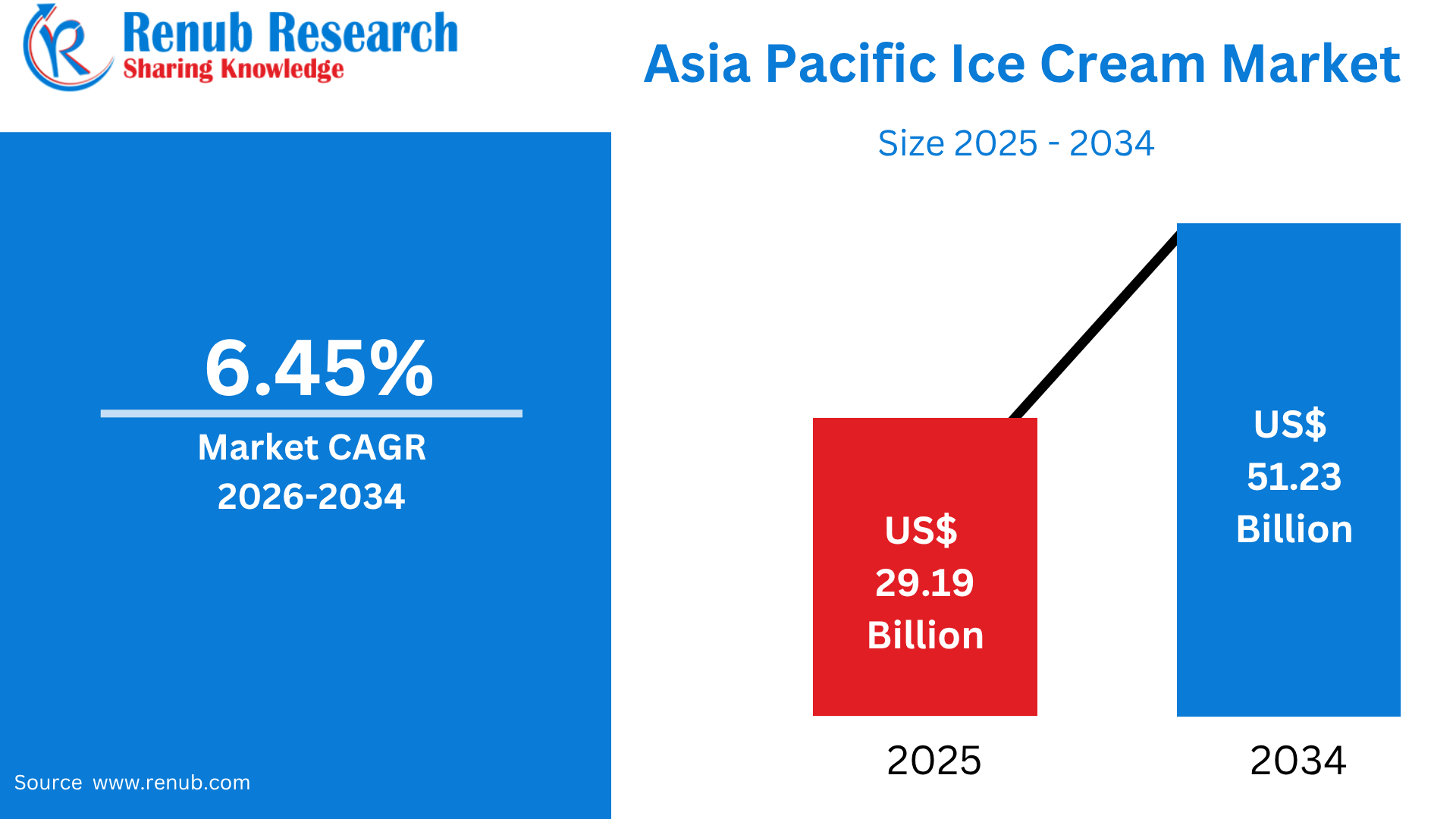
The Asia Pacific Ice Cream Market is projected to reach US$ 51.23 billion by 2034, rising from US$ 29.19 billion in 2025, and is expected to expand at a CAGR of 6.45% during 2026–2034. The regional market is poised for significant growth, supported by rising disposable incomes, rapid urbanization, expanding modern retail and e-commerce networks, and increasing consumer interest in premium and innovative frozen desserts. Growing demand for indulgent, convenient, and value-added ice cream products is encouraging manufacturers to introduce new flavors, healthier formulations, plant-based alternatives, and premium offerings.
What Is Ice Cream and Its Uses & Popularity in Asia Pacific
Ice cream is a frozen dessert generally produced from milk or cream, sweeteners, stabilizers, and flavorings, although the category increasingly includes plant-based and dairy-free alternatives. It is consumed as an everyday snack, dessert, refreshment, and indulgent treat and is widely sold through supermarkets, convenience stores, specialty parlors, restaurants, cafés, foodservice outlets, and e-commerce platforms. Asia Pacific represents one of the world’s largest ice cream consumption regions, supported by its huge population, rising urbanization, changing lifestyles, and increasing disposable incomes. In 2024, the region consumed approximately 11 million tons of ice cream, with consumption increasing about 2% year over year. China was the largest consumer at around 6 million tons, representing approximately 53% of regional consumption. South Korea, Japan, and China recorded the highest per-capita consumption levels at approximately 7.8 kg, 7.4 kg, and 4.2 kg, respectively. Premium flavors, artisanal products, healthier formulations, and convenient single-serve formats are further increasing the popularity of ice cream among younger and urban consumers.
Asian Countries by Ice Cream Consumption
- China: The largest ice cream-consuming country in Asia, with approximately 6.2 million tons consumed in 2024, accounting for about 43% of Asia’s total volume. China also represented 41.69% of Asia-Pacific ice cream market revenue in 2025.
- Indonesia: The second-largest consumer in Asia, with approximately 1.1 million tons of ice cream consumption in 2024. Consumption increased at an average annual rate of 3.6% between 2013 and 2024, reflecting strong long-term growth.
- Pakistan: Consumed approximately 933,000 tons in 2024, representing around 8% of Asia-Pacific consumption. Its consumption expanded at approximately 3.1% annually from 2013 to 2024.
- Iran: Recorded approximately 1.5 million tons of ice cream consumption in 2024, making it one of Asia’s largest markets by volume. Per-capita consumption reached about 17 kg, among the highest levels in Asia.
- Japan: Japan is a leading per-capita ice cream market, with consumption of approximately 7.1 kg per person in 2024. The country also ranked second in Asia-Pacific in market value, at around US$4.9 billion.
- South Korea: Per-capita ice cream consumption reached approximately 6.3 kg per person in 2024, making South Korea one of the region’s most mature ice cream markets. Premium, artisanal and impulse products are particularly important.
- Turkey: Turkey recorded approximately 12 kg of ice cream consumption per person in 2024, placing it among Asia’s highest per-capita consumers. Strong seasonal demand and a developed ice cream culture support consumption.
- India: India’s per-capita consumption remains relatively low at approximately 0.5 liters per person in 2024, indicating substantial room for penetration. The market is nevertheless expanding rapidly, supported by premiumization, urbanization and cold-chain investment.
- Philippines: The Philippines is among the faster-growing Asian ice cream markets, with consumption recording approximately 2.5% CAGR during 2013–2024. Tropical weather and increasing demand for convenient frozen desserts support market development.
- Thailand: Thailand has comparatively high consumer spending on ice cream, with ice cream expenditure of approximately US$5.6 per person in 2024. Its warm climate, tourism industry and strong convenience-store network contribute to demand.
Growth Drivers of the Asia Pacific Ice Cream Market
Rising Disposable Income and Premiumization
Increasing disposable income across emerging Asia Pacific economies is encouraging consumers to spend more on discretionary and indulgent food products, including premium ice cream. As household purchasing power improves, consumers are increasingly experimenting with premium, artisanal, imported, and innovative frozen desserts rather than relying exclusively on basic products. Market research indicates that rising disposable incomes are a major contributor to the region’s ice cream expansion, particularly in China, India, Southeast Asia, and other developing markets. Premiumization is particularly visible in China, Japan, and Australia, where consumers increasingly seek sophisticated flavors, high-quality ingredients, and innovative textures. Manufacturers are therefore introducing super-premium products, small-batch ice creams, natural ingredients, and specialty flavors. The growing willingness to pay for differentiated products is increasing market value and encouraging companies to expand their premium portfolios.
Rapid Urbanization and Changing Consumer Lifestyles
Rapid urbanization is transforming ice cream consumption across Asia Pacific by increasing demand for convenient, portable, and ready-to-eat desserts. Asia hosts more than 2.2 billion urban residents, representing approximately 54% of the world’s urban population, and this urban population is expected to increase by another 1.2 billion by 2050. Growing numbers of consumers are living busy lifestyles and increasingly prefer convenient snacks that can be consumed while commuting, shopping, or socializing. Urbanization is also encouraging the expansion of ice cream parlors, cafés, dessert chains, convenience stores, and modern supermarkets. In cities across India, China, Indonesia, the Philippines, and other Southeast Asian countries, changing lifestyles and greater exposure to international food trends are encouraging consumers to consume ice cream more frequently.
Expansion of Modern Retail, E-Commerce and Product Innovation
The expansion of supermarkets, hypermarkets, convenience stores, specialty outlets, and online grocery platforms is substantially improving ice cream accessibility across Asia Pacific. Modern retail networks allow manufacturers to distribute frozen products across wider geographic areas while refrigerated logistics and cold-chain infrastructure support product quality. In 2025, off-trade channels represented approximately 77.21% of Asia Pacific ice cream market revenue, highlighting the importance of retail distribution. At the same time, manufacturers are differentiating products through innovative flavors, healthier formulations, plant-based alternatives, and premium formats. Dairy-based ice cream remained dominant, while non-dairy products are projected to expand through 2034. Increasing online purchasing, social-media-driven product discovery, and new flavor launches are further encouraging trial and repeat consumption.
Challenges of the Asia Pacific Ice Cream Market
Cold-Chain Infrastructure Gaps and Product Spoilage
Insufficient cold-chain infrastructure remains a significant challenge for ice cream manufacturers and distributors, particularly in rural and developing areas of Asia Pacific. Ice cream requires continuous temperature-controlled storage and transportation from manufacturing facilities through warehouses and retailers to the final consumer. Interruptions in refrigeration can reduce product quality, cause melting and refreezing, increase waste, and negatively affect profitability. The problem is particularly pronounced in rural parts of India and Southeast Asia, where cold-chain infrastructure remains less developed than in major metropolitan markets. Industry research indicates that spoilage rates can reach up to 20% in some areas because of cold-chain gaps. These challenges increase distribution costs and make it difficult for manufacturers to reach lower-tier cities and remote communities efficiently. Companies are responding by investing in local production facilities, refrigerated transportation, digital temperature monitoring, and improved storage infrastructure. However, the capital required to establish and maintain reliable cold-chain networks remains substantial. Improving refrigeration infrastructure will therefore be critical for expanding ice cream penetration beyond major urban centers.
Volatile Raw-Material Costs and Health Concerns
Fluctuations in the prices of key ingredients, including milk, dairy fats, sugar, cocoa, and other inputs, can pressure manufacturers’ margins and ultimately increase retail prices. Recent industry analysis identifies milk and cocoa input-cost volatility as a near-term risk for Asia Pacific ice cream producers. Higher production costs can be particularly challenging in price-sensitive emerging markets, where consumers may shift toward lower-priced products when premium ice cream becomes more expensive. At the same time, growing health and wellness awareness is creating another challenge for traditional ice cream products because many consumers are increasingly concerned about sugar, calories, saturated fat, and artificial ingredients. Manufacturers must therefore balance indulgence with healthier positioning by developing low-sugar, reduced-fat, high-protein, vegan, and plant-based alternatives. Companies that fail to respond to changing nutritional preferences may face pressure from healthier frozen-dessert alternatives.
Ice Cream Launches in Asia
- Bombay Creamery Ice Cream – 2026 | India
Reliance Consumer Products launched Bombay Creamery, entering India’s competitive ice cream market with cones, cups, tubs, bars, and sticks. The range starts at around INR 10, with an initial rollout in western India and plans for broader distribution. - Meiji Dear Milk Tokuno – 2025 | Japan
Meiji introduced Dear Milk Tokuno, a winter-exclusive premium ice cream featuring 19.5% milk fat and fresh cream sourced from Hokkaido’s Tokachi region. The product was scheduled for nationwide launch in December 2025. - Godiva Cup Ice Cream Pistachio Chocolate – 2025 | Japan
Godiva Japan launched Pistachio Chocolate Cup Ice Cream in August 2025. The product combines pistachio and milk chocolate ice cream with a crisp Belgian chocolate shell and was initially distributed through Japanese convenience stores. - NIC Bourbon Ice Cream – 2025 | India
Britannia Industries introduced NIC Bourbon Ice Cream, combining rich chocolate ice cream with pieces of Britannia Bourbon biscuits. The launch extended the popular biscuit flavor into the premium frozen-dessert category. - HOCCO Modak-Shaped Ice Cream – 2025 | India
HOCCO Ice Creams introduced limited-edition Modak-shaped ice cream for Ganesh Chaturthi. The range included White Chocolate Modak and Milk Chocolate Modak variants, combining coconut-based ice cream with chocolate coatings. - Seolleim Milkshake Low Sugar – 2025 | South Korea
Lotte Wellfood expanded its Seolleim range with Milkshake Low Sugar, responding to growing interest in reduced-sugar frozen desserts. Other additions included Angelinus Low Sugar, Matcha, and Coolish Vanilla. - Seolreim Coolish Vanilla – 2025 | South Korea
Lotte Wellfood launched Seolreim Coolish Vanilla, adapting Japan Lotte’s popular Coolish Vanilla product for the Korean market. The launch represented the first introduction of a Japanese Lotte ice cream brand in Korea using the original brand name and specifications. - Choc Rocks Goguma & Choco Mint – 2024 | Indonesia
Indofood Ice Cream launched Choc Rocks Goguma and Choc Rocks Choco Mint in November 2024. Goguma features Korean sweet-potato-flavored ice cream with a white chocolate coating, while Choco Mint combines chocolate-mint ice cream with a crunchy chocolate layer. - eclipseco Plant-Based Ice Cream – 2024 | Japan
Eclipse Foods introduced its eclipseco plant-based ice cream range in Japan in March 2024. Initial flavors included Cookie Butter Crumble, Classic Chocolate, and Mango Passion Fruit, with availability through FamilyMart stores in Tokyo. - Havmor New Flavor Collection – 2024 | India
Havmor introduced a broad summer lineup including Shahi Kesar, Rajwadi Kulfi, Blueberry Cheesecake, Cookie and Cream cones, ice cream sandwiches, Jaljeera & Kalakhatta, Ratnagiri Hapus, and rose-flavored ice cream. The launch demonstrated the growing use of both traditional Indian flavors and contemporary international profiles.
India Ice Cream Market
India ice cream market is witnessing robust growth, supported by rising disposable incomes, rapid urbanization, expanding middle-class consumption, and changing preferences toward convenient and affordable indulgence. Impulse products such as cones, cups, sticks, and single-serve packs remain important growth categories, while take-home tubs and family packs are gaining traction. In 2024, impulse ice cream accounted for approximately 60.8% of market value, demonstrating the importance of on-the-go consumption. Expanding organized retail, cold-chain infrastructure, quick-commerce platforms, and food-delivery services are improving year-round availability, particularly in Tier-II and Tier-III cities. Manufacturers are also responding to demand for premium flavors, natural ingredients, vegan products, functional formulations, and regionally inspired flavors. Packaging innovation is becoming increasingly important as manufacturers seek to differentiate ice cream products and improve shelf appeal. In May 2024, Indian packaging company Topnotch Foods showcased rolled sugar cones and aluminum-foil sleeves in multiple sizes for the ice cream industry at the IntraPac Exhibition in Greater Noida. Such innovations can help brands strengthen product presentation, improve protection during distribution, and create distinctive packaging formats for impulse ice cream products.
China Ice Cream Market
The China ice cream market is one of the largest in Asia Pacific, supported by rising disposable incomes, urbanization, a large middle-income consumer base, and increasing demand for premium and innovative desserts. Premiumization is becoming an important growth opportunity as younger and affluent consumers increasingly seek sophisticated flavors, premium ingredients, artisanal products, and visually distinctive packaging. China’s per-capita annual ice cream consumption was approximately 3.5 liters in 2022, considerably below the 6–8 liters reported for Western countries, indicating significant potential for further consumption growth. Manufacturers are therefore expanding premium ranges while introducing products featuring exotic fruits, tea-based flavors, chocolate, nuts, functional ingredients, and reduced-sugar formulations. Supermarkets, convenience stores, specialty ice cream outlets, e-commerce platforms, and food-delivery applications are strengthening product accessibility. Digital marketing and social-media campaigns are particularly influential among younger consumers, while online grocery platforms enable brands to reach consumers beyond traditional urban retail locations. Domestic and international manufacturers are consequently investing in new products, premium packaging, localized flavors, and broader distribution networks to capture China’s evolving ice cream demand.
Japan Ice Cream Market
The Japan ice cream market is characterized by strong demand for premium-quality products, innovative flavors, seasonal launches, and convenient single-serve desserts. Japanese consumers are particularly receptive to limited-edition products, sophisticated flavor combinations, attractive packaging, and products incorporating traditional ingredients such as matcha, red bean, black sesame, and regional fruits. Convenience stores remain an important retail channel because of their extensive nationwide presence and ability to offer frequent product launches and seasonal varieties. Health consciousness is increasingly influencing product development, encouraging manufacturers to introduce low-sugar, dairy-free, plant-based, and portion-controlled alternatives. Sustainability is also becoming relevant to purchasing decisions. A Japanese consumer study cited by Japan’s Ministry of Agriculture, Forestry and Fisheries found that 45% of respondents considered environmental friendliness of the company an important purchasing driver, while 41% considered environmentally friendly packaging important. Japan’s Ministry of Economy, Trade and Industry also reports that 65% of surveyed consumers were willing to pay at least 1% more for environmentally friendly products, while younger consumers showed an even stronger willingness to pay a premium. ([Ministry of Economy, Trade and Industry][6]) This trend is encouraging manufacturers to reduce packaging waste, improve production efficiency, and explore more sustainable packaging and sourcing practices. Consequently, premiumization, sustainability, seasonal innovation, and health-oriented formulations are expected to remain important competitive factors in Japan’s ice cream industry.
South Korea Ice Cream Market
South Korea ice cream market is expanding through premiumization, convenience-oriented consumption, product innovation, and strong retail accessibility. Consumers increasingly seek unique flavors, visually appealing products, premium ingredients, and limited-edition offerings influenced by social media and broader Korean food trends. Premium ice cream is among the fastest-growing product categories, with consumers showing greater willingness to pay for products offering distinctive flavors, superior ingredients, and premium-brand positioning. Convenience stores play a particularly important role in South Korea’s ice cream distribution landscape. Industry sources indicate that convenience stores account for approximately 36.4% of ice cream distribution, reflecting consumers’ preference for accessible, impulse-oriented purchases. ([K-Food Trade][8]) South Korea also has an extensive convenience-store network, with more than 50,000 outlets, providing manufacturers with broad national reach. Manufacturers are increasingly introducing premium, artisanal, low-sugar, and plant-based ice cream products to address changing consumer preferences. Limited-edition launches, celebrity collaborations, differentiated packaging, and social-media-driven campaigns are helping brands generate consumer interest. Recent retail trends further demonstrate the strength of dessert demand: premium and dessert ice cream sales at GS25 convenience stores in major commercial districts increased 32.7% year over year during January–May 2026, while refrigerated dessert sales during late-night hours increased 94.2%. Overall, South Korea’s combination of dense convenience-store distribution, digitally engaged consumers, premiumization, and rapid product innovation is expected to continue supporting the country’s ice cream market.
Recent Developments in Asia Pacific Ice Cream Market
- November 2025: On December 1, 2025, Meiji will launch "Meiji Dear Milk Tokuno," a winter-only addition to its Dear Milk ice cream assortment. With a 19.5% milk fat level and fresh cream from the Tokachi region of Hokkaido, this new version ensured a fuller flavor suitable for the winter.
- August 2025: Godiva Japan debuted the Godiva Cup Ice Cream Pistachio Chocolate, a new high-end ice cream product. It was first sold in convenience stores across the country in late August 2025, and supermarkets started carrying it in mid-September. The product offers a multi-sensory treat by combining a layer of delicious pistachio ice cream with rich milk chocolate ice cream, all wrapped in a crisp Belgian chocolate shell.
- August 2025: To celebrate Ganesh Chaturthi, HOCCO Ice Creams added a limited-edition Modak-shaped ice cream to their lineup. The product combines cultural significance with decadent taste and is offered in two varieties: White Chocolate Modak (coconut ice cream in a white chocolate shell) and Milk Chocolate Modak (coconut cream base with milk chocolate coating).
- July 2025: NIC Bourbon Ice Cream, Britannia Industries' newest product, was introduced. This innovative product satisfies chocolate fans' demands by combining opulent chocolate ice cream with the cherished crumbs of Britannia's Bourbon biscuits. With this introduction, Britannia presents its iconic flavor in a rich ice cream form, further redefining the bourbon experience.
Asia Pacific Ice Cream Market Segmentation
Product
- Sticks/Bars
- Cones & Cups
- Tubs & Bricks
- Others
Category
- Dairy Based
- Non-Dairy Based
Type
- Impulse
- Take home
- Artisanal
Flavor
- Chocolate
- Vanilla
- Fruit
- Others
Distribution Channel
- Supermarkets and hypermarkets
- Convenience Stores
- Specialty Stores
- Online Sales Channel
Countries
- China
- Japan
- India
- South Korea
- Thailand
- Malaysia
- Indonesia
- Australia
- New Zealand
- Rest of Asia Pacific
All companies have been covered with 5 Viewpoints
- Overviews
- Key Person
- Recent Developments
- SWOT Analysis
- Revenue Analysis
Key Players Analysis
- Meiji co ltd.
- General Mills
- Yili Group
- Unilever Group
- Mondelez International, Inc.
- Nestlé SA
- Bright Dairy & Food Co. Ltd.
- Danone S.A.
Report Details:
| Report Features | Details |
| Base Year |
2025 |
| Historical Period |
2022 - 2025 |
| Forecast Period |
2026 - 2034 |
| Market |
US$ Billion |
| Segment Covered |
Product, Category, Type, Flavours, Distribution Channel and Countries |
| Countries Covered |
|
| Companies Covered |
|
| Customization Scope |
20% Free Customization |
| Post-Sale Analyst Support |
1 Year (52 Weeks) |
| Delivery Format |
PDF and Excel through Email (We can also provide the editable version of the report in PPT/Word format on request) |
Customization Services available
- Analysis of Market Size and Its Segments
- More Company Profiles (Upto 10 without any additional cost):
- Additional Countries (Other than mentioned Countries):
- Region/Country Specific Reports:
- Market Entry Strategy:
- Region-Specific Market Dynamics:
- Regional Market Share Analysis:
- Trade Analysis:
- Production Insights:
- Others Customized Requests:
For more information contact our analysts.
Need More Assistance?
- Talk to our analysts to get more precious information on the current market trends.
- Include more countries and segments and customize the report based on the final requirement.
- Get a competitive advantage in your industry by knowing the report findings and making a positive impact on your revenues and operations.
- Our analysts are always ready to provide more help and pertinent information if you need any additional assistance.