Global Agricultural Micronutrients Market Report by Form, Crop Type, Nutrient Type, Application, Countries and Company Analysis 2026-2034
Buy NowAgricultural Micronutrients Market Size & Forecast
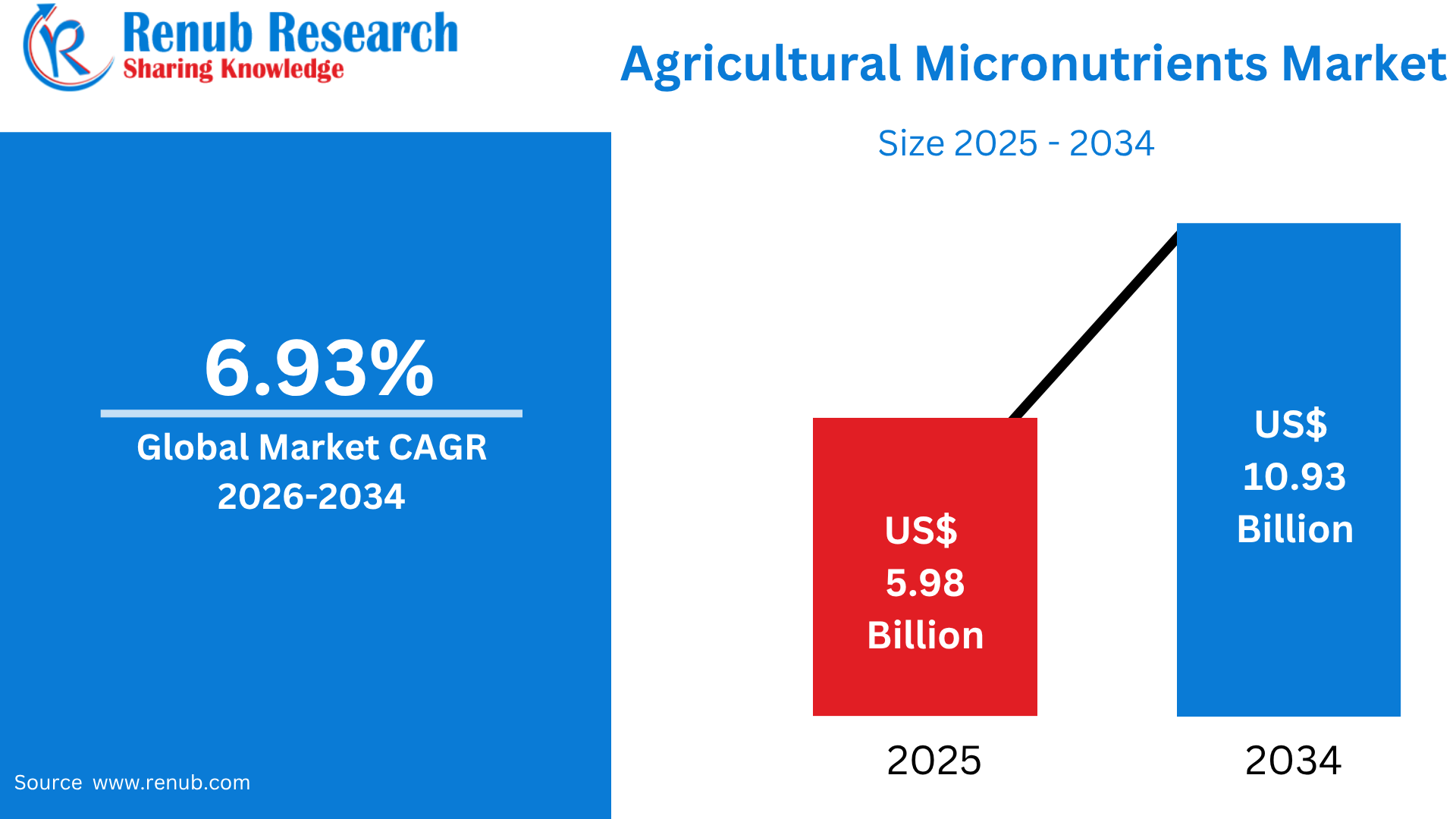
The Global Agricultural Micronutrients Market is expected to expand from US$ 5.98 Billion in 2025 to US$ 10.93 Billion by 2034, registering a Compound Annual Growth Rate (CAGR) of 6.93% during the forecast period from 2026 to 2034. Market growth is being driven by the increasing need to improve crop productivity, widespread depletion of essential nutrients in agricultural soils, and growing awareness among farmers regarding the importance of balanced and efficient fertilizer application. Furthermore, the adoption of micronutrient-based solutions to address nutrient deficiencies and enhance crop quality is expected to create additional growth opportunities worldwide.
What is Agricultural Micronutrients and its Uses & Popularity Worldwide
Agricultural micronutrients are essential trace elements required by plants in relatively small quantities for healthy growth, development, reproduction, and crop-quality improvement. Major agricultural micronutrients include zinc (Zn), boron (B), iron (Fe), manganese (Mn), copper (Cu), molybdenum (Mo), and chlorine (Cl). Unlike primary nutrients such as nitrogen, phosphorus, and potassium, micronutrients are needed in smaller amounts but play critical roles in enzyme activity, photosynthesis, protein synthesis, root development, and nutrient utilization. They are supplied through soil applications, foliar sprays, seed treatments, fertigation, and micronutrient-enriched fertilizers. Their popularity is increasing worldwide as intensive cultivation, soil degradation, and imbalanced fertilization contribute to nutrient deficiencies.
FAO identifies emerging deficiencies of zinc, boron, molybdenum, iron, and other micronutrients as important constraints to soil fertility and fertilizer efficiency. Zinc is particularly important, with research indicating that more than half of agricultural soils globally may be deficient in zinc. Consequently, micronutrients are increasingly used to improve crop yields, quality, nutrient-use efficiency, and agricultural sustainability.
Growth Drivers of the Agricultural Micronutrient Market
Rising Soil Micronutrient Deficiencies
Increasing micronutrient deficiencies in agricultural soils are a major driver of the global agricultural micronutrient market. Continuous cropping, nutrient removal through harvested crops, soil erosion, and imbalanced fertilizer application can reduce the availability of essential trace elements. FAO highlights emerging deficiencies of zinc, boron, molybdenum, iron, and manganese as important agricultural challenges. Zinc is particularly significant, with a recent agronomic review indicating that more than half of agricultural soils worldwide are inherently deficient in zinc. Evidence from India further demonstrates the scale of the issue: analysis of 242,827 soil samples from 615 districts found deficiencies of zinc in 51.2% of soils and boron in 44.7%, while iron, copper, and manganese deficiencies were 19.2%, 11.4%, and 17.4%, respectively. These conditions are encouraging farmers to adopt zinc, boron, iron, and other micronutrient fertilizers to restore soil fertility, improve nutrient availability, and support consistent crop productivity.
Growing Need to Increase Crop Yield and Quality
The increasing requirement to produce greater agricultural output from limited arable land is encouraging the adoption of micronutrient fertilizers. Micronutrients support critical plant functions, including root development, flowering, enzyme activation, photosynthesis, and reproductive growth, making them important for both yield and crop quality. FAO research notes that micronutrient deficiencies can become yield-limiting factors and reduce the efficiency of conventional NPK fertilization. Field evidence demonstrates the potential benefits: FAO-cited trials at Pantnagar recorded average long-term yield responses to zinc application of approximately 285 kg/ha in rice and 307 kg/ha in wheat. Similarly, field studies in semi-arid India found significant yield responses in maize, castor, groundnut, and mung bean following sulfur, boron, and zinc applications. As farmers increasingly focus on maximizing productivity, improving produce quality, and achieving better returns per hectare, demand is expanding for targeted micronutrient solutions, including soil-applied fertilizers, foliar formulations, chelated products, and micronutrient-enriched NPK fertilizers.
Increasing Adoption of Balanced and Precision Fertilization
The shift toward balanced and precision nutrient management is creating significant opportunities for agricultural micronutrient products. Instead of relying primarily on nitrogen, phosphorus, and potassium, farmers are increasingly using soil testing, tissue analysis, fertigation, foliar feeding, and site-specific recommendations to identify nutrient deficiencies and apply the appropriate quantities. FAO’s updated 2025 cropland nutrient balance dataset covering 1961–2023 emphasizes nutrient-use efficiency as an important indicator for evaluating nutrient deficits and surpluses in agricultural systems.This is important because insufficient nutrient application can reduce soil fertility, while excessive application can contribute to soil and water pollution. Micronutrients therefore fit into a broader movement toward efficient fertilizer utilization, where farmers seek to apply nutrients according to crop requirements and soil conditions. Growing use of precision agriculture, improved soil testing, fertigation systems, and customized fertilizer blends is expected to increase demand for specialized micronutrient formulations across cereals, fruits, vegetables, oilseeds, pulses, and commercial crops.
Challenges of the Agricultural Micronutrient Market
Limited Farmer Awareness and Incorrect Application
Limited awareness regarding micronutrient deficiencies, dosage requirements, and application methods remains a major challenge for market expansion, particularly among small and fragmented farms. Micronutrients are required in very small quantities, meaning that both under-application and over-application can reduce effectiveness or potentially cause toxicity. FAO has noted that site-specific fertilizer recommendations exist for important crops, but farmers may deviate from recommended application rates.The complexity of diagnosing deficiencies also creates difficulties because symptoms of different nutrient deficiencies can appear similar, while nutrient availability is influenced by soil pH, moisture, organic matter, and interactions with other nutrients. For example, excessive phosphorus can aggravate zinc deficiency, making fertilizer management more complicated. Consequently, farmers may prioritize familiar NPK fertilizers over specialized micronutrient products. Greater investment in soil testing, agricultural extension services, farmer education, demonstration plots, and digital advisory platforms is therefore necessary to encourage correct micronutrient selection, dosage, timing, and application.
Risk of Overuse, Nutrient Imbalance, and Environmental Concerns
The agricultural micronutrient market also faces challenges associated with improper application, nutrient imbalance, and environmental sustainability. Although micronutrients are essential, excessive quantities can negatively affect plant growth and soil conditions, while inappropriate combinations may interfere with the availability or uptake of other nutrients. FAO’s global nutrient-balance assessment emphasizes that insufficient nutrient use can reduce soil fertility, whereas excessive nutrient use can contribute to pollution through leaching and runoff and increase greenhouse-gas emissions. Micronutrient management is particularly complex because crop requirements differ substantially according to species, growth stage, soil characteristics, and climatic conditions. In addition, the cost of premium chelated and specialty micronutrient formulations can discourage adoption among price-sensitive farmers. Manufacturers therefore need to demonstrate clear yield and return-on-investment benefits while developing products that improve nutrient-use efficiency. Greater integration of soil testing, precision application, controlled-release technologies, and balanced fertilizer programs will be important for supporting sustainable market growth.
Agricultural Micronutrient Product Launches
- Trivar® EZ – CHS Inc. (2024) – CHS launched Trivar EZ in August 2024 as an enhanced granular micronutrient fertilizer containing its patented Levesol® chelating agent, designed to improve micronutrient availability and phosphate utilization by crops.
- Abivium™ – CHS Inc. (2024/2025 season) – A graphite-flow talc product combining micronutrients with a biostimulant, introduced as part of CHS’s new crop-input portfolio for the 2025 growing season.
- Soygreen® Pro – CHS Inc. (2024/2025 season) – A concentrated liquid iron micronutrient product introduced to help address iron deficiency chlorosis in soybean crops.
- Soygreen® Granular 2.4 – CHS Inc. (2024/2025 season) – A granular iron formulation developed for air-seeder applications and targeted at managing iron deficiency chlorosis in soybean fields.
- Allocate™ ZN – CHS Inc. (2024/2025 season) – A concentrated zinc formulation designed to be incorporated into dry commodity fertilizers, providing growers with a convenient zinc-fortification option.
- Allocate™ BCMZ – CHS Inc. (2024/2025 season) – A concentrated micronutrient formulation containing boron, copper, manganese and zinc, developed for blending with dry commodity fertilizers.
- Agrisia Bor-Cynk Active – Agrisia (2025) – A crystalline micronutrient fertilizer combining chelated zinc with soluble boron and molybdenum, designed for foliar application across fruit, vegetable, floriculture and field crops.
- NAPTA COMBI 4 – NAPTA Micro Industries (2024) – A foliar micronutrient mixture containing 3% zinc, 2% iron, 1% manganese and 0.5% boron, registered under India’s Fertilizer Control Order framework.
- AgriGold – NAPTA Micro Industries (2024) – A micronutrient formulation containing zinc, iron, manganese and boron, developed particularly for foliar application in red and laterite soils with acidic reactions.
- ZinBor – BJ Biologicals – A water-soluble micronutrient product combining chelated zinc (EDTA) and boron, positioned for cereals, pulses, oilseeds, vegetables and horticultural crops.
High Bioavailability and Efficient Nutrient Delivery
The global agricultural chelated micronutrients market is gaining importance as farmers seek more efficient ways to correct deficiencies of zinc, iron, manganese, and copper. Chelation surrounds a micronutrient ion with an organic ligand, helping protect it from precipitation, immobilization, oxidation, and other reactions that can reduce plant availability. Research indicates that chelated nutrients can improve uptake while reducing nutrient losses compared with some conventional forms. EDTA, DTPA, and EDDHA are among the commonly used chelating agents, although their effectiveness varies according to soil pH and crop conditions. For example, EDDHA-chelated iron remains particularly stable in alkaline soils, while DTPA and EDTA have different stability ranges. Chelated products are especially valuable for high-value fruits, vegetables, flowers, and other crops where precise nutrient management can influence yield, quality, and appearance. Growing emphasis on nutrient-use efficiency and sustainable fertilizer application is therefore supporting market expansion.
Rising Production and Quality Requirements
Fruits and vegetables represent an important application area for agricultural micronutrients because crop quality, appearance, size, and nutritional characteristics are highly sensitive to nutrient availability. Boron, zinc, iron, manganese, and other micronutrients contribute to physiological processes supporting plant development, flowering, fruit formation, and stress tolerance. The scale of global production creates a substantial opportunity for micronutrient fertilizers: FAO reported that worldwide fruit and vegetable production reached approximately 2.1 billion tonnes in 2023, increasing 1% from 2022. Chelated fertilizers are particularly relevant where soil conditions restrict micronutrient availability. The University of Florida notes that chelated fertilizers can improve the bioavailability of Fe, Cu, Mn, and Zn and are particularly useful when soil pH exceeds 6.5 or micronutrient stress is present. As commercial growers increasingly focus on consistent crop quality, export standards, and efficient fertilizer use, demand for targeted micronutrient applications in fruit and vegetable cultivation is expected to strengthen globally.
Expanding Protein and Oilseed Production
Oilseeds and pulses depend on balanced micronutrient availability for strong root development, reproductive growth, nitrogen-related processes, and efficient nutrient utilization. Zinc, iron, boron, and molybdenum are particularly relevant to many cropping systems, while seed treatment and foliar application can provide targeted supplementation when soil availability is inadequate. The importance of the segment is reinforced by the enormous scale of global oil-crop production. FAO reported that production of oil palm fruit, soybeans, and rapeseed reached 893 million tonnes in 2023, demonstrating the substantial agricultural base requiring efficient nutrient management. Soil deficiencies can materially constrain productivity; a large Indian assessment covering 242,827 soil samples from 615 districts across 28 states found zinc deficiency in 51.2% of soils and boron deficiency in 44.7%. Increasing demand for plant-based proteins, edible oils, and higher crop productivity is consequently encouraging farmers to adopt micronutrient fertilizers alongside conventional macronutrient programs.
Widespread Zinc Deficiency Supports Demand
Zinc is one of the most important agricultural micronutrients because it participates in enzyme activity, protein synthesis, plant growth regulation, and other physiological processes. Zinc deficiency can result in restricted growth, delayed maturity, poor development, and reduced yields, making zinc fertilizers an important component of balanced crop nutrition. FAO identifies zinc deficiency as the most widespread soil micronutrient deficiency globally, with almost half of agricultural soils in India and approximately one-third of agricultural soils in China considered zinc-deficient in the cited assessment. More recent evidence from India reinforces the scale of the problem: analysis of 242,827 soil samples found 51.2% of soils deficient in available zinc, with more than half of soils deficient in 131 districts. Farmers are therefore increasingly using soil-applied, foliar, and chelated zinc products to address localized deficiencies. Growing awareness of balanced fertilization, soil testing, and nutrient-use efficiency is expected to support continued expansion of the agricultural zinc micronutrients market.
Iron Chelates Address Availability Challenges
Iron is essential for photosynthesis, respiration, electron transfer, and chlorophyll formation. When available iron is insufficient, plants commonly develop interveinal chlorosis, particularly in young leaves, which can reduce plant vigor and ultimately affect crop productivity. Iron availability is strongly influenced by soil chemistry, with high-pH and alkaline conditions making iron less available to plants. Consequently, chelated iron products such as Fe-EDTA, Fe-DTPA, and Fe-EDDHA are increasingly used where conventional iron sources provide inadequate availability. The University of Florida reports that chelated fertilizers improve the bioavailability of micronutrients including Fe, Cu, Mn, and Zn, while EDDHA is particularly stable at soil pH above 7. Research under alkaline conditions also continues to evaluate different iron chelates for improving iron solubility and plant uptake. Furthermore, an extensive Indian soil assessment identified iron deficiency in 19.2% of analyzed soils, demonstrating a significant potential requirement for iron supplementation.
Soil Testing and Balanced Fertilization Drive Adoption
Soil application remains an important method of delivering micronutrients because it enables farmers to correct nutrient deficiencies directly within the crop’s growing environment. Essential micronutrients such as zinc, iron, manganese, boron, copper, and molybdenum are required in relatively small quantities but perform critical functions in enzyme activity, photosynthesis, root development, and plant metabolism. FAO’s Global Soil Partnership emphasizes that micronutrient availability depends on soil chemical, physical, and biological conditions and recommends soil micronutrient analysis as an important step in identifying deficiencies. Evidence from India demonstrates the scale of the opportunity: a national assessment of 242,827 soil samples found deficiencies of zinc in 51.2%, boron in 44.7%, iron in 19.2%, copper in 11.4%, and manganese in 17.4% of soils. These findings encourage greater use of soil testing, site-specific fertilizer programs, and targeted micronutrient applications. Increasing emphasis on soil health and sustainable nutrient management should further support market growth.
Precision Irrigation Improves Nutrient Efficiency
Fertigation, the application of fertilizers through irrigation systems, is becoming an increasingly important method for delivering agricultural micronutrients because it enables nutrients to be distributed directly within the crop root zone. Water-soluble micronutrient formulations can be incorporated into irrigation schedules, allowing farmers to control application timing and dosage according to crop requirements. This approach is particularly relevant to high-value horticulture, greenhouse production, protected cultivation, and other intensive farming systems where precise nutrient management is essential. Micronutrient availability is strongly influenced by soil conditions, and FAO notes that soil chemical and physical characteristics affect the amount of nutrient available for plant uptake. Fertigation can therefore complement soil testing and precision nutrient management by providing targeted supplementation. The broader agricultural sector also faces increasing pressure to improve nutrient-use efficiency while limiting unnecessary losses. FAO’s global nutrient-balance work highlights the importance of matching nutrient inputs with crop requirements to improve efficiency and reduce environmental impacts. This trend is supporting the adoption of fertigation-based micronutrient solutions worldwide.
Precision Agriculture and Soil Testing Support USA Adoption
USA agricultural micronutrients market is supported by advanced farming practices, widespread soil testing, and strong adoption of precision agriculture. Farmers increasingly use field-level data to identify nutrient deficiencies and apply fertilizers according to crop requirements, improving nutrient-use efficiency and reducing unnecessary applications. Zinc, boron, iron, manganese, and copper are particularly important in targeted nutrient-management programs. The scale of U.S. agriculture also creates substantial demand for efficient crop nutrition. According to the USDA, U.S. agricultural exports reached approximately US$176 billion in fiscal year 2024, highlighting the importance of maintaining productivity and crop quality in globally competitive farming operations. Sustainable agriculture programs are further encouraging efficient input management. In addition, growers are adopting specialty soil amendments and biological products alongside conventional fertilizers. Helena Agri-Enterprises expanded applications of its Zypro soil amendment in February 2024 to include side-dressing fertilizers, demonstrating continued product innovation in U.S. crop nutrition. These developments are expected to strengthen demand for precision micronutrient solutions.
Sustainable and High-Quality Crop Production in France
France represents an important European market for agricultural micronutrients because of its sophisticated agricultural sector and strong focus on crop quality, sustainability, and efficient input utilization. The country’s production of cereals, fruits, vegetables, and grapes requires balanced nutrient management to maintain productivity and quality. According to Eurostat, France accounted for approximately 12.7% of the EU’s utilized agricultural area in 2023, making it one of the bloc’s largest agricultural producers by land area. This extensive agricultural base creates opportunities for soil-applied, foliar, and chelated micronutrient products. Vineyard cultivation is particularly relevant because deficiencies of nutrients such as boron, zinc, iron, and manganese can influence plant development and grape quality. France is also promoting more sustainable agricultural practices, encouraging farmers to optimize fertilizer inputs and improve soil health. Chelated micronutrients can provide advantages where soil conditions restrict nutrient availability, particularly in high-value crops. Increasing adoption of precision farming, soil analysis, and sustainable fertilizer-management practices is therefore expected to support market development.
Widespread Soil Deficiencies and Rising Crop Productivity in India
India is a major growth market for agricultural micronutrients because of widespread soil deficiencies, increasing pressure to improve agricultural productivity, and growing awareness of balanced fertilization. A nationwide assessment covering 242,827 soil samples from 615 districts across 28 states found deficiencies of zinc in 51.2%, boron in 44.7%, iron in 19.2%, copper in 11.4%, and manganese in 17.4% of analyzed soils. These findings demonstrate the substantial requirement for targeted micronutrient supplementation across Indian agriculture. Zinc and iron fertilizers, foliar formulations, soil amendments, and fortified fertilizer products are increasingly used to address localized deficiencies and improve crop performance. Precision agriculture is also creating new opportunities for efficient application. In May 2023, Aries Agro introduced its 100 Days Drone Yatra, promoting drone-based micronutrient spraying across agricultural areas. Drone application can improve coverage and reduce the labor and time required for spraying. Government initiatives promoting soil testing, balanced fertilizer use, and improved nutrient management are further supporting adoption. Consequently, increasing soil-health awareness and the need for higher yields are expected to sustain strong growth in India’s agricultural micronutrients market.
Commercial Agriculture and Precision Nutrient Management in Brazil
Brazil is a significant agricultural market for micronutrients because of its large-scale production of soybeans, sugarcane, coffee, corn, and other export-oriented crops. The country’s tropical agricultural soils can present nutrient-availability challenges, increasing the importance of targeted micronutrient management for maintaining productivity. Soybean cultivation is particularly significant, with Brazil producing approximately 147 million tonnes of soybeans in the 2024/25 season, according to USDA estimates. Large commercial farms increasingly employ soil analysis, precision agriculture, variable-rate application, and foliar nutrition to improve fertilizer efficiency. Zinc, boron, manganese, and other micronutrients are commonly incorporated into crop nutrition programs according to soil and crop requirements. Product innovation is also expanding beyond conventional fertilizers. In September 2024, French agricultural biotechnology company Elicit Plant introduced EliZon, a solution designed to improve soybean resilience to water stress, reflecting the increasing focus on technologies that combine crop productivity with stress management. As Brazil continues to expand agricultural exports and pursue higher productivity from existing farmland, demand for precision nutrient-management solutions and specialized micronutrient products is expected to increase.
Agricultural Micronutrients Market Segments
Form
- Chelated
- Non-Chelated
Crop Type
- Fruits & Vegetables
- Cereals & Grains
- Oilseeds & Pulses
- Other Crop Types
Nutrient Type
- Zinc
- Boron
- Iron
- Molybdenum
- Manganese
- Others
Application
- Soil
- Foliar
- Fertigation
Countries
North America
- United States
- Canada
Europe
- France
- Germany
- Italy
- Spain
- United Kingdom
- Belgium
- Netherlands
- Turkey
Asia Pacific
- China
- Japan
- India
- Australia
- South Korea
- Thailand
- Malaysia
- Indonesia
- New Zealand
Latin America
- Brazil
- Mexico
- Argentina
Middle East & Africa
- South Africa
- Saudi Arabia
- UAE
All companies have been covered with 5 Viewpoints
- Overviews
- Key Person
- Recent Developments
- SWOT Analysis
- Revenue Analysis
Company Analysis
- Basf se
- Compass Minerals
- Coromandel International
- Deepak fertilizers
- Nouryon
- Nufarm
- Nutrien Ltd.
- The Mosaic Company
- Yara International
Report Details:
| Report Features | Details |
| Base Year |
2024 |
| Historical Period |
2021 - 2024 |
| Forecast Period |
2025 - 2033 |
| Market |
US$ Billion |
| Segment Covered |
By Form, By Crop Type, By Nutrient Type, By Application and By Countries |
| Countries Covered |
|
| Companies Covered |
|
| Customization Scope |
20% Free Customization |
| Post-Sale Analyst Support |
1 Year (52 Weeks) |
| Delivery Format |
PDF and Excel through Email (We can also provide the editable version of the report in PPT/Word format on request) |
Customization Services available
- Analysis of Market Size and Its Segments
- More Company Profiles (Upto 10 without any additional cost):
- Additional Countries (Other than mentioned Countries):
- Region/Country Specific Reports:
- Market Entry Strategy:
- Region-Specific Market Dynamics:
- Regional Market Share Analysis:
- Trade Analysis:
- Production Insights:
- Others Customized Requests:
For more information contact our analysts.
Need More Assistance?
- Talk to our analysts to get more precious information on the current market trends.
- Include more countries and segments and customize the report based on the final requirement.
- Get a competitive advantage in your industry by knowing the report findings and making a positive impact on your revenues and operations.
- Our analysts are always ready to provide more help and pertinent information if you need any additional assistance.