Aerospace 3D Printing Market Size, Share, Growth, Trends, Industry Analysis & Forecast 2026–2034
Buy NowAerospace 3D Printing Market Forecast
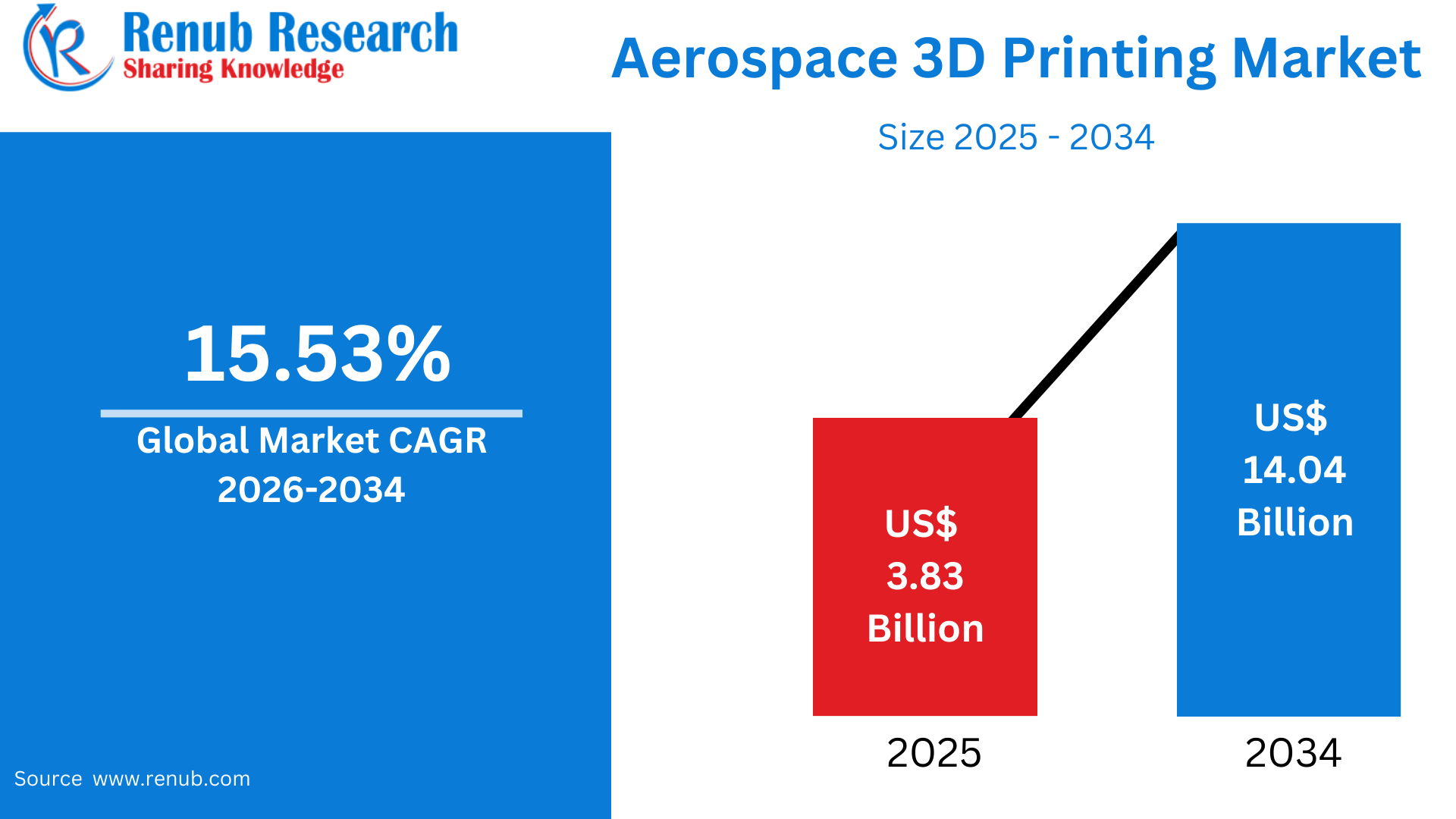
Aerospace 3D Printing Market is projected to grow from US$ 3.83 billion in 2025 to US$ 14.04 billion by 2034, expanding at a CAGR of 15.53% during the forecast period from 2026 to 2034. Market growth is driven by the increasing demand for lightweight, high-performance aircraft components that improve fuel efficiency and reduce emissions. Aerospace manufacturers are adopting 3D printing technologies to lower production costs, accelerate prototyping, minimize material waste, and simplify the manufacturing of complex parts.
What is Aerospace 3D Printing and Its Uses & Popularity Worldwide?
Aerospace 3D printing, also known as additive manufacturing, is an advanced manufacturing process that creates aircraft and spacecraft components layer by layer from digital designs using materials such as titanium, aluminum, nickel alloys, stainless steel, and high-performance polymers. Unlike traditional machining, aerospace 3D printing minimizes material waste, enables the production of lightweight and highly complex geometries, and significantly reduces manufacturing time. The technology is widely used to produce engine components, structural airframe parts, turbine blades, fuel nozzles, brackets, cabin interiors, satellite components, drones, and customized aerospace tools. It also accelerates rapid prototyping, spare parts production, and on-demand manufacturing, improving supply chain flexibility and reducing inventory costs.
Aerospace 3D printing has gained significant popularity worldwide as commercial aviation, defense organizations, and space agencies seek lighter, stronger, and more fuel-efficient components. Major aircraft manufacturers and aerospace suppliers increasingly use additive manufacturing to improve aircraft performance, reduce carbon emissions, shorten production cycles, and lower operational costs. Continuous advancements in metal printing technologies, artificial intelligence-driven design optimization, and advanced materials are further expanding the adoption of aerospace 3D printing across commercial aviation, military aircraft, satellites, and space exploration programs worldwide.
United Kingdom Aerospace & Defence Industry Statistics
- UK Aerospace, Defence, Security & Space sectors contributed £38.2 billion to the UK economy in 2023, representing 50% growth over the past decade.
- The global commercial airline fleet has reached approximately 30,000 aircraft, reflecting the continued recovery and expansion of worldwide air travel.
- Aircraft orders increased by 64% in April 2024 compared with the same month in the previous year, demonstrating strong demand for new aircraft.
- The recovery in global aviation has driven a significant rise in Maintenance, Repair and Overhaul (MRO) demand as airlines expand flight operations and fleet utilization.
- Despite rising demand, aircraft deliveries remain 14% below pre-COVID levels and are 7.4% lower than 2023, mainly due to supply chain constraints.
- The UK space sector employs approximately 48,800 highly skilled professionals, highlighting its growing importance within the aerospace industry.
- The UK space industry’s labour productivity is 2.5 times the national average, making it one of the country’s most productive high-technology sectors.
- Satellite services support at least 18% of UK GDP, equivalent to approximately £370 billion, through communications, navigation, weather forecasting, and financial infrastructure.
- The aviation and aerospace component manufacturing workforce declined by 28%, falling from approximately 138,500 to 99,750 professionals, with a median employee tenure of 1.8 years.
- In contrast, the defence and space manufacturing workforce grew by 24% year-over-year, increasing from approximately 100,000 to 125,000 professionals, with a median tenure of 2.1 years.
Aerospace 3D Printing Product Launches
- 2025 – Nikon SLM Solutions & ArianeGroup launched a strategic ultra-large-scale metal additive manufacturing initiative for producing aerospace and space components exceeding 1 cubic meter, supporting next-generation launch vehicles and defense applications.
- 2025 – Nikon SLM Solutions introduced SLM.Prep, a next-generation data preparation software that streamlines metal 3D printing workflows, improves build preparation, and increases production efficiency for aerospace manufacturers.
- 2024 – Airbus & European Space Agency (ESA) launched the world's first metal 3D printer for the International Space Station (ISS), enabling astronauts to manufacture metal tools and replacement parts directly in space.
- 2024 – Nikon SLM Solutions & Collins Aerospace expanded production by installing a second NXG XII 600 metal 3D printing system for large-scale aerospace engine nozzle manufacturing.
- 2024 – Hypermetal deployed the Nikon SLM NXG XII 600 to expand high-volume aerospace and defense metal additive manufacturing capabilities.
- 2024 – AMEXCI & Nikon SLM Solutions strengthened their partnership to deploy advanced industrial metal additive manufacturing technologies for aerospace production across the Nordic region.
- 2024 – Nikon SLM Solutions & Hartech Group partnered to supply advanced metal additive manufacturing systems for U.S. Department of Defense aerospace and defense applications.
- 2024 – Additive Manufacturing Solutions Ltd. adopted the SLM® 280 2.0 platform for manufacturing advanced aerospace alloy components with improved productivity and material performance.
- 2024 – GE Aerospace accelerated the commercialization of next-generation additive manufacturing technologies across aircraft engine production following its launch as an independent aerospace company, expanding investment in 3D-printed propulsion components.
- 2024 – Nikon opened the Nikon AM Technology Center in Long Beach, California, providing advanced metal 3D printing solutions, prototyping, and aerospace manufacturing support using large-format Nikon SLM Solutions systems.
Growth Driver in the Aerospace 3D Printing Market
Rising Demand for Lightweight and Fuel-Efficient Aircraft Components
The growing emphasis on reducing aircraft weight and improving fuel efficiency is a major driver of the aerospace 3D printing market. Every kilogram removed from an aircraft lowers fuel consumption, operating costs, and carbon emissions over its service life. Aerospace manufacturers increasingly use additive manufacturing to produce lightweight parts with complex lattice structures that cannot be manufactured using conventional methods. Commercial aviation is expected to witness strong long-term growth, with the global aircraft fleet projected to exceed 47,000 aircraft by 2043, creating substantial demand for lightweight components. Metal 3D printing enables manufacturers to reduce part weight by 30–60% while maintaining structural strength and durability. Components such as fuel nozzles, turbine blades, brackets, cabin interiors, and engine parts are increasingly produced using additive manufacturing technologies. Airlines also benefit from lower maintenance costs and improved fuel economy. As governments strengthen emissions regulations and aircraft manufacturers prioritize sustainability, demand for lightweight, high-performance 3D-printed aerospace components continues to accelerate worldwide.
Increasing Aircraft Production and Defense Modernization
Growing investments in commercial aviation, military aircraft, and defense modernization are significantly boosting demand for aerospace 3D printing technologies. Rising passenger traffic and fleet expansion are encouraging aircraft manufacturers to accelerate production while reducing manufacturing costs and lead times. Global air passenger traffic is projected to double over the next two decades, creating sustained demand for new commercial aircraft. Simultaneously, governments worldwide continue increasing defense budgets to modernize fighter aircraft, helicopters, unmanned aerial vehicles (UAVs), and missile systems. Aerospace 3D printing enables rapid production of mission-critical parts with reduced assembly requirements and enhanced design flexibility. Defense organizations also utilize additive manufacturing for on-demand spare parts production, minimizing supply chain disruptions and improving equipment readiness. Advanced alloys such as titanium and nickel-based superalloys further improve the durability and performance of printed components. As commercial aviation and defense procurement continue expanding, additive manufacturing is becoming an essential technology for faster, more efficient, and cost-effective aerospace production.
Rapid Adoption in Space Exploration and Advanced Manufacturing
The expanding global space industry is creating significant opportunities for aerospace 3D printing. Space agencies and private aerospace companies increasingly rely on additive manufacturing to produce lightweight rocket engines, propulsion systems, satellite components, heat shields, and structural assemblies. The global space economy is projected to surpass US$1 trillion by 2040, supporting continued investment in advanced manufacturing technologies. Aerospace 3D printing reduces production time, minimizes material waste, and enables highly complex geometries that improve spacecraft performance. The technology also supports rapid prototyping, allowing engineers to test and refine designs much faster than conventional manufacturing processes. On-demand manufacturing reduces inventory requirements and shortens supply chains, which is particularly valuable for satellite and launch vehicle production. Artificial intelligence-assisted design optimization and improvements in metal powder technology are further enhancing manufacturing precision and reliability. These technological advancements continue expanding the adoption of additive manufacturing across commercial space missions, satellite production, reusable launch systems, and deep-space exploration programs.
Challenge in the Aerospace 3D Printing Market
High Equipment Costs and Expensive Metal Materials
Despite strong market growth, the high cost of aerospace-grade 3D printing equipment remains a major challenge. Industrial metal additive manufacturing systems often require investments ranging from US$500,000 to more than US$2 million, making adoption difficult for many small and medium-sized aerospace suppliers. In addition, aerospace-grade materials such as titanium, Inconel, cobalt-chromium, and specialized aluminum powders are significantly more expensive than conventional manufacturing materials. Companies must also invest in post-processing equipment, heat treatment systems, quality inspection technologies, and skilled engineering personnel, increasing overall production costs. Certification testing, machine maintenance, and process validation further raise operational expenses. While additive manufacturing reduces long-term material waste and assembly costs, the high initial capital investment slows adoption among smaller manufacturers. The industry’s continued expansion depends on lowering equipment costs, improving production efficiency, and making aerospace-grade materials more affordable without compromising quality and performance.
Strict Certification Requirements and Limited Production Speed
Meeting stringent aerospace certification and regulatory standards remains one of the most significant challenges for the aerospace 3D printing market. Every printed aerospace component must undergo extensive mechanical testing, dimensional inspection, fatigue analysis, and material validation before receiving approval for commercial or military use. Regulatory agencies require manufacturers to demonstrate consistent quality, repeatability, and traceability throughout the production process. Certification procedures can significantly increase development time and production costs. Additionally, although additive manufacturing is highly effective for producing complex and customized components, it is generally slower than traditional high-volume manufacturing for large production runs. Printing large metal components can require many hours or even several days, followed by machining, heat treatment, and surface finishing. These limitations restrict its suitability for mass production of standardized aerospace parts. Improving printing speed, process consistency, automation, and certification efficiency will be essential for accelerating the widespread adoption of aerospace 3D printing technologies.
Increasingly invest in advanced additive manufacturing systems
Aerospace 3D Printers Market is experiencing rapid growth as aircraft manufacturers, defense organizations, and space companies increasingly invest in advanced additive manufacturing systems. Aerospace-grade 3D printers are capable of processing metals such as titanium, aluminum, stainless steel, cobalt-chromium, and nickel-based superalloys to manufacture lightweight and complex components with exceptional precision. More than 70% of commercial aircraft structural weight consists of metal components, creating significant opportunities for metal additive manufacturing. These printers reduce material waste, shorten production cycles, and enable the fabrication of geometries that are impossible using conventional machining methods. Aerospace companies are expanding investments in large-format industrial printers capable of producing engine parts, airframe structures, satellite components, and customized tooling. Artificial intelligence, automation, and real-time process monitoring further improve print quality and manufacturing efficiency. As aircraft production, defense modernization, and global space exploration continue expanding, demand for high-performance aerospace 3D printers is expected to grow steadily throughout the forecast period.
Direct Metal Laser Sintering Expanding in Printing Technology Worldwide
Aerospace Direct Metal Laser Sintering (DMLS) Market is gaining significant momentum as aerospace manufacturers seek highly precise and durable metal components for aircraft and spacecraft applications. DMLS technology uses high-powered lasers to fuse fine metal powders layer by layer, producing complex parts with superior mechanical strength and minimal material waste. Aerospace companies increasingly utilize DMLS to manufacture fuel nozzles, turbine blades, heat exchangers, brackets, combustion chambers, and satellite components. Titanium and nickel-based alloys remain the most widely used materials due to their excellent strength-to-weight ratio and corrosion resistance. DMLS enables manufacturers to consolidate multiple components into a single printed part, reducing assembly complexity and maintenance requirements. The technology also supports rapid prototyping and faster product development, helping shorten aircraft certification timelines. Increasing investments in commercial aviation, military aircraft, reusable launch vehicles, and satellite manufacturing continue driving demand for Direct Metal Laser Sintering technologies across the global aerospace industry.
Aircraft 3D Printing Market
Aircraft 3D Printing Market is expanding rapidly as commercial aircraft manufacturers adopt additive manufacturing to improve production efficiency, reduce aircraft weight, and lower operating costs. Modern aircraft increasingly incorporate 3D-printed brackets, cabin interiors, ventilation ducts, seat structures, engine components, and maintenance tools. The global commercial aircraft fleet is expected to surpass 47,000 aircraft over the next two decades, creating sustained demand for lightweight and high-performance components. Additive manufacturing enables weight reductions of 30–60% for selected components while maintaining structural integrity and safety standards. Airlines benefit from lower fuel consumption, reduced maintenance costs, and faster spare parts availability through on-demand manufacturing. Aircraft manufacturers are also using digital inventories and localized production facilities to improve supply chain resilience. Continuous improvements in metal printing technologies, advanced composite materials, artificial intelligence-assisted design optimization, and automated quality inspection systems are further strengthening the adoption of 3D printing throughout the global aircraft manufacturing industry.
Aerospace 3D Printing Engine Component Market
Aerospace 3D Printing Engine Component Market is witnessing strong growth as engine manufacturers increasingly adopt additive manufacturing to produce lightweight, heat-resistant, and highly efficient components. Aircraft engines operate under extreme temperatures and mechanical stress, making advanced metal alloys such as titanium, Inconel, and cobalt-chromium essential for printed engine parts. Components including fuel nozzles, combustors, turbine blades, compressor housings, heat exchangers, and engine brackets are now commonly produced using metal additive manufacturing. 3D printing enables highly complex internal cooling channels that significantly improve engine performance and fuel efficiency while reducing component weight. Consolidating multiple parts into a single printed component also decreases assembly time and enhances reliability. Aerospace manufacturers continue investing in next-generation engine technologies focused on reducing emissions and improving operational efficiency. The increasing production of commercial aircraft, military engines, business jets, and reusable space propulsion systems continues driving demand for aerospace 3D-printed engine components worldwide.
Aerospace 3D Printing OEM Market
Aerospace 3D Printing OEM Market is expanding steadily as original equipment manufacturers integrate additive manufacturing into aircraft, spacecraft, and defense production processes. OEMs increasingly utilize 3D printing to accelerate product development, reduce manufacturing costs, improve supply chain flexibility, and enhance component performance. Digital manufacturing enables faster design modifications, rapid prototyping, and efficient production of low-volume, high-value aerospace parts. The aerospace industry manufactures tens of thousands of aircraft components that require strict quality standards and precise engineering tolerances, making additive manufacturing an increasingly valuable production technology. OEMs are investing heavily in industrial metal printers, automated quality inspection systems, and artificial intelligence-driven manufacturing optimization to improve production efficiency. Partnerships between aerospace manufacturers, material suppliers, software developers, and additive manufacturing equipment providers continue strengthening the industry’s innovation ecosystem. Growing investments in commercial aviation, military modernization, urban air mobility, and space exploration are expected to further accelerate the adoption of aerospace 3D printing among global OEMs.
United States Aerospace 3D Printing Market
United States Aerospace 3D Printing Market leads the global industry due to its advanced aerospace manufacturing ecosystem, significant defense spending, and strong presence of commercial aircraft and space companies. The United States accounts for one of the world’s largest aerospace industries, generating over US$900 billion in annual economic output, while the country’s defense budget exceeds US$900 billion annually, supporting continuous investment in advanced manufacturing technologies. Aircraft manufacturers, engine producers, and space organizations increasingly utilize additive manufacturing to produce lightweight engine parts, structural components, satellites, rocket systems, and maintenance tools. Metal 3D printing enables rapid prototyping, reduced material waste, and faster certification of aerospace components. Artificial intelligence, digital twins, and automated quality inspection systems are further improving manufacturing precision and productivity. The country’s extensive research infrastructure, strong government funding, and collaboration between aerospace companies and technology providers continue accelerating innovation. Rising commercial aircraft production, defense modernization, and expanding private space exploration programs are expected to sustain strong growth in the United States aerospace 3D printing market.
United Kingdom Aerospace 3D Printing Market
United Kingdom Aerospace 3D Printing Market is expanding steadily as the country strengthens its position in aircraft engine manufacturing, aerospace research, and defense technology. The UK aerospace sector contributes more than £35 billion annually to the national economy and supports thousands of highly skilled engineering jobs. Aerospace manufacturers increasingly adopt additive manufacturing to produce lightweight turbine blades, engine casings, fuel systems, structural brackets, and aircraft interior components. The technology enables faster product development, lower material consumption, and improved production efficiency for both civil and military aircraft. The United Kingdom also maintains a globally recognized aerospace supply chain, encouraging investments in advanced metal printing technologies and digital manufacturing. Universities, research institutions, and aerospace companies continue collaborating to develop new printable alloys and automated production techniques. Growing investments in sustainable aviation, next-generation aircraft engines, and defense modernization are expected to increase the adoption of aerospace 3D printing technologies across the UK’s commercial aviation and military sectors during the forecast period.
India Aerospace 3D Printing Market
India Aerospace 3D Printing Market is witnessing rapid growth, supported by expanding domestic aircraft manufacturing, defense modernization, and increasing investments in space exploration. India has become one of the world’s fastest-growing aviation markets, with domestic air passenger traffic exceeding 220 million passengers annually. Government initiatives promoting indigenous manufacturing and self-reliance are encouraging aerospace companies to adopt additive manufacturing technologies for aircraft components, defense equipment, satellites, and unmanned aerial vehicles. Organizations involved in commercial aviation, defense production, and space missions increasingly use metal 3D printing to reduce production costs, accelerate prototyping, and improve supply chain flexibility. India’s rapidly expanding startup ecosystem is also contributing to innovation in additive manufacturing materials, software, and industrial printing equipment. Growing investments in satellite launches, reusable launch vehicles, aircraft maintenance, and military modernization continue creating new opportunities for aerospace 3D printing. As India’s aerospace manufacturing capabilities expand, additive manufacturing is expected to play an increasingly important role in future production processes.
Saudi Arabia Aerospace 3D Printing Market
Saudi Arabia Aerospace 3D Printing Market is developing rapidly as the Kingdom invests in aerospace manufacturing, defense localization, and advanced industrial technologies under its long-term economic diversification strategy. Saudi Arabia aims to localize more than 50% of its defense spending, creating strong opportunities for advanced manufacturing technologies, including aerospace additive manufacturing. The country is expanding investments in aircraft maintenance, repair, overhaul (MRO), defense production, drone manufacturing, and aerospace engineering capabilities. Aerospace companies are increasingly adopting 3D printing to manufacture lightweight aircraft components, customized spare parts, engine components, and maintenance tools while reducing dependence on imported products. Additive manufacturing also supports faster production, lower material waste, and improved supply chain resilience for military and civil aviation applications. Continued investments in smart manufacturing, industrial digitalization, research partnerships, and advanced engineering education are strengthening Saudi Arabia’s aerospace ecosystem. These developments are expected to drive increasing adoption of aerospace 3D printing technologies across commercial aviation, defense, and future space-related projects.
Recent Developments in Aerospace 3D Printing Market
- October 2024 – The U.S. Air Force has awarded Beehive Industries a USD 12.4 million contract to manufacture 3D-printed jet engines for unmanned military aircraft. As part of the initiative, Beehive will work with the University of Dayton Research Institute (UDRI) and the Air Force Rapid Sustainment Office at Wright-Patterson Air Force Base to design and produce low-cost, small expendable turbine (SET) engines, supporting enhanced affordability and rapid deployment capabilities.
- August 2024 – NASA’s Marshall Space Flight Center, together with Jacobs Space Exploration Group, has selected 3DCERAM Sinto to supply a FLEXMATIC Ceramic Printer C1000. Under this partnership, 3DCERAM will collaborate with NASA to develop and fabricate sample components—ranging from small parts to larger structures—using advanced ceramic materials. These components will be tested in space and other extreme environments to validate performance and expand the agency’s additive manufacturing capabilities.
- April 2024 – Relativity Space announced that it has secured an USD 8.7 million contract from the U.S. Air Force Research Laboratory (AFRL) to advance real-time defect detection in additive manufacturing. Over a two-year research period, the company is working to strengthen quality assurance capabilities in 3D printing, with a particular emphasis on enhancing reliability in large-format metal additive manufacturing.
Market Segmentation
Offerings
- Materials
- Printers
- Software
- Services
Printing Technology
- Direct Metal Laser Sintering (DMLS)
- Fused Deposition Modeling (FDM)
- Continuous Liquid Interface Production (CLIP)
- Selective Laser Melting (SLM)
- Selective Laser Sintering (SLS)
- Others
Platform
- Aircraft
- Unmanned Ariel Vehicles (UAV)
- Spacecraft
Application
- Engine Component
- Space Component
- Structural Component
End Use
- OEM
- MRO
Countries
North America
- United States
- Canada
Europe
- France
- Germany
- Italy
- Spain
- United Kingdom
- Belgium
- Netherlands
- Turkey
Asia Pacific
- China
- Japan
- India
- South Korea
- Thailand
- Malaysia
- Indonesia
- Australia
- New Zealand
Latin America
- Brazil
- Mexico
- Argentina
Middle East & Africa
- Saudi Arabia
- UAE
- South Africa
All companies have been covered with 5 Viewpoints
- Overview
- Key Persons
- Recent Development
- SWOT Analysis
- Financial Insights
Company Analysis
- 3D Systems Inc.
- General Electric Company
- Markforged
- Proto Labs
- SLM Solutions Group AG (Nikon AM. AG)
- Stratasys Ltd.
- The ExOne Company (Desktop Metal)
- VoxelJet AG
Report Details:
| Report Features | Details |
| Base Year |
2025 |
| Historical Period |
2022 - 2025 |
| Forecast Period |
2026 - 2034 |
| Market |
US$ Billion |
| Segment Covered |
Offerings, Printing Technology, Platform, Application, End User and Countries |
| Countries Covered |
|
| Companies Covered |
|
| Customization Scope |
20% Free Customization |
| Post-Sale Analyst Support |
1 Year (52 Weeks) |
| Delivery Format |
PDF and Excel through Email (We can also provide the editable version of the report in PPT/Word format on request) |
Key Questions Answered in Report:
- How big is the Aerospace 3D Printing industry?
- What is the Aerospace 3D Printing growth rate?
- Who are the key players in Aerospace 3D Printing industry?
- What are the factors driving the Aerospace 3D Printing industry?
- Which Region held the largest market share in the Aerospace 3D Printing industry?
- What segments are covered in the Aerospace 3D Printing Market report?
Customization Services available
- Analysis of Market Size and Its Segments
- More Company Profiles (Upto 10 without any additional cost):
- Additional Countries (Other than mentioned Countries):
- Region/Country Specific Reports:
- Market Entry Strategy:
- Region-Specific Market Dynamics:
- Regional Market Share Analysis:
- Trade Analysis:
- Production Insights:
- Others Customized Requests:
For more information contact our analysts.
Need More Assistance?
- Talk to our analysts to get more precious information on the current market trends.
- Include more countries and segments and customize the report based on the final requirement.
- Get a competitive advantage in your industry by knowing the report findings and making a positive impact on your revenues and operations.
- Our analysts are always ready to provide more help and pertinent information if you need any additional assistance.