Workforce Management Market Size, Share, Growth, Trends, Industry Analysis & Forecast 2026–2034
Buy NowWorkforce Management Market Size
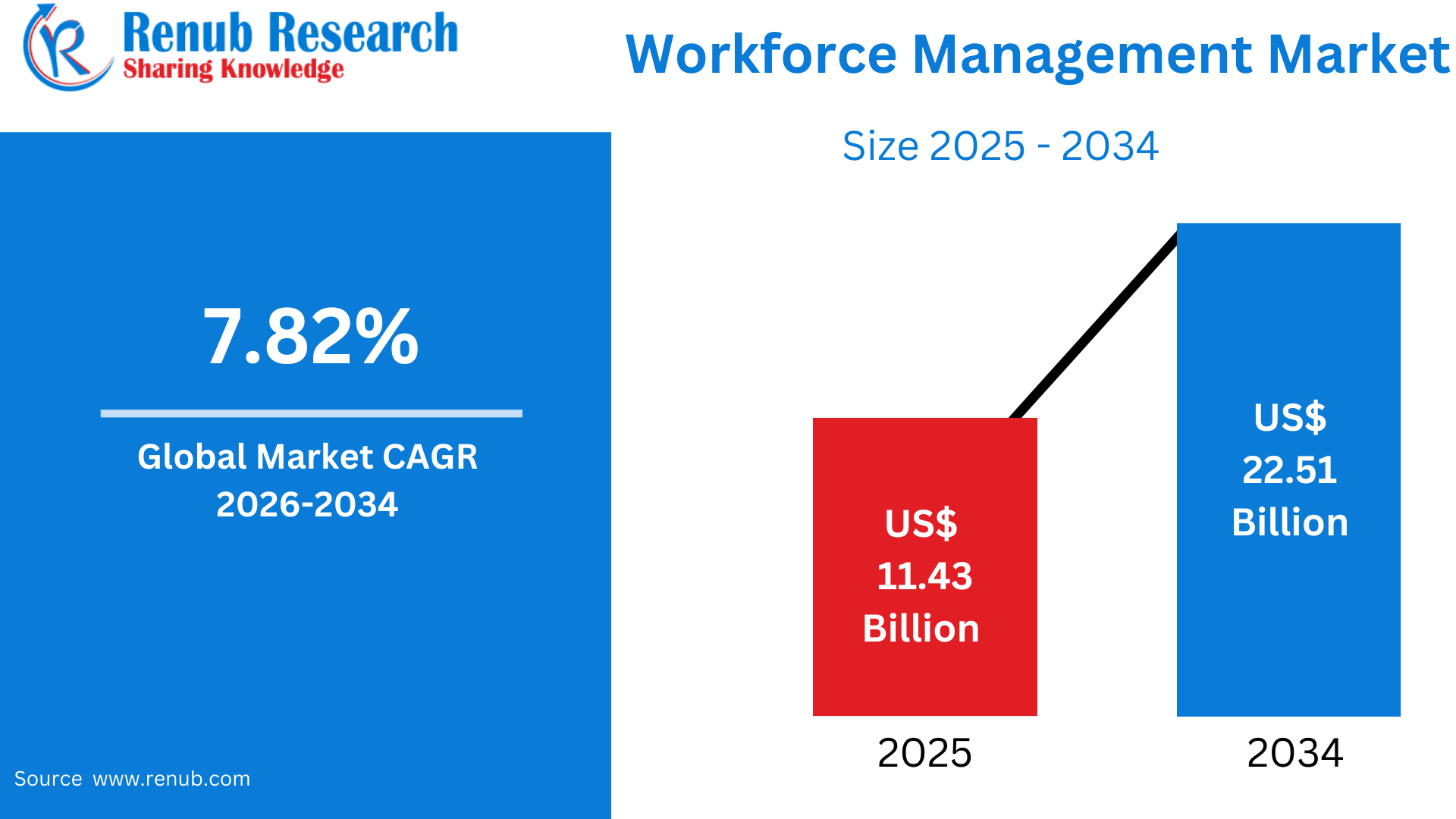
Global workforce management market is projected to expand from US$ 11.43 billion in 2025 to US$ 22.51 billion by 2034, growing at a CAGR of 7.82% during the forecast period from 2026 to 2034. Market growth is being driven by the increasing implementation of digital human resource solutions, rising demand for workforce optimization, the widespread adoption of remote and hybrid work models, and the growing need for organizations to efficiently manage labor expenses, payroll processes, and regulatory compliance.
Workforce Management and its Popularity
Workforce management (WFM) refers to a comprehensive set of processes, technologies, and software solutions that help organizations optimize employee productivity and operational efficiency. It includes essential functions such as employee scheduling, time and attendance tracking, labor forecasting, payroll administration, performance monitoring, and compliance management. Modern workforce management platforms are predominantly cloud-based, enabling organizations to access real-time workforce data, streamline operations, and improve decision-making. By aligning workforce availability with business demand, WFM solutions help organizations reduce labor costs, enhance workforce productivity, and maintain compliance with industry regulations across sectors including retail, healthcare, manufacturing, hospitality, and professional services.
Growing pressure to optimize labor costs while maintaining high-quality service standards is encouraging organizations to invest in advanced workforce analytics, automation, and intelligent scheduling solutions. At the same time, increasingly stringent labor regulations across global markets have made compliance management a critical business priority, further accelerating the adoption of workforce management platforms. As organizations continue to focus on operational agility, data-driven workforce planning, and improved employee engagement, workforce management solutions are becoming an integral component of modern business operations worldwide.
Technology’s importance
- A 2024 study published in the Behavioral Sciences journal found employee satisfaction, influenced by workplace technology, directly impacts employee morale and productivity.
- Ivanti’s 2024 DEX Report, which surveyed 7,800 IT professionals, executives, and office workers globally, highlighted that technology significantly influences employee productivity, satisfaction, and retention.
- 72% of employees consider their digital workplace to be extremely important.
- Technology is critical to employee experience, influencing factors that include employee engagement and burnout.
IT support
- HappySignals employee feedback data shows that 80% of employee lost time with IT incidents results from only 13% of tickets in 2023
- IT Support Services have the most significant positive impact on the overall IT experience. This is shown by the high percentage of positive employee feedback scores in 2023
- Every time an IT ticket is reassigned, end-user happiness decreases by seven points, and end-users lose an average of 1 hour and 46 minutes of work time. When a ticket is reassigned four times, it can mean a total loss of 9 hours and 8 minutes of work time in 2023
Growth Drivers
AI and Automation Driving Workforce Productivity
Artificial intelligence (AI), machine learning (ML), and automation technologies are transforming workforce management by streamlining repetitive administrative processes such as employee scheduling, payroll verification, and exception handling while enabling predictive workforce planning. These technologies reduce manual intervention by delivering actionable insights through demand forecasting, absenteeism prediction, and workforce optimization. AI-powered scheduling aligns staffing levels with anticipated business demand, helping organizations minimize overstaffing, reduce overtime expenses, and prevent understaffing that can negatively impact customer satisfaction. In addition, natural language processing (NLP) and AI-powered virtual assistants simplify employee interactions by facilitating shift swaps, leave requests, and policy-related inquiries. As businesses increasingly prioritize operational efficiency, workforce agility, and measurable return on investment, AI-enabled workforce management platforms are experiencing strong adoption across industries. For example, in September 2025, ADP introduced new AI-powered capabilities through ADP Assist during its Innovation Day event. Integrated into Workforce Now, ADP Global Payroll, and ADP Lyric HCM, these enhancements automate payroll anomaly detection, provide real-time HR insights, strengthen global compliance monitoring, and deliver AI-driven workforce development recommendations, significantly reducing administrative workloads.
Rising Adoption of Mobile Workforce Management and Employee Self-Service
The widespread use of smartphones and increasing employee expectations for intuitive digital workplace experiences have significantly accelerated the adoption of mobile-first workforce management solutions. Mobile applications enable employees to access work schedules, claim available shifts, request leave, exchange shifts with colleagues, and record attendance using location-based or biometric authentication without requiring direct managerial involvement. These self-service capabilities reduce administrative burden, improve scheduling efficiency, and enhance employee satisfaction and workforce engagement. For frontline and hourly employees, mobile platforms facilitate real-time communication by delivering schedule updates, organizational announcements, training materials, and daily task assignments, improving operational responsiveness. From an employer’s perspective, mobile workforce management provides instant visibility into employee attendance and location data, enabling faster operational decision-making. A notable example is the January 2023 collaboration between Accenture and UKG Inc., which supported Ardent Health Services in modernizing workforce management across its network of 30 hospitals and approximately 200 healthcare facilities. The partnership improved workforce visibility, operational flexibility, and employee experience for frontline healthcare professionals.
Increasing Regulatory Requirements and Compliance Needs
The growing complexity of labor regulations, overtime policies, predictive scheduling mandates, paid leave requirements, and shift premium regulations is encouraging organizations to adopt advanced workforce management solutions. Manual workforce administration increases the likelihood of compliance errors, exposing businesses to financial penalties and legal risks. Modern WFM platforms address these challenges by incorporating automated rule-based scheduling, regulatory compliance monitoring, audit trails, and comprehensive reporting capabilities that simplify adherence to evolving labor laws. These capabilities are particularly valuable for multinational organizations and highly regulated industries such as healthcare, transportation, manufacturing, and public services, where workforce compliance is essential. Reflecting this trend, ADP acquired WorkForce Software in October 2024 to strengthen its human capital management portfolio. The acquisition expanded ADP’s capabilities in workforce scheduling, time and attendance management, and payroll automation, enabling the company to deliver more comprehensive workforce management solutions while improving operational efficiency for its global customer base.
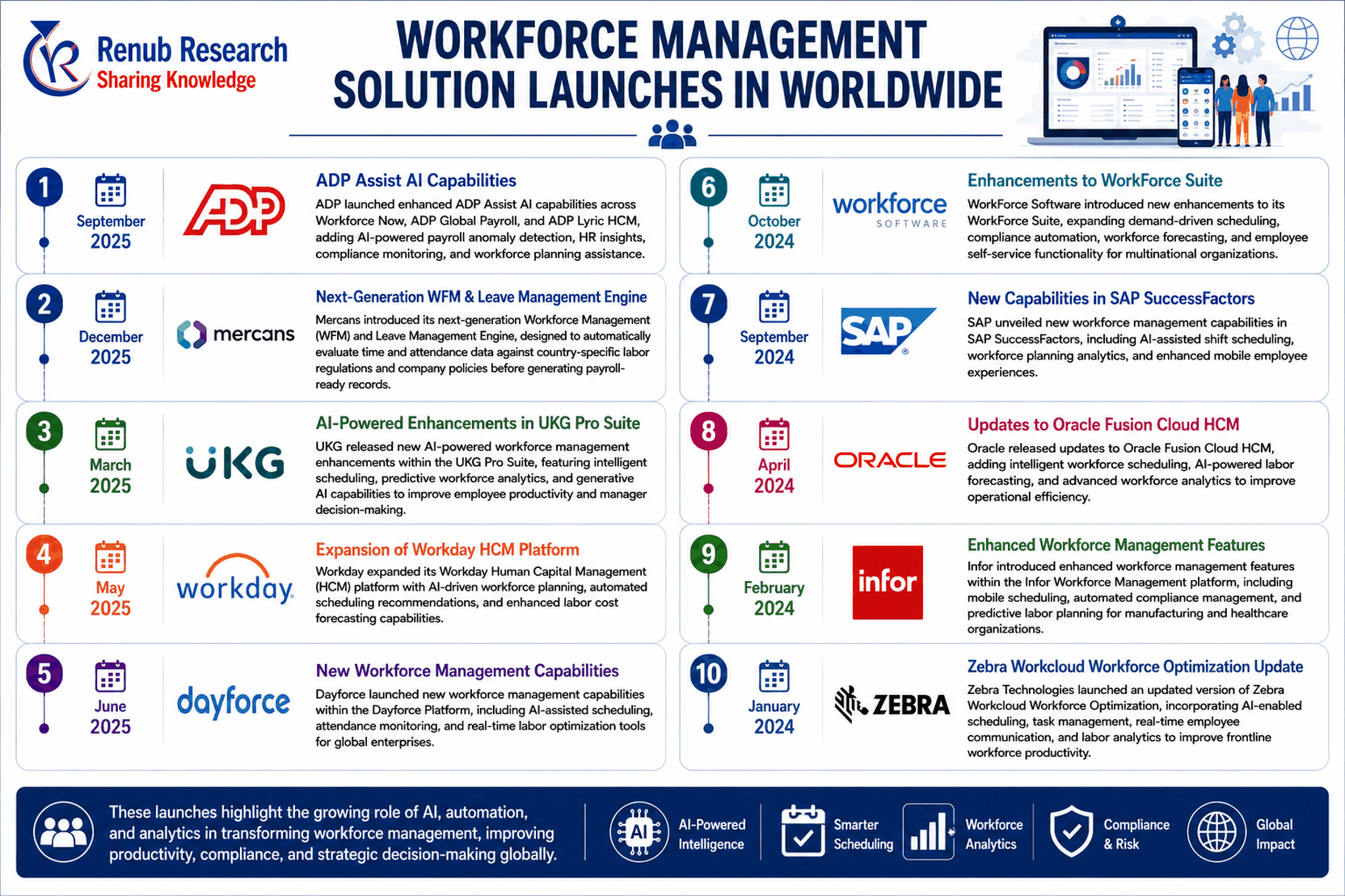
Workforce Management Solution Launches in Worldwide
- September 2025 – ADP launched enhanced ADP Assist AI capabilities across Workforce Now, ADP Global Payroll, and ADP Lyric HCM, adding AI-powered payroll anomaly detection, HR insights, compliance monitoring, and workforce planning assistance.
- December 2025 – Mercans introduced its next-generation Workforce Management (WFM) and Leave Management Engine, designed to automatically evaluate time and attendance data against country-specific labor regulations and company policies before generating payroll-ready records.
- March 2025 – UKG released new AI-powered workforce management enhancements within the UKG Pro Suite, featuring intelligent scheduling, predictive workforce analytics, and generative AI capabilities to improve employee productivity and manager decision-making.
- May 2025 – Workday expanded its Workday Human Capital Management (HCM) platform with AI-driven workforce planning, automated scheduling recommendations, and enhanced labor cost forecasting capabilities.
- June 2025 – Dayforce launched new workforce management capabilities within the Dayforce Platform, including AI-assisted scheduling, attendance monitoring, and real-time labor optimization tools for global enterprises.
- October 2024 – WorkForce Software introduced new enhancements to its WorkForce Suite, expanding demand-driven scheduling, compliance automation, workforce forecasting, and employee self-service functionality for multinational organizations.
- September 2024 – SAP unveiled new workforce management capabilities in SAP SuccessFactors, including AI-assisted shift scheduling, workforce planning analytics, and enhanced mobile employee experiences.
- April 2024 – Oracle released updates to Oracle Fusion Cloud HCM, adding intelligent workforce scheduling, AI-powered labor forecasting, and advanced workforce analytics to improve operational efficiency.
- February 2024 – Infor introduced enhanced workforce management features within the Infor Workforce Management platform, including mobile scheduling, automated compliance management, and predictive labor planning for manufacturing and healthcare organizations.
- January 2024 – Zebra Technologies launched an updated version of Zebra Workcloud Workforce Optimization, incorporating AI-enabled scheduling, task management, real-time employee communication, and labor analytics to improve frontline workforce productivity.
Challenges
Complexity of Integrating Workforce Management with Existing Enterprise Systems
Integrating workforce management platforms with existing human resource, payroll, and enterprise resource planning (ERP) systems remains one of the primary challenges limiting implementation. Many organizations continue to rely on highly customized legacy payroll systems and enterprise applications that require specialized data formats, unique processing schedules, and extensive system customization. Ensuring seamless, two-way integration is essential to prevent payroll errors that can increase operational costs and negatively affect employee trust. Integration projects are further complicated by issues such as inconsistent employee identifiers, data synchronization requirements, time zone differences, and complex payroll rules involving union agreements, shift premiums, overtime calculations, and retroactive compensation. As a result, organizations often face lengthy implementation timelines and higher deployment costs when modernizing workforce management infrastructure.
Employee Resistance and Organizational Change Management Challenges
Successful deployment of workforce management solutions depends not only on technology but also on employee and managerial acceptance. Scheduling practices and time-tracking processes are often deeply embedded within organizational culture, making transitions to automated scheduling, mobile timekeeping, and standardized workforce policies challenging. Employees, particularly hourly workers, may express concerns regarding reduced scheduling flexibility, increased workplace monitoring, or stricter policy enforcement, while managers may hesitate to rely on AI-generated scheduling recommendations instead of traditional planning methods. Without comprehensive change management strategies that include employee training, transparent communication, and stakeholder engagement, organizations may experience lower adoption rates, reduced user satisfaction, and diminished returns on workforce management investments.
Solution Analysis
Workforce Scheduling Management
The workforce scheduling management market focuses on software solutions that optimize employee scheduling by aligning workforce availability, skills, labor regulations, and anticipated business demand. Modern scheduling platforms combine historical operational data, real-time inputs such as point-of-sale (POS) transactions and customer bookings, employee qualifications, and labor compliance requirements to create cost-effective and efficient work schedules. Advanced capabilities, including automated shift templates, open shift marketplaces, rule-based scheduling engines, and predictive scheduling, help organizations reduce administrative effort while ensuring fair and transparent scheduling practices. Many platforms also support scenario planning and labor analytics to prepare organizations for seasonal demand, promotional events, or unexpected disruptions. Increasingly, workforce scheduling solutions emphasize employee preferences and schedule flexibility, particularly for hourly workers, to improve job satisfaction, engagement, and workforce retention.
Workforce Time and Attendance Management
The workforce time and attendance management market encompasses solutions that accurately record employee working hours, monitor attendance, enforce organizational policies, and streamline payroll processing. Traditional punch-clock systems have evolved into advanced digital platforms incorporating geofencing, biometric authentication, self-service kiosks, desktop applications, and mobile time-tracking capabilities with sophisticated fraud detection and exception reporting features. Seamless integration with payroll and human resource management systems ensures accurate, compliant, and auditable payroll processing while reducing administrative complexity. Modern solutions also automate leave management, overtime calculations, and attendance reconciliation. Industries such as manufacturing and healthcare require specialized capabilities to accommodate certification requirements, break regulations, union agreements, and complex shift structures. Cloud-based deployment has further strengthened accessibility, scalability, and real-time workforce visibility across distributed operations.
Component Analysis
Workforce Management Service
The workforce management service market includes consulting, implementation, system integration, configuration, training, and managed services that support the successful deployment and optimization of workforce management platforms. As WFM solutions continue to incorporate increasingly sophisticated capabilities, many organizations rely on specialized service providers to redesign workforce processes, integrate enterprise applications, configure business rules, migrate historical data, and manage ongoing system administration. Managed services extend beyond implementation by offering schedule optimization, exception management, workforce analytics, forecasting improvements, and continuous compliance support. System integrators and consulting firms also provide industry-specific implementation frameworks and change management programs that accelerate deployment and maximize return on investment. These services are particularly valuable for organizations with limited internal IT or HR resources or those operating in highly regulated or unionized environments.
Deployment Analysis
Workforce Management Cloud
Cloud-based workforce management solutions have emerged as the preferred deployment model due to their scalability, flexibility, and lower upfront investment requirements. Software-as-a-Service (SaaS) platforms enable centralized workforce management across geographically dispersed operations while supporting continuous software updates, simplified regulatory compliance, and seamless integration through application programming interfaces (APIs). Cloud deployment allows organizations to rapidly scale operations during seasonal demand fluctuations, support remote and hybrid workforces, and benefit from subscription-based pricing models that appeal to both large enterprises and mid-sized businesses. Multi-tenant cloud architectures accelerate product innovation by allowing vendors to deploy artificial intelligence capabilities, enhanced mobile applications, and cybersecurity updates without requiring customer-side upgrades. Additionally, configurable security controls and hybrid deployment models address concerns related to data residency and system integration while providing organizations with real-time workforce analytics and improved operational responsiveness.
End Use Analysis
Retail Workforce Management
The retail workforce management market addresses the industry’s highly dynamic labor requirements driven by promotional campaigns, holiday shopping seasons, omnichannel fulfillment, and fluctuating customer traffic. Workforce management solutions designed for retailers provide advanced demand forecasting, flexible scheduling options such as split shifts and on-call staffing pools, and workforce redeployment capabilities between physical stores and fulfillment centers. Integration with point-of-sale systems, inventory management platforms, and e-commerce applications enables retailers to optimize labor allocation for both in-store customer service and online order fulfillment. Compliance with labor regulations, youth employment laws, overtime policies, and holiday pay requirements remains a critical feature of retail workforce management solutions. Mobile employee applications further improve operational flexibility by supporting shift swaps, open shift bidding, and real-time schedule updates. The continued expansion of click-and-collect and buy-online-pick-up-in-store (BOPIS) services has increased demand for cross-trained employees and enhanced workforce visibility across retail operations.
Healthcare Workforce Management
The healthcare workforce management market focuses on optimizing staff scheduling while maintaining patient safety, regulatory compliance, and employee well-being. Healthcare organizations require workforce management solutions capable of managing complex scheduling requirements based on professional certifications, departmental expertise, shift duration limits, mandatory rest periods, and specialty coverage. Integration with electronic health record (EHR) systems and temporary staffing platforms enables healthcare providers to efficiently address staffing shortages, manage float pools, and reduce reliance on expensive agency personnel. Advanced demand forecasting models utilize patient admissions, seasonal healthcare trends, and epidemiological data to improve workforce planning and resource allocation. Time and attendance management solutions also support accurate tracking of overtime, on-call compensation, and regulatory compliance. As healthcare organizations increasingly prioritize employee wellness, modern workforce management platforms incorporate workload balancing, fairness analytics, and greater scheduling flexibility to help reduce clinician burnout and improve workforce retention.
Education Workforce Management
The education workforce management market addresses the unique workforce planning challenges faced by schools, colleges, and universities, including complex academic schedules, substitute staffing, part-time faculty management, and seasonal workforce fluctuations. Workforce management solutions support course scheduling, classroom allocation, adjunct faculty availability, and labor budget management while accommodating diverse employment arrangements involving full-time staff, hourly employees, and student workers. K-12 institutions utilize these platforms to manage substitute teachers, transportation staff scheduling, and compliance with collective bargaining agreements and contractual work schedules. Higher education institutions benefit from integrated workforce planning that connects student information systems, learning management platforms, and facility scheduling systems to improve operational efficiency. Additionally, workforce forecasting capabilities help educational institutions effectively manage staffing requirements during enrollment cycles, summer programs, examinations, and other seasonal academic activities.
Countries Analysis
United States Workforce Management
The United States represents one of the world’s most advanced and technologically mature workforce management markets, supported by widespread digital transformation across industries. Organizations in sectors such as retail, healthcare, manufacturing, logistics, and professional services are increasingly implementing advanced workforce management solutions to address labor shortages, rising wage expenses, and evolving federal and state labor regulations. Cloud-based workforce management platforms dominate the market due to their scalability, real-time analytics, and seamless mobile accessibility. Advanced capabilities including AI-powered demand forecasting, predictive scheduling, automated compliance monitoring, and intelligent workforce analytics continue to strengthen market adoption. Organizations are also placing greater emphasis on employee experience by offering mobile self-service applications, flexible scheduling options, and transparent time-tracking systems to improve workforce engagement and retention. Reflecting ongoing innovation, Helios introduced an integrated global workforce management platform in August 2024 that combines global payments and human resource management within a single solution, streamlining employee lifecycle management from onboarding through offboarding for multinational organizations.
United Kingdom Workforce Management
The United Kingdom workforce management market is experiencing steady growth, driven by increasing demand for regulatory compliance, workforce flexibility, and digital human resource transformation. Organizations are adopting workforce management solutions to simplify compliance with working time regulations, paid leave requirements, overtime rules, and data protection standards. Cloud-based platforms have gained significant popularity, particularly among mid-sized businesses seeking cost-efficient and rapidly deployable workforce management solutions. Rising adoption of hybrid work models has further increased demand for intelligent scheduling, attendance tracking, and workforce analytics capabilities. Retail, healthcare, and public sector organizations remain among the largest adopters as they focus on improving service quality while optimizing labor costs. In July 2025, OCS, one of the UK’s largest facilities management companies, implemented Totalmobile’s advanced field service management platform to modernize workforce planning, scheduling, and service delivery across its nationwide operations, supporting broader digital transformation initiatives.
China Workforce Management
China’s workforce management market continues to expand rapidly, supported by large-scale industrial employment and accelerating digital transformation across multiple sectors. Manufacturing, logistics, e-commerce, and service industries increasingly depend on workforce management platforms to efficiently manage extensive shift-based workforces while improving operational productivity. Organizations are investing in solutions that provide real-time attendance monitoring, automated scheduling, workforce analytics, and performance management at enterprise scale. Mobile-first workforce management applications have gained considerable traction due to widespread smartphone adoption and the country’s large frontline workforce. In addition, evolving regional labor regulations, overtime management requirements, and industry-specific compliance standards continue to drive demand for highly configurable workforce management platforms. Demonstrating continued technological innovation, Mercans introduced its next-generation Workforce Management and Leave Management Engine in December 2025, enabling organizations to automatically evaluate employee time and attendance data according to country-specific labor legislation and organizational policies before converting it into payroll-ready transactions.
Brazil Workforce Management
Brazil’s workforce management market is witnessing steady expansion as organizations increasingly modernize human resource operations and improve workforce efficiency through digital technologies. Industries including retail, food and beverage, logistics, customer service, and business process outsourcing are among the major adopters of workforce management solutions. Organizations are gradually replacing traditional paper-based workforce administration with cloud-enabled platforms that improve scheduling, attendance management, payroll accuracy, and workforce visibility. Strict labor regulations and the financial risks associated with non-compliance have become major factors encouraging investment in workforce management software. Mobile self-service capabilities have also become increasingly important by enabling employees, particularly remote and field-based workers, to manage attendance records and work schedules conveniently. Although demand continues to increase, budget limitations and the need for affordable, scalable deployment models remain key challenges for broader market adoption.
Saudi Arabia Workforce Management
Saudi Arabia’s workforce management market is expanding steadily as organizations accelerate digital transformation initiatives aligned with the country’s economic diversification and workforce modernization strategies. Businesses across construction, logistics, tourism, healthcare, government services, and other sectors are implementing advanced workforce management platforms to improve operational efficiency, workforce transparency, and labor productivity. Managing a diverse workforce comprising both domestic and expatriate employees has increased the need for sophisticated scheduling, attendance monitoring, payroll administration, and compliance management capabilities. Cloud-based workforce management solutions are becoming the preferred deployment model because they simplify multi-site workforce administration, improve scalability, and enable centralized operational control. In addition, workforce localization initiatives and evolving labor regulations continue to encourage organizations to adopt systems that support accurate reporting, regulatory compliance, and policy enforcement. Mobile workforce management applications are also gaining widespread acceptance, particularly among organizations employing geographically dispersed field personnel who require real-time communication and workforce visibility.
Market Segmentations
Solution
- Time & Attendance Management
- Workforce Scheduling
- Embedded Analytics
- Absence Management
- Others
Component
- Software
- Services
Deployment
- On-Premises
- Cloud
- Hybrid
End Use
- IT and Telecommunication
- BFSI
- Government
- Retail
- Healthcare
- Education
- Manufacturing
- Others
Countries
North America
- United States
- Canada
Europe
- France
- Germany
- Italy
- Spain
- United Kingdom
- Belgium
- Netherlands
- Turkey
Asia Pacific
- China
- Japan
- India
- South Korea
- Thailand
- Malaysia
- Indonesia
- Australia
- New Zealand
Latin America
- Brazil
- Mexico
- Argentina
Middle East & Africa
- Saudi Arabia
- UAE
- South Africa
All companies have been covered with 5 Viewpoints
- Overviews
- Key Person
- Recent Developments
- SWOT Analysis
- Revenue Analysis
Key Players Analysis
- UKG Inc.
- Oracle Corporation
- ActiveOps PLC
- NICE Ltd.
- Workday Inc.
- Blue Yonder Group, Inc.
- SAP SE
- The Sage Group plc
Report Details:
| Report Features | Details |
| Base Year |
2025 |
| Historical Period |
2022 - 2025 |
| Forecast Period |
2026 - 2034 |
| Market |
US$ Billion |
| Segment Covered |
Solution, Component, Deployment, End Use and Countries |
| Countries Covered |
|
| Companies Covered |
|
| Customization Scope |
20% Free Customization |
| Post-Sale Analyst Support |
1 Year (52 Weeks) |
| Delivery Format |
PDF and Excel through Email (We can also provide the editable version of the report in PPT/Word format on request) |
Customization Services available
- Analysis of Market Size and Its Segments
- More Company Profiles (Upto 10 without any additional cost):
- Additional Countries (Other than mentioned Countries):
- Region/Country Specific Reports:
- Market Entry Strategy:
- Region-Specific Market Dynamics:
- Regional Market Share Analysis:
- Trade Analysis:
- Production Insights:
- Others Customized Requests:
For more information contact our analysts.
Need More Assistance?
- Talk to our analysts to get more precious information on the current market trends.
- Include more countries and segments and customize the report based on the final requirement.
- Get a competitive advantage in your industry by knowing the report findings and making a positive impact on your revenues and operations.
- Our analysts are always ready to provide more help and pertinent information if you need any additional assistance.