Wiring Devices Market 2026–2034: Global Size, Share, Growth Trends, Type, Application & Country Analysis
Buy NowWiring Devices Market Size & Forecast 2026-2034
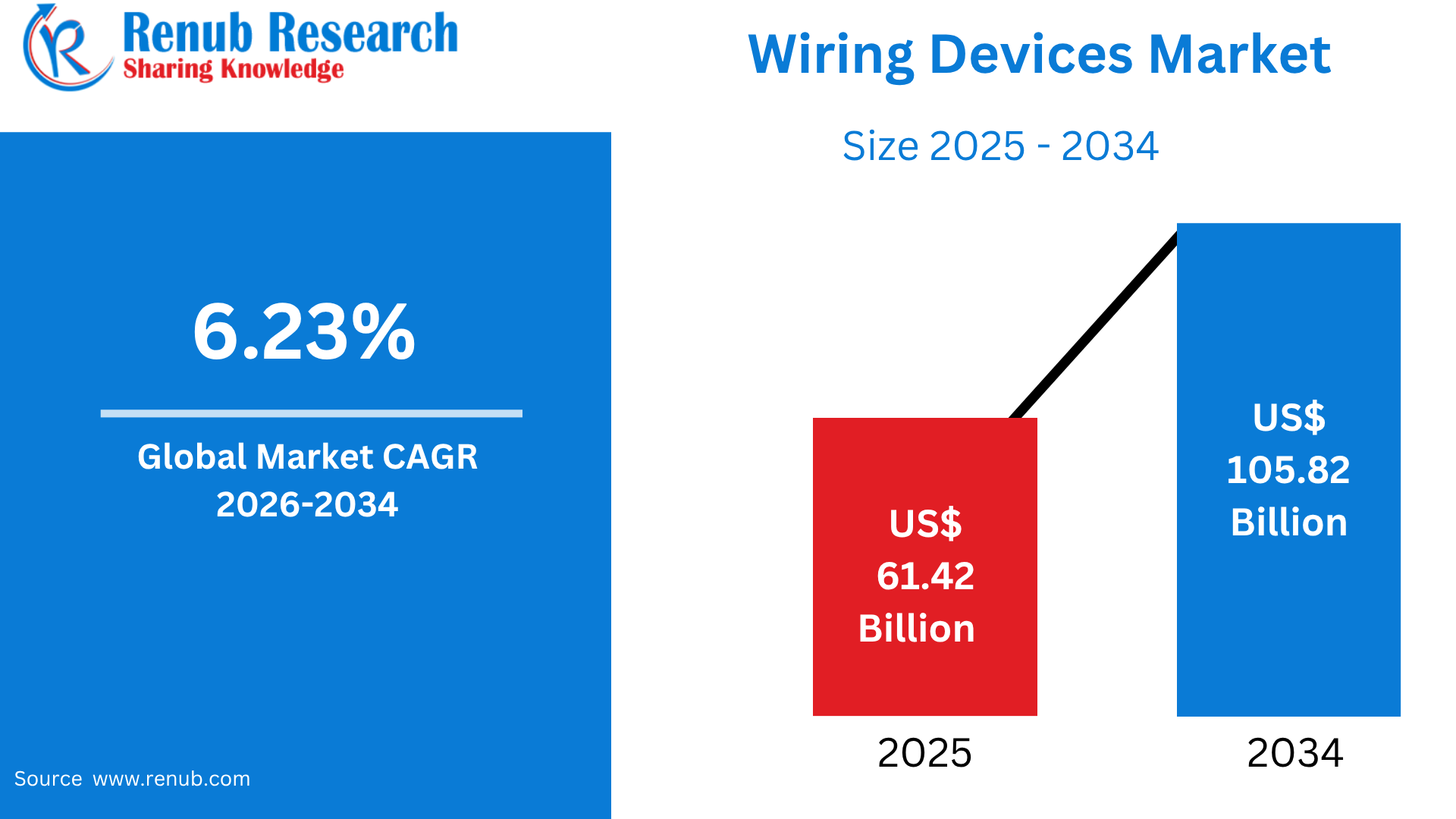
Wiring Devices Market is expected to grow from a value of US$ 61.42 billion in 2025 to US$ 105.82 billion in 2034, registering a compound annual growth rate of 6.23% from 2026 to 2034. This is attributed to factors such as increased construction activities, a rise in smart homes, and increased industrial infrastructure. Furthermore, developments in energy-saving and smart electrical equipment, in addition to urbanization and renovations, are likely to propel the market for wiring devices.
Wiring Devices Market Outlooks
The wiring devices are electrical components designed to control, distribute, and connect electricity in residential, commercial, and industrial environments. The wiring devices include switches, sockets, outlets, plugs, dimmers, circuit breakers, and connectors, among others. The wiring devices are essential in managing electrical components, providing efficient connection, and enhancing convenience. The wiring devices have also been designed with modern technologies to provide more convenience in electrical usage.
The wiring devices have gained popularity worldwide due to rapid urbanization, development in infrastructure, and increasing electricity demand. The development in smart homes with automated electrical components has also contributed to the demand for wiring devices with modern technologies, including digital technologies. The demand for wiring devices with safety, durability, and efficiency has also been on the rise, especially among consumers. The development in industries and commercial sectors has also contributed to the demand for wiring devices, which provide efficient electrical components. Government policies aimed at providing electrical safety and conserving electricity have also contributed to the demand for wiring devices. The wiring devices are becoming more intelligent with the development in technology, making them an essential component in electrical usage worldwide.
Growth Drivers in the Wiring Devices Market
Rapid Urbanization and Infrastructure Development
New constructions require new installations such as switches, sockets, and other electrical components. Renovation and retrofitting activities also contribute to the growth of the wiring devices market. In addition, the expansion of electrical installations in developing regions is driving the growth of basic wiring devices. As urban centers expand and develop, the need for effective electrical installations will always be on the forefront, thus driving the growth of the wiring devices market. Currently, more than half of the world’s population, which translates to over 4 billion people, resides in cities globally. Cities contribute to the creation of 80% of the world’s GDP and are responsible for the creation of 88% of the private sector jobs between 2010 and 2020. In addition, it is expected that by the year 2050, nearly 7 out of every 10 people globally will be residing in cities. Rapid growth in urban populations and large-scale infrastructure development are the major growth drivers for the wiring devices market. An increase in the population in urban areas has resulted in a rise in the need for residential buildings, commercial buildings, and industrial buildings, which in turn has fueled the demand for wiring devices.
Rising Adoption of Smart Homes and Connected Devices
The number of connected IoT devices is expected to rise by 14% in 2025, reaching 39 billion by 2030, and more than 50 billion by 2035. The number of connected IoT devices has reached 18.5 billion in 2024, a rise of 12% over the previous year, 2023. IoT Analytics has been tracking this data. The rise in popularity of smart homes and connected technologies is significantly contributing to the wiring devices market. Smart homes are increasingly becoming a reality, and people are embracing connected technologies. Smart switches, dimmers, and outlets are becoming increasingly popular. These can be connected to smartphones and operated, offering a high degree of convenience, efficiency, and security. They can be integrated with Internet of Things (IoT) platforms, offering a high degree of automation, control, and real-time monitoring of energy consumption. Smart wiring devices are becoming a crucial part of home automation systems. These smart wiring devices are being developed by manufacturers, offering user-friendly and technologically advanced features that cater to the ever-increasing demands of consumers. As more and more people are becoming aware of smart homes and connected technologies, this market is likely to grow significantly.
Increasing Focus on Energy Efficiency and Safety Standards
The increased focus on energy efficiency and electrical safety is another major factor influencing the market for wiring devices. Across the globe, various governments and regulating bodies are enforcing strict guidelines and regulations to ensure the safety of electrical equipment and minimize energy wastage. Wiring devices with improved safety attributes such as surge protection, child safety, and fire-resistant materials are gaining widespread acceptance among consumers. Moreover, energy-saving products such as dimmers and smart outlets assist in reducing energy wastage and minimizing energy bills. Educational initiatives and regulations encouraging the adoption of energy-saving habits are stimulating the market for modern wiring devices. Various industries and commercial entities are using superior-quality wiring devices for operational safety and compliance with regulations. This is another major factor driving the market for wiring devices. July 2024, Applied Materials, Inc. has introduced materials engineering innovations that can enable the performance-per-watt of computer systems to scale to the 2nm logic node and beyond by allowing copper wiring.
Challenges in the Wiring Devices Market
Price Sensitivity and Intense Market Competition
The market for wiring devices also faces challenges in terms of price sensitivity and high competition among wiring device manufacturers. The market comprises a large number of both local and international players offering a range of wiring devices at different price points, resulting in high competition. In price-sensitive markets, the demand for wiring devices with better features at higher prices may not be possible due to the price sensitivity of the market. This might put pressure on the wiring device manufacturers to ensure profitability in terms of the quality of wiring devices offered to the market. The availability of low-cost or unbranded wiring devices in the market might also impact the market environment.
Raw Material Price Fluctuations and Supply Chain Issues
The fluctuations in the prices of raw materials and disruptions in the supply chain are also posing a major challenge to the market for wiring devices. The prices of raw materials such as copper, plastics, and metals are highly volatile. This is a major challenge for manufacturers in this market. In addition to this, disruptions in the global supply chain can also pose a challenge to this market. In this context, manufacturers can find it difficult to maintain their prices and production schedules. Moreover, the dependence of this market on imported materials can also pose a challenge in terms of market fluctuations. In this context, manufacturers can find it difficult to manage such complexities.
Receptacles Wiring Devices Market
The receptacles wiring devices market is one of the basic sectors that is being driven by the fundamental need for electrical connection. Receptacles are also known as power outlets and are used to provide power to various devices. Advanced receptacles with various features such as USB outlets, surge protection, and smart connection are in high demand. People are increasingly looking for outlets that can provide maximum convenience. Moreover, safety standards are also driving this market towards using advanced receptacles that are of top-notch quality and also have child-proof and tamper-resistant features. In addition to this, smart home technology is also contributing to the growth of this market. Advanced receptacles that can be remotely controlled are in demand. Innovation is also expected to contribute to the growth of this market.
Light Dimmer Wiring Devices Market
The market for light dimmer wiring devices is increasing with the growing demand for energy efficiency. The use of light dimmers provides users with an opportunity to set different levels of brightness in lighting, making it suitable for creating an ambience. The segment has witnessed growth in recent years, especially with the addition of smart technology in dimmers. The dimmers can be controlled through mobile apps and voice assistants. The use of dimmers compatible with LED bulbs is also increasing with the growing popularity of LED lighting. The focus on energy conservation is another factor driving the growth of dimmers. The dimmers being developed by companies include advanced features such as touch screens. The growth in demand for customized lighting is expected to take this segment to new heights.
Electric Switches Wiring Devices Market
The market for electric switches and wiring devices is a vital part of the overall electrical infrastructure and is sustained by the persistent demand for such products in all sectors. Electric switches are vital for controlling electrical circuits and are utilized in homes, offices, and industries. This market is changing with the introduction of modern and innovative products in the market, such as safety features and smart switches that can be controlled remotely and automatically. Customers are now preferring products that are not only visually appealing but also technologically advanced and can fit in with the interior decor of homes and offices. Smart switches with home automation systems are gaining popularity in the market and are proving to be beneficial. In addition, the rising construction market is also contributing to the overall demand for new and replacement products in the market.
Residential Wiring Devices Market
The residential wiring devices market is growing rapidly due to various factors like an increase in residential construction activities, urbanization, and rising smart home device adoption. Residential wiring devices like switches, sockets, and dimmers are basic parts of any residential electrical installation. Modern and stylish residential wiring devices are gaining popularity because of homeowners' increasing demand for both functionality and aesthetics. Also, smart residential wiring devices like smart switches and smart sockets are gaining popularity because of their convenience and energy-saving advantages. Government initiatives towards housing construction and electrification activities are also contributing to market growth. Renovation and remodeling activities are also contributing to market growth. Residential safety features like surge protection and child safety are also important factors that influence market growth. This segment is growing rapidly because of rising living standards and smart home device adoption.
Construction Wiring Devices Market
The market for construction wiring devices is influenced by the growth in infrastructure development and building construction across the world. Construction wiring devices are required in new buildings, including residential buildings, commercial buildings, and industrial buildings. The market for wiring devices is closely related to the growth in building construction, which is rising due to factors such as urbanization and development in the economy. Construction companies are using high-quality wiring devices to meet the regulatory requirements. In addition, the use of smart technologies in modern building constructions is also driving the market for wiring devices. Moreover, the development in green buildings is promoting the use of sustainable wiring devices. The market for wiring devices is influenced by both new building constructions and renovation work, in which old wiring devices are replaced by new ones. As the growth in building construction across the world continues, the market for wiring devices is expected to continue to grow.
United States Wiring Devices Market
The market for wiring devices in the United States is quite mature and is growing because of robust demand for such products. This is because the country has highly developed infrastructure and consumes a lot of electricity. Moreover, smart home devices are also contributing to the growth of this market. This is because smart home devices are being increasingly used. In this context, smart home devices include smart switches, smart outlets, smart dimmers, and others. Renovation activities in existing buildings are also contributing to market growth. In addition to this, stringent safety regulations are also contributing to market growth. In this context, stringent safety regulations are acting as drivers for this market. This is because safety regulations are forcing consumers to purchase only high-quality products. January 2024, Honeywell announced its new smart outlets that work with the most popular smart home systems such as Amazon Alexa and Google Home.
United Kingdom Wiring Devices Market
The wiring devices market in the United Kingdom is expanding steadily. The market is being fueled by increasing focus on energy efficiency, safety, and smart building solutions. The need for modern wiring devices is being met by various factors such as residential and commercial building activities, as well as renovations. There is an increasing interest in wiring devices from customers who seek attractive and advanced wiring devices. Smart wiring devices connected to home automation systems are becoming increasingly popular in urban cities. The role played by the government in ensuring electrical safety and energy conservation is crucial in driving market trends. In addition, green buildings and sustainable building activities are promoting energy-efficient wiring solutions. Despite the fact that there is economic uncertainty in the market, it is expanding steadily. The expansion is being fueled by ongoing modernization activities. October 2025, Schneider Electric announces availability in the UK of an industry-leading surge protection device (SPD) - claimed to be the first plug-on SPD designed for direct connection to UK style 'fishbone' distribution boards.
India Wiring Devices Market
The market for wiring devices in India is witnessing rapid growth, mainly due to factors such as urbanization, infrastructure development, and initiatives related to electrification. Government initiatives related to providing more electricity and improving housing conditions are significantly impacting the market for wiring devices. The market is witnessing a strong presence of consumers in the residential sector, mainly due to factors such as increasing construction activities and the adoption of modern technology. Apart from this, factors such as the rise of smart homes are creating a strong demand for connected switches and outlets. Apart from this, factors such as economic development and infrastructure development are creating a strong presence in the commercial and industrial sector. Price is a significant factor that is impacting consumers’ preferences for wiring devices. Despite several challenges, this market has strong potential in terms of a large population, increasing income levels, and a rise in awareness. November 2025, APAR Industries Limited, a leading player in India's electrical equipment market, has announced that it is all set to launch “APAR Shakti” Green Wire, a next-generation wiring device.
Saudi Arabia Wiring Devices Market
The wiring devices market in Saudi Arabia is growing significantly due to high growth in urbanization and infrastructure development. In addition, wiring devices are in high demand due to their need for modernization. The government is investing heavily in infrastructure development and has planned many high-scale infrastructure projects, such as smart cities and business centers. In addition, residential areas are also witnessing growth in Saudi Arabia due to high population growth and improvements in living conditions. People are using high-quality and durable wiring devices that can withstand harsh environmental conditions. Furthermore, smart technologies are being implemented in residential areas, which is driving the wiring devices market. In addition, high investment in infrastructure and economic diversification is benefiting the wiring devices market. However, imports and price factors are affecting the wiring devices market in Saudi Arabia. Nov 2025, Himel, being a globally acclaimed manufacturer and supplier of electrical products, is further strengthening its presence in the premium segment of home electrical products through the global launch of its ALTIVO wiring device series. ALTIVO has successfully launched in Bahrain, UAE, Kenya, Oman, Saudi Arabia, Yemen, Indonesia, and Malaysia since 2024, receiving strong market taction for its modern look, long-lasting quality, and electrical performance, thus further strengthening Himel's presence as a trusted brand for both residential and commercial spaces.
Market Segment
Type
- Eceptacles
- Light Dimmer
- Lamp Holders
- Metal Contacts
- Electric Switches
- Wire Connectors
Application
- Residential
- Construction
- Institutional Occupancies
Countries
North America
- United States
- Canada
Europe
- France
- Germany
- Italy
- Spain
- United Kingdom
- Belgium
- Netherlands
- Turkey
Asia Pacific
- China
- Japan
- India
- Australia
- South Korea
- Thailand
- Malaysia
- Indonesia
- New Zealand
Latin America
- Brazil
- Mexico
- Argentina
Middle East & Africa
- South Africa
- Saudi Arabia
- United Arab Emirates
All companies have been covered with 5 Viewpoints
- Overviews
- Key Person
- Recent Developments
- SWOT Analysis
- Revenue Analysis
Key Players Analysis
- Siemens AG
- ABB Ltd.
- Eaton Corporation
- Panasonic Corporation
- Honeywell International Inc.
- General Electric Company
- Hager Group
- Molex, LLC
- Rockwell Automation, Inc.
- Emerson Electric Co.
Report Details:
| Report Features | Details |
| Base Year |
2025 |
| Historical Period |
2022 - 2025 |
| Forecast Period |
2026 - 2034 |
| Market |
US$ Billion |
| Segment Covered |
Type, Application and Countries |
| Countries Covered |
|
| Companies Covered |
|
| Customization Scope |
20% Free Customization |
| Post-Sale Analyst Support |
1 Year (52 Weeks) |
| Delivery Format |
PDF and Excel through Email (We can also provide the editable version of the report in PPT/Word format on request) |
Customization Services available
- Analysis of Market Size and Its Segments
- More Company Profiles (Upto 10 without any additional cost):
- Additional Countries (Other than mentioned Countries):
- Region/Country Specific Reports:
- Market Entry Strategy:
- Region-Specific Market Dynamics:
- Regional Market Share Analysis:
- Trade Analysis:
- Production Insights:
- Others Customized Requests:
For more information contact our analysts.
Need More Assistance?
- Talk to our analysts to get more precious information on the current market trends.
- Include more countries and segments and customize the report based on the final requirement.
- Get a competitive advantage in your industry by knowing the report findings and making a positive impact on your revenues and operations.
- Our analysts are always ready to provide more help and pertinent information if you need any additional assistance.