Weapons and Ammunition Market Report by Weapon Type, Caliber, Platform, Countries and Company Analysis, 2025–2034
Buy NowWeapons and Ammunition Market Size and Forecast
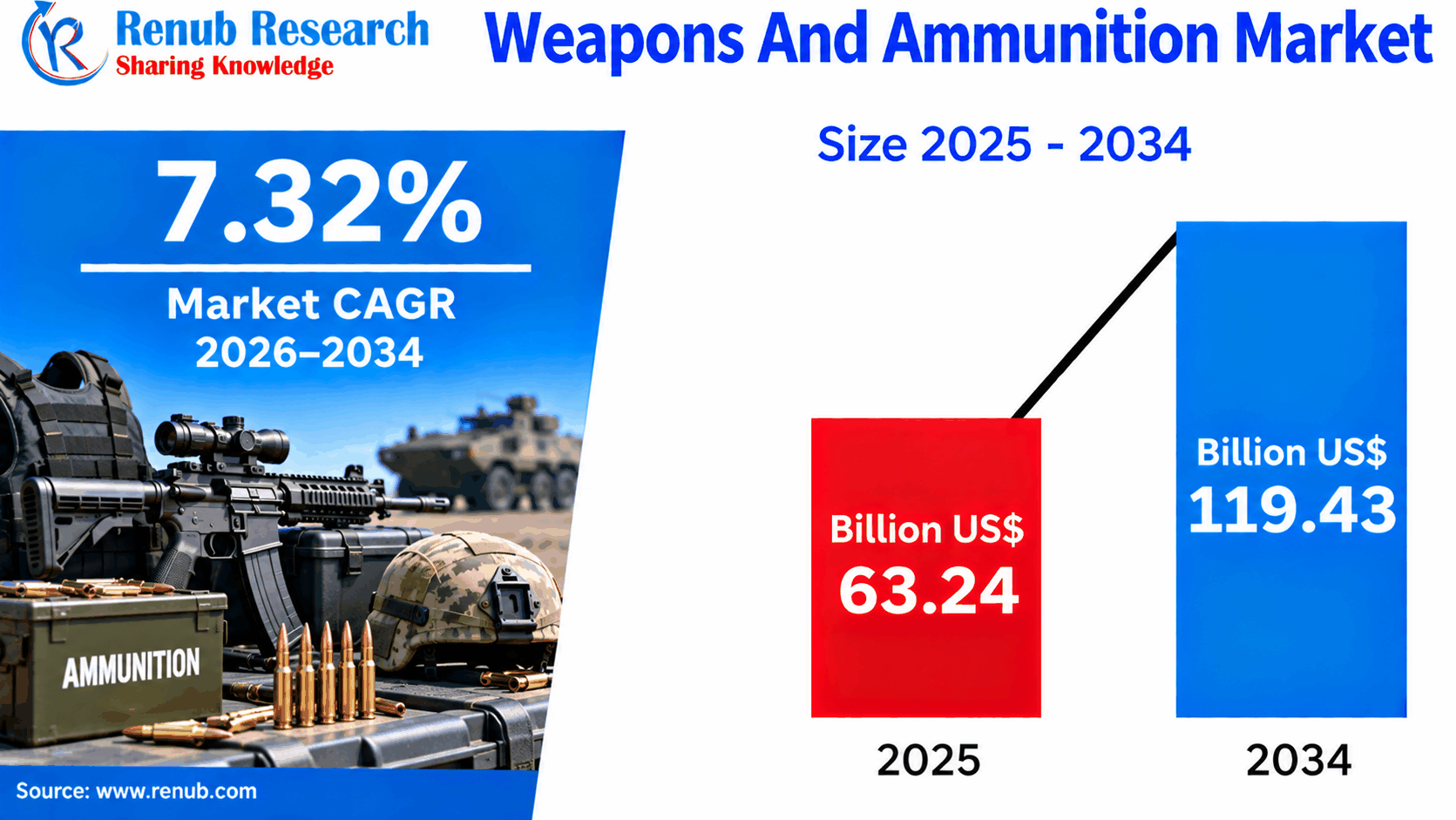
Weapons and Ammunition Market is projected to grow from approximately US$ 63.24 billion in 2025 to US$ 119.43 billion in 2034, registering an estimated CAGR of 7.32% from 2026 to 2034. Growth is supported by rising defense expenditure, geopolitical tensions, military modernization programs, and increasing demand for advanced weapon systems and ammunition. Additionally, investments in domestic manufacturing, stockpile replenishment, and precision-guided technologies are expected to strengthen market expansion worldwide.
What Are Weapons and Ammunition, and What Are Their Uses and Popularity Worldwide?
Weapons and ammunition comprise a broad category of military and defense equipment used by armed forces, law enforcement agencies, and authorized security organizations. Weapons include firearms, artillery systems, missiles, rockets, and other conventional weapon platforms, while ammunition includes bullets, shells, cartridges, and other consumable materials designed for use with compatible weapons. These products support national defense, military readiness, territorial protection, and authorized security operations. Demand is closely linked to geopolitical tensions, armed conflicts, military modernization programs, and government defense budgets.
The global market is influenced by procurement programs, replenishment of military stockpiles, technological advancements, and international arms trade. According to the Stockholm International Peace Research Institute (SIPRI), worldwide military expenditure reached US$2.887 trillion in 2025, increasing by 2.9% in real terms compared with 2024. This increase supports broader defense procurement, although spending also covers personnel, operations, infrastructure, and services rather than weapons and ammunition alone. The market faces strict export controls, licensing requirements, safety regulations, and international humanitarian obligations. As countries strengthen defense capabilities, demand for reliable equipment, compatible ammunition, and secure supply chains remains an important feature of the global defense industry.
Major Wars and Geopolitical Tensions Worldwide
1. Russia–Ukraine War: The war continues to affect European security, military spending, energy markets, and international arms supplies. The risk of wider escalation remains a concern for European countries and NATO.
2. Iran–Israel and United States Tensions: Military confrontation involving Iran, Israel, and the United States remains a major Middle Eastern security concern, with potential consequences for regional stability and global energy supplies.
3. Israel–Gaza Conflict: Despite ceasefire efforts, instability and humanitarian concerns persist in Gaza and the surrounding region. The situation continues to influence diplomatic relations and regional security.
4. Israel–Hezbollah Conflict in Lebanon: Tensions and reported ceasefire violations along the Israel–Lebanon border create risks of renewed fighting and broader regional escalation.
5. Sudan Civil War: Fighting between the Sudanese Armed Forces and the Rapid Support Forces has caused extensive displacement and humanitarian suffering, while raising concerns about instability spreading into neighboring countries.
6. Myanmar Civil War: Conflict involving Myanmar’s military authorities and multiple opposition and ethnic armed groups continues to threaten civilian security and regional stability.
7. Eastern Democratic Republic of the Congo: Fighting involving Congolese forces and M23-linked rebels, alongside regional tensions involving Rwanda, continues to threaten security in eastern Congo and complicate peace negotiations.
8. Yemen and Red Sea Security Crisis: Yemen’s conflict and Houthi-related attacks on shipping remain concerns for maritime security, international trade, and commercial shipping routes connecting Asia, Europe, and the Middle East.
9. India–Pakistan Tensions: Relations between India and Pakistan remain sensitive because of Kashmir, cross-border security concerns, and the risk of renewed military confrontation between two nuclear-armed countries.
10. China–Taiwan Tensions: China’s military pressure on Taiwan and the possibility of a crisis involving the United States and regional partners remain major geopolitical concerns, with potential implications for semiconductor supply chains and international trade.
Growth Drivers of the Weapons and Ammunition Market
Rising Global Military Expenditure and Defense Modernization
Increasing defense budgets are a major driver of the worldwide weapons and ammunition market. Governments invest in modernizing armed forces, replacing aging equipment, maintaining operational readiness, and replenishing inventories. According to SIPRI, global military expenditure reached US$2.887 trillion in 2025, representing a 2.9% real-terms increase over 2024 and the eleventh consecutive year of growth. Military spending increased by 14% in Europe and 8.1% in Asia and Oceania during 2025. These expenditure trends support procurement across multiple defense categories, including conventional weapons, ammunition, artillery, and associated military systems. Modernization programs also encourage governments to replace outdated platforms and improve compatibility with newer equipment. Defense manufacturers may benefit from long-term procurement agreements and domestic production initiatives designed to reduce dependence on foreign suppliers. However, military spending includes salaries, infrastructure, operations, and other expenses, so its growth does not translate directly into equivalent increases in weapons and ammunition sales. The extent of market expansion depends on procurement priorities, delivery schedules, budget allocations, and national defense strategies.
Geopolitical Tensions and the Need to Replenish Defense Stockpiles
Regional conflicts, changing security conditions, and concerns about national sovereignty encourage governments to strengthen defense preparedness. Military organizations require adequate stocks of compatible ammunition and reliable equipment to maintain readiness, support training, and sustain authorized defense operations. The scale of international arms transfers illustrates the changing security environment. SIPRI reported that the volume of major arms transferred between states increased by 9.2% in 2021–2025 compared with 2016–2020. Arms imports by European states more than trebled during the same periods. These developments encourage countries to reassess inventory levels, expand procurement programs, and establish longer-term supply agreements with defense manufacturers. Governments may also invest in domestic manufacturing capacity to improve supply resilience and reduce exposure to international disruptions. In addition, replenishment requirements can create demand for replacement equipment and ammunition after military inventories are drawn down. Nevertheless, actual purchasing patterns vary by country, and international arms-transfer figures measure major conventional weapons rather than the entire ammunition market. Budget availability, production capacity, delivery timelines, and political decisions influence how quickly procurement commitments become realized sales.
Technological Advancements and Expansion of Domestic Manufacturing
Technological modernization and investment in domestic defense production are supporting changes in the weapons and ammunition market. Governments increasingly emphasize equipment reliability, interoperability, production resilience, and the ability to maintain supplies during periods of heightened demand. Manufacturers are investing in advanced materials, digital quality-control systems, automated production processes, and improved inventory management to enhance manufacturing consistency and operational reliability. These developments can help suppliers manage complex procurement requirements and maintain quality standards. International defense trade also reflects the importance of manufacturing capabilities and supplier relationships. SIPRI identified the United States as the largest exporter of major arms in 2021–2025, accounting for 42% of global major-arms exports. This concentration highlights the role of established defense-industrial bases in international supply. Countries seeking greater strategic independence may support local manufacturing, technology partnerships, and industrial capacity expansion. Such initiatives can create opportunities for domestic suppliers while strengthening supply-chain resilience. However, technology transfers, production expansion, and defense-industrial projects often require substantial investment, regulatory approvals, skilled personnel, and lengthy qualification processes before they can generate significant commercial returns.
Challenges of the Weapons and Ammunition Market
Strict Regulatory Frameworks and International Arms Trade Restrictions
The weapons and ammunition market operates under extensive national and international regulations governing manufacturing, licensing, storage, transportation, exports, and imports. Governments must comply with applicable arms-control obligations, export restrictions, sanctions, and end-user verification requirements. These rules are important for preventing unauthorized transfers and reducing the risk of diversion, but they also increase administrative costs and complicate international transactions. SIPRI’s arms-transfer research illustrates the complexity of international trade: its database tracks major conventional arms transfers across countries and over time, reflecting the importance of monitoring suppliers, recipients, and changing trade relationships. Manufacturers and distributors may need to secure multiple approvals before completing cross-border contracts, while regulatory changes can delay deliveries or restrict access to particular markets. Compliance requirements also create additional responsibilities for recordkeeping, supply-chain transparency, and customer verification. Smaller manufacturers may find these obligations especially costly because they have fewer resources for dedicated legal and compliance teams. Consequently, regulatory uncertainty and lengthy approval processes can affect market entry, contract execution, and revenue timing, even when underlying defense demand remains strong.
High Manufacturing Costs and Supply-Chain Constraints
Weapons and ammunition manufacturing requires specialized equipment, trained personnel, rigorous quality assurance, secure facilities, and reliable supplies of raw materials and components. Expanding production capacity can therefore require substantial capital investment and considerable lead times. Manufacturers may also face shortages of skilled workers, fluctuating input costs, supplier concentration, and competition for industrial capacity from other defense programs. These pressures can delay contracts and increase the cost of fulfilling government procurement commitments. The challenge becomes more significant when several countries seek to replenish inventories or expand defense production at the same time. SIPRI reported that global military expenditure reached US$2.887 trillion in 2025, while international transfers of major arms increased by 9.2% between 2021–2025 and 2016–2020. These figures indicate a substantial defense environment, but they do not mean manufacturing capacity can expand immediately. Production facilities require investment, regulatory compliance, qualified suppliers, and dependable procurement forecasts. Manufacturers must balance capacity expansion against the risk of uneven future demand. Supply-chain disruptions, cost inflation, and delayed deliveries can reduce profitability and make it difficult for governments to receive equipment according to planned schedules.
Weapons and Ammunition Launches Worldwide
1. THUNDART Artillery Rocket System – France (2026): MBDA and Safran Electronics & Defense conducted the first firing of THUNDART ammunition on April 14, 2026. The demonstration validated key design and propulsion choices for a next-generation artillery rocket system.
2. Red Kite Precision Weapon – United Kingdom (2026): Raytheon UK introduced Red Kite at the Farnborough International Airshow on July 21, 2026. The digitally engineered precision weapon is designed to support scalable production and strengthen the UK’s sovereign defense capabilities.
3. LOCUST X3 Directed-Energy Weapon – United States (2026): AeroVironment introduced the third-generation LOCUST X3 high-energy laser system in March 2026. The system is designed to counter unmanned aerial threats using a modular, mobile directed-energy platform.
4. CROSSBOW Heavy One-Way Effector – Europe (2025): MBDA unveiled CROSSBOW at the DSEI defense exhibition in September 2025. The vehicle-launched system was presented as a long-range, heavy-payload strike capability, with production at scale targeted for 2026.
5. Rheinmetall L60 155 mm Gun System – Germany (2026): Rheinmetall unveiled its L60 artillery gun system at Eurosatory in June 2026. The company projects approximately 30% greater range than conventional L52 artillery guns; initial live-fire demonstrations were planned for 2026.
6. Drone Killer Cartridge – United States (2026): The U.S. Naval Surface Warfare Center, Crane Division, announced a new ammunition family in February 2026 designed to improve small-arms effectiveness against drones while reducing collateral damage.
7. SCEPTRE 155 mm Ramjet Munition – United Kingdom (2025): Tiberius Aerospace announced SCEPTRE in May 2025. The company describes it as a ramjet-powered, extended-range precision-guided artillery munition intended to expand the capabilities of conventional artillery platforms.
8. GRIZZLY Containerized Launcher – United States (2026): Lockheed Martin completed live-fire tests of its GRIZZLY containerized launcher in March 2026, including an integrated HELLFIRE missile test. The system is designed to provide a mobile, container-based missile-launch capability.
9. FN M3M Endurance Weapon System – Belgium (2026): FN Herstal announced the FN M3M Endurance in October 2026, highlighting improvements intended to extend the service life of its .50-caliber pintle-mounted weapon system and reduce maintenance requirements.
10. SPEAR Miniature Cruise Missile – Europe (2026): MBDA reported in July 2026 that manufacturing of its SPEAR air-launched precision weapon had begun under a low-rate initial production program. Initial operational deliveries were expected in early 2027.
United States High Defense Expenditure and Military Procurement
The United States is the world’s largest military spender, supporting substantial demand for weapons, ammunition, and advanced defense systems. According to the Stockholm International Peace Research Institute (SIPRI), U.S. military expenditure reached US$954 billion in 2025, accounting for approximately 33% of global military spending. Although expenditure declined by 7.5% in real terms compared with 2024, the country continues to maintain a substantial defense-industrial base. The U.S. defense industry benefits from established manufacturers, research institutions, and government procurement programs. Investments in precision-guided systems, next-generation military platforms, and advanced manufacturing support continued modernization. Defense contractors also supply major weapons systems to international partners under government-approved export arrangements. Military readiness and stockpile replenishment remain important procurement priorities. Government initiatives to strengthen domestic production capacity can create opportunities for ammunition manufacturers and defense suppliers. However, strict export controls, procurement costs, production lead times, and regulatory requirements influence market development.
United Kingdom Defense Spending and Modernization Programs
The United Kingdom maintains an established defense industry supported by government procurement, military modernization, and international partnerships. According to SIPRI, British military expenditure reached approximately US$89 billion in 2025, making the country the world’s sixth-largest military spender that year. Spending declined by 2.0% in real terms compared with 2024. The UK defense sector includes companies involved in military equipment, weapons systems, and ammunition-related technologies. Investment in advanced engineering, digital targeting, and precision systems supports the development of next-generation capabilities. Collaboration with NATO allies also encourages interoperability and participation in international defense programs. The UK government’s defense investment plans aim to strengthen military readiness and industrial capabilities. The House of Commons Library reported that defense spending was £62.0 billion in fiscal year 2025/26, with plans projecting £79.1 billion by 2029/30. Nevertheless, manufacturing costs, skilled-labor availability, regulatory requirements, and procurement schedules can affect the pace of market expansion.
ChinaRising Military Expenditure and Modernization
China is a major global defense market, supported by sustained military investment and domestic manufacturing capabilities. SIPRI estimated China’s military expenditure at US$336 billion in 2025, an increase of 7.4% in real terms from 2024. This represented approximately 12% of global military expenditure. China’s defense industry emphasizes domestic production and the development of advanced military equipment. State-backed industrial capabilities support the manufacture of conventional weapons, ammunition, and broader military systems. Research into automation, advanced materials, and precision technologies also contributes to modernization across land, air, and naval forces. Continued military modernization supports demand for equipment upgrades, replacement inventories, and manufacturing capacity. However, defense procurement faces challenges involving quality assurance, transparency, export restrictions, and international trade controls. Maintaining technological competitiveness also requires substantial research funding and specialized engineering expertise. These factors will influence how effectively China converts defense investment into sustainable industrial growth.
United Arab Emirates Defense Investment and National Security Priorities
United Arab Emirates maintains a significant focus on defense readiness, military modernization, and national security. Its strategic location and regional security requirements support demand for defense equipment and ammunition. Government procurement priorities include maintaining military capabilities and developing partnerships with international defense suppliers. The UAE is seeking to expand its domestic defense-industrial base through local manufacturing, research, and international cooperation. EDGE Group, established in 2019, brings together defense and advanced-technology businesses operating across areas that include weapons, munitions, and defense systems. These capabilities support the country’s objective of strengthening local production and reducing dependence on imported equipment. Investment in advanced defense technologies and local industrial capabilities may create opportunities for manufacturers and suppliers. International defense exhibitions and partnerships also provide avenues for collaboration and technology transfer. However, the market remains influenced by procurement cycles, import requirements, export-control rules, and the costs of developing specialized production facilities. Continued investment in workforce development, manufacturing quality, and regulatory compliance will be important to the UAE’s long-term defense-industrial growth.
Market Segmentations
Weapon Type
- Small Arms
- Rifles
- Machine Guns
- Portable Explosives
- Other
Caliber
- Small Caliber
- Medium Caliber
- Large Caliber
Platform
- Aerial
- Terrestrial
- Naval
Regional Outlook
North America
- United States
- Canada
Europe
- France
- Germany
- Italy
- Spain
- United Kingdom
- Belgium
- Netherlands
- Turkey
Asia Pacific
- China
- Japan
- India
- South Korea
- Thailand
- Malaysia
- Indonesia
- Australia
- New Zealand
Latin America
- Brazil
- Mexico
- Argentina
Middle East & Africa
- Saudi Arabia
- United Arab Emirates
- South Africa
All the Key players have been covered
- Overviews
- Key Person
- Recent Developments
- SWOT Analysis
- Revenue Analysis
Company Analysis:
- General Dynamics Corporation
- BAE Systems PLC
- Colt’s Manufacturing Company LLC
- Kalashnikov Concern JSC
- MBDA
- Nammo AS
- Denel SOC Ltd
- Diehl Stiftung & Co. KG
- FN Herstal
- Heckler & Koch GmbH
Report Details:
| Report Features | Details |
| Base Year |
2024 |
| Historical Period |
2021 - 2024 |
| Forecast Period |
2025 - 2033 |
| Market |
US$ Billion |
| Segment Covered |
By Type, By Product, By End Use and By Countries |
| Countries Covered |
|
| Companies Covered |
|
| Customization Scope |
20% Free Customization |
| Post-Sale Analyst Support |
1 Year (52 Weeks) |
| Delivery Format |
PDF and Excel through Email (We can also provide the editable version of the report in PPT/Word format on request) |
Customization Services available
- Analysis of Market Size and Its Segments
- More Company Profiles (Upto 10 without any additional cost):
- Additional Countries (Other than mentioned Countries):
- Region/Country Specific Reports:
- Market Entry Strategy:
- Region-Specific Market Dynamics:
- Regional Market Share Analysis:
- Trade Analysis:
- Production Insights:
- Others Customized Requests:
For more information contact our analysts.
Need More Assistance?
- Talk to our analysts to get more precious information on the current market trends.
- Include more countries and segments and customize the report based on the final requirement.
- Get a competitive advantage in your industry by knowing the report findings and making a positive impact on your revenues and operations.
- Our analysts are always ready to provide more help and pertinent information if you need any additional assistance.