United States Watch Market Report by Type, Gender, Price Range, Distribution Channel, Top States and Company Analysis 2026-2034
Buy NowUnited States Watch Market Size & Forecast
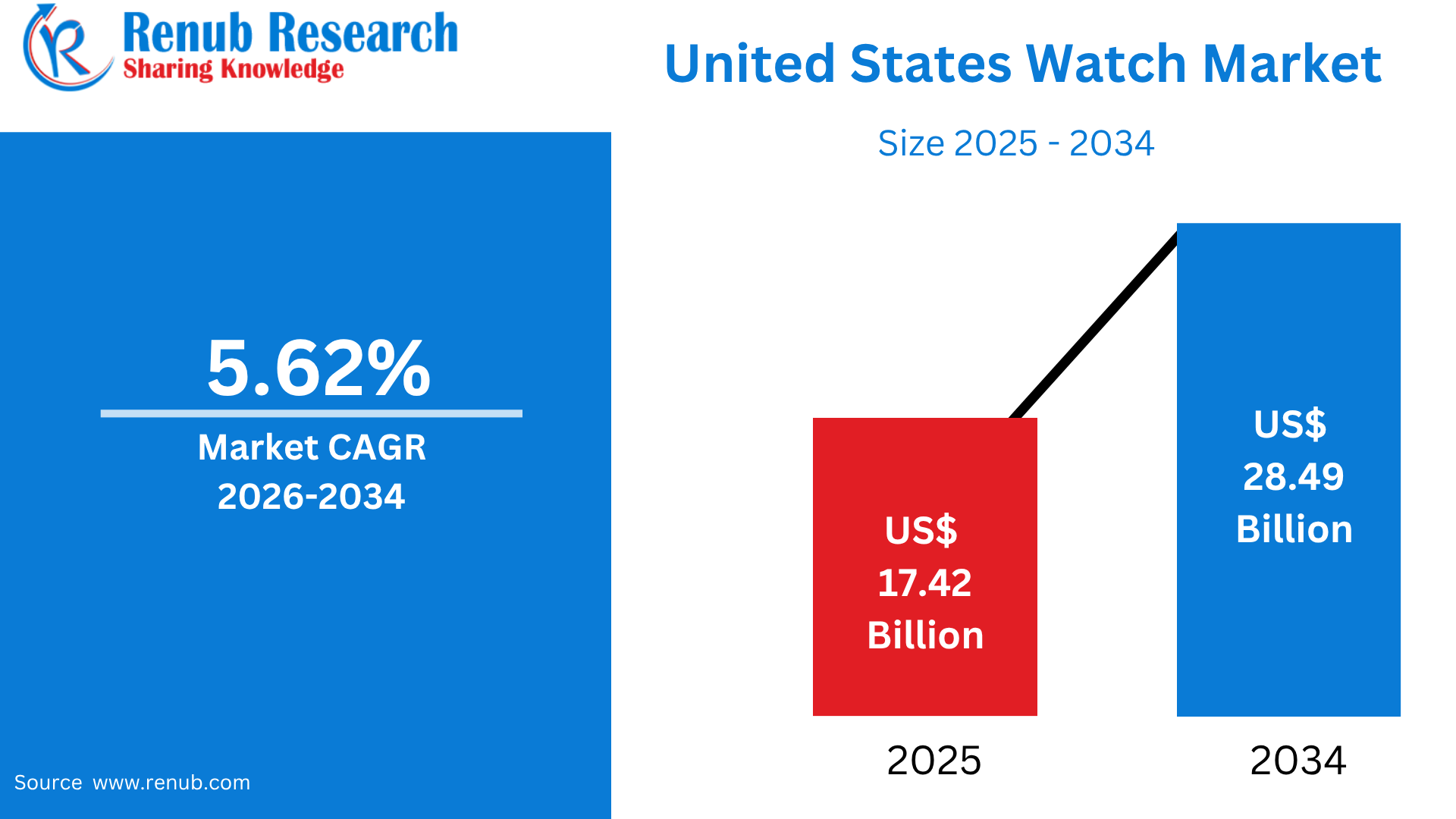
United States Watch Market is projected to grow from US$ 17.42 billion in 2025 to US$ 28.49 billion by 2034, registering a CAGR of 5.62% during 2026–2034. Market growth is driven by increasing consumer demand for luxury timepieces, premium smartwatches, and fashion-oriented watches, supported by rising disposable incomes and evolving lifestyle preferences. Technological advancements in wearable devices, including health monitoring, fitness tracking, and smartphone connectivity, are accelerating smartwatch adoption.
What is a Watch and Its Uses & Popularity in the United States
A watch is a portable timekeeping device worn on the wrist or carried as a personal accessory that displays the time and often includes additional functions such as date, alarms, GPS navigation, fitness tracking, heart rate monitoring, sleep analysis, and mobile connectivity. Watches are broadly categorized into analog, digital, luxury mechanical, quartz, hybrid, and smartwatches, catering to diverse consumer preferences and lifestyles. In the United States, watches serve not only as practical tools for time management but also as fashion statements, status symbols, and health-monitoring devices. The growing adoption of wearable technology has significantly increased the popularity of smartwatches, particularly among fitness enthusiasts and working professionals. According to industry estimates, over one-third of U.S. adults use wearable devices, with smartwatches accounting for the largest share of the market. Meanwhile, luxury watches continue to attract affluent consumers due to their craftsmanship, heritage, and investment value. The expansion of e-commerce, premium retail stores, and direct-to-consumer brands has further enhanced product accessibility. Rising disposable incomes, technological innovation, and increasing consumer interest in connected lifestyles continue to strengthen the popularity of watches across the United States, making them an essential component of both personal style and everyday functionality.
United States Annual Household Income per Capita (USD): 2020–2024
- 2020: Annual household income per capita stood at USD 33,740.8.
- 2021: Income increased to USD 36,430.0, reflecting a 7.97% year-on-year growth.
- 2022: Per capita income reached USD 39,167.9, marking a 7.52% increase from 2021.
- 2023: Income further rose to USD 40,722.0, representing a 3.97% annual growth.
- 2024: Annual household income per capita climbed to USD 43,419.6, the highest level during the five-year period, with a 6.63% year-on-year increase.
- Overall Growth (2020–2024): Household income per capita increased by approximately 28.7%, rising from USD 33.7 thousand to USD 43.4 thousand.
- Market Insight: Rising household income has strengthened consumer purchasing power, supporting higher spending on discretionary products such as luxury watches, smartwatches, fashion accessories, electronics, and premium lifestyle goods.
- Consumer Trend: Higher disposable incomes have accelerated demand for premium and technologically advanced wearable devices across the United States.
Source: CEIC Data – Annual Household Income per Capita, United States (2020–2024).
Growth Driver
Rising Demand for Smartwatches and Wearable Technology
The increasing adoption of smartwatches has become one of the strongest growth drivers for the United States watch market. Consumers are increasingly purchasing smartwatches that combine traditional timekeeping with advanced digital features such as heart rate monitoring, ECG, blood oxygen measurement, sleep tracking, GPS navigation, mobile payments, and smartphone connectivity. Industry estimates indicate that over one-third of U.S. adults use wearable devices, with smartwatches representing the largest product category. The country’s smartphone penetration exceeds 90%, enabling seamless integration between mobile devices and wearable technology. Growing awareness of preventive healthcare and fitness tracking has encouraged consumers to replace conventional watches with connected devices. Manufacturers continue introducing AI-enabled health monitoring, longer battery life, LTE connectivity, and personalized wellness applications to attract new buyers. In addition, enterprise adoption for productivity, contactless payments, and emergency communication further supports demand. Continuous technological innovation and strong consumer preference for multifunctional wearable devices are expected to remain major contributors to the long-term expansion of the U.S. watch market.
Strong Luxury Watch Demand and Rising Disposable Income
United States remains one of the world’s largest luxury watch markets, supported by high disposable incomes, affluent consumers, and increasing spending on premium lifestyle products. The U.S. recorded a GDP exceeding US$29 trillion in 2025, while household spending on discretionary luxury goods continues to increase steadily. Luxury watches are increasingly viewed as symbols of status, craftsmanship, exclusivity, and long-term investment value rather than simple timekeeping devices. Swiss-made mechanical watches, limited-edition collections, and heritage brands continue attracting high-net-worth individuals and collectors. Millennials and Generation Z consumers are also entering the luxury segment through premium entry-level collections and certified pre-owned watches. Growth in luxury retail boutiques, airport duty-free stores, and online luxury marketplaces has further improved accessibility. Collaborations with celebrities, athletes, and fashion designers have enhanced brand visibility and consumer engagement. As disposable income and premium spending continue to rise, luxury watches are expected to remain a significant growth engine for the United States watch industry.
Expanding E-commerce and Fashion-Driven Consumer Preferences
The rapid growth of e-commerce has transformed the distribution landscape for watches across the United States. Online retail now accounts for a substantial share of watch sales, providing consumers with access to thousands of brands, competitive pricing, personalized recommendations, and convenient home delivery. The U.S. has over 270 million online shoppers, while digital payment adoption and omnichannel retail strategies continue improving customer experiences. Fashion trends have also increased demand for designer watches, minimalist styles, sustainable materials, and customizable products that complement personal style. Younger consumers increasingly purchase multiple watches for different occasions, including business, sports, casual wear, and formal events. Social media marketing, influencer collaborations, and celebrity endorsements significantly influence purchasing decisions. Direct-to-consumer brands continue introducing affordable premium watches through digital platforms, reducing reliance on traditional retail channels. Continuous product innovation, improved online accessibility, and changing fashion preferences are expected to support sustained growth across both traditional and smart watch segments in the U.S. market.
Challenge
Intense Competition from Smartphones and Alternative Wearable Devices
One of the major challenges facing the United States watch market is the increasing reliance on smartphones and multifunctional wearable devices for timekeeping and communication. Modern smartphones provide accurate time displays, alarms, calendars, navigation, payment systems, and health applications, reducing the necessity for traditional watches among many consumers. Additionally, smart rings, fitness bands, and other wearable technologies offer health monitoring capabilities at competitive prices, increasing competition within the wearable ecosystem. Budget-conscious consumers often prioritize multifunctional electronic devices over conventional wristwatches. Traditional analog watch manufacturers also face pressure to integrate digital technologies while maintaining their heritage and craftsmanship. Rapid technological advancements shorten product replacement cycles for smartwatches, requiring manufacturers to invest continuously in research and development. As consumer preferences increasingly shift toward connected ecosystems, conventional watch brands must differentiate themselves through luxury positioning, craftsmanship, design innovation, and premium customer experiences to remain competitive.
Supply Chain Volatility and Rising Manufacturing Costs
U.S. watch industry continues to face challenges from global supply chain disruptions, rising manufacturing expenses, and fluctuating raw material prices. Many premium watch brands depend on imported movements, electronic components, stainless steel, titanium, precious metals, sapphire crystals, batteries, and semiconductors sourced from Europe and Asia. Transportation costs, geopolitical uncertainties, trade regulations, and component shortages can delay production and increase overall manufacturing expenses. Inflationary pressures have also increased labor, logistics, packaging, and retail operating costs, reducing profit margins for manufacturers and distributors. Luxury watch brands face additional challenges in maintaining exclusivity while balancing inventory levels and growing consumer demand. Smaller independent brands often experience greater financial pressure due to limited purchasing power and lower economies of scale. Furthermore, exchange rate fluctuations affect import pricing and retail competitiveness. Managing supply chain resilience, controlling production costs, and maintaining consistent product availability remain critical challenges for the long-term growth of the United States watch market.
Major Watch Product Launches in the United States
- September 2025 – Apple launched the Apple Watch Series 11, featuring an upgraded S11 chip, enhanced AI-powered health monitoring, longer battery life, and improved fitness tracking capabilities.
- September 2025 – Apple introduced the Apple Watch Ultra 3, designed for outdoor enthusiasts with satellite connectivity, advanced GPS, improved dive features, and extended battery performance.
- August 2025 – Google unveiled the Pixel Watch 4, offering Wear OS enhancements, improved health sensors, AI-powered fitness coaching, and tighter integration with Android devices.
- July 2025 – Samsung launched the Galaxy Watch8 Series, featuring upgraded BioActive sensors, enhanced sleep coaching, cardiovascular monitoring, and Galaxy AI-powered wellness features.
- June 2025 – Garmin introduced the Forerunner 970, a premium GPS running smartwatch with advanced training metrics, ECG support, and AMOLED display technology.
- May 2025 – Garmin launched the Venu X1, featuring a large AMOLED display, advanced health monitoring, smart notifications, and multi-sport tracking for active consumers.
- April 2025 – Casio G-SHOCK released the MTG-B4000, combining carbon-fiber construction, solar charging, Bluetooth connectivity, and enhanced shock resistance.
- March 2025 – Citizen expanded its Eco-Drive collection with the Series8 831 Mechanical Watch, featuring automatic movement, anti-magnetic technology, and premium stainless-steel construction.
- January 2025 – Timex launched the Q Timex 1975 Enigma Reissue, blending vintage-inspired styling with modern quartz movement and upgraded durability for heritage watch enthusiasts.
- October 2024 – Rolex expanded its luxury portfolio with the Oyster Perpetual Day-Date 40 featuring a new dial design, refined movement technology, and precious metal case options for the premium U.S. luxury watch market.
Smart Wearables and Digital Innovation Fueling the United States Watch
United States Electronic Watch Market is experiencing robust growth, driven by rising consumer demand for smartwatches, digital watches, and connected wearable devices. Electronic watches now account for a significant share of U.S. wearable technology sales, supported by smartphone penetration exceeding 90% and increasing adoption of digital health monitoring. Features such as heart rate tracking, ECG monitoring, blood oxygen measurement, GPS navigation, contactless payments, sleep tracking, and smartphone notifications have transformed electronic watches into multifunctional lifestyle devices. Growing health awareness and fitness participation have further accelerated smartwatch adoption across all age groups, particularly among millennials and Generation Z consumers. Manufacturers continue introducing AI-powered wellness features, longer battery life, and improved software ecosystems to enhance user experience. E-commerce platforms, electronics retailers, mobile carriers, and branded stores remain the primary distribution channels. Continuous innovation in wearable technology, expanding digital ecosystems, and rising consumer preference for connected lifestyles are expected to sustain strong long-term growth in the U.S. electronic watch market.
Premium Craftsmanship and Heritage Supporting United States Mechanical Watch Demand
United States Mechanical Watch Market maintains steady growth despite increasing competition from smartwatches, driven by consumer appreciation for precision engineering, luxury craftsmanship, and heritage watchmaking. Mechanical watches, powered by manual or automatic movements without batteries, remain highly desirable among collectors, professionals, and affluent consumers. The United States represents one of the world’s largest luxury watch markets, where premium Swiss and Japanese mechanical brands continue to enjoy strong demand. Limited-edition collections, handcrafted movements, and high-quality materials such as sapphire crystal, titanium, and precious metals enhance product exclusivity and long-term investment value. High-income consumers increasingly purchase mechanical watches as collectible assets and symbols of personal achievement. Luxury boutiques, authorized dealers, specialty retailers, and certified online marketplaces continue expanding product accessibility. As interest in timeless craftsmanship, sustainability, and premium lifestyle products grows, mechanical watches are expected to maintain a stable and profitable niche within the broader U.S. watch industry.
Fashion, Technology, and Lifestyle Driving Consumer Demand in the United States
United States Men’s Watch Market continues to expand as watches increasingly serve both functional and fashion purposes. Men’s watches range from affordable casual timepieces to premium luxury watches, sports watches, diving watches, and technologically advanced smartwatches that cater to diverse consumer preferences. Rising disposable incomes and evolving fashion trends have encouraged consumers to own multiple watches for business, sports, travel, and formal occasions. Smartwatches have gained remarkable popularity among men due to features including fitness tracking, GPS, smartphone connectivity, and health monitoring. Meanwhile, analog and mechanical watches continue to perform strongly in professional and luxury segments because of their timeless design and prestige. Manufacturers are investing in innovative materials, customizable straps, durable construction, and sustainable production methods to attract modern consumers. Celebrity endorsements, sports sponsorships, and influencer marketing continue strengthening brand awareness. Growing interest in premium accessories and wearable technology is expected to drive steady growth across the U.S. men’s watch market.
Premium Timepieces and Investment Demand Strengthening Luxury Watch Growth in United States
United States Luxury Watch Market is witnessing sustained expansion, supported by increasing disposable incomes, growing wealth among high-net-worth individuals, and rising consumer preference for premium lifestyle products. Luxury watches are widely recognized as symbols of prestige, craftsmanship, exclusivity, and long-term investment value. The United States remains one of the largest global markets for Swiss luxury watches, with strong demand for limited-edition collections, heritage brands, and high-complication mechanical timepieces. Consumers increasingly purchase luxury watches as collectible assets that often retain or appreciate in value over time. Premium materials such as gold, platinum, titanium, ceramics, and diamonds further enhance product appeal. Brand collaborations, celebrity ambassadors, digital marketing campaigns, and exclusive product launches continue strengthening consumer engagement. Luxury boutiques, department stores, and online premium retailers provide personalized shopping experiences that support market growth. Continued demand for high-end accessories and investment-grade watches is expected to reinforce long-term expansion across the U.S. luxury watch market.
Affordable Timepieces Supporting Mass-Market Sales in USA
United States Watch Convenience Stores Market represents an important retail distribution channel for affordable and everyday wristwatches. Convenience stores primarily cater to consumers seeking low-cost analog and digital watches for immediate purchase, replacement, or emergency use. With more than 150,000 convenience stores operating across the United States, these outlets provide widespread product accessibility in urban, suburban, and highway locations. Budget-friendly watches priced for value-conscious consumers continue generating consistent sales through impulse purchases and travel-related demand. Basic digital watches, children’s watches, sports watches, and private-label products dominate the product portfolio. Convenience retailers benefit from extended operating hours, high customer traffic, and proximity to residential and transportation hubs. While premium and luxury watches are primarily sold through specialty retailers and brand boutiques, convenience stores continue serving an important role in expanding market reach among price-sensitive consumers. Ongoing retail network expansion and increasing demand for affordable fashion accessories are expected to support steady growth in this distribution segment.
California Technology Leadership and Premium Consumer Spending Driving Watch Growth
California Watch Market is the largest and most technologically advanced regional watch market in the United States, supported by its population of nearly 39 million, high disposable incomes, and strong culture of innovation. Home to Silicon Valley, California serves as a major hub for wearable technology, driving substantial demand for smartwatches featuring health monitoring, fitness tracking, GPS, and AI-powered functionalities. Major metropolitan areas such as Los Angeles, San Francisco, San Diego, and San Jose exhibit strong demand for luxury, designer, and fashion watches due to affluent consumers and evolving lifestyle preferences. California’s active fitness culture has further accelerated smartwatch adoption among runners, cyclists, and wellness-conscious consumers. Luxury watch boutiques, flagship brand stores, shopping malls, and robust e-commerce platforms provide extensive product availability. In addition, increasing consumer awareness of sustainability has encouraged demand for eco-friendly watches manufactured using recycled materials, ethical sourcing, and environmentally responsible production practices, supporting continued market expansion across both premium and wearable watch segments.
Texas Population Growth and Rising Consumer Spending Supporting Watch Market Expansion
Texas Watch Market is experiencing consistent growth, driven by its rapidly expanding population of over 31 million, a strong economy, and increasing consumer expenditure on fashion accessories and wearable technology. Major metropolitan areas including Houston, Dallas, Austin, San Antonio, and Fort Worth account for a significant share of watch sales, supported by rising disposable incomes and a growing middle-class population. Smartwatches continue gaining popularity among younger consumers, professionals, and fitness enthusiasts due to increasing interest in health monitoring and digital connectivity. Meanwhile, analog and luxury watches remain popular for business, formal occasions, and gifting purposes. Seasonal shopping events, holiday gifting, and corporate purchases further contribute to steady market demand. Retail distribution is supported by department stores, jewelry retailers, electronics outlets, luxury boutiques, and rapidly expanding online marketplaces. Manufacturers continue introducing products across multiple price ranges, allowing consumers to choose from affordable digital watches to premium luxury timepieces, supporting sustained market growth throughout Texas.
Luxury Retail and Fashion Leadership Fueling New York Watches Demand
New York Watch Market remains one of the most influential watch markets in the United States due to the state’s leadership in fashion, finance, luxury retail, and international tourism. With a population approaching 20 million, New York offers a large and affluent customer base for premium watches, smartwatches, and luxury mechanical timepieces. New York City serves as a global shopping destination, hosting flagship boutiques, luxury department stores, and internationally recognized jewelry retailers that attract both domestic and international consumers. High-income professionals, business executives, collectors, and tourists continue driving demand for prestigious luxury watch brands and limited-edition collections. Smartwatches have also experienced strong growth as consumers increasingly seek wearable technology for productivity, health monitoring, and digital connectivity. Influencer marketing, fashion events, luxury exhibitions, and celebrity endorsements significantly influence purchasing decisions throughout the state. Continued investment in premium retail experiences and omnichannel sales strategies positions New York as a major contributor to the growth of the U.S. watch industry.
Tourism, Active Lifestyles, and Luxury Retail Supporting Florida Watches Growth
The Florida Watch Market continues to expand, supported by its population of more than 23 million, thriving tourism industry, and strong retail infrastructure. Florida welcomes well over 100 million visitors annually, creating substantial demand for luxury watches, designer timepieces, fashion watches, and affordable everyday models. Major cities including Miami, Orlando, Tampa, Jacksonville, and Fort Lauderdale have become important retail hubs for both domestic and international watch brands. Coastal lifestyles, outdoor recreation, and year-round warm weather have significantly increased demand for smartwatches equipped with fitness tracking, swimming, GPS navigation, and wellness monitoring features. Luxury watch sales also benefit from affluent residents, international visitors, and premium shopping destinations located throughout the state. Department stores, jewelry retailers, outlet malls, airport duty-free shops, and e-commerce platforms provide broad consumer access to watch products. Growing health awareness, rising disposable incomes, and expanding tourism are expected to sustain steady long-term growth across Florida’s watch market.
United States Watch Market Segments
Type
- Quatz Watches
- Electronic Watches
- Mechanical Watches
Gender
- Men
- Women
- Unisex
Price Range
- Luxury
- Non-Luxury
Distribution Channel
- Hyper Market/Super Market
- Convenience Stores
- Online
Top States
- California
- Texas
- New York
- Florida
- Illinois
- Pennsylvania
- Ohio
- Georgia
- New Jersey
- Washington
- North Carolina
- Massachusetts
- Virginia
- Michigan
- Maryland
- Colorado
- Tennessee
- Indiana
- Arizona
- Minnesota
- Wisconsin
- Missouri
- Connecticut
- South Carolina
- Oregon
- Louisiana
- Alabama
- Kentucky
- Rest of United States
All companies have been covered with 5 Viewpoints
- Overviews
- Key Person
- Recent Developments
- SWOT Analysis
- Revenue Analysis
Key Players Analysis
-
Fossil Group Inc.
-
Titan Company Limited
-
LVMH Group
-
Apple Inc.
-
Compagnie Financière Richemont S.A
-
The Swatch Group Ltd
-
Citizen Watch Co. Ltd.
-
Seiko Group Corporation
Report Details:
| Report Features | Details |
| Base Year |
2024 |
| Historical Period |
2020 - 2024 |
| Forecast Period |
2025 - 2033 |
| Market |
US$ Million |
| Segment Covered |
By Type, By Gender, By Price Range & By Distribution Channel |
| Companies Covered |
|
| Customization Scope |
20% Free Customization |
| Post-Sale Analyst Support |
1 Year (52 Weeks) |
| Delivery Format |
PDF and Excel through Email (We can also provide the editable version of the report in PPT/Word format on request) |
Key Questions Answered in This Report:
-
What was the market size of the U.S. watch industry in 2024?
-
What is the expected market size of the U.S. watch industry by 2033?
-
What is the projected CAGR (Compound Annual Growth Rate) of the U.S. watch market from 2025 to 2033?
-
Which key factors are driving the growth of the smartwatch segment in the U.S.?
-
How has the luxury watch segment maintained its dominance in the market?
-
What challenges does the traditional watch industry face due to smart devices?
-
How is e-commerce influencing watch sales in the U.S.?
-
Which are the major companies operating in the U.S. watch market?
-
What are the different price segments considered in the U.S. watch market analysis?
-
How does the counterfeit watch market impact the U.S. watch industry?
Customization Services available
- Analysis of Market Size and Its Segments
- More Company Profiles (Upto 10 without any additional cost):
- Additional Countries (Other than mentioned Countries):
- Region/Country Specific Reports:
- Market Entry Strategy:
- Region-Specific Market Dynamics:
- Regional Market Share Analysis:
- Trade Analysis:
- Production Insights:
- Others Customized Requests:
For more information contact our analysts.
Need More Assistance?
- Talk to our analysts to get more precious information on the current market trends.
- Include more countries and segments and customize the report based on the final requirement.
- Get a competitive advantage in your industry by knowing the report findings and making a positive impact on your revenues and operations.
- Our analysts are always ready to provide more help and pertinent information if you need any additional assistance.