United States Tracking-as-a-Service Market Report by Component, Type, Asset Type, Enterprise Size, End Use, States and Company Analysis, 2026-2034
Buy NowUnited States Tracking-as-a-Service Market Size & Forecast 2026-2034
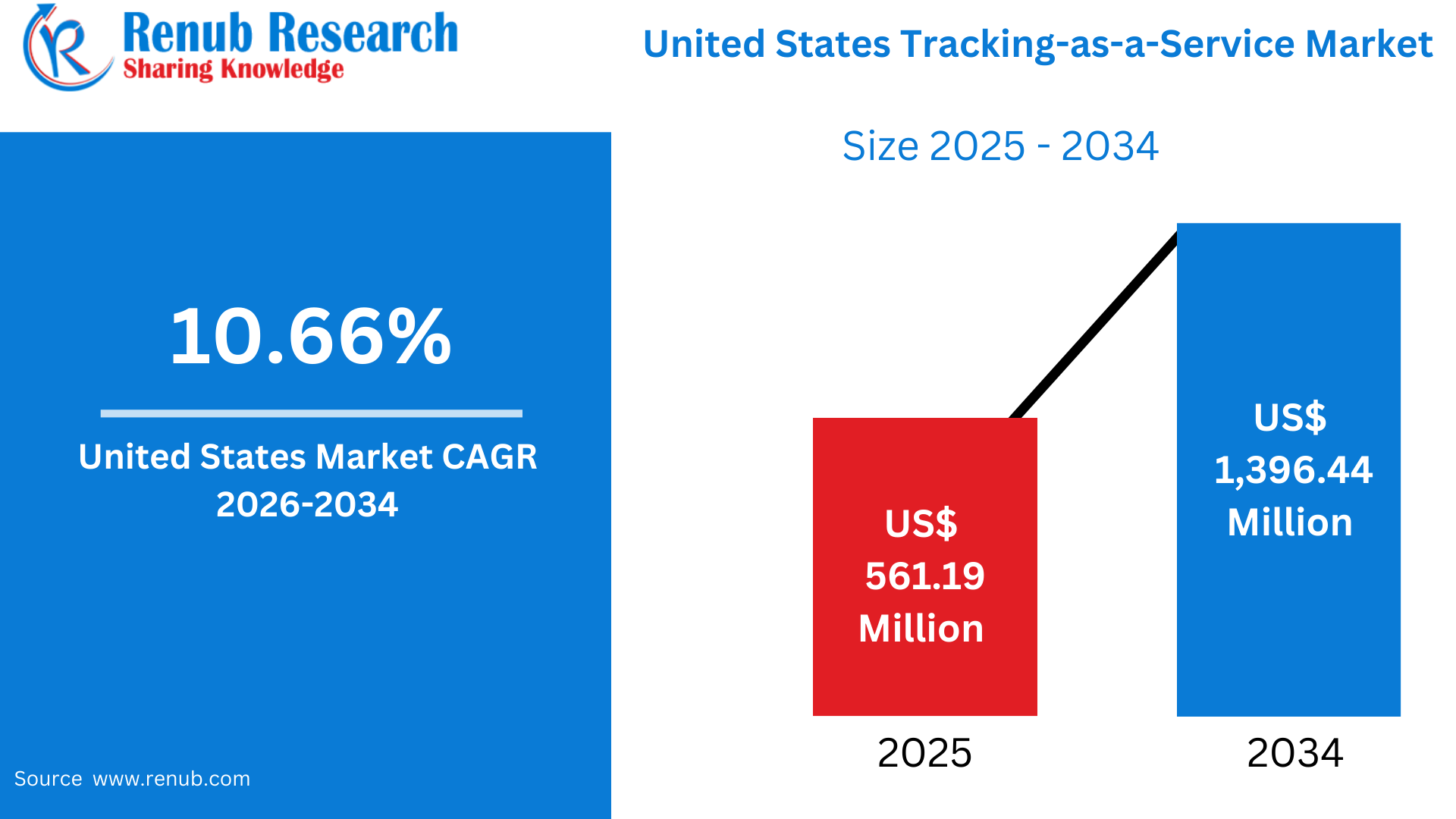
The United States Tracking-as-a-Service (TaaS) Market was valued at US$ 561.19 million in 2025 and is projected to reach US$ 1,396.44 million by 2034, registering a CAGR of 10.66% during the forecast period from 2026 to 2034. Market growth is being driven by the increasing adoption of Internet of Things (IoT)-enabled tracking solutions, rising demand for real-time asset visibility, and expanding applications across industries such as logistics, transportation, healthcare, retail, and manufacturing. Furthermore, the growing availability of cloud-based tracking platforms, advanced analytics, artificial intelligence (AI), and cost-effective subscription-based service models is accelerating adoption among businesses seeking scalable and efficient tracking solutions across the United States.
United States Tracking-as-a-Service Market Trends
The United States Tracking-as-a-Service (TaaS) Market was valued at US$ 561.19 million in 2025 and is projected to reach US$ 1,396.44 million by 2034, registering a CAGR of 10.66% during the forecast period from 2026 to 2034. Market growth is being driven by the increasing adoption of Internet of Things (IoT)-enabled tracking solutions, rising demand for real-time asset visibility, and expanding applications across industries such as logistics, transportation, healthcare, retail, and manufacturing. Furthermore, the growing availability of cloud-based tracking platforms, advanced analytics, artificial intelligence (AI), and cost-effective subscription-based service models is accelerating adoption among businesses seeking scalable and efficient tracking solutions across the United States.
Tracking-as-a-Service and its demands in United States
Tracking-as-a-Service (TaaS) is a cloud-based solution that enables organizations to monitor the location, movement, and condition of assets, vehicles, shipments, and personnel in real time without requiring significant investment in dedicated tracking infrastructure. The platform integrates technologies such as Global Positioning System (GPS), Internet of Things (IoT) sensors, wireless communication networks, and advanced data analytics to deliver continuous location intelligence and actionable operational insights through a subscription-based model. By eliminating large upfront capital investments, TaaS allows businesses to scale their tracking capabilities efficiently while improving operational visibility, reducing maintenance costs, optimizing resource utilization, and supporting faster, data-driven decision-making.
The United States has emerged as one of the leading markets for Tracking-as-a-Service due to its advanced digital infrastructure, widespread deployment of cloud computing, and rapid adoption of IoT technologies across multiple industries. Growing demand for real-time monitoring in logistics, e-commerce, fleet management, healthcare, retail, and industrial operations has significantly increased the adoption of flexible, cloud-enabled tracking solutions. In addition, the expansion of smart supply chains, rising investments in last-mile delivery optimization, and increasing reliance on data-driven business operations have strengthened the role of TaaS in improving operational transparency, enhancing asset security, reducing operational costs, and delivering better customer experiences across the U.S. economy.
Tracking-as-a-Service Software Product launches in USA
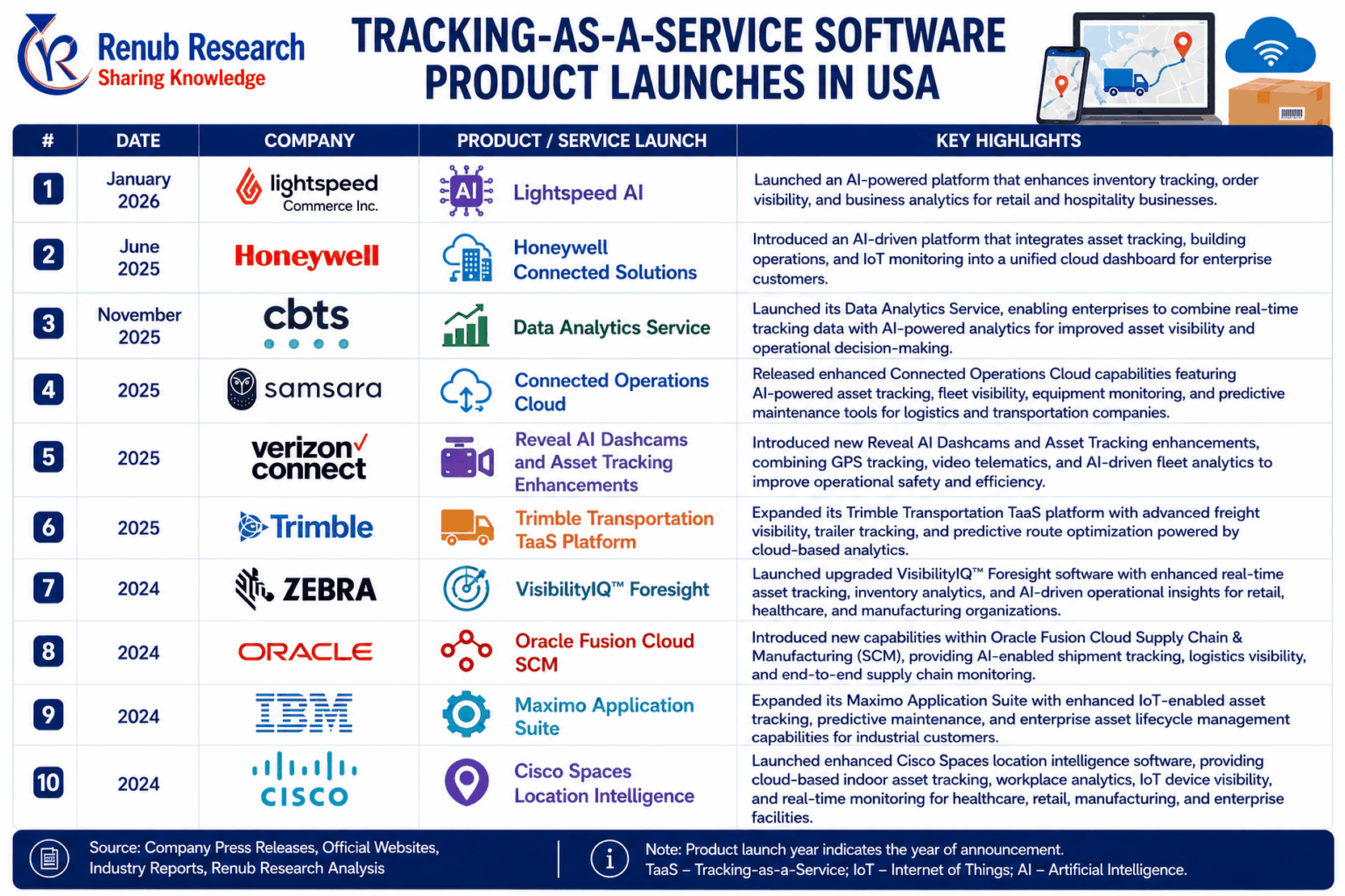
- January 2026 – Lightspeed Commerce Inc. launched Lightspeed AI, an AI-powered platform that enhances inventory tracking, order visibility, and business analytics for retail and hospitality businesses.
- June 2025 – Honeywell introduced Honeywell Connected Solutions, an AI-driven platform that integrates asset tracking, building operations, and IoT monitoring into a unified cloud dashboard for enterprise customers.
- November 2025 – CBTS launched its Data Analytics Service, enabling enterprises to combine real-time tracking data with AI-powered analytics for improved asset visibility and operational decision-making.
- 2025 – Samsara Inc. released enhanced Connected Operations Cloud capabilities featuring AI-powered asset tracking, fleet visibility, equipment monitoring, and predictive maintenance tools for logistics and transportation companies.
- 2025 – Verizon Connect introduced new Reveal AI Dashcams and Asset Tracking enhancements, combining GPS tracking, video telematics, and AI-driven fleet analytics to improve operational safety and efficiency.
- 2025 – Trimble Inc. expanded its Trimble Transportation TaaS platform with advanced freight visibility, trailer tracking, and predictive route optimization powered by cloud-based analytics.
- 2024 – Zebra Technologies launched upgraded VisibilityIQ™ Foresight software with enhanced real-time asset tracking, inventory analytics, and AI-driven operational insights for retail, healthcare, and manufacturing organizations.
- 2024 – Oracle introduced new capabilities within Oracle Fusion Cloud Supply Chain & Manufacturing (SCM), providing AI-enabled shipment tracking, logistics visibility, and end-to-end supply chain monitoring.
- 2024 – IBM expanded its Maximo Application Suite with enhanced IoT-enabled asset tracking, predictive maintenance, and enterprise asset lifecycle management capabilities for industrial customers.
- 2024 – Cisco launched enhanced Cisco Spaces location intelligence software, providing cloud-based indoor asset tracking, workplace analytics, IoT device visibility, and real-time monitoring for healthcare, retail, manufacturing, and enterprise facilities.
Key Growth Drivers
Rising Adoption of IoT and Connected Device Ecosystems
The rapid deployment of Internet of Things (IoT) technologies and connected devices is a major catalyst for the growth of the United States Tracking-as-a-Service (TaaS) market. Businesses across logistics, transportation, manufacturing, retail, and other industries are increasingly leveraging IoT-enabled sensors, GPS devices, and wireless communication networks to obtain real-time visibility into the location and condition of assets, vehicles, and shipments. When integrated with cloud-based tracking platforms, these technologies deliver scalable, cost-efficient, and highly responsive tracking capabilities. The rollout of high-speed 5G networks has further enhanced data transmission speed, connectivity, and tracking accuracy, enabling faster decision-making and improved operational efficiency. As organizations continue their digital transformation initiatives, IoT-powered Tracking-as-a-Service solutions are becoming an essential component of intelligent asset management and operational optimization. In June 2025, Honeywell introduced Honeywell Connected Solutions, an AI-powered platform that unifies building software and operational technologies into a single interface to improve efficiency, with early deployments at Verizon Communications Inc. and Vanderbilt University.
Expansion of E-commerce, Logistics, and Fleet Operations
The sustained growth of e-commerce and the increasing complexity of logistics networks are significantly accelerating demand for Tracking-as-a-Service solutions across the United States. Businesses are under growing pressure to provide real-time shipment visibility, accurate delivery updates, and optimized transportation routes to meet rising customer expectations for speed, reliability, and transparency. TaaS platforms enable logistics providers and fleet operators to centrally monitor vehicle locations, fuel consumption, driver performance, cargo movement, and delivery status, resulting in improved operational efficiency and lower transportation costs. Subscription-based tracking services also provide businesses with the flexibility to scale operations without substantial infrastructure investments. The rapid expansion of same-day delivery, last-mile logistics, and omnichannel retail continues to strengthen the role of Tracking-as-a-Service as a critical technology for modern supply chain management. In January 2026, Lightspeed Commerce Inc. launched Lightspeed AI, integrating agentic artificial intelligence into retail, hospitality, and commerce workflows to improve operational performance and business intelligence.
Increasing Demand for Data-Driven Business Intelligence
The growing emphasis on data-driven decision-making is another important factor supporting the expansion of the U.S. Tracking-as-a-Service market. Organizations are increasingly utilizing advanced analytics to improve operational performance, optimize asset utilization, minimize business risks, and strengthen strategic planning. Modern TaaS platforms transform large volumes of location and sensor-generated data into actionable insights through advanced reporting, predictive analytics, and artificial intelligence. These capabilities enable businesses to identify operational inefficiencies, forecast maintenance requirements, enhance fleet productivity, strengthen security, and improve overall resource management. Integration with enterprise software platforms further expands the value of tracking data, enabling organizations to make faster and more informed business decisions. Reflecting this trend, CBTS introduced its Data Analytics Service in November 2025, providing enterprise organizations with AI-ready analytics solutions designed to unlock greater value from business data and accelerate digital transformation initiatives.
Key Challenges
Growing Concerns Over Data Privacy and Cybersecurity
Protecting sensitive operational and location data remains one of the most significant challenges facing the United States Tracking-as-a-Service market. TaaS platforms continuously collect and transmit large volumes of information related to assets, personnel, vehicles, and business operations, making them attractive targets for cyberattacks and unauthorized data access. Service providers must implement robust cybersecurity measures, including encryption, secure cloud infrastructure, identity management, and continuous threat monitoring, while complying with increasingly stringent data privacy regulations. Any compromise of customer data can result in financial losses, legal liabilities, reputational damage, and reduced customer confidence, making cybersecurity a top priority for market participants.
Complex System Integration and Technology Dependence
Integrating Tracking-as-a-Service platforms with existing enterprise systems remains a significant implementation challenge for many organizations. Businesses often operate diverse legacy software, enterprise resource planning (ERP) platforms, transportation management systems, and warehouse management solutions, making seamless integration technically complex and resource-intensive. In addition, TaaS solutions rely heavily on stable network connectivity, reliable IoT devices, GPS infrastructure, and cloud computing platforms to ensure uninterrupted tracking performance. Network outages, hardware failures, software incompatibilities, or communication disruptions can negatively impact service reliability and operational continuity. Consequently, organizations require robust technology infrastructure, ongoing technical support, and effective system management to maximize the benefits of Tracking-as-a-Service deployments.
Component Insights
Tracking-as-a-Service Software
The Tracking-as-a-Service (TaaS) software market in the United States is experiencing robust growth as organizations increasingly prioritize digital transformation, operational visibility, and real-time asset monitoring. Modern TaaS software platforms provide comprehensive dashboards, reporting tools, alerts, and analytics that enable businesses to efficiently monitor assets, vehicles, inventory, and personnel. By combining GPS technology, Internet of Things (IoT) sensors, artificial intelligence (AI), and advanced analytics, these solutions convert real-time tracking data into actionable business intelligence. Subscription-based software models offer greater scalability, faster deployment, and lower upfront investment compared to traditional tracking systems, making them attractive to organizations of all sizes. Continuous software innovation, user-friendly interfaces, and seamless integration with enterprise applications such as Enterprise Resource Planning (ERP), Warehouse Management Systems (WMS), and Supply Chain Management (SCM) platforms are further accelerating market growth. As businesses increasingly adopt automation and data-driven operations, demand for advanced tracking software continues to expand across the United States.
Type Insights
Cloud-Based Tracking-as-a-Service
Cloud-based Tracking-as-a-Service solutions are gaining widespread adoption across the United States due to their flexibility, scalability, and cost-efficiency. Unlike traditional on-premise tracking systems, cloud-based platforms require minimal infrastructure investment while enabling secure access to real-time tracking information from virtually any location. These platforms support centralized data storage, advanced analytics, automated reporting, and seamless integration with existing enterprise systems, allowing organizations to scale operations as business requirements evolve. Continuous advancements in cloud computing, cybersecurity, and network connectivity have further strengthened enterprise confidence in cloud-based tracking solutions. Their ability to support geographically distributed operations makes them particularly valuable for industries such as logistics, transportation, healthcare, manufacturing, and retail. As cloud adoption continues to accelerate across U.S. enterprises, cloud-based TaaS platforms are expected to remain the preferred deployment model.
Asset Type Insights
Electronics and IT Asset Tracking-as-a-Service
The increasing value and volume of enterprise technology assets have significantly boosted demand for Tracking-as-a-Service solutions within the electronics and information technology sector. Organizations utilize TaaS platforms to monitor laptops, servers, networking equipment, mobile devices, and IoT assets throughout their entire lifecycle—from procurement and deployment to maintenance and disposal. These solutions help minimize asset loss, improve inventory accuracy, strengthen cybersecurity compliance, simplify audit processes, and optimize equipment utilization. The continued growth of remote and hybrid work environments, cloud computing infrastructure, and large-scale data centers has further increased the need for reliable IT asset tracking. As businesses place greater emphasis on operational security, productivity, and cost optimization, demand for intelligent IT asset management solutions continues to rise.
Enterprise Size Insights
Large Enterprise Tracking-as-a-Service
Large enterprises represent one of the most significant customer segments within the United States Tracking-as-a-Service market due to their extensive operations, complex supply chains, and large asset portfolios. These organizations require comprehensive real-time visibility across multiple business locations, transportation networks, warehouses, and field operations to improve operational efficiency and decision-making. Advanced TaaS platforms offer AI-powered analytics, predictive insights, automation capabilities, and seamless integration with enterprise software systems, enabling organizations to optimize asset utilization, improve workforce productivity, and reduce operational risks. Subscription-based pricing models also provide predictable operational expenses while allowing organizations to scale tracking capabilities as business requirements evolve. Ongoing investments in digital transformation, automation, and intelligent supply chain management continue to drive strong adoption among large enterprises.
End Use Insights
Retail Tracking-as-a-Service
The retail sector is increasingly adopting Tracking-as-a-Service solutions to improve inventory visibility, reduce product shrinkage, and optimize supply chain operations. Retailers rely on real-time tracking technologies to monitor inventory movement across distribution centers, warehouses, stores, and fulfillment facilities, enabling better stock management and faster replenishment. TaaS platforms enhance inventory accuracy, improve order fulfillment efficiency, and support omnichannel retail strategies by providing continuous visibility across multiple sales channels. As retailers strive to meet evolving consumer expectations for product availability and rapid delivery, demand for cloud-based tracking solutions continues to grow, helping businesses improve operational efficiency while enhancing customer satisfaction.
E-commerce Tracking-as-a-Service
The rapid expansion of e-commerce has become a major driver of Tracking-as-a-Service adoption throughout the United States. Online retailers depend on real-time shipment monitoring, order visibility, and last-mile delivery optimization to meet growing customer expectations for faster and more transparent delivery services. TaaS platforms provide end-to-end visibility across warehouses, transportation networks, fulfillment centers, and delivery partners, enabling businesses to optimize logistics operations and improve delivery performance. Advanced tracking capabilities also allow customers to receive accurate shipment updates, enhancing transparency and overall customer experience. As competition intensifies and delivery timelines continue to shorten, e-commerce companies are investing heavily in advanced tracking technologies to improve operational efficiency and maintain competitive advantage.
States Insights
California Tracking-as-a-Service Software
California represents one of the largest regional markets for Tracking-as-a-Service software, supported by its highly developed technology ecosystem, strong digital infrastructure, and early adoption of emerging technologies. The state’s concentration of technology companies, logistics providers, healthcare organizations, retailers, and multinational corporations has created substantial demand for advanced tracking solutions capable of delivering real-time operational intelligence. Widespread adoption of cloud computing, artificial intelligence, and IoT technologies has further strengthened the deployment of scalable TaaS platforms across multiple industries. California’s extensive transportation networks and complex logistics operations continue to encourage businesses to implement intelligent tracking software that enhances efficiency, visibility, and supply chain performance.
New York Tracking-as-a-Service Software
New York’s Tracking-as-a-Service software market is driven by the state’s diverse economy, which includes finance, retail, healthcare, logistics, and professional services. Organizations operating in densely populated urban environments require advanced tracking capabilities to monitor assets, shipments, equipment, and operational activities in real time. TaaS platforms enable businesses to improve operational visibility, reduce asset losses, strengthen inventory control, and enhance supply chain efficiency. Retail chains, financial institutions, healthcare providers, and e-commerce fulfillment centers are among the key adopters of cloud-based tracking solutions. The continued digital transformation of businesses across New York is expected to sustain strong demand for scalable and integrated Tracking-as-a-Service platforms.
Washington Tracking-as-a-Service Software
Washington has emerged as a growing market for Tracking-as-a-Service software due to its strong technology sector, expanding cloud computing industry, and strategic role in international trade. Businesses across logistics, aerospace, retail, manufacturing, and technology increasingly utilize TaaS platforms to improve asset visibility, streamline operations, and enhance decision-making through real-time data analytics. The state’s proximity to major seaports and global trade routes further increases demand for advanced shipment tracking and supply chain visibility solutions. In addition, organizations are increasingly integrating TaaS platforms with artificial intelligence, cloud analytics, and IoT technologies to improve operational efficiency and support digital transformation initiatives.
Georgia Tracking-as-a-Service Software
Georgia has become an important regional market for Tracking-as-a-Service software, largely due to its position as one of the United States’ leading logistics and transportation hubs. The state’s extensive freight networks, distribution centers, airports, and warehousing infrastructure generate strong demand for real-time tracking solutions across transportation and supply chain operations. Logistics providers, third-party logistics (3PL) companies, fleet operators, and e-commerce fulfillment centers increasingly rely on TaaS platforms to improve shipment visibility, optimize fleet performance, and enhance operational efficiency. Cost-effective cloud-based subscription models have also encouraged adoption among small and medium-sized enterprises seeking scalable tracking capabilities without significant capital investment. As Georgia continues to strengthen its logistics ecosystem, demand for Tracking-as-a-Service solutions is expected to remain robust.
Market Segmentations
Component
- Software
- Service
Type
- Cloud-based
- On-premises
- On-premises
Asset Type
- Electronics and IT Assets
- In-Transit Equipment
- Manufacturing Assets
- Others
Enterprise Size
- Large Enterprises
- Small and Medium-sized Enterprises
End Use
- Retail
- Manufacturing
- E-commerce
- Transportation and Logistics
- Healthcare
- Others
Top States
- California
- Texas
- New York
- Florida
- Illinois
- Pennsylvania
- Ohio
- Georgia
- New Jersey
- Washington
- North Carolina
- Massachusetts
- Virginia
- Michigan
- Maryland
- Colorado
- Tennessee
- Indiana
- Arizona
- Minnesota
- Wisconsin
- Missouri
- Connecticut
- South Carolina
- Oregon
- Louisiana
- Alabama
- Kentucky
- Rest of United States
All companies have been covered with 5 Viewpoints
- Overviews
- Key Person
- Recent Developments
- SWOT Analysis
- Revenue Analysis
Company Analysis
- Blackline Safety Corp.
- Geotab Inc.
- Sortly Inc.
- Trimble Transport & Logistics
- Honeywell International Inc.
- Mojix (Seagull Software, LLC)
- Motorola Solutions, Inc.
- Samsara
- Finale Inventory
Report Details:
| Report Features | Details |
| Base Year |
2025 |
| Historical Period |
2022 - 2025 |
| Forecast Period |
2026 - 2034 |
| Market |
US$ Million |
| Segment Covered |
Component, Type, Asset Type, Enterprise Size, End Use and States |
| States Covered |
|
| Companies Covered |
|
| Customization Scope |
20% Free Customization |
| Post-Sale Analyst Support |
1 Year (52 Weeks) |
| Delivery Format |
PDF and Excel through Email (We can also provide the editable version of the report in PPT/Word format on request) |
Customization Services available
- Analysis of Market Size and Its Segments
- More Company Profiles (Upto 10 without any additional cost):
- Additional Countries (Other than mentioned Countries):
- Region/Country Specific Reports:
- Market Entry Strategy:
- Region-Specific Market Dynamics:
- Regional Market Share Analysis:
- Trade Analysis:
- Production Insights:
- Others Customized Requests:
For more information contact our analysts.
Need More Assistance?
- Talk to our analysts to get more precious information on the current market trends.
- Include more countries and segments and customize the report based on the final requirement.
- Get a competitive advantage in your industry by knowing the report findings and making a positive impact on your revenues and operations.
- Our analysts are always ready to provide more help and pertinent information if you need any additional assistance.