United States Toys Market Report by Toys Segmentations, Sales Channel, States and Company Analysis 2026-2034
Buy NowU.S. Toy Market Report: E-Commerce Expansion, Kidult Trends, and Revenue Projection
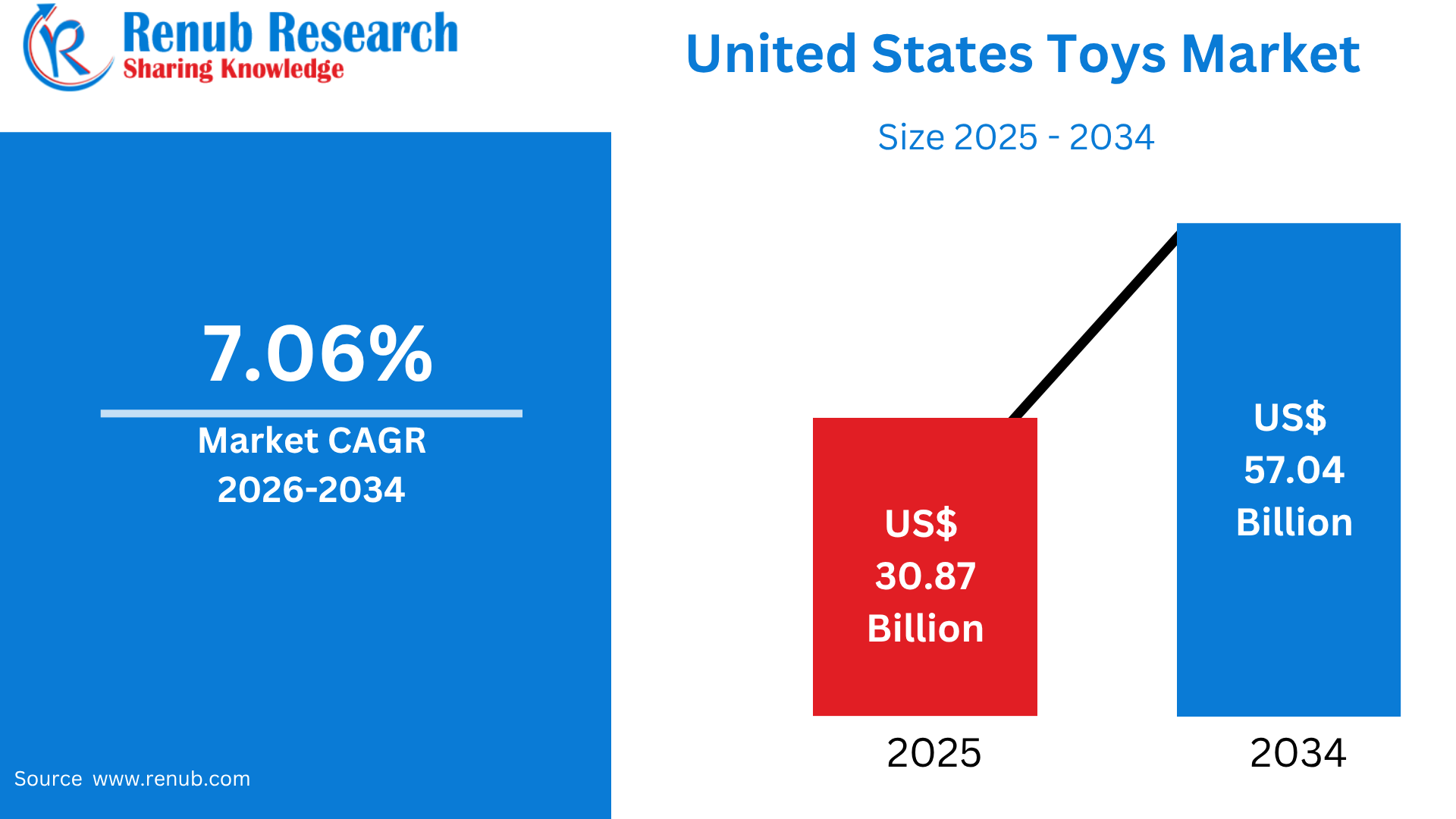
United States Toy Market is projected to expand from US$ 30.87 billion in 2025 to US$ 57.04 billion by 2034, registering a CAGR of 7.06% during the forecast period from 2026 to 2034. Market growth is being driven by robust consumer spending, increasing demand for licensed and character-based toys, and the rapid expansion of e-commerce retail channels. Continuous product innovation in educational toys, STEM learning kits, interactive electronic toys, and collectible merchandise is attracting consumers across multiple age groups.
Executive Overview of the United States Toy Industry
A toy is a product specifically designed for play, entertainment, education, and skill development among children, although many toys are also enjoyed by teenagers, collectors, and adults. Toys include action figures, dolls, puzzles, board games, construction sets, plush toys, electronic gadgets, STEM learning kits, outdoor play equipment, and collectible items. They play an important role in supporting children's cognitive, emotional, physical, and social development by encouraging creativity, imagination, problem-solving, communication, and motor skills. Educational toys are increasingly integrated into early childhood learning, helping children develop science, technology, engineering, mathematics (STEM), and language abilities through interactive play.
In the United States, toys remain one of the largest consumer product categories, supported by high household spending, strong gifting traditions, and a well-developed retail network. Parents increasingly prefer educational, technology-enabled, and environmentally sustainable toys that promote learning while entertaining children. Licensed products based on popular movies, television shows, video games, and superheroes continue to dominate sales across multiple age groups. E-commerce platforms, specialty toy retailers, supermarkets, and direct-to-consumer brands have expanded product accessibility nationwide. Seasonal events such as Christmas, birthdays, Halloween, and back-to-school shopping generate significant toy demand each year. Additionally, the growing popularity of collectible figures, trading cards, adult hobby toys, and family board games has broadened the consumer base, making the U.S. toy market one of the world's most innovative and dynamic industries.
United States Population by Age Group (2024–2025)
Age Group: 0–4 Years
- 2024 Population: 18,584,735
- 2025 Population: 18,491,867
- Share of Total Population (2024): 26%
- Share of Total Population (2025): 26%
- Change (2024–2025): -92,868 people (slight decline)
Age Group: 5–11 Years
- 2024 Population: 28,156,369
- 2025 Population: 28,009,584
- Share of Total Population (2024): 39%
- Share of Total Population (2025): 39%
- Change (2024–2025): -146,785 people (slight decline)
Source
- U.S. Census Bureau (2024–2025 Population Estimates)
Growth Driver
Rising Demand for Licensed and Entertainment-Based Toys
Licensed toys remain one of the strongest growth drivers in the U.S. toy market, supported by blockbuster movies, streaming platforms, gaming franchises, and popular television characters. Industry estimates indicate that licensed products account for approximately 30–35% of total U.S. toy sales, making them one of the largest revenue-generating categories. Franchises featuring superheroes, animated films, video games, and collectible characters consistently stimulate consumer demand across multiple age groups. Major toy manufacturers regularly collaborate with entertainment companies to launch exclusive action figures, dolls, construction sets, and collectibles alongside new media releases. The increasing popularity of anime, esports, and digital gaming has further expanded licensing opportunities. Retailers also benefit from seasonal movie releases that generate higher toy purchases during holidays and back-to-school periods. Social media marketing, influencer promotions, and digital advertising further increase product visibility and consumer engagement. Continuous expansion of intellectual property partnerships is expected to sustain long-term demand and strengthen revenue growth within the United States toy market.
Growth of Educational, STEM, and Interactive Toys
Educational toys have become a major growth segment as parents increasingly prioritize learning-oriented play experiences. Surveys indicate that over 65% of U.S. parents consider educational value an important factor when purchasing toys for children. STEM (Science, Technology, Engineering, and Mathematics) toys, coding kits, robotics sets, construction blocks, and interactive learning devices continue gaining popularity across preschool and school-age children. Digital integration through augmented reality (AR), artificial intelligence, voice recognition, and app-connected toys has created more engaging educational experiences. Schools, childcare centers, and homeschooling programs are also increasing purchases of educational play products that support cognitive development and problem-solving skills. Manufacturers continue introducing products that combine entertainment with creativity, critical thinking, and practical learning. Growing awareness of early childhood development and increasing investment in educational technology continue driving innovation across the toy industry. As demand for learning-based entertainment rises, educational and STEM toys are expected to remain one of the fastest-growing categories in the U.S. toy market.
Expansion of E-commerce and Omnichannel Retail
The rapid expansion of digital retail has significantly accelerated growth in the U.S. toy market. Online channels now account for approximately 35–40% of total toy purchases, supported by widespread internet access, mobile shopping applications, and fast home delivery services. Consumers increasingly purchase toys through e-commerce platforms due to greater product variety, competitive pricing, customer reviews, and personalized recommendations. Retailers continue investing in omnichannel strategies that integrate physical stores with online shopping, click-and-collect services, and same-day delivery. Artificial intelligence-powered recommendation engines and targeted digital marketing campaigns help improve customer engagement and increase average order values. Seasonal shopping events such as Black Friday, Cyber Monday, and holiday promotions generate substantial online toy sales each year. Subscription toy services and direct-to-consumer brand websites are also expanding market reach. Continuous improvements in logistics, warehouse automation, and digital payment technologies are expected to further strengthen online toy sales throughout the forecast period.
Challenge
Rising Manufacturing and Supply Chain Costs
Increasing manufacturing costs continue to present a significant challenge for the U.S. toy market. Rising prices for plastics, electronic components, packaging materials, shipping services, and labor have increased production expenses across the industry. Industry estimates suggest that raw material and logistics costs have increased by more than 20% compared with pre-pandemic levels in many manufacturing sectors. Many toy companies continue relying on global supply chains, exposing them to transportation delays, geopolitical uncertainties, fluctuating freight rates, and currency volatility. Seasonal demand requires manufacturers to build inventory months before major shopping periods, increasing warehousing and inventory management costs. Retailers also face pressure to maintain competitive pricing despite rising operational expenses. Smaller manufacturers often experience greater financial pressure due to limited purchasing power and lower production volumes. Improving supply chain resilience, diversifying sourcing strategies, and increasing manufacturing automation remain essential priorities for companies seeking to maintain profitability and product availability.
Short Product Life Cycles and Intense Market Competition
The U.S. toy market experiences intense competition due to frequent product launches, rapidly changing consumer preferences, and evolving entertainment trends. Thousands of new toy products enter the market annually, creating shorter product life cycles and increasing pressure on manufacturers to innovate continuously. Consumer demand is strongly influenced by movie releases, social media trends, gaming franchises, and seasonal shopping events, making demand forecasting increasingly complex. Failure to accurately predict consumer preferences can lead to excess inventory, markdowns, and financial losses. Competition from digital entertainment, mobile gaming, streaming platforms, and social media also reduces children’s time spent with traditional toys. Manufacturers must continuously invest in research and development, licensing agreements, marketing campaigns, and digital engagement strategies to remain competitive. Maintaining innovation while balancing product safety, affordability, and sustainability requirements presents an ongoing challenge. Companies that rapidly adapt to evolving consumer preferences and technological advancements are more likely to achieve long-term success in the U.S. toy market.
Toy Launches in the USA
- January 2026 – Mattel launched the Barbie AI DreamHouse Collection, featuring interactive voice-enabled accessories, smart home connectivity, and customizable play experiences.
- November 2025 – Hasbro introduced the NERF Pro HyperStrike Series, offering upgraded high-performance blasters with enhanced accuracy, rechargeable battery systems, and modular accessories.
- September 2025 – LEGO launched the LEGO Star Wars Ultimate Collector Series – The Ghost, expanding its premium licensed building set portfolio for collectors and enthusiasts.
- July 2025 – Spin Master released the PAW Patrol Rescue Command Interactive Playset, incorporating lights, sounds, and app-connected educational missions for preschool children.
- May 2025 – MGA Entertainment unveiled the L.O.L. Surprise! Magic Fashion Dolls, featuring augmented reality (AR) experiences, collectible accessories, and customizable outfits.
- March 2025 – Fisher-Price introduced the Smart Stages Learning Adventure Center, an interactive educational toy with adaptive learning modes, music, lights, and bilingual content for toddlers.
- January 2025 – Melissa & Doug launched its Eco Wooden Learning Collection, manufactured using FSC-certified wood, water-based paints, and recyclable packaging to support sustainable play.
- October 2024 – Jazwares expanded its Squishmallows Premium Plush Collection, introducing licensed characters from popular entertainment franchises with limited-edition holiday releases.
- August 2024 – Bandai Namco Toys & Collectibles America launched the Tamagotchi Uni, featuring Wi-Fi connectivity, downloadable content, multiplayer interactions, and customizable virtual pets.
- June 2024 – VTech introduced the KidiZoom Creator Studio Pro, combining HD video recording, green-screen technology, creative editing tools, and STEM-focused content creation for children.
United States Growing Interest in Creative and Educational Play
United States Arts & Crafts Toy Market continues to expand as parents increasingly encourage creativity, self-expression, and hands-on learning among children. Arts and crafts products account for approximately 10–12% of the educational toy segment, supported by rising demand for DIY kits, painting sets, clay modeling, jewelry-making kits, coloring products, and science-art combination activities. More than 70% of elementary-age children participate in arts and crafts activities at school or home each year, boosting product demand. Manufacturers are introducing eco-friendly materials, reusable crafting supplies, and STEM-integrated creative kits to enhance educational value. Retailers also benefit from seasonal demand during school vacations, holidays, and back-to-school shopping periods. Online tutorials and social media platforms have further increased consumer engagement with creative hobbies. Parents increasingly view arts and crafts toys as valuable tools for improving fine motor skills, imagination, concentration, and problem-solving abilities. Continued innovation in educational and sustainable craft products is expected to support long-term growth across the U.S. arts and crafts toy market.
United States Licensed Characters and Collectibles Driving Dolls Sales
United States Dolls Toy Market remains one of the largest categories within the toy industry, supported by strong consumer demand for fashion dolls, baby dolls, collectible figures, and licensed entertainment characters. Dolls represent approximately 15–18% of total traditional toy sales in the United States. Licensed dolls based on popular movies, animated series, gaming franchises, and streaming content continue generating substantial consumer interest. Manufacturers increasingly incorporate interactive features including voice recognition, artificial intelligence, augmented reality applications, and customizable accessories to enhance product appeal. Collectible dolls targeting teenagers and adult hobbyists have also become an important revenue source. Holiday gifting, birthdays, and seasonal promotions continue driving annual sales growth. Retailers are expanding premium product lines featuring diverse cultural representation, sustainability initiatives, and educational storytelling. Digital marketing campaigns and influencer partnerships further strengthen brand awareness. Continuous product innovation and entertainment licensing partnerships are expected to sustain steady growth within the U.S. dolls toy market.
United States Early Childhood Development Supporting Growth
United States Infant, Toddler, and Preschool Toys Market continues to grow steadily as parents prioritize early childhood education and developmental learning. Toys designed for children under five years old account for approximately 20–25% of total toy industry revenue, reflecting strong household spending on developmental products. Parents increasingly purchase sensory toys, stacking blocks, musical learning devices, shape sorters, ride-on toys, interactive books, and educational activity centers that support cognitive, language, and motor skill development. Pediatric development specialists frequently emphasize the importance of play-based learning during early childhood, encouraging continued demand for educational toys. Manufacturers are integrating lights, sounds, artificial intelligence, and mobile connectivity while maintaining strict safety standards. Sustainable materials, BPA-free plastics, and recyclable packaging are also becoming purchasing priorities among environmentally conscious families. Rising participation in daycare programs and preschool education further supports demand. Continuous innovation in developmental learning products is expected to strengthen long-term growth across the U.S. infant, toddler, and preschool toy market.
United States Toy Digital Retail Transforming Consumer Purchasing
United States Toy E-commerce Market has become one of the fastest-growing retail distribution channels, supported by widespread internet access, mobile commerce, and rapid home delivery services. Online platforms now account for approximately 35–40% of total toy purchases in the United States, with continued expansion expected throughout the forecast period. Consumers increasingly prefer digital shopping because of broader product selection, competitive pricing, customer reviews, personalized recommendations, and convenient delivery options. Major online retailers continue investing in artificial intelligence, predictive search algorithms, and automated fulfillment centers to improve shopping experiences and operational efficiency. Seasonal promotions during Black Friday, Cyber Monday, and holiday shopping periods generate significant online toy sales each year. Subscription toy services and direct-to-consumer brands are further expanding market accessibility. Retailers also integrate omnichannel services including buy-online-pick-up-in-store (BOPIS) and same-day delivery. Continued investments in logistics automation and digital retail technology are expected to accelerate long-term growth within the U.S. toy e-commerce market.
United States Premium Retail Experience Supporting Consumer Demand
United States Toy Specialty Market continues to play an important role despite the rapid expansion of online retail. Specialty toy retailers account for approximately 15–20% of premium toy sales, offering curated product selections, exclusive merchandise, educational toys, collectibles, and personalized customer service. These stores attract parents seeking expert product recommendations and unique brands not widely available through mass retailers. Educational toys, STEM kits, puzzles, wooden toys, board games, and premium collectibles remain among the strongest-performing product categories. Specialty retailers frequently organize in-store demonstrations, interactive play events, workshops, and seasonal promotions that strengthen customer engagement and brand loyalty. Many independent retailers are also adopting omnichannel strategies by combining physical stores with online ordering and local delivery services. Growing consumer interest in sustainable products, handcrafted toys, and limited-edition collectibles further supports specialty retail demand. Continuous emphasis on personalized shopping experiences, product expertise, and exclusive offerings is expected to sustain steady growth across the United States toy specialty market.
California Toy Market
California represents the largest state-level toy market in the United States, supported by a population of over 39 million residents, high household incomes, and one of the country’s highest consumer spending levels. The state accounts for an estimated 12–14% of total U.S. toy sales, driven by strong demand for licensed toys, STEM products, collectibles, and premium educational games. California’s close proximity to major entertainment companies and content creators fuels continuous demand for movie, television, and gaming-related merchandise. Online shopping is highly developed, with more than 80% of households regularly purchasing consumer products through digital platforms, strengthening toy e-commerce sales. Consumers also demonstrate increasing interest in sustainable toys manufactured using recycled plastics, FSC-certified wood, and biodegradable packaging. Specialty retailers, department stores, supermarkets, and online marketplaces collectively support broad product availability. Continued innovation in educational toys, entertainment licensing, and omnichannel retail strategies is expected to maintain California’s leadership position within the U.S. toy market.
Texas Toy Market
Texas has emerged as one of the fastest-growing toy markets in the United States, supported by a population exceeding 31 million people, strong economic expansion, and one of the nation’s youngest demographic profiles. Families with children represent a significant consumer base, contributing to consistent demand for educational toys, outdoor play equipment, action figures, board games, and licensed merchandise. The state accounts for approximately 8–10% of U.S. toy retail sales, supported by extensive retail infrastructure across metropolitan areas such as Houston, Dallas, Austin, and San Antonio. Digital retail continues expanding rapidly, with online toy purchases accounting for an increasing share of household spending due to convenient delivery services and competitive pricing. Retailers also benefit from advanced regional distribution centers that improve inventory availability and fulfillment speed. Seasonal events, school holidays, birthdays, and festive celebrations generate strong year-round sales. Continued population growth, rising disposable income, and expanding retail investments are expected to support sustained growth across the Texas toy market.
New York Toy Market
New York remains one of the country’s most influential toy markets, supported by a population of over 19 million residents, high urban purchasing power, and an extensive retail ecosystem. The state contributes an estimated 7–9% of total U.S. toy sales, with New York City serving as a major destination for flagship toy stores, specialty retailers, and international tourists. Demand is particularly strong for collectible figures, premium educational toys, licensed entertainment merchandise, puzzles, and family board games. Digital commerce continues expanding, with a large proportion of parents using online platforms offering same-day and next-day delivery services. The state’s multicultural consumer base supports broad demand across diverse toy categories reflecting various cultural interests and educational needs. Tourism, holiday shopping, and entertainment-related promotions further stimulate retail activity throughout the year. Continued investments in omnichannel retailing, experiential shopping, and premium toy offerings are expected to strengthen long-term market growth across New York.
Florida Toy Market
Florida’s toy market continues expanding due to a growing population of more than 23 million people, strong tourism activity, and increasing family-oriented consumer spending. The state accounts for approximately 6–8% of total U.S. toy sales, supported by consistent demand for preschool toys, outdoor play equipment, educational products, and licensed character merchandise. Major tourist destinations and theme parks generate significant sales of branded toys, souvenirs, plush products, and collectibles throughout the year. Retailers experience peak demand during school vacations, holiday seasons, and major travel periods, benefiting from both resident and tourist purchases. Online toy shopping continues growing rapidly as consumers increasingly utilize mobile applications and digital retail platforms for convenience and broader product selection. Growing awareness of STEM education and sustainable toys has encouraged manufacturers to expand environmentally friendly product portfolios. Florida’s expanding population, vibrant tourism industry, and strong retail infrastructure continue supporting stable long-term growth in the state’s toy market.
Recent Developments in United States Toy Market
- In May 2025, Moose Toys entered an exclusive global partnership with CrunchLabs and YouTuber-engineer Mark Rober to develop a new STEM-based toy line designed to inspire hands-on science and engineering learning among children. The product range is scheduled for a worldwide retail launch in summer 2026.
United States Toys Market Segments
Toys Segmentation
- Action Figures & Accessories
- Arts & Crafts
- Building Sets
- Dolls
- Explorative & Others Toys
- Games/Puzzles
- Infant/Toddler/Preschool Toys
- Outdoor & Sports Toys
- Plush
- Vehicles
- Youth Electronics
Sales Channel
- E-commerce
- Specialty
- Discounters
- Department Stores
- Others
States
- California
- Texas
- New York
- Florida
- Illinois
- Pennsylvania
- Ohio
- Georgia
- New Jersey
- Washington
- North Carolina
- Massachusetts
- Virginia
- Michigan
- Maryland
- Colorado
- Tennessee
- Indiana
- Arizona
- Minnesota
- Wisconsin
- Missouri
- Connecticut
- South Carolina
- Oregon
- Louisiana
- Alabama
- Kentucky
- Rest of United States
All the Key Trends have been covered from 5 Viewpoints:
- Overviews
- Key Person
- Recent Developments
- SWOT Analysis
- Revenue Analysis
Company Analysis:
- Mattel Inc.
- Hasbro Inc.
- LEGO
- Spin Master Corp.
- Vtech
- Nintendo Company Ltd.
- Funko Inc.
- JAKKS Pacific
Report Details:
| Report Features | Details |
| Base Year |
2025 |
| Historical Period |
2022 - 2025 |
| Forecast Period |
2026 - 2034 |
| Market |
US$ Billion |
| Segment Covered |
Toys Segmentations, Sales Channel, States and States |
| States Covered |
|
| Companies Covered |
|
| Customization Scope |
20% Free Customization |
| Post-Sale Analyst Support |
1 Year (52 Weeks) |
| Delivery Format |
PDF and Excel through Email (We can also provide the editable version of the report in PPT/Word format on request) |
Customization Services available
- Analysis of Market Size and Its Segments
- More Company Profiles (Upto 10 without any additional cost):
- Additional Countries (Other than mentioned Countries):
- Region/Country Specific Reports:
- Market Entry Strategy:
- Region-Specific Market Dynamics:
- Regional Market Share Analysis:
- Trade Analysis:
- Production Insights:
- Others Customized Requests:
For more information contact our analysts.
Need More Assistance?
- Talk to our analysts to get more precious information on the current market trends.
- Include more countries and segments and customize the report based on the final requirement.
- Get a competitive advantage in your industry by knowing the report findings and making a positive impact on your revenues and operations.
- Our analysts are always ready to provide more help and pertinent information if you need any additional assistance.