United States Thermoplastic Polyurethane (TPU) Market Report by Type, Raw Material, Application, End Use, States and Company Analysis, 2026-2034
Buy NowUnited States Thermoplastic Polyurethane Market Size and Forecast 2026-2034
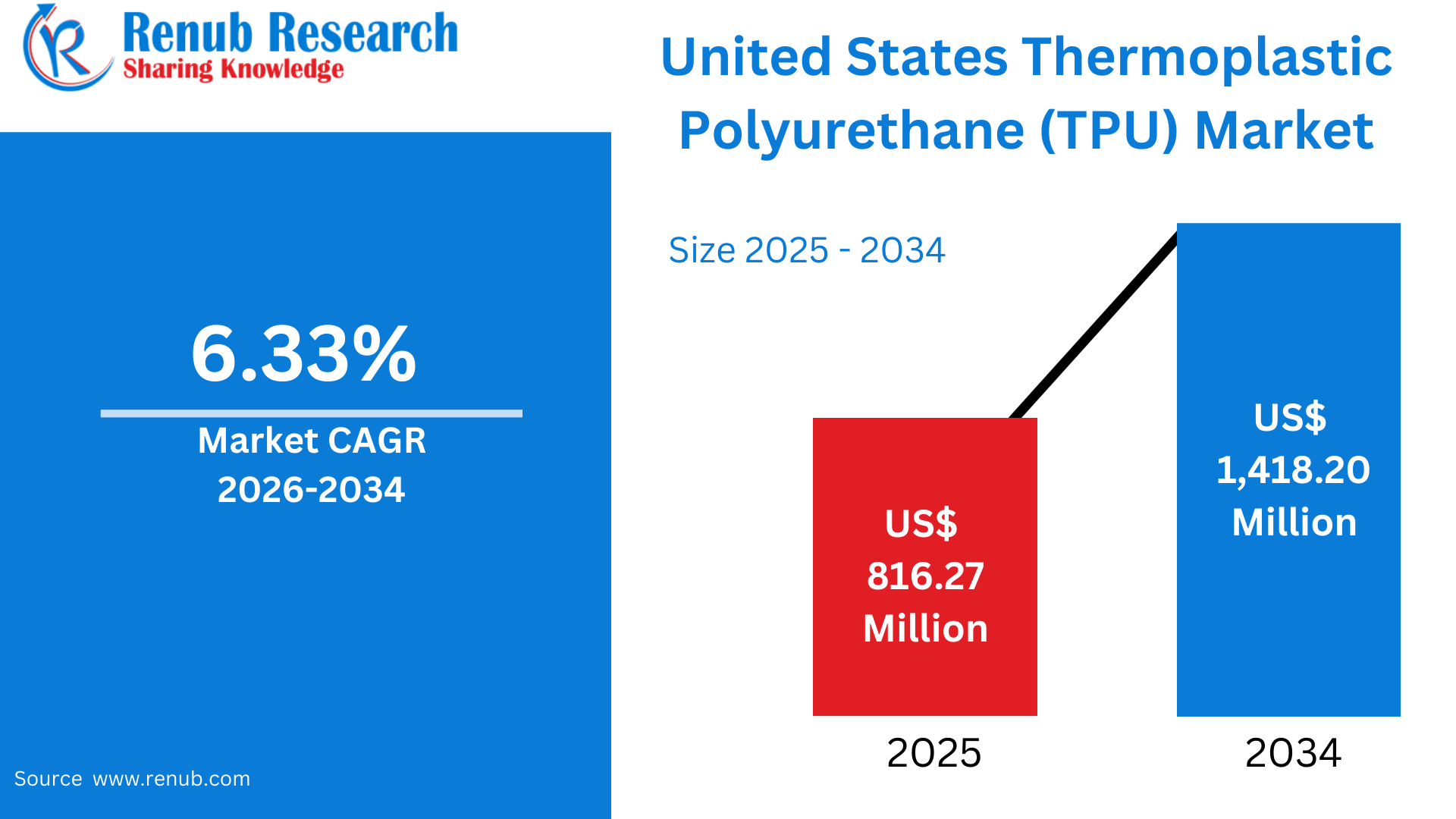
United States Thermoplastic Polyurethane Market is projected to witness consistent growth during the forecast period from 2026 to 2034. The market is anticipated to increase from US$ 816.27 million in 2025 to US$ 1,418.20 million by 2034, registering a compound annual growth rate (CAGR) of 6.33%. This growth is primarily driven by rising demand for TPU across major end-use industries, including automotive, footwear, electronics, and healthcare. Increasing adoption of lightweight, durable, and highly flexible materials in advanced manufacturing processes is further supporting market expansion.
Thermoplastic Polyurethane (TPU) and its demands in United States
Thermoplastic polyurethane (TPU) is a versatile elastomer that combines the flexibility and elasticity of rubber with the strength and durability of conventional plastics. It offers excellent abrasion resistance, impact strength, elasticity, and resistance to oils, chemicals, and weathering, making it suitable for demanding applications. TPU can be processed using standard thermoplastic manufacturing techniques such as injection molding, extrusion, and blow molding, enabling its use in a wide range of products, including automotive components, footwear soles, hoses and tubing, cables, films, medical devices, and consumer electronics accessories.
In the United States, TPU has gained widespread acceptance due to its ability to meet the stringent performance requirements of high-value and technologically advanced applications. The automotive sector increasingly utilizes TPU for lightweight, durable components that contribute to improved fuel efficiency and vehicle performance. In the footwear and sportswear industries, TPU enhances comfort, resilience, and design flexibility. Additionally, the growing demand for medical-grade materials, protective coatings, and sustainable material solutions is accelerating TPU adoption across diverse industrial sectors, reinforcing its importance in the U.S. manufacturing landscape.
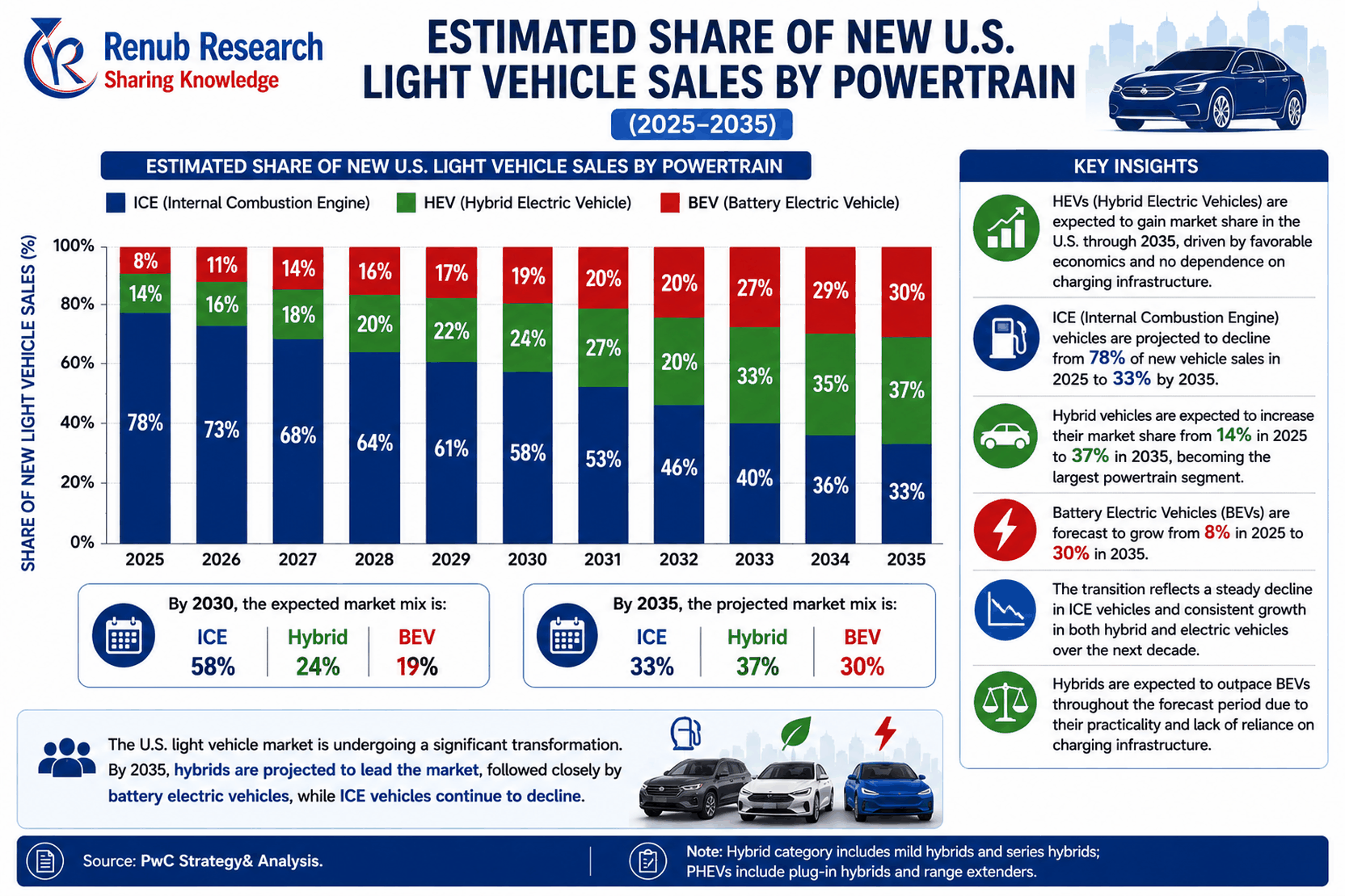
Estimated Share of New U.S. Light Vehicle Sales by Powertrain (2025–2035)
- HEVs (Hybrid Electric Vehicles) are expected to gain market share in the U.S. through 2035, driven by favorable economics and no dependence on charging infrastructure.
- ICE (Internal Combustion Engine) vehicles are projected to decline from 78% of new vehicle sales in 2025 to 33% by 2035.
- Hybrid vehicles are expected to increase their market share from 14% in 2025 to 37% in 2035, becoming the largest powertrain segment.
- Battery Electric Vehicles (BEVs) are forecast to grow from 8% in 2025 to 30% in 2035.
- By 2030, the expected market mix is:
- ICE: 58%
- Hybrid: 24%
- BEV: 19%
- By 2035, the projected market mix is:
- ICE: 33%
- Hybrid: 37%
- BEV: 30%
- The transition reflects a steady decline in ICE vehicles and consistent growth in both hybrid and electric vehicles over the next decade.
- Hybrids are expected to outpace BEVs throughout the forecast period due to their practicality and lack of reliance on charging infrastructure.
- Source: PwC Strategy& Analysis.
- Note: Hybrid category includes mild hybrids and series hybrids; PHEVs include plug-in hybrids and range extenders.
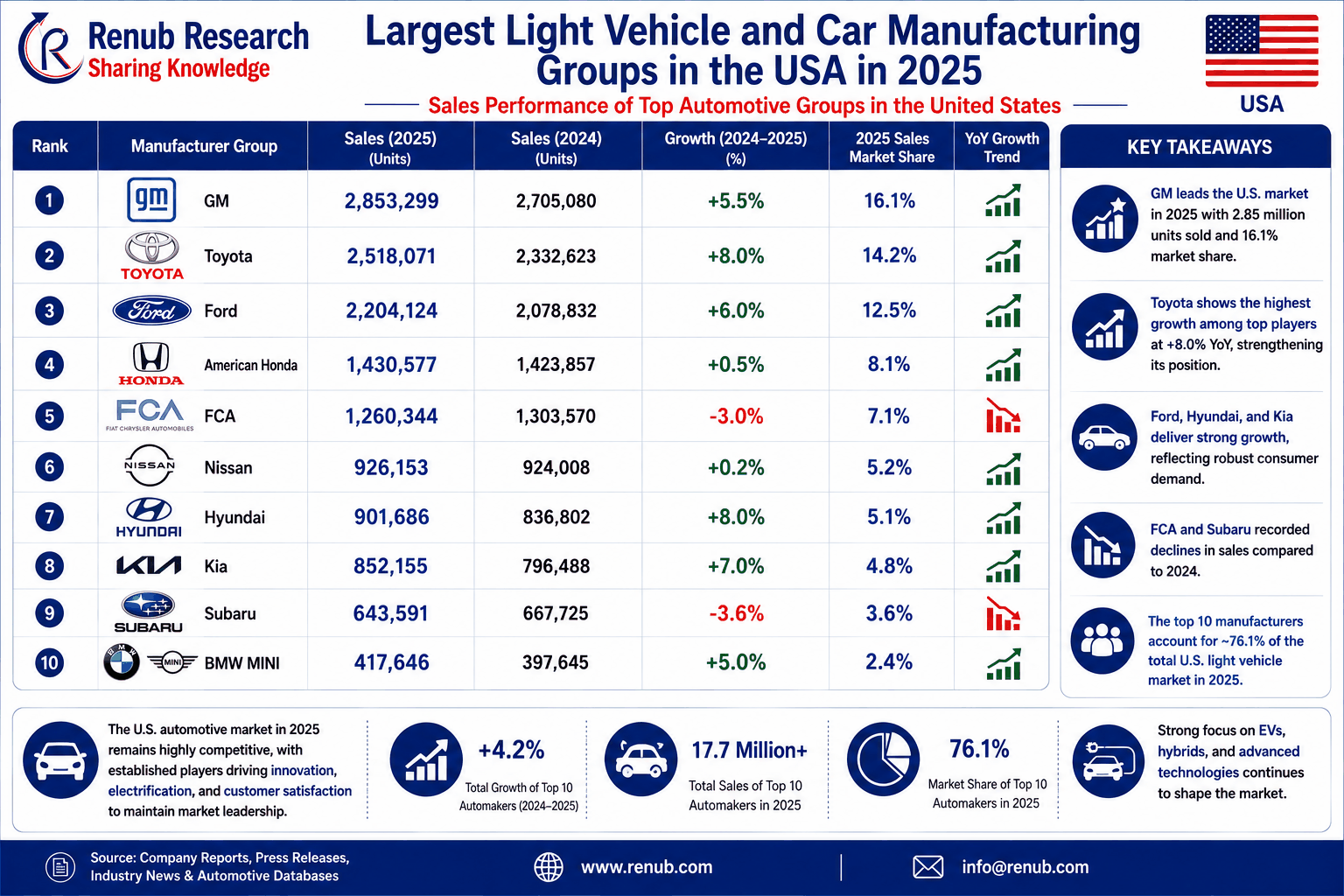
Largest Light Vehicle and Car Manufacturing Groups in the USA in 2025
- GM
- Sales (2025): 2,853,299
- Sales (2024): 2,705,080
- Growth (2024–2025): +5.5%
- Toyota
- Sales (2025): 2,518,071
- Sales (2024): 2,332,623
- Growth (2024–2025): +8.0%
- Ford
- Sales (2025): 2,204,124
- Sales (2024): 2,078,832
- Growth (2024–2025): +6.0%
- American Honda
- Sales (2025): 1,430,577
- Sales (2024): 1,423,857
- Growth (2024–2025): +0.5%
- FCA
- Sales (2025): 1,260,344
- Sales (2024): 1,303,570
- Growth (2024–2025): -3.0%
- Nissan
- Sales (2025): 926,153
- Sales (2024): 924,008
- Growth (2024–2025): +0.2%
- Hyundai
- Sales (2025): 901,686
- Sales (2024): 836,802
- Growth (2024–2025): +8.0%
- Kia
- Sales (2025): 852,155
- Sales (2024): 796,488
- Growth (2024–2025): +7.0%
- Subaru
- Sales (2025): 643,591
- Sales (2024): 667,725
- Growth (2024–2025): -3.6%
- BMW MINI
- Sales (2025): 417,646
- Sales (2024): 397,645
- Growth (2024–2025): +5.0%
Market Growth Drivers
Expanding Applications in the Automotive and Transportation Sector
The automotive and transportation industry remains one of the primary growth drivers of the United States thermoplastic polyurethane (TPU) market. TPU is extensively utilized in both interior and exterior vehicle components due to its exceptional abrasion resistance, flexibility, durability, and resistance to oils, chemicals, and harsh environmental conditions. As automotive manufacturers increasingly prioritize lightweight materials to improve fuel efficiency, reduce emissions, and enhance vehicle performance, TPU is replacing conventional plastics and rubber in applications such as hoses, seals, cable jacketing, protective films, and interior trims. The rapid expansion of the electric vehicle (EV) market is further accelerating TPU demand, as EV manufacturers require materials that offer excellent vibration damping, long-term durability, and superior design flexibility while supporting lightweight vehicle architectures. Continuous advancements in automotive engineering and increasing performance requirements are expected to sustain strong TPU consumption throughout the forecast period. For instance, in October 2024, BASF introduced its Elastollan® 1400 Series, a new range of ether-based TPUs offering outstanding hydrolysis and microbial resistance. The product line is designed for demanding applications, including rail pads, cable sheathing, tubes, hoses, and gearwheels, further expanding TPU's industrial and transportation applications.
Rising Demand from the Footwear and Consumer Goods Industries
Growing demand from the footwear and consumer goods sectors is another significant factor driving the U.S. TPU market. TPU is widely preferred in athletic, casual, and performance footwear because of its superior elasticity, excellent shock absorption, high durability, and extensive design flexibility. Manufacturers increasingly utilize TPU to develop lightweight, aesthetically appealing, and long-lasting footwear that meets evolving consumer preferences. Beyond footwear, TPU is gaining widespread adoption in consumer electronics for protective cases, wearable devices, flexible components, and accessories due to its combination of mechanical strength, flexibility, and attractive surface finish. The increasing popularity of premium sportswear, lifestyle products, and durable consumer accessories continues to strengthen demand for TPU across high-volume consumer applications. Supporting this trend, Huntsman Corporation introduced a new thermoplastic polyurethane solution specifically designed for footwear applications in September 2025, further reinforcing innovation within the performance footwear segment.
Growing Adoption Across Medical and Industrial Applications
Expanding utilization in medical and industrial applications is creating substantial growth opportunities for the U.S. TPU market. Medical-grade TPU offers excellent biocompatibility, flexibility, sterilization resistance, and long-term durability, making it well suited for manufacturing catheters, medical tubing, wound care products, implantable device components, and other healthcare equipment. In industrial applications, TPU is increasingly used in conveyor belts, hoses, seals, wear-resistant linings, protective coatings, and other components exposed to demanding operating conditions. Rising healthcare expenditure, an aging population, and the continued adoption of industrial automation are collectively driving demand for high-performance materials capable of meeting stringent regulatory and operational requirements. In March 2024, ICP DAS-BMP showcased its medical-grade TPU portfolio at the MD&M West exhibition, attracting orders from leading medical device manufacturers in the United States and Japan. Additionally, several of the company's TPU materials successfully passed the ISO 10993-6 90-day implantation test, demonstrating their suitability for manufacturing indwelling medical devices intended for use beyond 30 days.
Recent Thermoplastic Polyurethane (TPU) Product Launches Relevant to the U.S. Market
- October 2024 – BASF launched Elastollan® 1400 Series (Ether-based TPU): Introduced a new TPU portfolio featuring excellent hydrolysis resistance, microbial resistance, and long-term durability for transportation, industrial manufacturing, footwear, tubes, hoses, cable sheathing, and rail pad applications.
- August 2024 – Huntsman introduced AVALON® GECKO TPU: Launched a high-performance TPU range for footwear outsoles offering exceptional wet and dry grip, abrasion resistance, lightweight performance, and circularity-focused design. The products debuted at the NW Materials Show in Portland, Oregon.
- April 2025 – Covestro launched Desmopan® FLY TPU Series: Developed specifically for supercritical fluid (SCF) injection foaming technology, enabling lightweight, highly cushioned midsoles for footwear while also supporting sports equipment, furniture, and electronics applications.
- May 2024 – Covestro showcased recyclable Desmopan® TPU solutions for textiles: Expanded its TPU portfolio with recyclable Desmopan® materials for artificial leather, technical textiles, high-performance yarns, and circular textile applications.
- May 2024 – Covestro expanded Platilon® TPU film portfolio: Introduced advanced TPU film solutions for sportswear, outdoor equipment, inflatable structures, and technical textile applications with improved durability and sustainability.
- June 2024 – Covestro launched Desmopan® FR TPU Series: Released a new flame-retardant TPU portfolio designed for cable jacketing in electric vehicles, charging infrastructure, consumer electronics, and industrial wiring, featuring halogen-free and low-smoke formulations.
- October 2024 – BASF expanded Elastollan® 1400 grades for footwear applications: Added TPU grades with enhanced wet-slip resistance, dimensional stability, and improved processing performance for high-performance athletic and safety footwear.
- October 2024 – BASF introduced Elastollan® 1400 grades for industrial extrusion: Expanded the TPU family with extrusion grades optimized for tubes, hoses, industrial profiles, and gear wheels requiring superior burst pressure and long-term aging resistance.
- April 2025 – Covestro introduced TPU solutions for advanced lightweight consumer products: Expanded its SCF-compatible TPU materials to support lightweight components used in electronics, furniture, and sporting goods while improving energy return and process efficiency.
- August 2024 – Huntsman expanded AVALON® TPU platform with foamable grades: Introduced low-density, foamable TPU materials for premium footwear midsoles and outsoles, providing superior softness, durability, and enhanced sustainability for sports and lifestyle footwear.
Market Challenges
Volatility in Raw Material Prices
Fluctuating raw material prices remain one of the most significant challenges facing the U.S. TPU market. TPU production relies heavily on petrochemical-derived feedstocks, whose costs are influenced by crude oil price fluctuations, geopolitical uncertainties, and global supply chain disruptions. These factors create pricing instability, increase production costs, and compress manufacturers' profit margins. Smaller manufacturers are particularly vulnerable, as they often have limited capacity to absorb sudden increases in raw material costs. Price volatility also complicates long-term procurement strategies, contract negotiations, and investment planning. Consequently, effective raw material sourcing, supply chain optimization, and cost management remain critical priorities for market participants.
Intensifying Competition from Alternative Materials
The U.S. TPU market also faces growing competition from substitute materials, including thermoplastic elastomers (TPEs), silicone elastomers, and advanced rubber compounds. In several applications, these alternatives offer comparable performance at lower costs, making them attractive options for manufacturers seeking to optimize production expenses. Furthermore, increasing emphasis on sustainability and circular economy initiatives is accelerating the development and adoption of bio-based and recyclable polymer materials, placing additional competitive pressure on conventional TPU products. To maintain market competitiveness, TPU manufacturers must continue investing in product innovation, sustainable material development, and performance enhancement to differentiate their offerings and address evolving customer requirements across diverse end-use industries.
Type Insights
Polyester Thermoplastic Polyurethane
The polyester thermoplastic polyurethane (TPU) market in the United States is expanding steadily due to the material’s excellent mechanical strength, abrasion resistance, and chemical resistance. Polyester-based TPU is widely utilized in demanding applications such as industrial belts, hoses, coatings, and footwear components, where high durability and load-bearing capacity are essential. Its superior resistance to oils, fuels, and chemicals makes it well suited for harsh industrial environments. U.S. manufacturers in the automotive and heavy industrial sectors increasingly prefer polyester TPU for its reliability and long service life. Ongoing advancements in processing technologies and improvements in flexibility and heat resistance continue to support market growth, despite polyester TPU’s relatively lower resistance to moisture compared with polyether-based grades.
Raw Material Insights
Polyols Thermoplastic Polyurethane
The polyols thermoplastic polyurethane (TPU) market in the United States is witnessing steady growth owing to the material’s exceptional flexibility, elasticity, and hydrolysis resistance. Polyol-based TPUs are widely used in applications requiring excellent low-temperature performance and repeated bending or stretching without compromising mechanical integrity. Growing demand for soft-touch materials, flexible components, and high-performance elastomers across automotive, medical, electronics, and consumer goods industries is driving market expansion. In addition, continuous product innovation and increasing adoption in high-value applications are reinforcing the importance of polyol-based TPUs within the broader U.S. TPU market.
Application Insights
Thermoplastic Polyurethane Extruded Products
The U.S. market for thermoplastic polyurethane extruded products is experiencing robust growth, supported by increasing demand for durable and flexible tubes, films, sheets, profiles, and other extruded components. TPU extruded products are extensively used across automotive, healthcare, industrial manufacturing, and consumer goods industries due to their excellent impact resistance, flexibility, wear resistance, and ease of processing. Rising investments in industrial automation, medical device manufacturing, and protective film applications are further accelerating demand. As industries continue to seek customized and high-performance material solutions, extruded TPU products are expected to remain a major contributor to overall TPU consumption in the United States.
End Use Insights
Construction Thermoplastic Polyurethane
The construction sector represents an important application area for thermoplastic polyurethane in the United States. TPU is widely used in sealants, coatings, membranes, adhesives, and protective building materials because of its outstanding abrasion resistance, UV stability, flexibility, and chemical resistance. Its superior bonding performance enhances the durability and structural integrity of construction materials while providing long-term protection against environmental exposure. Growing investments in sustainable infrastructure and high-performance construction materials are expected to support continued demand for TPU across residential, commercial, and industrial building projects.
Medical Thermoplastic Polyurethane
The U.S. medical thermoplastic polyurethane (TPU) market is expanding steadily, driven by rising healthcare expenditure and increasing demand for biocompatible, high-performance medical materials. Medical-grade TPU is extensively used in catheters, medical tubing, wound care products, implantable device components, and medical equipment housings due to its excellent flexibility, durability, biocompatibility, and sterilization resistance. As healthcare providers and medical device manufacturers continue to prioritize safety, consistency, and regulatory compliance, TPU is becoming an increasingly preferred material for a broad range of advanced medical applications.
Automotive Thermoplastic Polyurethane
The automotive industry continues to be one of the largest end users of thermoplastic polyurethane in the United States. TPU is widely employed in interior trim, cable jacketing, hoses, seals, protective films, and exterior components owing to its excellent resistance to abrasion, oils, chemicals, and extreme temperatures. The industry’s growing emphasis on lightweight materials to improve vehicle efficiency and reduce emissions is further driving TPU adoption. Additionally, the rapid expansion of electric vehicle (EV) production is creating new opportunities for TPU in battery protection systems, vibration-dampening components, cable insulation, and other high-performance automotive applications.
States Insights
California
California represents one of the largest regional markets for thermoplastic polyurethane in the United States, supported by its strong presence in the automotive, consumer electronics, medical devices, and footwear industries. The state’s innovation-driven economy encourages the adoption of advanced polymer materials with superior performance characteristics. Strict environmental regulations promoting sustainability, lightweight materials, and recyclable products further support TPU demand. Moreover, California’s well-established medical device manufacturing sector continues to generate significant demand for high-quality biocompatible TPU materials.
New York
The New York TPU market is driven by robust demand from the healthcare, consumer goods, and manufacturing sectors. TPU is extensively utilized in medical tubing, healthcare devices, protective equipment, and durable consumer products due to its combination of flexibility, strength, and aesthetic appeal. The state’s advanced healthcare infrastructure, coupled with its diversified manufacturing base, continues to create favorable opportunities for high-performance TPU materials across multiple industrial applications.
Washington
Washington’s thermoplastic polyurethane market is primarily supported by the state’s advanced manufacturing, electronics, and industrial sectors. TPU is increasingly used in industrial machinery, electronic components, protective surfaces, and precision-engineered products where durability, flexibility, and dimensional stability are critical. The state’s strong focus on technological innovation, automation, and high-value manufacturing continues to stimulate demand for premium TPU materials, supporting stable long-term market growth.
New Jersey
The New Jersey thermoplastic polyurethane market benefits from the state’s well-established chemical, pharmaceutical, and specialty manufacturing industries. Strong expertise in advanced materials and polymer processing has created sustained demand for high-performance TPU across medical, industrial, and consumer product applications. In addition, New Jersey’s strategic transportation network and proximity to major commercial markets enhance supply chain efficiency and product distribution. Ongoing industrial activity, combined with replacement demand across multiple end-use sectors, is expected to support steady growth of the state’s TPU market throughout the forecast period.
Market Segmentations
Type
- Polyester
- Polyether
- Polycaprolactone
Raw Material
- Polyols
- Diisocyanate
- Diols
Application
- Extruded Products
- Injection Molded Products
- Adhesives
- Others
End Use
- Construction
- Automotive
- Footwear
- Medical
- Electrical and Electronics
- Heavy Engineering
- Others
Top States
- California
- Texas
- New York
- Florida
- Illinois
- Pennsylvania
- Ohio
- Georgia
- New Jersey
- Washington
- North Carolina
- Massachusetts
- Virginia
- Michigan
- Maryland
- Colorado
- Tennessee
- Indiana
- Arizona
- Minnesota
- Wisconsin
- Missouri
- Connecticut
- South Carolina
- Oregon
- Louisiana
- Alabama
- Kentucky
- Rest of United States
All companies have been covered with 5 Viewpoints
- Overviews
- Key Person
- Recent Developments
- SWOT Analysis
- Revenue Analysis
Company Analysis
- American Polyfilm Inc.
- Coim Group
- Covestro AG
- Kuraray Co. Ltd.
- Mitsui Chemicals Inc.
- Sumei Chemical Co. Ltd.
- Epaflex Polyurethanes Spa
- Hexpol AB
- Huntsman International LLC
- BASF SE
Report Details:
| Report Features | Details |
| Base Year |
2025 |
| Historical Period |
2022 - 2025 |
| Forecast Period |
2026 - 2034 |
| Market |
US$ Million |
| Segment Covered |
Type, Raw Material, Application, End Use and States |
| States Covered |
|
| Companies Covered |
|
| Customization Scope |
20% Free Customization |
| Post-Sale Analyst Support |
1 Year (52 Weeks) |
| Delivery Format |
PDF and Excel through Email (We can also provide the editable version of the report in PPT/Word format on request) |
Customization Services available
- Analysis of Market Size and Its Segments
- More Company Profiles (Upto 10 without any additional cost):
- Additional Countries (Other than mentioned Countries):
- Region/Country Specific Reports:
- Market Entry Strategy:
- Region-Specific Market Dynamics:
- Regional Market Share Analysis:
- Trade Analysis:
- Production Insights:
- Others Customized Requests:
For more information contact our analysts.
Need More Assistance?
- Talk to our analysts to get more precious information on the current market trends.
- Include more countries and segments and customize the report based on the final requirement.
- Get a competitive advantage in your industry by knowing the report findings and making a positive impact on your revenues and operations.
- Our analysts are always ready to provide more help and pertinent information if you need any additional assistance.