United States Smart Kitchen Appliances Market: Size, Trends, and Growth Forecast (2025–2033)
Buy NowUnited States Smart Kitchen Appliances Market Trends
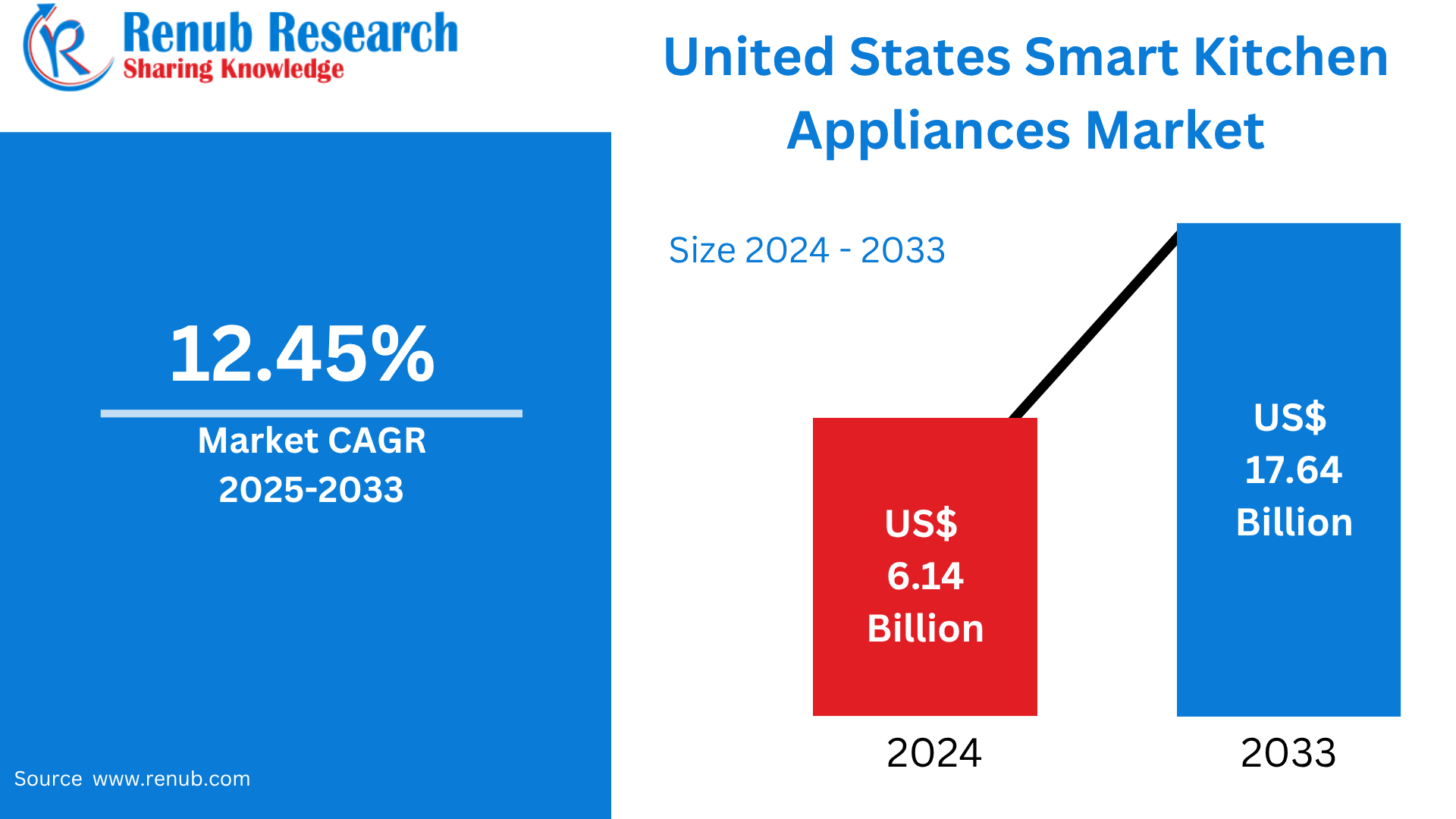
United States Smart Kitchen Appliances Market will grow from US$ 6.14 Billion in 2025 to US$ 17.64 Billion by 2034, registering a Compound Annual Growth Rate (CAGR) of 12.45% during the forecast period of 2026–2034. Market growth is driven by rising adoption of connected home technologies, increasing consumer demand for energy-efficient and AI-enabled appliances, expanding smart home ecosystems, and growing preference for convenience in meal preparation. Continuous technological advancements, integration with voice assistants, and increasing investments in IoT-enabled household appliances are expected to further accelerate market expansion.
USA Smart Home Devices Key Stats
- 77 million homes in the United States actively use smart home devices.
- 51.4% of all U.S. households have at least one smart home device.
- Consumer electronics, such as smart speakers and entertainment systems, account for around 37% of the global smart home devices market.
- 7 in 10 homebuyers are actively looking for a smart home.
- 78% of homebuyers would be willing to pay more for a smart home.
United States Smart Kitchen Appliances Industry Overview
Smart kitchen appliances are internet-connected household devices equipped with advanced technologies such as the Internet of Things (IoT), artificial intelligence (AI), sensors, and wireless connectivity that enable users to monitor, control, and automate kitchen tasks remotely through smartphones, tablets, or voice assistants. These appliances include smart refrigerators, ovens, microwaves, dishwashers, coffee makers, cooktops, air fryers, and other connected cooking devices. They offer features such as remote operation, energy monitoring, automated cooking programs, inventory management, maintenance alerts, recipe guidance, and compatibility with smart home ecosystems. By improving convenience, reducing energy consumption, and simplifying meal preparation, smart kitchen appliances enhance everyday household efficiency.
In the United States, the popularity of smart kitchen appliances has increased significantly due to growing smart home adoption, high internet penetration, and strong consumer demand for connected living solutions. Busy lifestyles, increasing disposable incomes, and rising awareness of energy-efficient appliances have encouraged homeowners to invest in intelligent kitchen technologies. Continuous innovations in AI, voice control, mobile applications, and predictive maintenance, combined with expanding smart home ecosystems, continue to drive widespread adoption of smart kitchen appliances across U.S. households.
Smart Kitchen Appliance Launches in the United States
- January 2023 – Samsung: Launched the Bespoke AI™ Oven, featuring AI Pro Cooking, internal camera monitoring, food recognition, and SmartThings connectivity for remote control and recipe guidance.
- August 2023 – LG Electronics USA: Expanded its LG Signature Kitchen Suite lineup with AI-enabled smart wall ovens and induction cooktops offering ThinQ® connectivity, remote diagnostics, and voice assistant integration.
- September 2023 – GE Appliances: Introduced the GE Profile™ Smart Indoor Smoker, a Wi-Fi-enabled countertop appliance that allows users to control smoking temperature and cooking cycles through the SmartHQ mobile app.
- January 2024 – Samsung: Launched the Bespoke 4-Door Flex™ Refrigerator with AI Family Hub+, featuring a 32-inch touchscreen, AI Vision Inside food recognition, SmartThings integration, and enhanced food inventory management.
- January 2024 – LG Electronics: Introduced an upgraded LG InstaView® Smart Refrigerator with ThinQ AI, improved food management features, and energy monitoring capabilities for connected households.
- January 2024 – GE Profile: Released the GE Profile™ Smart Mixer, equipped with Auto Sense technology, Wi-Fi connectivity, guided recipes, and automatic speed optimization for home baking.
- September 2024 – SharkNinja: Expanded its connected kitchen portfolio with the Ninja Luxe Café Premier Series, a smart espresso machine featuring guided brewing, automatic calibration, and intelligent beverage customization.
- January 2025 – Samsung: Introduced the Bespoke AI Refrigerator with AI Hybrid Cooling, incorporating AI energy optimization, advanced food preservation technology, and deeper SmartThings home integration.
- January 2025 – LG Electronics USA: Unveiled its latest ThinQ ON AI Home Hub alongside a new generation of connected kitchen appliances, enabling centralized control of smart refrigerators, ovens, and other kitchen devices through an AI-powered home platform.
- 2025 – GE Appliances: Expanded the GE Profile Smart Kitchen Ecosystem with new Wi-Fi-enabled wall ovens, induction ranges, and dishwashers featuring AI-assisted cooking modes, over-the-air software updates, and enhanced SmartHQ integration.
Key Growth Pillars
Increasing Adoption of Smart Home Ecosystems and IoT Technologies
The rapid expansion of smart home ecosystems is one of the primary drivers of the United States smart kitchen appliances market. Consumers are increasingly integrating connected devices into their homes to improve convenience, energy efficiency, and automation. Smart refrigerators, ovens, dishwashers, coffee makers, and cooktops can now communicate with smartphones and voice assistants, allowing users to remotely monitor and control appliances from virtually anywhere. Integration with Internet of Things (IoT) platforms enables real-time notifications, predictive maintenance alerts, automated cooking programs, and personalized settings based on user preferences. Compatibility with connected home ecosystems has also improved interoperability among multiple household devices, creating a seamless smart living experience. As broadband connectivity, Wi-Fi coverage, and cloud computing technologies continue to improve across the United States, consumers are becoming more willing to invest in intelligent kitchen solutions. Ongoing innovation in connected appliances and expanding smart home adoption are expected to remain major contributors to sustained market growth throughout the forecast period.
Rising Consumer Demand for Convenience and Time-Saving Solutions
Changing lifestyles and increasing demand for convenience have significantly accelerated the adoption of smart kitchen appliances in the United States. Busy work schedules, dual-income households, and growing urbanization have encouraged consumers to seek technologies that simplify daily cooking and kitchen management. Smart appliances offer automated cooking programs, remote monitoring, voice-controlled operation, recipe integration, inventory tracking, and scheduled operation, reducing the time and effort required for meal preparation. Mobile applications allow users to preheat ovens, monitor cooking progress, receive maintenance reminders, and control appliances even when away from home. Artificial intelligence further enhances the user experience by learning household preferences and recommending optimized cooking settings. Manufacturers continue introducing multifunctional appliances that combine several kitchen tasks into a single connected device, improving space utilization and convenience. As consumers increasingly prioritize efficiency, comfort, and personalized home experiences, demand for advanced smart kitchen appliances is expected to continue growing across residential households in the United States.
Growing Focus on Energy Efficiency and Sustainable Living
Increasing awareness of energy conservation and environmental sustainability is driving demand for smart kitchen appliances across the United States. Consumers are actively seeking appliances that reduce electricity and water consumption while lowering household utility costs. Smart refrigerators, dishwashers, ovens, and washing systems utilize intelligent sensors, automated power management, and energy optimization features that improve operational efficiency without compromising performance. Many connected appliances provide real-time energy usage monitoring through mobile applications, enabling homeowners to better manage consumption and identify opportunities for cost savings. Government initiatives promoting energy-efficient household appliances and growing consumer interest in environmentally responsible products further encourage market adoption. Manufacturers continue investing in inverter technologies, AI-powered resource optimization, and environmentally friendly materials to improve appliance performance and sustainability. As environmental awareness continues to increase and consumers prioritize long-term operating cost reductions, demand for energy-efficient smart kitchen appliances is expected to remain a significant growth driver for the U.S. market.
Market Restraints
High Product Costs and Limited Consumer Affordability
Despite growing adoption, the relatively high purchase price of smart kitchen appliances remains a significant challenge for the United States market. Connected appliances typically incorporate advanced technologies such as artificial intelligence, Internet of Things connectivity, sensors, touch-screen interfaces, and cloud-based software, resulting in higher manufacturing costs compared to conventional kitchen appliances. In addition to initial purchase expenses, consumers may also face installation costs, software updates, maintenance requirements, and occasional subscription-based smart services. Price-sensitive households may delay upgrading existing appliances, particularly when traditional alternatives continue to meet their daily needs. Economic uncertainty, inflation, and fluctuating consumer spending patterns can further influence purchasing decisions for premium smart appliances. Manufacturers are responding by introducing products across multiple price segments and offering financing options to improve affordability. However, balancing advanced functionality with competitive pricing remains a major challenge that could influence the pace of market penetration in the coming years.
Cybersecurity Risks and Data Privacy Concerns
Cybersecurity and data privacy concerns remain critical challenges for the United States smart kitchen appliances market as connected devices become increasingly integrated into home networks. Smart appliances continuously collect operational data, user preferences, and connectivity information to provide personalized services and remote management features. However, internet-connected devices may also become potential targets for cyberattacks, unauthorized access, malware, and data breaches if security measures are inadequate. Consumers are becoming more cautious about sharing personal information and connecting multiple household devices to cloud-based platforms. Security vulnerabilities can reduce consumer confidence and slow adoption of connected kitchen technologies. Manufacturers must continuously invest in software updates, encrypted communications, secure authentication methods, and compliance with evolving cybersecurity regulations to protect customer data. Maintaining robust cybersecurity infrastructure while ensuring seamless device performance and user convenience will remain essential for strengthening consumer trust and supporting the long-term growth of the United States smart kitchen appliances market.
Smart Refrigerators in United States
The United States smart refrigerators market is experiencing strong growth as consumers increasingly adopt connected home technologies that enhance convenience, food management, and energy efficiency. Smart refrigerators are equipped with Internet of Things (IoT) connectivity, internal cameras, touch-screen displays, artificial intelligence, and voice assistant compatibility, enabling users to remotely monitor food inventory, receive expiration alerts, create shopping lists, and control appliance settings through mobile applications. The growing popularity of smart homes and busy lifestyles has encouraged households to invest in intelligent appliances that simplify daily kitchen operations. Manufacturers continue introducing advanced features such as automatic temperature adjustment, beverage management, recipe recommendations, family communication hubs, and predictive maintenance alerts. Increasing consumer awareness of energy-efficient appliances and sustainable living further supports market demand. Continuous innovation in connected technologies, cloud integration, and AI-powered food preservation systems is expected to strengthen the adoption of smart refrigerators across residential households throughout the United States during the forecast period.
Smart Ovens in United States
The United States smart ovens market is expanding rapidly due to increasing consumer demand for automated cooking, remote appliance control, and personalized meal preparation. Smart ovens integrate artificial intelligence, wireless connectivity, voice control, and mobile applications to enable users to preheat ovens remotely, monitor cooking progress, adjust temperatures, and receive cooking notifications from virtually anywhere. Many advanced models feature automated cooking programs, food recognition technology, precision temperature control, and guided recipe integration that improve cooking consistency while reducing preparation time. Growing interest in home cooking, premium kitchen remodeling, and multifunctional appliances has further accelerated adoption among residential consumers. Manufacturers continue investing in innovative features such as steam cooking, convection technology, self-cleaning functions, and compatibility with smart home ecosystems. Increasing awareness of energy-efficient appliances and the demand for enhanced kitchen convenience are expected to support continued market expansion as consumers seek intelligent solutions that improve cooking performance and everyday household efficiency.
Wi-Fi Smart Kitchen Appliances in United States
The United States Wi-Fi smart kitchen appliances market is benefiting from widespread broadband availability, increasing smart home penetration, and growing consumer preference for connected living environments. Wi-Fi-enabled refrigerators, dishwashers, ovens, microwaves, coffee makers, and small kitchen appliances allow homeowners to monitor, schedule, and control appliance functions remotely through dedicated mobile applications or voice assistants. Cloud connectivity enables software updates, predictive maintenance notifications, energy consumption monitoring, and personalized operating preferences without requiring manual intervention. Consumers increasingly value the convenience of receiving maintenance alerts, accessing cooking guidance, and integrating multiple appliances within a unified smart home ecosystem. Manufacturers continue enhancing cybersecurity features, user interfaces, and interoperability with popular home automation platforms to improve customer experience. Rising investments in artificial intelligence, machine learning, and Internet of Things infrastructure are enabling more intelligent appliance functionality, making Wi-Fi connectivity a standard feature across premium and mid-range kitchen appliances in the United States market.
Residential Smart Kitchen Appliances industry in United States
The residential smart kitchen appliances market represents the largest application segment within the United States smart kitchen appliances industry. Homeowners are increasingly investing in connected refrigerators, ovens, dishwashers, coffee machines, microwaves, and other intelligent kitchen appliances that improve convenience, energy efficiency, and household productivity. Growing disposable incomes, rising home renovation activities, and increasing adoption of smart home ecosystems have significantly contributed to residential demand. Consumers are attracted to features such as remote operation, voice assistant compatibility, automated cooking programs, inventory management, energy monitoring, and predictive maintenance capabilities that simplify everyday kitchen tasks. The expansion of online retail channels and flexible financing options has also improved accessibility to premium smart appliances. Manufacturers continue introducing AI-powered personalization, improved connectivity, and sustainable energy-saving technologies to meet evolving consumer expectations. As digital lifestyles become increasingly common and homeowners prioritize convenience and automation, the residential segment is expected to remain the primary driver of growth in the United States smart kitchen appliances market.
Smart Kitchen Appliances Market Acceptance in California
California represents one of the largest and most technologically advanced markets for smart kitchen appliances in the United States. The state’s high adoption of smart home technologies, strong broadband infrastructure, and environmentally conscious consumer base continue to drive demand for connected kitchen solutions. Consumers increasingly prefer smart refrigerators, ovens, dishwashers, coffee makers, and other IoT-enabled appliances that improve convenience, energy efficiency, and home automation. California’s emphasis on sustainability and energy conservation has accelerated the adoption of ENERGY STAR-certified appliances featuring intelligent energy management systems and water-saving technologies. High disposable incomes, premium housing developments, and continuous investment in smart home ecosystems further support market expansion. The presence of leading technology companies and innovation-driven manufacturers also encourages the introduction of AI-enabled appliances with advanced automation, predictive maintenance, and voice assistant compatibility. Growing home renovation activities and increasing consumer preference for connected living are expected to sustain California’s leadership in the U.S. smart kitchen appliances market.
Texas Smart Kitchen Appliances Industry
The Texas smart kitchen appliances market is witnessing robust growth, supported by rapid population expansion, residential construction, urbanization, and increasing adoption of connected home technologies. Major metropolitan areas such as Houston, Dallas, Austin, and San Antonio are experiencing rising demand for intelligent kitchen appliances that improve household convenience, reduce energy consumption, and simplify meal preparation. Strong economic growth and increasing disposable household incomes encourage consumers to invest in premium and mid-range smart appliances equipped with artificial intelligence, Wi-Fi connectivity, and voice-controlled functionality. The expansion of modern housing developments incorporating smart home infrastructure further strengthens market demand. Retailers and manufacturers continue expanding their presence through omnichannel sales strategies, financing options, and promotional campaigns targeting homeowners upgrading their kitchens. Growing awareness of sustainability, combined with rising electricity cost management and increasing interest in home automation, is expected to support continued expansion of the Texas smart kitchen appliances market throughout the forecast period.
New York Smart Kitchen Appliances Market
The New York smart kitchen appliances market is expanding steadily due to high urbanization, strong digital connectivity, and increasing consumer demand for technologically advanced home appliances. Consumers, particularly in densely populated metropolitan areas, increasingly prefer compact, multifunctional, and connected kitchen appliances that maximize space while enhancing convenience. Smart refrigerators, ovens, microwaves, coffee machines, and dishwashers equipped with mobile connectivity and voice assistant integration have gained significant popularity among busy professionals and technology-oriented households. Growing awareness of energy-efficient appliances and sustainable living also supports purchasing decisions across residential consumers. The state’s mature retail network and expanding e-commerce channels provide consumers with access to a wide variety of premium smart appliance brands. Manufacturers continue introducing products featuring artificial intelligence, personalized cooking programs, and advanced automation to meet evolving consumer expectations. Continued investment in smart home technologies and increasing home renovation projects are expected to maintain steady growth in New York’s smart kitchen appliances market.
Florida Smart Kitchen Appliances Industry
The Florida smart kitchen appliances market is experiencing consistent growth, driven by expanding residential construction, rising smart home adoption, and increasing consumer interest in connected living solutions. The state’s growing population, including young professionals, families, and retirees, is creating strong demand for appliances that improve convenience, automate household tasks, and reduce energy consumption. Smart refrigerators, ovens, dishwashers, and coffee makers equipped with Wi-Fi connectivity, voice control, and mobile applications are becoming increasingly popular among homeowners seeking modern kitchen experiences. Florida’s expanding housing developments and luxury residential projects further encourage the installation of integrated smart home systems. Retailers are strengthening their market presence through online platforms, product bundles, and financing programs that improve affordability. Growing awareness of environmental sustainability and energy-efficient appliances continues to influence consumer purchasing behavior. Ongoing technological innovation, expanding digital infrastructure, and rising household investment in home automation are expected to support long-term growth of the Florida smart kitchen appliances market
Market Segmentations
Product
- Smart Refrigerators
- Smart Cookware & Cooktops
- Smart Ovens
- Smart Dishwashers
- Others
Connectivity Technology
- Bluetooth
- Wi-Fi
- NFC
- Others
Application
- Residential
- Commercial
States
- California
- Texas
- New York
- Florida
- Illinois
- Pennsylvania
- Ohio
- Georgia
- New Jersey
- Washington
- North Carolina
- Massachusetts
- Virginia
- Michigan
- Maryland
- Colorado
- Tennessee
- Indiana
- Arizona
- Minnesota
- Wisconsin
- Missouri
- Connecticut
- South Carolina
- Oregon
- Louisiana
- Alabama
- Kentucky
- Rest of United States
All the Key players have been covered
- Overviews
- Key Person
- Recent Developments
- SWOT Analysis
- Revenue Analysis
Company Analysis:
- AB Electrolux
- Samsung Electronics Co. Ltd
- Whirlpool Corporation
- LG Electronics Inc.
- BSH Home Appliances Corporation
- Panasonic Corporation
- Haier Group
- Breville Group Limited
- Miele
- Philips
Report Details:
| Report Features | Details |
| Base Year |
2024 |
| Historical Period |
2021 - 2024 |
| Forecast Period |
2025 - 2033 |
| Market |
US$ Billion |
| Segment Covered |
Product, Connectivity Technology, Application and States |
| States Covered |
|
| Companies Covered |
|
| Customization Scope |
20% Free Customization |
| Post-Sale Analyst Support |
1 Year (52 Weeks) |
| Delivery Format |
PDF and Excel through Email (We can also provide the editable version of the report in PPT/Word format on request) |
Customization Services available
- Analysis of Market Size and Its Segments
- More Company Profiles (Upto 10 without any additional cost):
- Additional Countries (Other than mentioned Countries):
- Region/Country Specific Reports:
- Market Entry Strategy:
- Region-Specific Market Dynamics:
- Regional Market Share Analysis:
- Trade Analysis:
- Production Insights:
- Others Customized Requests:
For more information contact our analysts.
Need More Assistance?
- Talk to our analysts to get more precious information on the current market trends.
- Include more countries and segments and customize the report based on the final requirement.
- Get a competitive advantage in your industry by knowing the report findings and making a positive impact on your revenues and operations.
- Our analysts are always ready to provide more help and pertinent information if you need any additional assistance.