United States Payment Gateway Market Forecast Report by Type, Enterprise Size, End User, States, and Companies Analysis 2026-2034
Buy NowUnited States Payment Gateway Market Size and Forecast 2026-2034
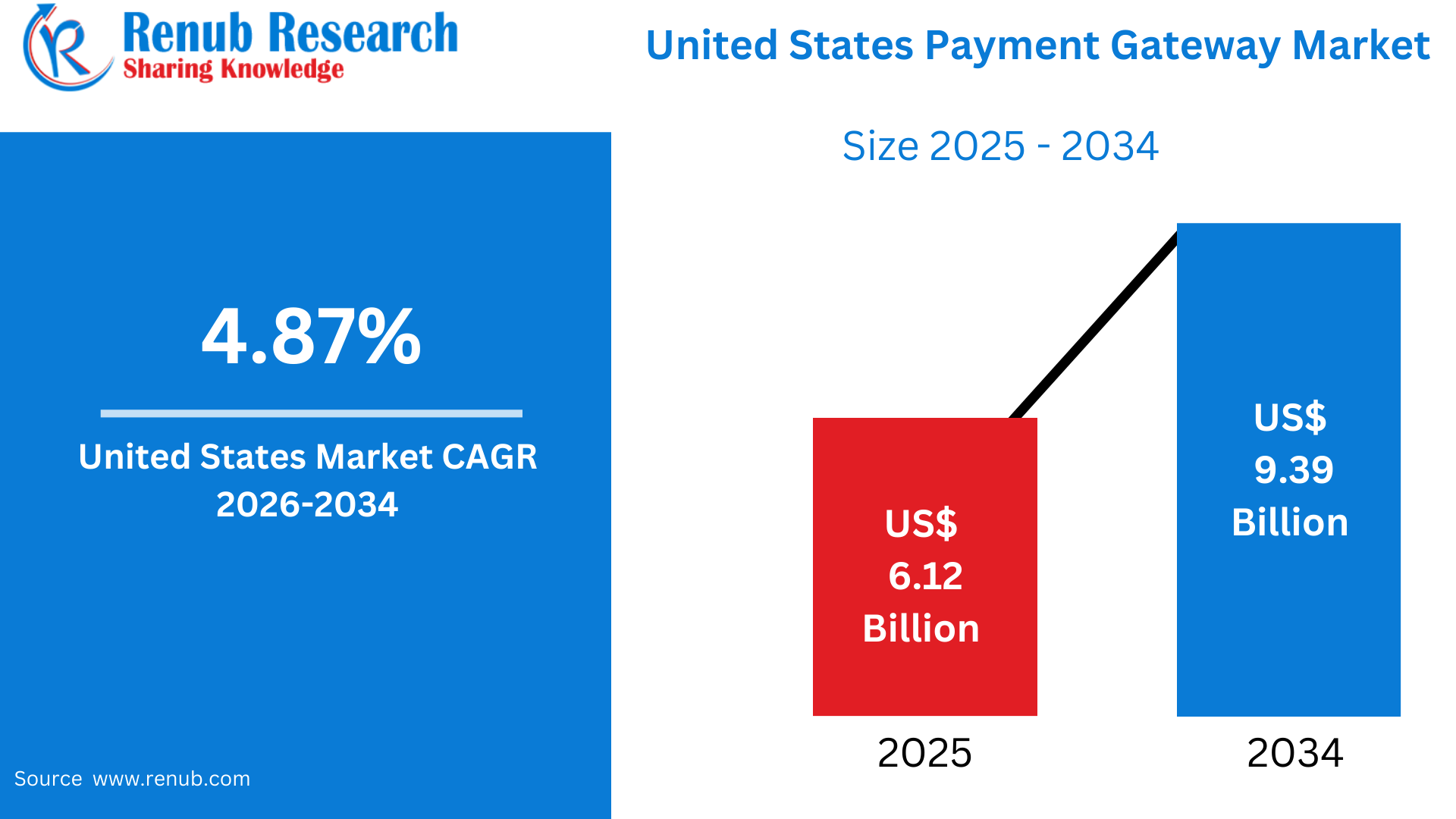
United States Payment Gateway Market is expected to reach US$ 9.39 billion by 2034 from US$ 6.12 billion in 2025, with a CAGR of 4.87% from 2026 to 2034. Rapid e-commerce growth, increasing mobile and contactless payments, adoption of digital wallets, technological innovations like AI and fraud detection, and regulatory compliance are driving demand for secure, efficient, and seamless payment gateway solutions in the U.S.
United States Payment Gateway Industry Overview
The United States payment gateway industry plays a pivotal role in the nation’s rapidly expanding digital economy, serving as a critical infrastructure for secure, efficient, and seamless online transactions. Payment gateways act as intermediaries between consumers, merchants, and financial institutions, facilitating the authorization, processing, and settlement of payments through credit/debit cards, digital wallets, bank transfers, and emerging digital currencies. The rapid growth of e-commerce, mobile commerce, and digital services has significantly increased transaction volumes, driving the demand for robust and scalable payment gateway solutions capable of handling high-speed, high-volume operations.
Technological advancements are shaping the U.S. payment gateway industry, with innovations in AI, machine learning, and advanced analytics improving fraud detection, transaction monitoring, and risk management. Cloud-based and API-driven solutions allow for seamless integration with websites, mobile applications, and point-of-sale systems, enabling businesses to deliver convenient, flexible, and secure payment experiences. Enhanced security measures, including tokenization, end-to-end encryption, and 3D Secure protocols, ensure that sensitive customer information remains protected, fostering trust and confidence among consumers and merchants alike.
Regulatory compliance is also a key factor influencing the market. U.S. payment gateways must adhere to stringent standards such as PCI DSS, alongside federal and state-level data protection and financial regulations. These measures not only enhance security but also promote transparency, reliability, and consumer confidence in digital transactions. Additionally, the growing adoption of contactless payments, mobile wallets, and cross-border e-commerce has expanded the market for multi-currency and international payment processing solutions. Competitive dynamics in the industry involve a mix of established financial institutions, global payment gateway providers, and fintech startups, all striving to innovate, improve user experience, and offer scalable solutions. With continued growth in online commerce, mobile payments, and digital financial services, the United States payment gateway industry is expected to sustain strong growth, reinforcing its role as a cornerstone of the country’s digital payment ecosystem.
Growth Drivers for the United States Payment Gateway Market
Increasing Cross-Border E-Commerce and Global Transactions
The rise of cross-border e-commerce is a significant growth driver for the U.S. payment gateway market. With U.S.-based businesses increasingly selling to international customers, there is a growing need for gateways that support multi-currency transactions, international payment methods, and compliance with foreign regulations. Payment gateways enable real-time currency conversion, tax calculation, and secure cross-border processing, allowing merchants to expand globally without operational delays or payment failures. Consumers also benefit from seamless international transactions with familiar local payment options, enhancing trust and conversion rates. The growing demand for global digital marketplaces, subscription-based services, and online exports further reinforces the need for versatile, multi-currency gateway solutions. By facilitating secure, efficient, and fast international payments, cross-border e-commerce is driving adoption and innovation in the U.S. payment gateway industry.
Growing Fintech Innovation and Startup Ecosystem
Fintech innovation is a key driver of growth in the U.S. payment gateway market. A vibrant startup ecosystem is introducing novel payment solutions, from digital wallets and BNPL (Buy Now, Pay Later) platforms to AI-based fraud prevention and mobile-first payment apps. These solutions are rapidly integrated with traditional payment gateways, improving flexibility, security, and convenience for both merchants and consumers. Established banks and financial institutions are also collaborating with fintech companies to offer advanced, seamless, and scalable payment services. Continuous innovation enhances user experience, reduces transaction time, and attracts tech-savvy consumers, while increasing competition fosters improvements in gateway reliability and features. The dynamic fintech environment drives adoption of advanced gateway solutions, accelerates technology upgrades, and expands the market for secure, efficient, and flexible payment processing in the United States.
Increasing Regulatory Compliance and Trust in Digital Payments
Regulatory frameworks and security standards play a crucial role in driving growth for the U.S. payment gateway market. Compliance with PCI DSS, federal and state-level data protection laws, and anti-fraud regulations enhances consumer and merchant trust in digital transactions. Payment gateways that adhere to these standards offer secure transaction processing, reduce risks of fraud, and maintain transparency, which encourages wider adoption among businesses and consumers. Furthermore, regulatory mandates incentivize the integration of advanced security features like tokenization, encryption, and two-factor authentication into gateway solutions. By ensuring reliability and reducing operational and legal risks, regulatory compliance fosters confidence in digital payments, promotes market growth, and enables widespread adoption of innovative payment technologies across industries in the United States.
Challenges in the United States Payment Gateway Market
High Competition and Market Saturation
The U.S. payment gateway market faces high competition due to the presence of numerous established players, fintech startups, and global payment providers. Market saturation makes customer acquisition and retention increasingly challenging, forcing providers to differentiate through pricing, technology, and service quality. Merchants often have multiple gateway options, leading to intense pressure on providers to offer faster processing, lower fees, and advanced features like fraud protection and multi-currency support. Smaller or emerging players may struggle to compete with larger incumbents that have extensive resources, strong brand recognition, and established client networks. Sustaining profitability and growth in a competitive and crowded market is a key challenge for U.S. payment gateway providers.
Technical Integration and Infrastructure Complexity
Integrating payment gateways with diverse merchant systems, e-commerce platforms, mobile apps, and point-of-sale solutions presents a significant challenge. Customization, API compatibility, and system upgrades can be complex, requiring specialized technical expertise. Poor integration can lead to failed transactions, delayed payments, and reduced user satisfaction. Maintaining uptime, scaling for high-volume transactions, and ensuring real-time processing further complicates operations, especially for high-density e-commerce and omnichannel businesses. Additionally, regular software updates and cybersecurity patches are necessary to maintain reliability and compliance, increasing operational demands. Technical integration complexity can limit adoption among small businesses and startups, making it a persistent challenge for the U.S. payment gateway market.
California Payment Gateway Market
The California payment gateway market benefits from being part of the broader rapidly expanding global and U.S. payment gateway sector, which is driven by e‑commerce growth, mobile and contactless payments, and demand for secure, seamless transaction processing solutions. Globally, the payment gateway market is projected to grow strongly through 2029 and beyond as businesses increasingly adopt digital payment methods and advanced technologies like AI and APIs for enhanced fraud prevention and scalability.
In California specifically, a thriving fintech ecosystem anchored in Silicon Valley fuels innovation and adoption of payment gateways. Major gateway and payments‑tech companies such as CyberSource (Foster City) and WePay (Redwood City) are headquartered in the state and contribute to both local and national market activity, providing APIs and integrated solutions for e‑commerce, platforms, and marketplaces.
California’s strong tech infrastructure, venture investment environment, and concentration of startups help support cutting‑edge payment services and attract talent, reinforcing the state’s role in shaping how digital payments evolve in the U.S. market.
Texas Payment Gateway Market
The Texas payment gateway market is expanding as digital commerce and fintech adoption grow across key cities like Dallas, Houston, Austin, and San Antonio. The U.S. South, including Texas, is projected to hold a significant share of the national payment gateway market, driven by robust e‑commerce activity and supportive business environments that attract technology providers and merchants alike.
Local payment technology firms and processors offer secure, scalable gateway services for online, in‑store, and mobile transactions, helping small and midsize businesses streamline payments and boost cash flow. Examples include Authorize. Net’s gateway operations based in Houston and regional providers that serve local merchants with customized solutions. Major fintech and payments companies in Texas also contribute to the ecosystem — from Green Dot’s payment platform technology in Austin to Usio’s integrated acceptance services in San Antonio — reinforcing statewide capabilities in transaction processing.
With continued digital transformation, increasing merchant demand for seamless online payments, and a large pool of fintech talent and startups, Texas is poised for strong growth in payment gateway adoption and innovation.
New York Payment Gateway Market
The New York payment gateway market is a dynamic segment of the broader U.S. digital payments landscape, bolstered by the state’s global financial hub status and large base of merchants and tech innovators. Major national and international gateways like Stripe, Square, and PayPal have strong usage among New York businesses, serving e‑commerce, retail, hospitality, and financial services with secure and scalable online and point‑of‑sale solutions. Local fintech activity also contributes with startups and firms developing niche payment technologies and cross‑border processing services.
New York’s robust fintech ecosystem attracts companies that expand or base key operations in the city, including crypto‑focused payment firms and established platforms growing their footprint, reflecting demand for advanced payment processing and innovation. Regulatory scrutiny—such as enforcement actions around compliance and fraud protection—also shapes how payment firms operate and manage risks in the state.
Overall, strong digital commerce growth, high merchant adoption, and New York’s financial services infrastructure make the payment gateway market in the state poised for continued expansion.
Florida Payment Gateway Market
The Florida payment gateway market is growing as businesses adopt digital and omnichannel payment solutions across tourism, retail, utilities, and services sectors. Local providers and national gateways like Authorize.Net are widely used by Florida merchants for secure online, in‑store, and mobile transactions, helping streamline checkout and fraud protection for small and mid‑size businesses.
Florida’s vibrant fintech ecosystem — especially in Miami, Tampa, and Jacksonville — supports innovation in payments, with firms offering integrated gateways, invoicing, ACH support, and tailored platforms for local needs. Regional players such as Nationwide Payment Systems deliver scalable gateway solutions with personalized service, while utilities and municipalities increasingly leverage platforms like Paymentus for multi‑channel billing and online payments.
Market trends in Florida reflect broader U.S. shifts toward contactless payments, mobile wallets, and real‑time processing, driven by merchant demand for seamless, secure digital experiences. Omnichannel gateways connecting e‑commerce, POS, and mobile channels bolster competitive adoption.
Recent Developments in the United States Payment Gateway Market
- In an effort to improve Account-to-Account (A2A) payments, Dwolla introduced its new Open Banking Services in April 2024. Dwolla provides businesses with a simple implementation process by pre-integrating with top open banking service providers. This reduces complexity and speeds up the launch of A2A payment solutions using Dwolla's single API.
- San Francisco, April 2024 Stripe, a financial infrastructure platform for businesses, has announced a partnership with URBN to manage retail transactions for Urban Outfitters, Anthropologie Group, Free People, and FP Movement both online and in-store. Additionally, by using Stripe as its primary payment infrastructure, URBN hopes to increase authorization rates, improve user checkout uniformity, and open the door for future developments.
Market Segmentation
Type
- Hosted
- Non-hosted
Enterprise
- Large Enterprises
- Small & Medium Enterprises
End User
- BFSI
- Media & Entertainment
- Retail & E-commerce
- Travel & Hospitality
- Others
States
- California
- Texas
- New York
- Florida
- Illinois
- Pennsylvania
- Ohio
- Georgia
- New Jersey
- Washington
- North Carolina
- Massachusetts
- Virginia
- Michigan
- Maryland
- Colorado
- Tennessee
- Indiana
- Arizona
- Minnesota
- Wisconsin
- Missouri
- Connecticut
- South Carolina
- Oregon
- Louisiana
- Alabama
- Kentucky
- Rest of United States
All companies have been covered with 5 Viewpoints
- Overviews
- Key Person
- Recent Developments
- SWOT Analysis
- Revenue
Company Analysis
- PayPal Holdings, Inc.
- Amazon Pay (Amazon.com, Inc.)
- Adyen
- JPMorgan Chase & Co.
- Stripe, Inc.
- BitPay Inc.
- Braintree
- Wepay, Inc
Report Details:
| Report Features | Details |
| Base Year |
2025 |
| Historical Period |
2022 - 2025 |
| Forecast Period |
2026 - 2034 |
| Market |
US$ Billion |
| Segment Covered |
Type, Enterprise, End User and States |
| States Covered |
|
| Companies Covered |
|
| Customization Scope |
20% Free Customization |
| Post-Sale Analyst Support |
1 Year (52 Weeks) |
| Delivery Format |
PDF and Excel through Email (We can also provide the editable version of the report in PPT/Word format on request) |
Customization Services available
- Analysis of Market Size and Its Segments
- More Company Profiles (Upto 10 without any additional cost):
- Additional Countries (Other than mentioned Countries):
- Region/Country Specific Reports:
- Market Entry Strategy:
- Region-Specific Market Dynamics:
- Regional Market Share Analysis:
- Trade Analysis:
- Production Insights:
- Others Customized Requests:
For more information contact our analysts.
Need More Assistance?
- Talk to our analysts to get more precious information on the current market trends.
- Include more countries and segments and customize the report based on the final requirement.
- Get a competitive advantage in your industry by knowing the report findings and making a positive impact on your revenues and operations.
- Our analysts are always ready to provide more help and pertinent information if you need any additional assistance.