United States In Situ Hybridization Market Report by Product, Technique, Application, End User, State and Companies Analysis 2026-2034
Buy NowUnited States In Situ Hybridization Market Size and Forecast 2026-2034
The United States In Situ Hybridization market is expected to rise from US$ 555.98 Million in 2025 to US$ 948.13 Million in 2034 due to increasing adoption of advanced molecular diagnostic techniques. Expanding applications in oncology, genetic disease detection, and infectious disease research are accelerating demand. The market is expected to grow at a CAGR of 6.11% from 2026–2034, supported by technological innovations, increased research investments, and growing importance of precision medicine in clinical and laboratory settings.
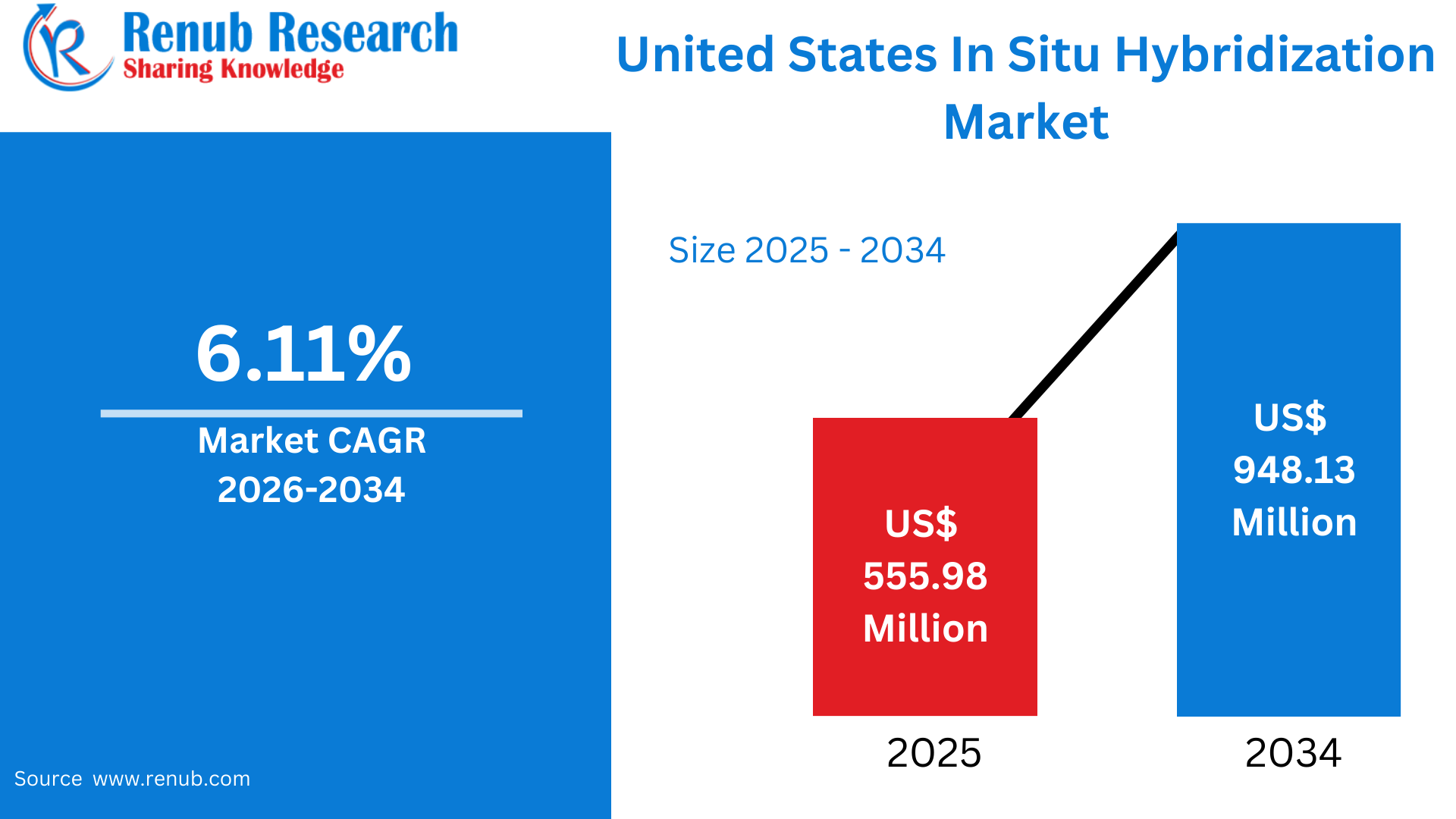
United States In Situ Hybridization Market Outlook
In Situ Hybridization (ISH) is a powerful molecular technique that detects and localizes specific nucleic acid sequences, DNA or RNA, in intact cells, tissues, or chromosomes. The method uses labeled probes that hybridize to the complementary genetic material to visualize gene expression patterns, chromosomal abnormalities, and the presence of pathogens directly in tissue samples. Variants like Fluorescence In Situ Hybridization (FISH) and Chromogenic In Situ Hybridization (CISH) offer high sensitivity and spatial resolution; thus, ISH is indispensable in cancer diagnostics, genetic testing, neuroscience, virology, and developmental biology.
In the U.S., ISH has gained great popularity in the face of a strong push toward precision medicine, early disease detection, and personalized treatment strategies. Oncology centers rely on ISH to identify gene amplifications, mutations, and biomarkers guiding targeted therapies. Academic research institutions and diagnostic laboratories also use the technique extensively for studying gene regulation and understanding disease mechanisms. The advancement in technology--automated platforms, improved probe design, and digital imaging--has increased its accuracy and efficiency even more. Due to increasing clinical applications and investments in molecular diagnostics, ISH continues to grow as an important tool within the biomedical and healthcare landscape of the United States.
Growth Drivers in the United States In Situ Hybridization Market
Rising Adoption of Precision Oncology & Biomarker-Guided Therapies
Precision oncology's growth is a key driver for the expansion of ISH in the U.S. ISH techniques, particularly FISH and CISH, are essential in the detection of gene amplifications, translocations, and copy-number variations that guide targeted therapies and companion diagnostics. As oncology moves toward biomarker-driven treatments from the use of one-size-fits-all treatments, so pathologists and oncologists are finding the use of ISH increasingly instrumental in the stratification of patients, confirmation of actionable mutations, and validation of therapeutic eligibility. The proliferation of targeted drugs and immunotherapies that depend on molecular confirmation propels clinical demand for robust tissue-based assays. Multidisciplinary tumor boards emphasize spatially resolved molecular data that ISH provides uniquely, supporting clinical decision-making. F. Hoffmann-La Roche Ltd received US FDA 510(k) clearance for its VENTANA Kappa and Lambda Dual ISH mRNA Probe Cocktail in January 2025. This clinically approved ISH assay is the first with the sensitivity to assess a full range of B-cell lymphoma subtypes.
Advances in Automation, Imaging & Probe Design
Technological innovations in automation, probe chemistry, and digital imaging also drive growth in the ISH market. Automated stainers, high-sensitivity labeled probes, improved fluorophores, and multiplexing chemistries have increased assay reproducibility, throughput, and assay complexity. Advances that reduce hands-on time and improve standardization across labs make ISH more accessible to medium- and high-volume diagnostic centers. High-resolution fluorescence microscopy and whole-slide imaging provide quantitative analysis, image archiving, and AI-assisted interpretation, enabling diagnostic confidence and remote consults. Improved probe specificities and signal-to-noise ratios reduce false results and broaden ISH applications to low-abundance targets and RNA-based detection. Bio-Techne Corporation announced, in October 2022, the commercialization of novel automated co-detection assays developed specifically for the Roche DISCOVERY ULTRA Platform, which allows for the simultaneous identification of both RNA and protein on the same tissue section, as the next step in the expansion of the Advanced Cell Diagnostics-branded RNAscope portfolio in ISH. Theradiag SA will supply autoimmune reagents and quality controls, while Quotient Limited can expect to see growth on its MosaiQ platform.
Increasing Clinical & Research Investment in Molecular Pathology
Growth in molecular pathology research and clinical testing is driving ISH demand. Federal, academic, and private investments in genomics, translational research, and companion diagnostic development are building laboratory capacity and specialized testing services. Clinical trials increasingly incorporate spatially resolved molecular endpoints that require ISH to validate gene expression patterns and tumor microenvironment studies. The increasing awareness among clinicians of the clinical value of tissue-based molecular assays is driving test ordering for cancer, genetic disorders, and infectious diseases. Finally, the expansion of centralized reference laboratories and pathology networks scales ISH testing as these entities offer specialized services to community hospitals and outpatient facilities. Training programs and continuing medical education on molecular diagnostics foster adoption among pathologists and lab directors. January 2025 - Leica Biosystems, a global leader in anatomic and digital pathology solutions; and Indica Labs, a global leader in artificial intelligence (AI)-powered digital pathology software announced that Leica Biosystems has agreed to make a significant strategic investment in Indica Labs. This will potentially accelerate AI-enabled companion diagnostics (CDx) and support discoveries and treatments based on discrete or complex biomarker expression profiles, not discernable by the human eye.
Challenges in the United States In Situ Hybridization Market
High cost of equipment, reagents, and skilled labor
A major barrier to the widespread adoption of ISH is the cumulative cost of implementation. Automated stainers, high-resolution imaging systems, and multiplex-capable fluorescence microscopes require substantial capital investment. Consumables—specialized probes, labeled nucleotides, signal amplification kits, and quality control materials—can be expensive on a per-test basis, particularly for multiplex assays. Additionally, ISH requires trained histotechnologists and molecular pathologists for protocol execution and result interpretation; recruiting and retaining such skilled personnel is costly and competitive. Smaller hospitals and community laboratories may find capital and operational expenditure unaffordable, with centralized testing models resulting in increased turnaround times. Another complication to economic viability is the variability in reimbursement for complex molecular tissue assays.
Technical Complexity, Standardization & Interpretation Variability
The second major challenge is that ISH assays are technically challenging and sensitive to pre-analytical and analytical variables. Tissue fixation time, embedding practices, and section thickness impact probe accessibility and quality of signal. Variability between laboratories may be introduced by differences in probe design, hybridization conditions, and signal amplification strategies. Expert judgment is often needed for the interpretation of ISH, particularly in borderline or heterogeneous cases, and interobserver variability can remain a challenge. Multiplexed assays increase complexity in both spectral separation and signal unmixing. Although there is active interest in standardization, a lack of universally adopted protocols and external quality assessment for all applications of ISH can stand in the way of reproducibility.
United States In Situ Hybridization Analytical Instruments Market
The U.S. ISH analytical instruments market includes automated slide stainers, fluorescence microscopes, whole-slide scanners, hybridization ovens, and image analysis software. Automation reduces variability and increases throughput, enabling clinical and reference labs to process larger testing volumes driven by oncology diagnostics and trials. High-sensitivity fluorescence microscopes feature advanced optics and cameras to support multiplex FISH assays and single-molecule RNA detection, while whole-slide scanners digitize results for archiving, telepathology consults, and AI-driven quantitation. Instruments that integrate staining, imaging, and analysis streamline workflows, reduce turnaround time, and support regulatory compliance. The demand for compact, user-friendly instruments that enable mid-sized laboratories to internalize ISH testing in their labs is on the rise.
United States Fluorescence In Situ Hybridization Market
FISH is a cornerstone ISH technique in the U.S., valued for its sensitivity, spatial resolution, and clinical utility in oncology and genetic diagnostics. This technique allows for the direct detection of chromosomal rearrangements, gene amplifications, and specific RNA targets within the tissue architecture, thus guiding targeted therapies and risk stratification. Multiplex FISH chemistries and improved fluorophores have increased assay throughput and allow complex karyotypic analyses. Clinical reliance on FISH for hematologic malignancies, breast cancer HER2 testing, ALK/ROS1 rearrangements, and other actionable targets drives steady demand. FISH is often performed as a reflex or confirmatory test in academic centers and commercial laboratories when the sequencing or IHC results are ambiguous.
United States Chromogenic In Situ Hybridization Market
CISH uses nucleic acid detection combined with brightfield histology, yielding colorimetric signals observable on standard microscopes-a feature advantageous for most pathology laboratories. CISH offers permanent, durable staining that is easily integrated with regular H&E review, allowing the pathologist to correlate molecular signals with morphology without specialized fluorescence equipment. Ease of interpretation without specialized equipment has made CISH an attractive alternative, especially in community hospitals and labs with limited resources for fluorescence imaging. In diagnostic workflows where long-term archiving and ease of interpretation are highly valued, such as HER2 amplification testing, CISH remains a valuable complement or alternative to FISH. Whereas multiplexing is more difficult than in fluorescence methods, recent advances in chromogenic chemistries and signal amplification have improved sensitivity and expanded applications.
United States Infectious Diseases In Situ Hybridization Market
ISH applications in infectious disease diagnostics allow the direct visualization of pathogen nucleic acids within tissue context, aiding in the identification of viral, bacterial, fungal, and parasitic infections—especially in those cases when culture or PCR yields limited information. ISH has been used to diagnose tissue-invasive infections, to confirm etiologies in biopsy specimens, and to provide information on pathogen tropism. In transplant medicine, neuropathology, and histopathologic evaluation of granulomatous disease, ISH provides critical localization data. During outbreak investigations and research, ISH can map viral distribution and tissue reservoirs, informing pathogenesis studies. Laboratories leverage ISH for organisms that are difficult to culture or require spatial resolution to confirm disease association. This method is complementary to molecular PCR testing because it correlates the presence of pathogen RNA/DNA with histologic changes, thereby enhancing diagnostic specificity.
United States Genetic & Rare Disorders In Situ Hybridization Market
ISH has an important role in the diagnosis of genetic conditions and rare diseases where the localization of gene expression or chromosomal aberrations in tissues is informative. For conditions caused by mosaicism, focal developmental anomalies, or organ-specific changes in gene expression, ISH offers a spatially resolved complement to genomic sequencing. In the prenatal pathology and neonatal diagnostic setting, ISH identifies structural chromosomal anomalies and gene amplifications within tissue sections. In the study of rare diseases, ISH maps aberrant expression patterns in affected tissues to enable mechanistic study and biomarker discovery. Reference laboratories frequently use ISH during confirmatory testing when karyotype or sequencing results require anatomic correlation. As interest in precision diagnostics for rare conditions increases and as therapeutic development targets tissue-specific mechanisms, ISH continues to serve as a valuable tool for clinical assessment and study in the U.S. rare disease community.
United States In Situ Hybridization Diagnostic Laboratories Market
These include large reference labs, hospital-based molecular pathology departments, and specialized academic centers. Centralized labs offer validated panels, multiplex assays, and high-throughput workflows that smaller hospitals often send out because of the cost and complexity of setting up such operations. Reference laboratories will invest in automation, quality management, and the diversification of assays, thus offering rapid turnaround for oncology biomarkers, infectious agents, and research studies. Hospital laboratories with in-house ISH capabilities will continue to support immediate clinical needs, surgical pathology correlation, and urgent oncology cases. Partnerships between diagnostics providers and therapeutic developers will also create testing-as-a-service models for clinical trials and companion diagnostics. Overall, quality assurance programs, proficiency testing, and adherence to regulations are major differentiators in diagnostic labs. With the demand for tissue-based molecular testing continuing to grow, diagnostic laboratories that offer a combination of validated assays, expert interpretation, and robust logistics will lead the U.S. ISH service market.
California In Situ Hybridization Market
California's ISH market benefits from its dense network of academic institutions, biotech companies, and leading oncology centers. Research-intensive universities and translational labs often use ISH for developmental biology, neuroscience, and cancer research, thus creating strong demand for probes, instruments, and specialized services. Biotech and pharmaceutical firms in the state incorporate ISH in preclinical studies and biomarker development for drug candidates. Large cancer centers and hospital systems employ ISH for diagnostic assays and clinical trial endpoints, thus fueling investment in automation and digital pathology. The state's emphasis on innovation and early adoption of advanced molecular diagnostics undergirds growth in both clinical and research ISH segments. Moreover, tech companies and life-science labs are collaborating in teleradiology and clinical diagnostics to accelerate software-driven image analysis and AI applications in ISH interpretation, further enhancing California's leadership.
New York In Situ Hybridization Market
New York is home to many of the largest medical centers, research hospitals, and clinical laboratories that drive the utilization of ISH in oncology, infectious disease pathology, and translational studies. Academic medical centers tend to emphasize novel applications of ISH for challenging case work and clinical trials, while urban hospital networks support a core role for ISH in confirmatory diagnosis and therapy selection. The dense healthcare landscape and large patient volumes in the state support the availability of high-order ISH services, such as multiplex assays and rapid reflex testing. Reference labs based in the region provide send-out services to smaller hospitals throughout the Northeast. In addition, New York's strong clinical research environment facilitates the integration of ISH study endpoints into trial design, resulting in significant demand for validated assays and harmonized reporting. Taken together, complexity of practice, large caseloads, and research activity ensure consistent levels of ISH market activity within the state.
Washington In Situ Hybridization Market
The growing biotech industry, research institutions, and specific clinical centers throughout Washington State support the state's ISH market. Smaller in size compared to California or New York, the State of Washington's numerous biotech companies and medical research institutions fuel demand for ISH in translational projects and diagnostic development. Regional hospitals and academic laboratories apply ISH in targeted oncology testing and infectious disease diagnosis. Collaboration between research groups and technology companies advances the development of imaging and analysis tools that improve ISH workflows. Innovation and interdepartmental collaboration are highlighted within the state, where ISH services grow selectively to support applications in which tissue-based molecular insight is complementary to regional research priorities.
Arizona In Situ Hybridization Market
Arizona's ISH market is a segment with continuous growth, as its healthcare infrastructure, oncology services, and regional diagnostic laboratories expand. Concomitantly, as molecular pathology testing capacities increase at various hospitals and cancer treatment centers, ISH is increasingly indicated for confirmatory diagnostics and biomarker testing. Community hospitals frequently rely on send-out arrangements with large regional reference laboratories for sophisticated ISH assays, hence creating demand for centralized services. The state's growing population and investment in medical facilities continue to favor further adoption of ISH for the diagnosis of infectious diseases, tissue-based genetic testing, and clinical trial participation. Training programs and telepathology collaborations extend specialized interpretive expertise to more rural and suburban areas, enabling access to ISH diagnostics across wider swaths of Arizona.
Market Segmentations
Product
- Analytical Instruments
- Probes, Kits & Reagents
- Software & Services
- Other Products
Technique
- Fluorescence ISH (FISH)
- Chromogenic ISH (CISH)
- Amplified RNA-ISH (HCR, RNAscope)
- In-situ Sequencing (ISS)
Application
- Cancer Diagnostics & Research
- Infectious Diseases
- Genetic & Rare Disorders
- Neurological & Developmental Biology
- Other Applications
End User
- Diagnostic Laboratories
- Academic & Research Institutes
- Pharma-Biotech & CROs
- Veterinary & Environmental Labs
Top States
- California
- Texas
- New York
- Florida
- Illinois
- Pennsylvania
- Ohio
- Georgia
- New Jersey
- Washington
- North Carolina
- Massachusetts
- Virginia
- Michigan
- Maryland
- Colorado
- Tennessee
- Indiana
- Arizona
- Minnesota
- Wisconsin
- Missouri
- Connecticut
- South Carolina
- Oregon
- Louisiana
- Alabama
- Kentucky
- Rest of United States
All companies have been covered with 5 Viewpoints
- Overviews
- Key Person
- Recent Developments
- SWOT Analysis
- Revenue Analysis
Company Analysis:
- PerkinElmer, Inc.
- Thermo Fisher Scientific, Inc.
- BioView
- Agilent Technologies, Inc.
- Merck KGaA
- Bio-Rad Laboratories, Inc.
- Oxford Gene Technology IP Limited
- Neogenomics Laboratories, Inc.
- Advanced Cell Diagnostics, Inc.
Report Details:
| Report Features | Details |
| Base Year |
2025 |
| Historical Period |
2022 - 2025 |
| Forecast Period |
2026 - 2034 |
| Market |
US$ Billion |
| Segment Covered |
Product, Technique, Application, End User and States |
| States Covered |
|
| Companies Covered |
|
| Customization Scope |
20% Free Customization |
| Post-Sale Analyst Support |
1 Year (52 Weeks) |
| Delivery Format |
PDF and Excel through Email (We can also provide the editable version of the report in PPT/Word format on request) |
Customization Services available
- Analysis of Market Size and Its Segments
- More Company Profiles (Upto 10 without any additional cost):
- Additional Countries (Other than mentioned Countries):
- Region/Country Specific Reports:
- Market Entry Strategy:
- Region-Specific Market Dynamics:
- Regional Market Share Analysis:
- Trade Analysis:
- Production Insights:
- Others Customized Requests:
For more information contact our analysts.
Need More Assistance?
- Talk to our analysts to get more precious information on the current market trends.
- Include more countries and segments and customize the report based on the final requirement.
- Get a competitive advantage in your industry by knowing the report findings and making a positive impact on your revenues and operations.
- Our analysts are always ready to provide more help and pertinent information if you need any additional assistance.