United States Hydroponics Market Report by Type, Crop Type, Equipment, States and Company Analysis 2026-2034
Buy NowUnited States Hydroponics Market Size & Forecast
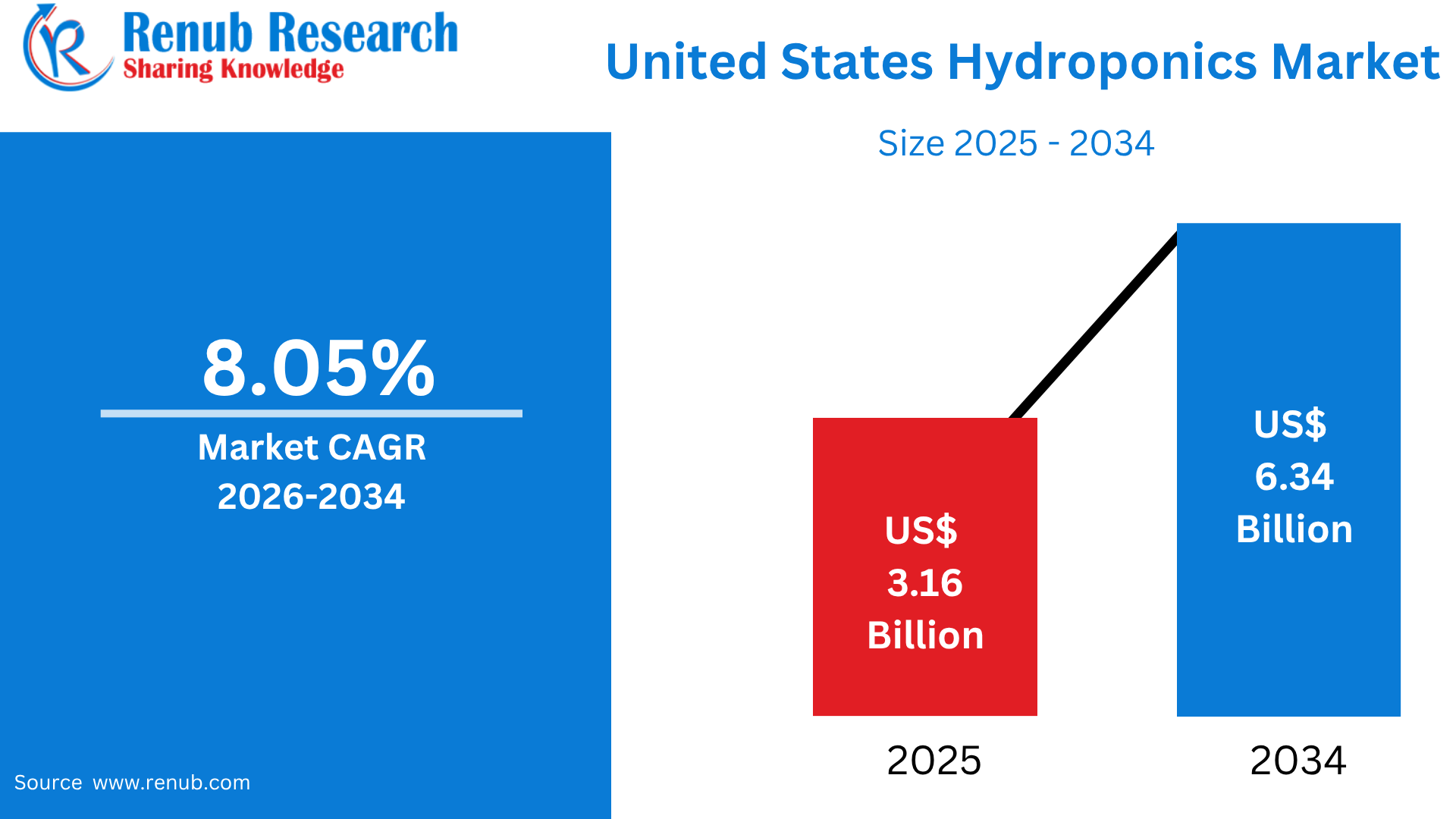
The United States Hydroponics Market is projected to grow from US$ 3.16 Billion in 2025 to US$ 6.34 Billion by 2034, expanding at a Compound Annual Growth Rate (CAGR) of 8.05% during 2026–2034. Market growth is driven by the increasing adoption of sustainable agricultural practices, rising demand for environmentally friendly farming solutions, and the need to achieve higher crop yields while using less water and land. Growing interest in controlled-environment agriculture is also expected to support market expansion.
What is Hydroponics and its Uses & Popularity in the United States
Hydroponics is a soilless cultivation technique in which plants are grown using a water-based nutrient solution, with systems sometimes incorporating growing media such as coconut coir, perlite, or vermiculite. The method enables growers to precisely manage nutrients, water, lighting, temperature, and other environmental conditions. In the United States, hydroponics is used to produce lettuce, tomatoes, cucumbers, peppers, herbs, strawberries, and other high-value crops for supermarkets, restaurants, foodservice companies, and direct-to-consumer channels. It is also increasingly used in vertical farms, greenhouses, urban agriculture, research facilities, and home-growing systems. USDA identifies hydroponics as one of the major methods within controlled-environment agriculture (CEA). CEA operations in the United States more than doubled from 1,476 in 2009 to 2,994 in 2019, while production increased 56% to 7.86 million hundredweight. Hydroponic systems were the most common cultivation method among CEA operations, highlighting their growing popularity.
Growth Drivers of the United States Hydroponics Market
Rising Adoption of Controlled-Environment and Urban Agriculture
The increasing adoption of controlled-environment agriculture is a major driver of the U.S. hydroponics market. Hydroponic systems allow growers to produce crops in greenhouses, warehouses, vertical farms, and other controlled facilities while reducing dependence on soil quality and outdoor weather conditions. USDA data show that U.S. CEA operations increased from 1,476 in 2009 to 2,994 in 2019, representing more than a doubling in the number of operations. During the same period, CEA production increased 56% to 7.86 million hundredweight. Tomatoes, lettuce, and cucumbers represented approximately 60–70% of CEA crops in both years, while hydroponics was the most common cultivation method. The expansion of urban farming is further supporting demand because hydroponic facilities can be established close to population centers and food markets. This enables producers to supply fresh produce locally while reducing transportation distances and improving supply reliability. Growing private and public investment in CEA technologies, automation, sensors, LED lighting, and climate-control systems is therefore creating favorable conditions for hydroponic farming expansion across the United States.
Water-Efficient Production and Increasing Resource Sustainability
Water efficiency is another important factor supporting hydroponics adoption in the United States. Conventional agriculture depends heavily on irrigation, while hydroponic systems can recirculate nutrient-rich water within closed or semi-closed production systems. This makes hydroponics particularly attractive in regions where growers face water constraints, drought conditions, or increasing pressure to improve resource efficiency. According to USDA’s 2023 Irrigation and Water Management Survey, U.S. farms used approximately 81 million acre-feet of irrigation water in 2023, a 2.8% decline from 2018. The survey covered 212,714 farms and 53.1 million irrigated acres, demonstrating the enormous scale of agricultural water demand. Hydroponics offers growers an alternative production model in which water and nutrients can be monitored and reused, potentially reducing wastage and improving input management. These characteristics are particularly valuable for greenhouse and vertical-farming operations located near urban markets. As sustainability becomes increasingly important for growers, retailers, investors, and consumers, hydroponics is gaining attention as a technology capable of producing vegetables and herbs with more controlled resource use.
Demand for Consistent, Fresh and Locally Produced Produce
Growing consumer and retailer demand for fresh, high-quality, locally produced vegetables is encouraging investment in hydroponic farming. Unlike traditional outdoor agriculture, hydroponic and other CEA systems provide greater control over temperature, lighting, water, nutrients, and other growing conditions. This can support more consistent production throughout the year and reduce exposure to adverse weather and certain pests. USDA reports that CEA systems help producers increase production while limiting factors that can inhibit crop growth, including unfavorable weather and common pests. Hydroponics is particularly suitable for leafy greens, herbs, tomatoes, cucumbers, and other crops that can be harvested frequently and sold through retail and foodservice channels. The broader U.S. horticulture sector also provides a substantial commercial base: horticulture operations generated US$18.3 billion in sales in 2024, with 23,060 operations recorded by USDA. Increasing interest in year-round availability, shorter supply chains, predictable quality, and local food production is therefore encouraging supermarkets, restaurants, institutional buyers, and entrepreneurs to explore hydroponic production.
Challenges of the United States Hydroponics Market
High Capital and Operating Costs
High initial investment and operating expenses remain significant challenges for the U.S. hydroponics market. Commercial hydroponic facilities require specialized infrastructure, including growing systems, pumps, reservoirs, nutrient-delivery equipment, LED lighting, sensors, climate-control systems, water-treatment equipment, automation technologies, and backup power. Large vertical farms and sophisticated greenhouses can therefore require substantial capital before generating commercial revenue. USDA’s research on controlled-environment agriculture specifically identifies economic and technical challenges associated with the expansion of these systems. Operating expenses can also be considerable because indoor facilities may require continuous electricity for lighting, cooling, heating, ventilation, pumping, and environmental monitoring. Labor costs add another burden, particularly for operations that require crop monitoring, harvesting, packaging, and system maintenance. Energy-price fluctuations can significantly affect production economics, especially for indoor vertical farms that rely heavily on artificial lighting. Smaller growers may therefore find it difficult to compete with conventional farms benefiting from established infrastructure and economies of scale. Improving automation, energy efficiency, system design, and production yields will remain essential for strengthening the profitability of U.S. hydroponic businesses.
Technical Complexity and Skilled-Labor Requirements
Technical complexity is another major challenge because hydroponic production requires continuous management of water quality, nutrient concentrations, pH, electrical conductivity, temperature, humidity, lighting, and plant health. Unlike conventional soil farming, problems within a hydroponic system can spread rapidly because plants may share the same water or nutrient circulation system. Equipment failures, power interruptions, pump breakdowns, incorrect nutrient concentrations, or inadequate environmental controls can consequently cause significant crop losses. USDA research notes that CEA expansion involves not only economic but also technical challenges, reflecting the need for specialized knowledge and reliable production systems. Skilled workers are needed to operate climate-control systems, monitor sensors, manage nutrients, troubleshoot equipment, and maintain crop health. The complexity becomes greater in automated vertical farms that integrate robotics, artificial intelligence, sensors, and sophisticated software. Additionally, producers must maintain consistent food-safety and sanitation practices to reduce contamination risks. These requirements can increase training expenses and operational complexity. Consequently, successful U.S. hydroponic businesses increasingly depend on experienced horticulturists, technicians, engineers, and data-driven crop-management teams.
Hydroponics Launches in the USA
- AeroGarden Harvest 2.0 – February 2024: AeroGarden launched the Harvest 2.0, an updated indoor hydroponic garden priced at US$89.99, featuring a redesigned grow deck and capacity for up to six plants.
- OASIS AeroSelect PlugSheet – March 2024: Oasis Grower Solutions introduced AeroSelect PlugSheet, a precision hydroponic substrate designed with higher water-holding capacity for crops and growing environments with greater water requirements.
- Vertefarm Hydroponic Micro Plant Factory – April 2024: Vertefarm launched its US$799 indoor hydroponic micro plant factory, combining vertical surface planting, cyclic drip irrigation, LED lighting, UV treatment, and smart app-based controls.
- Babylon Micro-Farms STEM Garden – April 2024: Babylon Micro-Farms introduced the STEM Garden, a smaller and more affordable hydroponic growing system designed specifically for K–12 schools and educational environments.
- Nature’s Miracle MiracleTainer – April 2024: Nature’s Miracle announced initial shipments of its MiracleTainer modular indoor container farms, incorporating LED grow lights, hydroponic systems, and sensors for environmental and nutrient monitoring.
- Eden Green Flagship Herb Program – 2024: Texas-based Eden Green launched its flagship herb program, using proprietary hydroponic vine technology and microclimate controls to produce multiple herb varieties year-round for retail and private-label markets.
- Plantaform Smart Indoor Garden – January 2025: Plantaform launched its Smart Indoor Garden in the United States at CES 2025, using fogponics technology and receiving the CES Innovation Awards Best of Innovation recognition in Food and AgTech.
- Babylon Micro-Farms Galleri Lite – February 2025: Babylon Micro-Farms launched Galleri Lite, a more accessible onsite hydroponic micro-farm designed for senior living, corporate dining, hospitality, and educational facilities.
- GrowGeneration New Hydroponic Product Lines – November 2024: GrowGeneration introduced new proprietary product lines covering grow lighting, accessories, and growing media for indoor cultivation and greenhouse hydroponics, including the ION 135 Watt Under Canopy LED Light.
- Aquager Hydroponic Home Farm – December 2024: Aquager officially launched its Hydroponic Home Farm, an indoor system for herbs, microgreens, leafy vegetables, and other crops. The closed-loop design is marketed as using up to 90% less water than traditional soil gardening.
United States Hydroponics Aggregate Systems Market
United States hydroponics aggregate systems market is expanding as growers increasingly adopt solid growing media such as coconut coir, perlite, vermiculite, and rockwool. These materials provide physical support while maintaining a suitable balance of moisture, oxygen, and nutrients around plant roots. Aggregate systems are particularly useful for tomatoes, cucumbers, peppers, strawberries, and leafy vegetables cultivated in greenhouses and indoor farms. USDA reported that U.S. controlled-environment agriculture (CEA) operations increased from 1,476 in 2009 to 2,994 in 2019, while production reached 7.86 million hundredweight, highlighting the expansion of controlled growing systems. Hydroponics was the most common cultivation method among these operations. Aggregate-based systems also provide growers with greater control over irrigation and nutrient delivery, while reducing dependence on soil quality. Their modular structure allows systems to be deployed in small commercial farms as well as large greenhouse operations. Growing investment in CEA, resource-efficient agriculture, and automated nutrient management is therefore expected to support demand for hydroponic aggregate systems across the United States.
United States Tomatoes Hydroponics Market
Tomatoes represent one of the most commercially important crops for hydroponic cultivation in the United States, supported by strong consumer demand and the advantages of controlled-environment production. Hydroponic tomato cultivation allows growers to precisely manage nutrients, water, temperature, humidity, and lighting, supporting consistent yields and quality throughout the year. Tomatoes are also among the principal crops produced through U.S. controlled-environment agriculture. USDA data indicate that tomatoes, lettuce, and cucumbers together accounted for approximately 60–70% of CEA crops in both 2009 and 2019. CEA production increased 56% to 7.86 million hundredweight in 2019, demonstrating the growing commercial importance of controlled cultivation. Hydroponic tomatoes are commonly grown in sophisticated greenhouses using substrate systems, drip irrigation, climate controls, and automated fertigation. The technology can also help growers reduce exposure to soil-borne diseases and unfavorable outdoor weather. Demand from supermarkets, restaurants, foodservice operators, and consumers seeking fresh, locally produced vegetables is encouraging investment in greenhouse tomato production. As year-round supply becomes increasingly valuable, hydroponics is strengthening its position in the U.S. tomato production ecosystem.
United States Herbs Hydroponics Market
The United States hydroponic herbs market is benefiting from increasing demand for basil, mint, cilantro, parsley, chives, and other fresh culinary herbs. Hydroponic cultivation provides precise control over nutrient availability, irrigation, temperature, humidity, and light, enabling growers to maintain consistent product quality and production schedules. Herbs are particularly suitable for indoor and greenhouse hydroponic production because they have relatively short growing cycles and can be harvested continuously. Retail supermarkets, restaurants, foodservice businesses, meal-kit companies, and direct-to-consumer platforms represent important demand channels. The ability to grow herbs close to urban consumers also helps shorten supply chains and improve freshness. USDA reported that U.S. controlled-environment agriculture operations increased by more than 100% between 2009 and 2019, reaching 2,994 operations. The expansion of CEA infrastructure is creating additional opportunities for commercial herb growers. At the consumer level, countertop and home hydroponic systems are also expanding awareness of indoor herb cultivation. Improvements in LED lighting, automated nutrient delivery, sensors, and compact growing systems are making hydroponic herb production more accessible. These developments are expected to support continued expansion of the U.S. hydroponic herbs segment.
United States Hydroponics HVAC Market
HVAC systems are a critical component of indoor farms and hydroponic greenhouses because plant productivity depends on maintaining suitable temperature, humidity, airflow, and carbon-dioxide conditions. As hydroponic production increasingly shifts toward highly controlled environments, demand for specialized HVAC equipment is growing. HVAC systems help prevent excessive heat and humidity, maintain crop-specific growing conditions, reduce condensation, and support consistent plant development. This is particularly important for vertical farms where multiple growing levels can generate substantial heat from LED lighting and electrical equipment. The expansion of U.S. controlled-environment agriculture provides a strong underlying market opportunity. USDA reported 2,994 CEA operations in 2019, more than double the 1,476 operations recorded in 2009. Energy consumption remains a major consideration because heating, cooling, dehumidification, and ventilation can represent significant operating expenses. Consequently, hydroponic operators are increasingly interested in energy-efficient HVAC, heat recovery, variable-speed systems, sensors, and automated environmental controls. Smart HVAC platforms can integrate temperature and humidity data with crop-management software, enabling real-time adjustments. As indoor agriculture becomes more automated and commercially sophisticated, efficient climate-control infrastructure will remain essential for improving productivity and controlling operating costs.
United States Hydroponics Irrigation Systems Market
United States hydroponics irrigation systems market is driven by the need to deliver water and nutrients accurately, consistently, and efficiently to crops. Hydroponic systems rely on carefully controlled nutrient solutions, making pumps, drip lines, reservoirs, dosing equipment, sensors, and automated irrigation controllers essential components. Common approaches include drip irrigation, nutrient film technique (NFT), and ebb-and-flow systems, with the choice depending on crop type and production configuration. Water efficiency is an especially important advantage. USDA reported that U.S. farms used approximately 81 million acre-feet of irrigation water in 2023, while irrigated acreage reached 53.1 million acres. The scale of agricultural water use is encouraging interest in technologies that improve water management. Hydroponic systems can recirculate nutrient solutions, allowing growers to monitor and reuse water rather than continuously applying fresh irrigation. Automation is further transforming the segment through remote monitoring, electronic dosing, moisture and EC sensors, and data-driven irrigation schedules. These technologies can reduce manual intervention while improving crop uniformity. As U.S. growers pursue resource efficiency, higher yields, and more predictable production, advanced hydroponic irrigation systems are expected to become increasingly important in greenhouses, indoor farms, and vertical agriculture facilities.
California Hydroponics Market
California represents a major opportunity for hydroponics because of its large agricultural economy, concentration of agri-tech companies, and recurring concerns regarding water availability and drought. Controlled-environment cultivation can help growers produce vegetables and herbs while maintaining tighter control over water and nutrient use. California’s proximity to large population centers, including Los Angeles and the San Francisco Bay Area, also creates attractive markets for locally produced fresh vegetables. USDA’s 2023 Irrigation and Water Management Survey reported that California had approximately 7.8 million irrigated acres, making it one of the country’s largest irrigated agricultural states. Such substantial irrigation demand increases the importance of efficient water-management technologies. Hydroponic and greenhouse production is particularly suitable for crops such as leafy greens, tomatoes, herbs, cucumbers, and strawberries. The state also benefits from a mature ecosystem of agricultural technology companies, universities, growers, greenhouse operators, and investors. Automation, sensors, climate controls, and precision fertigation are increasingly incorporated into controlled-environment facilities. Furthermore, demand for locally grown produce from supermarkets, restaurants, and consumers supports the commercial case for indoor production. These factors position California as one of the most important U.S. markets for hydroponic technology and controlled-environment agriculture.
Texas Hydroponics Market
Texas is emerging as an attractive market for hydroponic agriculture because of its large population, expanding food demand, extensive land area, and challenging climate conditions. High temperatures, periodic drought, and weather variability can make consistent outdoor production difficult for certain crops. Hydroponic greenhouses and indoor farms allow producers to control growing conditions and maintain production schedules independent of many outdoor conditions. High-demand crops such as lettuce, leafy greens, herbs, tomatoes, and cucumbers are particularly suitable for these systems. Texas also benefits from major metropolitan markets, including Dallas–Fort Worth, Houston, Austin, and San Antonio, which provide substantial demand for fresh produce. The state’s population reached approximately 31.3 million in 2025, according to the U.S. Census Bureau, creating a large consumer base for food and agricultural products. Hydroponic farms located close to urban centers can reduce transportation distances and provide more consistent local supply. Texas also offers comparatively abundant land and business-development opportunities compared with highly dense coastal markets. Investment in greenhouse technology, vertical farming, automation, LED lighting, and precision irrigation is therefore creating new opportunities. As food demand and interest in local production increase, Texas is likely to become an increasingly important hydroponics market.
New York Hydroponics Market
New York’s hydroponics market is supported by strong urban food demand, limited availability of affordable agricultural land near major population centers, and growing interest in local food production. New York City alone has more than 8 million residents, creating a large potential market for fresh leafy greens, herbs, and other rapidly perishable products. Hydroponic farms can operate in warehouses, greenhouses, rooftops, and other urban or peri-urban spaces, allowing production closer to consumers. Indoor cultivation also enables year-round production and reduces exposure to New York’s seasonal weather conditions. Leafy greens, basil, microgreens, and other high-value crops are particularly suited to these facilities because they can be harvested frequently and transported quickly to retailers and restaurants. New York State’s interest in climate-smart and sustainable agriculture further supports investment in resource-efficient production technologies. Automated nutrient delivery, LED lighting, sensors, and environmental monitoring are increasingly used to optimize production. The proximity of hydroponic farms to supermarkets, restaurants, institutional buyers, and foodservice businesses can improve freshness and shorten supply chains. As urban agriculture develops and consumers increasingly value locally produced food, hydroponics is positioned to play a growing role in New York’s controlled-environment agriculture ecosystem.
Florida Hydroponics Market
Florida provides favorable opportunities for hydroponic agriculture because of its large consumer population, extensive tourism and hospitality sector, and demand for fresh vegetables throughout the year. At the same time, extreme heat, humidity, hurricanes, pests, and weather variability create challenges for conventional production, increasing interest in protected and controlled cultivation. Greenhouse hydroponics can provide growers with greater control over irrigation, nutrients, temperature, humidity, and crop protection. Common hydroponic crops include tomatoes, cucumbers, peppers, leafy greens, herbs, and strawberries. Florida’s horticultural economy also provides an established agricultural base for adopting advanced production technologies. The state’s population reached approximately 23.5 million in 2025, according to U.S. Census Bureau estimates, providing a large consumer market. In addition, Florida attracts millions of visitors annually, creating significant demand from hotels, restaurants, resorts, and foodservice businesses. Hydroponic farms located near metropolitan and tourism centers can supply fresher produce while reducing dependence on distant suppliers. Improvements in greenhouse structures, climate management, fertigation, automation, and pest-management technologies are further supporting adoption. As growers seek higher productivity and more reliable year-round production, hydroponics is expected to become increasingly important within Florida’s controlled-environment agriculture sector.
United States Hydroponics Market Segments
Type
- Aggregate Systems
- Liquid Systems
Crop Type
- Tomatoes
- Herbs
- Lettuce
- Cucumbers
- Peppers
- Others
Equipment
- HVAC
- LED Grow Light
- Irrigation Systems
- Material Handling
- Control Systems
- Others
Top States
- California
- Texas
- New York
- Florida
- Illinois
- Pennsylvania
- Ohio
- Georgia
- New Jersey
- Washington
- North Carolina
- Massachusetts
- Virginia
- Michigan
- Maryland
- Colorado
- Tennessee
- Indiana
- Arizona
- Minnesota
- Wisconsin
- Missouri
- Connecticut
- South Carolina
- Oregon
- Louisiana
- Alabama
- Kentucky
- Rest of United States
All companies have been covered with 5 Viewpoints
- Overviews
- Key Person
- Recent Developments
- SWOT Analysis
- Revenue Analysis
Company Analysis
- AeroFarms
- AmHydro
- Freight Farms
- Green Sense Farms Holdings, Inc.
- LumiGrow
- Unrivaled Brands Inc
- BrightFarms
- The Scotts Company LLC
- Hydrodynamics International
- Signify Holding
Report Details:
| Report Features | Details |
| Base Year |
2024 |
| Historical Period |
2021 - 2024 |
| Forecast Period |
2025 - 2033 |
| Market |
US$ Billion |
| Segment Covered |
By Type, By Crop Type, By Equipment, By Region |
| Regions Covered |
|
| Companies Covered |
|
| Customization Scope |
20% Free Customization |
| Post-Sale Analyst Support |
1 Year (52 Weeks) |
| Delivery Format |
PDF and Excel through Email (We can also provide the editable version of the report in PPT/Word format on request) |
Customization Services available
- Analysis of Market Size and Its Segments
- More Company Profiles (Upto 10 without any additional cost):
- Additional Countries (Other than mentioned Countries):
- Region/Country Specific Reports:
- Market Entry Strategy:
- Region-Specific Market Dynamics:
- Regional Market Share Analysis:
- Trade Analysis:
- Production Insights:
- Others Customized Requests:
For more information contact our analysts.
Need More Assistance?
- Talk to our analysts to get more precious information on the current market trends.
- Include more countries and segments and customize the report based on the final requirement.
- Get a competitive advantage in your industry by knowing the report findings and making a positive impact on your revenues and operations.
- Our analysts are always ready to provide more help and pertinent information if you need any additional assistance.