United States Combine Harvesters Market Size, Share, Trends, Growth and Forecast Report by Type, Type of Movement, Cutting Width, Power, Application, States and Company Analysis 2026–2034
Buy NowUnited States Combine Harvesters Market Trends
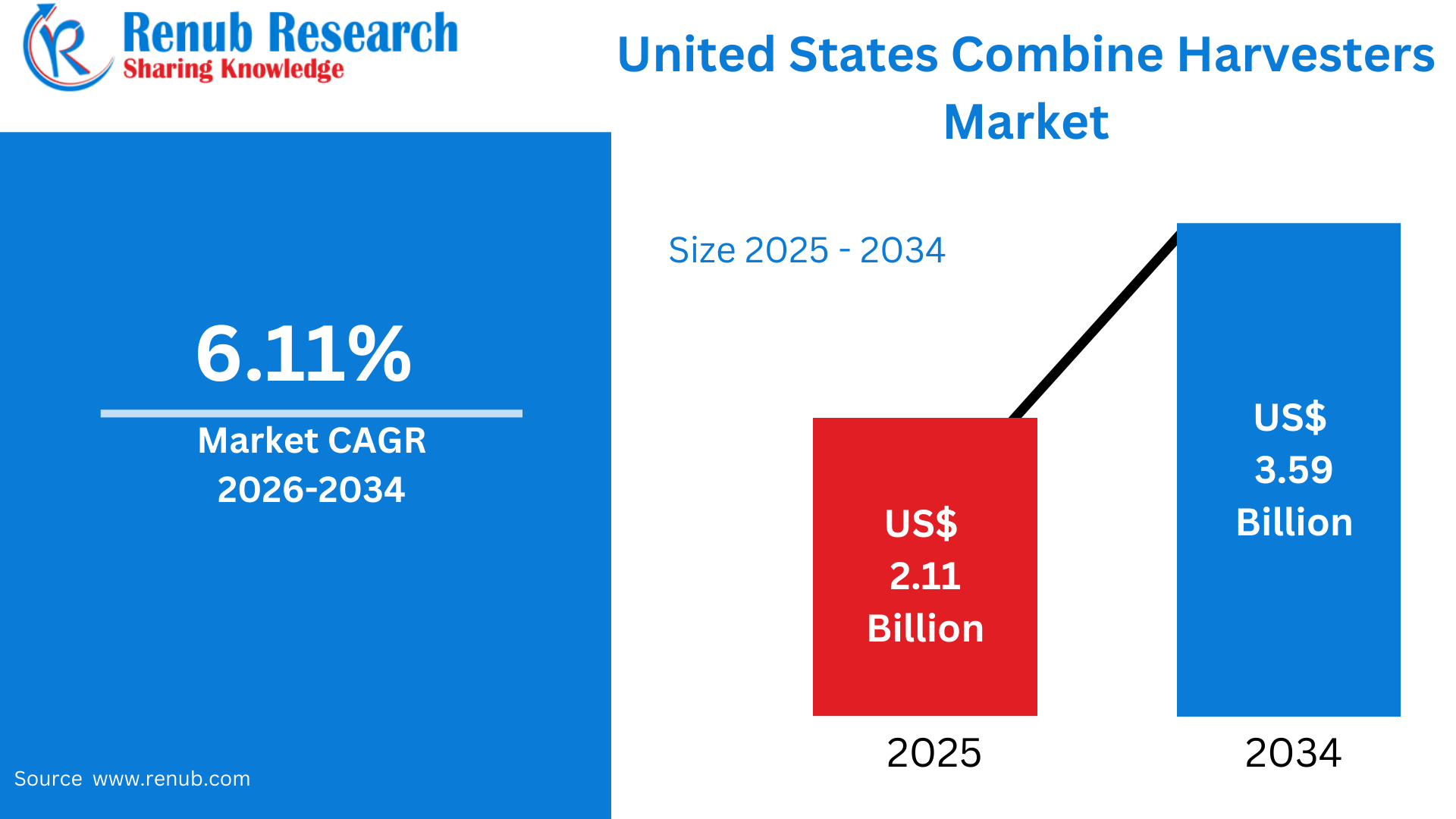
United States combine harvesters market is projected to grow from US$ 2.11 billion in 2025 to US$ 3.59 billion by 2034, registering a compound annual growth rate (CAGR) of 6.11% during the forecast period from 2026 to 2034. Market expansion is being driven by the increasing adoption of agricultural mechanization, rising labor costs and workforce shortages, growing demand for high-capacity harvesting equipment, and continuous technological advancements in precision farming. The integration of smart farming technologies and automation is further supporting the adoption of advanced combine harvesters across the U.S. agricultural sector.
What is Combine Harvesters and its Adoption in Europe
A combine harvester is a highly efficient agricultural machine designed to perform three essential harvesting operations—reaping, threshing, and winnowing—in a single process. It is widely used to harvest a variety of grain crops, including wheat, corn, soybeans, barley, oats, and rice. By combining multiple harvesting functions into one machine, combine harvesters help reduce labor requirements, improve operational efficiency, increase productivity, and minimize crop losses during harvesting. Modern combine harvesters are equipped with advanced technologies such as GPS-guided navigation, yield monitoring systems, automated controls, telematics, and precision agriculture features, enabling farmers to optimize harvesting operations and improve overall farm profitability.
In the United States, combine harvesters have become an indispensable part of modern agriculture due to the country’s extensive commercial farming operations and strong emphasis on farm mechanization. Increasing labor shortages, coupled with the need to improve harvesting efficiency and reduce operational costs, have accelerated the adoption of advanced harvesting equipment. American farmers prefer combine harvesters for their durability, high productivity, and ability to efficiently harvest multiple crop types under varying field conditions. Furthermore, the growing adoption of precision agriculture practices and investments in technologically advanced machinery continue to strengthen the demand for combine harvesters across the U.S. market.
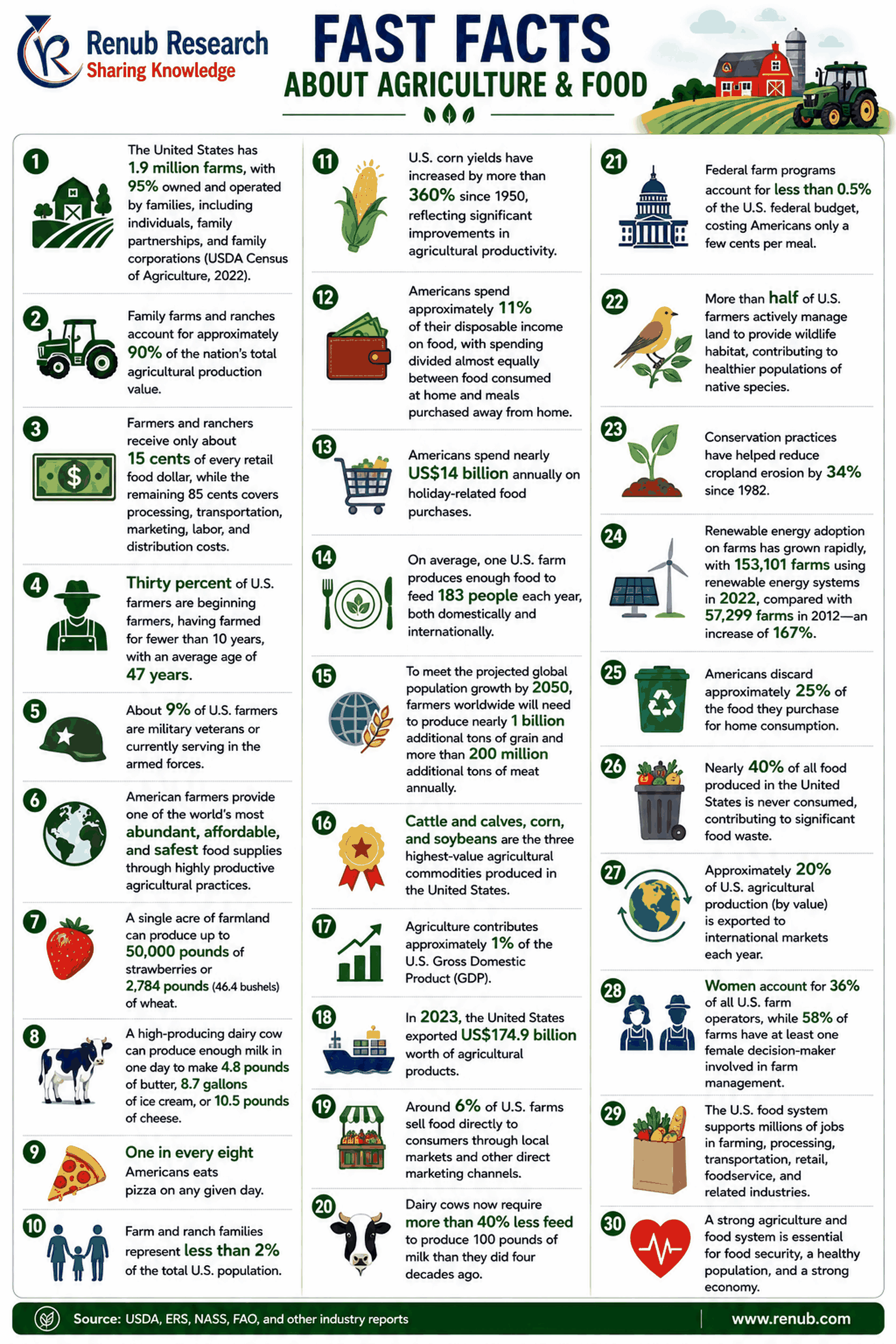
Fast Facts About Agriculture & Food
- The United States has 1.9 million farms, with 95% owned and operated by families, including individuals, family partnerships, and family corporations (USDA Census of Agriculture, 2022).
- Family farms and ranches account for approximately 90% of the nation’s total agricultural production value.
- Farmers and ranchers receive only about 15 cents of every retail food dollar, while the remaining 85 cents covers processing, transportation, marketing, labor, and distribution costs.
- Thirty percent of U.S. farmers are beginning farmers, having farmed for fewer than 10 years, with an average age of 47 years.
- About 9% of U.S. farmers are military veterans or currently serving in the armed forces.
- American farmers provide one of the world’s most abundant, affordable, and safest food supplies through highly productive agricultural practices.
- A single acre of farmland can produce up to 50,000 pounds of strawberries or approximately 2,784 pounds (46.4 bushels) of wheat.
- A high-producing dairy cow can produce enough milk in one day to make 4.8 pounds of butter, 8.7 gallons of ice cream, or 10.5 pounds of cheese.
- One in every eight Americans eats pizza on any given day.
- Farm and ranch families represent less than 2% of the total U.S. population.
- U.S. corn yields have increased by more than 360% since 1950, reflecting significant improvements in agricultural productivity.
- Americans spend approximately 11% of their disposable income on food, with spending divided almost equally between food consumed at home and meals purchased away from home.
- Americans spend nearly US$14 billion annually on holiday-related food purchases.
- On average, one U.S. farm produces enough food to feed 183 people each year, both domestically and internationally.
- To meet the projected global population growth by 2050, farmers worldwide will need to produce nearly 1 billion additional tons of grain and more than 200 million additional tons of meat annually.
- Cattle and calves, corn, and soybeans are the three highest-value agricultural commodities produced in the United States.
- Agriculture contributes approximately 1% of the U.S. Gross Domestic Product (GDP).
- In 2023, the United States exported US$174.9 billion worth of agricultural products.
- Around 6% of U.S. farms sell food directly to consumers through local markets and other direct marketing channels.
- Dairy cows now require more than 40% less feed to produce 100 pounds of milk than they did four decades ago.
- Federal farm programs account for less than 0.5% of the U.S. federal budget, costing Americans only a few cents per meal.
- More than half of U.S. farmers actively manage land to provide wildlife habitat, contributing to healthier populations of native species.
- Conservation practices have helped reduce cropland erosion by 34% since 1982.
- Renewable energy adoption on farms has grown rapidly, with 153,101 farms using renewable energy systems in 2022, compared with 57,299 farms in 2012—an increase of 167%.
- Americans discard approximately 25% of the food they purchase for home consumption.
- Nearly 40% of all food produced in the United States is never consumed, contributing to significant food waste.
- Approximately 20% of U.S. agricultural production (by value) is exported to international markets each year.
- Women account for 36% of all U.S. farm operators, while 58% of farms have at least one female decision-maker involved in farm management.
Market Catalysts
Growing Farm Mechanization and Agricultural Labor Shortages
The increasing adoption of farm mechanization is a major factor driving the growth of the United States combine harvesters market. Large-scale commercial farming dominates the U.S. agricultural sector, creating strong demand for efficient harvesting equipment capable of covering vast acreages within limited harvesting windows. At the same time, persistent labor shortages and rising farm wages have made manual harvesting increasingly expensive and impractical. Combine harvesters address these challenges by integrating reaping, threshing, and grain separation into a single operation, significantly reducing labor requirements while improving harvesting efficiency and productivity. As a result, farmers are increasingly investing in modern harvesting equipment to optimize operations and minimize labor dependency. In July 2024, Case IH introduced its new AF11 combine harvester, featuring enhanced grain-handling capacity and faster unloading speeds, enabling operators to improve harvesting efficiency and reduce downtime.
Advancements in Precision Agriculture and Smart Harvesting Technologies
Continuous technological innovation is transforming combine harvesters into highly advanced, data-driven agricultural machines. Modern harvesters are equipped with features such as GPS guidance, automated steering, yield mapping, remote diagnostics, telematics, and real-time performance monitoring, allowing farmers to maximize productivity while reducing fuel consumption and operating costs. The growing adoption of precision agriculture is further accelerating demand for technologically sophisticated harvesting equipment, as farmers increasingly rely on field data collected during harvest to optimize future planting, fertilization, and crop management decisions. As digital farming practices become more widespread across the United States, manufacturers continue to introduce advanced harvesting solutions. In February 2024, John Deere launched its S7 Series combine harvesters, designed to improve harvesting efficiency, enhance grain quality, reduce crop losses, and provide greater operator comfort through advanced automation and intelligent harvesting technologies.
Rising Demand for Food Production and Agricultural Exports
Growing domestic consumption and strong international demand for major crops such as corn, soybeans, wheat, and barley continue to support the expansion of the U.S. combine harvesters market. As one of the world’s leading agricultural producers and exporters, the United States requires efficient harvesting equipment to ensure timely crop collection while maintaining grain quality and minimizing post-harvest losses. High-capacity combine harvesters enable farmers to harvest large volumes of crops quickly, supporting productivity and helping meet the increasing demand from food, livestock feed, and biofuel industries. According to the U.S. Department of Agriculture (USDA), the United States exported approximately US$175 billion worth of agricultural products in 2024, while agricultural imports totaled around US$215 billion. Given the country’s significant role in global agricultural trade, maintaining efficient harvesting operations remains essential for ensuring supply chain reliability and market competitiveness.
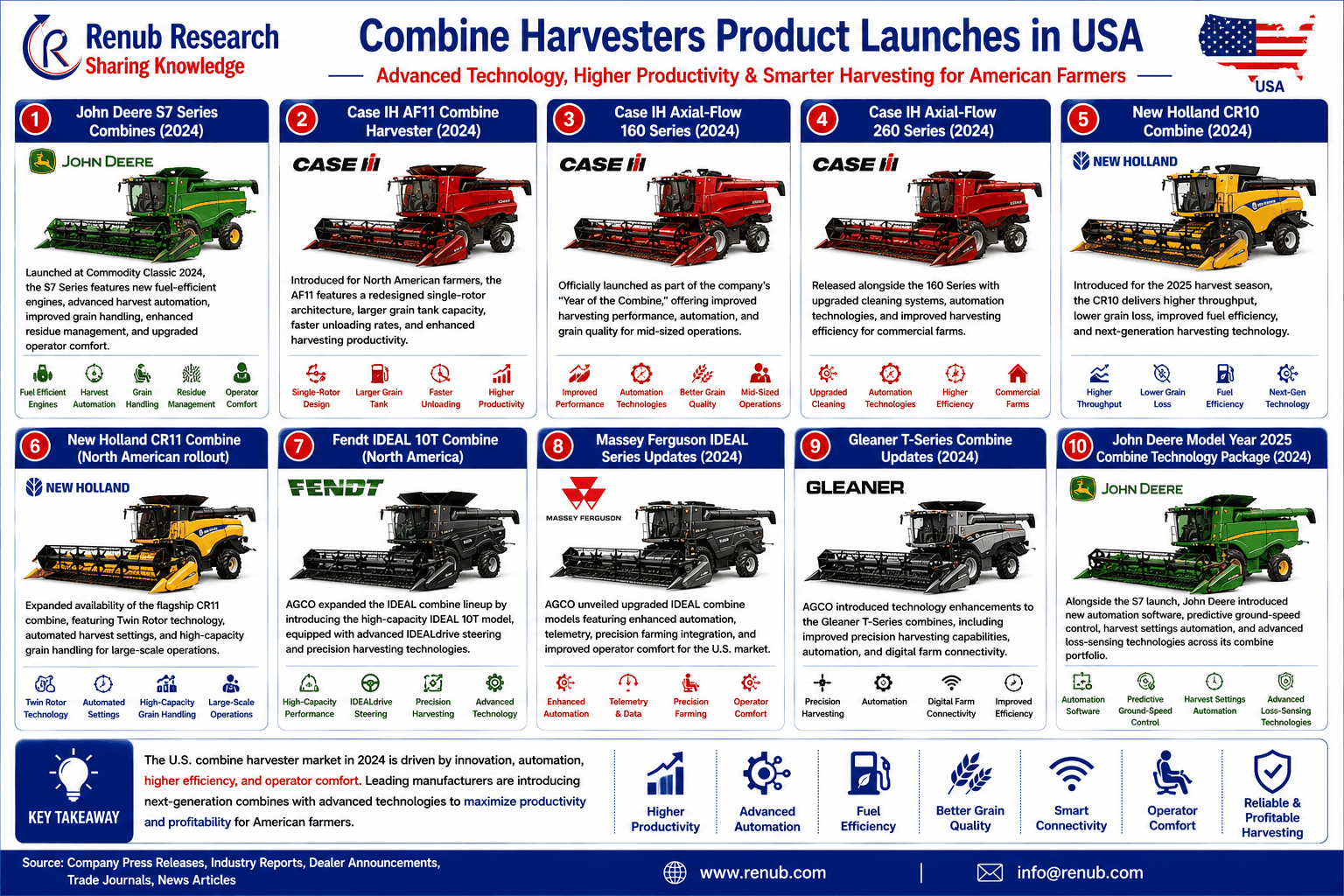
Combine Harvesters product launches in USA
- John Deere S7 Series Combines (2024) – Launched at Commodity Classic 2024, the S7 Series features new fuel-efficient engines, advanced harvest automation, improved grain handling, enhanced residue management, and upgraded operator comfort.
- Case IH AF11 Combine Harvester (2024) – Introduced for North American farmers, the AF11 features a redesigned single-rotor architecture, larger grain tank capacity, faster unloading rates, and enhanced harvesting productivity.
- Case IH Axial-Flow 160 Series (2024) – Officially launched as part of the company’s “Year of the Combine,” offering improved harvesting performance, automation, and grain quality for mid-sized operations.
- Case IH Axial-Flow 260 Series (2024) – Released alongside the 160 Series with upgraded cleaning systems, automation technologies, and improved harvesting efficiency for commercial farms.
- New Holland CR10 Combine (2024) – Introduced for the 2025 harvest season, the CR10 delivers higher throughput, lower grain loss, improved fuel efficiency, and next-generation harvesting technology.
- New Holland CR11 Combine (North American rollout) – Expanded availability of the flagship CR11 combine, featuring Twin Rotor technology, automated harvest settings, and high-capacity grain handling for large-scale operations.
- Fendt IDEAL 10T Combine (North America) – AGCO expanded the IDEAL combine lineup by introducing the high-capacity IDEAL 10T model, equipped with advanced IDEALdrive steering and precision harvesting technologies.
- Massey Ferguson IDEAL Series Updates (2024) – AGCO unveiled upgraded IDEAL combine models featuring enhanced automation, telemetry, precision farming integration, and improved operator comfort for the U.S. market.
- Gleaner T-Series Combine Updates (2024) – AGCO introduced technology enhancements to the Gleaner T-Series combines, including improved precision harvesting capabilities, automation, and digital farm connectivity.
- John Deere Model Year 2025 Combine Technology Package (2024) – Alongside the S7 launch, John Deere introduced new automation software, predictive ground-speed control, harvest settings automation, and advanced loss-sensing technologies across its combine portfolio.
Market Restraints
High Equipment Costs and Significant Capital Investment
The high purchase price of modern combine harvesters remains one of the primary challenges facing the U.S. market. Advanced harvesting machines equipped with automation, precision farming technologies, and high-capacity systems require substantial upfront investment, making them less affordable for small and medium-sized farming operations. Beyond the initial acquisition cost, farmers must also account for ongoing expenses such as maintenance, insurance, replacement parts, and financing costs. Fluctuations in crop prices and farm income can further discourage equipment purchases by increasing financial uncertainty. Although leasing programs, equipment financing, and rental services provide alternative acquisition options, the significant capital requirements continue to limit broader market adoption.
Complex Maintenance Requirements and Rising Operating Expenses
Modern combine harvesters incorporate sophisticated mechanical, hydraulic, electronic, and software-based systems that require specialized maintenance and technical expertise. Equipment breakdowns during critical harvesting periods can lead to costly delays, reduced productivity, and potential crop losses. In addition, rising fuel prices, increasing maintenance expenses, and the growing cost of replacement components continue to place pressure on farmers’ operating budgets. The need for skilled technicians and operator training to effectively manage advanced harvesting equipment further adds to ownership costs. These factors collectively increase the total cost of operation and present ongoing challenges for farmers seeking to maximize profitability while maintaining high harvesting efficiency.
Type Insights
Tractor-Pulled Combine Harvesters
The market for tractor-pulled combine harvesters in the United States primarily serves small-scale farmers, diversified agricultural operations, and budget-conscious buyers. Unlike self-propelled models, these machines rely on external tractors for power, making them a more affordable harvesting solution with lower acquisition and maintenance costs. Tractor-pulled combines are well suited for smaller fields and farms with limited harvesting requirements, offering an economical option for growers seeking basic mechanization. Although they have lower harvesting capacity and operate at slower speeds than self-propelled machines, their affordability, simplicity, and ease of maintenance continue to support demand among niche farming segments where large-scale mechanization is not financially practical.
Type of Movement Insights
Wheel-Type Combine Harvesters
Wheel-type combine harvesters account for a significant share of the U.S. market owing to their versatility, operational speed, and adaptability across a wide range of crops and field conditions. These machines offer excellent maneuverability and perform efficiently on the dry and firm soil conditions commonly found across many agricultural regions in the country. Their compatibility with advanced harvesting attachments, GPS guidance systems, and precision agriculture technologies further enhances their appeal among commercial farmers. As a result, wheel-type combine harvesters remain the preferred choice for large-scale farming operations, driving sustained market demand throughout the United States.
Cutting Width Insights
Small-Size Combine Harvesters
Small-size combine harvesters are increasingly being adopted by small farms, specialty crop producers, and agricultural operations with relatively limited acreage. These compact machines deliver efficient harvesting performance while offering a lower purchase price and reduced operating costs compared to larger models. Their compact dimensions improve maneuverability in irregularly shaped or confined fields, while lower fuel consumption helps reduce overall operating expenses. Growing interest in affordable mechanization among diversified farms, family-owned operations, and new agricultural entrants continues to support demand for small-size combine harvesters across the United States.
Power Insights
150–300 HP Combine Harvesters
The 150–300 horsepower segment represents an ideal solution for medium-sized farming operations seeking a balance between performance and cost efficiency. These combine harvesters provide sufficient power and harvesting capacity for major grain crops while maintaining manageable operating and maintenance expenses. Farmers increasingly prefer this horsepower range because it delivers strong productivity without the higher capital investment associated with ultra-high horsepower models. Steady replacement demand and ongoing technological upgrades continue to make this segment a stable contributor to the overall growth of the U.S. combine harvesters market.
300–450 HP Combine Harvesters
Combine harvesters with engine capacities ranging from 300 to 450 horsepower are primarily designed for large-scale commercial farming operations that require maximum productivity across extensive acreage. These high-performance machines offer superior harvesting capacity, advanced automation features, and enhanced operational efficiency, enabling farmers to complete harvesting within narrow seasonal windows. Their ability to handle large crop volumes with minimal downtime makes them indispensable for major grain producers and agricultural contractors. Continued investments in high-capacity harvesting equipment are expected to support growth in this premium market segment.
Application Insights
Wheat Harvesting
Wheat harvesting remains one of the largest application areas for combine harvesters in the United States. Given the country’s extensive wheat cultivation and relatively short harvesting windows, efficient harvesting equipment is essential to minimize grain losses and maintain crop quality. Modern combine harvesters equipped with advanced threshing systems, yield monitoring technologies, and precision agriculture features enable farmers to harvest wheat quickly and efficiently while maximizing productivity. Strong domestic wheat production and continued demand for high-quality grain continue to drive investments in advanced harvesting machinery.
States Insights
California Combine Harvesters
California represents one of the most important regional markets for combine harvesters due to its substantial agricultural production, high labor costs, and persistent workforce shortages. Although the state is widely recognized for specialty crops, it also has significant requirements for harvesting grains, rice, and forage crops, particularly in the Central Valley. Farmers are increasingly adopting technologically advanced combine harvesters to improve operational efficiency, reduce dependence on seasonal labor, and optimize harvesting across diverse crop types and field conditions. Environmental regulations and growing demand for fuel-efficient equipment are further encouraging the adoption of modern, precision-enabled harvesting machines. In addition, strong replacement demand, driven by farmers upgrading aging equipment, continues to support steady market growth across California.
New York Combine Harvesters
The New York combine harvesters market is characterized by stable demand supported by the state’s diversified agricultural sector. Grain, corn, soybean, and forage production is largely concentrated on small- and medium-sized farms, creating strong demand for versatile mid-sized combine harvesters rather than large, high-horsepower models. Farmers prioritize equipment reliability, ease of maintenance, and the flexibility to harvest multiple crop varieties efficiently. Since agricultural mechanization is already well established across the state, replacement purchases account for a significant share of market demand. Although market growth is relatively moderate compared to major grain-producing states, ongoing equipment modernization and consistent agricultural activity continue to sustain demand for combine harvesters in New York.
Washington Combine Harvesters
Washington is a significant regional market for combine harvesters, supported by its large-scale grain production, particularly wheat cultivation across the eastern part of the state. Large farm sizes and a strong export-oriented agricultural sector have created sustained demand for high-capacity, technologically advanced harvesting equipment. Combine harvesters play a critical role in enabling timely harvesting, minimizing crop losses, and improving operational efficiency during short harvesting seasons. Farmers are increasingly investing in precision agriculture technologies, including GPS guidance, yield mapping, and automated harvesting systems, to enhance productivity and optimize farm management. Labor shortages and rising production costs are also accelerating mechanization, particularly driving demand for wheel-type and high-horsepower combine harvesters capable of efficiently covering large acreages.
New Jersey Combine Harvesters
The New Jersey combine harvesters market is relatively small but remains stable, reflecting the state’s limited grain cultivation area and high agricultural land values. Farming operations are generally smaller and more diversified, leading to greater demand for compact and mid-sized combine harvesters that offer superior maneuverability, operational efficiency, and cost-effectiveness. Farmers place a strong emphasis on maximizing productivity from limited farmland, making efficient harvesting equipment an important investment. Market demand is largely driven by equipment replacement rather than new farm expansion, as mechanization levels are already well established. Despite its relatively modest size, the market benefits from New Jersey’s proximity to major consumer markets, encouraging efficient harvesting practices and supporting consistent demand for combine harvesters across the state.
Market Segmentation
Type
- Self-propelled Combine Harvester
- Tractor-pulled Combine/PTO Powered Combine Harvester
Type of Movement
- Wheel Type Combine Harvester
- Crawler Type Combine Harvester
Cutting Width
- Small Size Combine Harvester
- Large Size Combine Harvester
Power
- Below 150 HP
- 150-300 HP
- 300-450 HP
- 450-550 HP
- Above 550 HP
Application
- Wheat Harvesting
- Rice Harvesting
- Soyabeans Harvesting
- Others
Top States
- California
- Texas
- New York
- Florida
- Illinois
- Pennsylvania
- Ohio
- Georgia
- New Jersey
- Washington
- North Carolina
- Massachusetts
- Virginia
- Michigan
- Maryland
- Colorado
- Tennessee
- Indiana
- Arizona
- Minnesota
- Wisconsin
- Missouri
- Connecticut
- South Carolina
- Oregon
- Louisiana
- Alabama
- Kentucky
- Rest of United States
All companies have been covered with 5 Viewpoints
- Overviews
- Key Person
- Recent Developments
- SWOT Analysis
- Revenue Analysis
Company Analysis
- AGCO Corporation
- CLAAS KGaA mbH
- Deere & Company
- Iseki & Co. Ltd.
- KARTAR Agro Industries Private Limited
- KS Agrotech Pvt. Ltd.
- KUBOTA Corporation
- Mahindra & Mahindra Ltd.
- PREET AGRO Industries (P) Limited
- Yanmar Holdings Co. Ltd
Report Details:
| Report Features | Details |
| Base Year |
2025 |
| Historical Period |
2022 - 2025 |
| Forecast Period |
2026 - 2034 |
| Market |
US$ Billion |
| Segment Covered |
Type, Type of Movement, Cutting Width, Power, Application and States |
| States Covered |
|
| Companies Covered |
|
| Customization Scope |
20% Free Customization |
| Post-Sale Analyst Support |
1 Year (52 Weeks) |
| Delivery Format |
PDF and Excel through Email (We can also provide the editable version of the report in PPT/Word format on request) |
Customization Services available
- Analysis of Market Size and Its Segments
- More Company Profiles (Upto 10 without any additional cost):
- Additional Countries (Other than mentioned Countries):
- Region/Country Specific Reports:
- Market Entry Strategy:
- Region-Specific Market Dynamics:
- Regional Market Share Analysis:
- Trade Analysis:
- Production Insights:
- Others Customized Requests:
For more information contact our analysts.
Need More Assistance?
- Talk to our analysts to get more precious information on the current market trends.
- Include more countries and segments and customize the report based on the final requirement.
- Get a competitive advantage in your industry by knowing the report findings and making a positive impact on your revenues and operations.
- Our analysts are always ready to provide more help and pertinent information if you need any additional assistance.