United States Breast Reconstruction Market Report by Product, Shape, End Use, States and Companies Analysis 2026-2034
Buy NowUnited States Breast Reconstruction Market Size and Forecast
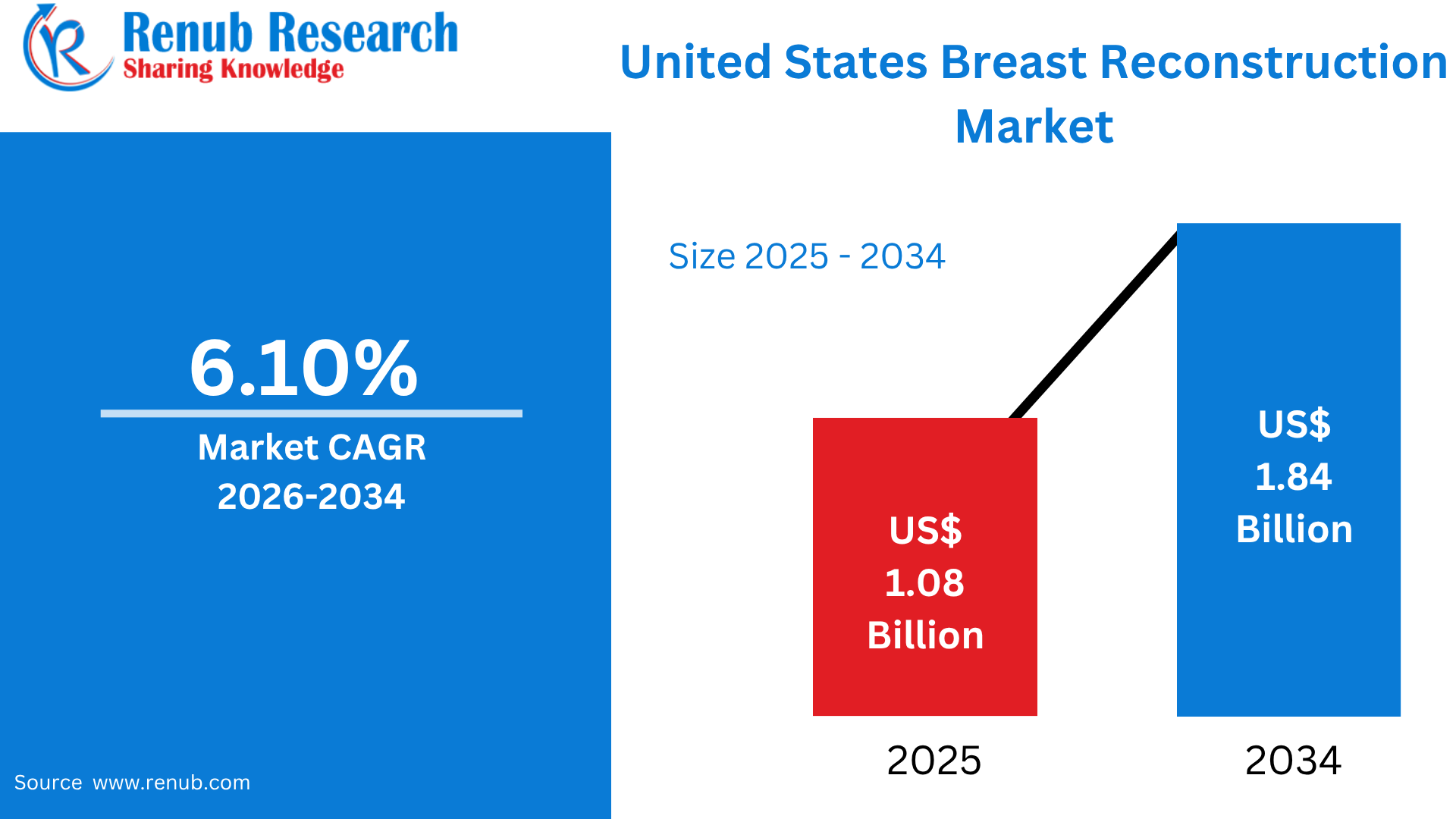
United States Breast Reconstruction Market is projected to expand from US$ 1.08 Billion in 2025 to US$ 1.84 Billion by 2034, registering a CAGR of 6.10% during 2026–2034. Market growth is supported by increasing breast cancer incidence, rising awareness of reconstructive procedures, and advancements in implant-based and autologous reconstruction techniques. Growing emphasis on post-mastectomy recovery, improved surgical outcomes, and greater access to specialized plastic and reconstructive surgeons are also contributing to demand.
What is Breast Reconstruction and Its Uses & Popularity in the United States
Breast reconstruction is a surgical procedure designed to restore the shape, appearance, symmetry, and size of one or both breasts following mastectomy, lumpectomy, cancer treatment, trauma, or congenital abnormalities. Reconstruction can be performed immediately during breast cancer surgery or delayed until after treatment. The two major approaches are implant-based reconstruction and autologous flap reconstruction, which uses tissue from another area of the patient’s body.
In the United States, breast reconstruction has become an important component of comprehensive breast cancer care, supporting physical restoration, body image, confidence, and quality of life. The U.S. performed approximately 162,579 breast reconstruction procedures in 2024, up 3% from 157,740 in 2023, making it one of the country’s leading reconstructive procedures. Demand is also supported by the continuing breast cancer burden, with an estimated 316,950 new invasive female breast cancer cases in 2025.
Breast cancer incidence in the United States
- In 2026, an estimated 382,640 women will be diagnosed with breast cancer, including 321,910 with invasive breast cancer and 60,730 with non-invasive (in situ) breast cancer.
- There are currently over 4 million breast cancer survivors in the United States.
- An estimated 168,000 breast cancer survivors in the U.S. are living with Stage 4 metastatic breast cancer.
- An estimated 42,140 U.S. women will die from breast cancer in 2026.
- Risk of breast cancer recurrence depends on the type and staging of the initial breast cancer. Typically, the highest risk of recurrence is during the first few years after treatment and decreases over time.
- 1 in 8 women, or approximately 13% of the female population in the U.S., will develop breast cancer in their lifetime.
- Breast cancer is the most common cancer in American women, except for skin cancers.
- Approximately 30% of all new female cancer diagnoses will be breast cancer.
- On average, every 2 minutes a woman is diagnosed with breast cancer in the United States.
- Approximately 66% of breast cancer cases are diagnosed at a localized stage, before cancer has spread outside of the breast, when it is easiest to treat.
- The 5-year relative survival rate for early-stage cancer diagnosed at the localized stage is over 99%.
- Approximately 10-15% of women diagnosed have a family history of breast cancer. Those with a first-degree relative (mother, sister, daughter) with breast cancer are nearly twice as likely to develop breast cancer themselves.
Growth Drivers
Rising Breast Cancer Burden and Growing Reconstruction Demand
The increasing prevalence of breast cancer in the United States remains a fundamental growth driver for the breast reconstruction market. Breast cancer is the second most common cancer among U.S. women, while the National Cancer Institute estimated 316,950 new cases of invasive female breast cancer in 2025, in addition to 59,080 ductal carcinoma in situ cases. A substantial proportion of patients undergo mastectomy or other breast surgeries that may create a need for reconstructive procedures. The growing number of breast cancer survivors is also expanding the potential patient pool for delayed reconstruction and revision procedures. Improvements in cancer detection and treatment have increased survival, allowing more patients to consider reconstructive options as part of long-term recovery. In 2024, ASPS members performed 162,579 breast reconstruction procedures, representing a 3% increase from 2023. Consequently, the continuing cancer burden, improved survival, and greater integration of reconstruction into multidisciplinary breast cancer care are expected to sustain market demand.
Advances in Implant and Autologous Reconstruction Technologies
Technological and surgical advancements are strengthening the adoption of breast reconstruction by improving aesthetic outcomes, personalization, and procedural options. Modern reconstruction increasingly includes implant-based techniques, tissue expanders, microsurgical free flaps, and other autologous approaches that allow surgeons to select procedures according to patients’ anatomy, cancer treatment, health status, and preferences. The American Society of Plastic Surgeons identifies implant-based and flap reconstruction as the two principal approaches, with procedures potentially performed immediately or during a later stage. Improvements in microsurgery, surgical planning, implant technology, tissue handling, and postoperative care are helping physicians achieve more natural breast contours and improved symmetry. Digital planning and multidisciplinary coordination between oncologists, breast surgeons, and reconstructive specialists are also supporting individualized treatment pathways. The continuing development of these techniques expands the number of reconstructive choices available to patients and encourages earlier consultation with plastic surgeons. As clinical capabilities improve, technological innovation is expected to remain an important contributor to the expansion and sophistication of the U.S. breast reconstruction market.
Greater Patient Awareness and Insurance Support
Increasing patient awareness, education, and insurance support are contributing to broader consideration of breast reconstruction following mastectomy. In the United States, the Women’s Health and Cancer Rights Act (WHCRA) has required insurance coverage for breast reconstruction after mastectomy since 1998, helping establish reconstruction as an important component of post-mastectomy care. Greater access to information through healthcare providers, patient organizations, educational campaigns, and digital resources is also helping women understand immediate and delayed reconstruction options. ASPS research analyzing more than 1.5 million mastectomy patients found that nearly one-third, 32.7%, underwent immediate reconstruction during the 2005–2017 study period. Although reconstruction rates later stabilized, access among some historically underserved groups improved, with the proportion of reconstruction patients covered by Medicaid increasing from 3.3% to 6.6% and Medicare from 9.9% to 15.6% during the study period. Continued education, insurance coverage, and patient-centered decision-making can therefore support market development.
Challenges
High Procedure Costs, Complications, and Patient Eligibility
High treatment costs and the clinical complexity of breast reconstruction can limit adoption among some patients. Reconstruction may require multiple procedures, extended recovery periods, hospitalization, follow-up care, and potential revision surgeries, particularly when complications occur. Patient eligibility can also be affected by age, comorbidities, previous cancer treatments, smoking, obesity, and overall surgical risk. ASPS notes that reconstruction may involve several procedures performed in stages, depending on the selected technique and individual patient circumstances. A 2024 ASPS report also highlighted research linking older age with increased complications following breast reconstruction. These clinical considerations can influence patients’ decisions about whether and when to undergo reconstruction. Moreover, differences in insurance benefits, deductibles, out-of-pocket expenses, and availability of specialized reconstructive surgeons may create additional financial barriers. Consequently, healthcare providers must balance desired aesthetic outcomes with medical suitability, treatment costs, recovery requirements, and long-term patient safety.
Geographic Access and Unequal Availability of Specialized Surgeons
Unequal geographic access to reconstructive specialists remains a significant challenge for the U.S. breast reconstruction market. Breast reconstruction frequently requires coordinated care involving breast surgeons, oncologists, plastic surgeons, nursing teams, and specialized facilities. However, the availability of experienced reconstructive surgeons varies considerably across geographic regions. Research examining U.S. healthcare data has specifically identified plastic surgeon density as an important factor associated with access to breast reconstruction following mastectomy. Earlier ASPS analysis also highlighted geographic variability associated with plastic surgeon density and identified access to care as an important factor influencing reconstruction decisions. Patients living in rural or underserved areas may therefore need to travel considerable distances to access specialized procedures and multidisciplinary cancer centers. Limited availability can delay reconstruction or encourage some patients to choose mastectomy without reconstruction. Expanding specialist networks, improving referral pathways, increasing multidisciplinary services, and developing appropriate telehealth-supported consultations could help reduce geographic barriers and improve access to reconstructive care.
Major List of Breast Reconstruction Product Launches / Approvals in the United States
- 2024 – Motiva SmoothSilk Round & Round Ergonomix Breast Implants – Establishment Labs: FDA approved the Motiva SmoothSilk Round and SmoothSilk Round Ergonomix silicone gel-filled breast implants in September 2024. The approval covers breast augmentation and revision-augmentation for women aged 22 and older.
- 2024 – MENTOR MemoryGel Enhance Breast Implants – Johnson & Johnson MedTech: FDA approved the MemoryGel Enhance line in November 2024 for primary and revision breast reconstruction in post-mastectomy women. The implants range from 930 cc to 1,445 cc, addressing reconstruction needs among women requiring larger-volume implants.
- 2024 – Motiva SmoothSilk Post-Approval Expansion: Following U.S. approval, Establishment Labs advanced its SmoothSilk portfolio through post-approval clinical monitoring and U.S. market adoption. FDA records list ongoing post-approval studies for the Motiva implants.
- 2025 – MENTOR MemoryGel Enhance Commercial Rollout: Johnson & Johnson MedTech planned the U.S. commercial launch of MemoryGel Enhance beginning in mid-2025, expanding availability of large-volume implant options for post-mastectomy reconstruction.
- 2025 – MENTOR CPX 4 PLUS Enhance Breast Tissue Expander – Johnson & Johnson MedTech: The Mentor CPX 4 PLUS Enhance Breast Tissue Expander received FDA 510(k) clearance in January 2025, providing another device option for staged reconstruction in which tissue is expanded before placement of a permanent implant.
- 2025 – MemoryGel Enhance Post-Approval Study Expansion: FDA records show continued regulatory activity around the MemoryGel Enhance post-approval study, supporting long-term evaluation of the device following its reconstruction indication.
- 2025 – Expanded Implant-Based Reconstruction Options: U.S. hospitals and reconstructive centers continued adopting larger-volume and differentiated silicone implant configurations, reflecting demand for products tailored to individual anatomy and post-mastectomy tissue requirements. The FDA maintains approved labeling for multiple silicone and saline breast implant systems.
- 2026 – Advanced Tissue-Expander and Implant Systems: Product development in the U.S. continues to focus on improved tissue expansion, implant sizing, surgical planning, and patient-specific reconstruction. FDA-regulated tissue expanders are used to stretch tissue before placement of an implant or autologous tissue.
- 2026 – Next-Generation Reconstruction Technologies: Companies continue developing minimally invasive, personalized, and regenerative approaches to breast reconstruction. These technologies remain at different stages of clinical development and should be distinguished from FDA-approved commercial products.
- 2026 – Regenerative and Biologic Reconstruction Pipeline: Acellular dermal matrices, biologic scaffolds, and regenerative approaches remain important areas of innovation for implant-based reconstruction, although individual products must obtain appropriate FDA authorization before commercialization for specific indications.
Growing Adoption in Staged Breast Reconstruction
United States breast tissue expander market is a major component of implant-based breast reconstruction, particularly for patients requiring staged reconstruction after mastectomy. Tissue expanders are temporary devices implanted beneath breast tissue, skin, or chest muscle and gradually expanded to create sufficient tissue for a permanent implant. The FDA specifically recognizes tissue expanders as devices used to stretch tissue for subsequent placement of an implant or the patient’s own tissue. Market expansion is supported by the large U.S. breast reconstruction population, with Johnson & Johnson MedTech citing more than 150,000 breast reconstruction procedures annually in the United States. Technological improvements, including improved expander shapes, fill volumes, integrated ports, and patient-specific sizing, are helping surgeons optimize reconstruction. The 2025 FDA 510(k) clearance of the MENTOR CPX 4 PLUS Enhance Breast Tissue Expander demonstrates continuing innovation in this category. However, multiple expansion visits, discomfort, infection risks, and longer treatment timelines remain barriers.
Predictable Shape and Broad Surgical Utility
United States round breast reconstruction market represents an important segment of implant-based reconstruction. Round implants are available in different diameters, profiles, volumes, and silicone gel formulations, allowing surgeons to customize reconstruction according to breast anatomy and desired projection. FDA-approved breast implants include both saline-filled and silicone gel-filled products, with variations in shape, size, shell characteristics, and surface. Demand is supported by increasing breast cancer survivorship, continuing reconstruction volumes, and improvements in implant technology. In 2024, the U.S. market received a significant product addition when FDA approved Motiva SmoothSilk Round and Round Ergonomix implants. Round implants are attractive because rotation does not generally create the same contour concern associated with anatomically shaped implants. Nevertheless, complications such as capsular contracture, rupture, infection, malposition, and rippling can require revision procedures. Increasing surgeon experience, improved silicone-gel characteristics, and broader implant sizing are expected to support continued demand for round reconstruction implants.
Demand for Natural-Looking Breast Contours
United States anatomical breast reconstruction market focuses on implants designed with a contoured or teardrop profile to approximate the natural breast slope. These implants can provide greater control over upper- and lower-pole volume and may be considered when surgeons seek a more anatomically shaped reconstruction. The FDA’s approved implant database includes anatomically shaped silicone implants, including Natrelle 410 Highly Cohesive Anatomically Shaped Silicone-Filled Breast Implants, which are among the approved U.S. options. Growth is supported by increasing patient interest in individualized and natural-looking reconstructive outcomes. Advances in cohesive silicone gels, implant dimensions, and surgical planning have improved the ability to match implants with patient anatomy. However, anatomical implants require careful positioning because rotation can change breast shape and symmetry. This may increase the importance of precise surgical placement and postoperative monitoring. Although round implants remain widely used, anatomical designs continue to serve patients seeking specific contour characteristics, particularly where gradual projection and lower-pole shaping are priorities.
Hospitals Remain the Primary Center for Complex Reconstruction
United States breast reconstruction hospitals market encompasses hospitals, academic medical centers, cancer institutes, and specialized breast centers providing reconstructive surgery and postoperative care. Hospitals remain particularly important for complex cases requiring immediate reconstruction, microsurgical flap procedures, tissue expansion, implant placement, and multidisciplinary cancer treatment. This expansion supports demand for specialized hospital infrastructure, surgical technology, implants, tissue expanders, and biologic materials. Major academic hospitals also provide access to reconstructive plastic surgeons, breast surgeons, oncologists, radiologists, nurses, and rehabilitation specialists. Insurance coverage for post-mastectomy reconstruction further supports treatment availability. However, high procedure costs, shortages of specialized surgeons in some regions, hospital capacity constraints, and disparities between metropolitan and rural areas can limit access. Continued investment in multidisciplinary breast centers is expected to strengthen this segment.
Advanced Healthcare Infrastructure Supports Califonia Market Development
California breast reconstruction market is a major regional segment supported by a large population, sophisticated healthcare infrastructure, leading cancer centers, and strong availability of plastic and reconstructive surgeons. California has established academic and specialized medical institutions capable of providing implant-based, tissue-expander, microsurgical, and autologous reconstruction procedures. The state’s large and diverse population creates a substantial potential patient base for breast cancer treatment and post-mastectomy reconstruction. California also has strong exposure to medical innovation, supporting adoption of new implant systems, surgical planning technologies, biologic materials, and minimally invasive approaches. Patient demand is additionally influenced by awareness of reconstructive options and emphasis on aesthetic outcomes. However, high healthcare costs and geographic differences in specialist availability can affect access, particularly outside major metropolitan areas. Continued innovation and specialist capacity should support California’s market position.
Texas Large Patient Population and Expanding Cancer-Care Capacity
Texas breast reconstruction market is supported by a large population, growing cancer-care infrastructure, and major medical centers concentrated in cities such as Houston, Dallas, San Antonio, and Austin. Texas provides access to implant-based reconstruction, tissue expansion, autologous flap surgery, and advanced microsurgical techniques through specialized hospitals and cancer institutes. Large academic medical centers also contribute to clinical research and adoption of new reconstruction technologies. The state’s population size creates a significant potential patient pool, while increasing awareness of reconstruction after mastectomy supports consultation and treatment demand. Texas nevertheless faces healthcare-access differences between large metropolitan areas and rural communities. Travel requirements, availability of specialized reconstructive surgeons, procedure costs, and differences in healthcare resources can influence reconstruction rates. Continued expansion of cancer centers and multidisciplinary services is expected to strengthen the state’s long-term market potential.
High Concentration of Specialized Medical Centers in New York
New York breast reconstruction market benefits from a highly developed healthcare ecosystem, substantial concentration of academic medical centers, and access to experienced breast and plastic surgeons. New York City in particular has numerous hospitals and cancer centers providing immediate and delayed reconstruction, including implant-based reconstruction, tissue expansion, and advanced autologous flap techniques. Patient awareness and access to specialized cancer care contribute to demand for reconstructive procedures following mastectomy. The availability of advanced surgical infrastructure also supports adoption of new implant systems and reconstruction technologies. FDA-approved implant options include silicone and saline products from several manufacturers, providing surgeons with a broad selection based on patient anatomy and reconstructive requirements. The market can nevertheless face challenges related to high treatment costs, hospital capacity, and uneven access outside major metropolitan areas. In addition, complex reconstruction may require multiple procedures and extended follow-up. Continued innovation, multidisciplinary breast programs, and improved patient counseling are expected to maintain New York’s importance within the U.S. breast reconstruction landscape.
Aging Population and Expanding Surgical Services in Florida
Florida breast reconstruction market is supported by a large and aging population, established hospital networks, cancer treatment facilities, and growing demand for reconstructive and post-mastectomy services. Florida has numerous hospitals and specialty centers offering implant-based reconstruction, tissue expanders, and autologous procedures. The state’s large population creates a substantial potential patient base, while increased awareness of breast cancer treatment and reconstruction can encourage patients to consider restorative procedures. Nationally, more than 150,000 women undergo breast reconstruction annually in the United States, according to Johnson & Johnson MedTech, highlighting the sizeable demand for reconstruction services. Florida’s healthcare market also benefits from continued investment in surgical infrastructure and specialist services. However, availability can vary between large metropolitan areas and rural communities, while procedure costs, insurance considerations, and specialist capacity may affect access. The growing emphasis on personalized reconstruction, improved implant technologies, and coordinated cancer care is expected to support continued development of Florida’s breast reconstruction market.
Market Segmentations
Product
- Implants
- Tissue Expander
- Acellular Dermal Matrix
Shape
- Round
- Anatomical
End Use
- Hospitals
- Ambulatory Surgery Centers
- Cosmetology Clinics
Top States
- California
- Texas
- New York
- Florida
- Illinois
- Pennsylvania
- Ohio
- Georgia
- New Jersey
- Washington
- North Carolina
- Massachusetts
- Virginia
- Michigan
- Maryland
- Colorado
- Tennessee
- Indiana
- Arizona
- Minnesota
- Wisconsin
- Missouri
- Connecticut
- South Carolina
- Oregon
- Louisiana
- Alabama
- Kentucky
- Rest of United States
All the Key players have been covered with 5 Viewpoints
- Overviews
- Key Person
- Recent Developments
- SWOT Analysis
- Revenue Analysis
Key Players Analysis
- Mentor Worldwide LLC
- AbbVie Inc.
- Integra LifeSciences
- Sientra, Inc.
- Stryker Corp.
- Establishment Labs
- RTI Surgical
- TELA Bio, Inc.
Report Details:
| Report Features | Details |
| Base Year |
2025 |
| Historical Period |
2022 - 2025 |
| Forecast Period |
2026 - 2034 |
| Market |
US$ Billion |
| Segment Covered |
Product, Shape, End Use and States |
| States Covered |
|
| Companies Covered |
|
| Customization Scope |
20% Free Customization |
| Post-Sale Analyst Support |
1 Year (52 Weeks) |
| Delivery Format |
PDF and Excel through Email (We can also provide the editable version of the report in PPT/Word format on request) |