United Kingdom Steel Market Size, Share, Growth, Trends, Industry Analysis & Forecast 2026–2034
Buy NowUnited Kingdom Steel Market Size and Share
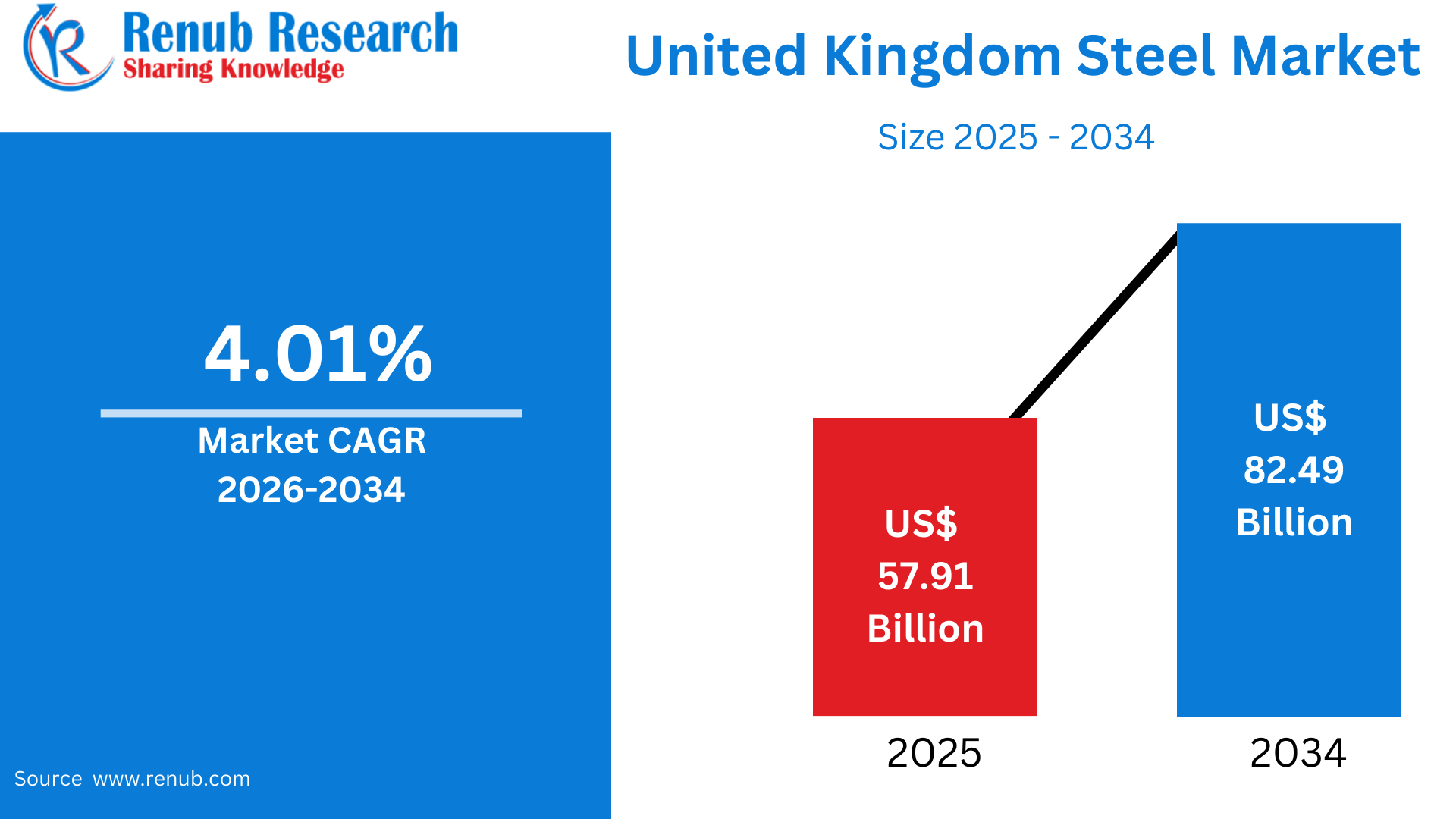
United Kingdom steel sector is positioned for sustained expansion, with market valuation projected to climb from US$ 57.91 Billion in 2025 to US$ 82.49 Billion by 2034. This trajectory represents a compound annual growth rate (CAGR) of 4.01% over the 2026–2034 forecast period. Momentum is primarily underpinned by structural demand across core industrial sectors, including building and construction, infrastructure engineering, automotive manufacturing, and renewable energy installations. Key systemic growth vectors include ongoing national infrastructure modernization, the scaling of domestic electric vehicle (EV) production, and an accelerating industrial shift toward high-strength, sustainable steel grades.
United Kingdom Steel Market Trends
Steel is a high-strength engineering material primarily composed of iron and carbon, with additional alloying elements such as chromium, nickel, manganese, and molybdenum incorporated to enhance specific mechanical and chemical properties. Depending on its composition and manufacturing process, steel can be tailored for a wide range of applications requiring varying levels of strength, corrosion resistance, ductility, and durability. It is extensively used in construction, automotive manufacturing, transportation, machinery, energy infrastructure, consumer appliances, packaging, and industrial equipment. Its ability to be recycled repeatedly without significant loss of quality makes steel a critical material in advancing circular economy initiatives and sustainable industrial development.
The United Kingdom continues to regard steel as a strategic material supporting its manufacturing, construction, and infrastructure sectors. Demand is primarily driven by the construction industry, where structural steel and reinforcement products are widely used in residential, commercial, and infrastructure projects, including bridges, rail networks, and public buildings. The automotive, aerospace, shipbuilding, and rail industries also rely on high-grade steel to manufacture lightweight, durable, and high-performance components. In addition, the country's growing investments in renewable energy projects, particularly offshore wind farms, electricity transmission networks, and energy storage infrastructure, are creating new opportunities for steel consumption. The UK's commitment to achieving net-zero carbon emissions is further encouraging the adoption of low-carbon steel production technologies, electric arc furnaces, and recycled steel, strengthening the industry's long-term sustainability and competitiveness.
Government Policies Supporting the UK Steel Industry
The UK government has reaffirmed its commitment to strengthening the domestic steel industry by announcing a new Steel Strategy, unveiled on September 2024, with publication scheduled for spring 2025. The strategy aims to encourage long-term investment, improve the resilience of domestic supply chains, and create high-quality employment opportunities in key industrial regions. Rather than relying on short-term financial support, the government intends to promote sustainable growth through structural reforms and strategic investment. A public consultation on the strategy remained open until 30 March 2025, allowing industry stakeholders to contribute to policy development.
A central focus of the government’s approach is supporting the steel sector’s transition toward low-carbon steel production, which is considered essential for achieving the UK’s net-zero emissions targets. The strategy includes measures to strengthen domestic steel manufacturing through public procurement policies while addressing challenges such as the UK’s comparatively high industrial electricity costs, which affect the global competitiveness of steel producers.
To accelerate industry transformation, the government has committed £2.5 billion in funding for the steel sector, in addition to the £500 million previously allocated for the decarbonization of the Port Talbot steelworks. Financial support will primarily be delivered through the newly established National Wealth Fund (NWF) and other government funding mechanisms. The NWF will provide at least £5.8 billion in investment across strategic sectors, including green steel, green hydrogen, carbon capture technologies, and other low-carbon industrial projects, further supporting the modernization and long-term sustainability of the UK steel industry.
Steel Product launches in the United Kingdom
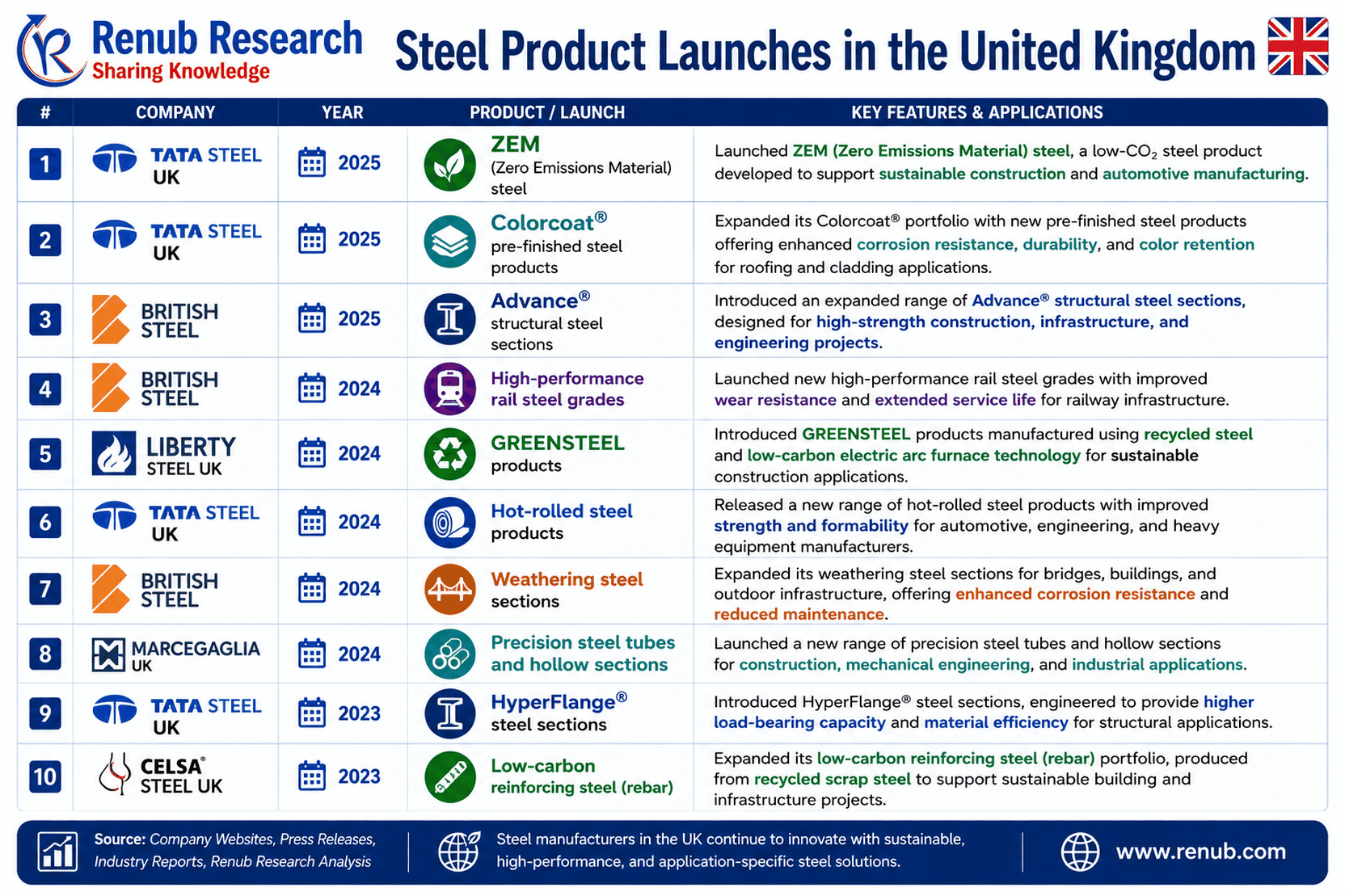
- Tata Steel UK (2025): Launched ZEM (Zero Emissions Material) steel, a low-CO₂ steel product developed to support sustainable construction and automotive manufacturing.
- Tata Steel UK (2025): Expanded its Colorcoat® portfolio with new pre-finished steel products offering enhanced corrosion resistance, durability, and color retention for roofing and cladding applications.
- British Steel (2025): Introduced an expanded range of Advance® structural steel sections, designed for high-strength construction, infrastructure, and engineering projects.
- British Steel (2024): Launched new high-performance rail steel grades with improved wear resistance and extended service life for railway infrastructure.
- Liberty Steel UK (2024): Introduced GREENSTEEL products manufactured using recycled steel and low-carbon electric arc furnace technology for sustainable construction applications.
- Tata Steel UK (2024): Released a new range of hot-rolled steel products with improved strength and formability for automotive, engineering, and heavy equipment manufacturers.
- British Steel (2024): Expanded its weathering steel sections for bridges, buildings, and outdoor infrastructure, offering enhanced corrosion resistance and reduced maintenance.
- Marcegaglia UK (2024): Launched a new range of precision steel tubes and hollow sections for construction, mechanical engineering, and industrial applications.
- Tata Steel UK (2023): Introduced HyperFlange® steel sections, engineered to provide higher load-bearing capacity and material efficiency for structural applications.
- Celsa Steel UK (2023): Expanded its low-carbon reinforcing steel (rebar) portfolio, produced from recycled scrap steel to support sustainable building and infrastructure projects.
Market Catalysts
Capital Expenditure in Public Infrastructure and Civil Engineering
A primary driver of volume expansion in the UK steel sector is the sustained requirement for national infrastructure modernization and asset renewal. Major capital investments across transport networks—encompassing rail corridors, highway networks, deepwater ports, and aviation hubs—rely heavily on structural sections, heavy plates, and reinforcing bars (rebar) for bridges, transit stations, and foundational civil works. Concurrently, large-scale urban regeneration programs converting legacy industrial brownfields into mixed-use commercial and residential zones stimulate steady demand for fabricated steel components. Demographically driven high-rise residential construction and the rapid expansion of logistics networks, regional distribution hubs, and data centers further intensify material consumption. To systematically address these requirements, long-term procurement visibility has been enhanced through centralized strategic tracking. In July 2025, the National Infrastructure and Service Transformation Authority (NISTA) launched an interactive 10-year Infrastructure Pipeline portal. This digital framework provides real-time tracking for major public and private sector capital schemes, providing the supply chain with granular market transparency and driving institutional co-investment to stabilize the long-term order pipeline.
Clean Energy Transitions and Renewable Infrastructure Mandates
The UK’s legally binding mandate to achieve net-zero greenhouse gas emissions by 2050 serves as a critical systemic catalyst for structural steel demand. Under the government’s Clean Power 2030 Action Plan—which targets a completely decarbonized power grid by the end of the decade—decarbonization projects require unprecedented volumes of specialized, high-grade steels. The rapid scaling of onshore and offshore wind farms, solar array mounting architectures, high-voltage grid reinforcement, and utility-scale battery storage facilities are highly material-intensive. Furthermore, the engineering of next-generation green hydrogen networks and carbon capture, utilization, and storage (CCUS) facilities underpins long-term consumption trends for specialized tubular products and high-strength alloys. This regulatory environment is pushing commercial real estate and manufacturing sectors toward energy-efficient building specifications and structural retrofits that utilize low-carbon steel solutions. Highlighting this rapid energy transition, global operators like TotalEnergies are heavily building out integrated UK portfolios, deploying substantial capital into offshore wind, utility solar, and advanced battery storage pipelines to meet impending grid-operational deadlines.
Advanced Industrial Manufacturing, E-Mobility, and Near-Shoring
Domestic industrial manufacturing remains a foundational pillar of UK steel consumption, specifically across advanced automotive platforms, heavy industrial machinery, precision engineered components, and sustainable product packaging. Structural shifts toward industrial resilience and supply chain insulation have triggered selective near-shoring and localized procurement, favoring regional steel mills. Within the automotive sector, the transition to electrification is rewriting material specifications; manufacturers are increasingly deploying specialized flat-rolled and coated steel grades for vehicle chassis structures, high-stress safety enclosures, and electric vehicle (EV) battery housings. Simultaneously, the explosive growth of e-commerce networks keeps demand high for heavy-duty structural racking, automated material handling frames, and modular shelving systems. This industrial market expansion is attracting major global players; for instance, in late 2025, automotive conglomerate Geely Auto officially integrated into the UK retail market, establishing localized commercial distribution networks and scheduling high-volume vehicle deliveries to capture a share of the evolving domestic electric transport ecosystem.
UK Demand for Steel Mill Products (2010–2024)
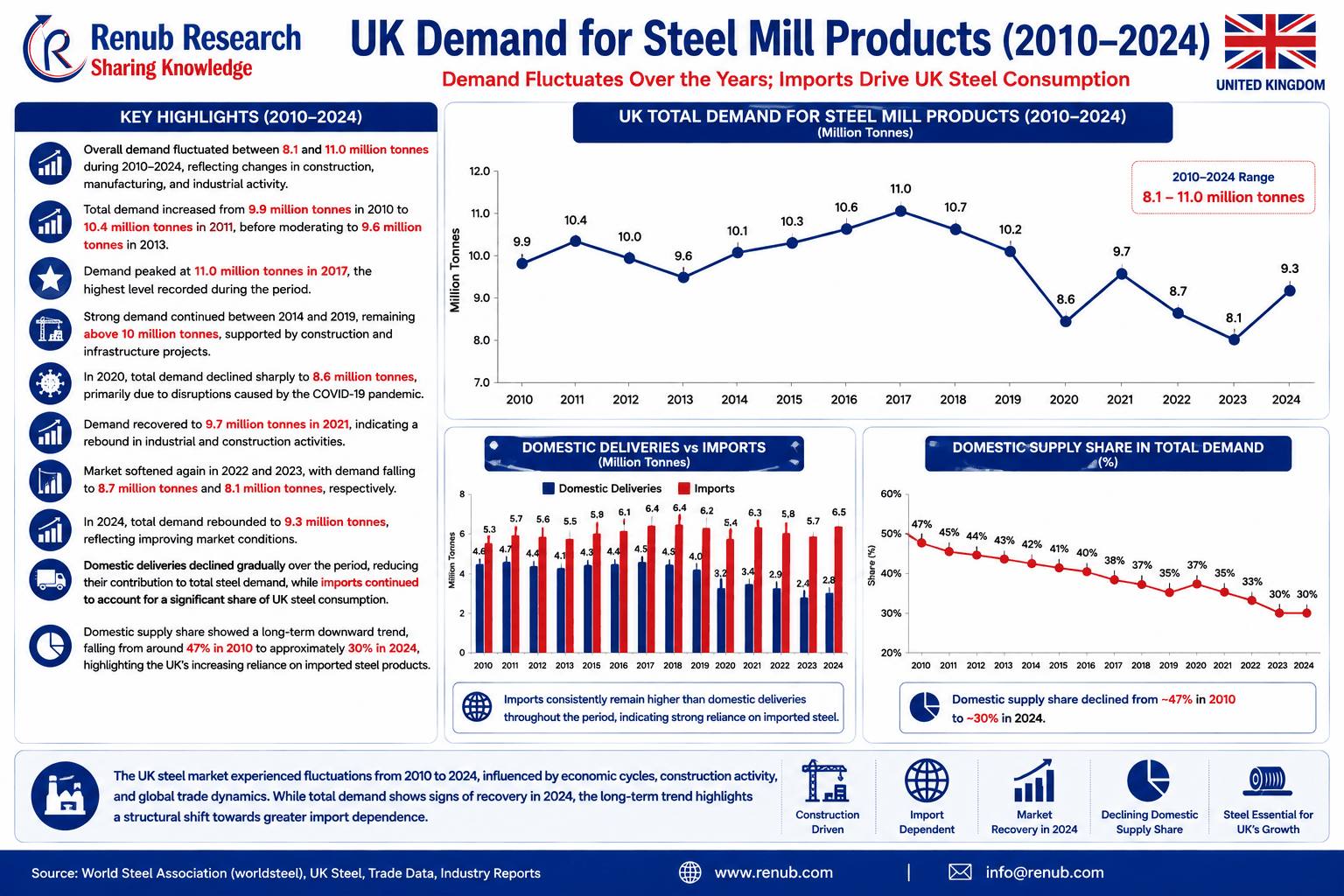
- Overall demand fluctuated between 8.1 and 11.0 million tonnes during 2010–2024, reflecting changes in construction, manufacturing, and industrial activity.
- Total demand increased from 9.9 million tonnes in 2010 to 10.4 million tonnes in 2011, before moderating to 9.6 million tonnes in 2013.
- Demand peaked at 11.0 million tonnes in 2017, the highest level recorded during the period.
- Strong demand continued between 2014 and 2019, remaining above 10 million tonnes, supported by construction and infrastructure projects.
- In 2020, total demand declined sharply to 8.6 million tonnes, primarily due to disruptions caused by the COVID-19 pandemic.
- Demand recovered to 9.7 million tonnes in 2021, indicating a rebound in industrial and construction activities.
- Market softened again in 2022 and 2023, with demand falling to 8.7 million tonnes and 8.1 million tonnes, respectively.
- In 2024, total demand rebounded to 9.3 million tonnes, reflecting improving market conditions.
- Domestic deliveries declined gradually over the period, reducing their contribution to total steel demand, while imports continued to account for a significant share of UK steel consumption.
- Domestic supply share showed a long-term downward trend, falling from around 47% in 2010 to approximately 30% in 2024, highlighting the UK’s increasing reliance on imported steel products.
Market Headwinds
Industrial Power Tariffs, Emissions Pricing, and Margin Compression
The core operational constraint facing UK steel producers is the compounding pressure of uncompetitive industrial energy pricing and stringent carbon reduction mandates, which collectively dilute domestic competitiveness against overseas mills. Steel manufacturing is fundamentally energy-intensive; consequently, high volatility in wholesale electricity and natural gas markets directly compresses processing margins. Simultaneously, tight domestic carbon emission caps and environmental compliance targets require aggressive capital expenditure into process optimizations, electric arc furnace (EAF) conversions, and experimental green hydrogen reduction technologies. While these investments are required for long-term compliance, they dramatically elevate short-to-medium-term operational expenditures. This structural cost disadvantage leaves domestic producers vulnerable to displacement by lower-cost imported product forms originating from regions with less restrictive environmental governance and subsidized energy infrastructure.
Import Penetration, Macroeconomic Cyclicality, and Demand Volatility
The domestic steel ecosystem remains highly sensitive to international market dynamics, currency fluctuations, and aggressive import competition from lower-cost manufacturing hubs. During periods of global macroeconomic overcapacity, sudden influxes of imported flat, long, and specialty steel grades frequently undercut domestic pricing structures and erode local market share. This exposure is exacerbated by the highly cyclical nature of core consumer sectors like automotive manufacturing and commercial civil construction. When downstream demand fluctuates, domestic mills suffer from destabilizing utilization rates and highly volatile order books, which hampers long-term workforce retention and limits capital planning capabilities. Furthermore, domestic producers must manage these macroeconomic shifts while fulfilling customer demands for lower lead times, customized metallurgical profiles, and highly competitive pricing—all within a supply chain that remains vulnerable to global raw material bottlenecks and transport logistics disruptions.
United Kingdom Flat Steel Industry
The UK flat steel market comprises hot-rolled, cold-rolled, and coated sheets and coils that find widespread applications in the automotive, construction, appliances, engineering, and packaging industries. Automotive manufacturers use high-strength and advanced high-strength flat steels for body panels, crash structures, and structural components. Applications of flat steel in construction include cladding, roofing, composite floor decks, and structural plate. Coated steels, in the form of galvanized and pre-painted products, play an important role in building envelopes, agricultural structures, and light fabrication. Engineering and general fabrication make use of flat steel for machinery, chassis, and fabricated assemblies. Demand is closely linked to industrial activity, vehicle production, housing starts, and commercial projects. Service centres and stockholders play a key role in slitting, cutting, and distribution with just-in-time delivery and tailored sizes.
Structural Steel Market in United Kingdom
The structural steel market in the UK focuses on beams, columns, channels, hollow sections, and fabricated assemblies used primarily in building frames, industrial sheds, warehouses, bridges, and infrastructure. Structural steel is preferred because of its strength-to-weight ratio, speed of erection, design flexibility, and compatibility with modern construction methodologies like offsite fabrication and modular building. Logistic hubs, distribution centres, commercial offices, and multi-storey car parks depend heavily on the steel frameworks. Faster build times and adaptable space have driven demand for structural steel, particularly when construction programs are tight. Fabricators and steelwork contractors provide design, detailing, fabrication, and on-site erection services, forming a key link between mills and project owners. The demand in this segment is strongly influenced by public infrastructure investment, urban regeneration, and large commercial developments.
Iron & Steel Wire Industry in UK
The main product types that make up the UK iron and steel wire market include wire rod, drawn wire, mesh products, fencing, cables, nails, springs, and reinforcement systems. The main consuming industry sectors are: construction (welded wire mesh, reinforcement wire, and strand); agriculture (fencing wire, barbed wire, and netting); and industry, which covers a vast spectrum, from springs and fasteners to wire ropes and cable assemblies that are used in applications as diverse as lifting, mining, marine, and engineering. Packaging and consumer goods industries also utilize fine wires and mesh products. Demand is related to the level of construction activity, infrastructure projects, agricultural investment, and manufacturing output. Producers and wire-drawers add value through coatings (galvanizing, plastic), strength classes, and customized sizes.
United Kingdom Steel Building and Construction Market Expansions
Steel is fundamental to the UK's building and construction sector, having applications in structural frames, reinforcement, cladding, roofing, and a wide range of building components. Structural steel frameworks are commonly adopted for high-rise offices, commercial buildings, industrial units, stadia, and transport facilities due to their speed of construction and adaptability. Reinforcing bar and mesh play a vital role in reinforcing concrete foundations, slabs, bridges, and civil structures. Light-gauge steel framing and steel-based building systems are increasingly used in residential and modular construction, facilitating rapid delivery and consistent quality. Planning policies, infrastructure spending, housing programs, and private-sector development cycles dictate market demand. Sustainability, including embodied carbon and lifecycle performance, is increasingly driving choices of material and approaches to design.
Steel Electrical Appliances Industry Growths in United Kingdom
The steel electrical appliances segment covers the use of flat and coated steels in refrigerators, washing machines, ovens, dishwashers, cookers, and smaller appliances. Manufacturers value steel for its strength, formability, corrosion resistance especially when coated, and aesthetic potential via painted or patterned finishes. Steel is also used internally in components such as drums, frames, brackets, and structural supports, where robustness and cost-efficiency are required. UK consumers continuing to replace and upgrade appliances, and tightening energy-efficiency standards, underpin demand for well-engineered steel components. The growth in demand for built-in and premium appliances sustains demand for attractive, durable outer panels. At the same time, the market remains sensitive to consumer confidence, housing activity, and broader economic conditions.
Automotive Steel Industry in UK
The UK's major steel-using sector includes flat and coated products, plus certain long and tubular components. Vehicle manufacturers rely on advanced high-strength steels for body-in-white structures, crash management systems, and chassis parts to meet exacting safety, light weighting, and cost targets. Exhaust systems, seat structures, and steering and suspension units commonly utilize steel. As the production of electric vehicles continues to ramp up, specialized steels are being increasingly used in the manufacture of battery enclosures, motor casings, and underbody protection systems. Demand from the automotive market is directly influenced by domestic vehicle production volumes, export demand, and model cycles. Supply chain resilience, just-in-time delivery, and quality consistency matter hugely. Collaboration between steelmakers, automotive OEMs, and component suppliers is driving the development of new grades with enhanced formability, strength, and fatigue properties.
Steel Consumptions in London
London is a major regional centre of steel consumption, with its high-density concentration of commercial, residential, transport, and infrastructure projects. High-rise office towers, mixed-use projects, major transport hubs, rail upgrades, and regeneration schemes have strong requirements for structural steel frameworks, rebar, and fabricated components. Continuous redevelopment of older buildings and brownfield sites ensures a pipeline of steel-intensive construction. In addition, logistics, data centres, and large public buildings across Greater London supplement demand. While the city would not normally host primary steelmaking, it is often a key market for steel distributors, fabricators, and project-based supply chains.
Significant Investment in Manchester Steel Industry
Ongoing urban regeneration, commercial expansion, and logistics and housing growth shape Manchester's steel market. Significant investment has already been made in the city and surrounding region into office space, residential towers, educational facilities, and cultural venues, many of which utilize steel frames and rebar. This redevelopment of former industrial areas into mixed-use neighbourhoods and business districts drives demand for structural and reinforcement steel. The region's position as a key logistics and warehousing hub, supported by strong transport links, adds further steel demand for large-span sheds and distribution centres. Local fabricators, stockholders, and engineering firms provide bespoke steel solutions directly to contractors and developers.
Steel Industry in Liverpool
The status of Liverpool as a major port city and gateway for trade influences its steel market. The different requirements of port-related infrastructure, logistic facilities, warehouses, and industrial units all utilize structural steel and rebar. Urban regeneration projects along the waterfront and in inner-city districts have created ongoing demand for building frames, cladding systems, and reinforcement. Similarly, the city's cultural developments, such as hotels, apartments, offices, and leisure venues, are all driving up the usage of steel. The proximity to maritime-related, logistics, and manufacturing activities assists in supporting local demand for steel components and fabricated structures.
Edinburgh Steel Market Demands
Institutional, residential, commercial, and infrastructure projects form the core drivers of Edinburgh's steel market, set against an urban environment that is sensitive to its history. University expansions, healthcare facilities, cultural institution developments, and high-quality residential developments often use steel frameworks and reinforcement, especially for those with demanding flexibility and span. Retail and office refurbishment schemes, as well as new-build projects, also adopt various steel solutions to meet structural and architectural demands. Infrastructure works, including transport and utilities improvements, add to the demand for rebar and structural components. The onus of the city's heritage character means that many such projects involve complex engineering and refurbishment works where steel plays a critical role in strengthening and adapting existing structures.
Market Segmentations
Type
- Flat Steel
- Long Steel
Product
- Structural Steel
- Prestressing Steel
- Bright Steel
- Welding Wire and Rod
- Iron Steel Wire
- Ropes
- Braids
Application
- Building and Construction
- Electrical Appliances
- Metal Products
- Automotive
- Transportation
- Mechanical Equipment
- Domestic Appliances
Cities
- London
- Manchester
- Birmingham
- Leeds
- Liverpool
- Edinburgh
- Glasgow
- Tyneside
- Bristol
- Rest of United Kingdom
All companies have been covered with 5 Viewpoints
- Overviews
- Key Person
- Recent Developments
- SWOT Analysis
- Revenue Analysis
Company Analysis:
- ArcelorMittal S.A.
- Gerdau S.A.
- Hyundai Steel Co. Ltd
- JFE Steel Corporation (JFE Holdings Inc.)
- Jiangsu Shagang Group Co. Ltd
- Nippon Steel Corporation
- Nucor Corporation
- Shougang Group Co. Ltd.
- Tata Steel Ltd. (Tata Group)
- United States Steel Corporation
Report Details:
| Report Features | Details |
| Base Year |
2025 |
| Historical Period |
2022 - 2025 |
| Forecast Period |
2026 - 2034 |
| Market |
US$ Billion |
| Segment Covered |
Type, Product, Application and Cities |
| Cities Covered |
|
| Companies Covered |
|
| Customization Scope |
20% Free Customization |
| Post-Sale Analyst Support |
1 Year (52 Weeks) |
| Delivery Format |
PDF and Excel through Email (We can also provide the editable version of the report in PPT/Word format on request) |
Customization Services available
- Analysis of Market Size and Its Segments
- More Company Profiles (Upto 10 without any additional cost):
- Additional Countries (Other than mentioned Countries):
- Region/Country Specific Reports:
- Market Entry Strategy:
- Region-Specific Market Dynamics:
- Regional Market Share Analysis:
- Trade Analysis:
- Production Insights:
- Others Customized Requests:
For more information contact our analysts.
Need More Assistance?
- Talk to our analysts to get more precious information on the current market trends.
- Include more countries and segments and customize the report based on the final requirement.
- Get a competitive advantage in your industry by knowing the report findings and making a positive impact on your revenues and operations.
- Our analysts are always ready to provide more help and pertinent information if you need any additional assistance.