United Kingdom Feed Additives Market Report by Animal Type, Ingredient, Cities and Company Analysis 2026-2034
Buy NowUnited Kingdom Feed Additives Market Size and Forecast 2026-2034
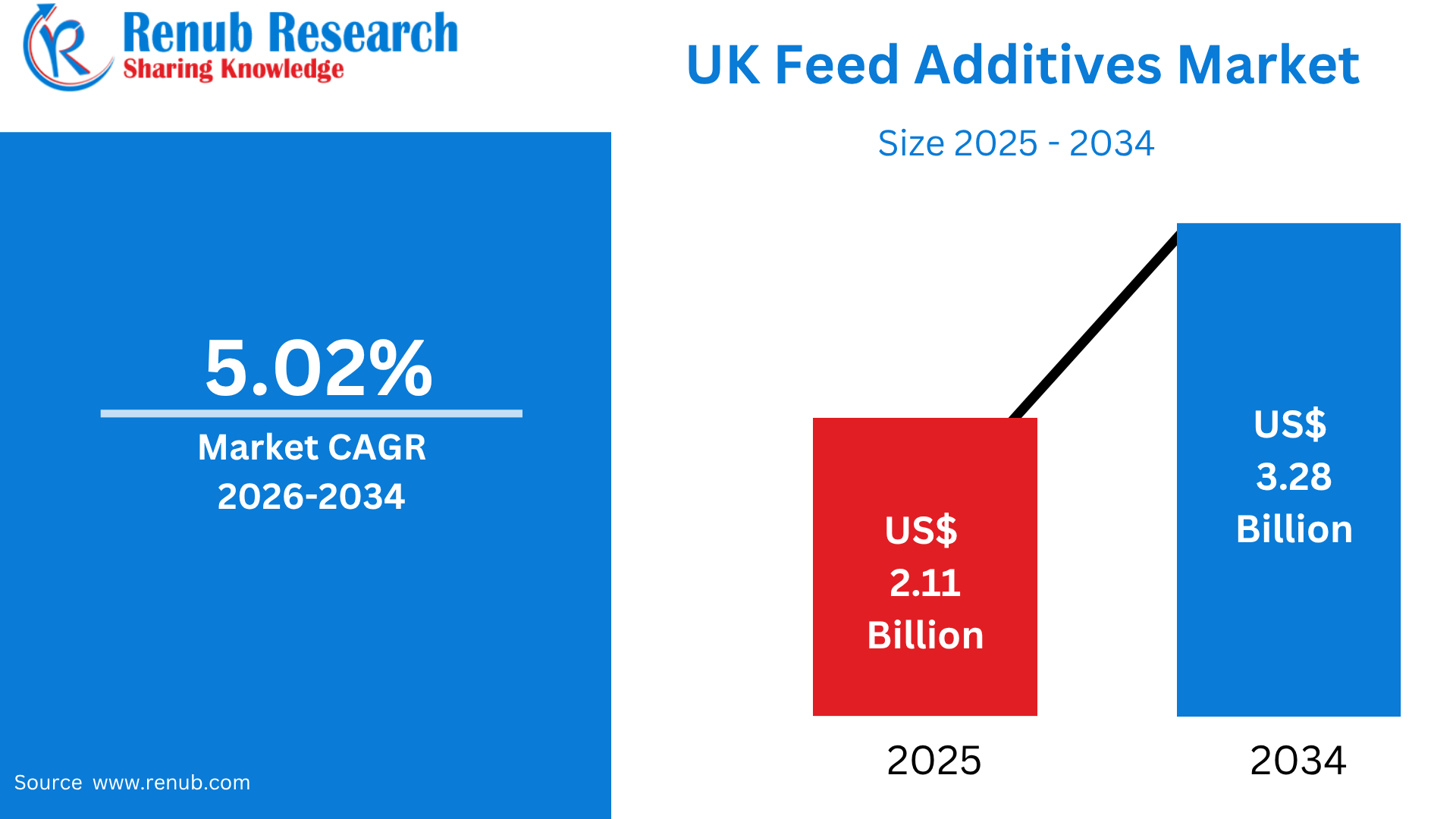
United Kingdom Feed Additives Market is expected to reach US$ 3.28 billion by 2034 from US$ 2.11 billion in 2025, with a CAGR of 5.02% from 2026 to 2034. The UK feed additives market grows due to rising demand for high-quality livestock products, strict animal health regulations, advances in nutrition science, and increased awareness of sustainable farming practices. Expanding poultry and aquaculture sectors further fuel additive adoption.
United Kingdom Feed Additives Overview
Feed additives are nutritional or functional ingredients incorporated into animal feed to improve growth performance, health, and feed efficiency. They include vitamins, minerals, enzymes, amino acids, probiotics, antioxidants and specialty ingredients that support immunity, digestion, and productivity. By enhancing nutrient absorption and preventing deficiencies, additives help farmers maintain healthier livestock with improved weight gain and reproductive performance. They also reduce disease risks, support gut balance, and optimize feed utilization, lowering overall production costs. With growing attention to food safety, sustainability, and antibiotic reduction, feed additives increasingly serve as essential tools in modern animal agriculture.
Growth in the UK feed additives market is driven by stricter animal welfare laws, increased focus on sustainable farming, and rising demand for premium meat, dairy, and egg products. The shift away from antibiotic growth promoters has created opportunities for natural alternatives such as enzymes, probiotics, and phytogenics. Expanding poultry and aquaculture industries also demand high-performance nutrition solutions. Technological advancements in feed formulation and precision farming further accelerate adoption. Additionally, consumer pressure for transparent and ethical supply chains pushes producers to invest in additives that enhance health, reduce emissions, and improve productivity across the livestock sector.
Growth Drivers for the United Kingdom Feed Additives Market
Shift Toward Antibiotic-Free Livestock Production
The UK’s transition toward antibiotic-free livestock production is a major driver of feed additive demand. As regulations tighten and consumer awareness grows, farmers must adopt alternatives that maintain animal health and productivity without relying on antibiotics. This shift has accelerated the use of probiotics, prebiotics, organic acids, yeast cultures, enzymes, and phytogenic additives that support gut integrity, immunity, and efficient nutrient absorption. Natural additives help reduce pathogenic loads, stabilize the microbiome, and improve digestion, resulting in healthier animals and more consistent performance. Retailers and food companies increasingly require antibiotic-free sourcing, pushing producers to reformulate feeds accordingly. Furthermore, industry commitments to responsible antimicrobial use have made additives essential tools for preventing disease and supporting resilience in livestock systems. As sustainability and traceability become central to UK agriculture, these solutions gain strategic importance, creating strong long-term demand within the feed additives market.
Expansion of Poultry and Aquaculture Sectors
The rapid growth of the UK poultry and aquaculture sectors is significantly boosting the demand for feed additives. Poultry remains the most consumed protein in the UK, requiring efficient, cost-effective nutrition strategies to meet rising demand. Feed additives—including amino acids, enzymes, antioxidants, and mineral blends—play a crucial role in enhancing feed efficiency, improving growth rates, and supporting gut health in high-density production systems. Aquaculture, especially salmon and trout farming, depends heavily on specialized additives like pigments, immune enhancers, and digestive enzymes to ensure optimal fish health and product quality. As both industries emphasize reduced mortality, uniformity, and improved feed conversion ratios, additive innovation becomes essential. Environmental regulations also push producers toward solutions that lower waste output and support sustainable production. These combined factors make poultry and aquaculture powerful engines driving UK feed additive market expansion.
Sustainability and Environmental Compliance
Sustainability pressures and regulatory compliance requirements are central growth drivers in the UK feed additives market. Farmers and feed manufacturers face strict rules concerning emissions, nutrient management, and responsible resource use. Additives such as enzymes, methane-reducing compounds, and enhanced mineral formulations help optimize digestion, reduce nitrogen and phosphorus excretion, and minimize greenhouse gas emissions. By improving feed conversion efficiency, additives also reduce overall feed consumption, lowering the environmental footprint of livestock production. As UK agriculture moves toward climate-neutral and circular farming models, producers increasingly adopt additives that support reduced waste, improved manure quality, and better soil health. Retailers and consumers also expect sustainable sourcing and minimal environmental impact, pushing the supply chain to adopt innovative additive solutions. Government incentives, sustainability certifications, and carbon reduction commitments further strengthen long-term market growth rooted in environmental responsibility.
Challenges in the United Kingdom Feed Additives Market
High Costs and Margin Pressures
One of the biggest challenges in the UK feed additives market is the high cost associated with premium additive ingredients. Specialty additives such as enzymes, probiotics, and organic minerals require sophisticated manufacturing, driving up prices. At the same time, farmers face tight profit margins due to fluctuating feed grain costs, rising energy expenses, and competitive market pricing for meat, dairy, and eggs. As a result, producers may hesitate to invest in advanced additives unless the return on investment is clear and measurable. Smaller farms, which dominate parts of the UK agricultural landscape, often lack the financial flexibility to adopt high-performance additive programs, slowing market penetration.
Regulatory Complexity and Compliance Burden
Strict feed and food safety regulations create significant challenges for manufacturers and distributors. Compliance with evolving UK and EU-aligned standards requires extensive testing, documentation, and product validation, raising operational costs and delaying market entry for new additives. Rules governing claims, permissible ingredients, antimicrobial alternatives, and environmental impacts add further complexity. The regulatory approval process can be lengthy, limiting innovation speed and discouraging smaller companies from entering the market. Post-Brexit divergences also create uncertainty in labeling, import procedures, and equivalence standards. These factors make navigating the regulatory landscape demanding, affecting both local producers and international suppliers serving the UK market.
London Feed Additives Market
London serves as a strategic hub for the UK feed additives market due to its concentration of corporate headquarters, research institutions, trading companies, and regulatory bodies. While it is not an agricultural production center, its strong financial and commercial ecosystem supports investment, innovation, and international partnerships. Many global feed additive manufacturers operate regional offices or distribution networks from London, coordinating supply chains across the UK. The city's research universities and biotech firms also drive advancements in feed formulation, sustainability, and microbial technologies. London’s role in policy-making and standards development further influences national market trends, shaping adoption of sustainable and health-focused additives across the livestock industry.
Manchester Feed Additives Market
Manchester plays an important role in the UK feed additives market through its strong logistics network, manufacturing base, and proximity to major livestock-producing regions in northern England. The city hosts distribution centers, feed manufacturers, and specialized suppliers serving the poultry, dairy, and beef sectors. Manchester’s academic institutions contribute to research in biotechnology, animal nutrition, and sustainable farming practices, fostering regional innovation. Its well-developed transport links support efficient movement of feed ingredients and additives across the North West. As northern agriculture continues to modernize, demand for performance-enhancing and eco-friendly additives rises, making Manchester a key commercial and operational hub for the industry.
Birmingham Feed Additives Market
Birmingham’s central location makes it a vital distribution and commercial center for the UK feed additives industry. The city’s access to major motorways and logistics routes enables efficient supply to livestock farms across the Midlands. Birmingham hosts feed companies, agricultural suppliers, and technical advisory services that guide farmers in adopting advanced nutrition solutions. Its strong university and research presence supports innovation in enzymes, probiotics, and sustainable feed technologies. As the Midlands region includes significant poultry, pig, and dairy production, demand for additives that enhance health, improve efficiency, and support antibiotic reduction continues to rise. Birmingham’s role in trade and supply chain coordination strengthens its importance to the national market.
Leeds Feed Additives Market
Leeds is a growing hub for the feed additives market due to its proximity to key livestock regions in Yorkshire and the North. The city’s thriving agricultural economy, supported by dairy, beef, and poultry farming, drives steady demand for nutritional and functional additives. Leeds benefits from strong connections to feed mills, agricultural cooperatives, and veterinary service providers that influence on-farm adoption of additives. Local universities contribute to research in animal health, feed efficiency, and sustainable farming, supporting innovation and workforce development. With increasing focus on productivity and welfare in northern agriculture, Leeds plays a strategic role in distribution, technical services, and market expansion for feed additives.
Recent Developments in United Kingdom Feed Additives Market
- March 2024: Northern Ireland–based Devenish Nutrition Group completed the sale of its North American subsidiary, Devenish LLC, to South Korea’s Easy Bio Corporation. The transaction includes five manufacturing plants and six research facilities located across the United States and Mexico. Devenish plans to use the proceeds to reduce debt and concentrate on strengthening its core markets in northwest Europe and other international regions.
- February 2023: Evonik introduced its first plant-based feed additive, PhytriCare IM. The product is formulated from selected plant extracts rich in flavonoids, compounds recognized for their anti-inflammatory properties. PhytriCare IM is now available throughout Europe, supporting the industry’s shift toward natural, sustainable feed solutions.
United Kingdom Feed Additives Market Segments
Additive Type
- Antibiotics
- Vitamins
- Antioxidants
- Amino Acids
- Enzymes
- Prebiotics
- Probiotics
- Binders
- Others
Animal Type
- Ruminants
- Swine
- Poultry
- Others
Cities
- London
- Manchester
- Birmingham
- Leeds
- Liverpool
- Edinburgh
- Glasgow
- Tyneside
- Bristol
- Rest of United Kingdom
All companies have been covered with 5 Viewpoints
- Overviews
- Key Person
- Recent Developments
- SWOT Analysis
- Revenue Analysis
Key Players Analysis
- Alltech
- BASF SE
- Novozymes A/S.
- Archer Daniels Midland Co.
- Cargill Inc.
- DSM Nutritional Products Inc.
- Evonik Industries AG
- Nutreco N.V.
- Dupont Danisco
Report Details:
| Report Features | Details |
| Base Year |
2024 |
| Historical Period |
2020 - 2024 |
| Forecast Period |
2025 - 2033 |
| Market |
US$ Billion |
| Segment Covered |
Animal Type, Ingredient and Region |
| Region Covered |
|
| Companies Covered |
|
| Customization Scope |
20% Free Customization |
| Post-Sale Analyst Support |
1 Year (52 Weeks) |
| Delivery Format |
PDF and Excel through Email (We can also provide the editable version of the report in PPT/Word format on request) |
Customization Services available
- Analysis of Market Size and Its Segments
- More Company Profiles (Upto 10 without any additional cost):
- Additional Countries (Other than mentioned Countries):
- Region/Country Specific Reports:
- Market Entry Strategy:
- Region-Specific Market Dynamics:
- Regional Market Share Analysis:
- Trade Analysis:
- Production Insights:
- Others Customized Requests:
For more information contact our analysts.
Need More Assistance?
- Talk to our analysts to get more precious information on the current market trends.
- Include more countries and segments and customize the report based on the final requirement.
- Get a competitive advantage in your industry by knowing the report findings and making a positive impact on your revenues and operations.
- Our analysts are always ready to provide more help and pertinent information if you need any additional assistance.