Global Uninterruptible Power Supply (UPS) Market Report by Capacity (Less than 10 kVA, 10–100 kVA, Above 100 kVA), Type (Standby UPS System, Online UPS System, Line-Interactive UPS System), Application (Data Centers, Telecommunications, Healthcare, Industrial, Others), Countries and Company Analysis 2026-2034
Buy NowUPS Market Forecast and Size, Regional Demand Drivers, and Expenditure Trajectories
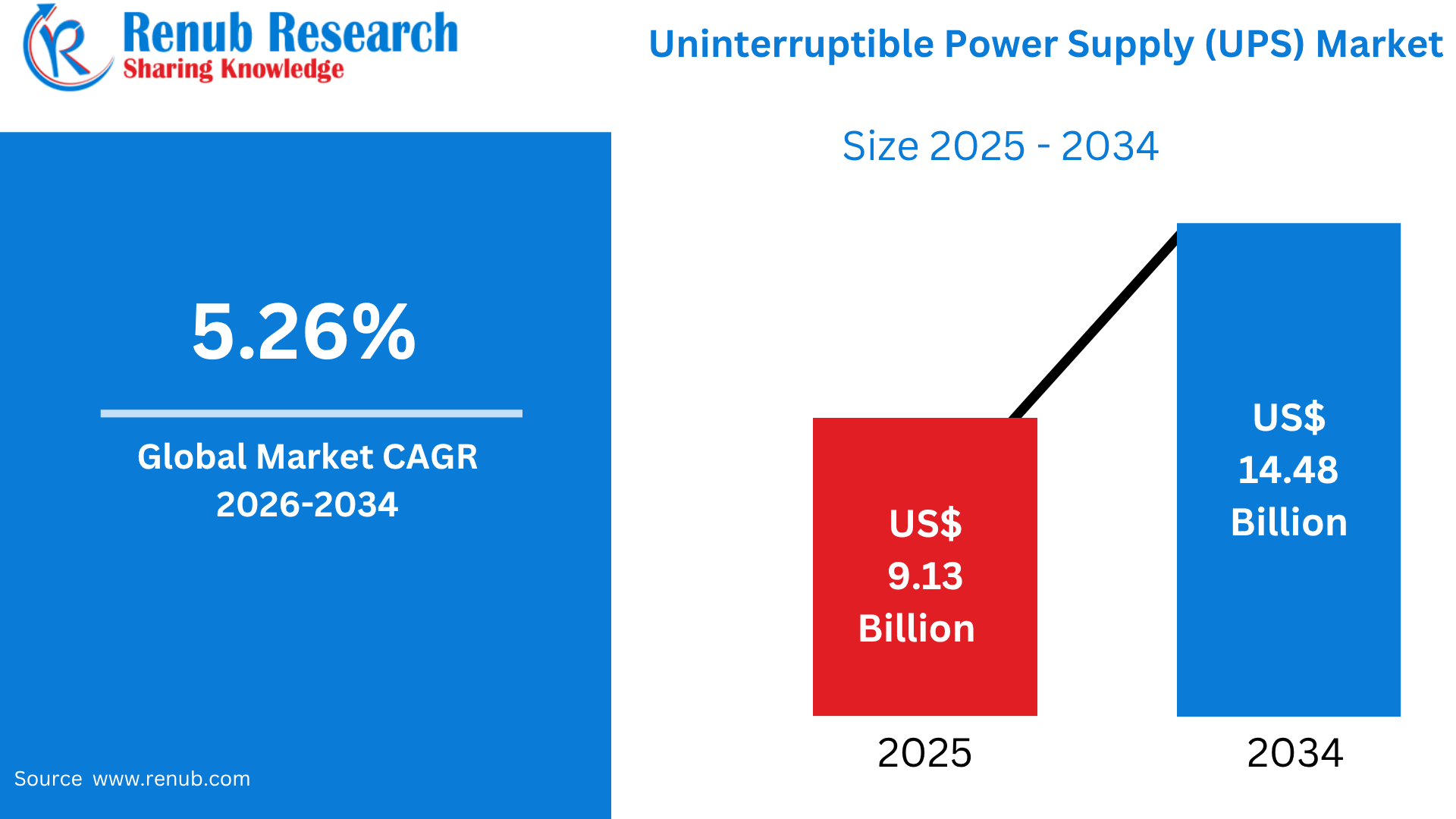
Uninterruptible Power Supply market is expected to experience steady growth, expanding from US$ 9.13 billion in 2025 to US$ 14.48 billion by 2034, registering a compound annual growth rate (CAGR) of 5.26% during 2026–2034. Market growth is primarily driven by the increasing demand for reliable power backup solutions across data centers, healthcare facilities, industrial operations, commercial buildings, and critical infrastructure. The rapid expansion of digitalization, cloud computing, and IT infrastructure has significantly increased the need for uninterrupted power to protect sensitive equipment and prevent operational downtime.
UPS Market and Popularity
An Uninterruptible Power Supply (UPS) is an electrical device that provides immediate backup power to connected equipment when the main power source fails or experiences voltage fluctuations. Unlike generators, a UPS delivers power instantly from internal batteries or energy storage systems, ensuring there is no interruption to critical operations. It also protects electronic equipment from power surges, voltage sags, spikes, frequency variations, and electrical noise, helping extend the lifespan of sensitive devices. UPS systems are available in various types, including standby, line-interactive, and online (double-conversion) UPS, depending on the level of power protection required.
UPS systems are widely used worldwide across data centers, hospitals, telecommunications networks, manufacturing facilities, commercial buildings, financial institutions, educational campuses, and residential applications. They ensure continuous operation of servers, medical equipment, industrial automation systems, and communication infrastructure during power disruptions. The growing adoption of cloud computing, artificial intelligence, Internet of Things (IoT), and edge computing has significantly increased the need for reliable power backup solutions. Rising concerns about grid instability, frequent power outages, and the expansion of digital infrastructure have further boosted the global popularity of UPS systems. Additionally, advancements in lithium-ion battery technology, modular UPS designs, and intelligent remote monitoring are enhancing efficiency, reliability, and energy management, driving widespread adoption across both developed and emerging markets.
Global BESS capacity set for sixfold growth by 2030
- Global BESS Capacity Growth: Global Battery Energy Storage System (BESS) installed capacity is projected to increase sixfold between 2025 and 2030, registering a robust compound annual growth rate (CAGR) of 42%.
- Rising Electricity Demand: Increasing electricity consumption driven by electrification, industrial expansion, and AI-powered data centers is expected to significantly boost demand for battery energy storage systems worldwide.
- Renewable Energy Integration: The growing deployment of wind and solar power is accelerating the need for energy storage solutions to improve grid stability, balance intermittent renewable generation, and enhance energy reliability.
- Declining Battery Costs: Falling lithium-ion battery prices, coupled with improvements in manufacturing efficiency and stronger global supply chains, are making BESS projects more economically viable.
- Supportive Government Policies: Favorable government regulations, clean energy targets, financial incentives, and investments in grid modernization are encouraging faster adoption of battery energy storage technologies.
- China and the United States Leading the Market: China and the United States are expected to remain the largest BESS markets, jointly accounting for approximately 74.6% of global installed battery energy storage capacity by the end of 2025.
- Utility-Scale Investments: Large-scale utility procurement programs, expanding renewable energy projects, and supportive regulatory frameworks in both countries are expected to continue driving global BESS market growth.
Growth Drivers of the Uninterruptible Power Supply (UPS) Market
Rapid Expansion of Data Centers and Cloud Computing Infrastructure
The rapid growth of data centers, cloud computing, and digital services is one of the primary drivers of the global UPS market. UPS systems are essential for maintaining uninterrupted power to servers, networking equipment, and storage systems, preventing data loss and costly downtime. The increasing adoption of artificial intelligence (AI), big data analytics, Internet of Things (IoT), and edge computing has significantly increased demand for reliable power protection. Global data center investments continue to rise, with hyperscale facilities expanding across North America, Europe, and Asia-Pacific. Industry estimates indicate that more than 8,000 data centers operate worldwide, each requiring advanced UPS systems for continuous operation. Online double-conversion UPS systems are increasingly preferred because they provide high-quality power and eliminate voltage fluctuations. As businesses continue migrating to cloud-based platforms and digital infrastructure expands, demand for high-capacity, energy-efficient, and scalable UPS solutions is expected to remain strong throughout the forecast period.
Rising Demand for Reliable Power Backup Across Critical Infrastructure
Growing dependence on continuous electricity supply across healthcare, manufacturing, telecommunications, banking, and commercial facilities is significantly driving the UPS market. Hospitals rely on UPS systems to support life-saving medical equipment, operating rooms, and intensive care units during power interruptions. Financial institutions require uninterrupted power to ensure secure transaction processing and prevent operational disruptions. Manufacturing facilities use UPS systems to protect automated production lines, robotics, and industrial control systems from unexpected shutdowns. Globally, billions of dollars are lost annually due to power outages and electrical disturbances, encouraging organizations to invest in advanced power backup solutions. Increasing urbanization, industrialization, and digital transformation have further expanded the need for reliable electricity. Governments and businesses are strengthening investments in resilient electrical infrastructure to minimize downtime and improve operational continuity. These trends continue to create strong demand for UPS systems across mission-critical applications worldwide.
Technological Advancements in UPS Systems and Battery Technologies
Continuous innovation in UPS technology is accelerating market growth by improving energy efficiency, reliability, and operational flexibility. Modern UPS systems increasingly incorporate lithium-ion batteries, intelligent monitoring software, modular architecture, and remote management capabilities. Compared with traditional lead-acid batteries, lithium-ion batteries offer up to two to three times longer service life, faster charging, reduced maintenance requirements, and a smaller physical footprint. Intelligent UPS platforms equipped with cloud connectivity and predictive maintenance features allow operators to monitor system performance in real time and reduce unexpected failures. Modular UPS systems enable organizations to expand power capacity incrementally while improving energy efficiency and reducing operating costs. Growing emphasis on sustainability and lower energy consumption is encouraging businesses to replace aging UPS equipment with next-generation solutions featuring high operating efficiencies exceeding 95% under optimal conditions. These technological advancements are expected to support long-term growth across commercial, industrial, and institutional markets.
Challenges of the Uninterruptible Power Supply (UPS) Market
High Initial Investment and Battery Replacement Costs
The high capital investment required for advanced UPS systems remains a major challenge for market growth, particularly among small and medium-sized enterprises. High-capacity online UPS systems, modular installations, and lithium-ion battery technologies require substantial upfront spending on equipment, installation, electrical integration, and maintenance. In addition to initial investment, battery replacement represents a significant long-term operating expense. Traditional valve-regulated lead-acid (VRLA) batteries generally require replacement every 3 to 5 years, increasing lifecycle costs for organizations operating large UPS installations. Routine maintenance, cooling requirements, and periodic testing also contribute to operational expenses. Although lithium-ion batteries provide longer service life and lower maintenance, their higher purchase costs may discourage adoption among cost-sensitive customers. As organizations carefully evaluate return on investment, manufacturers must continue developing cost-effective, energy-efficient UPS solutions that reduce total ownership costs while maintaining high performance and reliability.
Environmental Concerns and Battery Disposal Regulations
Environmental sustainability and battery disposal remain significant challenges for the global UPS market. Conventional UPS systems commonly use lead-acid batteries, which contain hazardous materials requiring specialized recycling and disposal processes to prevent environmental contamination. Millions of industrial batteries reach the end of their operational life every year, increasing pressure on recycling infrastructure and regulatory compliance. Governments worldwide are implementing stricter environmental regulations governing battery manufacturing, transportation, recycling, and waste management. Manufacturers are therefore required to invest in environmentally responsible production methods and sustainable end-of-life management programs. Additionally, the extraction of raw materials used in advanced battery technologies, including lithium and other critical minerals, presents supply chain and sustainability concerns. Growing corporate environmental, social, and governance (ESG) commitments are encouraging organizations to adopt greener UPS technologies with improved energy efficiency and recyclable components. Meeting these environmental expectations while maintaining competitive pricing remains an ongoing challenge for UPS manufacturers.
UPS Product Launches
Schneider Electric – Galaxy VXL UPS (2025): Schneider Electric launched the Galaxy VXL, a compact, high-density three-phase UPS designed for AI-ready data centers, semiconductor facilities, and large commercial buildings. The system offers efficiency of up to 99% in ECOnversion mode and features lithium-ion battery compatibility.
Vertiv – Liebert EXL S1 UPS Expansion (2025): Vertiv introduced higher-capacity models of the Liebert EXL S1, delivering scalable power protection for hyperscale and colocation data centers with improved energy efficiency and reduced operating costs.
Eaton – 93T UPS (2025): Eaton launched the 93T UPS, offering advanced double-conversion technology, compact design, and high operating efficiency for healthcare, industrial facilities, and commercial infrastructure.
ABB – MegaFlex DPA UPS (2025): ABB expanded its MegaFlex DPA modular UPS portfolio with enhanced power capacity, intelligent monitoring, and flexible scalability for mission-critical applications.
Huawei – FusionPower9000 UPS Solution (2025): Huawei introduced upgraded FusionPower9000 integrated UPS solutions featuring AI-based energy management, modular architecture, and higher operational efficiency for large data centers.
Delta Electronics – Modulon DPH 500 kVA UPS (2024): Delta launched the Modulon DPH 500 kVA UPS, providing modular scalability, efficiency of up to 97%, and intelligent power management for enterprise and industrial facilities.
APC by Schneider Electric – Smart-UPS Ultra (2024): APC expanded its Smart-UPS Ultra portfolio with lithium-ion battery technology, delivering a lighter, smaller UPS for edge computing, networking, and distributed IT environments.
Riello UPS – Multi Power2 (2024): Riello introduced the Multi Power2 modular UPS featuring hot-swappable power modules, advanced cybersecurity features, and operating efficiency exceeding 98% in smart operating modes.
Socomec – DELPHYS XM UPS (2024): Socomec launched the DELPHYS XM UPS series for hospitals, manufacturing plants, and critical infrastructure, offering high resilience, compact footprint, and improved energy efficiency.
Mitsubishi Electric – 9900D Series UPS (2024): Mitsubishi Electric expanded its 9900D Series UPS lineup with enhanced double-conversion technology, improved reliability, and higher efficiency to support data centers, telecommunications, and industrial applications.
10–100 kVA UPS Rising Demand from Commercial and Industrial Applications
10–100 kVA Uninterruptible Power Supply (UPS) market is experiencing steady growth due to rising demand for medium-capacity power backup solutions in commercial buildings, manufacturing facilities, hospitals, educational institutions, and small- to medium-sized data centers. UPS systems in this capacity range provide reliable protection for mission-critical equipment, ensuring uninterrupted operations during power outages, voltage fluctuations, and electrical disturbances. Businesses are increasingly investing in digital infrastructure, automation, and connected technologies, creating greater demand for dependable power continuity. Industry estimates suggest that commercial and industrial facilities account for more than 60% of medium-capacity UPS installations worldwide. The expansion of edge data centers and distributed IT infrastructure is also supporting demand for 10–100 kVA UPS systems. Manufacturers are introducing modular designs, lithium-ion battery integration, and remote monitoring capabilities to improve efficiency and reduce maintenance costs. Growing investments in smart buildings and industrial automation are expected to sustain long-term growth in this market segment.
Standby UPS Cost-Effective Power Protection for Small Applications
The standby UPS system market continues to expand due to increasing demand for affordable backup power solutions for residential users, small offices, retail stores, and personal computing applications. Standby UPS systems automatically switch to battery power when electrical interruptions occur, providing sufficient backup time to safely shut down connected devices or continue short-duration operations. These systems are widely used to protect desktop computers, routers, point-of-sale terminals, security systems, and home office equipment. Globally, millions of standby UPS units are installed each year because of their simple design, lower purchase cost, and ease of maintenance. The growing trend of remote working, online education, and home-based businesses has further increased demand for reliable power protection. Manufacturers continue improving battery efficiency, compact product designs, and intelligent monitoring features while maintaining competitive pricing. Increasing awareness of equipment protection against power surges and outages is expected to support continued growth of the standby UPS market.
Line-Interactive UPS Growing Adoption for Business Continuity
line-interactive UPS system market is witnessing strong growth as organizations seek efficient power protection for network equipment, servers, telecommunications systems, and business-critical applications. Unlike standby UPS systems, line-interactive UPS units feature automatic voltage regulation (AVR), enabling them to correct minor voltage fluctuations without switching to battery power, thereby extending battery life and improving energy efficiency. These systems are widely deployed in small and medium-sized enterprises, banking institutions, healthcare facilities, and educational organizations. Industry estimates indicate that small and medium-sized businesses represent a significant share of global line-interactive UPS demand, driven by increasing digitalization and IT investments. The rapid expansion of cloud services, cybersecurity infrastructure, and remote operations has further strengthened market demand. Manufacturers are integrating LCD monitoring panels, remote management software, and lithium-ion battery options to improve operational performance. Growing emphasis on reducing downtime and protecting sensitive electronic equipment continues to support expansion of the line-interactive UPS market.
Expanding Digital Infrastructure Driving Demand for Data Center UPS
The data centers UPS market is one of the fastest-growing segments within the global UPS industry, supported by rapid expansion of cloud computing, artificial intelligence, edge computing, and digital services. UPS systems are essential components of data center infrastructure because they provide uninterrupted power to servers, storage devices, networking equipment, and cooling systems during utility failures. Globally, more than 8,000 data centers operate across various regions, with hyperscale facilities accounting for a growing share of new investments. Even brief power interruptions can result in significant financial losses and service disruptions, making high-reliability UPS systems essential. Data center operators increasingly prefer modular online UPS systems with efficiencies exceeding 95%, intelligent energy management, and lithium-ion battery technology to reduce operating costs and improve scalability. Rising investments in hyperscale facilities, colocation services, and edge computing infrastructure are expected to generate sustained demand for advanced UPS solutions worldwide.
Reliable Power Backup for Critical Medical Operations in Healthcare UPS Market
Healthcare UPS market is expanding steadily as hospitals, diagnostic centers, laboratories, and specialty clinics require uninterrupted electricity to support life-saving medical equipment and critical healthcare services. UPS systems protect ventilators, imaging equipment, operating rooms, intensive care units, laboratory analyzers, and electronic health record systems from unexpected power interruptions. Continuous power availability is essential because even short outages can disrupt patient treatment, compromise diagnostic accuracy, and damage sensitive medical devices. Healthcare facilities worldwide are investing heavily in modern electrical infrastructure and backup power systems to improve operational reliability and patient safety. Industry estimates indicate that hospitals account for one of the largest shares of critical UPS installations across institutional sectors. Increasing healthcare expenditure, rising patient volumes, and expanding hospital infrastructure in both developed and emerging economies are strengthening market demand. Technological advancements, including modular UPS architecture, intelligent monitoring systems, and longer-lasting lithium-ion batteries, are further supporting the adoption of advanced UPS solutions throughout the global healthcare sector.
United States Expanding Data Center Infrastructure Driving Demand
United States Uninterruptible Power Supply (UPS) market is witnessing robust growth due to the rapid expansion of data centers, cloud computing, and digital infrastructure. The U.S. hosts more than 5,000 data centers, representing the largest concentration globally, creating substantial demand for reliable power backup systems. UPS solutions are widely deployed across hyperscale data centers, hospitals, financial institutions, manufacturing plants, and telecommunications facilities to ensure uninterrupted operations during power failures. The increasing adoption of artificial intelligence (AI), edge computing, and Internet of Things (IoT) technologies has further strengthened the need for high-capacity online UPS systems. Additionally, the country’s aging power grid and increasing frequency of weather-related outages are encouraging organizations to invest in advanced backup power solutions. Manufacturers are introducing lithium-ion battery-based UPS systems, modular architectures, and AI-enabled remote monitoring platforms to improve efficiency and reduce maintenance costs. Continued investment in digital transformation and mission-critical infrastructure is expected to support sustained growth in the U.S. UPS market.
United Kingdom UPS Growing Digital Economy Supporting Power Backup Demand
United Kingdom UPS market is expanding steadily due to increasing investments in digital infrastructure, healthcare modernization, and commercial facilities. The UK’s growing cloud computing industry, financial services sector, and expanding network of data centers are driving demand for reliable power protection systems. UPS solutions are widely used across hospitals, universities, banking institutions, industrial facilities, and telecommunications networks to protect sensitive electronic equipment from power interruptions and voltage fluctuations. The country continues to experience increasing adoption of remote working, digital services, and cloud-based business operations, strengthening the importance of uninterrupted electricity supply. Businesses are increasingly replacing aging UPS systems with energy-efficient solutions featuring lithium-ion batteries and intelligent energy management software. Growing investments in renewable energy integration and smart buildings are also creating opportunities for advanced UPS technologies. As organizations continue prioritizing operational continuity and cybersecurity, demand for reliable UPS systems is expected to remain strong throughout the forecast period.
UPS Rapid Industrialization and Infrastructure Expansion Fueling India Growth
India UPS market is experiencing significant growth due to rapid industrialization, expanding IT infrastructure, increasing digitalization, and rising concerns over power reliability. India has one of the world’s fastest-growing data center industries, supported by cloud computing, digital payment systems, e-commerce, and government digital transformation initiatives. Frequent voltage fluctuations and localized power outages continue to encourage businesses, hospitals, educational institutions, and residential consumers to invest in UPS systems. The country’s expanding manufacturing sector and increasing automation are further driving demand for industrial UPS solutions. India also has more than 900 million internet users, significantly increasing dependence on reliable digital infrastructure that requires uninterrupted power. Small and medium-sized enterprises increasingly adopt line-interactive and online UPS systems to protect servers, networking equipment, and business operations. Continuous investments in smart cities, telecommunications infrastructure, and renewable energy projects are expected to generate substantial opportunities for UPS manufacturers across the Indian market.
Vision 2030 and Infrastructure Modernization Supporting Saudi Arabia UPS Market Expansion
Saudi Arabia UPS market is growing steadily due to large-scale infrastructure development, expanding healthcare facilities, and increasing investments in digital transformation under Vision 2030. The country is witnessing rapid construction of smart cities, industrial zones, commercial complexes, and hyperscale data centers, all of which require reliable power backup systems to ensure continuous operations. UPS solutions are extensively used across hospitals, oil and gas facilities, financial institutions, airports, and telecommunications networks to minimize operational disruptions caused by power fluctuations. Rising demand for cloud computing, artificial intelligence, and digital government services is further increasing the need for high-performance UPS systems. Additionally, Saudi Arabia’s harsh climatic conditions and high dependence on continuous cooling systems make uninterrupted electricity essential for critical infrastructure. Manufacturers are introducing modular UPS systems, lithium-ion battery technologies, and intelligent monitoring platforms to improve operational efficiency and reduce energy consumption. Continued investments in modernization, industrial diversification, and digital infrastructure are expected to support long-term growth in the Saudi Arabia UPS market.
Key Market Segments
Capacity
- Less than 10 kVA
- 10-100 kVA
- Above 100 kVA
Type
- Standby UPS System
- Online UPS System
- Line-interactive UPS System
Application
- Data Centers
- Telecommunications
- Healthcare (Hospitals, Clinics, etc.)
- Industrial
- Other Applications
Countries
North America
- United States
- Canada
Europe
- France
- Germany
- Italy
- Spain
- United Kingdom
- Belgium
- Netherlands
- Turkey
Asia Pacific
- China
- Japan
- India
- Australia
- South Korea
- Thailand
- Malaysia
- Indonesia
- New Zealand
Latin America
- Brazil
- Mexico
- Argentina
Middle East & Africa
- South Africa
- Saudi Arabia
- UAE
All the Key players have been covered from 5 Viewpoints:
- Overviews
- Key Person
- Recent Developments
- SWOT Analysis
- Revenue Analysis
Key Players Analysis
- Hitachi Ltd
- ABB Ltd
- General Electric Company
- Emerson Electric Co.
- Mitsubishi Electric Corporation
- Toshiba Corporation
- Delta Electronics Inc.
- Schneider Electric SE
Report Details:
| Report Features | Details |
| Base Year |
2025 |
| Historical Period |
2022 - 2025 |
| Forecast Period |
2026 - 2034 |
| Market |
US$ Billion |
| Segment Covered |
Capacity, Type, Application and Countries |
| Countries Covered |
|
| Companies Covered |
|
| Customization Scope |
20% Free Customization |
| Post-Sale Analyst Support |
1 Year (52 Weeks) |
| Delivery Format |
PDF and Excel through Email (We can also provide the editable version of the report in PPT/Word format on request) |
Customization Services available
- Analysis of Market Size and Its Segments
- More Company Profiles (Upto 10 without any additional cost):
- Additional Countries (Other than mentioned Countries):
- Region/Country Specific Reports:
- Market Entry Strategy:
- Region-Specific Market Dynamics:
- Regional Market Share Analysis:
- Trade Analysis:
- Production Insights:
- Others Customized Requests:
For more information contact our analysts.
Need More Assistance?
- Talk to our analysts to get more precious information on the current market trends.
- Include more countries and segments and customize the report based on the final requirement.
- Get a competitive advantage in your industry by knowing the report findings and making a positive impact on your revenues and operations.
- Our analysts are always ready to provide more help and pertinent information if you need any additional assistance.