Transcatheter Heart Valve Replacement Market Report by Type, Material, End User, Countries and Company Analysis 2026-2034
Buy NowTranscatheter Heart Valve Replacement Market Size and Forecast
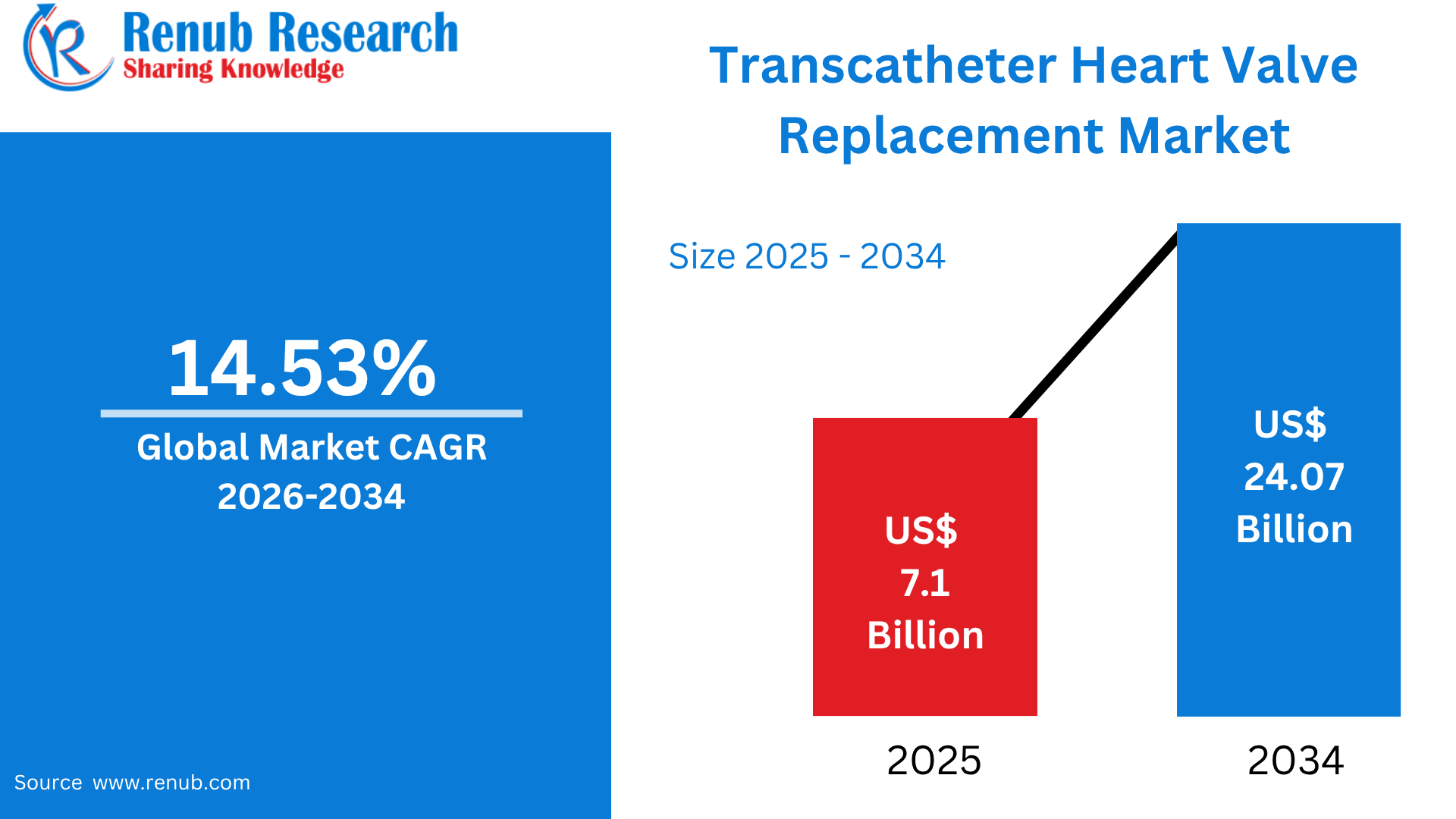
Transcatheter Heart Valve Replacement Market is projected to reach US$ 24.07 billion by 2034, rising from US$ 7.1 billion in 2025, and is expected to expand at a CAGR of 14.53% during 2026–2034. The market is anticipated to experience robust growth as the prevalence of heart valve disorders continues to increase worldwide, particularly among aging populations. The rising incidence of conditions such as aortic stenosis and mitral regurgitation is increasing the demand for minimally invasive valve replacement and repair procedures. Transcatheter heart valve technologies, including transcatheter aortic valve replacement (TAVR), offer an alternative to conventional open-heart surgery and are increasingly being adopted among eligible patients.
What is Transcatheter Heart Valve Replacement and its Uses & Popularity Worldwide
Transcatheter Heart Valve Replacement (THVR) is a minimally invasive procedure used to replace a diseased heart valve without conventional open-heart surgery. The most established form is transcatheter aortic valve replacement (TAVR), in which a replacement valve is delivered through a catheter, commonly through an artery, and positioned inside the diseased aortic valve. Transcatheter approaches are primarily used to treat severe aortic stenosis, while transcatheter technologies are also being developed and used for selected mitral and other valve disorders. Aortic stenosis affected more than 9 million people worldwide in 2019, while a 2022 estimate reported 13.6 million cases of non-rheumatic calcific aortic valve disease.
THVR has become increasingly popular because it can provide an alternative to surgical valve replacement, particularly for older or higher-risk patients. A 2025 systematic review covering 311 studies and more than 11 million patients across 26 countries found that TAVR accounted for 39.1% of aortic valve replacements. Growing physician experience, improved valve designs, better imaging, and shorter recovery associated with minimally invasive treatment are supporting worldwide adoption.
Key facts
- Cardiovascular diseases (CVDs) are the leading cause of death globally.
- An estimated 19.8 million people died from CVDs in 2022, representing approximately 32% of all global deaths. Of these deaths, 85% were due to heart attack and stroke.
- Over three quarters of CVD deaths take place in low- and middle-income countries.
- Out of the 18 million premature deaths (under the age of 70) due to noncommunicable diseases in 2021, at least 38% were caused by CVDs.
- Most cardiovascular diseases can be prevented by addressing behavioural and environmental risk factors such as tobacco use, unhealthy diet (including excess salt, sugar, and fats) and obesity, physical inactivity, harmful use of alcohol and air pollution.
- It is important to detect cardiovascular disease as early as possible so that management with counselling and medicines can begin.
Growth Drivers of the Transcatheter Heart Valve Replacement Market
Rising Prevalence of Aortic Stenosis and Aging Population
The increasing prevalence of age-related heart valve diseases is one of the strongest growth drivers for the transcatheter heart valve replacement market. Aortic stenosis is particularly important because calcific valve disease becomes more common as populations age. Research indicates that aortic stenosis affects more than 2% of adults over 65, while older studies estimated severe aortic stenosis prevalence at approximately 3.4% among elderly populations. A 2022 global estimate placed non-rheumatic calcific aortic valve disease at 13.6 million cases, demonstrating the substantial patient population requiring monitoring and potential intervention. As life expectancy increases across developed and emerging economies, the number of elderly individuals vulnerable to degenerative valve disorders is expected to rise. This demographic shift is increasing the potential pool of patients eligible for transcatheter procedures. TAVR is particularly attractive for elderly patients who may face higher risks from conventional open-heart surgery. Consequently, expanding diagnosis of valvular disease, improved echocardiographic screening, and increasing awareness of treatment options are contributing to greater procedural demand and supporting long-term market expansion.
Increasing Preference for Minimally Invasive Valve Replacement
The growing preference for minimally invasive cardiac procedures is accelerating adoption of transcatheter heart valve replacement. Unlike conventional surgical aortic valve replacement, TAVR can be performed through catheter-based access, reducing the need for open-heart surgery in appropriate patients. Clinical evidence and increasing physician experience have allowed TAVR to expand beyond patients considered unsuitable for surgery toward intermediate- and lower-risk populations. A recent systematic review covering 311 studies involving more than 11 million patients across 26 countries found that 39.1% of aortic valve replacements were performed using TAVR, illustrating its substantial role in contemporary valve treatment. Adoption has been particularly strong in North America, where the proportion of TAVR among aortic valve replacements increased from approximately 21.5% in 2015 to 49.1% in 2024 in the analyzed real-world studies. Technological improvements in delivery systems, valve positioning, imaging, and procedural planning are further improving treatment efficiency. Growing patient preference for less invasive treatment, combined with the potential for shorter recovery and reduced surgical trauma, is therefore expected to support continued expansion of transcatheter valve procedures worldwide.
Technological Advancements and Expansion into Lower-Risk Patients
Continuous innovation in transcatheter valve technology is expanding the addressable patient population and creating new growth opportunities. Modern valve systems offer improved delivery, repositionability, sealing, durability, and compatibility with different anatomical structures. Advances in imaging and procedural planning are also enabling physicians to select appropriate patients and perform increasingly precise interventions. Importantly, TAVR is no longer limited exclusively to patients considered at extremely high surgical risk. Evidence from U.S. practice shows substantial expansion across age groups; TAVR utilization for isolated aortic stenosis increased from 44.9% in 2015–2016 to 88% in 2021, while utilization among patients older than 80 years exceeded 98% in 2021 in the analyzed population. The development of valve-in-valve procedures is another important opportunity, allowing transcatheter valves to be implanted inside previously placed surgical bioprosthetic valves. Furthermore, manufacturers are working on smaller delivery systems and improved valve designs to address complex anatomies. These innovations, combined with expanding clinical indications and growing physician expertise, are expected to increase procedure volumes and strengthen the global transcatheter heart valve replacement market.
Challenges of the Transcatheter Heart Valve Replacement Market
High Procedure Costs and Healthcare Infrastructure Requirements
High treatment costs and the need for specialized infrastructure remain significant challenges for transcatheter heart valve replacement. TAVR requires expensive valve systems, advanced imaging equipment, catheterization facilities, trained interventional cardiologists, cardiac surgeons, anesthesiology support, and multidisciplinary heart teams. These requirements can make transcatheter procedures difficult to implement in low- and middle-income countries where healthcare budgets and specialist infrastructure are limited. Earlier industry estimates showed that TAVR penetration was only 4.3% of eligible patients globally in 2021, illustrating the substantial gap between potential candidates and actual treatment volumes. In China, penetration was estimated at only 0.8% of eligible patients in the same year, reflecting limitations in infrastructure and experienced centers. Cost-effectiveness is also an important consideration because healthcare systems must evaluate the higher upfront expense of transcatheter valves against potential benefits such as reduced hospitalization and recovery time. Reimbursement policies differ considerably across countries, creating additional barriers to adoption. Expanding specialized cardiac centers, improving reimbursement coverage, reducing device costs, and increasing physician training will therefore be essential for broader market penetration.
Procedural Risks, Patient Selection, and Long-Term Durability
Although transcatheter valve replacement offers important advantages, procedural risks and questions surrounding long-term outcomes can create challenges for market adoption. TAVR requires careful anatomical assessment and multidisciplinary patient selection because complications can include vascular injury, bleeding, conduction abnormalities, stroke, valve leakage, and the need for permanent pacemaker implantation. A 2025 systematic review found that, compared with surgical valve replacement, TAVR was associated with lower risks of atrial fibrillation, acute kidney injury or dialysis, and bleeding or blood transfusion, but higher risks of permanent pacemaker implantation and vascular complications. Long-term durability is another consideration, particularly as TAVR expands into younger and lower-risk patients who may live for several decades after valve implantation. Evidence regarding valve durability continues to develop as newer-generation devices are followed for longer periods. In addition, complex anatomical characteristics may make certain patients unsuitable for transcatheter treatment. Healthcare providers must therefore balance procedural benefits against individual risks and expected longevity. Continued clinical studies, improved valve designs, better imaging, and longer-term follow-up data will be important for addressing these concerns and supporting wider adoption.
Transcatheter Heart Valve Replacement Launches Worldwide
- SAPIEN 3 Ultra RESILIA – Europe, 2024: Edwards Lifesciences launched the SAPIEN 3 Ultra RESILIA transcatheter aortic valve in Europe. It incorporates RESILIA tissue technology designed to improve durability and was CE marked for patients with calcific aortic stenosis across surgical-risk categories.
- SAPIEN 3 Platform – United States, 2025: Edwards received FDA approval to expand its TAVR platform to asymptomatic patients with severe aortic stenosis, covering SAPIEN 3, SAPIEN 3 Ultra, and SAPIEN 3 Ultra RESILIA.
- SAPIEN M3 – Europe, 2025: Edwards received the CE Mark for SAPIEN M3, described by the company as the world’s first transfemoral transcatheter mitral valve replacement system, expanding transcatheter treatment beyond aortic valves.
- VitaFlow Liberty – Saudi Arabia, 2024: MicroPort CardioFlow advanced the registration of its VitaFlow Liberty Transcatheter Aortic Valve and Retrievable Delivery System in Saudi Arabia, supporting regional access to next-generation TAVR technology.
- Myval – India/International Markets: Meril Life Sciences has expanded commercialization of its Myval transcatheter heart valve system, supporting the growing adoption of TAVR in emerging markets and international cardiac centers.
- Navitor Vision – India, 2025: Abbott’s Navitor Vision transcatheter aortic valve was used in complex valve-in-valve TAVI procedures in India, demonstrating the expanding application of next-generation TAVR technology for challenging anatomies.
- EVOQUE – Europe/Global, 2024: Edwards expanded availability of the EVOQUE Tricuspid Valve Replacement System, a transcatheter solution designed for patients with severe tricuspid regurgitation who require an alternative to conventional surgery. Edwards reported positive TRISCEND II results supporting the technology.
- Hydra TAVR – Europe, 2025: Sahajanand Medical Technologies’ Hydra TAVR system demonstrated five-year clinical and durability results in a European CE study involving 157 patients, supporting continued development and adoption of the transcatheter valve platform.
- ACURATE neo2 – Europe/Global: Boston Scientific’s ACURATE neo2 represented an important next-generation transcatheter aortic valve platform developed for minimally invasive treatment of severe aortic stenosis. Its clinical development contributed to competition and innovation within the global TAVR market.
- Evolut FX Platform – United States/Global: Medtronic’s Evolut FX transcatheter aortic valve platform introduced an updated delivery system focused on improved positioning, visualization, and control during TAVR procedures, strengthening competition among major global structural-heart manufacturers.
TAVR Remains the Leading Application
Transcatheter heart aortic valve replacement market is the largest application area within transcatheter heart valve replacement, driven primarily by the increasing prevalence of aortic stenosis and the aging global population. TAVR provides a minimally invasive alternative to surgical aortic valve replacement for appropriately selected patients. Real-world evidence also demonstrates increasing acceptance: a systematic review of 311 studies involving more than 11 million patients across 26 countries found that TAVR accounted for 39.1% of all aortic valve replacement procedures. Improved valve designs, smaller delivery systems, enhanced imaging, and expanding use among intermediate- and lower-risk patients are supporting market growth. In Europe, TAVI activity reached a median of 122.1 procedures per million inhabitants across ESC member countries, demonstrating the growing integration of transcatheter aortic interventions into cardiac care.
Growing Adoption for Congenital Heart Disease
Transcatheter heart pulmonary valve replacement market is a specialized but increasingly important segment of the global transcatheter valve industry. Pulmonary valve replacement through catheter-based techniques is primarily used for patients with congenital heart disease, particularly those who have previously undergone surgical repair and subsequently develop pulmonary valve dysfunction. The approach can reduce the need for repeated open-heart surgery and is therefore attractive for patients requiring lifetime management of congenital cardiac conditions. Compared with TAVR, pulmonary valve procedures remain substantially smaller in volume because the eligible patient population is more limited. However, advances in catheter technology, valve design, imaging, and delivery systems are improving treatment possibilities. Increasing availability of congenital-heart-disease centers, greater physician expertise, and development of valves suitable for different pulmonary anatomies are expected to support gradual expansion of this segment.
Emerging Technology with Long-Term Durability Potential
Mechanical transcatheter heart valves represent an emerging area of valve technology designed to combine the minimally invasive delivery advantages of transcatheter procedures with the durability traditionally associated with mechanical valves. Conventional mechanical valves are widely recognized for long-term durability, but their use generally requires surgical implantation. Transcatheter mechanical valve development could potentially expand treatment options for selected younger patients and those requiring repeat valve intervention. However, mechanical transcatheter valves remain a relatively small and developing segment compared with established biological transcatheter valves. Challenges include device miniaturization, thrombogenicity, durability validation, delivery through vascular anatomy, and the requirement for long-term anticoagulation. Consequently, clinical development and regulatory evaluation are important determinants of future commercialization. If manufacturers successfully demonstrate safety, durability, and procedural advantages, mechanical transcatheter valves could create additional opportunities, particularly as transcatheter therapies expand toward younger and lower-risk patient populations.
Strong Adoption of Tissue-Based Transcatheter Valves
Biological or tissue-based transcatheter heart valves represent the established technology used in most current TAVR procedures. These valves generally incorporate biological tissue mounted within a stent frame and are delivered through a catheter to replace a diseased native valve or, in selected cases, a failing surgical bioprosthetic valve. Their popularity is supported by the avoidance of lifelong anticoagulation that is typically associated with mechanical valves, making them attractive for many older patients. The increasing adoption of transcatheter aortic procedures is creating substantial demand for biological valve systems. A systematic review covering 11,069,277 patients from 311 studies across 26 countries found that 39.1% of aortic valve replacements were performed using TAVR, demonstrating the scale of the transcatheter tissue-valve market. Manufacturers are focusing on improved leaflet durability, reduced paravalvular leakage, repositionability, smaller delivery profiles, and better hemodynamic performance. Valve-in-valve procedures are also expanding opportunities for biological transcatheter valves by allowing treatment of failing surgical tissue valves without conventional reoperation. These developments are expected to sustain strong demand for biological transcatheter valves worldwide.
Hospitals Remain the Primary Treatment Setting
Hospitals represent the dominant end-user segment for transcatheter heart valve replacement because these procedures require specialized cardiac catheterization laboratories, advanced imaging systems, multidisciplinary heart teams, and emergency surgical support. Hospitals perform the majority of TAVR and other complex transcatheter valve interventions, particularly for patients with severe or high-risk valve disease.) Procedural volumes and hospital capabilities are also expanding. A large U.S. analysis recorded 113,662 TAVR procedures across 555 hospitals between 2015 and 2017, illustrating the scale of hospital-based adoption. Hospitals are investing in structural-heart programs, specialized imaging, cardiac surgery backup, and trained interventional teams to accommodate rising procedure volumes. Increasing adoption of minimally invasive treatment and improved reimbursement in developed healthcare systems should support hospital demand. Over time, ambulatory and specialty centers may gain share, but hospitals are expected to remain the principal end-user channel for complex transcatheter valve procedures.
High Cardiovascular Disease Burden Supports United States Market Expansion
United States Transcatheter Heart Valve Replacement (THVR) market is experiencing strong growth, supported by the country’s substantial cardiovascular disease burden, aging population, advanced healthcare infrastructure, and increasing adoption of minimally invasive cardiac procedures. According to the CDC, approximately 805,000 people in the United States experience a heart attack each year, including both first-time and recurrent events. The broader cardiovascular disease burden is also influenced by major risk factors such as high blood pressure, high cholesterol, smoking, diabetes, and obesity. The CDC estimates that nearly 47% of U.S. adults have at least one of three major cardiovascular risk factors: high blood pressure, high cholesterol, or smoking. Although these statistics primarily reflect cardiovascular disease rather than valve disorders specifically, they demonstrate the country’s significant need for advanced cardiac care. The availability of specialized heart centers, experienced interventional cardiologists, sophisticated imaging technologies, and established reimbursement systems is supporting the adoption of TAVR and other transcatheter valve procedures. Increasing preference for minimally invasive interventions that can reduce surgical trauma and recovery time is further strengthening demand. Continued technological innovation and expanding treatment eligibility are expected to maintain the United States as the leading THVR market.
Aging Population and Strong Cardiac Infrastructure Drive Germany Adoption
Germany Transcatheter Heart Valve Replacement (THVR) market is expanding steadily, supported by the country’s aging population, high cardiovascular disease burden, advanced medical infrastructure, and strong adoption of minimally invasive cardiac interventions. Cardiovascular diseases remain among Germany’s most significant health challenges, while degenerative valve conditions such as aortic stenosis become increasingly prevalent with advancing age. Germany has developed into one of Europe’s leading markets for transcatheter valve interventions, particularly TAVR, due to its extensive network of specialized cardiac centers and experienced multidisciplinary heart teams. The country’s mature healthcare system provides broad access to diagnostic imaging, interventional cardiology, and surgical backup facilities required for complex structural-heart procedures. Increasing preference for less invasive treatment options is also supporting adoption among appropriately selected patients, particularly older adults who may face elevated risks from conventional open-heart surgery. Technological developments, including improved valve designs, enhanced delivery systems, repositionable devices, and advanced imaging, are further improving procedural precision. Germany’s established reimbursement framework and emphasis on high-quality cardiovascular care provide additional market support. As the elderly population continues to increase and awareness of minimally invasive valve replacement improves, demand for transcatheter heart valve technologies is expected to remain strong.
Rapid TAVR Adoption Creates Significant Growth Opportunities in China
China Transcatheter Heart Valve Replacement (THVR) market is emerging as one of the fastest-growing markets in the Asia-Pacific region, driven by the country’s aging population, increasing cardiovascular disease burden, expanding healthcare infrastructure, and rising adoption of minimally invasive cardiac procedures. China has a particularly large elderly population, creating a substantial potential patient base for age-related valvular disorders such as aortic stenosis. The country’s 60-and-over population exceeded 300 million in 2025, representing approximately one-fifth of the total population, highlighting the growing importance of age-related cardiovascular care. TAVR adoption has increased significantly as hospitals gain greater access to advanced imaging technologies, catheterization laboratories, and structural-heart programs. Both international and domestic medical-device manufacturers are contributing to market development through new valve systems and delivery technologies. Physician training and growing clinical experience are also improving procedural capabilities across major metropolitan hospitals. In addition, China’s healthcare modernization initiatives and increasing investment in specialized cardiovascular services are supporting wider access to advanced treatment. Although procedure costs, regional disparities in healthcare access, and the availability of trained specialists remain challenges, the country’s large patient population provides substantial long-term potential. Continued clinical adoption, technological innovation, and expansion beyond major urban centers are expected to accelerate THVR market development.
Healthcare Modernization Accelerates Advanced Cardiac Treatment in Saudi Arabia
The Saudi Arabia Transcatheter Heart Valve Replacement (THVR) market is witnessing robust development as the country increases investment in healthcare infrastructure and expands access to advanced cardiovascular technologies. Cardiovascular diseases represent a major health concern in Saudi Arabia, with risk factors including diabetes, obesity, hypertension, and sedentary lifestyles contributing to demand for specialized cardiac care. The country’s healthcare transformation programs are encouraging investment in modern hospitals, advanced diagnostic technologies, and minimally invasive treatment capabilities. TAVR is gaining attention because it provides an alternative to conventional surgical valve replacement for appropriately selected patients, particularly older individuals and those with elevated surgical risk. A notable industry development occurred in January 2024, when MicroPort CardioFlow advanced the registration process for its VitaFlow Liberty Transcatheter Aortic Valve and Retrievable Delivery System in Saudi Arabia. The development demonstrates increasing availability of next-generation transcatheter valve technologies within the Saudi healthcare market. Growing physician expertise, establishment of specialized cardiac centers, and increasing awareness of minimally invasive treatment options are further supporting market development. Saudi Arabia’s continued healthcare investment under its broader Vision 2030 transformation agenda is expected to improve access to advanced cardiovascular therapies. Consequently, increasing demand for sophisticated structural-heart interventions and the introduction of innovative valve systems should support sustained THVR market growth.
Recent Developments in Transcatheter Heart Valve Replacement Market
- In After receiving CDSCO approval in June 2025, Medtronic introduced its Evolut FX+ transcatheter aortic valve in India in September 2025. Patients with severe aortic stenosis now have more therapy options thanks to the valve's improved coronary access and shown hemodynamic efficacy.
- In June 2025, a 61-year-old patient who had previously had a Bentall treatment underwent the first hybrid procedure in India, which combined transcatheter aortic valve replacement (TAVR) with a Frozen Elephant Trunk (FET) graft at SIMS Hospital in Chennai.
- Eisenhower Health's record of almost 1,000 surgeries with a 99% success rate and its contribution to the advancement of minimally invasive cardiac treatment made it the first hospital in the United States to be designated as an Edwards Benchmark Case Observation Site in February 2025.
- The Hydra Transcatheter Aortic Valve Replacement device was presented in Mexico in December 2024 by Sahajanand Medical Technologies (SMT), a world leader in cardiovascular solutions. With this introduction, SMT's dedication to provide patients worldwide cutting-edge, minimally invasive cardiac treatments has advanced significantly.
Transcatheter Heart Valve Replacement Market Segments
Type
- Transcatheter Aortic Valve Replacement
- Transcatheter Mitral Valve Replacement
- Transcatheter Pulmonary Valve Replacement
Material
- Mechanical valves
- Biological Valves
End-User
- Hospitals
- Ambulatory Surgical Centers
- Others
Countries
North America
- United States
- Canada
Europe
- France
- Germany
- Italy
- Spain
- United Kingdom
- Belgium
- Netherlands
- Turkey
Asia Pacific
- China
- Japan
- India
- South Korea
- Thailand
- Malaysia
- Indonesia
- Australia
- New Zealand
Latin America
- Brazil
- Mexico
- Argentina
Middle East & Africa
- Saudi Arabia
- UAE
- South Africa
Rest of the World
All companies have been covered with 5 Viewpoints
- Overviews
- Key Person
- Recent Developments
- SWOT Analysis
- Revenue Analysis
Key Players Analysis
- Edwards Lifesciences
- Abbott Laboratories
- Medtronic Plc
- LIVANOVA PLC
- Boston Scientific Corporation
- Artivion, Inc.
- MicroPort Scientific Corporation
- Venus Medtech (Hangzhou) Inc.
Report Details:
| Report Features | Details |
| Base Year |
2025 |
| Historical Period |
2022 - 2025 |
| Forecast Period |
2026 - 2034 |
| Market |
US$ Billion |
| Segment Covered |
Type, Material, End User and Countries |
| Countries Covered |
|
| Companies Covered |
|
| Customization Scope |
20% Free Customization |
| Post-Sale Analyst Support |
1 Year (52 Weeks) |
| Delivery Format |
PDF and Excel through Email (We can also provide the editable version of the report in PPT/Word format on request) |
Customization Services available
- Analysis of Market Size and Its Segments
- More Company Profiles (Upto 10 without any additional cost):
- Additional Countries (Other than mentioned Countries):
- Region/Country Specific Reports:
- Market Entry Strategy:
- Region-Specific Market Dynamics:
- Regional Market Share Analysis:
- Trade Analysis:
- Production Insights:
- Others Customized Requests:
For more information contact our analysts.
Need More Assistance?
- Talk to our analysts to get more precious information on the current market trends.
- Include more countries and segments and customize the report based on the final requirement.
- Get a competitive advantage in your industry by knowing the report findings and making a positive impact on your revenues and operations.
- Our analysts are always ready to provide more help and pertinent information if you need any additional assistance.