Global Soybean Market Report by Nature, Form, End User, Countries and Company Analysis 2026-2034
Buy NowSoybean Market Size & Forecast
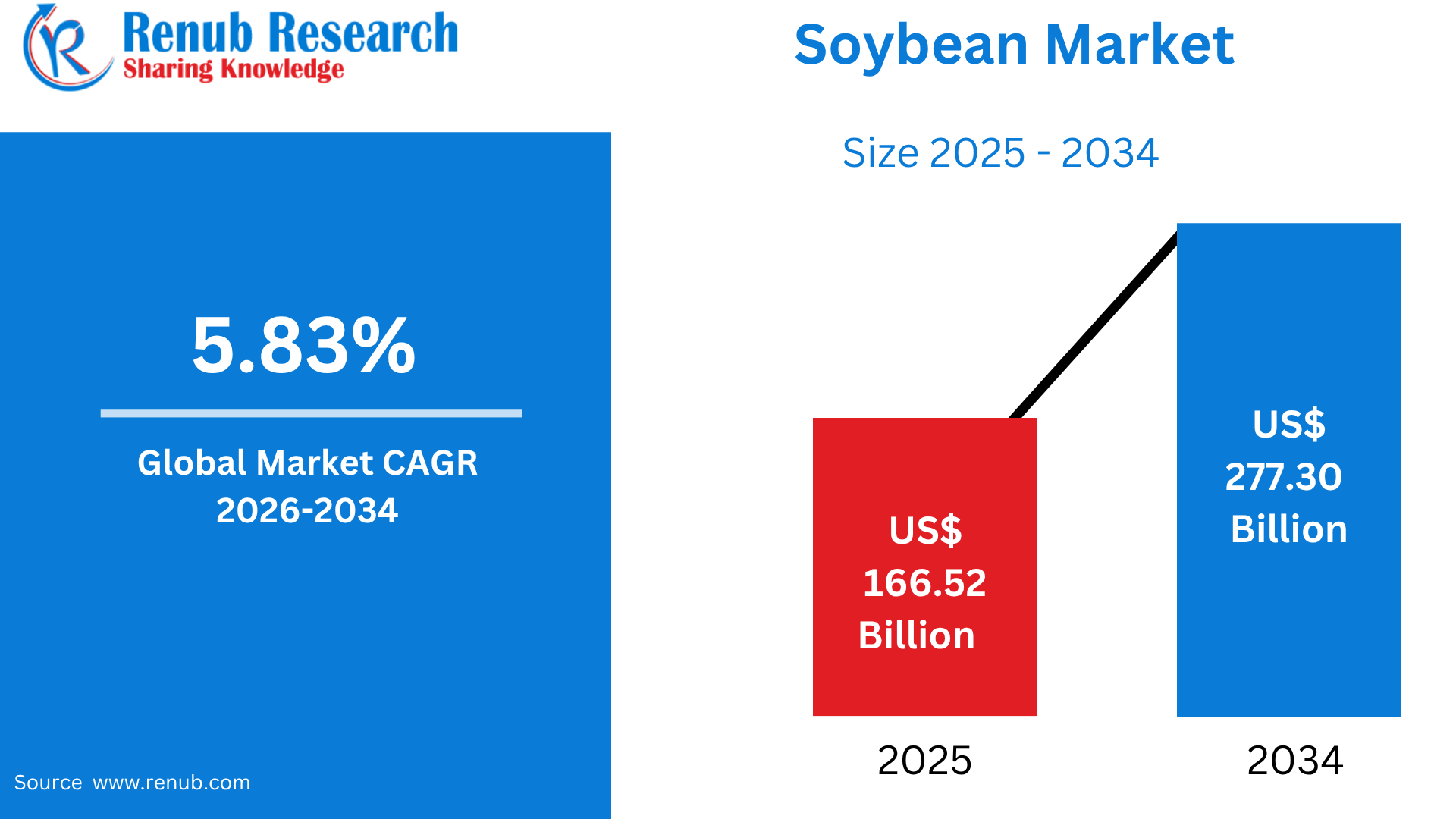
Global soybean market is projected to expand from approximately US$ 166.52 billion in 2025 to US$ 277.30 billion by 2034, registering a CAGR of 5.83% during 2026–2034. Market growth is being supported by increasing global population, rising demand for protein-rich foods, and the expanding consumption of soybean-based products. Soybeans are widely utilized in food and beverages, animal feed, edible oils, plant-based proteins, and various industrial applications. Growing consumer interest in plant-based diets and alternative protein sources is further strengthening demand for soy-derived products.
Soybean: What It Is, Uses & Global Popularity
Soybean is a nutrient-rich legume scientifically known as Glycine max and is one of the world’s most important oilseed and protein crops. It contains high-quality plant protein, healthy fats, carbohydrates, vitamins, and minerals, making it valuable for both food and industrial applications. Soybeans are primarily processed into soybean oil and soybean meal, while whole soybeans are used in numerous food products.
In the food and beverage industry, soybeans are used to produce tofu, soy milk, tempeh, soy flour, textured vegetable protein, soy-based meat alternatives, and other plant-based foods. Soybean oil is widely utilized for cooking, food processing, and margarine production. Soybean meal is an important high-protein ingredient in poultry, livestock, and aquaculture feed. The crop is also used in biodiesel, animal nutrition, adhesives, inks, and other industrial products.
Soybeans are highly popular worldwide because of their versatility, nutritional value, relatively high protein content, and efficient cultivation. Growing consumer interest in plant-based diets and alternative proteins is further increasing demand. In addition, expanding livestock production, rising food consumption, and growing biofuel applications continue to support global soybean demand and production.
Top Soybean Producing Countries (2025/2026)
- Brazil: 180.5 million metric tons — 42% of global production.
- United States: 115.99 million metric tons — 27% of global production.
- Argentina: 49.5 million metric tons — 12% of global production.
- China: 20.9 million metric tons — 5% of global production.
- Paraguay: 12.1 million metric tons — 3% of global production.
- India: 11.03 million metric tons — 3% of global production.
- Russia: 9 million metric tons — 2% of global production.
- Canada: 6.92 million metric tons — 2% of global production.
- Ukraine: 5.5 million metric tons — 1% of global production.
- Bolivia: 3.9 million metric tons — 0.91% of global production.
Growth Drivers of the Soybean Market
Rising Demand for Soybean Meal in Animal Feed
Growing global livestock, poultry, and aquaculture production is one of the strongest drivers of soybean demand because soybean meal is a high-protein feed ingredient. Soybean processing generates both soybean meal and soybean oil, allowing processors to serve expanding food, feed, and industrial markets simultaneously. USDA forecasts global soybean crush at 383.1 million metric tons in 2026/27, an increase of 13.6 million metric tons from the previous marketing year. The agency attributes much of this growth to increasing demand for soybean meal associated with expanding meat and aquaculture production and relatively competitive feed prices. China is particularly important because its poultry and aquaculture industries are increasing soybean meal consumption. China imported a record 111.83 million metric tons of soybeans in 2025, up 6.5% year over year, demonstrating the scale of its crushing and feed requirements. Rising meat consumption, commercial poultry production, aquaculture expansion, and demand for protein-rich animal feed are therefore expected to sustain soybean consumption worldwide.
Expansion of Plant-Based Foods and Soy-Derived Products
Increasing consumer interest in plant-based nutrition is creating additional demand for soybeans and soybean-derived ingredients. Soybeans provide a relatively high concentration of protein and are used to manufacture tofu, soy milk, tempeh, textured vegetable protein, meat alternatives, protein ingredients, and other food products. Their versatility allows food manufacturers to formulate products aimed at consumers seeking plant-based or alternative protein options. Soybean oil also remains an important edible oil for cooking and food processing. The broader soybean processing industry is expanding: USDA reports that global soybean production reached approximately 420.87 million metric tons in 2024/25, compared with a 10-year average of 364.2 million metric tons, representing 33% growth over the decade. In addition, growing awareness of protein intake, vegetarian and flexitarian diets, and demand for convenient nutritional foods are encouraging manufacturers to introduce innovative soy-based products. Continued product development in plant-based meat, beverages, snacks, and nutritional foods is expected to broaden soybean consumption beyond traditional applications.
Increasing Demand for Soybean Oil and Biofuel Applications
Growing utilization of soybean oil for food processing and renewable fuel production is providing another important growth opportunity for the soybean market. Soybean crushing produces soybean oil alongside soybean meal, creating a strong link between soybean demand and the expanding vegetable-oil and biofuel industries. USDA projects that global soybean oil demand will increase, with growth supported particularly by industrial applications and biofuel production. Global soybean crush is forecast at 383.1 million metric tons in 2026/27, while Brazil’s soybean oil consumption is projected to reach 11.4 million metric tons, largely because of higher industrial use associated with its biodiesel mandate. In the United States, soybean oil used as a biofuel feedstock was forecast at 13.9 billion pounds for 2025/26, highlighting the growing importance of renewable-fuel demand. Expansion of biodiesel and renewable diesel production, government support for renewable fuels, and rising demand for vegetable oils are encouraging additional soybean crushing capacity. Consequently, energy-sector demand is becoming an increasingly important driver alongside food and animal-feed applications.
Challenges of the Soybean Market
Climate Change and Weather-Related Production Risks
Soybean production is highly dependent on favorable rainfall, temperature, soil conditions, and growing-season weather, making the market vulnerable to droughts, excessive rainfall, heatwaves, and other climate-related disruptions. Brazil, the United States, and Argentina collectively represent a substantial share of global soybean production, meaning adverse weather in these major producing regions can affect international supply and prices. USDA estimates that Brazil’s soybean production could reach a record 186 million metric tons in 2026/27, supported by higher harvested area and trend yields, illustrating how favorable conditions can significantly increase global supply. However, weather variability can quickly reverse these gains. Research examining Brazil found that a major drought combined with other disruptions contributed to a 10.5% decline in national soybean production in 2022, the country’s largest decline since 1990. Climate uncertainty can therefore affect crop yields, farmer income, processing volumes, export availability, and global prices. Increasing temperatures, water constraints, soil degradation, and unpredictable rainfall patterns may raise production costs and encourage farmers to invest in irrigation, improved varieties, and climate-resilient farming practices.
Trade Dependence, Price Volatility, and Geopolitical Risks
The global soybean industry is highly interconnected, making it vulnerable to trade disputes, tariffs, currency movements, transportation disruptions, and changes in import policies. China is particularly important because it is the world’s largest soybean importer and a major consumer of soybean meal and oil. USDA projects China’s soybean imports to increase from 112.5 million metric tons in 2025/26 to 140.4 million metric tons by 2034/35, highlighting its significant influence on global trade. Brazil has also strengthened its position, with USDA estimating that Brazilian soybean exports could account for approximately 62% of global soybean trade in 2026/27. Such concentration creates exposure to geopolitical and logistical disruptions. China’s record 111.83 million metric tons of soybean imports in 2025 also demonstrated how changes in purchasing patterns can rapidly shift global trade flows. Currency fluctuations, tariffs, changing trade agreements, port congestion, freight costs, and diplomatic tensions can consequently influence soybean prices and profitability. These uncertainties create challenges for farmers, processors, exporters, and food manufacturers attempting to maintain stable supply and pricing.
Soybean Product Launches Worldwide
- Special Grade Domestic Soybean Soy Milk – Pulmuone (South Korea, 2026): Pulmuone launched a premium soy milk made from specially graded domestic Korean soybeans, expanding its soybean-based beverage portfolio.
- Special Grade Domestic Soybean Tofu Chips – Pulmuone (South Korea, 2026): Pulmuone introduced tofu chips made with premium domestic soybeans, targeting consumers seeking convenient soybean-based snacks.
- Drinking Tofu Soybean Juice – Pulmuone Nokjeup (South Korea, 2024): A plant-based beverage made by grinding whole domestic soybeans, providing 6.5 g of soybean-derived protein per bottle.
- Drinking Black Soybean Juice – Pulmuone Nokjeup (South Korea, 2024): A sugar-free beverage made from domestic Seoritae black soybeans, offering 5 g of dietary fiber per 190-ml bottle.
- Seoritae Soybean Juice Soy Milk – Pulmuone Nokjeup (South Korea, 2024): Pulmuone expanded its plant-based beverage range with a soy milk product made using Seoritae black soybeans.
- Ultra-High Protein Soy Flour – Amfora (United States, 2024): Amfora launched a soy flour containing more than 60% protein, produced from proprietary soybeans with approximately 25% higher protein content than conventional soybeans.
- Ultra-High Protein Texturized Vegetable Protein – Amfora (United States, 2024): Amfora introduced a high-protein textured vegetable protein made from its proprietary soybean varieties for food and alternative-protein applications.
- Ultra-High Protein Soy Crisps – Amfora (United States, 2024): Amfora launched soy-based crisps as part of its initial commercial portfolio, focusing on high-protein food applications.
- Five Value-Added Soybean Varieties – Benson Hill (United States, 2024): Benson Hill expanded its commercial soybean portfolio with five new varieties featuring traits including ultra-high protein, high-oleic and low-linoleic oils, and low-oligosaccharide characteristics.
- PRO Denali and Two Other Soybean Varieties – Protealis (Europe, 2025): Protealis launched three new soybean varieties, including PRO Denali, its first variety in the 00 maturity group, targeting soybean cultivation in northern and central European regions.
High Yield and Cost Efficiency Support Conventional Soybean Market Dominance
Conventional soybeans continue to account for the largest share of the global soybean market because of their high productivity, established farming systems, and relatively competitive production costs. Conventional cultivation commonly relies on improved seeds, fertilizers, crop-protection products, mechanized farming, and other modern agricultural practices to improve yields and protect crops from pests and diseases. Genetically modified soybean varieties are also widely cultivated in major producing countries because of their herbicide tolerance and other agronomic characteristics. The scale of conventional production is evident in global soybean output, which reached approximately 421 million metric tons in 2024/25, according to USDA data. Conventional soybeans are extensively processed into soybean meal and soybean oil, serving major food, animal-feed, and industrial markets. Their availability, established supply chains, and suitability for large-scale processing make them particularly attractive to farmers and processors. Although organic soybean demand is increasing, conventional soybeans are expected to remain the primary source of global soybean supply because of their production efficiency, established infrastructure, and ability to meet large-scale demand.
Growing Consumer Preference for Sustainable and Non-GMO Foods
The global organic soybean market is gaining momentum as consumers increasingly seek organically produced, non-GMO, and environmentally responsible food ingredients. Organic soybeans are cultivated without synthetic pesticides and fertilizers and must comply with organic certification requirements, making them attractive to consumers seeking more natural food products. They are used in tofu, soy milk, tempeh, plant-based meat alternatives, soy flour, and other food products. The organic sector remains relatively small compared with conventional soybean production, but premium pricing provides farmers with an opportunity to generate higher returns from certified crops. In the United States, certified organic soybean production reached approximately 6.4 million bushels in 2024, demonstrating the continued presence of organic soybeans within the agricultural sector. Demand is particularly strong in developed markets where consumers have greater awareness of organic certification, sustainable agriculture, and ingredient traceability. Expansion of plant-based diets and clean-label products is providing additional opportunities. However, lower yields, higher production costs, certification requirements, and limited availability of organic seeds can constrain supply. Nevertheless, increasing sustainability awareness is expected to support gradual expansion of the organic soybean segment.
Expanding Processing Capacity and International Trade Drive Raw Soybean Market Demand
Raw soybeans represent the foundation of the global soybean value chain and serve as the primary agricultural input for producing soybean meal, soybean oil, protein ingredients, and numerous food products. The market is strongly influenced by crop production, international trade, crushing capacity, weather conditions, and demand from food and animal-feed industries. Brazil, the United States, and Argentina are among the world’s major soybean suppliers, while China remains the largest importer. China imported a record 111.83 million metric tons of soybeans in 2025, an increase of 6.5% from 2024, demonstrating the enormous scale of international demand for raw soybeans. Raw soybean handling also requires efficient harvesting, storage, transportation, and port infrastructure to minimize quality deterioration and post-harvest losses. Modern grain-storage systems, automated handling technologies, digital supply-chain monitoring, and improved logistics are helping processors and traders manage large volumes more efficiently. However, raw soybean prices remain sensitive to droughts, floods, changing trade policies, tariffs, and currency fluctuations. Continued expansion of soybean crushing facilities and global demand for meal and oil is expected to support international trade and strengthen the raw soybean market.
Plant-Based Nutrition and Functional Food Trends Accelerate Food & Beverages Demand
The global soybean food and beverages market is expanding as consumers increasingly adopt plant-based, protein-rich, and functional food products. Soybeans are highly versatile and are used to manufacture soy milk, tofu, tempeh, soy yogurt, textured soy protein, protein powders, soy-based meat alternatives, and numerous processed foods. Soy’s high-quality protein profile makes it particularly attractive to vegetarian, vegan, and flexitarian consumers. Demand is also supported by growing interest in dairy alternatives and products suitable for consumers seeking lactose-free options. According to the Good Food Institute, global retail sales of plant-based meat, seafood, milk, yogurt, ice cream, and cheese reached approximately US$29.9 billion in 2024, highlighting the expanding commercial opportunity for plant-based food categories. Soybeans also provide manufacturers with functional properties that support texture, emulsification, protein enrichment, and formulation stability. Growing health awareness, product innovation, sustainability concerns, and increasing availability of plant-based products through supermarkets and foodservice channels are strengthening demand. As manufacturers continue introducing soy-based beverages, meat alternatives, snacks, and nutritional products, soybean-derived foods are expected to become increasingly important in the global food and beverage industry.
Rising Meat and Poultry Consumption Strengthens Soybean Meal Demand
Soybean animal feed is a major component of the global soybean industry because soybean meal provides concentrated, high-quality protein for poultry, livestock, aquaculture, and other animal-production systems. Soybean meal is produced primarily as a co-product of soybean oil extraction and is widely incorporated into commercial feed formulations because of its nutritional value, amino-acid profile, availability, and relatively efficient cost compared with several alternative protein sources. Global soybean crushing is projected to reach approximately 383.1 million metric tons in 2026/27, reflecting continued demand for soybean meal and soybean oil. Expansion of commercial poultry farming, livestock production, and aquaculture in emerging economies is increasing the need for reliable high-protein feed ingredients. Rising incomes and urbanization are also contributing to higher consumption of meat, eggs, milk, and seafood, indirectly supporting soybean meal demand. China remains particularly important because of its enormous livestock and feed industry. In addition, soybean meal’s established supply chain and compatibility with modern feed formulations strengthen its position in animal nutrition. Continued growth in global animal-protein consumption and commercial farming is therefore expected to sustain demand for soybean-based animal feed.
Strong Production Base, Processing Capacity, and Export Demand in USA
United States soybean market remains one of the world’s largest, supported by extensive farmland, advanced agricultural infrastructure, established processing facilities, and strong export networks. Soybeans are an important US agricultural commodity and are processed into soybean meal, soybean oil, and other value-added products for domestic and international markets. The United States produced approximately 4.34 billion bushels of soybeans in 2025, with an average yield of around 46.6 bushels per acre, demonstrating the country’s substantial production capacity. Soybean meal supports the domestic livestock and poultry industries, while soybean oil serves food, industrial, and biofuel applications. Government agricultural programs, technological advances, precision farming, improved seed varieties, and sustainable cultivation practices are also strengthening productivity. In addition, investment in processing and renewable-fuel infrastructure is creating further demand for soybean oil. In August 2025, M.S. Technologies and Syngenta announced plans to develop a new herbicide-tolerant soybean trait stack, with commercialization targeted for 2029, subject to regulatory approvals. Such innovations are expected to improve crop-management options and support the long-term competitiveness of US soybean production.
Import Dependence and Growing Demand for Sustainable Soy Products in the United Kingdom
United Kingdom soybean market is largely dependent on imports because domestic soybean cultivation remains limited by climatic and agricultural conditions. Imported soybeans and soybean-derived products are particularly important for the country’s animal-feed industry, while soy ingredients are also used in tofu, soy milk, meat alternatives, protein products, and processed foods. The UK’s feed sector represents a substantial source of soybean demand, with soybean meal serving as an important protein ingredient for poultry, livestock, and other animal-production systems. At the same time, increasing consumer interest in plant-based diets is creating additional demand for soy-based foods. Sustainability and responsible sourcing have also become increasingly important considerations, encouraging businesses to improve supply-chain traceability and source soybeans from suppliers meeting environmental and responsible-production standards. The UK government’s UK Soy Manifesto has brought together companies seeking to ensure that soy used in their supply chains is responsibly sourced. Despite dependence on international suppliers, the market continues to benefit from steady feed demand, expanding plant-based food consumption, and increasing interest in non-GMO and responsibly sourced ingredients. These factors are expected to sustain soybean demand in the United Kingdom.
Expanding Oilseed Production and Growing Protein Demand in India
India’s soybean market is expanding as soybean cultivation, food processing, animal feed, and edible-oil demand continue to develop. Soybean is one of India’s major oilseed crops and plays an important role in supplying raw materials for soybean oil, soybean meal, food products, and livestock feed. The country’s major soybean-producing states include Madhya Pradesh, Maharashtra, and Rajasthan, with favorable monsoon conditions supporting cultivation. India produced approximately 15.2 million tonnes of soybeans in 2024/25, according to USDA estimates. Domestic demand is supported by poultry and livestock production, while soy-based foods are increasingly popular among consumers seeking affordable plant-based protein. Government initiatives aimed at increasing domestic oilseed production and reducing edible-oil import dependence are also creating opportunities for soybean cultivation and processing. However, production remains exposed to monsoon variability, crop diseases, and fluctuations in global soybean and edible-oil prices. Technological developments are helping farmers improve crop management. In May 2023, FMC introduced Galaxy NXT herbicide for soybean cultivation in India and announced drone-spray services in Madhya Pradesh, supporting the adoption of modern agricultural technologies. Increasing demand for protein-rich foods, soybean products, animal feed, and edible oils is expected to maintain the market’s growth momentum.
Import Dependence and Expanding Animal-Feed Industry Drive Saudi Arabia Demand
Saudi Arabia’s soybean market is primarily dependent on imports because the country’s arid climate, limited freshwater availability, and scarce agricultural land restrict large-scale soybean cultivation. Imported soybeans and soybean meal are therefore essential to the country’s livestock, poultry, and feed industries. Demand is increasing as Saudi Arabia expands domestic food production and seeks to strengthen food security under Saudi Vision 2030. The country’s poultry industry is particularly important for soybean meal consumption because soybean meal provides a high-protein ingredient for commercial feed formulations. Saudi Arabia’s poultry meat production reached approximately 910,000 tonnes in 2024, according to USDA estimates, illustrating the scale of the domestic poultry sector and its associated feed requirements. Rising consumer demand for poultry, meat, processed foods, and protein-rich products is expected to support continued soybean and soybean-meal consumption. Meanwhile, growing interest in plant-based foods is creating additional opportunities for soy-based beverages, meat alternatives, and other food products. However, the market remains vulnerable to international soybean prices, freight costs, exchange-rate movements, and supply-chain disruptions. Continued investment in food processing, animal production, storage, and logistics is expected to support long-term soybean demand in Saudi Arabia.
Soybean Market Segments
Nature
- Conventional
- Organic
Form
- Processed
- Raw
End User
- Food & Beverages
- Animal-feed
- Others
Countries
North America
- United States
- Canada
Europe
- France
- Germany
- Italy
- Spain
- United Kingdom
- Belgium
- Netherlands
- Turkey
Asia Pacific
- China
- Japan
- India
- Australia
- South Korea
- Thailand
- Malaysia
- Indonesia
- New Zealand
Latin America
- Brazil
- Mexico
- Argentina
Middle East & Africa
- South Africa
- Saudi Arabia
- UAE
All the Key players have been covered from 5 Viewpoints:
- Business overview
- Key Persons
- Recent Development & Strategies
- SWOT Analysis
- Revenue Analysis
Key Players Analysis
- Kerry Group plc.
- Fuji Oil Co., Ltd.
- House Foods Corporation
- Danone North America
- DuPont de Nemours, Inc.
- CHS Inc.
- Cargill, Inc.
- Scoular
- Archer-Daniels-Midland Co.
Report Details:
| Report Features | Details |
| Base Year |
2025 |
| Historical Period |
2022 - 2025 |
| Forecast Period |
2026 - 2034 |
| Market |
US$ Billion |
| Segment Covered |
By Nature, By Form, By End User and By Countries |
| Countries Covered |
|
| Companies Covered |
|
| Customization Scope |
20% Free Customization |
| Post-Sale Analyst Support |
1 Year (52 Weeks) |
| Delivery Format |
PDF and Excel through Email (We can also provide the editable version of the report in PPT/Word format on request) |
Customization Services available
- Analysis of Market Size and Its Segments
- More Company Profiles (Upto 10 without any additional cost):
- Additional Countries (Other than mentioned Countries):
- Region/Country Specific Reports:
- Market Entry Strategy:
- Region-Specific Market Dynamics:
- Regional Market Share Analysis:
- Trade Analysis:
- Production Insights:
- Others Customized Requests:
For more information contact our analysts.
Need More Assistance?
- Talk to our analysts to get more precious information on the current market trends.
- Include more countries and segments and customize the report based on the final requirement.
- Get a competitive advantage in your industry by knowing the report findings and making a positive impact on your revenues and operations.
- Our analysts are always ready to provide more help and pertinent information if you need any additional assistance.