South East Asia Building Management System Market Size, Share, Growth, Trends, Industry Analysis & Forecast 2026–2034
Buy NowSouth East Asia Building Management System Market
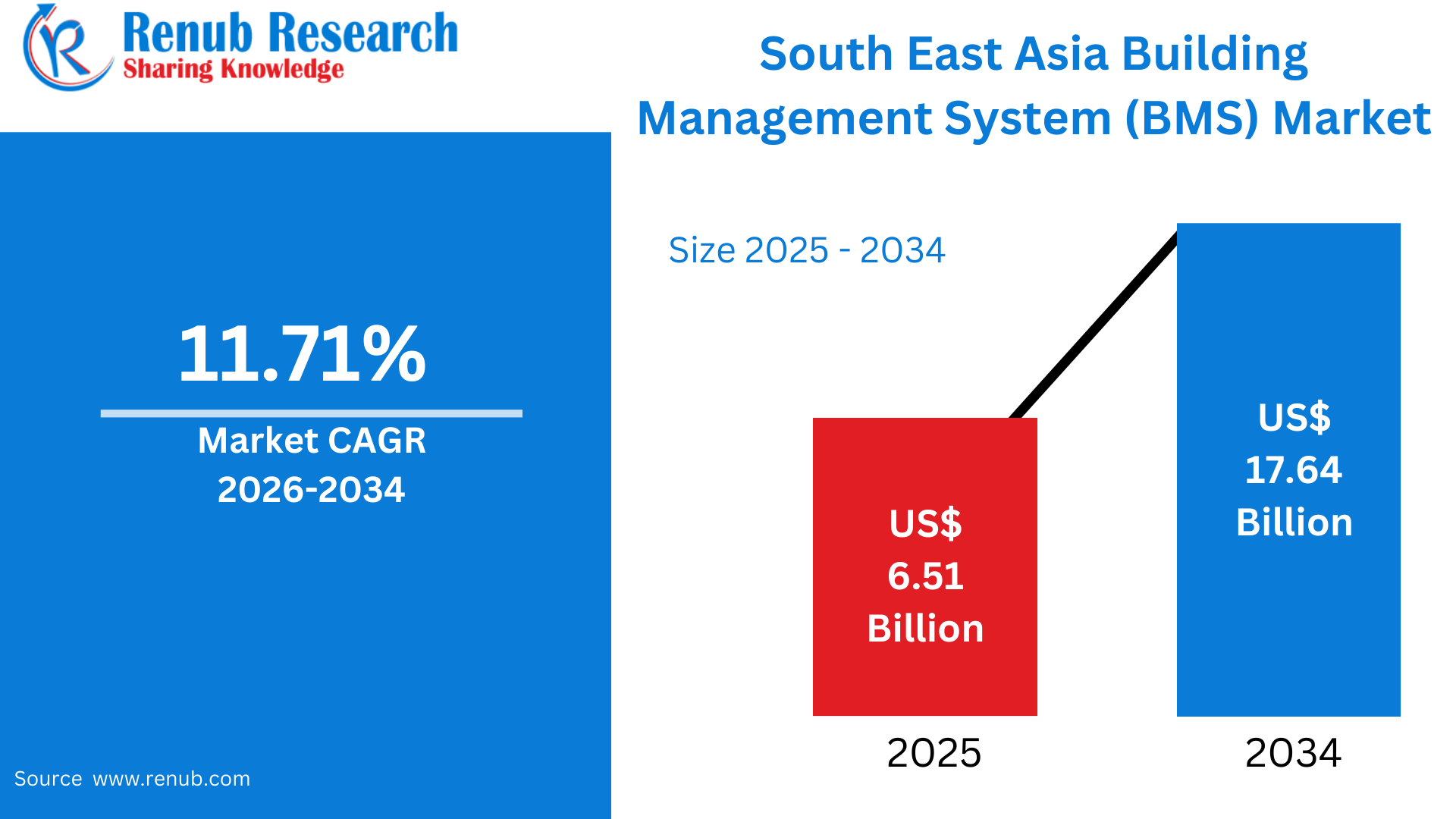
South East Asia Building Management System (BMS) Market is projected to grow from US$ 6.51 billion in 2025 to US$ 17.64 billion by 2034, registering a CAGR of 11.71% during the forecast period (2026–2034). Market growth is being driven by rapid urbanization, rising investments in commercial and residential infrastructure, and the increasing adoption of smart building technologies across the region. Governments are actively promoting energy-efficient and environmentally sustainable buildings through green building regulations and digital transformation initiatives.
South East Asia Building Management System Market Outlook
A Building Management System (BMS) is described as the integrated application of digital technology in building management and control. This technology is applied in the monitoring and management of building operations like heating, ventilation, and air-conditioning, lighting, energy management, fire safety, and building security. A building management system is developed through the integration of sensors, control units, and computer-based software technology. Automation of building management is implemented through the application of building management system technology. This technology is applied to achieve cost savings and increased safety and sustainability within the building.
Building Management Systems are increasing in popularity in South East Asia, courtesy of the growing rates of urbanization, development, and expansions in massive infrastructural projects across South East Asia. South East Asia, including Singapore, Indonesia, Thailand, Malaysia, and Vietnam, is developing and growing increasingly, resulting in more constructions being made on commercial centers, offices, hotels, airports, and intelligent residential buildings. Higher energy rates, as well as growing sustainability programs initiated by governments across South East Asia, are pushing building management systems into wider use to ensure that buildings are more energy-efficient and environmentally friendly.
South East Asia Building Management System Market Outlook
A Building Management System (BMS) is an integrated software and hardware platform designed to automate, monitor, and optimize the operation of a building’s critical systems. These systems include heating, ventilation, air conditioning (HVAC), lighting, electrical distribution, energy management, fire detection, access control, security surveillance, elevators, and other building services. By connecting sensors, controllers, communication networks, and centralized management software, BMS enables real-time monitoring, predictive maintenance, remote operation, and automated control of building functions. The technology helps reduce operational costs, improve energy efficiency, enhance occupant comfort, strengthen security, and ensure compliance with environmental and safety regulations. As smart building technologies continue to evolve, Building Management Systems are becoming an essential component of modern commercial, industrial, healthcare, educational, and residential infrastructure.
The adoption of Building Management Systems is accelerating across Southeast Asia as countries such as Singapore, Indonesia, Malaysia, Thailand, Vietnam, and the Philippines continue to invest heavily in smart cities, commercial complexes, airports, industrial parks, hospitals, hotels, data centers, and mixed-use developments. Rapid urban population growth and increasing construction activity are creating strong demand for intelligent building automation solutions capable of optimizing energy consumption and improving operational efficiency. Rising electricity costs, stricter environmental regulations, and government initiatives promoting green buildings are encouraging property developers and facility managers to implement advanced BMS platforms. Furthermore, the integration of Internet of Things (IoT), artificial intelligence (AI), cloud computing, and data analytics is enabling predictive maintenance, real-time performance monitoring, and automated decision-making, making Building Management Systems a key technology supporting the region’s sustainable urban development and digital transformation.
The State of Energy Efficiency in Southeast Asia
Southeast Asia’s energy efficiency landscape is undergoing a significant transformation, driven by rapid urbanization, industrial expansion, economic recovery, and increasing commitments to decarbonization. According to the 8th ASEAN Energy Outlook, regional energy consumption rebounded strongly after the pandemic, increasing by 15.2% in 2022, and is projected to more than double by 2050 if current consumption trends continue. Over the past decade, the region’s total energy demand has grown by more than 35%, while electricity demand has surged by over 60%, making Southeast Asia one of the fastest-growing energy markets globally. Rising electrification, expanding industrial production, increasing urban populations, higher household incomes, and greater demand for cooling systems, commercial operations, and digital infrastructure continue to place significant pressure on regional energy resources. As a result, improving energy efficiency has become a strategic priority for governments seeking to strengthen energy security, reduce operational costs, and support sustainable economic development.
ASEAN member states have made measurable progress in improving energy efficiency, reducing regional energy intensity by 24.5% compared with 2005 levels through stronger energy policies, efficiency standards, and investments in modern infrastructure. However, this improvement remains below the ASEAN Plan of Action for Energy Cooperation (APAEC) Phase II target of a 32% reduction by 2025, highlighting the need for faster implementation of energy-saving measures. Achieving future efficiency goals will require broader adoption of advanced Building Management Systems (BMS), smart building technologies, energy-efficient HVAC systems, digital energy monitoring platforms, artificial intelligence, and Internet of Things (IoT)-enabled automation. In addition, expanding renewable energy integration, strengthening policy frameworks, encouraging public-private partnerships, and accelerating the modernization of commercial and industrial buildings will play a critical role in reducing energy consumption, lowering carbon emissions, and supporting Southeast Asia’s long-term transition toward a more sustainable and energy-efficient economy.
Growth Drivers of the South East Asia Building Management System Market
Rapid Urbanization and Large-Scale Infrastructure Development
Currently, about 50% of the population in ASEAN is living in urban areas. However, there is a significant variation in the level of urbanization in different countries. For example, the level of urbanization in Singapore is 100% compared to only 25.57% in Cambodia. The rate of urbanization in some countries in South East Asia is among the highest in the world today. There is a substantial rise expected in the number of people living in Jakarta and Manila by 2030. Then, more than 55% of the population in Asia will be living in urban areas Rapid urbanization across Southeast Asia is one of the primary factors driving the demand for Building Management Systems (BMS). The region continues to experience strong population growth in urban centers, resulting in increasing investments in commercial buildings, residential complexes, airports, hospitals, shopping malls, industrial parks, educational institutions, and mixed-use developments. Countries including Indonesia, Vietnam, Thailand, Malaysia, the Philippines, and Singapore are accelerating infrastructure development to support expanding urban populations and economic growth. As modern buildings become larger and more technologically advanced, efficient management of HVAC, lighting, security, elevators, and energy systems has become increasingly complex. Building Management Systems enable centralized monitoring, automation, and real-time control of these critical building functions, improving operational efficiency while reducing maintenance costs. Furthermore, developers are integrating smart building technologies into new construction projects from the design stage, making BMS an essential component of modern infrastructure and supporting sustained market growth across the region.
Growing Focus on Energy Efficiency and Sustainable Buildings
The increasing emphasis on energy conservation and environmental sustainability is significantly accelerating the adoption of Building Management Systems throughout Southeast Asia. Commercial and industrial buildings account for a substantial share of electricity consumption, making energy optimization a key priority for property owners and facility managers. Building Management Systems help monitor, analyze, and optimize energy usage by automatically controlling lighting, HVAC systems, ventilation, and other utilities based on occupancy and operational requirements. Governments across the region are also introducing stricter energy-efficiency regulations, green building certification programs, and carbon reduction initiatives to promote sustainable construction practices. As organizations seek to lower operating expenses while meeting environmental compliance standards, demand for intelligent building automation solutions continues to increase. The integration of renewable energy systems, energy analytics, predictive maintenance, and real-time performance monitoring further strengthens the role of BMS in supporting sustainable building operations and reducing long-term operational costs. February 2025 – G Element Pte Ltd, a prominent innovator in digital twin smart building solutions, and Daikin Airconditioning (Singapore) Pte. Ltd., a renowned pioneer in state-of-the-art cooling and air conditioning solutions, are delighted to announce that a Memorandum of Understanding (MOU) has now been signed between the two organizations.
Smart City Development and Digital Transformation Initiatives
The rapid expansion of smart city projects and digital transformation programs is creating significant growth opportunities for the Southeast Asia Building Management System market. Governments across the region are investing heavily in intelligent urban infrastructure that leverages digital technologies to improve public services, energy efficiency, transportation, and environmental sustainability. Building Management Systems serve as a core component of smart buildings by enabling seamless integration between IoT devices, cloud computing platforms, artificial intelligence, big data analytics, and automated control systems. These technologies provide real-time monitoring, predictive maintenance, remote building management, and data-driven decision-making, enhancing operational performance while improving occupant comfort and safety. As cities increasingly adopt connected infrastructure and intelligent building ecosystems, demand for advanced BMS platforms is expected to rise significantly. Ongoing digital transformation initiatives across sectors such as commercial real estate, healthcare, education, hospitality, and industrial facilities will continue to accelerate market expansion throughout Southeast Asia. The government of Vietnam has recently approved The National Digital Transformation Programme until 2025, with an orientation towards 2030. This will result in speeding up the process of digital transformation due to differences in awareness, enterprise strategy, and incentives for the digital transformation of business activities.
Building Management System (BMS) Launches & Product Introductions in Southeast Asia
- Honeywell Forge Building Management System – Singapore (2023)
-
- Honeywell launched Singapore’s first large-scale cloud-based BMS at Resorts World Sentosa, enabling AI-driven energy optimization and decarbonization initiatives.
- Delta Controls Red5 BACnet Controllers – Malaysia (2023)
-
- Delta Controls introduced its Red5 Series BACnet controllers, featuring secure IoT connectivity, scalable automation, and the Proviso commissioning app for simplified deployment.
- Schneider Electric EcoStruxure Building Operation 2024 – Singapore & Southeast Asia
-
- Launched the latest EcoStruxure platform with cloud integration, AI-powered analytics, and enhanced cybersecurity for smart buildings.
- Siemens Desigo CC Version 5.1 – Southeast Asia (2024)
-
- Siemens released an upgraded Desigo CC platform featuring improved IoT integration, energy monitoring, and centralized building automation.
- Johnson Controls Metasys 13.0 – Southeast Asia (2024)
-
- Introduced enhanced building automation software with advanced dashboards, predictive maintenance capabilities, and cybersecurity improvements.
- ABB ABB Ability™ Building Analyzer – Indonesia & Southeast Asia (2025)
-
- ABB expanded its cloud-based energy and building performance analytics platform to improve operational efficiency and sustainability.
- Daikin × G Element Smart Building Digital Twin Solution – Singapore (2025)
-
- Following their strategic partnership, Daikin and G Element introduced integrated digital twin technology for intelligent HVAC and building management.
- Carrier Abound™ for Buildings – Southeast Asia (2024)
-
- Carrier expanded its Abound digital platform, providing cloud-based building monitoring, indoor air quality management, and predictive maintenance.
- Bosch Building Integration System (BIS) Version 5.2 – Southeast Asia (2024)
-
- Bosch launched an updated Building Integration System with enhanced access control, video surveillance integration, and building automation features.
- Huawei Smart Building Solution 2.0 – Southeast Asia (2025)
-
- Huawei introduced its next-generation smart building platform integrating AI, IoT, cloud management, intelligent energy optimization, and digital building operations for commercial infrastructure.
Challenges of the South East Asia Building Management System Market
High Initial Investment and Budget Constraints
One of the major challenges limiting the adoption of Building Management Systems in Southeast Asia is the significant upfront investment required for deployment. Implementing a comprehensive BMS involves substantial expenditure on sensors, controllers, communication networks, software platforms, integration services, and ongoing maintenance. For small and medium-sized enterprises (SMEs), residential developers, and owners of older buildings, these costs can represent a considerable financial burden. Retrofitting existing buildings with modern automation systems is often more complex and expensive than incorporating BMS into newly constructed facilities, requiring extensive upgrades to electrical and communication infrastructure. In many emerging Southeast Asian economies, budget-conscious organizations continue to prioritize lower initial capital expenditure over long-term operational savings, slowing the pace of BMS adoption despite its proven benefits in energy efficiency, maintenance optimization, and asset management.
Technical Skill Gaps and Complex System Integration
Shortage of skilled professionals capable of designing, implementing, integrating, and maintaining advanced Building Management Systems remains a significant challenge across Southeast Asia. Modern BMS solutions combine multiple building technologies—including HVAC, lighting, fire safety, security, access control, elevators, and energy management—into a single centralized platform. Successfully integrating these systems often requires specialized expertise, particularly when equipment from multiple vendors must operate together seamlessly. Many organizations face difficulties in system configuration, interoperability, software upgrades, and ongoing maintenance due to the limited availability of trained engineers and building automation specialists. Inadequate technical expertise can lead to inefficient system performance, underutilization of advanced features, increased maintenance costs, and reduced return on investment. Addressing workforce development through technical training, certification programs, and stronger collaboration between technology providers and industry stakeholders will be essential for supporting the long-term growth of the Southeast Asia Building Management System market.
Southeast Asia Building HVAC Market
Southeast Asia building HVAC market is experiencing strong growth, driven by rapid urbanization, rising construction activity, and the region’s hot and humid tropical climate. As commercial buildings, residential complexes, hospitals, hotels, airports, and industrial facilities continue to expand, the demand for efficient heating, ventilation, and air conditioning (HVAC) systems is increasing significantly. Building owners are increasingly investing in energy-efficient HVAC technologies to reduce electricity consumption, improve indoor comfort, and lower operating costs. Government initiatives promoting green buildings and stricter energy-efficiency regulations are further encouraging the adoption of advanced HVAC solutions. The integration of HVAC systems with Building Management Systems (BMS) enables automated climate control, predictive maintenance, real-time monitoring, and optimized energy performance. With continued infrastructure development and growing awareness of sustainable building operations, the Southeast Asia HVAC market is expected to witness robust long-term growth.
Southeast Asia Building Security and Access Control Market
Southeast Asia building security and access control market is expanding rapidly due to increasing concerns over occupant safety, asset protection, and regulatory compliance. Rapid urban development and the construction of commercial offices, residential complexes, government facilities, healthcare institutions, and educational campuses have significantly increased the need for advanced security solutions. Organizations are increasingly deploying biometric authentication, facial recognition, RFID cards, smart access systems, mobile credentials, and cloud-based security platforms to strengthen building security. Integration with Building Management Systems enables centralized monitoring, automated alerts, visitor management, and real-time incident response, improving operational efficiency and risk management. Furthermore, the growing adoption of smart city initiatives and intelligent infrastructure is accelerating the deployment of connected security systems. As digital transformation continues across Southeast Asia, demand for intelligent access control and integrated building security solutions is expected to grow steadily.
Southeast Asia Building Management System Software Market
Southeast Asia Building Management System software market is witnessing significant growth as digital technologies become increasingly central to modern building operations. BMS software enables centralized monitoring, automation, remote management, data analytics, and real-time control of critical building systems, including HVAC, lighting, energy management, fire safety, and security. The increasing adoption of cloud computing, artificial intelligence, Internet of Things (IoT), and predictive analytics is transforming traditional building management into intelligent, data-driven operations. Property owners and facility managers benefit from improved operational efficiency, reduced maintenance costs, enhanced energy optimization, and better decision-making through advanced analytics and automated reporting. The growing demand for smart buildings, digital infrastructure, and connected facilities across commercial, industrial, healthcare, and residential sectors continues to drive software adoption. As organizations accelerate digital transformation initiatives, the BMS software market is expected to remain one of the fastest-growing segments within Southeast Asia’s smart building industry.
Southeast Asia Building Activated Carbon Market
Southeast Asia building activated carbon market is gaining momentum as awareness of indoor air quality, environmental sustainability, and occupant health continues to increase. Activated carbon plays a critical role in air filtration and purification systems by effectively removing odors, volatile organic compounds (VOCs), harmful gases, and airborne pollutants from indoor environments. Growing urbanization, industrial emissions, and air pollution have increased the need for advanced air purification solutions across commercial buildings, healthcare facilities, hotels, educational institutions, and residential complexes. The widespread adoption of HVAC systems integrated with activated carbon filtration further supports market growth by improving indoor environmental quality and occupant comfort. In addition, stricter environmental regulations and green building standards are encouraging developers to invest in sustainable air filtration technologies. As healthy building concepts gain greater importance across Southeast Asia, demand for activated carbon solutions is expected to increase steadily.
Commercial Southeast Asia Building Management System Market
Commercial Building Management System market in Southeast Asia is expanding rapidly, driven by increasing investments in office buildings, shopping malls, hotels, hospitals, airports, educational institutions, and mixed-use developments. Modern commercial facilities require integrated platforms capable of efficiently managing HVAC systems, lighting, security, elevators, fire safety, and energy consumption through centralized control. Building Management Systems enable facility managers to optimize operational performance, reduce energy costs, improve occupant comfort, and enhance overall building efficiency. Rising electricity prices, corporate sustainability goals, and stricter environmental regulations are encouraging businesses to adopt intelligent building automation solutions. In addition, smart office concepts and digital workplace initiatives are creating further opportunities for advanced BMS deployment. As commercial real estate development continues to accelerate across Southeast Asia, demand for integrated building management solutions is expected to remain strong throughout the forecast period.
Online Southeast Asia Building Management System Market
Southeast Asia online Building Management System market is experiencing rapid growth as organizations increasingly adopt cloud-based and web-enabled building automation solutions. Online BMS platforms enable facility managers to remotely monitor, control, and optimize building operations from any location through secure internet connectivity. These solutions provide real-time performance monitoring, centralized data management, predictive maintenance, automated reporting, and remote diagnostics while reducing the need for extensive on-site IT infrastructure. Growing internet penetration, expanding cloud adoption, and ongoing digital transformation initiatives across Southeast Asian countries are accelerating the deployment of online BMS platforms. Multi-site property owners, commercial real estate operators, and facility management companies particularly benefit from centralized monitoring and scalable cloud-based solutions. As cybersecurity technologies continue to improve and cloud infrastructure becomes more advanced, the online Building Management System market is expected to play an increasingly important role in Southeast Asia’s smart building ecosystem.
Malaysia Building Management System Market
Malaysia Building Management System (BMS) market is witnessing steady growth, driven by rapid urban development, increasing commercial construction, and rising demand for energy-efficient building operations. Major cities such as Kuala Lumpur, Penang, Johor Bahru, and Cyberjaya are experiencing significant investments in office towers, shopping malls, hotels, hospitals, educational institutions, and mixed-use developments, creating strong demand for intelligent building automation solutions. Malaysia’s tropical climate makes efficient management of HVAC systems essential for reducing energy consumption and maintaining occupant comfort. Government initiatives promoting green buildings, sustainable construction, and energy-efficient infrastructure—including the Green Building Index (GBI) and various environmental policies—are encouraging wider adoption of Building Management Systems. In addition, the growing integration of Internet of Things (IoT), cloud computing, and artificial intelligence into building operations is improving automation, predictive maintenance, and operational efficiency. As Malaysia continues to modernize its infrastructure and expand smart city initiatives, the BMS market is expected to experience sustained long-term growth.
Indonesia Building Management System Market
Indonesia represents one of Southeast Asia’s fastest-growing Building Management System markets, supported by rapid urbanization, strong economic development, and expanding investments in commercial and industrial infrastructure. Major metropolitan areas such as Jakarta, Surabaya, Bandung, and Medan are witnessing continuous development of office buildings, residential complexes, airports, shopping centers, and industrial facilities, increasing the demand for intelligent building automation. Rising electricity costs and growing awareness of energy conservation are encouraging building owners to implement advanced BMS solutions that optimize HVAC, lighting, security, and energy management systems. The Indonesian government’s focus on smart cities, digital transformation, and sustainable urban development is further accelerating the deployment of intelligent building technologies. Integration of IoT-enabled sensors, cloud-based monitoring platforms, and AI-powered analytics allows facility managers to improve operational efficiency while reducing maintenance costs and energy consumption. As infrastructure investment continues to expand, Indonesia is expected to remain a major growth market for Building Management Systems in Southeast Asia.
Singapore Building Management System Market
Singapore has established itself as the leading Building Management System market in Southeast Asia, supported by its advanced digital infrastructure, smart city vision, and strong commitment to sustainability. The widespread adoption of intelligent building technologies across commercial offices, residential developments, healthcare facilities, educational institutions, airports, and government buildings has positioned Singapore at the forefront of smart building innovation. Strict energy-efficiency regulations, Green Mark certification standards, and ambitious carbon reduction targets continue to encourage investment in advanced building automation systems. Given the country’s high concentration of high-rise buildings and limited land availability, Building Management Systems play a critical role in optimizing HVAC performance, lighting control, energy management, security, and facility operations. The integration of artificial intelligence, Internet of Things (IoT), cloud computing, and advanced data analytics enables real-time monitoring, predictive maintenance, and automated decision-making, significantly improving operational efficiency. Backed by continued government support, ongoing digital transformation initiatives, and increasing adoption of smart infrastructure, Singapore is expected to maintain its leadership position in the Southeast Asian Building Management System market throughout the forecast period.
Market Segmentation
System Type
- HVAC system
- Fire and safety
- Energy management
- Security and access control
- Smart building integration
- Facility management system
- Emergency management
- Others
Component
- Hardware
- Software
- Services
Technology
- Activated Carbon
- Electrostatic Precipitators
- High Efficiency Particulate Air (HEPA)
- Ion and Ozone Generators
- Others
Application
- Commercial
- Industrial
- Residential
End User
- Offline
- Online
Countries
- Singapore
- Malaysia
- Thailand
- Indonesia
- Vietnam
- Philippines
- Rest of Southeast Asia
All companies have been covered with 5 Viewpoints
- Overviews
- Key Person
- Recent Developments
- SWOT Analysis
- Revenue Analysis
Company Analysis:
- Cisco Systems Inc.
- Hitachi Ltd.
- Mitsubishi Electric Corporation
- Honeywell International Inc.
- Emerson Electric Co.
- United Technologies Corporation
- Trane Technologies
- Huawei Technologies Corporation
- Hubbell Inc.
Report Details:
| Report Features | Details |
| Base Year |
2025 |
| Historical Period |
2022 - 2025 |
| Forecast Period |
2026 - 2034 |
| Market |
US$ Billion |
| Segment Covered |
System Type, Component, Technology, Application, End User and Countries |
| Countries Covered |
|
| Companies Covered |
|
| Customization Scope |
20% Free Customization |
| Post-Sale Analyst Support |
1 Year (52 Weeks) |
| Delivery Format |
PDF and Excel through Email (We can also provide the editable version of the report in PPT/Word format on request) |
Customization Services available
- Analysis of Market Size and Its Segments
- More Company Profiles (Upto 10 without any additional cost):
- Additional Countries (Other than mentioned Countries):
- Region/Country Specific Reports:
- Market Entry Strategy:
- Region-Specific Market Dynamics:
- Regional Market Share Analysis:
- Trade Analysis:
- Production Insights:
- Others Customized Requests:
For more information contact our analysts.
Need More Assistance?
- Talk to our analysts to get more precious information on the current market trends.
- Include more countries and segments and customize the report based on the final requirement.
- Get a competitive advantage in your industry by knowing the report findings and making a positive impact on your revenues and operations.
- Our analysts are always ready to provide more help and pertinent information if you need any additional assistance.