Smart Textiles Market Size, Share, Growth, Trends, Industry Analysis & Forecast 2026–2034
Buy NowGlobal Smart Textile Market Size & Forecast
Global Smart Textiles Market, valued at USD 5.12 billion in 2025, is projected to reach USD 23.50 billion by 2034, registering a robust CAGR of 18.45% during the forecast period from 2026 to 2034. Market growth is being driven by the rising adoption of wearable technologies, increasing demand for health-monitoring and biometric sensing textiles, and continuous advancements in conductive fibers, electronic fabrics, and embedded sensor technologies. Expanding applications across healthcare, sports and fitness, defense, automotive, and fashion industries are further accelerating market development.
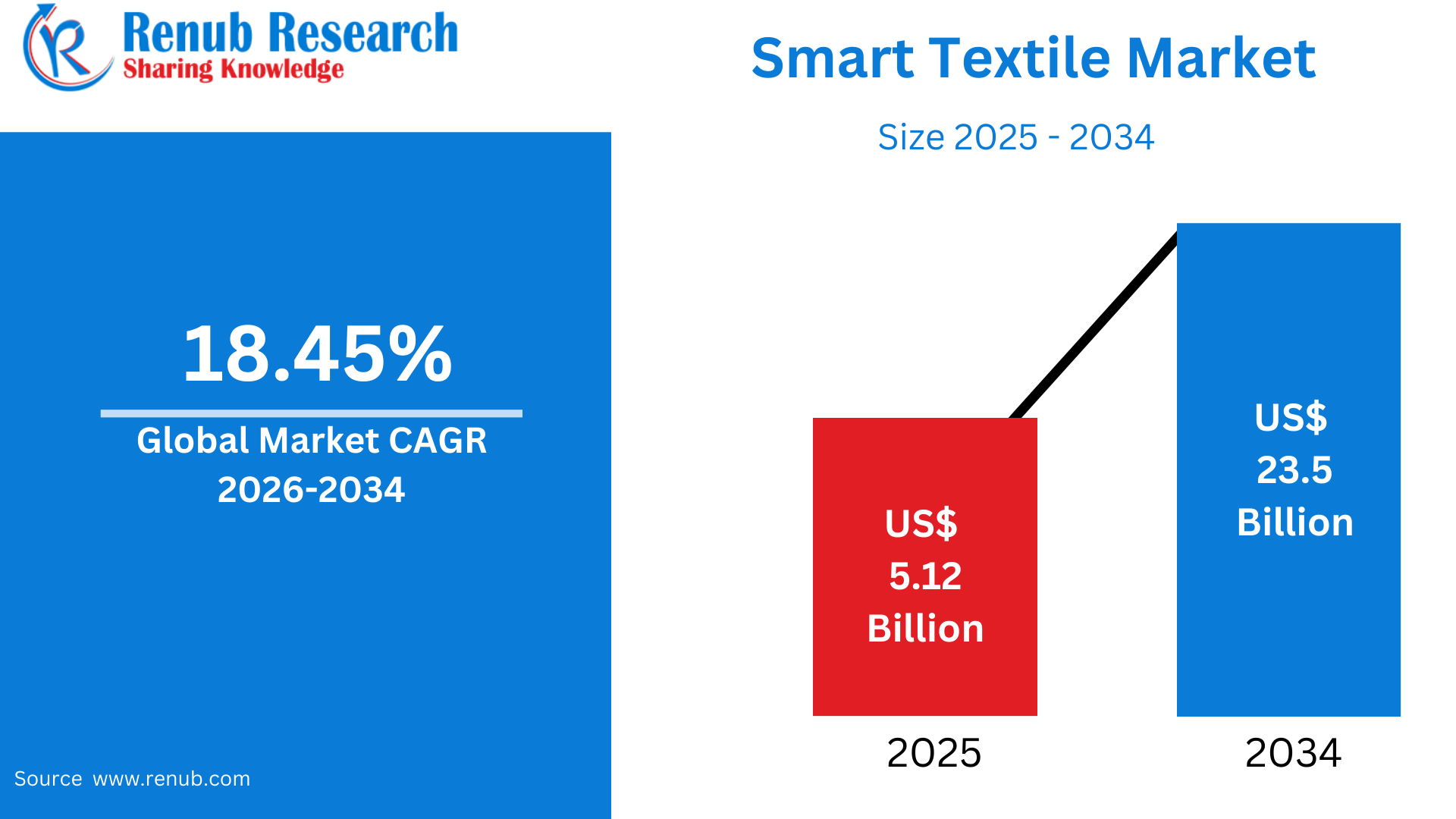
Global Smart Textile Market Outlook
Smart fabrics, also referred to as intelligent fabrics or e-textiles, are fabrics that are embedded with various sophisticated technologies such as sensors, conductive threads, micro-electronics, and connectivity that enable them to react or adapt to certain external stimuli. Smart fabrics are known to have the ability to detect physical, chemical, or environmental changes such as body temperature, heart rate, movement, pressure, or moisture. Smart fabrics are mostly classified into passive, active, and ultra-smart fabrics that have the ability to detect, respond, and adapt, respectively. Smart fabrics are also engineered with the purpose of maintaining fabric comfort while implementing various functional characteristics.
Worldwide, the use of smart textiles is rapidly increasing owing to the surge in the demand for wearables. In the health sector, smart textiles are used for continuous monitoring and elderly care. In sports, smart textiles are used for performance analysis and injury prevention. In the defense and military sector, smart textiles are used for monitoring and protective apparel. In the fashion and lifestyle segment, smart textiles are increasingly being used for personalizing and interacting with apparel. Technological developments in material science and the increasing interest in a healthy and smart lifestyle are catalysts for the global smart textile market.
What are Smart Textiles and Their Uses & Popularity Worldwide
Smart textiles, also known as e-textiles or intelligent fabrics, are advanced materials embedded with electronic components, conductive fibers, sensors, actuators, or microprocessors that enable them to sense, react, and adapt to environmental or physiological conditions. Unlike conventional fabrics, smart textiles can monitor body temperature, heart rate, muscle activity, movement, humidity, and other biometric parameters while maintaining the flexibility and comfort of traditional clothing. These textiles are categorized into passive, active, and ultra-smart textiles based on their sensing and response capabilities. Smart textiles are widely used in healthcare for remote patient monitoring, sports and fitness apparel for performance tracking, military uniforms for soldier safety, automotive interiors, industrial protective clothing, and fashion products with integrated lighting or connectivity features. Globally, the popularity of smart textiles has grown rapidly due to increasing wearable technology adoption, digital healthcare expansion, and advancements in conductive yarns, flexible electronics, and Internet of Things (IoT) technologies. Rising consumer demand for connected devices, preventive healthcare, and high-performance sportswear continues to drive innovation. As artificial intelligence, wireless communication, and nanotechnology evolve, smart textiles are becoming an integral part of modern healthcare, defense, industrial safety, and consumer lifestyle applications worldwide.
Major Smart Textile Product Launches Worldwide
- January 2023 – Myant launched the SKIIN BioWear System, a smart textile garment with integrated ECG sensors capable of continuously monitoring heart rate, respiration, sleep quality, and physical activity for healthcare and wellness applications.
- May 2023 – Hexoskin introduced its next-generation Hexoskin Smart Shirt, featuring enhanced biometric sensors for real-time monitoring of ECG, breathing rate, heart rate variability (HRV), activity, and sleep analytics for medical and sports performance applications.
- September 2023 – Interactive Wear AG launched an upgraded Smart Workwear Platform, integrating conductive textiles and IoT sensors to monitor worker safety, environmental conditions, and physiological status in industrial environments.
- January 2024 – Transforming Textiles AB launched Sense-Tex, an advanced five-fiber smart yarn platform designed for wearable health monitoring, environmental sensing, and aerospace applications while maintaining sustainability and textile flexibility.
- March 2024 – Kyocera Corporation launched the TRUE BLUE TEXTILE project built around its FOREARTH textile technology, showcasing sustainable smart textiles that significantly reduce water consumption in textile printing while supporting next-generation functional fabrics.
- July 2024 – Loomia introduced the Gentoo Flexible Textile Heater, a smart textile heating solution engineered to operate in temperatures as low as –60°C, targeting industrial protective clothing, defense, and extreme outdoor applications.
- September 2024 – Myant and Coapt announced a smart textile neural-interface wearable platform, integrating textile computing with advanced neural control technology to support assistive healthcare and prosthetic applications.
- December 2024 – Imperial College London researchers unveiled an AI-assisted smart T-shirt capable of continuously monitoring cardiac activity and supporting early diagnosis and treatment of heart rhythm disorders.
- February 2025 – Livinguard Technologies launched Livinguard Better Fresh, an advanced functional textile designed with long-lasting odor control and microfiber-shedding protection for sustainable apparel applications.
- July 2026 – Bharat Tex 2026 showcased multiple new smart textile products, including smart yarns, healthcare textiles, specialized protective garments, and advanced technical fabrics for medical, industrial, and defense applications.
Growth Drivers of the Smart Textiles Market
Rising Adoption of Wearable Devices and Connected Healthcare
The growing popularity of wearable technology is one of the primary drivers of the global smart textiles market. Worldwide shipments of wearable devices now exceed 500 million units annually, reflecting increasing consumer demand for continuous health monitoring and connected lifestyles. Smart textiles enable real-time monitoring of vital signs such as heart rate, respiratory rate, body temperature, blood oxygen levels, and physical activity without requiring separate wearable devices. Healthcare providers increasingly utilize smart garments for remote patient monitoring, post-operative care, elderly care, and chronic disease management. The expansion of telemedicine and digital healthcare services has further accelerated demand for textile-integrated sensors capable of transmitting biometric information directly to healthcare professionals. Sports and fitness companies are also adopting smart fabrics to monitor athletic performance, muscle fatigue, and recovery. Continuous improvements in flexible electronics, wireless connectivity, and battery technologies are making smart garments lighter, more comfortable, and more reliable. These developments are significantly expanding commercial adoption across healthcare, fitness, wellness, and consumer electronics industries worldwide.
Technological Advancements in Conductive Fibers and Flexible Electronics
Rapid innovation in conductive fibers, nanomaterials, printed electronics, and flexible sensors is transforming the smart textiles industry. Modern smart fabrics incorporate conductive yarns made from silver, copper, stainless steel, graphene, and carbon nanotubes that enable electrical conductivity while maintaining softness and durability. Flexible electronic components can now be integrated directly into fabrics without compromising comfort or wearability. Industry estimates indicate that investment in flexible electronics continues to grow at double-digit annual rates, accelerating commercialization of intelligent textile products. Advances in miniaturized sensors, energy harvesting technologies, wireless communication modules, and low-power electronics have expanded the capabilities of smart garments across healthcare, defense, sports, and industrial applications. Artificial intelligence algorithms further improve the interpretation of biometric data collected by textile sensors, enabling predictive health monitoring and performance optimization. Continuous research into washable electronic textiles, stretchable circuits, and durable conductive coatings is overcoming previous technical limitations, making smart textiles increasingly suitable for large-scale commercial production and long-term consumer use.
Expanding Applications Across Healthcare, Defense, Sports, and Industrial Safety
The expanding range of commercial applications continues to drive strong growth in the global smart textiles market. Healthcare remains the largest application segment, with hospitals and medical device companies adopting smart garments for continuous patient monitoring and rehabilitation. Military organizations worldwide are investing in intelligent combat uniforms capable of monitoring soldiers’ physiological conditions, environmental hazards, and fatigue levels. Global defense spending exceeds US$2 trillion annually, creating significant opportunities for advanced wearable technologies. Sports apparel manufacturers increasingly integrate biometric monitoring into athletic clothing to improve performance analysis and injury prevention. Industrial sectors also deploy smart protective clothing capable of detecting hazardous gases, excessive heat, toxic chemicals, and worker fatigue, improving workplace safety. Automotive manufacturers are incorporating smart textiles into vehicle seats and interiors for occupant monitoring and comfort enhancement. As demand for connected technologies continues to increase across multiple industries, smart textiles are becoming an essential component of next-generation wearable systems, supporting sustained market expansion over the forecast period.
Challenges of the Smart Textiles Market
High Manufacturing Costs and Complex Production Processes
One of the major challenges facing the smart textiles market is the high cost of manufacturing advanced electronic fabrics. Smart textiles require specialized conductive fibers, embedded sensors, flexible electronic circuits, communication modules, and sophisticated assembly techniques that significantly increase production costs compared with conventional textiles. Integrating electronics into fabrics while maintaining flexibility, comfort, durability, and washability presents considerable engineering challenges. Many smart textile products also require extensive testing to ensure reliable performance under repeated stretching, bending, and laundering conditions. Small and medium-sized textile manufacturers often face substantial financial barriers when investing in advanced production equipment and research capabilities. Furthermore, large-scale manufacturing remains difficult because production processes have not yet achieved the same level of standardization as traditional textile manufacturing. The relatively high retail prices of smart garments may also limit widespread consumer adoption in price-sensitive markets. Continued technological innovation, manufacturing automation, and economies of scale will be essential for reducing costs and enabling broader commercialization of smart textile products.
Durability, Battery Life, and Data Privacy Concerns
Maintaining long-term durability while integrating electronic functionality remains a significant challenge for the smart textiles industry. Smart garments are expected to withstand repeated washing, exposure to moisture, mechanical stress, and varying environmental conditions without degrading sensor performance or electrical conductivity. Battery life also remains a limitation, as many smart textiles rely on compact power sources that require regular charging or replacement. Although research into energy harvesting and flexible batteries is advancing, commercially viable long-duration power solutions are still evolving. Additionally, smart textiles continuously collect sensitive biometric and personal health information, creating concerns regarding cybersecurity, data privacy, and unauthorized access. Healthcare providers, employers, and technology companies deploying connected garments must comply with increasingly stringent data protection regulations while ensuring secure storage and transmission of personal information. Consumer confidence may be affected if privacy risks are not adequately addressed. Overcoming these technical, security, and regulatory challenges will be essential for accelerating mass-market adoption of smart textiles across healthcare, industrial, and consumer applications.
Interactive Fabrics with Real-Time Response Capabilities Drive Active Smart Textile Market Growth
Active smart textiles represent one of the fastest-growing segments within the smart textiles industry because they can both sense external stimuli and actively respond to environmental or physiological changes. Unlike passive smart textiles that only monitor conditions, active textiles integrate sensors, actuators, conductive fibers, and microcontrollers capable of adjusting temperature, compression, illumination, or electrical stimulation based on real-time inputs. Industry estimates indicate that active smart textiles account for nearly 35–40% of the advanced smart textile market, with healthcare and sports applications leading adoption. Medical compression garments, rehabilitation suits, heated clothing, and intelligent sports apparel increasingly utilize active textile technologies to improve patient recovery and athletic performance. Continuous advancements in flexible electronics, miniaturized sensors, and wireless communication technologies have significantly improved product comfort and durability. Growing demand for wearable healthcare devices, personalized medical treatments, and connected consumer products continues to expand commercial adoption. As research into washable electronics and energy-efficient conductive materials progresses, active smart textiles are expected to become increasingly integrated into healthcare, industrial safety, and consumer applications worldwide.
Growing Smart Textile Sensing Demand for Continuous Biometric and Environmental Monitoring
Smart textile sensing is one of the largest technology segments within the smart textiles market, driven by increasing demand for continuous physiological monitoring and environmental sensing. These textiles incorporate embedded sensors capable of measuring heart rate, respiratory rate, body temperature, muscle activity, posture, motion, pressure, and humidity without compromising garment flexibility. Industry studies suggest that healthcare applications account for more than 40% of smart textile sensing deployments, reflecting growing adoption in hospitals, home healthcare, and remote patient monitoring. Sports organizations and fitness companies also increasingly utilize sensing textiles to monitor athlete performance, fatigue, hydration, and recovery in real time. Industrial sectors are deploying sensor-integrated protective clothing capable of detecting hazardous gases, excessive temperatures, and worker fatigue to improve workplace safety. Advancements in nanotechnology, conductive yarns, printed electronics, and artificial intelligence continue to improve sensing accuracy while reducing device size and power consumption. Increasing integration with IoT platforms and cloud-based health monitoring systems is expected to further accelerate market growth over the forecast period.
Energy Harvesting Technologies Support Next-Generation Wearables in Smart Textile Thermoelectricity
The smart textile thermoelectricity market is expanding as researchers and manufacturers develop fabrics capable of generating electrical energy from body heat or temperature differences. Thermoelectric textiles utilize conductive polymers, nanomaterials, graphene, carbon nanotubes, and specialized semiconductor materials to convert thermal energy into electricity through the Seebeck effect. These self-powered textile systems reduce dependence on conventional batteries while extending the operational life of wearable electronic devices. Industry estimates indicate that wearable electronics continue to expand at double-digit annual growth rates, creating significant demand for alternative energy sources integrated directly into fabrics. Healthcare monitoring garments, military uniforms, industrial safety clothing, and sports apparel are increasingly incorporating thermoelectric technologies to power embedded sensors and wireless communication modules. Continuous improvements in flexible thermoelectric materials, lightweight conductive fibers, and energy conversion efficiency are enhancing commercial viability. As battery-free wearable technologies become a major focus of research and development, thermoelectric smart textiles are expected to play an increasingly important role in future connected healthcare and wearable electronics ecosystems.
Defense & Military Modernization and Soldier Protection Accelerate Adoption
The defense and military sector represents one of the most advanced application areas for smart textiles, driven by increasing investments in soldier modernization programs and battlefield safety technologies. Global defense expenditure exceeds US$2 trillion annually, supporting continuous development of intelligent military uniforms capable of monitoring soldiers’ physiological conditions, fatigue levels, hydration status, and environmental exposure. Smart military textiles integrate biometric sensors, GPS modules, communication systems, thermal regulation technologies, and chemical or biological hazard detection capabilities into lightweight fabrics. These advanced garments improve situational awareness while reducing the weight of traditional wearable equipment carried by military personnel. Smart textiles are also being developed with infrared camouflage, ballistic protection enhancement, and adaptive thermal management to improve survivability in extreme environments. Ongoing advances in flexible electronics, energy harvesting systems, conductive fibers, and AI-powered health monitoring continue to strengthen military adoption. Increasing geopolitical tensions and defense modernization initiatives worldwide are expected to sustain long-term demand for intelligent textile technologies across armed forces and homeland security organizations.
Connected Mobility and Passenger Comfort Fuel Transportation Market Expansion
The transportation smart textile market is experiencing steady growth as automotive, aviation, rail, and public transportation industries increasingly integrate intelligent fabrics into vehicle interiors. Smart textiles are used in seats, steering wheels, seat belts, headliners, and interior panels to improve passenger comfort, safety, and vehicle functionality. Modern transportation textiles incorporate pressure sensors, heating elements, biometric monitoring, occupancy detection, and adaptive climate control systems capable of enhancing the overall travel experience. The global connected vehicle fleet is expected to exceed 400 million vehicles over the coming years, creating growing opportunities for intelligent textile integration. Automotive manufacturers increasingly utilize smart seat fabrics to monitor driver fatigue, posture, heart rate, and occupancy while supporting advanced driver assistance systems (ADAS). In aviation and rail transport, smart textiles contribute to lightweight interior components, passenger comfort, and predictive maintenance systems. Continuous innovation in conductive fibers, flexible sensors, and IoT-enabled vehicle technologies is expected to accelerate the adoption of smart textiles across the global transportation industry.
Intelligent Building Materials Enhance Sustainability and Energy Efficiency in Architecture
The architecture smart textile market is emerging as an innovative segment that combines advanced textile engineering with intelligent building design. Architectural smart textiles are increasingly used in tensile structures, building facades, shading systems, roofing membranes, and interior construction applications. These textiles can respond dynamically to sunlight, temperature, humidity, and environmental conditions by adjusting transparency, insulation, or ventilation characteristics. Smart architectural fabrics also integrate photovoltaic fibers, conductive coatings, and embedded sensors that enable real-time structural monitoring and energy generation. Global investments in smart buildings continue to expand as governments and developers prioritize energy-efficient construction and sustainable urban infrastructure. Intelligent textile membranes reduce heating and cooling requirements by improving thermal regulation while lowering overall building energy consumption. Sensor-integrated architectural fabrics also provide continuous monitoring of structural integrity, wind loads, and environmental conditions, improving building safety and maintenance planning. As green building standards and smart city initiatives continue to expand worldwide, architectural smart textiles are expected to become an increasingly important component of sustainable construction and next-generation building technologies.
Strong Defense Spending and Advanced Healthcare Innovation Drive United States Market Growth
The United States is one of the largest smart textile markets globally, supported by its advanced technology ecosystem, strong defense sector, and rapidly expanding digital healthcare industry. The country allocates more than US$850 billion annually to defense spending, creating significant opportunities for intelligent military uniforms, wearable health monitoring systems, and next-generation protective clothing. The U.S. healthcare sector, valued at over US$4 trillion annually, is increasingly adopting smart garments for remote patient monitoring, rehabilitation, chronic disease management, and elderly care. Additionally, the country has over 310 million smartphone users, accelerating demand for connected wearable technologies integrated with smart textiles. Leading sports apparel manufacturers and technology companies are investing heavily in conductive fabrics, biometric sensors, and AI-powered wearable solutions for fitness tracking and athletic performance optimization. Research institutions continue to develop flexible electronics, washable sensors, and energy-harvesting fabrics to improve product performance and durability. Growing investments in Industry 4.0, IoT, and wearable medical technologies are expected to maintain the United States’ leadership in the global smart textile market throughout the forecast period.
Research Excellence and Healthcare Digitalization Accelerate Adoption in the United Kingdom
The United Kingdom has established itself as a leading European market for smart textiles, driven by strong research capabilities, innovation in advanced materials, and increasing adoption across healthcare and defense sectors. The UK has a population of approximately 68 million, with one of Europe’s highest levels of digital healthcare adoption. Universities and research centers continue to collaborate with textile manufacturers to develop intelligent fabrics incorporating conductive fibers, flexible sensors, and wearable electronic systems. The National Health Service (NHS) is increasingly exploring remote patient monitoring technologies, supporting the use of smart garments for cardiac monitoring, rehabilitation, and chronic disease management. The country’s sportswear industry is also adopting intelligent textiles for athlete performance analysis and injury prevention. Defense modernization programs continue to encourage research into lightweight protective clothing, biometric monitoring uniforms, and adaptive thermal management systems. Sustainability remains another important market driver, with manufacturers investing in recyclable smart fabrics and energy-efficient production methods. Continuous government support for advanced manufacturing and digital innovation is expected to strengthen the UK’s smart textile market over the coming years.
Expanding Textile Industry and Digital Healthcare Create New Opportunities in India
India is emerging as one of the fastest-growing smart textile markets due to its large textile manufacturing base, expanding healthcare infrastructure, and increasing adoption of wearable technologies. The country’s textile and apparel industry contributes significantly to national manufacturing output, while employing more than 45 million people across the value chain. India has over 900 million internet users and an estimated 750 million smartphone users, creating a favorable environment for connected wearable products and smart clothing applications. Healthcare providers are increasingly adopting wearable monitoring systems to support telemedicine, remote patient care, and chronic disease management, particularly in underserved regions. The defense sector is also investing in advanced protective uniforms capable of monitoring soldier health and environmental conditions. India’s growing sports and fitness industry has encouraged demand for biometric sportswear and intelligent performance apparel. Government initiatives promoting technical textiles, domestic electronics manufacturing, and digital innovation continue to stimulate research into conductive fibers, flexible electronics, and sensor-integrated fabrics. These factors are expected to support sustained expansion of India’s smart textile market throughout the forecast period.
Smart Healthcare Investments Support Saudi Arabia Market Expansion
Saudi Arabia’s smart textile market is experiencing steady growth as the Kingdom advances digital transformation through its Vision 2030 strategy and investments in healthcare, defense, and smart city development. The country’s population exceeds 36 million, while smartphone penetration is estimated at over 95%, supporting widespread adoption of wearable technologies and connected healthcare devices. Government investments in modern hospitals and digital health services are creating demand for smart garments capable of monitoring patient vital signs, rehabilitation progress, and chronic medical conditions. The defense sector is also investing in intelligent military uniforms equipped with biometric sensors, communication technologies, and environmental monitoring capabilities to improve soldier safety and operational efficiency. Smart textiles are gradually finding applications in industrial safety clothing, particularly within the oil and gas, construction, and manufacturing sectors, where wearable monitoring systems help improve worker protection. In addition, luxury retail and sportswear markets are showing increasing interest in intelligent apparel with integrated health and fitness tracking features. Continued investments in artificial intelligence, IoT infrastructure, advanced manufacturing, and innovation ecosystems are expected to drive long-term growth of the Saudi Arabian smart textile market.
Market Segemntation
Type
- Passive
- Active
Functionality
- Sensing
- Luminescence & Aesthetics
- Energy Harvesting
- Thermoelectricity
- Others
End Use
- Defense & Military
- Sports & Fitness
- Transportation
- Architecture
- Fashion & Entertainment
- Medical
Countries
North America
- United States
- Canada
Europe
- France
- Germany
- Italy
- Spain
- United Kingdom
- Belgium
- Netherlands
- Turkey
Asia Pacific
- China
- Japan
- India
- Australia
- South Korea
- Thailand
- Malaysia
- Indonesia
- New Zealand
Latin America
- Brazil
- Mexico
- Argentina
Middle East & Africa
- South Africa
- Saudi Arabia
- United Arab Emirates
All companies have been covered with 5 Viewpoints
- Overview
- Key Persons
- Recent Development & Strategies
- Product Portfolio
- Financial Insights
Company Analysis
- Adidas AG
- Dupont De Nemours Inc.
- Gentherm Incorporated
- Google LLC
- Texas Instruments Incorporated
- Toray Industries, Inc.
- Ohmatex A/S
- Schoeller Textil AG
Report Details:
| Report Features | Details |
| Base Year |
2025 |
| Historical Period |
2022 - 2025 |
| Forecast Period |
2026 - 2034 |
| Market |
US$ Billion |
| Segment Covered |
Type, Functionality, End Use and Countries |
| Countries Covered |
|
| Companies Covered |
|
| Customization Scope |
20% Free Customization |
| Post-Sale Analyst Support |
1 Year (52 Weeks) |
| Delivery Format |
PDF and Excel through Email (We can also provide the editable version of the report in PPT/Word format on request) |
Customization Services available
- Analysis of Market Size and Its Segments
- More Company Profiles (Upto 10 without any additional cost):
- Additional Countries (Other than mentioned Countries):
- Region/Country Specific Reports:
- Market Entry Strategy:
- Region-Specific Market Dynamics:
- Regional Market Share Analysis:
- Trade Analysis:
- Production Insights:
- Others Customized Requests:
For more information contact our analysts.
Need More Assistance?
- Talk to our analysts to get more precious information on the current market trends.
- Include more countries and segments and customize the report based on the final requirement.
- Get a competitive advantage in your industry by knowing the report findings and making a positive impact on your revenues and operations.
- Our analysts are always ready to provide more help and pertinent information if you need any additional assistance.