Smart Doorbell Market Report by Doorbell Type, Technology Component, Customer Segment, Sales Channel, Country and Company Analysis 2026-2034
Buy NowSmart Doorbell Market Size and Forecast
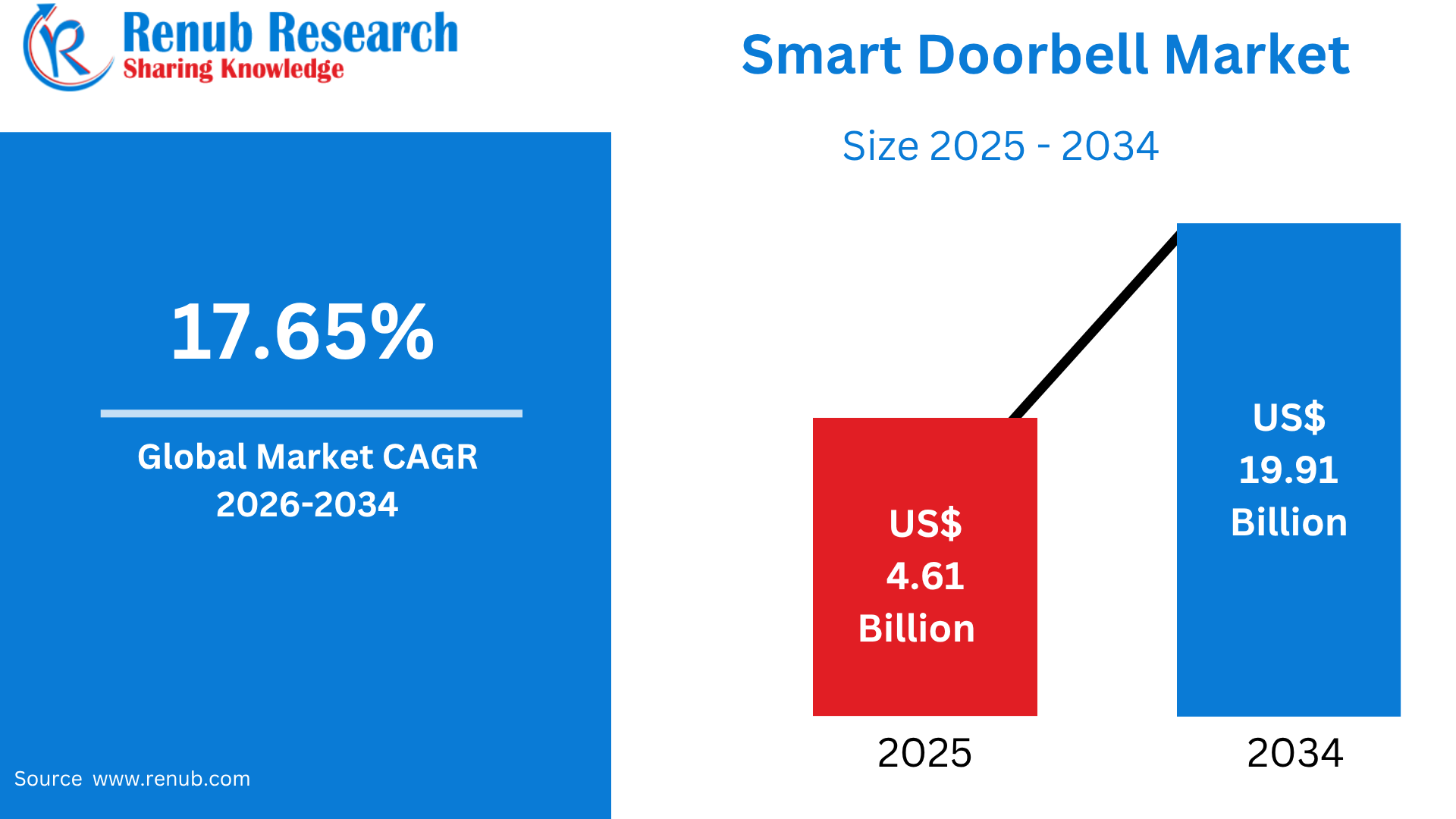
Smart Doorbell Market is projected to expand from US$4.61 billion in 2025 to US$19.91 billion by 2034, registering a CAGR of 17.65% during the 2026–2034 forecast period. Market growth is being supported by the increasing adoption of smart home security systems, rapid urbanization, and rising consumer demand for convenient remote-monitoring technologies. Smart doorbells provide homeowners with real-time video surveillance, visitor alerts, two-way communication, and remote access through connected smartphones and other devices. The growing penetration of connected homes and IoT-enabled security solutions is further encouraging adoption across residential properties.
What is a Smart Doorbell and Its Uses & Popularity Worldwide
A smart doorbell is an internet-connected security device that combines a traditional doorbell with a camera, microphone, speaker, motion sensor, and mobile connectivity. It allows homeowners and businesses to see visitors, communicate remotely, receive real-time alerts, monitor deliveries, and record activity around an entrance. Depending on the model, smart doorbells can include HD or 4K video, night vision, cloud or local storage, facial or person detection, package recognition, and integration with smart-home platforms. These devices are increasingly used in residential properties, apartments, offices, hotels, rental properties, and other buildings requiring remote access monitoring.
Global demand is increasing as consumers seek convenient security solutions that can be controlled through smartphones. A 2025 U.S. homeowner survey found that 19% planned to purchase a smart doorbell within the following 12 months. Growing smart-home adoption, e-commerce deliveries, urbanization, improved wireless connectivity, and AI-powered video analysis are making smart doorbells increasingly popular worldwide.
Growth Drivers of the Smart Doorbell Market
Rising Demand for Connected Home Security
Growing concerns about residential safety and the increasing adoption of connected-home technologies are major drivers of the smart doorbell market. Modern consumers increasingly want security devices that provide real-time monitoring, remote access, visitor identification, and instant notifications rather than relying solely on conventional doorbells or standalone CCTV systems. Smart doorbells address these requirements by connecting directly to smartphones and broader home-automation ecosystems. According to Vivint’s 2025 homeowner survey found that 85% of homeowners used at least one smart-home device, while 19% intended to purchase a smart doorbell during the following 12 months. Integration with smart locks, alarms, cameras, voice assistants, and lighting systems is further increasing the usefulness of doorbell cameras. Consumers can remotely verify visitors, communicate with delivery personnel, and monitor entrances while away from home. As connected-home ecosystems become more mainstream, smart doorbells are increasingly viewed as an essential component of integrated residential security rather than an optional electronic accessory.
AI-Powered Video Analytics and Advanced Features
Rapid advances in artificial intelligence, computer vision, motion detection, facial recognition, and package identification are significantly improving the functionality of smart doorbells. Traditional video doorbells primarily provided basic surveillance and two-way communication, whereas newer AI-enabled models can distinguish between people, vehicles, animals, and other moving objects, helping users receive more relevant alerts. AI is also enabling more sophisticated activity monitoring and reducing unnecessary notifications. Smart doorbells are also benefiting from improvements in wireless connectivity, higher-resolution cameras, cloud storage, night vision, and smartphone applications. These capabilities make the devices useful beyond basic visitor identification. For example, package detection can notify homeowners when deliveries arrive, while two-way audio allows communication without opening the door. AI-powered security can therefore increase both convenience and perceived protection. As processing costs decline and manufacturers incorporate AI into mid-range products, advanced video analytics are expected to become increasingly accessible to mass-market consumers worldwide.
E-Commerce Growth and Increasing Package Deliveries
The rapid expansion of e-commerce and home deliveries is creating another important opportunity for smart doorbells. Consumers increasingly receive parcels at residential addresses, making package monitoring an important feature of modern home-security systems. Smart doorbells allow users to receive notifications when a courier approaches, monitor delivery activity, communicate with delivery personnel, and review recorded footage after a package has been delivered. This functionality is particularly valuable for consumers who spend significant time away from home. Market research identifies parcel monitoring as a structural demand factor supporting smart doorbell adoption as online shopping expands. The development of connected-home ecosystems further strengthens this trend because smart doorbells can be integrated with smart locks and other security devices to create coordinated delivery-management systems. Online retail is also becoming an important sales channel for smart doorbells themselves. As online shopping, last-mile delivery, and residential parcel volumes continue to expand, package detection and remote monitoring are expected to remain important drivers of smart doorbell demand.
Challenges of the Smart Doorbell Market
Privacy and Cybersecurity Concerns
Privacy and cybersecurity remain major challenges because smart doorbells continuously collect and process video, audio, images, motion information, and potentially sensitive household data. Because these devices are connected to the internet, weak passwords, outdated firmware, insecure cloud accounts, or vulnerabilities in connected applications can expose users to unauthorized access. The increasing use of AI and facial-recognition technologies can further intensify concerns about how biometric or identifying information is collected, stored, and processed. The U.S. National Institute of Standards and Technology (NIST) highlighted that smart-home users can have security and privacy concerns or uncertainty regarding how to protect connected devices and the data they collect. Regulatory requirements concerning data protection and recording individuals without consent can create additional compliance obligations for manufacturers and users. To address these risks, companies increasingly invest in encrypted communication, secure authentication, local storage, privacy controls, automatic firmware updates, and transparent data policies. Nevertheless, continued cybersecurity incidents could weaken consumer trust and increase the cost of developing and maintaining smart doorbell ecosystems.
High Product Costs and Installation & Subscription Expenses
Cost remains a barrier, particularly in emerging markets where consumers may consider smart doorbells a discretionary security upgrade rather than an essential household product. In addition to the initial hardware purchase, consumers may face expenses for professional installation, cloud storage, premium AI features, extended warranties, and subscription-based monitoring services. These recurring costs can make advanced smart doorbells considerably more expensive over their lifetime than conventional doorbells or basic security cameras. Wireless models are helping address installation barriers because they generally require less complex wiring and can be installed more easily in existing homes or rental properties. Nevertheless, battery replacement or charging can create additional maintenance requirements. Manufacturers are responding by introducing lower-cost devices, local-storage options, and more affordable subscription tiers. As competition increases and component costs decline, affordability is likely to improve, but the combined cost of hardware, connectivity, and premium software services will remain an important challenge to widespread adoption.
Smart Doorbell Launches Worldwide
- Ring Battery Video Doorbell Pro (2nd Gen) – 2026: Ring launched its second-generation battery-powered Pro doorbell with 4K video, 10x digital zoom, AI-powered features, and a removable battery, expanding high-resolution security to wire-free installations.
- Ring Battery Video Doorbell Plus (2nd Gen) – 2026: The updated Plus model introduced 2K video, 6x zoom, and a removable battery, targeting consumers seeking higher-resolution monitoring without hardwiring.
- Ring Battery Video Doorbell (2nd Gen) – 2026: Ring introduced a more affordable battery model featuring 2K video and a built-in battery, broadening access to higher-resolution smart-doorbell security.
- Ring Wired Doorbell (2nd Gen) – 2026: The entry-level wired model was upgraded to 2K resolution, offering improved image quality at a lower price point.
- Tapo D225 – 2024: TP-Link’s Tapo brand launched the D225 dual-powered smart video doorbell, combining a 10,000mAh battery with hardwired operation and supporting 2K QHD video and 24/7 continuous recording when wired.
- Tapo D210 – 2024: Launched alongside the D225, the battery-powered Tapo D210 offered AI detection, color night vision, local microSD storage, and smart-home integration at a more affordable price.
- Aqara Video Doorbell G4 – Global Launch: Aqara expanded its G4 smart video doorbell globally with 1080p video, on-device facial recognition, Apple Home compatibility, Alexa and Google Home support, and wired or wireless installation.
- Reolink Video Doorbell – Global Launch: Reolink introduced its Video Doorbell lineup with 2K+ image quality, a 180-degree diagonal field of view, Wi-Fi connectivity, and PoE options, targeting comprehensive front-door monitoring.
- Tapo D660 Dual Video Doorbell – Global: TP-Link expanded its Tapo portfolio with the D660 dual-camera doorbell, using forward- and downward-facing cameras to provide more than 180° coverage and improve package-area monitoring.
- Ring 2K/4K Doorbell Lineup – 2025: Amazon expanded Ring’s doorbell portfolio with 2K and 4K models, introducing AI-oriented capabilities such as Retinal Vision, Familiar Faces, Alexa+ greetings, and AI-powered video search.
Reliable Power Supply Supports Adoption
Smart wired doorbells represent an important segment of the smart doorbell market, particularly among users who prioritize continuous power and uninterrupted security monitoring. These devices connect directly to a property’s existing doorbell wiring, eliminating the need for frequent battery replacement or charging. Their continuous power supply supports features such as high-definition video, motion detection, night vision, two-way communication, and real-time alerts. Wired models are particularly suitable for homeowners constructing new properties or upgrading electrical and security systems during renovations. Wired devices can also provide stable performance for users who require continuous video monitoring and frequent camera activity. Their integration with Wi-Fi, smartphones, smart locks, and broader home-automation platforms further enhances functionality. However, installation can be more complex than battery-powered alternatives because existing wiring and compatible voltage are required. As smart-home adoption expands, wired doorbells are expected to maintain strong demand among homeowners seeking dependable, permanently installed security solutions.
Easy Installation and Portability Drive Consumer Preference
Smart wireless doorbells are gaining popularity because they combine easy installation, portability, and connected security features. Unlike wired models, wireless devices generally operate using rechargeable or replaceable batteries and communicate through Wi-Fi, allowing installation without extensive electrical work. This makes them particularly attractive to renters, apartment residents, older-property owners, and consumers seeking DIY installation. Wireless smart doorbells commonly provide HD video, motion detection, night vision, cloud or local storage, two-way audio, and smartphone notifications. Consumers can purchase and install these devices with relatively little professional assistance, while battery-powered designs make relocation and upgrades easier. Improvements in battery life, low-power processors, wireless connectivity, and AI-based detection are further enhancing product performance. Nevertheless, battery charging remains a limitation compared with wired models. As Wi-Fi availability and smart-home adoption continue to expand globally, wireless doorbells are expected to remain one of the most accessible and rapidly developing segments of the smart security-device market.
AI, Cameras, and Sensor Innovation Enhance Product Performance
The smart doorbell hardware market encompasses the cameras, sensors, microphones, speakers, processors, connectivity modules, batteries, storage components, and protective housings required to operate connected doorbell systems. Hardware innovation is increasingly focused on improving image quality, processing speed, energy efficiency, durability, and intelligent detection capabilities. Manufacturers are introducing higher-resolution cameras, enhanced night vision, wider viewing angles, improved motion sensors, and weather-resistant housings to support reliable outdoor operation. AI-enabled processors are also becoming increasingly important because they allow devices to distinguish between people, vehicles, animals, and other movements, thereby reducing unnecessary alerts. Hardware manufacturers are also developing smaller designs and more aesthetically integrated products to complement contemporary residential architecture. Improvements in semiconductor efficiency can extend battery life in wireless models while enabling more sophisticated on-device processing. As consumers demand better security, manufacturers are expected to continue investing in AI chips, advanced sensors, high-resolution imaging, and energy-efficient components, making hardware innovation a fundamental contributor to smart doorbell market development.
Home Security and Package Monitoring Sustain Strong Demand
Residential applications represent the largest end-use segment of the smart doorbell industry, as homeowners increasingly integrate connected doorbells into broader home-security systems. Smart doorbells provide residents with real-time video, visitor notifications, two-way communication, motion detection, and remote monitoring through smartphones. They are particularly valuable for households concerned about unauthorized visitors, package theft, children returning home, elderly family members, and deliveries. The increasing adoption of smart-home technologies is further encouraging homeowners to connect doorbells with smart locks, security cameras, alarms, lighting, and voice assistants. E-commerce growth is another important factor because consumers increasingly want to monitor parcels delivered when they are away from home. In addition, falling hardware prices and expanding online distribution are making smart doorbells more accessible to mainstream households. New residential construction and renovation activity provide additional installation opportunities. With consumers placing greater emphasis on convenience, remote monitoring, and connected security, residential applications are expected to remain the principal growth engine for the global smart doorbell market.
Local Storage and Privacy Concerns Create a Niche Opportunity
Offline or locally stored smart doorbells are designed to provide security functionality while reducing dependence on continuous cloud connectivity. Instead of sending all recordings to remote servers, these systems can store video footage on microSD cards, internal storage, network-attached storage, or other local devices. This approach appeals to consumers who prioritize privacy, data ownership, and reduced reliance on recurring cloud-storage subscriptions. Local storage can also be useful in locations where internet connectivity is unreliable or unavailable. Depending on the model, offline-capable doorbells can provide motion detection, video recording, visitor alerts, and local playback even when cloud services are unavailable. The increasing awareness of connected-device privacy and cybersecurity is creating interest in alternative storage architectures. NIST research has highlighted consumer concerns regarding security and privacy risks associated with smart-home devices and the data they collect. However, completely offline functionality can limit remote viewing, smartphone notifications, AI cloud processing, and other advanced connected features. As a result, many manufacturers are moving toward hybrid storage, allowing users to combine local recording with optional cloud services. This approach provides greater control over sensitive footage while retaining connected functionality, giving offline and local-storage solutions a specialized role within the evolving smart doorbell market.
Advanced Smart-Home Adoption Supports USA Market Leadership
United States represents one of the most developed markets for smart doorbells, supported by widespread smart-home adoption, strong consumer awareness of residential security, and high demand for connected devices. Homeowners increasingly use smart video doorbells to monitor entrances, communicate with visitors, and receive real-time alerts through smartphones. Features such as HD video, motion detection, night vision, two-way audio, cloud storage, and AI-based recognition are becoming increasingly common. The rapid expansion of e-commerce and home deliveries is another important demand driver, as consumers seek greater visibility over packages and visitors. Smart doorbells are also increasingly integrated with voice assistants, smart locks, security cameras, and broader home-automation ecosystems. The United States benefits from the presence of major technology companies and a mature technology infrastructure supporting cloud computing, wireless connectivity, and AI-enabled security solutions. In August 2024, Tapo, a TP-Link brand, introduced the Tapo D225 and Tapo D210 smart video doorbells, with the D225 offering dual-power operation and continuous recording capabilities. These product developments demonstrate the market’s continued movement toward more sophisticated and reliable residential security solutions.
Home-Security Awareness and DIY Installation Encourage United Kingdom Adoption
United Kingdom smart doorbell market is expanding steadily as consumers increasingly prioritize convenient and connected home-security solutions. Smart doorbells enable homeowners to view visitors remotely, communicate through two-way audio, and receive instant smartphone notifications when motion is detected. Demand is particularly strong in urban areas, where online shopping and frequent home deliveries have increased the importance of monitoring front entrances and parcels. Rising interest in DIY security installations is also supporting adoption because many wireless smart doorbells can be installed without extensive professional assistance. High internet connectivity and widespread smartphone usage provide a strong technological foundation for connected doorbell systems. Consumers are also showing growing interest in AI-powered functions that can distinguish people, vehicles, animals, and other movements. In October 2024, Swann launched its EVO wireless video doorbell in the UK, featuring the company’s SwannShield AI technology. Such product innovation is strengthening competition in the market and expanding access to intelligent security features. As smart-home ecosystems become increasingly integrated with cameras, locks, alarms, and voice assistants, smart doorbells are expected to remain an important component of UK residential security systems.
Urbanization and E-Commerce Create Strong India Growth Opportunities
India’s smart doorbells market is experiencing rapid development as urban consumers increasingly adopt connected home-security technologies. Growing smartphone usage, expanding internet connectivity, rising disposable incomes, and increasing awareness of residential security are supporting demand. Smart doorbells are particularly relevant in urban apartments, gated communities, and independent houses, where consumers want to monitor visitors and deliveries remotely. The expansion of e-commerce has also increased the frequency of home deliveries, encouraging households to adopt video doorbells for package monitoring and entrance surveillance. Smartphone integration allows users to receive alerts, view live footage, and communicate with visitors even when they are away from home. Manufacturers are increasingly offering affordable products with features such as HD cameras, motion detection, night vision, cloud or local storage, and two-way communication. In April 2024, Qubo, the smart-device brand of Hero Group, introduced Qubo InstaView, alongside enhancements to its video doorbell portfolio and a portable display unit. Such locally developed products can support broader adoption by combining smart functionality with more accessible pricing. Continued urbanization, smart-home development, and consumer awareness are expected to make India an increasingly important growth market for smart doorbells.
Smart Housing Projects and Digitalization Drive Demand in Saudi Arabia
Saudi Arabia’s smart doorbells market is benefiting from the country’s increasing adoption of smart-home technologies, digital infrastructure, and modern residential security systems. Rising disposable incomes and consumer interest in connected home technologies are encouraging homeowners to install smart doorbells as part of broader automation and surveillance systems. Demand is particularly relevant in new residential developments, luxury housing projects, villas, and smart-city initiatives, where connected security technologies can be incorporated during construction. Smart doorbells provide residents with real-time video monitoring, visitor identification, two-way communication, and smartphone-based access to their properties. High-speed internet availability and widespread smartphone use further support connected-device adoption. Saudi Arabia’s broader digital-transformation agenda and smart-city development are also creating a favorable environment for advanced residential technologies. In September 2025, Taichuan showcased its smart doorbell and security solutions at Intersec Saudi Arabia, highlighting continued industry interest in advanced entrance-security technologies. As residential developers increasingly incorporate automation, surveillance, and connected access systems into modern properties, smart doorbells are expected to gain greater penetration across Saudi Arabia’s premium and technology-oriented housing market.
Market Segments
Type
- Wired Doorbells
- Wireless Doorbells
Component
- Hardware
- Software
End User
- Residential
- Commercial
Sales Channel
- Offline
- Online
Countries
North America
- United States
- Canada
Europe
- France
- Germany
- Italy
- Spain
- United Kingdom
- Belgium
- Netherlands
- Turkey
Asia Pacific
- China
- Japan
- India
- Australia
- South Korea
- Thailand
- Malaysia
- Indonesia
- New Zealand
Latin America
- Brazil
- Mexico
- Argentina
Middle East & Africa
- South Africa
- Saudi Arabia
- UAE
All the Key players have been covered from 5 Viewpoints:
- Overviews
- Key Person
- Recent Developments
- SWOT Analysis
- Revenue Analysis
Key Players Analysis
- Panasonic Corporation
- August, Inc.
- Smartwares Group
- Arlo Technologies, Inc.
- Intelligent Technology Co. Ltd.
- Vivint Smart Home, Inc.
- Ring Inc.
- Sky Bell Technologies Inc.
Report Details:
| Report Features | Details |
| Base Year |
2025 |
| Historical Period |
2022 - 2025 |
| Forecast Period |
2026 - 2034 |
| Market |
US$ Billion |
| Segment Covered |
Type, Component, End User, Sales Channel and Countries |
| Countries Covered |
|
| Companies Covered |
|
| Customization Scope |
20% Free Customization |
| Post-Sale Analyst Support |
1 Year (52 Weeks) |
| Delivery Format |
PDF and Excel through Email (We can also provide the editable version of the report in PPT/Word format on request) |
Customization Services available
- Analysis of Market Size and Its Segments
- More Company Profiles (Upto 10 without any additional cost):
- Additional Countries (Other than mentioned Countries):
- Region/Country Specific Reports:
- Market Entry Strategy:
- Region-Specific Market Dynamics:
- Regional Market Share Analysis:
- Trade Analysis:
- Production Insights:
- Others Customized Requests:
For more information contact our analysts.
Need More Assistance?
- Talk to our analysts to get more precious information on the current market trends.
- Include more countries and segments and customize the report based on the final requirement.
- Get a competitive advantage in your industry by knowing the report findings and making a positive impact on your revenues and operations.
- Our analysts are always ready to provide more help and pertinent information if you need any additional assistance.