Server Chassis Market Size, Share, Growth, Trends, Industry Analysis & Forecast 2026–2034
Buy NowServer Chassis Market Size & Forecast
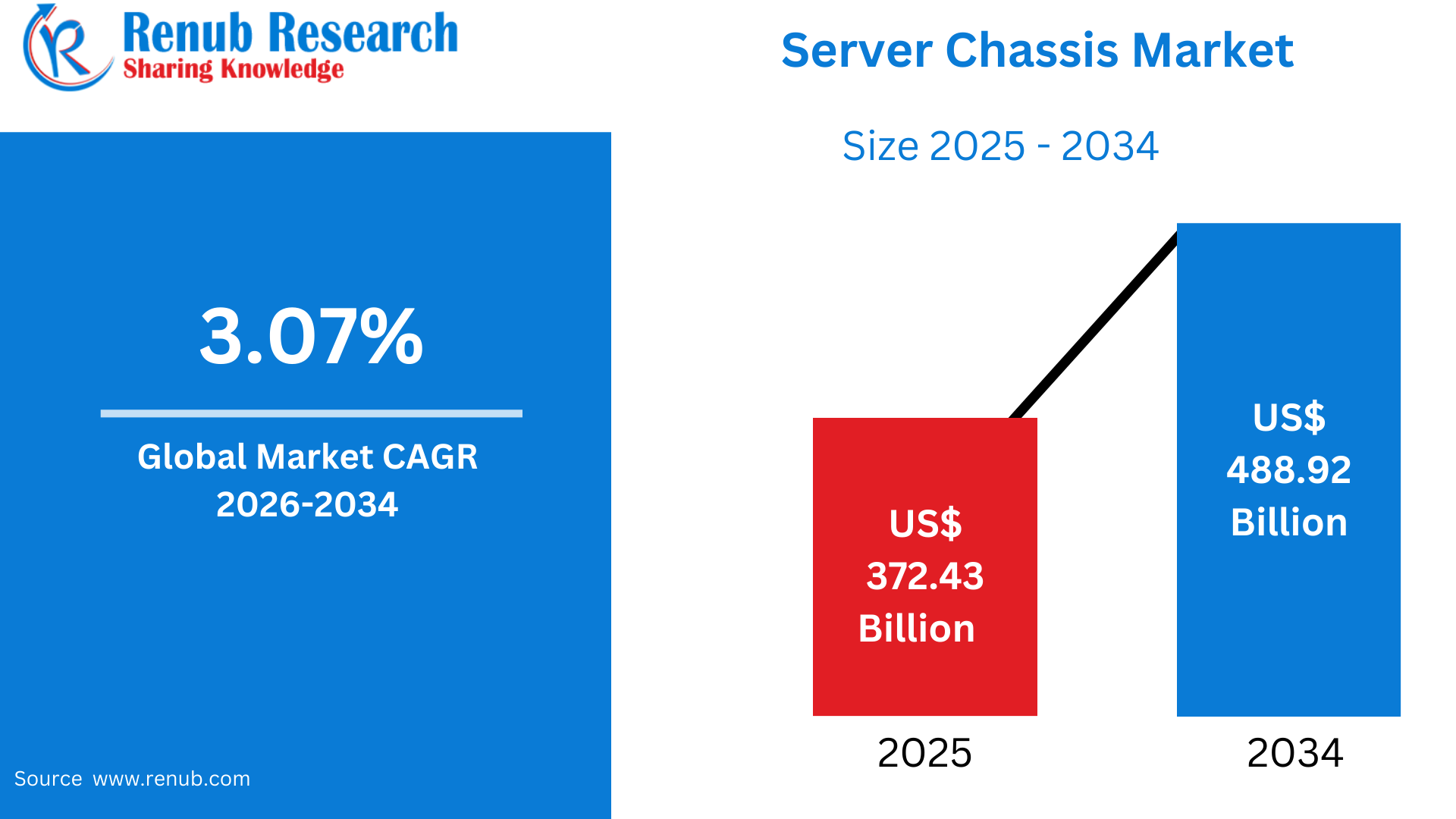
Server Chassis Market is projected to grow from US$ 372.43 billion in 2025 to US$ 488.92 billion by 2034, registering a CAGR of 3.07% during the forecast period from 2026 to 2034. Market growth is being driven by rising investments in data center infrastructure, rapid adoption of cloud computing services, expanding artificial intelligence (AI) and machine learning workloads, and increasing deployment of high-density server architectures. Organizations are also prioritizing energy-efficient server solutions to reduce operational costs and improve sustainability.
What is a Server Chassis? Its Uses & Worldwide Popularity
A server chassis is the physical enclosure that houses, protects, and organizes the essential hardware components of a server, including the motherboard, processors, memory modules, storage drives, power supplies, cooling fans, and networking interfaces. It serves as the structural framework that ensures efficient airflow, thermal management, cable organization, and hardware protection while supporting reliable server operation. Server chassis are available in various form factors, such as rackmount, tower, blade, and modular designs, allowing organizations to select configurations that best suit their computing requirements. Advanced server chassis also feature hot-swappable components, redundant power supplies, tool-less maintenance, and high-density designs to improve system availability, scalability, and operational efficiency.
Worldwide, server chassis have become indispensable due to the rapid expansion of data centers, cloud computing, artificial intelligence (AI), big data analytics, enterprise IT infrastructure, and edge computing. Hyperscale cloud providers, telecommunications companies, financial institutions, healthcare organizations, government agencies, and research institutions rely on advanced server chassis to support mission-critical applications and high-performance computing workloads. The increasing adoption of virtualization, Internet of Things (IoT) devices, and 5G networks has further accelerated demand for scalable and energy-efficient server infrastructure. Modern server chassis are designed to maximize computing density while minimizing power consumption, cooling requirements, and maintenance costs. As global digital transformation continues and data generation increases exponentially, the demand for innovative, reliable, and high-performance server chassis is expected to grow steadily across industries worldwide.
Growth Drivers of the Server Chassis Market
Rapid Expansion of Data Centers and Cloud Infrastructure
The rapid growth of data generation, cloud computing, and digital services is one of the primary factors driving the global server chassis market. Enterprises across industries are investing heavily in hyperscale, colocation, and enterprise data centers to support cloud applications, artificial intelligence (AI), video streaming, enterprise software, and digital transformation initiatives. Server chassis provide the structural foundation for deploying high-performance servers in rack-based environments, enabling efficient space utilization, simplified maintenance, and scalable infrastructure expansion. Cloud service providers increasingly deploy high-density rackmount server chassis to maximize computing capacity while reducing floor space, energy consumption, and operational costs. Significant investments in data center construction across North America, Europe, and Asia-Pacific continue to strengthen demand for advanced server chassis solutions. For example, in January 2026, Bitdeer AI, a subsidiary of Bitdeer Technologies Group and an NVIDIA Cloud Partner, announced the deployment of its NVIDIA GB200 NVL72 AI computing solutions in Malaysia, reflecting the growing investment in next-generation AI cloud infrastructure that requires advanced server chassis technologies.
Rising Adoption of Artificial Intelligence, Big Data, and High-Performance Computing
The rapid adoption of artificial intelligence (AI), machine learning, big data analytics, and high-performance computing (HPC) is significantly increasing demand for advanced server chassis designed to support compute-intensive workloads. Modern AI servers require chassis capable of accommodating powerful processors, multiple GPUs, specialized accelerators, high-capacity memory, and advanced storage systems while maintaining optimal thermal performance. Manufacturers are developing modular server chassis with improved airflow management, liquid cooling compatibility, and high-density configurations to meet the growing computational demands of AI training, scientific research, financial modeling, and enterprise analytics. Organizations across healthcare, life sciences, manufacturing, research institutions, and cloud computing continue investing in high-performance computing infrastructure to accelerate innovation and process massive datasets more efficiently. In November 2025, Merck partnered with Lenovo Group and Equinix to deploy an advanced high-performance computing system in Germany, supporting research across its life sciences, healthcare, and electronics businesses while highlighting the growing importance of high-performance server infrastructure.
Expansion of Edge Computing and 5G Infrastructure
The global expansion of edge computing and 5G networks is creating significant opportunities for the server chassis market. Unlike traditional centralized data centers, edge computing requires compact, rugged, and energy-efficient server chassis capable of operating in remote and space-constrained environments such as telecommunications sites, manufacturing facilities, retail stores, transportation hubs, and smart city infrastructure. Edge-compatible server chassis enable low-latency computing by processing data closer to end users and connected devices, supporting applications including industrial automation, Internet of Things (IoT), autonomous vehicles, smart factories, video surveillance, and real-time analytics. The rapid deployment of private and public 5G networks is further accelerating investments in distributed edge infrastructure worldwide. For instance, in January 2025, Siemens introduced an upgraded private 5G infrastructure solution for industrial environments capable of supporting up to 24 radio units, with each unit covering approximately 5,000 square meters, highlighting the growing demand for advanced edge computing hardware and compact server chassis solutions.
Challenges of the Server Chassis Market
Thermal Management and Energy Efficiency Challenges
As computing performance continues to increase, managing heat generation and power consumption has become one of the most significant challenges for the server chassis industry. Modern processors, graphics processing units (GPUs), AI accelerators, and high-density memory modules generate substantial amounts of heat, requiring increasingly sophisticated cooling technologies. Server chassis manufacturers must design enclosures that optimize airflow, support advanced air and liquid cooling systems, and maintain stable operating temperatures while minimizing energy consumption. Inadequate thermal management can reduce system performance, shorten hardware lifespan, increase maintenance requirements, and raise overall operating costs. Additionally, data center operators are placing greater emphasis on sustainability and energy efficiency, encouraging manufacturers to develop innovative chassis designs that improve cooling effectiveness while reducing power usage. Balancing computing performance, thermal efficiency, environmental sustainability, and operating costs remains a major technical challenge for server chassis manufacturers.
Global Supply Chain Disruptions and Rising Manufacturing Costs
The server chassis market continues to face challenges arising from global supply chain disruptions, fluctuating raw material prices, and increasing manufacturing costs. Production of server chassis depends heavily on materials such as steel, aluminum, electronic components, cooling equipment, and precision manufacturing technologies, all of which have experienced periodic supply shortages and price volatility. Transportation disruptions, geopolitical uncertainties, and longer procurement lead times have further complicated manufacturing operations and delayed product deliveries. At the same time, intense competition among server manufacturers and data center equipment suppliers places continuous pressure on pricing and profit margins. Manufacturers must balance customer demand for customized, high-performance chassis with cost-effective production strategies while maintaining product quality and delivery schedules. Successfully managing supply chain resilience, manufacturing efficiency, and raw material costs will remain essential for sustaining profitability and long-term growth in the global server chassis market.
Server Chassis Launches Worldwide
- January 2025 – Supermicro launched the Hyper 2U X14 Server Chassis, supporting Intel® Xeon® 6 processors with enhanced cooling, AI optimization, and PCIe 5.0 expansion for enterprise and cloud workloads.
- October 2024 – ASUS introduced the RS720Q-E12 Series 2U Multi-Node Server Chassis, designed for AI, HPC, virtualization, and hyperscale data center deployments with improved power efficiency.
- September 2024 – GIGABYTE launched the R283-ZK0 2U GPU Server Chassis, supporting NVIDIA HGX™ H200 GPUs and liquid-cooling compatibility for AI training and inference.
- August 2024 – Lenovo unveiled the ThinkSystem SR685a V3 Server Chassis, optimized for AMD EPYC™ processors and NVIDIA GPUs to support AI, analytics, and high-performance computing.
- June 2024 – Dell Technologies introduced the PowerEdge XE9680L AI Server Chassis, featuring high-density GPU support, advanced thermal architecture, and liquid cooling for generative AI workloads.
- March 2024 – Hewlett Packard Enterprise (HPE) launched the HPE ProLiant Compute DL380 Gen12 Server Chassis, delivering improved security, modularity, and energy efficiency for enterprise data centers.
- November 2023 – Advantech released the SKY-722V4 2U Server Chassis, supporting dual Intel Xeon Scalable processors for edge computing, cloud infrastructure, and industrial applications.
- September 2023 – ASRock Rack introduced the 2U12L2E-GENOA2 Server Chassis, built for AMD EPYC™ 9004 Series processors with PCIe Gen5 support and high-density storage capabilities.
- July 2023 – Chenbro launched the RM24600 Series 2U Rackmount Server Chassis, offering modular storage, enhanced airflow, and flexible expansion for enterprise and storage applications.
- May 2023 – InWin Development Inc. introduced the IW-RS224-07 2U Rackmount Server Chassis, featuring redundant power supplies, tool-less maintenance, and optimized airflow for cloud and enterprise server environments.
2U Server Chassis High-Density Computing Supporting Enterprise and Data Center Growth
2U Server Chassis Market is experiencing steady growth as enterprises, cloud service providers, and hyperscale data centers increasingly require high-performance computing platforms that balance processing power, storage capacity, and cooling efficiency. A 2U server chassis occupies two rack units within a standard server rack, providing additional internal space compared to 1U systems for multiple processors, memory modules, storage drives, GPUs, and advanced cooling solutions. These chassis are widely deployed in virtualization, database management, artificial intelligence (AI), high-performance computing (HPC), and enterprise applications where greater expansion capability and improved thermal management are essential. Their ability to support hot-swappable components, redundant power supplies, and flexible storage configurations makes them ideal for mission-critical environments. Growing investments in cloud infrastructure, digital transformation, and enterprise data centers continue to strengthen demand for 2U server chassis. Manufacturers are also integrating modular designs, improved airflow systems, and energy-efficient architectures to enhance operational reliability, scalability, and long-term performance in modern computing environments.
Pedestal Server Chassis Flexible Tower Solutions for Small and Medium Enterprises
Pedestal Server Chassis Market is expanding steadily as small and medium-sized enterprises (SMEs), branch offices, educational institutions, healthcare facilities, and government organizations increasingly seek cost-effective server infrastructure that does not require dedicated rack installations. Pedestal server chassis, also known as tower server chassis, are designed to operate as standalone systems while providing sufficient space for processors, storage devices, memory expansion, and cooling components. Their quiet operation, simple installation, and ease of maintenance make them particularly suitable for offices with limited IT infrastructure. These chassis support a wide range of business applications, including file sharing, business management software, virtualization, security systems, and local database hosting. Manufacturers continue enhancing pedestal server chassis with improved cooling systems, tool-less maintenance, modular storage expansion, and energy-efficient power supplies to improve operational efficiency. As digital adoption accelerates among smaller organizations and edge computing deployments increase, pedestal server chassis continue to offer an affordable, reliable, and scalable solution for decentralized computing environments.
Server Chassis Direct Sales Customized Solutions Strengthening Enterprise Procurement
Server Chassis Direct Sales Market continues to grow as enterprises, hyperscale cloud providers, telecommunications companies, and government organizations increasingly prefer purchasing server chassis directly from manufacturers and authorized suppliers. Direct sales enable customers to obtain customized server configurations, technical consultation, warranty services, and after-sales support that align with specific operational requirements. Large organizations often require specialized chassis designs optimized for high-density computing, artificial intelligence workloads, storage-intensive applications, and advanced cooling technologies. Direct procurement also improves supply chain transparency, reduces procurement complexity, and facilitates long-term service agreements and volume-based pricing advantages. Manufacturers benefit from stronger customer relationships, direct feedback, and the ability to develop tailored solutions for mission-critical deployments. As organizations continue investing in data center expansion, private cloud infrastructure, and digital transformation initiatives, direct sales channels are becoming increasingly important for delivering customized server chassis that meet demanding performance, scalability, and reliability requirements across enterprise and hyperscale computing environments.
Commercial Server Chassis Supporting Enterprise Digital Infrastructure Worldwide
Commercial Server Chassis Market is witnessing consistent growth as organizations across banking, healthcare, manufacturing, retail, telecommunications, education, government, and information technology continue expanding their digital infrastructure. Commercial server chassis are specifically designed to support enterprise computing workloads, including virtualization, cloud services, business applications, database management, cybersecurity, artificial intelligence, and large-scale data processing. These chassis emphasize reliability, scalability, thermal efficiency, and simplified maintenance to ensure continuous operation in business-critical environments. Enterprises increasingly demand modular server chassis capable of accommodating multiple processors, high-capacity memory, advanced storage systems, GPU accelerators, and redundant power supplies while minimizing operational costs. The rapid growth of cloud computing, hybrid IT environments, and edge computing is further driving demand for commercial-grade server chassis with enhanced cooling technologies and energy-efficient designs. Manufacturers continue introducing innovative chassis architectures that improve deployment flexibility, operational reliability, and infrastructure scalability, making commercial server chassis an essential component of modern enterprise and data center ecosystems.
United States Server Chassis Leading Hub for Data Center Infrastructure and AI Computing
United States Server Chassis Market is the largest globally, supported by the country’s leadership in cloud computing, hyperscale data centers, artificial intelligence (AI), and enterprise digital transformation. Major cloud service providers, technology companies, financial institutions, healthcare organizations, and government agencies continue investing heavily in advanced server infrastructure to support growing computing requirements. The widespread deployment of AI, machine learning, high-performance computing (HPC), and big data analytics has significantly increased demand for high-density server chassis capable of supporting multiple GPUs, advanced cooling systems, and modular configurations. The rapid expansion of edge computing, 5G networks, and hybrid cloud environments is further driving demand for compact and energy-efficient chassis solutions. Additionally, continuous investments in hyperscale data center expansion and server modernization encourage manufacturers to develop highly scalable, thermally optimized, and power-efficient chassis designs. Despite challenges such as rising manufacturing costs and increasing energy consumption, the U.S. market continues to lead global innovation through advanced engineering, technological development, and strong enterprise IT spending, making it a key contributor to worldwide server chassis demand.
United Kingdom Server Chassis Growing Demand Driven by Cloud Adoption and Enterprise Digitalization
United Kingdom Server Chassis Market is expanding steadily as businesses accelerate digital transformation, cloud migration, and cybersecurity investments across multiple industries. Financial services, healthcare, government organizations, educational institutions, and telecommunications companies increasingly rely on modern server infrastructure to support cloud applications, virtualization, artificial intelligence, and secure data management. The growing adoption of hybrid cloud environments and edge computing has created demand for flexible server chassis capable of supporting high-performance processors, scalable storage, and efficient cooling systems. Data center operators across the UK are also upgrading existing infrastructure with energy-efficient rackmount and modular server chassis to improve operational efficiency and sustainability. Government initiatives promoting digital innovation and smart infrastructure further support market growth. Manufacturers continue introducing advanced chassis featuring modular architecture, improved airflow management, and support for liquid cooling technologies. As enterprises modernize their IT infrastructure while emphasizing energy efficiency and business continuity, the UK server chassis market is expected to experience sustained long-term growth.
India Server Chassis Rapid Expansion Supported by Digital Transformation and Data Center Investments
India Server Chassis Market is witnessing strong growth, driven by expanding digital infrastructure, increasing cloud adoption, and significant investments in domestic data center development. Rapid digitalization across banking, e-commerce, telecommunications, healthcare, manufacturing, education, and government sectors has substantially increased demand for reliable server infrastructure. The widespread deployment of artificial intelligence, big data analytics, Internet of Things (IoT), and enterprise cloud applications has accelerated the need for scalable, high-performance server chassis with enhanced cooling capabilities and modular configurations. Government initiatives promoting digital services, local data storage, and smart city development are further encouraging investments in hyperscale and edge data centers throughout the country. The rapid rollout of 5G networks and increasing enterprise adoption of hybrid cloud solutions are also creating opportunities for compact and energy-efficient server chassis. Although infrastructure costs and power management remain challenges, continuous investments by domestic and international technology companies position India as one of the fastest-growing markets for server chassis in the Asia-Pacific region.
Saudi Arabia Server Chassis Advancing Digital Infrastructure Under Vision 2030
Saudi Arabia Server Chassis Market is expanding rapidly as the Kingdom accelerates investments in digital infrastructure, cloud computing, and smart technologies under its Vision 2030 economic transformation strategy. Government agencies, financial institutions, healthcare providers, telecommunications companies, and energy enterprises are modernizing their IT infrastructure to support digital services, artificial intelligence, cybersecurity, and large-scale data management. The increasing establishment of local cloud regions, hyperscale data centers, and edge computing facilities has significantly boosted demand for advanced server chassis capable of supporting high-density computing, efficient thermal management, and reliable continuous operation. The expansion of 5G connectivity, smart city initiatives, and industrial digitalization is also driving demand for rugged and energy-efficient server chassis suitable for distributed computing environments. International technology vendors continue partnering with regional organizations to deploy advanced server infrastructure and cloud services across the Kingdom. As Saudi Arabia strengthens its position as a regional technology and data center hub, demand for innovative, scalable, and energy-efficient server chassis solutions is expected to grow steadily over the coming years.
Market Segmentation
Type
- 1U Server Chassis
- 2U Server Chassis
- 3U Server Chassis
- 4U Server Chassis
- Others
Form
- Rack Mount
- Pedestal
Distribution Channel
- Direct Sales
- Distributors
Application
- Personal Use
- Commercial
Countries
North America
- United States
- Canada
Europe
- France
- Germany
- Italy
- Spain
- United Kingdom
- Belgium
- Netherlands
- Turkey
Asia Pacific
- China
- Japan
- India
- Australia
- South Korea
- Thailand
- Malaysia
- Indonesia
- New Zealand
Latin America
- Brazil
- Mexico
- Argentina
Middle East & Africa
- South Africa
- Saudi Arabia
- United Arab Emirates
All companies have been covered with 5 Viewpoints
- Overview
- Key Persons
- Recent Development & Strategies
- Product Portfolio
- Financial Insights
Company Analysis
- Ablecom Technology Inc.
- Advantech Co. Ltd.
- Chenbro Micom Co. Ltd.
- Cisco Systems Inc.
- In Win Development Inc.
- Intel Corporation
- iStarUSA Inc.
- Mootek Technologies
- OneChassis Technology Company Ltd.
- Rosewill Inc.
- SilverStone Technology Co. Ltd.
Report Details:
| Report Features | Details |
| Base Year |
2025 |
| Historical Period |
2022 - 2025 |
| Forecast Period |
2026 - 2034 |
| Market |
US$ Billion |
| Segment Covered |
Type, Form, Distribution Channel, Application and Countries |
| Countries Covered |
|
| Companies Covered |
|
| Customization Scope |
20% Free Customization |
| Post-Sale Analyst Support |
1 Year (52 Weeks) |
| Delivery Format |
PDF and Excel through Email (We can also provide the editable version of the report in PPT/Word format on request) |
Key Questions Answered in Report:
- How big is the Server Chassis industry?
- What is the Server Chassis growth rate?
- Who are the key players in Server Chassis industry?
- What are the factors driving the Server Chassis industry?
- Which Region held the largest market share in the Server Chassis industry?
- What segments are covered in the Server Chassis Market report?
Customization Services available
- Analysis of Market Size and Its Segments
- More Company Profiles (Upto 10 without any additional cost):
- Additional Countries (Other than mentioned Countries):
- Region/Country Specific Reports:
- Market Entry Strategy:
- Region-Specific Market Dynamics:
- Regional Market Share Analysis:
- Trade Analysis:
- Production Insights:
- Others Customized Requests:
For more information contact our analysts.
Need More Assistance?
- Talk to our analysts to get more precious information on the current market trends.
- Include more countries and segments and customize the report based on the final requirement.
- Get a competitive advantage in your industry by knowing the report findings and making a positive impact on your revenues and operations.
- Our analysts are always ready to provide more help and pertinent information if you need any additional assistance.