Semiconductor Market Size, Share, Growth, Trends, Industry Analysis & Forecast 2026–2034
Buy NowSemiconductor Market Size
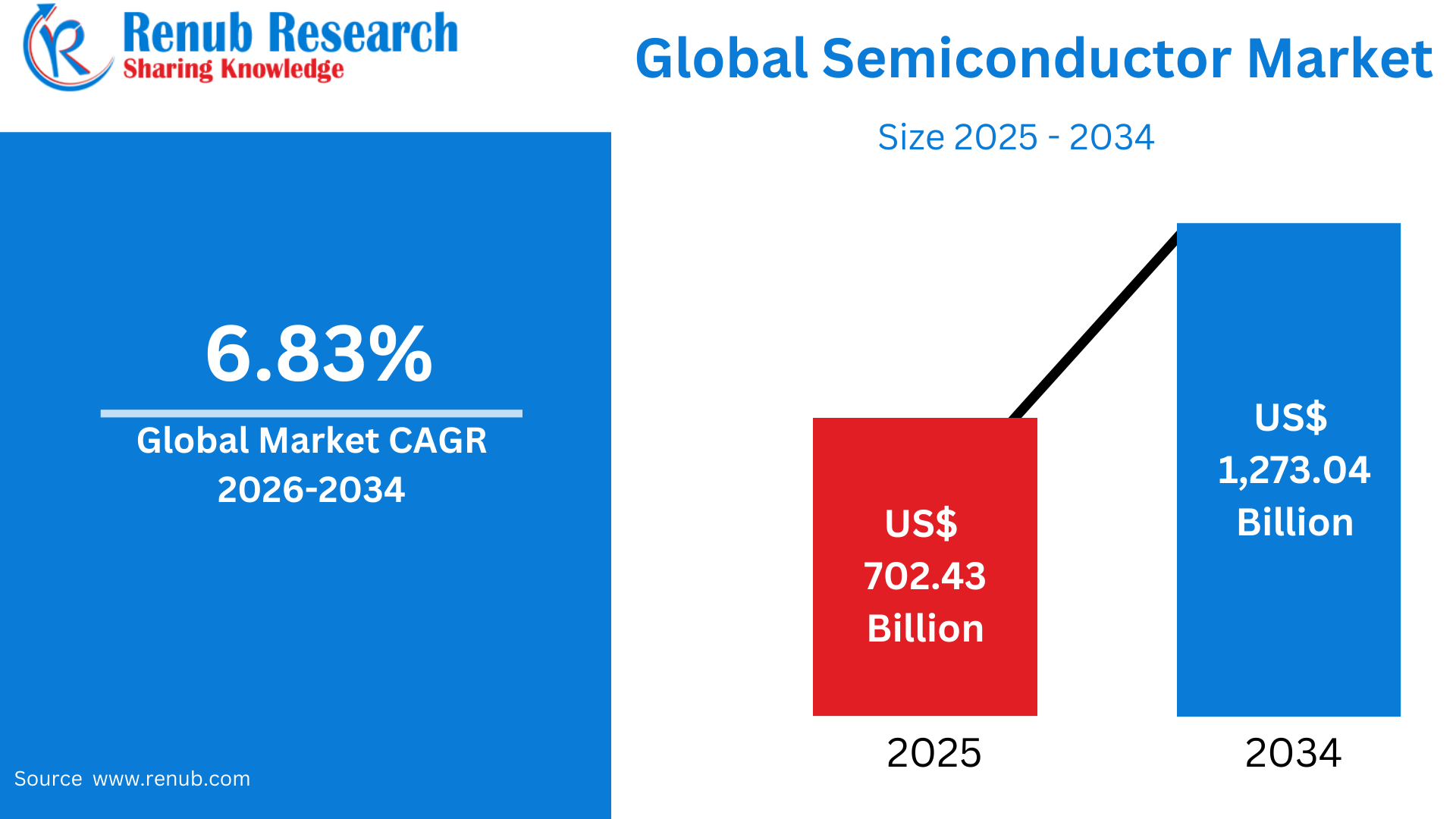
Global Semiconductor Market is projected to grow from US$ 702.43 billion in 2025 to US$ 1,273.04 billion by 2034, registering a compound annual growth rate (CAGR) of 6.83% during the forecast period from 2026 to 2034. The market is being driven by rising demand for semiconductor devices across consumer electronics, automotive systems, artificial intelligence (AI), cloud computing, data centers, and 5G communication networks. The increasing adoption of advanced technologies such as the Internet of Things (IoT), autonomous vehicles, high-performance computing (HPC), and edge computing is further accelerating semiconductor consumption worldwide.
Global Semiconductor Market Outlook
A semiconductor is essentially a material whose electrical conductivity is between that of a conductor and an insulator. This quality of semiconductors makes them critically useful in controlling the flow of electric currents. The most commonly used semiconductors are silicon, germanium, and gallium arsenide. Semiconductors are essentially the building blocks of contemporary electronic devices. In fact, using semiconductors, many devices such as integrated circuits, microprocessors, memory chips, sensors, and power devices are fabricated. A critical aspect of semiconductors is the ability to perform multiple functions through impurity introduction.
Globally, the demand for semiconductors has grown exponentially as a result of digitalization and technological advancements. Semiconductors are essential components for various electronics such as smartphones, laptops, and smart appliances. Additionally, they are also vital in the automotive space and industries such as telecommunication and healthcare. Emerging sectors like artificial intelligence, cloud computing, 5G networks, and electric cars have completely depended on advanced semiconductor technology for support. Governments around the world are spending heavily on semiconductor production to enhance supply chains. The rising adoption of digital connectivity will continue to see the semiconductor serve as the backbone of economic development.
What is a Semiconductor and Its Uses & Popularity Worldwide?
A semiconductor is a material with electrical conductivity that lies between that of a conductor and an insulator, allowing it to precisely control the flow of electricity. Silicon is the most widely used semiconductor material, although germanium, gallium arsenide, and silicon carbide are also utilized for specialized applications. Semiconductors are the foundation of modern electronic devices, as they are used to manufacture integrated circuits (ICs), microprocessors, memory chips, sensors, transistors, and power management components. These devices are essential in smartphones, laptops, televisions, home appliances, medical equipment, industrial automation systems, telecommunications infrastructure, automobiles, aerospace technologies, and defense systems.
The global popularity of semiconductors has increased dramatically with the rapid expansion of digital technologies, artificial intelligence (AI), cloud computing, Internet of Things (IoT), 5G networks, and electric vehicles. Modern automobiles may contain more than 1,000 semiconductor chips, while smartphones typically integrate dozens of semiconductor components to support advanced functionality. Data centers and AI applications also rely heavily on high-performance semiconductor processors to handle massive computational workloads. Continuous advancements in chip design, manufacturing technologies, and miniaturization are enabling faster processing speeds, improved energy efficiency, and greater device functionality. As digital transformation accelerates across industries, semiconductors have become one of the most critical enabling technologies driving innovation, economic growth, and technological advancement worldwide.
Semiconductor Mission: Accelerating India’s Journey from Policy to Manufacturing
India’s semiconductor industry has entered a new phase, transitioning from policy formulation to large-scale manufacturing under the India Semiconductor Mission (ISM). To date, 12 semiconductor manufacturing projects have been approved, representing a cumulative investment of approximately ₹1.64 lakh crore. These projects include one semiconductor fabrication (fab) facility, two compound semiconductor fabrication units, and nine semiconductor packaging and assembly units, establishing a strong foundation for domestic chip production.
The launch of India Semiconductor Mission 2.0 under the Union Budget 2026–27 further reinforces the government’s commitment to developing a self-reliant semiconductor ecosystem. The initiative places greater emphasis on semiconductor equipment, specialty materials, indigenous intellectual property (IP), advanced manufacturing capabilities, and resilient supply chains to strengthen India’s global competitiveness.
India has also made significant progress in semiconductor design. Under the Design Linked Incentive (DLI) Scheme, 24 semiconductor design projects are being supported, while 105 companies have gained access to advanced chip design software and infrastructure. Additionally, 23 chip tapeouts have been successfully completed across various semiconductor foundries, including advanced technology nodes, demonstrating the country’s expanding expertise in chip design and innovation.
India’s growing prominence in the global semiconductor industry was further highlighted at SEMICON India 2025, which attracted more than 350 exhibiting companies from 48 countries and regions. The event also witnessed the signing of 13 Memorandums of Understanding (MoUs) and participation from leading global semiconductor executives, reflecting increasing international confidence in India’s semiconductor policies, investment environment, and long-term vision for becoming a major global semiconductor manufacturing hub.
- The Indian government has allocated INR 760 Bn under the India Semiconductor Mission (ISM) to develop a domestic semiconductor and display manufacturing ecosystem.
- India’s semiconductor industry currently represents only 3% of the global market.
- India’s semiconductor industry currently employs around 220,000 professionals, with plans to expand the workforce by 1 million jobs by 2026.
- As of 2025, women represent 25% of India’s semiconductor workforce, with expectations to rise to 35% by 2030.
- Annually, India produces around 600,000 engineering graduates in electronics-related fields.
- India allows 100% Foreign Direct Investment (FDI) in electronics manufacturing under the automatic route, except for countries that share a land border with India.
- The Indian government offers up to 50% fiscal support for semiconductor fabrication units and has introduced initiatives such as Production Linked Incentive (PLI) and Semiconductor and Display Manufacturing Scheme (SPECS) to foster domestic manufacturing.
- India has signed agreements with countries like the USA, Japan and the EU to strengthen its semiconductor supply chain and foster innovation.
Growth Drivers of the Semiconductor Market
Rising Demand for Artificial Intelligence and Data Center Infrastructure
Artificial intelligence (AI) has become one of the strongest growth drivers for the global semiconductor market. AI workloads require high-performance processors, graphics processing units (GPUs), AI accelerators, and high-bandwidth memory to process complex algorithms and massive datasets. Global data generation now exceeds 180 zettabytes annually, creating unprecedented demand for advanced computing infrastructure and semiconductor devices. Hyperscale cloud providers continue expanding data center capacity, with more than 1,000 hyperscale data centers operating worldwide. These facilities require millions of processors, memory chips, networking integrated circuits, and power management semiconductors to support cloud computing, machine learning, and generative AI applications. Semiconductor manufacturers are investing heavily in advanced process nodes below 5 nanometers, enabling higher computing performance while reducing power consumption. Increasing enterprise adoption of AI across healthcare, finance, manufacturing, retail, and autonomous systems continues to stimulate demand for advanced semiconductor technologies. As AI becomes embedded across virtually every industry, semiconductor consumption is expected to maintain strong long-term growth.
Rapid Expansion of Automotive Electronics and Electric Vehicles
The automotive industry has emerged as one of the fastest-growing semiconductor markets due to increasing vehicle electrification, digitalization, and autonomous driving technologies. Modern passenger vehicles typically incorporate 1,000 to over 3,000 semiconductor chips, depending on vehicle type and level of electronic sophistication. Electric vehicles require significantly more semiconductors than conventional internal combustion vehicles because they utilize advanced battery management systems, power electronics, electric motor controllers, infotainment systems, and advanced driver assistance systems (ADAS). Growing consumer demand for connected vehicles has further increased semiconductor content through navigation systems, digital instrument clusters, wireless connectivity, radar sensors, lidar, cameras, and vehicle-to-everything (V2X) communication technologies. Automotive manufacturers continue investing in software-defined vehicles, requiring increasingly powerful processors and AI-enabled computing platforms. Government incentives promoting vehicle electrification, stricter emission regulations, and expanding autonomous driving research continue supporting semiconductor demand. As global electric vehicle production accelerates, automotive electronics will remain one of the most important drivers of semiconductor market expansion.
Global Deployment of 5G, IoT, and Smart Connected Devices
The worldwide expansion of 5G communication networks and Internet of Things (IoT) ecosystems continues to accelerate semiconductor demand across multiple industries. Industry estimates indicate that connected IoT devices are expected to exceed 30 billion globally over the coming years, requiring billions of microcontrollers, sensors, communication chips, RF semiconductors, and power management integrated circuits. The rollout of 5G infrastructure significantly increases demand for advanced radio frequency components, baseband processors, network processors, and high-speed memory devices. Consumer electronics, industrial automation, healthcare monitoring systems, smart factories, smart cities, and connected home applications all depend on semiconductor technologies for wireless communication and real-time data processing. Semiconductor manufacturers are developing increasingly energy-efficient processors capable of supporting edge computing and AI applications within connected devices. The integration of cloud computing, industrial automation, robotics, and intelligent infrastructure continues to expand semiconductor applications. Ongoing investments in telecommunications infrastructure and digital transformation are expected to sustain long-term semiconductor market growth worldwide.
Challenges of the Semiconductor Market
Supply Chain Disruptions and Manufacturing Capacity Constraints
One of the most significant challenges facing the semiconductor industry is the complexity of its global supply chain. Semiconductor manufacturing depends on highly specialized fabrication facilities, advanced lithography equipment, ultrapure chemicals, silicon wafers, rare gases, and precision manufacturing technologies sourced from multiple countries. Building a modern semiconductor fabrication plant often requires investments exceeding US$15–20 billion and construction periods of several years. Supply chain disruptions, geopolitical tensions, natural disasters, and raw material shortages can significantly affect chip production and global availability. During periods of strong demand, limited manufacturing capacity often results in extended lead times, higher component prices, and production delays across automotive, consumer electronics, industrial automation, and telecommunications industries. The increasing concentration of advanced semiconductor manufacturing within a limited number of fabrication facilities also creates supply chain vulnerabilities. Governments and private companies continue investing in regional semiconductor manufacturing capabilities to improve supply chain resilience, but expanding fabrication capacity remains both capital-intensive and technologically challenging.
Escalating Research Costs and Rapid Technology Evolution
Continuous technological advancement represents both an opportunity and a major challenge for semiconductor manufacturers. The transition to increasingly smaller process nodes, including 5 nm, 3 nm, and future 2 nm technologies, requires substantial investments in research, development, equipment, and manufacturing processes. Companies must continuously develop new chip architectures capable of delivering higher performance, improved energy efficiency, and greater transistor density while maintaining commercial competitiveness. Extreme ultraviolet (EUV) lithography systems, advanced packaging technologies, and AI chip development require billions of dollars in annual research expenditures. Smaller semiconductor companies often struggle to finance these investments, leading to industry consolidation and strategic partnerships. In addition, product life cycles continue to shorten as consumer demand for faster and more energy-efficient electronics accelerates. Manufacturers must balance innovation with production efficiency while managing increasing development complexity. Maintaining technological leadership under these conditions remains one of the semiconductor industry’s most significant long-term challenges.
Major Semiconductor Product Launches Worldwide
- January 2023 – AMD launched the Ryzen™ 7000X3D Series desktop processors, featuring 3D V-Cache technology to deliver enhanced gaming and high-performance computing capabilities with improved power efficiency.
- May 2023 – NVIDIA introduced the GH200 Grace Hopper Superchip, combining an Arm-based Grace CPU with Hopper GPU architecture to accelerate generative AI, large language models (LLMs), and high-performance computing (HPC) workloads.
- September 2023 – Intel launched the Core™ Ultra Processor Family (Meteor Lake), integrating dedicated AI acceleration through a Neural Processing Unit (NPU), advanced Intel 4 process technology, and improved integrated graphics for AI-enabled personal computers.
- October 2023 – Qualcomm Technologies unveiled the Snapdragon® 8 Gen 3 Mobile Platform, featuring on-device generative AI processing, enhanced gaming performance, advanced camera capabilities, and improved energy efficiency for flagship smartphones.
- March 2024 – NVIDIA launched the Blackwell B200 GPU Platform, designed for generative AI, trillion-parameter language models, and hyperscale data centers, delivering substantial improvements in AI training and inference performance.
- April 2024 – Intel introduced the Gaudi® 3 AI Accelerator, optimized for enterprise AI inference and large-scale deep learning applications while offering higher computational efficiency and lower operating costs for data centers.
- June 2024 – AMD announced the Ryzen™ AI 300 Series Processors, incorporating the XDNA™ 2 Neural Processing Unit (NPU) to deliver advanced on-device AI computing for next-generation AI-enabled laptops.
- October 2024 – MediaTek launched the Dimensity 9400 flagship chipset, manufactured using an advanced 3-nanometer process, delivering significant improvements in AI computing, graphics performance, power efficiency, and 5G connectivity.
- January 2025 – NVIDIA introduced the GeForce RTX™ 5090 GPU, based on the Blackwell architecture, offering enhanced ray tracing, AI-powered rendering, and high-performance gaming and professional visualization capabilities.
- March 2025 – Qualcomm Technologies launched the Snapdragon® G Series Gen 2 Gaming Platforms, designed specifically for handheld gaming devices with improved graphics processing, AI acceleration, and next-generation connectivity for premium mobile gaming experiences.
Digital Electronics Expansion Continues to Drive Integrated Circuit Demand
Integrated circuits (ICs) represent the largest segment of the global semiconductor market, serving as the foundation of nearly every electronic device. ICs combine millions or even billions of transistors onto a single silicon chip, enabling complex computing, communication, and control functions while reducing power consumption and manufacturing costs. Industry estimates indicate that billions of integrated circuits are produced annually, supporting applications ranging from smartphones and personal computers to industrial automation systems and medical equipment. Consumer electronics remain the largest application segment, while growing demand from automotive electronics, AI servers, telecommunications infrastructure, and smart appliances continues to expand the market. Advanced manufacturing technologies below 5 nanometers allow significantly higher transistor density and improved processing performance. Continuous growth in cloud computing, edge computing, IoT devices, and 5G communication networks further strengthens IC demand. Ongoing investments in semiconductor fabrication plants and advanced chip packaging technologies are expected to support long-term expansion of the integrated circuits market.
AI Computing and Cloud Infrastructure Accelerate Memory Demand
Memory semiconductors are essential components used for temporary and permanent data storage in electronic systems. Dynamic Random Access Memory (DRAM), NAND Flash, and emerging memory technologies support applications ranging from smartphones and laptops to AI servers and enterprise storage systems. The rapid expansion of artificial intelligence, cloud computing, and hyperscale data centers has significantly increased memory requirements. Modern AI servers often require hundreds of gigabytes of high-bandwidth memory, while enterprise storage systems increasingly utilize high-capacity NAND flash technologies for improved performance and energy efficiency. Consumer electronics continue to demand larger storage capacities as smartphones, tablets, and gaming devices process increasingly complex applications. Automotive electronics also require high-reliability memory solutions for autonomous driving systems and infotainment platforms. Manufacturers continue investing in higher-density memory architectures, advanced packaging, and three-dimensional memory technologies to improve performance while reducing power consumption. Growing global demand for digital data storage ensures sustained expansion of the memory semiconductor market.
Micro Semiconductor High-Performance Processing Powers Digital Transformation
The micro semiconductor market, including microprocessors, microcontrollers, and digital signal processors, continues to experience strong growth due to expanding digital transformation across multiple industries. These semiconductor devices serve as the computing engines of smartphones, personal computers, industrial automation equipment, medical devices, consumer electronics, and embedded control systems. The proliferation of IoT devices, expected to exceed 30 billion connected devices worldwide, has significantly increased demand for low-power microcontrollers capable of supporting intelligent sensing and wireless communication. Artificial intelligence applications are also driving demand for increasingly powerful processors optimized for machine learning and real-time analytics. Automotive manufacturers integrate multiple microprocessors to control engine management, battery systems, infotainment, safety systems, and autonomous driving functions. Industrial automation and robotics further contribute to market growth through programmable logic controllers and embedded computing platforms. Continuous advances in processor architecture, energy efficiency, and AI acceleration technologies continue to strengthen the commercial importance of micro semiconductor devices across global industries.
Automotive Semiconductor Market
Electrification and Autonomous Driving Fuel Long-Term Growth
The automotive semiconductor market is expanding rapidly as vehicles become increasingly electrified, connected, and software-defined. Modern passenger vehicles contain 1,000–3,000 semiconductor devices, while premium electric vehicles may utilize even greater numbers of advanced chips. Power semiconductors, microcontrollers, sensors, memory devices, analog integrated circuits, and communication processors play critical roles in battery management, electric powertrains, advanced driver assistance systems (ADAS), infotainment, navigation, and vehicle connectivity. The growing deployment of radar, lidar, cameras, and AI-enabled driving systems continues to increase semiconductor content per vehicle. Electric vehicles require significantly more power electronics than conventional vehicles, creating substantial opportunities for silicon carbide (SiC) and gallium nitride (GaN) semiconductor technologies. Government policies promoting vehicle electrification, stricter safety regulations, and investments in autonomous driving research continue supporting long-term market expansion. As connected mobility and intelligent transportation systems evolve, automotive semiconductors will remain one of the semiconductor industry’s fastest-growing application segments.
Advanced Electronics Strengthen National Security Applications
The aerospace and defense semiconductor market is driven by increasing investments in advanced military technologies, satellite systems, avionics, secure communications, and space exploration. Global defense expenditure exceeds US$2 trillion annually, supporting demand for highly reliable semiconductors capable of operating under extreme environmental conditions. Aerospace systems require radiation-hardened processors, high-reliability memory devices, RF communication chips, navigation processors, and advanced sensor technologies for aircraft, satellites, unmanned aerial vehicles (UAVs), and missile guidance systems. Military modernization programs increasingly utilize artificial intelligence, electronic warfare systems, secure communication networks, and autonomous defense platforms, significantly expanding semiconductor requirements. Commercial aerospace also relies on advanced semiconductor components for flight control systems, cockpit electronics, engine management, passenger connectivity, and predictive maintenance applications. Continuous innovation in gallium nitride (GaN), silicon carbide (SiC), and radiation-resistant semiconductor technologies continues improving performance and operational reliability. Increasing global investments in defense modernization and space technology are expected to sustain strong long-term growth within the aerospace and defense semiconductor market.
Advanced Chip Manufacturing and AI Leadership Drive United States Market Growth
The United States is one of the world’s largest semiconductor markets, supported by its leadership in semiconductor design, advanced computing, artificial intelligence (AI), cloud infrastructure, and high-performance electronics. The country accounts for a significant share of global semiconductor research and development, with annual semiconductor R&D investments exceeding tens of billions of dollars. The U.S. hosts many of the world’s leading chip designers and technology companies, driving innovation in AI processors, graphics processing units (GPUs), central processing units (CPUs), and data center accelerators. More than 5,000 large-scale data centers operate across the country, creating strong demand for high-performance processors, memory chips, networking integrated circuits, and power semiconductors. Additionally, the United States is investing heavily in expanding domestic semiconductor manufacturing capacity through new fabrication plants and advanced packaging facilities. Rising adoption of electric vehicles, industrial automation, aerospace technologies, and 5G infrastructure continues to strengthen semiconductor demand. Continuous investments in next-generation manufacturing technologies, including 3-nanometer and 2-nanometer process development, are expected to maintain the country’s technological leadership throughout the forecast period.
Innovation in Compound Semiconductors and Automotive Electronics SupportsUnited Kingdom Expansion
The United Kingdom’s semiconductor market is growing steadily due to strong research capabilities, innovation in compound semiconductors, and increasing demand across automotive, telecommunications, healthcare, and aerospace industries. The UK has established expertise in gallium arsenide (GaAs), silicon carbide (SiC), and compound semiconductor technologies used in radio frequency communications, photonics, electric vehicles, and defense systems. The country’s automotive industry manufactures hundreds of thousands of vehicles annually, creating sustained demand for automotive microcontrollers, power semiconductors, sensors, and advanced driver assistance system (ADAS) chips. Growth in artificial intelligence research, quantum computing, and telecommunications infrastructure is also increasing demand for advanced semiconductor devices. Universities and research institutions continue collaborating with semiconductor companies to develop next-generation chip technologies and advanced packaging solutions. Government initiatives supporting semiconductor innovation and supply chain resilience further encourage industry expansion. Increasing deployment of 5G networks, renewable energy systems, industrial automation, and medical electronics is expected to strengthen the UK’s semiconductor market over the coming years.
India Government Manufacturing Initiatives and Electronics Production Accelerate Growth
India is emerging as one of the fastest-growing semiconductor markets, driven by rapid expansion of electronics manufacturing, digital transformation, and government initiatives promoting domestic semiconductor production. The country has more than 900 million internet users and over 750 million smartphone users, creating enormous demand for processors, memory chips, sensors, and communication semiconductors used in consumer electronics. India’s electronics manufacturing sector continues to expand rapidly, supported by production-linked incentive (PLI) programs encouraging semiconductor fabrication, assembly, testing, and packaging investments. The automotive sector is also increasing semiconductor consumption through electric vehicles, connected mobility, and advanced safety technologies. Growing adoption of cloud computing, artificial intelligence, industrial automation, and 5G telecommunications further strengthens market demand. India is investing in semiconductor fabrication facilities, chip design ecosystems, and skilled workforce development to reduce dependence on imported semiconductor components. Rising demand from consumer electronics, telecommunications, healthcare equipment, and industrial automation is expected to position India as a strategically important semiconductor manufacturing and consumption market throughout the forecast period.
Digital Transformation and Smart Infrastructure Create New Opportunities in Saudi Arabia
Saudi Arabia’s semiconductor market is expanding steadily as the Kingdom accelerates digital transformation under its Vision 2030 economic diversification strategy. Investments in smart cities, artificial intelligence, cloud computing, telecommunications, renewable energy, and advanced manufacturing are increasing demand for semiconductor devices across multiple industries. The country’s population exceeds 36 million, while smartphone penetration is estimated at over 95%, supporting continued growth in consumer electronics and mobile communication devices. Expansion of 5G infrastructure and hyperscale data centers is driving demand for networking chips, processors, memory devices, and power management semiconductors. The automotive sector is gradually adopting electric mobility and connected vehicle technologies, increasing semiconductor content in transportation systems. Saudi Arabia’s growing investments in industrial automation, healthcare modernization, defense technologies, and smart energy infrastructure are creating additional opportunities for advanced semiconductor applications. Government initiatives encouraging technology localization, digital innovation, and foreign investment are expected to strengthen the Kingdom’s semiconductor ecosystem, supporting long-term market growth across consumer, industrial, telecommunications, and public sector applications.
Market Segemntation
Device Type
- Integrated Circuits (ICs)
- Memory
- Logic
- Micro
- Analog
- Optoelectronics
- Discrete
- Sensors
Application
- Automotive
- Industrial
- Data Centre
- Telecommunication
- Consumer Electronics
- Aerospace and Defense
- Healthcare
- Others
Countries
North America
- United States
- Canada
Europe
- France
- Germany
- Italy
- Spain
- United Kingdom
- Belgium
- Netherlands
- Turkey
Asia Pacific
- China
- Japan
- India
- Australia
- South Korea
- Thailand
- Malaysia
- Indonesia
- New Zealand
Latin America
- Brazil
- Mexico
- Argentina
Middle East & Africa
- South Africa
- Saudi Arabia
- United Arab Emirates
All companies have been covered with 5 Viewpoints
- Overview
- Key Persons
- Recent Development & Strategies
- Product Portfolio
- Financial Insights
Company Analysis
- Broadcom Inc.
- Infineon Technologies AG
- Intel Corporation
- Micron Technology Inc.
- NXP Semiconductors N.V.
- Samsung Electronics Co. Ltd.
- Toshiba Corporation
Report Details:
| Report Features | Details |
| Base Year |
2025 |
| Historical Period |
2022 - 2025 |
| Forecast Period |
2026 - 2034 |
| Market |
US$ Billion |
| Segment Covered |
Device Type, Application and Countries |
| Countries Covered |
|
| Companies Covered |
|
| Customization Scope |
20% Free Customization |
| Post-Sale Analyst Support |
1 Year (52 Weeks) |
| Delivery Format |
PDF and Excel through Email (We can also provide the editable version of the report in PPT/Word format on request) |
Key Questions Answered in Report:
- How big is the Semiconductor industry?
- What is the Semiconductor growth rate?
- Who are the key players in Semiconductor industry?
- What are the factors driving the Semiconductor industry?
- Which Region held the largest market share in the Semiconductor industry?
- What segments are covered in the Semiconductor Market report?
Customization Services available
- Analysis of Market Size and Its Segments
- More Company Profiles (Upto 10 without any additional cost):
- Additional Countries (Other than mentioned Countries):
- Region/Country Specific Reports:
- Market Entry Strategy:
- Region-Specific Market Dynamics:
- Regional Market Share Analysis:
- Trade Analysis:
- Production Insights:
- Others Customized Requests:
For more information contact our analysts.
Need More Assistance?
- Talk to our analysts to get more precious information on the current market trends.
- Include more countries and segments and customize the report based on the final requirement.
- Get a competitive advantage in your industry by knowing the report findings and making a positive impact on your revenues and operations.
- Our analysts are always ready to provide more help and pertinent information if you need any additional assistance.