Security Analytics Market Size, Share, Growth, Trends, Industry Analysis & Forecast 2026–2034
Buy NowSecurity Analytics Market Size
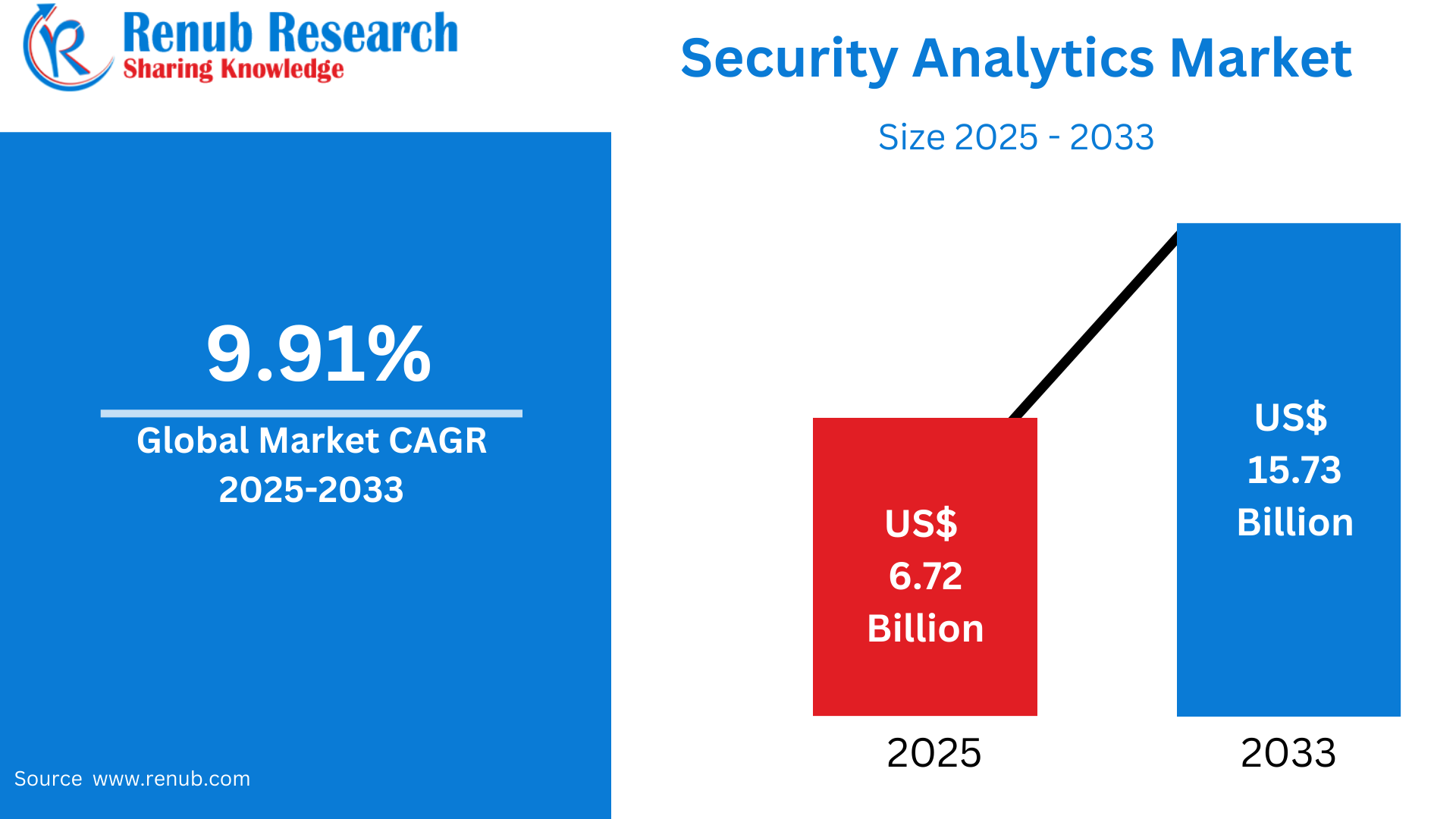
Security Analytics Market is projected to grow from US$ 6.72 billion in 2025 to US$ 15.73 billion by 2034, expanding at a CAGR of 9.91% during the forecast period from 2026 to 2034. The market is witnessing robust growth due to the rising frequency and sophistication of cyberattacks, the increasing adoption of cloud computing, the expansion of digital transformation initiatives, and the growing demand for real-time threat detection and incident response solutions. Organizations across industries are investing in advanced security analytics platforms powered by artificial intelligence (AI), machine learning (ML), and big data analytics to strengthen cybersecurity, improve regulatory compliance, and protect critical digital assets.
Security Analytics Industry Overview
The security analytics industry is a rapidly evolving segment of the broader cybersecurity ecosystem, focused on detecting, analyzing, and responding to threats across digital environments. Security analytics involves collecting and processing vast amounts of data from networks, endpoints, applications, and cloud platforms to identify anomalies, potential breaches, and vulnerabilities. By leveraging advanced technologies such as artificial intelligence (AI), machine learning (ML), big data analytics, and behavioral analysis, organizations can gain real-time insights into security events, reduce response times, and proactively mitigate risks. The growing complexity of IT infrastructures, proliferation of connected devices, and increasing sophistication of cyberattacks have made traditional security approaches insufficient, highlighting the need for advanced analytics solutions that go beyond basic monitoring and signature-based detection.
The industry serves multiple sectors including finance, healthcare, government, retail, and critical infrastructure, all of which face escalating cyber threats. Security analytics solutions encompass security information and event management (SIEM), user and entity behavior analytics (UEBA), network traffic analysis, threat intelligence, and predictive risk modeling. By identifying patterns and correlating data from disparate sources, these tools enable organizations to detect insider threats, ransomware attacks, phishing campaigns, and other malicious activities before they cause significant damage. Additionally, compliance with data privacy regulations and industry standards drives adoption, as analytics platforms help maintain audit trails, generate reports, and enforce security policies.
Market growth is further fueled by the increasing adoption of cloud services, remote work, and digital transformation initiatives, all of which expand the attack surface for cyber threats. Vendors are focusing on integrating automation, AI-driven threat detection, and advanced visualization techniques to improve decision-making and reduce the burden on security operations teams. Despite challenges such as high implementation costs, shortage of skilled professionals, and complexity of integrating analytics across heterogeneous IT environments, the security analytics industry continues to experience robust growth. Organizations worldwide recognize that proactive threat detection and predictive analytics are essential for safeguarding sensitive data, ensuring business continuity, and building resilient cybersecurity strategies.
What is Security Analytics? Its Uses & Worldwide Popularity
Security analytics is the process of collecting, monitoring, and analyzing data from networks, endpoints, cloud environments, applications, and security systems to identify, investigate, and respond to cyber threats in real time. It combines technologies such as artificial intelligence (AI), machine learning (ML), big data analytics, behavioral analysis, and threat intelligence to detect suspicious activities, prevent cyberattacks, and improve an organization’s overall cybersecurity posture. Unlike traditional security tools that rely mainly on predefined rules, security analytics can identify unknown threats, insider attacks, and advanced persistent threats (APTs) through continuous monitoring and predictive analysis.
Security analytics is widely used across industries including banking, healthcare, government, retail, manufacturing, telecommunications, and information technology. Organizations use these solutions to detect malware, ransomware, phishing attacks, unauthorized access, data breaches, fraud, and compliance violations while improving incident response and risk management. The technology also helps security teams automate threat detection, reduce false positives, and accelerate forensic investigations.
Worldwide, the popularity of security analytics continues to rise due to increasing cybercrime, rapid digital transformation, cloud adoption, remote working, and stricter data privacy regulations. Businesses are investing heavily in advanced security analytics platforms to safeguard sensitive information, maintain regulatory compliance, and protect critical digital infrastructure. As cyber threats become more sophisticated, security analytics has become an essential component of modern enterprise cybersecurity strategies across both developed and emerging markets.
Cyber Attack Trends by Year
- 2020
- Daily Attacks: 304.6 million
- Total Incidents: 111.2 million
- Primary Attack Types: Ransomware, Phishing
- 2021
- Daily Attacks: 623.3 million
- Total Incidents: 227.5 million
- Primary Attack Types: Supply Chain Attacks, Business Email Compromise (BEC)
- 2022
- Daily Attacks: 493.3 million
- Total Incidents: 180.0 million
- Primary Attack Types: Social Engineering
- 2023
- Daily Attacks: 600.0 million
- Total Incidents: 219.0 million
- Primary Attack Types: AI-Enhanced Attacks
- 2024
- Daily Attacks: 656.4 million
- Total Incidents: 239.6 million
- Primary Attack Types: Malware-Free Attacks
- 2025* (Projected)
- Daily Attacks: 803.0 million
- Total Incidents: 292.9 million
- Primary Attack Types: Identity-Based Threats
Growth Drivers for the Security Analytics Market
Increasing Frequency and Complexity of Cyber Threats
The rapid rise in the frequency and sophistication of cyberattacks is one of the primary factors driving the global security analytics market. Organizations are facing increasingly advanced threats, including ransomware, phishing attacks, insider threats, advanced persistent threats (APTs), malware, and zero-day exploits that can evade conventional security systems. As businesses continue to digitize operations and store large volumes of sensitive information, protecting critical assets has become a strategic priority. Security analytics platforms leverage artificial intelligence (AI), machine learning (ML), and behavioral analytics to detect anomalies, identify suspicious activities, and uncover hidden attack patterns in real time. These solutions enable organizations to proactively respond to threats before they cause significant operational or financial damage. Rising cybercrime costs, increasing data breaches, and stricter regulatory penalties are encouraging enterprises to invest in advanced security analytics technologies. As cyber threats continue to evolve in complexity, demand for intelligent, predictive, and automated threat detection solutions is expected to accelerate globally.
Accelerating Digital Transformation and Cloud Adoption
The rapid adoption of digital transformation initiatives, cloud computing, remote working models, and Internet of Things (IoT) technologies is significantly boosting demand for security analytics solutions. Organizations are increasingly operating across hybrid and multi-cloud environments while managing thousands of connected devices, creating more complex IT ecosystems and expanding the potential attack surface. Traditional perimeter-based security solutions are no longer sufficient to protect these distributed infrastructures. Security analytics platforms provide centralized visibility into network traffic, cloud workloads, user behavior, applications, and endpoints, allowing security teams to identify unusual activities and respond to threats in real time. The continued growth of Software-as-a-Service (SaaS), remote workforce adoption, and digital business operations has further increased the need for continuous monitoring and intelligent risk assessment. By delivering advanced analytics across diverse environments, security analytics solutions help organizations strengthen cyber resilience, reduce security risks, and protect valuable digital assets throughout their digital transformation journey.
Stringent Regulatory Compliance and Data Privacy Requirements
Increasing regulatory requirements and growing emphasis on data privacy are major factors driving the expansion of the security analytics market. Organizations handling sensitive customer, financial, healthcare, and business information must comply with stringent regulations related to cybersecurity, privacy protection, and risk management. Security analytics solutions assist organizations by continuously monitoring user activities, identifying policy violations, tracking access logs, detecting suspicious behavior, and generating detailed compliance reports. Automated monitoring and real-time threat detection reduce the likelihood of regulatory violations, data breaches, and financial penalties while improving audit readiness. As governments worldwide introduce stricter cybersecurity frameworks and privacy legislation, businesses are investing in advanced security analytics platforms to strengthen governance and demonstrate proactive security measures. The growing need for continuous compliance monitoring, incident reporting, and risk assessment is expected to remain a significant driver supporting long-term growth in the global security analytics market.
Security Analytics Product Launches Worldwide
- Microsoft – Microsoft Security Copilot (April 2024): Microsoft commercially launched Security Copilot, an AI-powered security analytics platform that helps security teams investigate threats, analyze incidents, and automate cyber defense using generative AI.
- Cisco – Splunk Enterprise Security with AI Enhancements (2024): Following the Cisco–Splunk integration, new AI-powered security analytics capabilities were introduced to improve threat detection, incident investigation, and Security Operations Center (SOC) efficiency.
- Google Cloud – Gemini in Google Security Operations (2024): Google Cloud launched Gemini-powered security analytics within Google Security Operations, enabling AI-assisted threat hunting, alert triage, and incident investigation.
- IBM – QRadar Suite with AI Assistant (2024): IBM expanded its QRadar Suite by introducing AI-powered security analytics and automated investigation capabilities to help security analysts accelerate threat detection and response.
- Varonis – Microsoft Copilot Security Monitoring (April 2024): Varonis introduced new security analytics capabilities to monitor Microsoft Copilot activity, detect abnormal user behavior, and strengthen enterprise data protection.
- Varonis – Salesforce Security Posture Management (September 2024): Varonis launched enhanced Salesforce Security Posture Management (SSPM) with advanced analytics to identify and automatically remediate data security risks.
- XM Cyber – Generative AI Security Analytics Assistant (February 2024): XM Cyber launched a generative AI-powered chat interface that delivers real-time security insights and simplifies exposure analysis through natural-language queries.
- XM Cyber – SAP Exposure Management (June 2024): XM Cyber introduced SAP Exposure Management, providing advanced security analytics and continuous exposure assessment for business-critical SAP environments.
- Silverfort – Identity-First Incident Response (September 2024): Silverfort launched its Identity-First Incident Response solution, enabling organizations to analyze authentication events and automatically block suspicious identity-based attacks.
- Security Onion – Version 2.4.70 Platform Release (May 2024): Security Onion released Version 2.4.70, introducing enhancements for enterprise security monitoring, log management, threat hunting, and security analytics across hybrid environments.
Challenges in the Security Analytics Market
Shortage of Skilled Cybersecurity Professionals
One of the most significant challenges facing the security analytics market is the global shortage of qualified cybersecurity professionals capable of managing advanced security platforms. Modern security analytics solutions generate vast amounts of data from networks, cloud environments, endpoints, applications, and connected devices, requiring specialized expertise to accurately interpret security events and distinguish genuine threats from false positives. Organizations often struggle to recruit and retain professionals with expertise in cybersecurity, threat intelligence, artificial intelligence, machine learning, and data analytics. This skills shortage can delay incident detection, reduce operational efficiency, and limit the overall effectiveness of security analytics implementations. Although many enterprises are adopting AI-driven automation, security orchestration, and managed security services to address resource shortages, human expertise remains essential for threat investigation, strategic decision-making, and incident response. The persistent cybersecurity talent gap continues to present a major challenge for organizations seeking to maximize the value of advanced security analytics solutions.
Complex Integration and High Deployment Costs
The complexity of integrating security analytics platforms with existing IT infrastructure and the high cost of implementation remain significant barriers to market adoption. Most organizations operate diverse technology environments consisting of on-premises systems, hybrid clouds, legacy applications, multiple security tools, and third-party software solutions. Integrating data from these different sources into a unified security analytics platform requires extensive planning, customization, and technical expertise. The deployment process can be resource-intensive and often involves substantial investments in software licensing, hardware infrastructure, cloud services, implementation consulting, employee training, and ongoing system maintenance. Small and medium-sized enterprises, in particular, may find these costs difficult to justify despite growing cybersecurity needs. Additionally, ensuring seamless interoperability with firewalls, endpoint detection platforms, SIEM systems, identity management solutions, and cloud security tools adds further complexity. Overcoming these integration challenges while controlling implementation costs remains essential for achieving scalable, cost-effective, and efficient security analytics deployments across organizations of all sizes.
Security Analytics Services Growing Demand for Managed Cybersecurity Solutions
The Security Analytics Services Market is expanding rapidly as organizations increasingly seek expert support to strengthen their cybersecurity capabilities and respond to evolving cyber threats. Security analytics services include consulting, implementation, integration, managed security services, incident response, threat intelligence, risk assessment, compliance management, and continuous security monitoring. These services help businesses deploy advanced analytics platforms, optimize security operations, and improve their ability to detect, investigate, and mitigate cyberattacks. The growing shortage of skilled cybersecurity professionals has encouraged many organizations to outsource security monitoring and analytics to specialized service providers. Cloud adoption, hybrid work environments, and increasingly complex IT infrastructures have further increased the need for professional security analytics services that offer continuous monitoring and rapid incident response. Service providers also assist organizations in meeting regulatory compliance requirements while improving operational efficiency and cyber resilience. As cyber threats become more sophisticated and businesses prioritize proactive security strategies, the demand for comprehensive security analytics services is expected to experience sustained global growth.
Web Security Analytics Protecting Digital Platforms from Evolving Cyber Threats
The Web Security Analytics Market is witnessing significant growth due to the increasing number of cyberattacks targeting websites, web applications, and online business platforms. Organizations rely on web security analytics solutions to continuously monitor internet traffic, detect malicious activities, identify vulnerabilities, and prevent unauthorized access to digital assets. These platforms leverage artificial intelligence, machine learning, behavioral analytics, and real-time threat intelligence to detect phishing attempts, malware infections, distributed denial-of-service (DDoS) attacks, bot activities, and application-layer threats before they cause significant damage. The rapid growth of e-commerce, cloud-based applications, online banking, digital healthcare services, and remote work has substantially increased the importance of securing web environments. Web security analytics also helps organizations maintain regulatory compliance, protect customer information, and strengthen business continuity. Continuous innovation in cloud security, application protection, and automated threat detection is expected to drive further adoption, making web security analytics an essential component of modern enterprise cybersecurity strategies worldwide.
Large Enterprises Security Analytics Advanced Threat Intelligence Supporting Enterprise Cybersecurity
The Large Enterprises Security Analytics Market continues to grow as major organizations invest heavily in advanced cybersecurity technologies to protect complex digital infrastructures and valuable business assets. Large enterprises generate enormous volumes of security data from multiple sources, including cloud platforms, data centers, endpoints, mobile devices, IoT networks, and enterprise applications. Security analytics platforms enable centralized monitoring, behavioral analysis, threat intelligence, and automated incident response, allowing organizations to quickly identify sophisticated cyber threats and minimize business disruption. Artificial intelligence, machine learning, and big data analytics significantly improve the speed and accuracy of threat detection while reducing false positives and operational workloads. Large organizations also face strict regulatory compliance requirements and increased exposure to ransomware, insider threats, and targeted cyberattacks, making security analytics a strategic investment. Continuous digital transformation, hybrid cloud adoption, and expanding remote workforces are further increasing demand for scalable, integrated, and intelligent security analytics solutions across large enterprises worldwide.
Healthcare Security Analytics Strengthening Cyber Protection for Critical Healthcare Data
The Healthcare Security Analytics Market is experiencing strong growth as healthcare organizations prioritize the protection of sensitive patient information and critical medical systems from increasingly sophisticated cyber threats. Hospitals, clinics, pharmaceutical companies, diagnostic laboratories, and health insurance providers generate large volumes of confidential healthcare data that require continuous monitoring and advanced threat detection. Security analytics solutions help identify unusual user behavior, detect ransomware attacks, monitor medical devices, protect electronic health records (EHRs), and ensure compliance with healthcare cybersecurity and privacy regulations. The rapid adoption of digital health technologies, telemedicine, cloud-based healthcare platforms, connected medical devices, and electronic patient records has significantly expanded cybersecurity risks across the healthcare sector. Artificial intelligence, machine learning, and behavioral analytics enable healthcare organizations to respond quickly to cyber incidents while minimizing operational disruptions and protecting patient safety. As healthcare digitalization accelerates worldwide, investment in advanced security analytics solutions is expected to increase, supporting stronger cyber resilience and secure delivery of healthcare services.
United States Security Analytics Market
The United States security analytics market is one of the most advanced and largest worldwide, supported by widespread digitalization, increasing cybersecurity investments, and a rapidly evolving threat landscape. Organizations across industries such as banking, healthcare, government, defense, manufacturing, retail, and critical infrastructure are increasingly deploying security analytics solutions to detect, investigate, and respond to cyber threats in real time. Advanced technologies, including Security Information and Event Management (SIEM), User and Entity Behavior Analytics (UEBA), network traffic analysis, and AI-powered threat intelligence platforms, enable enterprises to identify suspicious activities, automate threat detection, and strengthen incident response capabilities. The continued adoption of cloud computing, hybrid work environments, and Internet of Things (IoT) devices has expanded enterprise attack surfaces, driving demand for centralized security monitoring solutions. In addition, stringent cybersecurity regulations and data privacy requirements encourage organizations to invest in advanced analytics platforms that improve compliance and operational resilience. Although implementation costs and the shortage of cybersecurity professionals remain challenges, continuous technological innovation and increasing cyber risks continue to support the long-term growth of the U.S. security analytics market.
The growing number of cybercrime incidents further highlights the need for advanced security analytics solutions in the United States. According to the Federal Bureau of Investigation (FBI) Internet Crime Report 2023, the Internet Crime Complaint Center (IC3) received 21,489 Business Email Compromise (BEC) complaints, 2,825 ransomware complaints, 14,190 government impersonation complaints, and 37,560 technology and customer support impersonation complaints. These increasing cyber incidents underscore the importance of AI-driven security analytics platforms that enable organizations to rapidly detect threats, reduce response times, and strengthen their overall cybersecurity posture.
United Kingdom Security Analytics Market
The United Kingdom security analytics market is expanding steadily as organizations strengthen their cybersecurity capabilities in response to increasing cyber threats and rapid digital transformation. Enterprises across financial services, healthcare, government, retail, telecommunications, and manufacturing sectors are investing in advanced security analytics platforms to improve threat detection, incident response, and risk management. Solutions such as SIEM, UEBA, threat intelligence, and network traffic analytics powered by artificial intelligence and machine learning enable organizations to detect abnormal activities, minimize false positives, and respond to cyber incidents more efficiently. Strong regulatory frameworks governing data privacy and cybersecurity have further accelerated market adoption by encouraging organizations to implement continuous monitoring, compliance reporting, and security auditing capabilities. Growing adoption of cloud computing, hybrid work models, and connected devices has expanded cybersecurity risks, increasing the demand for intelligent analytics platforms. Despite challenges related to integration complexity and implementation costs, ongoing investments in digital infrastructure and cybersecurity innovation continue to drive the long-term growth of the UK security analytics market.
India Security Analytics Market
The India security analytics market is witnessing strong growth, driven by rapid digital transformation, increasing cyberattacks, expanding cloud adoption, and rising investments in enterprise cybersecurity. As organizations across banking, information technology, healthcare, manufacturing, retail, telecommunications, and government sectors accelerate digitalization, the need for advanced cybersecurity solutions has become increasingly critical. Security analytics platforms, including SIEM, UEBA, network traffic analysis, endpoint analytics, and AI-powered threat detection solutions, enable organizations to monitor large volumes of security data, identify suspicious behavior, and respond to incidents in real time. Growing adoption of digital payments, e-commerce, cloud services, and remote working has significantly increased the complexity of cybersecurity risks across the country. Government initiatives promoting digital infrastructure and evolving data protection regulations are also encouraging enterprises to strengthen cybersecurity frameworks through intelligent analytics solutions. Although challenges such as limited cybersecurity expertise, budget constraints, and implementation complexity remain, rising awareness of cyber resilience and increasing investments in artificial intelligence continue to create significant growth opportunities for India’s security analytics market.
United Arab Emirates Security Analytics Market
The United Arab Emirates (UAE) security analytics market is experiencing rapid expansion as organizations accelerate digital transformation and invest heavily in advanced cybersecurity technologies. Increasing adoption of cloud computing, smart city initiatives, digital government services, financial technologies, and connected infrastructure has created greater demand for real-time security monitoring and intelligent threat detection solutions. Organizations across government, banking, energy, healthcare, telecommunications, and transportation sectors are deploying Security Information and Event Management (SIEM), User and Entity Behavior Analytics (UEBA), threat intelligence platforms, and artificial intelligence-based security analytics to improve visibility, automate incident response, and reduce cyber risks. The UAE government’s strong commitment to national cybersecurity strategies and digital innovation has further supported widespread adoption of advanced security technologies. Growing investments in smart infrastructure, data centers, and critical digital assets continue to increase the importance of proactive cybersecurity solutions. Although organizations face challenges related to evolving cyber threats, integration complexity, and skilled workforce shortages, continued investments in AI-driven security analytics and national cybersecurity initiatives are expected to support sustained growth in the UAE security analytics market.
Recent Developments in Security Analytics Market
- In An AI-powered office security suite that protects email, browsers, and collaboration tools was introduced by Fortinet in June 2025.
- In May 2025, Palo Alto Networks reported a 34% ARR increase in next-generation security and a 15% year-over-year increase in revenue.
- In May 2025, KDDI and NEC established a combined cybersecurity business aimed at infrastructure and supply-chain customers.
- In order to secure AI application pipelines, Aurascape debuted in April 2025 with USD 50 million.
- August 2024: Next DLP, a business that specializes in insider risk management and data protection, was acquired by Fortinet, Inc., a leader in cybersecurity. Fortinet's position in the integrated and standalone enterprise DLP market will be strengthened by this transaction.
- Cisco introduced Cisco Hypershield, a next-generation security architecture designed for contemporary AI-driven data centers, in April 2024. The design includes new enforcement points, and eBPF, an open-source technology, is used to firmly embed security into virtual machines or Kubernetes clusters in public cloud environments.
Market Segmentation
Offering
- Solutions
- Services
Application
- Web Security Analytics
- Network Security Analytics
- Endpoint Security Analytics
- Application
- Security Analytics
- Others
Organization Size
- Large Enterprises
- SMEs
Industry Vertical
- BFSI
- Telecom & IT
- Retail
- Healthcare
- Government & Defense
- Manufacturing
- Others
Countries
North America
- United States
- Canada
Europe
- France
- Germany
- Italy
- Spain
- United Kingdom
- Belgium
- Netherlands
- Turkey
Asia Pacific
- China
- Japan
- India
- Australia
- South Korea
- Thailand
- Malaysia
- Indonesia
- New Zealand
Latin America
- Brazil
- Mexico
- Argentina
Middle East & Africa
- South Africa
- Saudi Arabia
- United Arab Emirates
All the key players have been covered from 5 Viewpoints:
- Overview
- Key Persons
- Recent Development
- SWOT Analysis
- Financial Insights
Key Players Analysis:
- Cisco Systems Inc
- International Business Machines Corporation
- Juniper Networks, Inc.
- Palo Alto Networks, Inc
- Fortinet, Inc.
- Hewlett Packard Enterprise Co
- Splunk Inc.
- Logrhythm Inc.
Report Details:
| Report Features | Details |
| Base Year |
2025 |
| Historical Period |
2022 - 2025 |
| Forecast Period |
2026 - 2034 |
| Market |
US$ Billion |
| Segment Covered |
Offering, Application, Organization Size, Industry Vertical and Countries |
| Countries Covered |
|
| Companies Covered |
|
| Customization Scope |
20% Free Customization |
| Post-Sale Analyst Support |
1 Year (52 Weeks) |
| Delivery Format |
PDF and Excel through Email (We can also provide the editable version of the report in PPT/Word format on request) |
Customization Services available
- Analysis of Market Size and Its Segments
- More Company Profiles (Upto 10 without any additional cost):
- Additional Countries (Other than mentioned Countries):
- Region/Country Specific Reports:
- Market Entry Strategy:
- Region-Specific Market Dynamics:
- Regional Market Share Analysis:
- Trade Analysis:
- Production Insights:
- Others Customized Requests:
For more information contact our analysts.
Need More Assistance?
- Talk to our analysts to get more precious information on the current market trends.
- Include more countries and segments and customize the report based on the final requirement.
- Get a competitive advantage in your industry by knowing the report findings and making a positive impact on your revenues and operations.
- Our analysts are always ready to provide more help and pertinent information if you need any additional assistance.