Saudi Arabia Ecommerce Market Report by Types, Cities and Company Analysis 2026-2034
Buy NowSaudi Arabia Ecommerce Market Size & Forecast 2026-2034
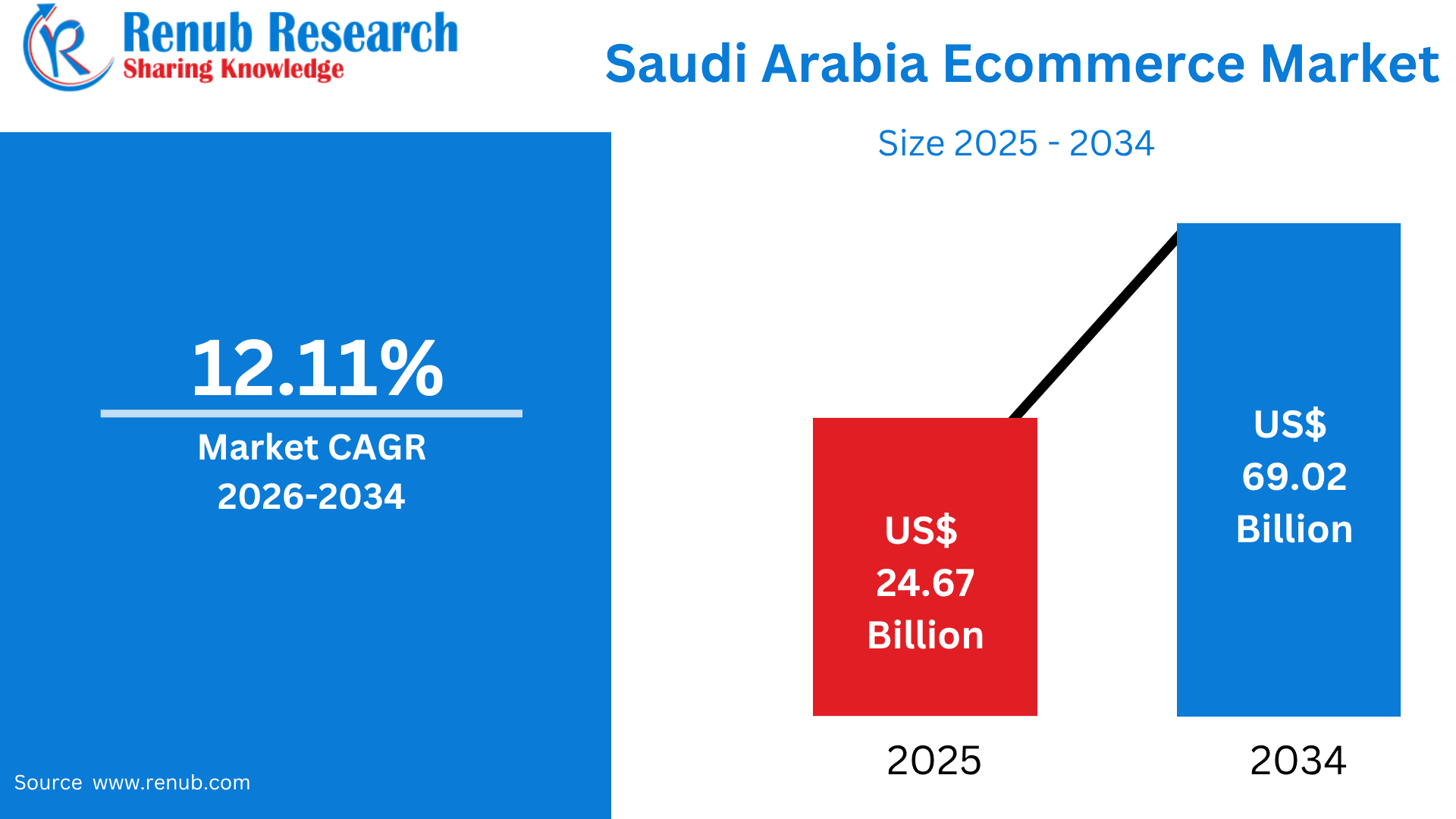
Saudi Arabia eCommerce Market is anticipated to reach a value of US$ 69.02 billion by 2034 from US$ 24.67 billion in 2025, growing at a CAGR of 12.11% from 2026 to 2034. The growth will be influenced by the increasing adoption of internet services, increased use of smartphones, and favorable government policies as part of Vision 2030.
Saudi Arabia Ecommerce Market Outlooks
Ecommerce or electronic commerce is a type of transaction involving the exchange of goods or services over digital channels such as websites and mobile apps. This mode of transaction allows individuals to research products and their prices, conduct transactions, and receive goods from sellers without physically traveling to brick-and-mortar businesses. There are several different types of ecommerce including B2C, B2B, and C2C. In these types of transactions, there is usually an advanced system of digital payments and logistical support required.
In Saudi Arabia, the prevalence of ecommerce is increasing rapidly owing to digital transformations in the region and changes in consumer behavior. The majority of the population uses smartphones for most operations, and this has resulted in an increase in internet usage. Moreover, there is active government support through various programs under the Vision 2030 initiative that seeks to promote the use of digital technology and cashless transactions in Saudi Arabia. Most people are also interested in ecommerce due to its advantages of doorstep delivery, diverse range of products at competitive prices, and a high-quality service offering.
Growth Driver of the Saudi Arabia Ecommerce Market
Rapid Digital Infrastructure and Internet Penetration
For instance, in Saudi Arabia, the CST Commission estimated that in 2023, about 52.3% of Saudi Arabia's population uses the internet for approximately seven hours. Saudi Arabia's ecommerce industry is highly influenced by the country's technological advances which include wide internet availability and penetration of smartphones. With 99% of internet penetration and the rapid spread of 5G, customers can easily access the online space where they can conveniently shop across various channels. Digitalization has contributed to improved navigation experience, security, and efficient logistics services. Saudi Arabia's Vision 2030 program is also helping to boost digitalization through support of e-commerce by urging organizations to embrace technology and improve digitalization throughout the entire country. Recently, there have been developments in the ecommerce space such as the introduction of new digital payment platforms like Google pay, and the upcoming Alipay+ within the country, boosting ecommerce and transaction experience.
Growing Young, Tech-Savvy Population
The Kingdom of Saudi Arabia boasts a youthful and tech-friendly population that serves a crucial part in pushing for the adoption of ecommerce. Many people in Saudi Arabia are under the age of 35 and have high familiarity with smart phones, mobile applications, and mobile payments. An increase in the number of people who would prefer to do their shopping from the comfort of their mobile devices and the availability of quick commerce services is contributing towards the growth of the market. Customers like the ease and speed associated with ecommerce transactions and the way that online businesses leverage artificial intelligence to make them more convenient. One notable trend that has emerged recently in line with this development is the rise of quick-commerce, where customers receive their orders at a lightning fast pace.
Expansion of Digital Payments and Logistics
The development of secure digital payment systems and effective logistics networks has played a huge part in driving ecommerce forward in Saudi Arabia. There is an increasing tendency towards cashless payments made possible by innovative fintech and advanced payment system infrastructure created through government intervention. The improvement in delivery network, storage facilities, and last mile logistics contributes to making orders arrive faster and more efficiently for consumers. The rapid rise in sales on ecommerce platforms can be attributed to the adoption of more efficient payment systems and delivery services. One recent innovation in the field that is worth mentioning includes investments into ecommerce logistics which are expected to grow steadily providing faster delivery all over the kingdom.
Challenges in the Saudi Arabia Ecommerce Market
Logistics and Last-Mile Delivery Complexities
Mastercard introduced a technological platform in Saudi Arabia in 2024 that allows for the processing of e-commerce payments domestically. The platform provides reliable and effective solutions for the processing of payments for Mastercard clients and partners. It also shows the dedication of the Kingdom towards e-commerce development through digital technology. Meanwhile, Barq, a financial service firm operating in Saudi Arabia, partnered with Mastercard with the intention of using the Mastercard Gateway platform to facilitate payment solutions. This initiative intends to provide personalized solutions to merchants and customers to foster growth in the digital payments industry in Saudi Arabia.
Regulatory Compliance and Data Privacy Concerns
Even though there have been notable advancements in e-commerce in the Saudi Arabian markets, there still exists the challenge of efficient logistics and last mile delivery. Due to its wide geographical size and uneven population distribution, effective logistics in such a market could prove to be quite challenging, especially in areas that are relatively hard to access. It can prove to be difficult to achieve on-time delivery while at the same time controlling costs due to rising demands from consumers regarding faster shipping processes. Moreover, ensuring high-quality delivery services throughout the regions will entail considerable investments in terms of infrastructure and technology. One of the developments that have helped in overcoming the challenge includes the expansion of logistics networks in Saudi Arabia as well as improvements in delivery infrastructure.
Saudi Arabia B2C Ecommerce
Data protection and regulation can also be seen as a hindrance for the development of ecommerce in the country. As the business develops and more companies emerge, the government has put into place regulations that safeguard customers' interests, protect the privacy of consumers, and enhance data security. While this has brought about increased credibility in the sector, it has posed additional complexities for businesses that have to abide by the regulations. Businesses have to incorporate technologies that will help them achieve data security while ensuring that they have clear return policies and adequate licensing. One way through which the ministry of commerce ensures compliance with the regulations is by examining the websites and determining how they comply with cybersecurity and data protection policies. This process has revealed some non-compliance within certain companies.
Saudi Arabia B2B Ecommerce
Saudi Arabia’s business-to-consumer (B2C) ecommerce industry is witnessing a period of exponential growth due to the rising demand for online shopping among consumers, especially when buying fashion items, electronics, groceries, and foods. The advantages of ordering goods without leaving the comfort of their homes have increased customers' purchasing interest. Moreover, the presence of various products, both domestic and foreign, at online stores has positively contributed to demand in the sector. Leading players such as Amazon and Noon, along with the regional companies, are using strategies of recommendation and rewarding schemes to engage more people. Moreover, the development of online payments and the ability to deliver orders quickly has played an important role in the growth. Additionally, the use of mobile devices among the young and technology-oriented population is a major driver for this phenomenon. One of the latest events in 2024 concerns the expansion of quick-commerce services that deliver orders within several hours or even in just one hour.
Market Segmentations
Types
- B2C E-commerce
- B2B E-commerce
All the Key players have been covered from 5 Viewpoints:
- Overviews
- Key Person
- Recent Developments
- SWOT Analysis
- Revenue Analysis
Company Analysis
- Amazon.com Inc.
- eBay Inc.
- Emaar Properties Namshi
- Noon
- Alibaba
- Jarir Marketing (Bookstore)
- Carrefour
Report Details:
| Report Features | Details |
| Base Year |
2024 |
| Historical Period |
2021 - 2024 |
| Forecast Period |
2025 - 2033 |
| Market |
US$ Billion |
| Segment Covered |
By Type |
| Companies Covered |
|
| Customization Scope |
20% Free Customization |
| Post-Sale Analyst Support |
1 Year (52 Weeks) |
| Delivery Format |
PDF and Excel through Email (We can also provide the editable version of the report in PPT/Word format on request) |
Customization Services available
- Analysis of Market Size and Its Segments
- More Company Profiles (Upto 10 without any additional cost):
- Additional Countries (Other than mentioned Countries):
- Region/Country Specific Reports:
- Market Entry Strategy:
- Region-Specific Market Dynamics:
- Regional Market Share Analysis:
- Trade Analysis:
- Production Insights:
- Others Customized Requests:
For more information contact our analysts.
Need More Assistance?
- Talk to our analysts to get more precious information on the current market trends.
- Include more countries and segments and customize the report based on the final requirement.
- Get a competitive advantage in your industry by knowing the report findings and making a positive impact on your revenues and operations.
- Our analysts are always ready to provide more help and pertinent information if you need any additional assistance.