Precipitated Calcium Carbonate Market Report by Grade, Application, Country and Company Analysis 2026-2034
Buy NowPrecipitated Calcium Carbonate Market Size & Forecast
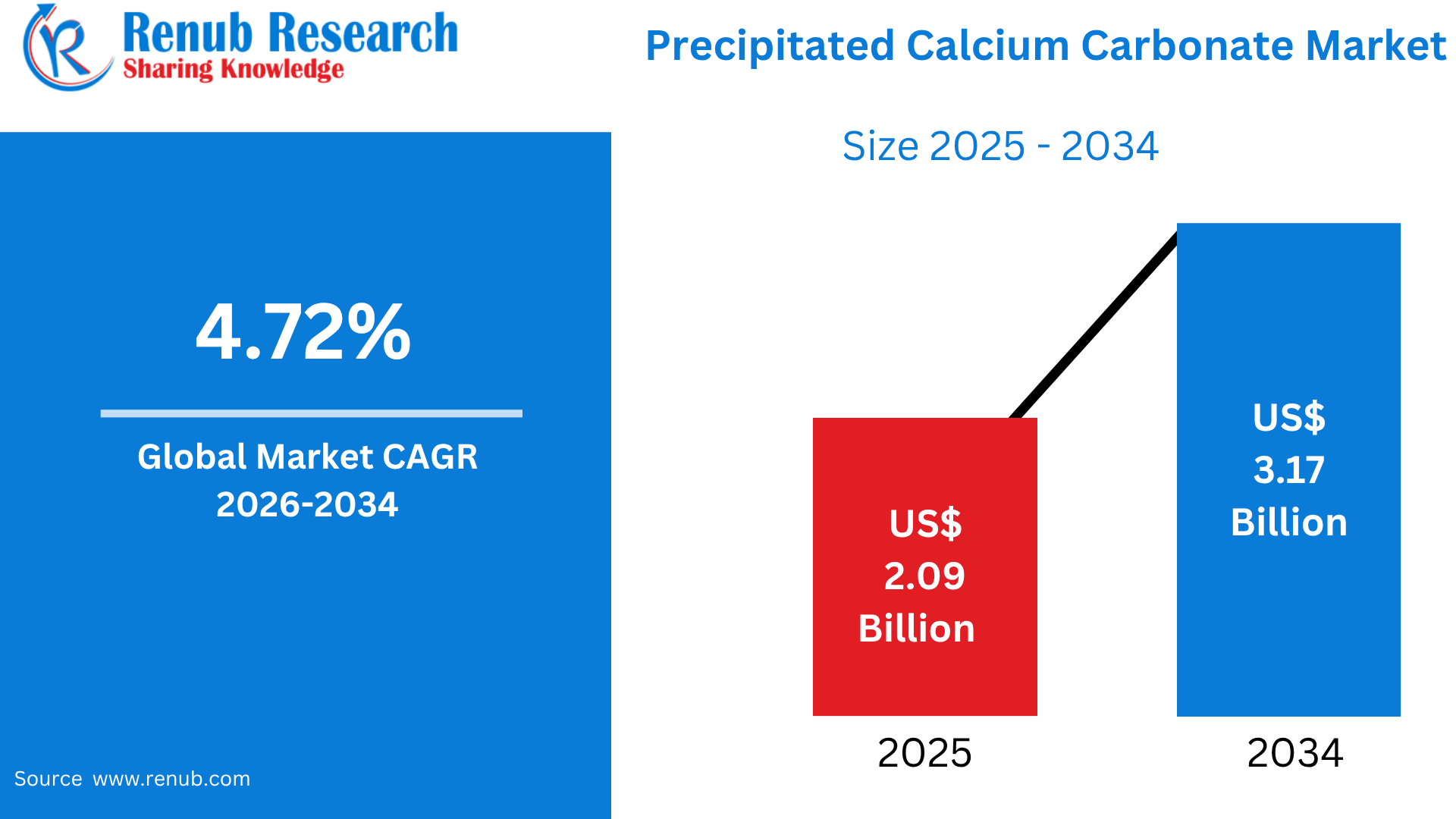
Precipitated Calcium Carbonate Market is projected to increase from US$ 2.09 billion in 2025 to approximately US$ 3.17 billion by 2034, registering a CAGR of 4.72% during the 2026–2034 forecast period. Market expansion is being supported by growing consumption across the paper, plastics, paints and coatings, adhesives, and pharmaceutical industries. Precipitated calcium carbonate is widely preferred because of its high purity, controlled particle size, brightness, and functional performance.
What Is Precipitated Calcium Carbonate and Its Uses & Popularity Worldwide
Precipitated Calcium Carbonate (PCC) is a manufactured form of calcium carbonate produced through a controlled chemical precipitation process. Unlike naturally occurring ground calcium carbonate, PCC offers controlled particle size, morphology, purity, brightness, and surface characteristics, allowing manufacturers to tailor its performance for specific applications. It is widely used as a functional filler, coating material, extender, and additive across numerous industries.
The paper industry is one of its largest applications, where PCC improves brightness, opacity, smoothness, printability, and filler loading. It is also used in plastics and rubber to improve stiffness and dimensional stability, while paints and coatings use PCC to enhance opacity and surface finish. Pharmaceutical and healthcare products utilize high-purity PCC as an excipient and calcium source. It also finds applications in adhesives, sealants, inks, animal feed, and construction materials. Its popularity is increasing worldwide because manufacturers seek high-performance materials that can improve product quality while controlling production costs. Asia Pacific remains a major consumption region due to strong paper, plastics, construction, and manufacturing industries.
Total Global Plastics Production (430.9 Mt in 2024)
- China: 34.5%
- Rest of Asia: 20.1%
- North America: 16.3%
- EU27+3: 12%
- Middle East, Africa: 8.3%
- Central & South America: 3.7%
- Japan: 2.6%
- CIS: 2.5%
Global Mechanically & Chemically Recycled (Post-Consumer) Plastics Production (41.2 Mt in 2024)
- China: 30.3%
- Rest of Asia: 24.6%
- EU27+3: 19.1%
- North America: 8.3%
- Middle East, Africa: 6.8%
- Central & South America: 4.9%
- Japan: 4.5%
- CIS: 1.5%
Global Bio-Based and Bio-Attributed Plastics Production (2.6 Mt in 2024)
·China: 35.5%
·EU27+3: 23.5%
·Rest of Asia: 19.6%
·North America: 10.1%
·Central & South America: 7.1%
·Japan: 3.9%
·CIS: 0.3%
Growth Drivers of the Precipitated Calcium Carbonate Market
Growing Demand from the Paper Industry
The expanding paper and paperboard industry is a major growth driver for precipitated calcium carbonate. PCC is extensively used as a filler and coating pigment because its controlled particle structure can improve paper brightness, opacity, smoothness, and printability. It can also enable manufacturers to replace a portion of more expensive pulp while maintaining desired paper properties. Global paper and paperboard production remains enormous, with worldwide output estimated at more than 400 million tonnes annually, creating substantial demand for mineral fillers and coating materials. The shift toward higher-quality printing papers, specialty papers, packaging boards, and lightweight paper grades is further supporting PCC consumption. In addition, packaging demand continues to expand alongside e-commerce, food delivery, and consumer goods industries. PCC manufacturers are developing customized grades for different paper applications, including products designed for improved retention, brightness, and coating performance. Asia Pacific is particularly important because China, India, Japan, and other countries have large paper manufacturing bases. Continued investments in paper mills, packaging production, and specialty paper capacity are therefore expected to sustain demand for precipitated calcium carbonate over the forecast period.
Expansion of Plastics, Paints, and Coatings Applications
Increasing consumption of plastics, paints, and coatings is creating significant opportunities for precipitated calcium carbonate. PCC functions as a fine and highly controlled filler that can improve mechanical properties, surface finish, opacity, dimensional stability, and processing characteristics. PCC is increasingly incorporated into products such as PVC pipes, profiles, films, cables, masterbatches, and molded components. In paints and coatings, it contributes to opacity, brightness, rheology, and surface quality while helping manufacturers optimize formulation costs. Global paint and coatings demand is also supported by construction, infrastructure development, automotive manufacturing, and industrial maintenance. Rapid urbanization in Asia, the Middle East, and Latin America is increasing consumption of architectural coatings, while industrial applications continue to require high-performance coatings. Manufacturers are developing surface-treated and ultra-fine PCC grades to improve compatibility with polymer systems and coating formulations. Growing demand for lightweight plastics, durable coatings, and cost-efficient formulations is therefore expected to broaden PCC applications across global industrial markets.
Rising Pharmaceutical and Healthcare Applications
The pharmaceutical sector is another important growth opportunity for high-purity precipitated calcium carbonate. PCC is used as a calcium supplement, pharmaceutical excipient, antacid ingredient, and formulation component because of its high purity, controlled particle size, and relatively consistent chemical characteristics. Calcium carbonate remains one of the most widely used calcium ingredients in dietary supplements and pharmaceutical products. Increasing awareness of calcium deficiency, aging populations, bone-health concerns, and expanding healthcare access are supporting demand for calcium-containing products. PCC is also used in toothpaste and oral-care formulations, where it can function as a polishing and cleaning agent. Pharmaceutical manufacturers require strict quality control, consistent particle characteristics, and compliance with regulatory standards, encouraging demand for specialized high-purity PCC grades. Emerging economies are particularly attractive because expanding healthcare expenditure and pharmaceutical manufacturing are increasing consumption of functional ingredients. Continued development of pharmaceutical-grade PCC with enhanced purity and controlled morphology is expected to support long-term market growth.
Challenges of the Precipitated Calcium Carbonate Market
High Production Costs and Energy Requirements
The production of precipitated calcium carbonate involves several controlled processing stages, including limestone calcination, hydration, carbonation, filtration, drying, and particle-size management. These processes can require considerable energy, particularly during calcination, making production costs sensitive to electricity and fuel prices. Limestone calcination also generates carbon dioxide as part of the chemical reaction, creating additional pressure on manufacturers to improve energy efficiency and reduce emissions. The industrial sector is increasingly focused on decarbonization, and carbon dioxide emissions from global cement and lime-related activities remain substantial, with cement production alone contributing roughly 7–8% of global CO₂ emissions. Although PCC production differs from cement manufacturing, it relies on related calcium carbonate processing and therefore faces similar energy and emissions considerations. Manufacturers must invest in efficient kilns, renewable energy, heat recovery, process optimization, and lower-carbon production technologies. Higher operating costs can make PCC less competitive against alternative fillers such as ground calcium carbonate, kaolin, talc, and other mineral materials. Consequently, producers are under increasing pressure to improve productivity, reduce energy consumption, and develop lower-emission manufacturing processes without compromising PCC purity and performance.
Availability of Substitutes and Raw-Material Price Volatility
PCC market faces competition from several alternative fillers and additives, including ground calcium carbonate, kaolin, talc, silica, titanium dioxide, and other mineral materials. In cost-sensitive applications, manufacturers may select ground calcium carbonate because it can offer a lower-cost alternative where highly controlled particle characteristics are not essential. PCC producers also remain exposed to fluctuations in limestone availability, energy prices, transportation expenses, and processing costs. Although calcium carbonate resources are abundant globally, high-quality limestone deposits with suitable chemical characteristics and proximity to manufacturing facilities are not uniformly distributed. Environmental regulations governing quarrying and mineral extraction can further affect raw-material supply and operating costs. In addition, customers in paper, plastics, paints, and coatings increasingly demand customized materials with specific particle sizes, surface treatments, and purity levels, which can increase production complexity. Competitive pressure becomes particularly strong when customers prioritize cost reduction over advanced performance. Producers therefore need to differentiate their products through high-purity grades, customized particle morphology, surface modification, improved technical support, and sustainable production methods to maintain market share and protect margins.
Precipitated Calcium Carbonate Product Launches Worldwide
- CarbonFree – endurocal® (2024): CarbonFree launched endurocal®, a calcium carbonate mineral made using captured carbon dioxide. The product is designed as a lower-carbon alternative to conventional PCC and GCC for applications including plastics, paints, paper, and other industrial products.
- Omya – Specialty PCC Grades for Plastics and Pharmaceuticals (2025): Omya introduced a new line of specialty PCC products in Asia Pacific, featuring controlled particle-size distribution and enhanced surface treatments for high-performance plastics and pharmaceutical applications.
- Minerals Technologies – Asia PCC Expansion (2025–2026): Minerals Technologies expanded its PCC offering in Asia by bringing three satellite PCC plants into operation, including facilities in China and India, to support paper and packaging customers with localized PCC production.
- Gulshan Polyols – Specialized PCC Grades (2025): Gulshan Polyols manufactures approximately 19 calcium carbonate grades, including PCC products for paints, plastics, PVC, pharmaceuticals, paper, construction, and adhesives, strengthening its specialty mineral portfolio in India and export markets.
- CMIPL – Vical-D PCC Grade: CMIPL offers Vical-D, an ultra-fine synthetic PCC grade characterized by consistent particle-size distribution and good dispersibility for paper, food, pharmaceutical, cosmetics, paints, printing inks, leather, and rubber applications.
- Kuantum Papers – Expanded On-Site PCC Production (2026): Kuantum Papers expanded its on-site PCC capacity from 25,000 tonnes per year to 50,000 tonnes per year through its collaboration with Specialty Minerals, strengthening the supply of high-quality PCC for paper manufacturing.
- Specialty Minerals – Opacarb® 3000 PCC: Specialty Minerals introduced Opacarb® 3000, a PCC-based paper-coating product developed to improve paper properties and coating performance. It represents an earlier notable PCC product innovation in the paper industry.
- Mississippi Lime – Magnum Fill™ PCC: Mississippi Lime launched the Magnum Fill™ PCC product line for applications requiring calcium carbonate fillers, adding a specialized PCC offering to the industrial minerals market.
- CalciTech – CalciRC100S Filler: CalciTech introduced CalciRC100S, a calcium carbonate filler designed for the plastics industry, demonstrating the development of specialized calcium carbonate materials for polymer applications.
- ShengdaTech – Nano-PCC Products: ShengdaTech introduced nanoprecipitated calcium carbonate (NPCC) products, including grades developed for paper and polyethylene plastics, highlighting the industry’s move toward nano-scale PCC with controlled particle characteristics and enhanced performance.
Growing Demand for Pharmaceutical-Grade PCC
Precipitated calcium carbonate (PCC) is increasingly used in pharmaceutical applications because of its high purity, controlled particle size, consistency, and suitability for regulated formulations. It serves as an excipient in tablets and capsules, while pharmaceutical-grade PCC is also widely used as a calcium source in supplements and nutraceutical products. Calcium carbonate is among the most commonly used active ingredients in over-the-counter antacid products, where it neutralizes excess stomach acid. Growing awareness of nutritional deficiencies, bone health, and preventive healthcare is encouraging demand for calcium-fortified products. An aging global population is another important factor because calcium supplementation becomes increasingly relevant for maintaining skeletal health. Manufacturers are consequently focusing on pharmaceutical-grade PCC with consistent particle morphology, purity, and regulatory compliance. Increasing healthcare expenditure, expanding pharmaceutical manufacturing, and rising nutraceutical consumption are expected to support the continued adoption of PCC in pharmaceutical and healthcare applications.
Increasing Demand for Fortified and Functional Foods
Precipitated calcium carbonate has important applications in the food industry as a calcium fortifier, food additive, stabilizer, and anti-caking agent. It can be incorporated into products such as dairy foods, cereals, bakery products, beverages, nutritional powders, and other fortified foods to increase calcium content. Rising awareness of bone health and calcium intake is encouraging manufacturers to introduce fortified foods and beverages, creating opportunities for food-grade PCC. Its controlled particle characteristics and high purity make it suitable for applications requiring consistent dispersion and nutritional performance. Regulatory approvals for food-grade calcium carbonate in major markets also support its use across processed-food applications. In addition, the expansion of the global food-processing industry is increasing demand for functional ingredients that improve nutritional value, stability, and product quality. Manufacturers are developing food-grade PCC with controlled particle size and purity to meet increasingly stringent food-safety and formulation requirements.
PCC Strengthens Paper Quality and Production Efficiency
The paper industry remains one of the largest application areas for precipitated calcium carbonate because PCC functions as both a filler and coating pigment. Its controlled particle size and morphology help improve brightness, opacity, smoothness, printability, and surface finish, making it valuable in printing, writing, specialty, and packaging papers. PCC can also partially replace wood pulp, enabling paper manufacturers to optimize raw-material consumption and production costs. Global paper and paperboard production exceeds 400 million tonnes annually, creating a substantial potential market for mineral fillers such as PCC. Growing demand for packaging materials, particularly corrugated packaging, folding cartons, and paperboard, is supporting continued consumption. The shift toward lightweight paper products is also encouraging manufacturers to optimize filler utilization while maintaining strength and appearance. Advances in PCC manufacturing are enabling producers to tailor particle size and morphology for specific paper grades and coating applications. Furthermore, growing emphasis on resource efficiency and sustainable paper manufacturing is supporting technologies that reduce dependence on virgin fiber. Increasing packaging consumption, publishing requirements, and demand for high-quality printable surfaces are expected to keep the paper segment a major contributor to PCC market growth.
Construction and Industrial Coatings Drive PCC Consumption
Precipitated calcium carbonate is widely utilized in paints and coatings as a functional filler and pigment extender, where it contributes to whiteness, opacity, durability, smoothness, and surface quality. It can also improve coating rheology and application characteristics while helping manufacturers control formulation costs. Growing construction activity, infrastructure investment, automotive production, and industrial development are increasing demand for architectural and protective coatings. PCC is particularly attractive in formulations where manufacturers require controlled particle size, high brightness, and consistent performance. Increasing urbanization in Asia Pacific, the Middle East, and Latin America is creating additional demand for residential and commercial paints. At the same time, manufacturers are increasingly developing environmentally responsible coatings with lower VOC emissions, encouraging the use of efficient mineral fillers and optimized formulations. PCC producers are introducing specialized grades for architectural coatings, industrial coatings, automotive finishes, and other applications. Continued investment in construction and infrastructure, combined with advances in coating technologies, is expected to support PCC consumption over the coming years.
Packaging and High-Quality Printing Support Market Growth
Precipitated calcium carbonate is used in printing inks as a functional additive and pigment extender to improve brightness, opacity, smoothness, consistency, and print quality. It is particularly relevant to packaging, newspapers, magazines, commercial printing, and paper-based labeling applications. Growing consumption of flexible packaging, cartons, labels, and paper-based packaging is creating additional demand for high-quality printing inks. PCC can also help ink manufacturers reduce formulation costs by partially replacing more expensive pigments while maintaining desirable optical and processing properties. Increasing brand competition is encouraging consumer-goods companies to use attractive graphics and high-resolution printing on packaging, further supporting demand for performance-enhancing additives. Advances in digital, flexographic, and gravure printing are also encouraging the development of specialized ink formulations with improved printability and consistency. As global packaging volumes continue to increase and brands place greater emphasis on visual presentation, the demand for functional mineral additives such as PCC is expected to remain strong within the printing ink industry.
Advanced Manufacturing and Diverse End-Use Demand in USA
United States precipitated calcium carbonate market is well established, supported by strong demand from the paper, plastics, paints and coatings, pharmaceuticals, food, and rubber industries. The country’s advanced manufacturing ecosystem and technological capabilities enable producers to manufacture high-purity PCC with controlled particle size and specialized performance characteristics. The paper sector remains an important consumer, particularly for products requiring high brightness, opacity, smoothness, and printability. Demand from plastics and automotive applications is also increasing as manufacturers seek lightweight and cost-efficient materials. Sustainability initiatives and environmental regulations are encouraging companies to improve resource efficiency and adopt lower-impact production technologies. Pharmaceutical and healthcare applications provide additional opportunities because PCC is used in calcium supplements, antacids, and drug formulations. In December 2024, PCC SE announced plans to establish a chlor-alkali production facility at the Chemours titanium dioxide site in DeLisle, Mississippi. The facility is designed to use advanced technology and produce up to 340,000 metric tons annually, with operations planned for 2028 following construction beginning in early 2026. Such investments demonstrate continued industrial development and technological advancement in the U.S. market.
Paper, Construction, and Healthcare Applications Support UK Growth
United Kingdom PCC market is driven by demand from paper and packaging, paints and coatings, food, pharmaceuticals, and plastics. Sustainability remains an important market consideration as manufacturers seek efficient and environmentally responsible materials for industrial applications. PCC is particularly relevant to the paper and packaging industry, where it improves brightness, opacity, smoothness, and printability while supporting efficient filler utilization. Growth in e-commerce and packaged goods is increasing demand for paperboard and packaging products, indirectly supporting PCC consumption. The construction sector also contributes to demand through paints, coatings, sealants, and building materials. Pharmaceutical and food applications provide additional opportunities because high-purity PCC can be used as a calcium source, nutritional ingredient, and functional additive. The UK pharmaceutical market is valued at tens of billions of pounds annually, highlighting the scale of the downstream healthcare sector. Technological improvements in PCC processing are enabling manufacturers to develop products with more precise particle characteristics and application-specific performance. Overall, sustainability requirements, packaging consumption, construction activity, and healthcare demand are expected to support steady PCC market development in the United Kingdom.
Industrialization and Packaging Expansion Create Opportunities in India
India’s precipitated calcium carbonate market is expanding as industrialization, infrastructure investment, and manufacturing activity increase demand across the paper, plastics, paints and coatings, rubber, food, and pharmaceutical sectors. The country’s rapidly expanding packaging industry is particularly important because e-commerce, organized retail, food delivery, and packaged consumer products are increasing demand for paperboard, cartons, and other packaging materials that use mineral fillers. India’s paper and paperboard production is estimated at more than 20 million tonnes annually, providing a substantial downstream opportunity for PCC manufacturers. Growing construction and infrastructure investment is also increasing consumption of paints, coatings, plastics, and construction materials. Government programs supporting domestic manufacturing and industrial development are creating additional opportunities for local PCC production. India also benefits from the availability of limestone resources and comparatively competitive manufacturing costs, which can strengthen its position in the regional market. However, producers face challenges related to energy costs, environmental compliance, production technology, and competition from alternative fillers. In February 2026, Piramal Critical Care announced a collaboration with Blue-Zone Technologies for the capture and recycling of waste anesthetic gases, highlighting broader sustainability and technology trends within India’s healthcare and industrial sectors.
Infrastructure Investment and Industrial Diversification Drive Saudi Arabia Demand
Saudi Arabia’s precipitated calcium carbonate market is developing as infrastructure investment, industrial diversification, and construction activity increase demand for mineral-based materials. The construction, plastics, paints and coatings, rubber, and healthcare sectors represent important application areas for PCC. Large-scale infrastructure and real-estate projects under Saudi Vision 2030 are stimulating demand for architectural paints, protective coatings, plastics, sealants, and other construction-related products that can incorporate PCC as a functional filler. The country’s paints and coatings market is also benefiting from residential, commercial, and infrastructure development. In plastics, PCC can improve stiffness, dimensional stability, and processing performance while helping manufacturers control formulation costs. Healthcare expansion provides additional opportunities for pharmaceutical-grade PCC used in calcium supplements, antacids, and other formulations. Saudi Arabia’s substantial limestone resources provide an important raw-material advantage for calcium carbonate production. However, energy consumption, environmental requirements, water availability, and the need to develop recycling and processing infrastructure remain challenges. Continued investment in manufacturing, construction, and economic diversification is expected to create favorable long-term conditions for PCC demand, while technological improvements can help producers enhance energy efficiency and reduce environmental impacts.
Market Segments
Grade
- Industrial
- Pharmaceutical
- Food
- Coating
- Paper
Application
- Plastics
- Paper
- Rubber
- Paints & Coatings
- Pharmaceuticals
- Adhesives & Sealants
- Inks
- Others
Countries
North America
- United States
- Canada
Europe
- France
- Germany
- Italy
- Spain
- United Kingdom
- Belgium
- Netherlands
- Turkey
Asia Pacific
- China
- Japan
- India
- Australia
- South Korea
- Thailand
- Malaysia
- Indonesia
- New Zealand
Latin America
- Brazil
- Mexico
- Argentina
Middle East & Africa
- South Africa
- Saudi Arabia
- United Arab Emirates
All companies have been covered with 5 Viewpoints
- Overviews
- Key Person
- Recent Developments
- SWOT Analysis
- Revenue Analysis
Key Players Analysis
- Minerals Technologies
- Fujian Sanmu Nano Calcium Carbonate Co. Ltd.
- Guangdong Qiangda New Materials Technology Co.
- NanoMaterials Technology
- EZ Chemicals Inc.
- Nanoshel LLC
- GCCP Resources Ltd.
Report Details:
| Report Features | Details |
| Base Year |
2025 |
| Historical Period |
2022 - 2025 |
| Forecast Period |
2026 - 2034 |
| Market |
US$ Billion |
| Segment Covered |
Grade, Application, & Countries |
| Countries Covered |
|
| Companies Covered |
|
| Customization Scope |
20% Free Customization |
| Post-Sale Analyst Support |
1 Year (52 Weeks) |
| Delivery Format |
PDF and Excel through Email (We can also provide the editable version of the report in PPT/Word format on request) |
Customization Services available
- Analysis of Market Size and Its Segments
- More Company Profiles (Upto 10 without any additional cost):
- Additional Countries (Other than mentioned Countries):
- Region/Country Specific Reports:
- Market Entry Strategy:
- Region-Specific Market Dynamics:
- Regional Market Share Analysis:
- Trade Analysis:
- Production Insights:
- Others Customized Requests:
For more information contact our analysts.
Need More Assistance?
- Talk to our analysts to get more precious information on the current market trends.
- Include more countries and segments and customize the report based on the final requirement.
- Get a competitive advantage in your industry by knowing the report findings and making a positive impact on your revenues and operations.
- Our analysts are always ready to provide more help and pertinent information if you need any additional assistance.